
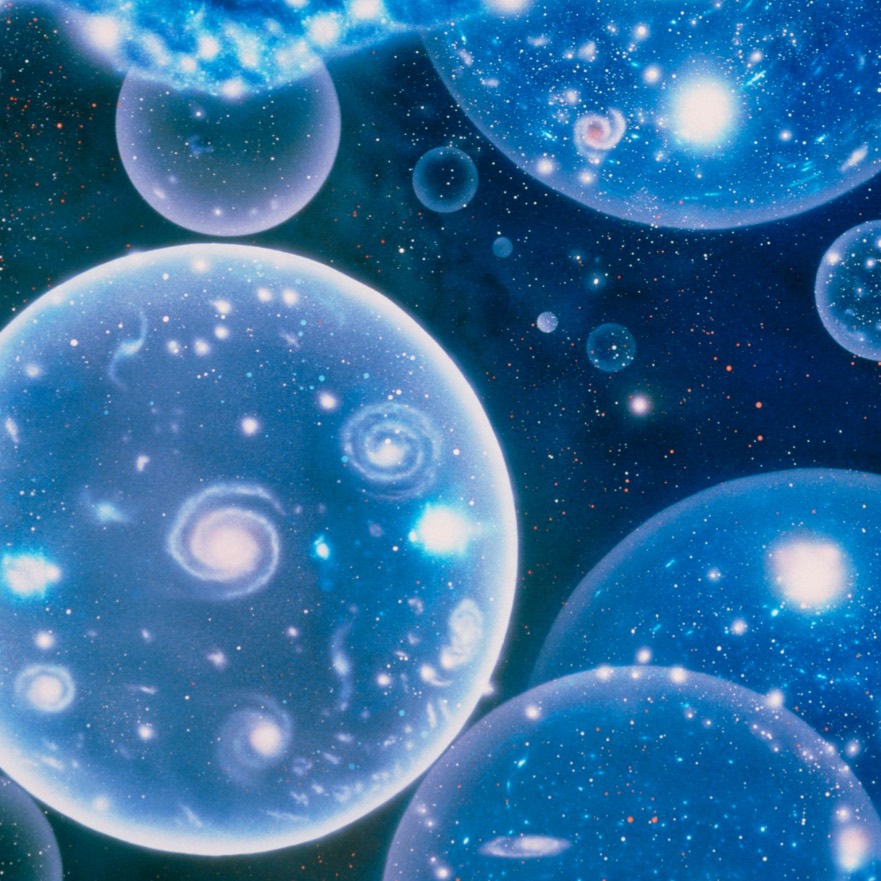
The 200th episode of Mindscape! Thanks to everyone for sticking around for this long. To celebrate, a solo episode discussing a set of issues naturally arising at the intersection of philosophy and physics: how to think about probabilities and expectations in a multiverse. Here I am more about explaining the issues than offering correct answers, although I try to do a bit of that as well.
Support Mindscape on Patreon.
References:
- Guth, "Inflation and Eternal Inflation"
- Weinberg, "Living In the Multiverse"
- Susskind, "The Anthropic Landscape of String Theory"
- Carroll, Johnson, and Randall, "Dynamical Compactification from De Sitter Space"
- Sebens and Carroll, "Self-Locating Uncertainty and the Origin of Probability in Everettian Quantum Mechanics"
- Wald, "Asymptotic behavior of homogeneous cosmological models in the presence of a positive cosmological constant"
- Gibbons and Hawking, "Cosmological Event Horizons, Thermodynamics, and Particle Creation"
- Carroll and Chatwin-Davies, "Cosmic Equilibration: A Holographic No-Hair Theorem from the Generalized Second Law"
- Dyson, Kleban, and Susskind, "Disturbing Implications of a Cosmological Constant"
- Albrecht and Sorbo, "Can the Universe Afford Inflation?"
- Boddy, Carroll, and Pollack, "De Sitter Space Without Dynamical Quantum Fluctuations"
- Carroll, "Why Boltzmann Brains Are Bad"
- Aguirre, Carroll, and Johnson, "Out of Equilibrium: Understanding Cosmological Evolution to Lower-Entropy States"
- Carroll, "Beyond Falsifiabiliy: Normal Science in a Multiverse"
- Carter and McCrea, "The Anthropic Principle and its Implications for Biological Evolution"
- Leslie, "Doomsday Revisited"
- Gott, "Implications of the Copernican Principle for Our Future Prospects"
- Bostrom, Anthropic Bias
- Vilenkin, "The Principle of Mediocrity"
- Olum, "Conflict Between Anthropic Reasoning and Observation"
- Elga, "Self-Locating Belief and the Sleeping Beauty Problem"
- Lewis, "Sleeping Beauty: Reply to Elga"
- Hartle and Srednicki, "Are We Typical?"
- Hartle and Srednicki, "Science in a Very Large Universe"
- Neal, "Puzzles of Anthropic Reasoning Resolved Using Fully Non-Indexical Conditioning"
Click to Show Episode Transcript
0:00:00.1 Sean Carroll: Hello everyone, and welcome to The mindscape podcast. I'm your host, Sean Carroll, and this, believe it or not, is the 200th regular episode of mindscape. But I say regular, 'cause there's been a lot more episodes, if you count various bonuses and the Ask Me Anything episodes and holiday messages and things like that, but 200 is pretty good at roughly 50 a year, that's four years. This is the fourth anniversary of mindscape, so pretty long compared to many projects that people launch in various points of their careers, and I've been very, very gratified with all of the responses from people listening and hoping that it does some good. So, I wanna do something to celebrate.
0:00:22.3 SC: So I thought I would do a solo episode, which is often what I do in these situations, and meanwhile, I have going on this shift from Los Angeles and Caltech to Baltimore and Johns Hopkins, where I will be a professor of natural philosophy which is the title that I made up to indicate that I'll be both doing philosophy and physics, really secretly it's physics, but it's the kind of physics that fits into a philosophy department very well, there's no boundary between these two areas, in both cases, you're thinking hard, trying to understand the fundamental workings of reality, that's what I'm interested in doing, so I don't perceive a barrier, but because of various ways which academia has evolved over the years, there is a quite a substantial barrier that other people perceive.
0:01:27.9 SC: So I thought that because this is happening, and because this is the 200th episode for my solo episode, I would talk about a particular set of issues that count as natural philosophy in this sense, the intersection of physics and philosophy. And furthermore, some of the ways in which Physics and Philosophy intersect are pretty well known. You've heard about them before. We've talked a lot about quantum mechanics and the collapse of the wave function. The Foundations of quantum mechanics. We've also talked a lot about time, the arrow of time and entropy and emergence, the connections between fundamental physics and higher level, so all of those things are recognizable, obvious places where both physics and philosophy have something to say, there is another area which has been sometimes remarked on, but not quite as much, which is cosmology, and cosmology is what I grew up doing as a research scientist.
0:02:04.2 SC: So I'm especially interested in philosophical issues in cosmology, and even though it has gotten less attention, it is really a perfectly natural place for thinking philosophically about questions in Physics, because... For better, for worse, the fact that the cosmology problems that are asking big questions like what happened at the beginning of the universe? Why is there something rather than nothing? Things like that, we don't have data on these questions, or at least what I should say to be more slightly more careful is there is no straightforward path to addressing these questions just by doing the appropriate experiment.
0:03:00.1 SC: Nevertheless, they're important questions, and we should think about them, and therefore we should think carefully about them, there's a tendency to think sloppily about things in Physics, Physicists often sort of rely on the fact that eventually we'll do experiments and therefore get the right answer, so they can think pretty sloppily along the way, knowing that they're fundamentally guided by the data in questions like this, that's harder to do, but that doesn't remove our responsibility to do a good job at it, thinking about the nature of space and time in the universe. So the training the philosophers have in digging out our hidden presumptions, making sure that we're being logical along the way, things like that make perfect sense, but in fact, the philosophy of cosmology is quite a broad field by itself, so I wanna home in on something very specific, which is the philosophy of the multiverse? Now, when I say that, there's two different things that come to mind, and I wanna talk about both of them. One is, Is the multiverse even physics? Is it even science, right? This is sort of a meta or a methodological or a epistemological question about how science is done, does this particular set of questions count as science. It's been debated to death, I will give you my little perspective on it, but I don't wanna dwell too much on it.
0:04:12.9 SC: What I really wanna emphasize is, beyond those methodological questions, there's a real ontological question or a set of questions about how the world actually works that are at the intersection of physics, of cosmology and philosophy in particular, in the case of the multiverse, how do we reason, If we live in a multiverse? How do we talk about probabilities and where we are and what our expectation should be, this is one of those things in physics that is crucially important, what do we expect when we do an experiment? What do we expect a theory to predict, but usually we're lucky 'cause there's a pretty straight forward answer. And in cosmology in the multiverse in particular, it's not straightforward, how do we think anthropically? Does it even make sense to think anthropically all of these questions, that's what I wanna talk about in today's podcast, so that's what I mean in this particular case by the philosophy of the multiverse, and to me, it's a perfect example of the sort of intersection that we will be pursuing at Johns Hopkins, not only myself, but other people as well who are interested in these sort of interdisciplinary questions.
0:05:20.4 SC: One other note I wanted to put out there, which is that some people have asked quite sensibly whether or not the podcast will keep going at its current pace, given that I have these new responsibilities, and the answer is, I certainly wanted to keep going at quite a strong pace. But I also had to be realistic, I'm gonna be teaching, and I have other duties that I will have that I haven't had before, so I've come up with the following temporary strategy. We'll see how this works, which is that at some point, I'm not sure whether we immediately or in a couple of months, we'll switch to a mode where rather than having a podcast come out every Monday plus and Ask Me Anything episode in the middle of the month, as a bonus, I'm just gonna start counting the Ask Me Anything episodes as regular Monday episodes, so I'll still have the numbered interview plus solo episodes that will appear on Mondays, but one of those Mondays during the month, we will get an ask me Anything episode the same Ask Me Anything episodes that I've been doing, but it will be that Monday slot, so overall, instead of roughly five podcast episodes per month will be getting four.
0:06:26.1 SC: And I think that a little bit of a change, but it'll save me some time and that change in time savings might be crucially important to my sanity and my ability to do a good job quality-wise with all the things that I'll be doing. So we'll see how it goes, who knows? Maybe I'll find that I have extra time on my hands and go back to the previous schedule, I'm not sure it's an experiment, that's what we do in this field.
0:06:47.4 SC: Finally, for those of you who are not long time listeners, what I mean by an ask me anything, episode it is an episode where people send in questions and I answer them, but the people in this case are Patreon supporters. So if you want to become a Patreon supporter of mindscape, just go to Patreon.com/Sean M. Carroll, and you sign up for a dollar a week or a dollar an episode, whatever... By the way, the AMA episodes are not charged to Patreon, so the Patreons will be saving a little money because of this new arrangement because there'll be one fewer charged episode per month for the Patreons, but the Patreons get to ask the questions and they also get access to ad free episodes of the podcast, as well as the feeling that they're doing something right and they're part of a the community that is kind of fun, there's a separate conversation in the comments of the Patreon site and things like that. So if you wanna do that, please do.
0:07:43.1 SC: I certainly appreciate the support of the Patreons enormously. It helps me finance various things for the podcast, and it's also just a nice thing, but of course, as I always say, it's perfectly okay not to do that, especially for some people, even four or five bucks a month is an extra outlay that they don't really want to do... That's perfectly fine. Anyway, I really appreciate the support, 200 episodes in. From everyone listening to mindscape, help spread the word. Help send it to other people. Leave reviews on iTunes or wherever you listen to your podcasts. And hopefully we'll be going for another couple hundred in the future with that let's go.
[music]
0:08:39.7 SC: My main goal here really is to bring out the fact that this is an area, the philosophy of the multiverse, where both physics and philosophy have both real interest and real things to say, real things to offer in this discussion, and they don't talk to each other that much to be honest. Sometimes philosophers talk about the multiverse or physics or whatever, but they don't talk to physicists as much as they should, and physicists never talk to philosophers about these things, 'cause Physicists have this attitude that if they sat down for 15 minutes and thought about it hard, they could figure it out.
0:09:14.7 SC: And I think that attitude is often not correct, but the point is that today I'm not necessarily focusing on solving these problems, but just pointing out that the problems are there, that this is an area where discussions should be had, that we should be open-minded, not only have individual people who are interested in both sides of the philosophy physics discussion, but have actual interactions between people on both sides. I do have some opinions about some of these issues, so I will try to put them forward, but I very quickly admit that my positions are not completely settled here yet, so the questions are truly open in my mind. Let's start by thinking about what we mean when we say the word multiverse. As you all know, as sophisticated mindscape listeners, that there's more than one idea that is captured by the word multiverse. We're not talking about the multiverse of movies like Dr. Strange or everything everywhere all at once. We're talking about the scientific multiverse, but even there, we have different ideas in mind, very, very different ideas, but some of the same philosophical questions are common to these scenarios. So let's focus on three kinds, I think that there are probably more kinds than this, but there's three ways in which these multiverse questions pop up in my work anyway.
0:10:25.7 SC: One is, and probably what most working physicists have in mind when they say the word multiverse, what we might call the cosmological multiverse. And already it's a bit of a misnomer because the other so-called universes and in the cosmological multiverse are just regions of our universe that are very far away. The cosmological multiverse is the idea that we see an observable universe roughly tens of billions of light years across. And the reason why we can't see further than that is because there's a horizon where you look back in time and you hit the big bang, so you can't see further away than that, just because the speed of light is a finite number, one light year per year.
0:11:12.2 SC: Within this observable universe, within the part of the universe that we can see, things look pretty smooth, things look pretty uniform over large scales, on the small scales, there's galaxies and stars and whatever, but if you average out over millions of light years, you will get a more or less similar situation in different parts of the observable universe, the same number of galaxies, same density of matter, all that stuff. Outside the universe we can observe... Let's just be honest, we don't know what's gonna happen, so we can guess, and that's what we traditionally did in cosmology, the traditional thing in cosmology was to say, "Well, let's just guess that what happens outside is more or less a continuation of what happens inside." And you could do that, and then that's where you get this idea that the universe is either flat or positively curved or negatively curved, there's really only three choices, maybe there's some topological obstruction or something like that, or complications, who knows. But that idea that the universe just continued on indefinitely or maybe for some finite amount if it was a closed universe looking just like it does in our observable universe was always just a gas.
0:12:27.9 SC: There's no principled reason why it should be that, and if you worry about the multiverse or different copies of yourself, as many people have pointed out, if the universe is spatially flat or negatively curved and not topologically twisted up, it will be infinite in size in this simple minded idea where the universe is just uniform on large scales forever. And within our universe, if we're just taking the conditions we see and extending them indefinitely, the average density is a number, then there are fluctuations around that density, and there's kind of only a finite number of ways that the number of particles we see in our observable universe could possibly have arranged themselves. Right, it's a big number.
0:13:16.9 SC: A lot of possible ways, because we have something like 10 to the 80th Atoms or massive particles in our universe, another 10 to the 88th photons and neutrinos and stuff like that, so a lot of particles, that they could arrange themselves in a lot of ways, but remember, infinity is way bigger than any finite number. So if you really think that the universe is the same everywhere on very large scale, so every patch of the universe, the size of our observable universe has roughly 10 to the 80th atoms in it, and those atoms arrange themselves differently from place to place, but space goes on infinitely far, then everything that could possibly happen will happen within those universes, within those parts of the universe that are the sides for our observable universe, and there will be an infinite number of them.
0:14:08.9 SC: So there will be an infinite number of people exactly like you and me, somewhere else very, very, very far away in this infinitely big universe. That right there raises these philosophical problems of how to deal with the multiverse, 'cause the philosophical problems that I'm gonna care about are ones that have to do with, Who are you in the multiverse? Which copy of this person are you? How do we reason about that if there are multiple copies of me to which everything happens in some sense? How do we make predictions for anything. And none of any of those questions rely on crazy ideas about inflation or string theory or quantum mechanics. It's just letting our universe be infinitely big.
0:14:50.9 SC: I think this is one of the reasons why people like Einstein favored the idea that the universe would be spatially closed, positively curved and finite in size, as far as we know, observationally, it's very close to flat, which would be consistent with it going on for Infinity, but not... It doesn't demand it. You could have a flat universe that was still wrapped over on itself like a Taurus, for example. But anyway, as I tried to say at the start, there's no principled reason to think that the universe is the same everywhere, it's just a guess. Maybe it's true, maybe it's not. The idea of the Cosmological multiverse is that it's not. That different regions of space very far away from each other are really very different, even maybe not only different densities of matter or different collections of galaxies and stars.
0:15:11.3 SC: But maybe even different local laws of physics, different things we would use and recognize as equivalence of the standard model of particle physics, but with different particles, different forces, different strengths of those forces, maybe even different numbers of dimensions of space time. I once wrote a paper with Matt Johnson [0:15:58.0] ____ about how you could dynamically undergo a transition from a certain number of dimensions of space in some region to a different number of dimensions of the space, so that could be part of the cosmological multiverse. And the crucial thing to understand about this idea of the cosmological multiverse is, like will be the same crucial thing to remember about the other versions of the multiverse, is that it wasn't invented because it sounds cool, it wasn't invented because physicists thought you know it would be fun to think about this.
0:16:31.1 SC: We were dragged kicking and screaming into thinking about the cosmological multiverse against our will, and the reason why is because the cosmological multiverse is not a theory. It is a prediction of various theories, and it is a consequence of those theories, but you should judge the theories that it's a consequence of not the prediction all by itself, you can't divorce the prediction from the theory that is making that prediction. In this case, the cosmological multiverse case, the theories came about by starting from inflationary theory, which Alan Guth and others invented circa 1980, and it was driven by an attempt to understand the data, in particular the data that our universe is smooth, homogeneous and isotropic, and also nearly spatially flat. Also, in fact, that there are no observable magnetic Monopoles in the universe, which was a prediction of various grand unified theories at the time.
0:17:26.2 SC: So Guth used this idea of inflation, which says that if a the universe starts out or at some early time anyway, its energy density is dominated by what we call a false vacuum energy, so much like today, we think since 1998 when we discovered the universe was accelerating, we think that there is an energy in empty space, a cosmological constant, a vacuum energy. But you can also get a temporary form of vacuum energy or false vacuum energy, which could be really a lot of energy in empty space, and it would cause the universe to expand at a hugely accelerated, very fast rate. And that's kind of like pulling the edges of a wrinkly bed sheet or something like that, it tends to smooth everything out, the super accelerated expansion. So Guth did the physics and he showed that you could start in this false vacuum and then you could turn all that vacuum energy into ordinary matter and radiation. So first you inflate, you are dominated by a false vacuum energy, you smooth out the universe and make it flat, and then you convert all that false vacuum energy into ordinary matter and radiation. Now, he got it a little bit wrong, but he knew he got it wrong, he pointed out that in his own original model, you never left inflation, you didn't get this nice exit, graceful exit as it was called, into a situation where you've turned that energy into ordinary matter and radiation.
0:18:49.4 SC: So soon there, after Andrei Linde and Andy Albrecht and Paul Steinhardt proposed models where you smoothly rolled a scalar field down from a high potential energy to a low potential energy and you could convert all of that energy into ordinary matter and radiation. No problem. So this was called New inflation, and it solved the graceful exit problem. But here's the problem in either old inflation or new inflation, this scalar field, which we posited, we invent it, there's no evidence for it yet, but it was posited and it very well could be related to other ideas in physics.
0:19:24.3 SC: It's not a classical scalar field, there is such a thing in the world as quantum mechanics, and so as the scalar field rolls down its potential and turns into matter and energy, there are quantum fluctuations, it's not absolutely the same value at different points in space. And that's crucially important. That is the explanation, we think in inflationary universe theory for the perturbations in density that give rise to stars and galaxies, today. We see the imprint of those quantum fluctuations in the cosmic microwave background and in the pattern of large-scale structure in the universe.
0:20:00.9 SC: If inflation is correct, we certainly see the fluctuations in density and temperature in the universe. Inflation attributes those fluctuations to quantum fluctuations during the inflationary period, and people soon thereafter noticed Paul Steinhardt, Andrei Linde and Alex Flankan and others, that if you allowed for these quantum fluctuations, you could sometimes have quantum fluctuations where instead of rolling down the hill. If you visualized the potential energy of a scalar field like a hill, the field tends to roll down like a ball rolls down a the hill, but the quantum fluctuation, say that maybe you could bounce up the hill occasionally, it's a quantum fluctuation, it's a rare thing, but it could happen. And these potentials are very flat, so it's not that hard to bounce up the hill, and when you bounce up the hill, you now have more energy density, inflation happens faster and you create more volume of space. So you do the calculation and you show that for very reasonable values of the parameters, inflation never really ends, it will end in some region of the space, but somewhere else, the inflaton field, as we call it, this new scalar field that we invented, it quantum fluctuated up the hill, and even though that's relatively rare when it happens, it generates a huge amount of space 'cause it inflates very, very quickly.
0:21:24.2 SC: And then the process repeats where in that new region that you have created, some places, inflation ends, other places it keeps going, but overall, it will keep going somewhere in the universe, so this is the idea called eternal inflation.
0:21:38.5 SC: And it's not necessarily a part of inflationary theory, but it's a very natural part of the inflationary theory. It happens very easily, you don't need to work very hard to make inflation be eternal. So that's already giving you a kind of a multi-verse because it says that inflation will end where the inflaton field turns into ordinary matter and radiation, and it will end it differently at different points in space at different times in the history of the universe, but that only became super exciting when we realized that when inflation ends the local laws of physics could be different in different regions of space. And this was something people had thought about also, once again, but it became very on people's minds when we stumbled across what is called the String Theory landscape, and the string theory landscape was also in some sense inspired by data once again. When we discovered in 1998 that the universe is accelerating, we attribute that to a cosmological constant and this was a revolution, this is the only revolution that I personally have lived through in fundamental physics in my time, when we realized that the cosmological constant was probably not zero, because we all knew that there was an issue here that the cosmological constant.
0:22:51.0 SC: The energy of empty space could be anything in principal, but you could estimate what it should be, you could estimate on the basis of effective quantum field theory what a natural value for the cosmological constant would be, and the answer is way, way, way bigger than what you actually observe. So most people... When I was in grad school, most people strongly believed that because the vacuum energy was for some unknown reason, much, much, much smaller than it would be predicted to be on the basis of naturalness, probably, even though we didn't know what, there was some mechanism that was setting it to exactly zero, 'cause it's just hard to think of some reason why you should say that it's so close to zero and not go all the way right in the space of all possible theoretical ideas, it was easier to come up with hypothetical ideas or imagine that they're there, if they just set the Cosmological constant to exactly zero.
0:23:44.3 SC: But then we discovered it's not zero, or at least it doesn't look like it's a zero, it's certainly also possible that what is causing the universe to accelerate is something like a dynamical scalar field, much like inflation, but at a much, much lower energy density, that's on the table as a possibility, but it's harder to make that work. So we don't know yet, we're testing that experimentally once again, but the simplest idea is just that is the vacuum energy.
0:24:11.7 SC: So back to the drawing board, we can't say that there's some unknown mechanism that sets the cosmological constant to zero 'cause it's not zero. And in string theory, which was the leading candidate for quantum gravity, it certainly it was easier to make string theory work if the cosmological Constant was not positive. In fact, it was much, much easier to make it work if the cosmological constant is negative, that's a nice way to understand string theory. But if it was zero, okay, we could get along with it. It was really hard, it remains really hard to understand why you would have zero cosmological constant in the string theory, even though you do not have manifest supersymmetry at low energies. Supersymmetry is part of the string theory tool kit. It's easy enough to hide it, we don't see any evidence for String Theory experimentally, but it's easy enough to hide it, just like we hide other symmetries in physics. But in general, when you break supersymmetry in order to hide it, you're not left with a zero cosmological constant it's easy for it to be negative, it's hard for it to be exactly zero, it's conjectured to be easy to be positive, but the word easy is problematic there we don't know.
0:25:19.6 SC: There are debates that are still raging about whether or not the cosmological constant can indeed be positive in the String Theory. But again, naively, it seems that you could get a positive cosmological constant in the String Theory, and then once that possibility was put front and center, we need to understand how the Cosmological constant could be a positive number, people sat down and realized, Well, yeah, we could do that, we have all these extra dimensions of space, in the string theory. String Theory works most naturally, if spacetime is 10 dimensional.
0:25:49.3 SC: Some versions it's 11 dimensional. But more than four-dimensional, Okay. So we have to hide those extra dimensions of space, how do we do that? We crawl them up into some geometrically interesting shape, and different geometrically interesting shapes give rise to different low energy laws of physics, including different values of the cosmological constant, and this seems at least to many people to be a natural outcome of the string theory. Something you didn't need to put in, it's just something that we didn't really notice or dwell on that much before the data forced it on us, as it often happens in physics. Okay, so now what you have, if you combine eternal inflation with the string theory landscape, not only do you have inflation giving rise to many different regions of universe, but the string theory says that the local laws of physics in those regions might be based on different ways of compactifying the extra dimensions of space, and that could give rise to different local laws of physics, including the vacuum energy.
0:26:47.9 SC: So suddenly what you have is different values of the vacuum energy in different regions of space, and then you apply an old argument, Steven Weinberg made it famous, but other people have pointed it out long before Him, namely that if the cosmological constant was very, very big, either big and positive or big and negative, it's very hard to imagine how human beings could exist or how life could exist, 'cause a big vacuum energy tends to either blow things apart if it's positive or crunch the universe in a very short period of time, if it's negative. So there is what we call an anthropic selection, if... And this is a very, very big if. If there are many different regions of space where the vacuum energy is different, it is completely natural, so the story goes to imagine that living beings only arise in that subset of all these parts of the universe where the vacuum energy is not that large. And this would be an explanation for why we observe a small but not zero vacuum energy.
0:27:46.9 SC: And to be completely historically accurate, Steven Weinberg pointed this out 10 years before we discovered the cosmological constant. He pointed out specifically that if the explanation for the vacuum energy is not some dynamical mechanism that sets it equal to zero, but rather some anthropic selection that says that, "There's many different values of the vacuum energy, but we only observe the ones that are compatible with our existence, then you should predict that the cosmological constant should be observable. It should be small, but not so small that we can't observe it."
0:28:27.4 SC: It's just easier. There are more values of the cosmological constant that are observable that are not observable, even compatible with our existence. And that's a prediction that he made 10 years before we actually observed it. So that's a plus in the ledger... On the plus side of the ledger for this kind of reasoning. Anyway, that's the cosmological multiverse. That's one of the ways in which you can get a multiverse. And so in the cosmological multiverse, as far as we know, with the kind of calculational techniques we have, there are an infinite number of universes out there, at least, if you include the future and the past as well as the present moment.
0:29:05.3 SC: And not only do we have different laws of physics in many of them, but we could also have exactly the same laws of physics in some of them. This is a very different idea than the second scenario we wanna talk about, which is the many worlds interpretation of quantum mechanics. Long-time listeners will be familiar with this, so I don't have to do quite as much detail. But many worlds comes about because we're, again, trying to explain the data, but the data are very different data.
0:29:29.8 SC: Here we're trying to explain the data of quantum physics. The fact that when you observe the position of an electron, even though you describe the position of an electron in terms of a wave function that is spread out all over space, when you're not observing it, when you do observe it you always see it in a position. You never see the full wave function. What's up with that. There are many different possibilities for what's up with that. The many world's possibility says, when you think about that measurement of you measuring the position of the electron you really need to think of yourself as a quantum mechanical system that has a wave function.
0:30:06.5 SC: And when you model the interaction between you and the electron, that qualifies as a measurement, what really happens is you become entangled with the electron. So the reality is not that the electron collapses to some position according to many worlds, but that there is part of the wave function that says the electron was here and you observed it here. Another part that says, the electron was over there and you observe it over there. And so on for every possible measurement outcome.
0:30:33.4 SC: And whatever it proposed is that we take these different parts of the wave function and treat them as separate independent worlds. He had reasons for doing that, but I think that the best reasons post-date ever... The best reasons for talking about these different parts of the wave function as completely independent worlds come down to what we call decoherence. And decoherence was started in the '70s. People had premonitions of it before that, but really the theory was developed in the '70s and '80s, and it explains why these different worlds become independent from each other. So that what happens in one world does not affect anything that happens in another world. So they can't affect each other in typical circumstances, and therefore that's why we call them other worlds.
0:31:19.0 SC: Completely different idea than the cosmological multiverse. The cosmological multiverse literally has regions that are far away from each other in space. The many worlds of quantum mechanics literally come into being in my room when I do a measurement of a quantum system. I'm not creating a different region of space far away, I'm creating a whole another parallel universe. And it's not located anywhere, they just exist simultaneously. The world's all are there with different amplitudes and the amplitudes matter if we're talking about many worlds, but we're not talking about that today. We're not talking about the details of many worlds. The point is that there are many copies of my future self. So there's one copy of me right now, there's other copies that have descended from my past self, but here I am right now. I do some measurements, there will be many descendants of my present self in all of these different worlds. So that's a different kind of multiverse that appears in physics.
0:32:14.2 SC: And finally, there's the idea of eternally fluctuating cosmologies which don't have a great name. That's what I will call them eternally fluctuating cosmologies. The idea is the following: So remember back again, the accelerating universe. So we discovered in 1998, the universe is accelerating. The easiest explanation for that is the cosmological constant, and there is a theorem proved back in the 1980s by Bob Wald at the University of Chicago that says that under pretty general circumstances, if you have a universe with a positive cosmological constant and not too much other stuff, then that universe will always empty out.
0:32:57.1 SC: So if you have other stuff... If you have a positive cosmological constant but a lot of matter, so much matter that it curls space into itself and you get a positively curved universe, then that will eventually re-collapse. But if there's not too much matter... So if the universe is close to flat, for example, then the universe expands forever. And what happens is galaxies and other things are just pulled away from each other. All of the density perturbations that we had in the early universe will flatten out under the influence of this cosmological constant accelerated expansion.
0:33:27.7 SC: This is called the cosmic no-hair theorem. There's more details you can put on it, because the galaxies have dynamics, they have stars in them, the stars will burn out, fall into black holes. The black holes will evaporate. The evaporating radiation from the black holes will be red shifted to essentially non-existence, and then you're really left with nothing but empty space. And the name of this empty space with nothing in it but vacuum energy is called de Sitter space after Willem de Sitter, the astronomer who first solved Einsteins equations and found this cosmological solution.
0:34:02.2 SC: One of the things I love about this cosmic no-hair theorem that all the universes with the positive cosmological constant evolved toward de Sitter space, just like all black holes evolve towards just mass charge and spin black holes is that like the black hole case, there's an entropy interpretation here... Whenever you have a system that inevitably evolve towards some microscopic state and then just sits there forever, that sounds like increasing entropy thermal-ization approach of the system to equilibrium.
0:34:36.1 SC: So I had long conjectured that this cosmic no-hair theorem was probably equivalent to equilibration. To entropy increase... To the Second Law of Thermodynamics. And finally, with a graduate student, Aidan Chatwin-Davies I was able to prove that. Aidan did most of the proving I've got to admit. But we basically found a definition of entropy that applied to these cases and we showed that even without Einstein's equation of general relativity, if you just had an expanding universe with a certain definition of entropy, and you conjectured that the entropy in a region approached a maximum value then stayed there forever, that would be equivalent to de Sitter space. To this exponentially expanding accelerating universe.
0:35:21.8 SC: So that's the standard model of our universe. So guys I'm not making anything up about inflation or string theory or anything, I'm teasing about making things up. I'm not speculating. This is the most common... The accepted view of what our actual universe is doing. It's accelerating because there's a cosmological constant. It's conceivable that the cosmological constant will disappear sometime in the future, but we don't know. And it's conceivable that it won't.
0:35:51.7 SC: Okay, so the easiest thing is that the universe just expands forever under the influence of that cosmological constant. In which case we will approach de Sitter space. And again, just like black holes, de Sitter space has a horizon and a temperature and an entropy. And this was all figured out by Stephen Hawking and Gary Gibbons back in the 1970s.
0:36:14.4 SC: So just like a black hole gives off a little bit of radiation there is a sense in which de Sitter space is a thermal state. A black body state. A state with the physical characteristics of a body at a fixed temperature. And the temperature is going to be very low. We think about the cosmic microwave background out there today at about 2.7 kelvin. This is going to be... Oh I forget the numbers, unfortunately. I think it's something like 10 to the minus 35 kelvin when we eventually reach the de Sitter equilibrium in our future. I forget the exact number. Is that the right number? I really don't know. Maybe 10 to the minus 30. But way, way lower than the current temperature of the cosmic microwave background.
0:37:00.2 SC: But just as with the classic universe that is just infinitely big, the de Sitter universe is infinitely old. It lasts forever under this simple way of thinking about it... So if you have a de Sitter universe that lasts forever, there is a sense... And this is an argument... This is less clear than other things I've said. So let me just say the argument, and then I'll sort of give you the caveats to it. It's a little bit like a box of gas at a fixed temperature that lasts forever. Okay.
0:37:29.8 SC: So if you have a box of gas at a fixed temperature that lasts forever, you have a bunch of particles running around inside bumping into each other. And mostly for most of the time, they will sit there in their highest entropy state, but just due to random fluctuations occasionally, the thermal fluctuations inside the box of gas will lead to an entropy decrease. There will be fluctuation downward in entropy to a more orderly configuration, and then it will relax back.
0:38:00.1 SC: And sometimes you can actually calculate how much of an entropy fluctuation you expect. And the answer is, you will get all sorts of fluctuations if you wait long enough. So a very standard thing to torture undergraduates with is calculate how long you would have to wait for all of the air in the room, in the classroom that we have right now, to move over to one side of the classroom and leave the students on the other side gasping for breath. It's many, many times the current age of the universe, not something you have to worry about, but it will happen if you thought that your classroom would last forever. And the probability of such a fluctuation is bigger for small fluctuations, smaller for big fluctuations... That should make sense. A tiny fluctuation away from equilibrium will be much, much more likely than a huge crazy fluctuation away from equilibrium.
0:38:50.9 SC: So it's much more likely that the gas in the room goes on to one half of the room than it is that all the gas in the room shrinks down to one little cubic centimeter in the corner of the room. Both will happen, but the medium-sized fluctuation happens much more often than the huge fluctuation. And this of course, this way of thinking... If de Sitter space is like this, if the future of our universe is a thermally fluctuating box of gas, then you will eventually fluctuate downward in entropy. And you will fluctuate so much that you know sometimes you'll have a couple of particles appear out of the vacuum.
0:39:29.2 SC: A couple of times, more rarely you'll have a few particles appear with high energies and bump into each other and make atoms. If you wait long enough, you'll have enough stuff fluctuate into existence that it makes molecules or microscopic amounts of stuff. If you wait long enough, you'll fluctuate into stars and planets and galaxies, or even the whole universe. I wrote a whole another paper about that with Matt Johnson and Anthony Aguirre. Anthony, of course, was a previous Mindscape guest.
0:39:57.8 SC: And... So it will happen if you wait long enough. And the de Sitter future of our universe is supposed to last infinitely long. So you'll get all sorts of these fluctuations. And that leads to the Boltzmann brain problem. The idea is that if you had some reason to believe that you are a typical observer in the universe... Well, what is a typical observer in this universe look like? It looks like a random fluctuation, right.
0:40:25.2 SC: Most observers... You get who knows how many billions or trillions of observers like you and me after the Big Bang, but then you get an infinite number of observers that are random fluctuations in the future. So who cares about us living right after the Big Bang. Most observers in this situation are going to be random fluctuations. That causes a philosophical problem, which is exactly what we're gonna get to in a second.
0:40:48.8 SC: Before I get to that, let me just mention that we're not sure by any means, that even if our universe does settle down to an empty de Sitter like phase, there will be these random fluctuations. Because there's a tricky interplay between quantum mechanics and gravity going on here. I wrote a paper with Kim Boddy and Jason Polack, where we explained that in a very natural set of assumptions where the Hilbert space of quantum gravity is infinite dimensional... If you don't know what any of those words mean, don't worry about it. Some of you who have followed for a long time will know what they mean. But it's basically a fancy way of saying if an arbitrarily large number of things can happen in the universe then that actually lets the universe settled down into a static quantum state.
0:41:38.9 SC: So what happens in that case is that you interpret the statement that de Sitter is a thermal state as saying that if you were to make a measurement of it then you would measure... If you had a thermometer there literally... Which you can't 'cause you're not an empty de Sitter space, 'cause you're a thing. You're not emptiness. But anyway, if you had a thermometer there you would measure a thermal spectrum of photons.
0:42:02.5 SC: But in the many worlds interpretation, there's a difference between what is happening when you're not measuring the thing where it's just a wave function versus what you observe when you physically interact with it in order to measure it. And the point is that when you're not measuring it... When there's nothing disturbing the state there's also nothing happening. There's no dynamical fluctuations. The thermal-ness of this quantum state is a statement of what you would observe, but not a statement about the dynamical things coming and going, like brains coming into existence or anything like that.
0:42:36.6 SC: By the way, I forgot to finish the Boltzmann brain story. The reason why they're called Boltzmann brains is because a typical observer would not just be a random fluctuation, but the typical random fluctuation would be, we expect, the minimum fluctuation needed to count as an observer in this universe. That's because there's more easy... Way, easier to get small fluctuations in entropy than large ones. So the idea is that the minimum observer is just a brain. You randomly fluctuate into existence, a brain which looks around and says, "Huh, thermal equilibrium," and then it dies. Then it goes back into... It dissolves back into the surrounding thermal equilibrium.
0:43:14.7 SC: And the argument by some people says, well, we're not a Boltzmann brain, therefore that can't be the world. And the issue here is that this is not some speculative scenario about the early universe. This is the most popular view of our actual universe. And so that's a real problem. So the paper that Kim and Jason and I wrote, tried to say that it's easy to avoid this problem if you make certain assumptions about quantum gravity. But of course, we don't know if those assumptions are true. So it's still very, very worth thinking about these ideas.
0:43:46.1 SC: So that's three different versions of physics-oriented multiverse. The cosmological multiverse, the many worlds of quantum mechanics, and an eternal fluctuating cosmology. The eternal fluctuating cosmology is a kind of a multiverse in time. It's not like different regions of space or are different universes, but if you wait long enough, whatever kind of universe you want to think about will fluctuate into existence. So it is effectively a multiverse.
0:44:11.6 SC: One thing to emphasize, which I've noted all along, is that every single one of these three options is a consequence of other ideas. It is not put forward for its own sake. And it's a consequence of other ideas that were proposed in order to account for data. In order to explain the universe that we see... So it is 100% the standard scientific process going on here. There is no sense, some diversion or distraction away from doing real science by thinking about these different multi-verses.
0:44:47.7 SC: Nevertheless, not everyone agrees. People object. There are people out there who don't like these discussions of multi-verses. And to be honest, it gets weirdly emotional. People get very angry talking about the multi-verse on both sides. On all sides, I should say. They talk to each other about being unscientific and they get kind of ad hominem and name call-y. And it's really kind of tiresome. And that's kind of what I don't want to talk about here today.
0:45:16.7 SC: I don't wanna dwell on the question of, does talking about these scenarios count as science. I feel... What I wanna do is dig into how to talk about these scenarios, if you think that it is okay to do it. But I need to very quickly comment on this issue of is it science at all to talk about the multiverse.
0:45:39.4 SC: The all too easy objection to the multiverse is that it's not falsifiable. Famously Sir Karl Popper, a philosopher of science proposed the falsifiability criterion to demarcate scientific theories from non-scientific theories. Now, almost none of the physicists who bring up falsifiability have actually read when Karl Popper wrote, but they carry on their shoulder a little straw Popper that they have simplified down to this motto that says, "If you can't falsify the theory through an experiment then it's not science." That's not what Popper said. That's certainly not what philosophers of science believe. They don't even believe the falsifiability works at all, generally... Most of them... As a demarcation between science and non-science.
0:46:22.6 SC: But Popper was on to something. The real Popper, he did have good reasons to propose this criterion. Even if I don't think that it actually gives you the final answer. He cared about having theories that were definite, that said something. Okay... So he was worried about theories that he thought like Marxist analysis of history or Freudian psychoanalysis. In Poppers mind... And I'm not gonna make any statement about whether I agree with this or not. I hadn't really thought about it.
0:46:53.2 SC: But in his mind, literally anything could happen and advocates of Marxist history or Freudian psychoanalysis could after the fact tell a story to purportedly explain it. So he was really worried about the fact that these theories didn't have any content to them. And that's why he proposed falsifiability because he said, "Look, if you can say "If anything happening in the world is explicable in terms of your theory... Anything that could possibly happen is explicable then your theory has no explanatory value."
0:47:29.3 SC: That is not the worry in the case of the multiverse. Though all these different multiverse scenarios are absolutely un-disputably saying something than saying non other things. The problem is that what they're saying happens in the universe are things that we can't see. Things that we can never in principle see. We can never touch the other worlds of the many worlds theory. We can never see the cosmological multiverse. We can never notice the Boltzmann brains coming into existence. Tens of tens of tens of... 10 to the 10 to the 10 billion years in the future, or whatever.
0:48:05.2 SC: So it's saying something definite, but you don't know. You're not gonna be able to test it in any simple way. So should we count it as science? Well, of course, we should. And Popper, I think would agree with me about this 'cause he had different fish to fry. The basic issue is that these scenarios could be true, and that really could be the way nature works. And that's a difference with what Popper was worried about. There really could be other universes out there elsewhere in the wave function or in space or in time.
0:48:36.5 SC: And the reason why it matters is because whether or not there are these other universes affects how we do science here in this universe trying to explain the data that we have in our observable part of the universe. When you do cosmology or when you do these large scale scenarios to explain the universe, things are connected to each other. They're interrelated. We talk about the multiverse and things we can't observe. But the reason why we talk about them is because they play an explanatory role in what we do observe. And this is just science. This is not anything new.
0:49:14.0 SC: I'm not in the camp that says, we need to think about a new paradigm for doing science because of the multiverse. It's exactly the same paradigm we always had. We come up with a theory, we use it to account for the data. So for example, in the cosmological multiverse, we invoke the cosmological multiverse as an explanation for the observed value of the vacuum energy and possibly for the observed values of other constants of nature, like the mass of the Higgs boson and so forth. To account for the apparent mysterious numbers that we observe in physics. The fine tuning of certain parameters. That was what Steven Weinberg tried to do before we even knew the cosmological constant was not zero. And so the point is, if you are a working physicist and you say, I would like to understand why the vacuum energy has the value it does. Whether or not you think that the cosmological multiverse is a promising theory... Absolutely, indisputably affects what kind of theoretical ideas you will consider and put forward.
0:50:20.7 SC: If you don't think that the multiverse makes sense or is there, then it is beholden on you to come up with some dynamical mechanism that explains why the cosmological constant has the value we observe. If you do think that the multi-verse is there, then arguably, you don't need to do that, it's just an environmental selection effect. Although you can't have a dynamical theory that predicts with probability, one, that the cosmological constant has a certain value and think that that's a good theory if it has other values elsewhere.
0:50:51.8 SC: So how you do science is affected by whether or not you take this particular theory seriously. Likewise, for the many worlds of quantum mechanics, again, you're trying to do science. Science is not done. Physics does not have the theory of everything yet. You're trying to build on what we currently know. And how you do that will be dramatically affected by your attitude towards the foundations of quantum mechanics. If you don't believe many worlds... Many worlds just comes out of thinking that there's a wave function or a quantum state that obeys the Schrodinger equation.
0:51:26.0 SC: If you don't believe that, you need to tell me either what there is in addition to the wave function or why and how the wave function doesn't obey the Schrodinger equation. That's extra work you gotta do if you don't believe in the many worlds of quantum mechanics. Tell me what the hidden variables are. Tell me what the explicit objective collapse rule is if you believe in those kinds of things.
0:51:49.3 SC: Again, your practice of science is affected by the reason-ability of this multiverse scenario. And finally, again, likewise for the fluctuating cosmology, the eternal fluctuating cosmology scenarios, because how do you account for the Big Bang and its low entropy state. That will matter, that will be affected by, if you think our universe is eternal and fluctuating. What do you think will happen in the future to our universe also affects... Is affected by how you think about these scenarios.
0:52:19.1 SC: So in my mind, of course, it is science. It's not a close call. It's not like quasi science. It's hard. That's true. That's okay. I'm not saying that I can tell you some easy, straightforward experiment that I can imagine to do, which will once and for all reveal whether one of these multiverses exist or not. But nobody ever promised you a rose garden. Just because I can't think of an experiment which will help us change our credences to either close to zero or close to one, doesn't mean it's not science. Sometimes science is just gonna be hard. Sometimes we will be left in the dark for maybe a long time about what is the correct scenario.
0:53:00.5 SC: But there is something that is true about what the universe looks like outside our horizon, what the wave function of the universe looks like overall, and so forth. So therefore, in my mind, it is completely science. Having said all that, I think that... And this is always a dangerous angle to take when you start to probe the psychology of people you don't agree with. But I wanna give people credit here a little bit. I think that the anxiety that is centered on multiverse scenarios does arise out of a perfectly legitimate worry. And the worry is, how do you think about our place in the universe in such cases.
0:53:43.2 SC: So this is fundamentally a philosophical problem. There's just no question. This is what philosophers were trained to do, and often there are philosophy papers written about problems that are typically not phrased in down-to-earth cosmological terms, but nevertheless utterly relevant to them that address the question of what credence should we have for these different questions. Credence being a degree of belief. How confident are we that these things are true. And in particular, there's actually two different sets of credences we need to think about.
0:54:16.8 SC: One is the standard scientific question of which theory is correct. Which theory is there a multiverse... A cosmological multiverse or not? Is many worlds correct? Or is Bohmian mechanics correct or something like that. Is the Hilbert space of quantum gravity finite dimensional or infinite dimensional? Down to earth questions about what is the physics underlying what's going on.
0:54:39.6 SC: So that's a credence that we all have as working scientists for these different models, and we would like to adjust them according to Bayes' theorem. In the correct way. But there's also a different credence that comes in. And that's why even though there's always some philosophy of science involved in doing science here the philosophy of science is sort of more interesting and fun. Because the other credence is who are we in the universe. In other words, these are multiverse scenarios that have a lot of people in them. If it's the cosmological multiverse, we have different regions of space, possibly an infinite number with different laws of physics. But some of them will have the same laws of physics, and we can imagine there's a wide variety of different kinds of intelligent observers in them.
0:55:28.0 SC: How do we place ourselves within that huge set of different numbers of observers? In the case of many worlds, it's a very down-to-earth and very in-your-face version of this question. When the Wave Function branches and there are now two different versions of the observer who made the measurement? What probability do they assign to being on the spin-up or spin-down branches of the Wave Function of the universe that they measured the spin of some electron, that is the problem of deriving the born rule in the many-worlds interpretation and quantum mechanics, which version are you? Charles Sebens, my Caltech colleague and I wrote a paper about this, where we called it self-locating uncertainty, sometimes people also call it indexical uncertainty. It's not just there are many observers in the universe, there are multiple copies of the same kind of observer, they're different, 'cause one's on one branch of the wave function one's on the other, but they're identical except for where they're located in the universe. That's self-locating uncertainty, which one are you? And finally, for the Boltzmann brain/eternally fluctuating universe scenario, right? Are you a Boltzmann brain? Are you sure? Are you a Boltzmann, something else, or are you really, really confident that you're an ordinary observer, and if so, does that lead you to reject the hypothesis that there are Boltzmann brains at all?
0:56:52.7 SC: Okay. All very good questions. All questions that require careful Philosophical Analysis, and again, just to be a little bit editorialising here, one of the reasons why it's fun and interesting and also productive to get physicists and philosophers talking to each other is because they have different kinds of blind spots, I would say. I love them both, some of my best friends are physicists and/or philosophers, but they have different things they're really good at and different things they're not so good at. Philosophers are really good at telling you why your theory is wrong, to put it in more careful terms, philosophers are good at analyzing the logical chain of reasoning that leads you to some conclusion and telling you where you messed up, you made a leap here that isn't quite okay, physicists just wanna get the right answer, and over and over again in the history of physics, they get the right answer for the wrong reasons. Right, the data always save you in physics, you will eventually get the right answer no matter how bad your reasoning is, 'cause the data's just not gonna let you continue to get it wrong over and over and over again. This is exactly the case where when you get to the multiverse, you're gonna get in trouble.
0:58:06.4 SC: Because with something like quantum field theory, you write down the quantum field theory is in the 1930s or '40s and you get an infinite answer. And if you didn't have any data, you might just say, Well, this is bad, theory is wrong, answer is infinite. The data side, you couldn't get away with that, you needed to do something about it. So you did a lot of work to understand renormalization and getting rid of the infinities and so forth. Even the invention of quantum mechanics is an example, just like that, where there was just so much data forcing you to these crazy conclusions. But the multiverse, you can reason very sloppily about it and think that you're on the right track because there's no immediate experiment that is guiding you to the correct answer... Right, that's exactly where philosophers are very helpful. That is their strong point.
0:58:51.0 SC: Their weak point, in my mind, is that they care less about getting the right answer, than the right reasoning that gets you to whatever answer you're getting, that's a slightly overly harsh way of saying it, but the way that it shows up in practice is there's a lot of philosophical effort put into working out the consequences of theoretical constructs that in my mind, I would say we know are not right.
0:59:14.6 SC: Quantum field theory is a very good theory, but it's probably not the right answer for what nature does, 'cause it doesn't really play well with gravity. General relativity is a very good theory of gravity classically, but it's not the final answer for gravity 'cause it doesn't play well with quantum mechanics. And there's a lot of my philosophy friends who just put a lot of effort into understanding consequences at the very, very detailed level of these theories, 'cause it's a fun little puzzle of logic, etcetera. But to me, it's not actually helping us understand nature that well. So I rely on philosophers to tell me where my chain of reasoning is wrong, but they're not as good at picking out a better theory, and that's what physicists are very good at. So that's why we need both in the case of the multiverse. Okay, editorialising over.
1:00:00.6 SC: To the problem that we're facing with... You can think about it in terms of Bayesian inference, Bayesian reasoning. We have Bayes' rule. For those of you who don't know it, Bayes' rule is a way of saying, I have some propositions, some are gonna be true, some are gonna be false. Let's pick a set of propositions that are mutually exclusive so they can't all be true at the same time, like there is a cosmological multiverse or there's not, okay, or I am this branch of the Wave Function or I am some other branch of the wave function. Well, Bayes gives you a way of updating that the probability, the credence really, that you put on these different propositions when new information comes in, when new data comes in, as we usually say.
1:00:44.0 SC: And Bayes' rule says that the probability of any given theory given the new data, is proportional to the probability of what... The Probability, you would have to get that data if the theory were true times the original prior probability of the theory. Okay, so you have some prior probability on all the different propositions like this multiverse or that multiverse, you say, "If these different propositions were true, what's the probability, the likelihood, as we call it, that I would get some data, you multiply those together and that tells you the probability of your theory now that you have that data." And the problem we're facing with here is, what exactly do you mean by the likelihood function of Bayesian analysis? The likelihood is, what is the probability you would see that data if this theory were true. And unfortunately or fortunately, the data we're talking about is, I exist.
1:01:40.9 SC: That's the data. Okay, what is the probability that I would exist or you would exist, if you can go ahead and do it yourself, that we would exist in this cosmological scenario.
1:01:52.1 SC: What does that mean, exactly? I mean, is it the probability that intelligent observers exist or what exists in this scenario or is it the probability that observers like me or exactly like me really exist? And do I have to exist with certain other features or anywhere in the universe, etcetera. In fact, this is a well-known problem in Bayesian reasoning called the problem of old evidence. Does something that we've known about all along, some evidence that we've had from the start really help us update our priors? Does it provide extra evidence, so does the fact that you and I are here thinking about this count as evidence for anything? Obviously, if you have a cosmological scenario where I could not exist, then I should give that a credence of zero. My existence is a very well-known fact, but can I pretend not to know that, write down all the cosmological scenarios and then update the credences I have on them using Bayes' rule. And with the data that I do exist, I don't know, can I do that? Is that okay? Or did the fact that I exist already go into me making up these credences in the first place, so I shouldn't count it twice, that's the problem. And then furthermore, in a slightly more detailed level, if I say, Okay, I exist, is that supposed to favor a scenario where I would exist with probability 0.9 over a scenario where I would exist with probability, 0.1 maybe, probably... That seems reasonable, but okay. Now, what about this one?
1:03:28.7 SC: What about comparing a universe where there is exactly one person like me with another universe where there is a huge number of billion Quintillion people exactly like me? In both universes, the probability that someone like me exists is one, but there's more people like me in the other universe, so should I count that, Should give that a bonus, Should I count that as extra evidence in favor of that cosmological scenario? I'm not sure this is the question, this is what we're trying to address right here, right now.
1:04:01.9 SC: So let me finally, whenever I get the solo podcast, I just can't help talking and keep talking for a long time, so I'm finally now introduction over ready to talk about what we're actually here to talk about, how do we think about probabilities and credences in these multiverse-theories, and this is a question for the philosophy of cosmology. And it's... Look, I'm not pioneering this question, people have certainly worried about this quite a bit, and there is a standard strategy for dealing with this, which is to say something like the following: We should reason as if we are typical in some reference class of observers. Okay, so the idea is, this is called the principle of typicality or the principle of mediocrity or the Copernican principle. The idea is that we're not special in the universe, and the motivation comes from the anthropic principle.
1:04:58.2 SC: From thinking about this question, A la Weinberg, if you had many, many different parts of the universe with let's say different values of the cosmological constant, how do you use that to make a prediction for what you should observe? And the idea is you say, Well, there's many observers in this collection, this ensemble, some of them might live in high values of the cosmodial constant parts of the universe, others might live in low values, whatever, there's some distribution, there's some number that you could figure out, and I should not, according to this reasoning, think of myself as special, I'm a typical observer in this, and so I predict that I should observe what a typical observer in this ensemble should see.
1:05:43.8 SC: Okay, that's the idea of typicality, mediocrity, Copernican principle, whatever you want to call it. And I think that some version of... Two things Number one, some version of this idea is more or less universally accepted among modern cosmologists, this is how modern cosmologists think, if they think about it at all. I'm putting aside the people who just don't think it's science to talk about the multiverse, within multiverse theorists, this idea that You should presume we're typical is more or less consensus. And number two, I don't think it's very well-defined or a very good idea at all, I think we need to do better, that's why we're here having this conversation. So why am I worried about this? Well, number one, why are we typical? Why are we supposed to think that we're typical observers? To me, it's perfectly obvious that I am not a typical observer, even among people here on Earth.
1:06:38.1 SC: Most people on earth don't have podcasts, there you go, that's one of the very large number of ways in which I am not a typical observer, so isn't that evidence against this so-called principle of reasoning that you are putting forward? And even more importantly, at a more technical level, I'm typical within precisely what class of observers like all living beings, do bacteria count? Or do they have to be really conscious? What level of consciousness do I need to count as a typical observer in this scenario, What if there's a hive mind, What if there's the board, do they count as one observer or they count as... Do I count them separately for all the different biological entities that went into making them up, do I count artificial observers, do I count artificial intelligences in silicon in the simulation in the matrix, these are all important questions that are not immediately addressed, so this is called the reference class problem in this sort of principle of typicality way of thinking.
1:07:42.8 SC: Let's put all on aside, I'm gonna be very, very generous for the moment, I'm gonna say, Okay, forget about the reference class problem. That's something to keep in mind. It should bug us. It seems that you're proposing a fundamental principle of reasoning that is tremendously ill-defined, that should worry you, but let's assume you can figure it out, let's assume that's a technicality. And I would say nevertheless that this is not... We're not done yet, just to say we're typical in some reference class of observers isn't quite enough to let us make the next step and turn this into... Given a cosmological scenario, what probabilities do I predict? So to make this down to earth, I'm gonna... I can't draw pictures. This an audio podcast, but I want you to imagine two different universes. Okay. Universe A and universe B. Universe a is A small universe by which, I mean, there are relatively few observers, there's maybe it doesn't have to be, when I say relatively few. Maybe it's like the universe we see with billions of galaxies in it and so forth, but nothing outside, not an infinite amount of extra stuff. That's universe A, small universe, and then there's a big universe, universe B is big, and it's physically in many ways like the small universe A, but it's just bigger, so there's many, many, many more observers in universe B than in universe A.
1:09:04.2 SC: Okay. So we have two numbers for each scenario, and when I talk about these universes, I should try very hard to get the vocabulary right, these are two different theories, not really two different universes, these are two different theories of the cosmological whole shebang, the whole ensemble. So theory A has relatively few observers everywhere in the multiverse, theory B has many, many, many observers in the multiverse, and so they come attached with both the number of observers in them, NA and NB, but then also our prior probabilities. We're gonna try to be good Bayesians. We're are gonna try to say like, What do the observations tell us about these two cosmological scenarios should we give more likelihood to theory A or theory B. There's a prior probability just based on questions of simplicity and fruitfulness and how well it fits in with other things we know about physics, probability, the prior probability of scenario A and scenario B. Then how do you reason in this set of questions? How should we update our priors when new data comes in, and there's actually out there. So even though I said almost every multiverse cosmologists believe some kind of version of the principle of typicality they employ it in very different ways. And in fact, there's two different ways, roughly speaking, two big popular camps for dealing with this, one is more popular than the other.
1:10:35.1 SC: And they have terrible names. One is called the self-sampling assumption or SSA, and the other is called the self-indication assumption or SIA. We talked about these a little bit in the podcast with Nick Bostrom some while ago, he is partly responsible for this nomenclature. So I honestly struggle because when you say SSA self-sampling assumption and SIA self-indication assumption, those words imply nothing in my brain. I have no idea which is supposed to be which, so I've re-christened them. Think about them as the world first versus observer first approaches. Okay, so the world first approach says you assign your prior probability to each world each scenario, scenario A or scenario B, and then inside each scenario, you assume we are a typical observer, so that's a very sensible thing to do. You have your first... Your prior, that the theory is right then within the theory, you assume that you're typical. But notice what this is doing. If you had in theory A in theory B the same prior probability, they were equally likely a priori, but there was only one observer like you in your reference class in theory A, and who knows 10 to the 100 observers like you in theory B, then the probability that you are that observer in theory A is 50%, and the probability that you are any one of the observers in theory B is 50% times 10 to the minus 100.
1:12:12.0 SC: So you see what's going on, it's like a non-trivial move, you're much more likely to be that particular single observer in the small universe scenario, given these assumptions, the world first approach, than you are any one of the observers in the big universe, but the total probability you're in the big universe is assumed to be equal under this set of assumptions. That's the self-sampling assumption, SSA, when other people out there talk about the self-sampling assumption, they mean the world first approach to assigning probabilities assign a prior to this scenario to the world, then assume your typical within it. The other approach, the self-indication assumption is what I call the observer first approach, and this is a bit of a move here, you can roll argue about it, but people do. It's to say, Assume your typical within the set of all observers, and what that means is effectively, so all observers in all of the different scenarios assume that you are typical and effectively, and you need to do some extra work to make that work at a quantitative level, because if you had different priors for the different cosmological scenarios, then how do you mean to assign yourself typicality within that ensemble of all of them.
1:13:28.8 SC: But you can do it, you can do the math. You can run the numbers. The point of this move, even though it seems a little bit counter-intuitive, is if you have a cosmological scenario with more observers in it, then you should think that that scenario is more likely to produce an observer like you, 'cause there's just more ways. So if you don't say that these observers were considering in our reference class are exactly like you. Let's just say we have the reference class of all intelligent observers, right. And in universe A, there's literally one intelligent observer, and we don't know, it's like a human-like observer, maybe it's an octopus or a gas bag in the clouds of Jupiter or something. Right. And in scenario B, there's 10 to the 100 intelligent observers. The argument would be that even if on physics grounds, you had equal prior probability for scenario A and scenario B, given that you are a human being with certain characteristics and so forth, it's just easier to imagine someone just like you coming into existence in the universe scenario with more observers in it, so we should count that more. And the way that we do that in this observer first approach, the self-indication assumption is effectively to boost the prior probability by the number of observers in your reference class.
1:14:53.3 SC: So roughly speaking, world-first says, "Give your prior probabilities to all the different scenarios and then assume you're typical within them." observer first says, "Assume that you're somehow typical in the space of all observers in all possible worlds and therefore favor those scenarios with more observers in them." Okay. And Bostrom himself, as well as people like Brandon Carter and Alice Lincoln have argued for the world first approach, Ken Olm, others have argued for the observer first approach, so they're both people arguing for these approaches. Now, do the philosophers have anything to tell us about this... Well, yes, what philosophers are really good at is setting up a problem logically and clearly, and then disagreeing about how to solve it. So there is a problem that if you are a philosopher or philosophically, adjacent these words I've been telling you about small universe A, big Universe B, assigning priors to them will very strongly remind you of a very well-known problem in philosophy called the Sleeping Beauty problem, which I believe was first put in these words by Adam Elga a philosopher at Princeton. And so the Sleeping Beauty Problem is the following, and it's nothing to do with cosmology, but you'll see what the connection is right away.
1:16:11.6 SC: So this is a thought experiment. You don't really do this, you would never get approval from the Institutional Research Board to do this experiment, but the idea is you have a test subject Sleeping Beauty, who you are going to put to sleep and then wake up and ask a question. Okay, and what happens is you put sleeping beauty to sleep and then you flip a coin, and Sleeping Beauty knows exactly what the experimental protocol is going to be and the experimental protocol is the following you flip the coin after she's asleep, it's gonna be heads or tails and it's a fair coin. So it's what you would ordinarily assign 50/50 credence to 50/50 for heads versus tails. If the coin comes up heads, then you put her to sleep on Monday... On Sunday, sorry. On Monday, you wake her up, if it came up heads, and you say, What is your credence that the coin came up heads. But if the coin came up tails, then you wake her up Monday, you ask her that question and then you put her back to sleep and you wipe her memory, this is why you would never get approval to do this in the real world, and you wake her up again on Tuesday, and you ask her the question again.
1:17:24.0 SC: So the difference is, if the coin came up heads, you only wake her up once well, you will make her up on Wednesday in either case, and let her live her life, but you do the experiment where you wake her up and ask her about the credence that it's heads only once on Monday, if it is heads. If it was tails, you will wake her up and ask that question twice once on Monday, once on Tuesday. Okay, and the question is, when she is awakened and asked this question, What is your credence that the coin is... Came up heads, what should she say? What is the rational thing to say? And I believe that... Well, there's two possible... There's two ways of thinking about it. There is the idea, which Elga originally argued for in his paper, which says that even though it's a 50/50 coin, when Sleeping Beauty wakes up, she doesn't know whether it's Monday or Tuesday, she doesn't know whether it's been heads or tails, and she should give a one-third probability one-third credence to the question, Did the coin comes up heads. Why?
1:18:26.3 SC: Well, imagine that you changed the experiment a little bit and you told her if it was Monday, okay, so now you're saying If you wake her up, if it's heads and Monday, you say It's Monday, what's the probability it was heads if it's tails. And Monday you say, It's tails and Monday sorry yeah, it's Monday. What is the probability it was tails or heads. And if it's Tuesday, you say, never mind it's Tuesday. Okay, that doesn't count. Well, in that case, she knows that it's Monday and there's a 50/50 chance of being heads or tails, and it's the same either way, if it's Monday, there's no extra thing going on, so therefore it's 50/50 or... Sorry, I shouldn't say I skipped ahead. She should give equal credences to it being heads or being tails if she knows it's Monday, 'cause conditionalized on knowing that it's Monday, there's an equal probability that the coin came up heads or the coin came up tails.
1:19:24.6 SC: But you can also use the same logic says Elga, if you tell Sleeping Beauty that the coin came up tails and ask her, Is it Monday or Tuesday? If the coin came up tails, she's gonna be awakened twice, they're completely identical situation, she should have equal credences for it being Monday or Tuesday, and therefore you have equal credences for tails and Monday.
1:19:49.7 SC: Tails and Tuesday, and heads and Monday. There's only one way to make three numbers equal, which is to make them one-third each, I don't know whether not that was a very clear explanation of the point you can Wikipedia it, it's there or you can read Elga's original paper. I think this is a very sensible... This is a perfectly reasonable thing to say, because think about just doing the experiment over and over again, and think about making bets with Sleeping Beauty, are you gonna bet that it was heads or tails, you'll be making bets twice as often with versions of Sleeping Beauty where the thing came up tails, 'cause there she'll be awakened both Monday and Tuesday. And therefore the way to break even for sleeping beauty is to assign equal probabilities to each of the three possibilities, heads, tails Monday tails, Tuesday. That's the thirder possibility. But then David Lewis comes along, famous philosopher who passed away a while ago, and Lewis said No, no, no.
1:20:52.7 SC: Before she goes to sleep on Sunday, Sleeping Beauty would assign a credence of 50/50 to the coin coming up heads or tails, and when you wake her up, she gains no new information in the original version of the experiment, she's not told whether it's Monday or Tuesday, so she's just awakened and she should stick by her guns and still say that the credence for the coin coming up, heads or tails is 50/50. You don't learn anything new.
1:21:19.0 SC: Okay. So most of us would say that the thirder position is probably a bit more reasonable, a bit more intuitive anyway, whether it's right or not. And again, people argue back and forth, David Lewis, Adam Elga, both very smart people, but think about what's going on.
1:21:38.2 SC: The thirder position is basically saying, I give, even though my prior probability for the head... For the tails... For the coin coming up, heads or tails was 50/50. If I know that in the tails universe, there will be two copies of me, one that woke up Monday, one that woke up Tuesday, and in the heads universe, there is only one copy of me if I'm giving equal probability to all three of those ideas. That's the observer first approach. The observer first approach in cosmology, the self-indicating assumption was, assume we are typical in the set of all observers in all different universes. The analogy is that the different universes are a universe where coin comes up heads, and the universe where the coin comes up tails. A scenario, a scenario where it's heads, a scenario where it's tails, right. If you just stuck with the world first approach, you assign a prior to being in the head's world, 50% prior to the being the tails word 50%, the fact that there are more of you in the tails world doesn't matter.
1:22:45.0 SC: So hopefully, the tension here is a little bit clear. When I described what was going on in the cosmology context, I think the more obvious, intuitively appealing thing is the world first approach. You assign a probability... Prior probability to a cosmological scenario, and only afterward do you assume your typical within that. Whereas in the Sleeping Beauty approach, what seems to be kinda like most obviously intuitive is the observer-first approach, where we give equal credences to being all of the observers in all of the different scenarios. So, what this should be teaching us is, we need to think about it, [chuckle] and this is not an obvious set of things to do at all.
1:23:29.0 SC: Okay, now it's gonna get worse. I'm just gonna keep digging holes for us, 'cause remember, my goal here is not to tell you the once and for all final answer, even though I have some ideas, but rather it is to explain why this is such an interesting philosophical problem. And the problem is that in either idea, with either the world first approach, assign priors, different cosmological scenarios, and then assume you're typical within them, or the observer first approach where you assume you're typical within the set of all possible observers, both of them lead you to draw conclusions that in retrospect seem unwarranted. Okay? So there is a name, there is something called the presumptuous philosopher problem [chuckle] that arises in the observer first approach. But I think that there are equally weird problems that arise in either approach.
1:24:22.8 SC: So, let me tell you what the problems are, 'cause I think they stem from the same mistake ultimately. In the world first approach, so remember, I'm gonna keep repeating this 'cause I know it's hard to keep the jargon straight. World First approach is, I first assign a credence to the different scenarios, then I assume I'm typical within the scenario. So the problem here is that you seem to be giving yourself leverage over the future. This leads to what is called the doomsday argument that you predict imminent demise for humanity. And let me explain what I mean by that. So, let the reference class... Remember the world first, so you have a reference class, we're gonna see more typical within it, but what we do is we first assign a prior probability, and then we assume we're typical within all the observers within that scenario. So, let theory A, the small universe theory, be a theory in which there are 200 billion human beings who will ever live, okay?
1:25:21.5 SC: So we can go... You can go again, go to Wikipedia and ask how many human beings have ever lived in the history up to today? The answer is about 100 billion. So what we're assuming here in theory A is a cosmological scenario where about an equal number of human beings are born in the future, it won't take that long, we already have seven or eight billion already live, so because the population growth won't take that many more years before we reach a total of 200 billion, and then we imagine some terrible disaster happens, okay? That's theory A, that's a cosmological scenario in a very broad idea of what qualifies as cosmology. Theory B is humanity is much more successful. So theory A is like, humanity is doing pretty soon, in a 100 or 200 years, humanity is gonna be gone.
1:26:10.5 SC: Theory B says, no, humanity is gonna flourish for a long time and maybe it will go away, but it won't necessarily go away by dying, maybe we'll transform into something else, but who cares? The point is that in theory B, the big universe theory, we're imagining there are 200 trillion human beings who will ever exist. So theory A only has 200 billion human beings, only twice as many that actually have existed. Theory B has 200 trillion, so over a thousand times the number that have already existed. Now, those are our two scenarios. We have some prior that they are likely or unlikely. What is the prior? Well, I don't know roughly speaking, but let's assume they're not too different. This is always a problem with Bayesian reasoning is assigning what the prior credences are supposed to be.
1:26:57.8 SC: But let's assume they're not too different, let's be sufficiently pessimistic that we say, Look, it's completely plausible that humanity wipes itself out within a few centuries, right? I think that is plausible. So let's give that some prior, and let's give the more successful theory B, some other prior. Who cares about the exact numbers, they won't be relevant. The point is, we have data in this scenario, in this way of thinking about things with the world first scenario, we've assigned our prior and now we update on the basis of the data. What is the data? The data is that we find ourselves within the first 100 billion human beings who ever existed, okay? And the reasoning is without going into the numbers, the reasoning is in theory A, that data is really likely. You know, if there's only 200 billion humans that will ever exist, the probability that a random human, a typical human is within the first 100 billion is 50%. It's pretty darn likely.
1:27:55.1 SC: But in theory B, if there are 200 trillion humans, then the probability that you find yourself within the first 100 billion is really small, less than 10 to the minus three, right? So, therefore, the logic goes, I can now conclude using reasoning that theory A is 10 to the three times more likely than I thought it was based on my prior probabilities. In other words, I predict just on the basis that I am a typical person, that humanity won't last for much longer. That's why it's called the doomsday argument. And Brandon Carter, John, Leslie, Richard Gott, other people have argued exactly along these lines. That's the prediction of the observer first scenario, that because we are more likely to have certain qualities, if those qualities are typical, we can reason our way into believing that if we're typical, life is not gonna continue on for human beings much longer.
1:29:00.2 SC: It might not be a Doomsday scenario, like, maybe we all get uplifted or sublimed into the matrix or something like that. That would also count, but human beings as we know it, are not gonna last very long according to this Doomsday reasoning. And Richard Gott, in particular, got a lot of publicity for pushing this way of reasoning. There's a very similar argument that was put forward by James Hartle and Mark Srednicki, where they consider two different scenarios, one of which is human beings with roughly speaking, 10 billion human beings alive today. That's a little bit larger, but okay, it is a round number. Human beings are the only life forms, only intelligent life forms in the solar system, right? That's the theory A assumption. Theory B is that there are human beings here on Earth, but also the atmosphere of Jupiter is teeming with life forms, with intelligent beings, there's 10 trillion Jovians out there, okay? So a thousand times more intelligent Jovians than there are human beings here on earth. That's theory B.
1:30:06.3 SC: So two cosmological scenarios, both of which fit our data that we have from telescope, etcetera, perfectly well. We haven't really explored the atmosphere of Jupiter, so we can assign some priors to these. But then we do reasoning, we do logic from this world first point of view, and the idea would be in theory A, if we're typical observers, well, typical observers would be humans, because theory A says, the only observers in the solar system are humans. Under theory B, a typical observer in the solar system would be a Jovian, right? Would be a gas bag floating in the atmosphere of Jupiter. We are not a gas bag floating in the atmosphere of Jupiter, therefore we have good evidence against theory B. Because in this way of thinking... [chuckle] And by the way, I mean, Hartle and Srednicki are making this argument to make fun of it, they don't believe this argument, they say, surely you don't believe this.
1:31:04.4 SC: What they're saying is, we can conclude that there probably are intently intelligent gas bags in the atmosphere of Jupiter without ever going and looking just by sitting in our arm chairs and doing this kind of reasoning, right? And what's going on is that by assuming that we are typical observers, we are granting ourselves a huge amount of leverage over what a typical observer is. So, in other words, the way I like to put it is when you say, Well, I'm a typical observer, principle of mediocrity, it sounds all humble. [chuckle] It sounds like you're not really saying anything grandiose, but if you think about it, the proposal that you are a typical observer in the universe is really proposing the typical observers in the universe are like you. Typical observers are roughly in our era of human history, typical observers are here on Earth, not in Jupiter, right?
1:31:58.8 SC: So you're giving yourself enormous leverage over the rest of the universe by assuming that there aren't many, many more observers that are not like you. Because if there were a typical observer wouldn't be like you. So, this is the worry that this world first approach, which seemed logical when we first said it out loud, is secretly granting you an enormous amount of leverage over the universe without ever getting out of your arm chair and looking at it. So, you might say, Okay, I wanna fix that problem. I don't believe these Doomsday arguments or aliens arguments, let's go to the observer first approach. The observer first approach, remember, gives a boost to scenarios that have more observers in them, because you're saying that you're typical within the set of all observers over all the different possible scenarios.
1:32:48.9 SC: So, if you were... If you give a boost to, let's say the theory where human beings last longer or a boost to the prior probability, to prior credence to the theory where there are a lot of aliens on Jupiter, so in both large universe scenarios get more of a boost and then you conditionalize by observing that, you're in this tiny little piece of the universe. These cancel out, okay? And so, you don't end up helping yourself to extra reasoning or extra conclusions about the large universe, but... [chuckle] So in other words, the observer-first approach gets rid of the Doomsday argument or the Jovians argument. It has a different problem, and this is technically what Bostrom has labeled the presumptuous philosopher problem.
1:33:38.4 SC: So again... And I'll pick yet another set of numbers just to be clear about this. Let's imagine scenario A is some cosmological scenario with, I don't know, a trillion observers, 10 to the 12 observers in it. And scenario B is a big universe, something like 10 to the 21 observers in it. And as far as physics is concerned, they're equally simple, these two scenarios, there's no reason to think that the big universe or the small universe are favoured. Precisely as we would say for, is the universe beyond our horizon stretching on for infinity or does it curl up into a sphere or a torus or whatever? There's no strong huge difference between those two scenarios. Do we live in an infinite universe or a finite one? I could imagine good arguments for either one, I would give them roughly equal credences if I didn't have any other information.
1:34:33.9 SC: And what Bostrom points out is that if you take the observer first approach, so you give equal priors or roughly comparable priors to the small universe and the big universe, but now you say you're a typical observer within the entire ensemble, then with overwhelming probability, with probability 10 to the 9 or so with one minus 10 to the 9, I suppose you're gonna be in the big universe, 'cause there's more observers in the big universe. And therefore, you conclude that theory B is correct, you conclude that our universe does in fact extend infinitely far, it does not curl up into a sphere or a torus, just because there are many more observers in that scenario. And so, to Bostrom, even though he's a fan of the Doomsday argument, he says that's presumptuous, [chuckle] I don't think that I should be able to conclude that the universe is big just from the fact that I exist. Again, without getting out of my arm chair, without doing anything.
1:35:31.1 SC: So, this is the problem as I see it. You started in both cases in the world first or observer first approach, you started by acting humble by saying, yeah, I'm just a typical observer, nothing special about me. But in either way, just the assumption that you are a typical observer has given you enormous leverage over what the rest of the universe is like without going out and looking at it. So the point is that typicality is actually presumptuous. It is not humble at all. The statement I am typical is the statement, the typical observers are like me, what right do you have to say that? That is saying something really, really strong about the nature of the universe that you haven't looked at.
1:36:14.7 SC: Okay, so this is a problem. This is a problem for anthropic reasoning. This is a problem for trying to go from a scenario like the cosmological multiverse to a prediction for the cosmological constant, the vacuum energy, right? We need to have some mechanism. We need to have some formulas, some formalism that allows us to plug in numbers and the good thing about the principal of typicality was that that's what it let us do. It let us say, if there were, there were some different competing theories of the universe with different numbers of observers and so forth, and we had distributions over what those observers saw, you could make predictions for what those... What we should see in that scenario. And if we can't assume that we're typical, then how do we make predictions? How do we use anthropic reasoning at all? Can we use it at all? So, there are a couple of different solutions to this, and I wanna talk about one solution that I don't like, because it's a little... I know why people do like it, it's tempting, but I really... I wanna disagree with it. So, [chuckle] this is the point of that Hartle and Srednicki paper.
1:37:19.8 SC: I'll try to remember to put links to some of these papers in the show notes. The Hartle and Srednicki paper, which gave us the issue with the aliens and the Jovian and whatever, why was it doing that? It was to argue against typicality at all, that was their point. They thought... And I agree with them this far, but not with their solution to it, they thought that assuming we're a typical observer is both unjustified and leads to incorrect conclusions, it's too presumptuous. So what is their solution? Their solution is what they call a zero graphic distribution. So, what they say is that when you have a theory, a cosmological theory with many observers, rather than just saying we are a typical observer, in other words, we have equal probability of being any observer in this universe within some specified reference class, the theory comes not just with a list of observers, but with the distribution over those observers. And the distribution over those observers tells you what is the probability that you are one of those observers, okay?
1:38:26.9 SC: So in other words, they consider two different theories. So here's a cosmological scenario that has no Boltzmann brains in it. So theory A, the small universe theory has ordinary observers in it, people like you and me who came to exist after the Big Bang as a result of the evolution governed by the arrow of time, etcetera, etcetera, etcetera. Ordinary thermodynamic observers. Let's imagine there's some large number of those 10 to the 40th... I don't know, I made up a number and zero Boltzmann brains. So let's imagine the universe just settles down, there are no fluctuations, no Boltzmann brains, that's theory A. Okay? But then there's theory B. Theory B has the same number of ordinary observers, but it also has a ginormous number of Boltzmann brains in it, 10 to the 10 to the 100 or whatever you want, 10 to the, 10 to the, 10 to the, 10 to the 100, if you want. A large number of Boltzmann brains.
1:39:19.1 SC: And we'll get in a little bit to what I mean exactly by a Boltzmann brain, because that's an important question here. But an observer who has randomly fluctuated into existence, that's what I mean by that for the moment. So, the typical cosmologists on the street, when faced with these two scenarios would say, Okay, there's scenario A, only ordinary observers, no Boltzmann brains. Scenario B, that has both. And there are a lot of Boltzmann brains. And the way that most cosmologists on the street would reason is to say, Well, I am an ordinary observer, and the probability that I would be an ordinary observer in theory A is one. All observers in theory A are ordinary ones. So the likelihood function for being an ordinary observer, conditionalized on theory A being correct is one. That's... The data is I'm ordinary. The theory is, in theory A there are no Boltzmann brains.
1:40:14.5 SC: Whereas in theory B, the probability under the typicality assumption that I would be an ordinary observer is vanishingly small, 10 to the minus, 10 to the 100. Okay? If theory B were right, I would be a Boltzmann brain, because most observers are Boltzmann brains, therefore, says the ordinary cosmologist on the street, Theory B is ruled out. I don't need to leave my arm chair, I know that's not right, 'cause if it were right, I would be a Boltzmann brain. What Hartle and Srednicki say, and these are very different moves than most cosmologists make, they wanna say, I don't know whether theory A or theory B is right. I have not left my armchair and I shouldn't allow myself to conclude issues that only have to deal with things that are far away from my armchair or any of my other observations. And... But they... That's okay. [chuckle] But then they say, Well, I know I'm not a Boltzmann brain, and yet I want it to be in some sense typical, but not really.
1:41:17.1 SC: So that's what they solve with this idea of a zero graphic distribution. And so they say that in addition to theory A saying, It's just ordinary observers. No Boltzmann brains. Theory B saying, there's ordinary observers and the Boltzmann brains, theory B needs to come along with the distribution over those observers. And they say, Well, consider the following distribution within theory B. So theory B has both ordinary observers and Boltzmann brains. They say, What if my probability of being a certain kind of observer is zero for all the Boltzmann brains, and one over the number of ordinary observers for all the ordinary observers? So I'm typical, but only within the subset of ordinary observers. So they're admitting that there exist all these Boltzmann brains, but they're putting this extra probability distribution that just says by Fiat, I am not one of them. How can they justify doing that? Well, they look around and they know they're not one of them.
1:42:12.3 SC: This might be considered cheating, right? Because you're using your data to define your theory ahead of time. Maybe it's a little cheating, but we'll get to the specific way in which I think this fails. But the claim is that this solves the Boltzmann brain problem without doing any work. So, most cosmologists want to say, If your cosmological scenario predicts that most observers are Boltzmann brains then your cosmological scenario is wrong. What Hartle and Srednicki wanna say is, all it shows is that you're not Boltzmann brain. I'm perfectly happy to consider universes that have lots of Boltzmann brains in them, because I can just say I'm not one of them. That is their move with a zero graphic distribution. Okay? Here's why I don't think that works. I really do think that it's cheating. And the reason why it's cheating is slightly more nuanced... Comes from slightly more nuanced understanding of what you mean by a Boltzmann brain.
1:43:08.8 SC: Like, people... Like, literally today on Twitter for no good reason, someone was asking about Boltzmann brains, and what counts as a Boltzmann brain? How much oxygen do you need, how much of a body do you need, how long do you need to survive to be a Boltzmann brain? So my point is that none of these questions matter in any real point, because you can work the calculation the other way around. You tell me what you want to count as an observer, okay? Do you just need a brain? Do you need a brain in a body? Do you need a brain in a body on a planet with an atmosphere? Do you need a family? [chuckle] Do you need other people to keep you happy, do you need maybe everything you see? So, are you an observer that is literally in exactly the macroscopic state that you personally are in right now, so what's in your brain, all the things you're seeing with your eyeballs, they're really there.
1:44:03.2 SC: So like, let's take all that. But the point is, I'm defining all of this stuff in terms of stuff that exists right now. Okay? Not... I'm not allowed to include the history of the stuff that got you there. I'm saying, here are different kinds of observers that can exist at one point in time. And we can basically classify them into two types, There are thermodynamically sensible observers, right? This is what we call ordinary observers, people like you and me, people who came into existence through ordinary evolution, through physical processes, biology, natural selection, etcetera, from a low entropy past in some sense. The past hypothesis, which you've heard me talk about before, the idea that there was a low entropy past around 14 billion years ago, that's what gives rise in the immediate aftermath, a few tens of billions of years aftermath to thermodynamically sensible observers.
1:44:54.6 SC: And the thing about those observers is, when they look out at the cosmic microwave background, for example, and they say, Aha, that's evidence of a low entropy past. That's literally telling me that the universe was pretty smooth at very, very early times and therefore low entropy. Well, there's a secret there, [chuckle] there's a secret step in that conclusion, how do you know when you look at the universe that the universe did have a low entropy? The answer is that it's consistent, but it's not implied by any observations we make. If you just say, Let's think of all the different possible ways that photons could hit my telescope and give me a map of the cosmic microwave background that looks like the one we see, most of them do not correspond to universes where the early times really were smooth.
1:45:45.8 SC: It's true that if the early universe was smooth, then we would see what we see in our telescopes. But it's not true that if we see what we see in our telescopes, then the early universe must have been smooth. Just conditionalizing on what we see in our telescopes, and not some extra assumption about entropy. It is overwhelmingly likely that the early universe was really, really lumpy, wildly inhomogeneous from place to place, but there's a number of different effects that give rise to the final wavelength of light when we observe it, there's the density and the temperature, there's also the Doppler effect. There's also gravitational Redshift and blueshift etcetera. There's a whole bunch of effects. And even though it seems really unlikely, it is much more probable that there are wildly fluctuating things going on, all of which almost exactly cancel out by the time the photons reach as.
1:46:40.8 SC: And this is just a fancy round-about way of saying that given any medium entropy state, like us here in our telescope looking at the past, given any medium entropy state, there are many more high entropy pasts from which it could have evolved via a random fluctuation, Than there are low entropy pasts that would naturally have led to it. So I know I'm repeating myself, but this a critical and kind of difficult point, so I'll repeat it again. If you start by saying, what are the kinds of early conditions which naturally would lead to us? The answer is, they must have been low entropy. I talked about this with David Wallace on the podcast not too long ago. But if instead you're asking what are the kinds of conditions that naturally would be in the past, given that we're here? You see the difference? You're asking a slightly different question, not what are the kinds of universes, that the kinds of initial conditions that would usually lead to us, but instead of what are the kinds of... What are the total set of universes that could lead to us, okay?
1:47:45.5 SC: So, the kinds of universes that could lead to us, kinds of initial conditions, early universe scenarios are overwhelmingly high entropy and we are the result of a random fluctuation. Okay, so all of this was a side to say, the idea of a thermodynamically sensible observer is one for whom that's not the case. We did not randomly fluctuate into existence. The past hypothesis that says there's low entropy is correct, and therefore, our inferences from the data about what happened in the past of our universe are reliable, thermodynamically sensible. And then there's another kind of observer, the generalization of the idea of a Boltzmann brain, which we can call a randomly fluctuated observer, okay? So if you don't have a past hypothesis, if you don't insist by assumption that the early universe had low entropy, all you know is some features of your current state.
1:48:37.9 SC: Then, if you live in a thermal universe that exists forever, if you live in this eternal, thermally fluctuating universe, it is overwhelmingly likely that both your past and your future had higher entropy and that you represent a random fluctuation. And this has nothing to do with brains or minimal observers or anything like that. The statement is that for any conditions on your current macroscopic self, if that's all you know, you don't also know the past hypothesis. If you just think that you are an element of some randomly fluctuating ensemble, you have resulted from a set of wild coincidences cancelling out in the past, to go from a high entropy to create you, okay? And if you live in this universe with random fluctuations forever, the number of randomly fluctuating observers of any kind. In other words, any macroscopic features living on earth, have a sun, have memories in their heads, whatever you wanna say, conditions you put on your present self, the number of randomly fluctuating observers like that is enormously larger than the number of thermodynamically sensible observers like that, if you live in this randomly fluctuating universe.
1:49:44.0 SC: So this is the problem, if you really think about it, with the Hartle and Srednicki way of wriggling out of the Boltzmann brain problem, 'cause they say, "Well, I just assume by Fiat that I'm not a Boltzmann brain." Fine, let's imagine that I let you do that. There are still... If you live in that eternally fluctuating cosmology, there are still observers that look exactly like you, but are random fluctuations. By exactly like you I mean, wherever you're sitting, the room around you, I'll grant you the entire Earth if you want, okay? And all of the light that is coming to the Earth from the sun and the stars and the planets and whatever, all that stuff, I will grant you all of that, it is still true that you are overwhelmingly likely to be randomly fluctuated into existence.
1:50:42.1 SC: In fact, I could continue on, I can say like, let's take our past light cone, let's take you and all of your observations and extend it into the past and assume that everything you think is true about your past is true. I'm gonna grant you all that. But I say also that past that you think you're observing is not actually resulting from a uniform universe, it's a selection out of an ensemble in a randomly fluctuating eternal universe, okay? Like, Hartle and Srednicki want to allow for, they want to say that's okay. So if I give you your entire past and say I conditionalize on observers like that, they are still likely to be part of a bigger thermal equilibrium ensemble, which means that tomorrow when you go out to the telescope and look at the microwave background, it won't be there any more. It just... Your previous experience [chuckle] was just a random fluctuation. There's no reason... 'Cause...
1:51:44.5 SC: Think about it... Sorry, I need to back up, 'cause this is obvious to me, but if you have not really thought about cosmology and general relativity, it's not always obvious. When we look at the cosmic microwave background, we're looking into the past, right? We're using light to observe conditions far away. It takes light time to reach us, and therefore billions of years have passed since the moment that this photon that we're observing today last interacted with the microwave background. And as time goes on, what that means is, there's more and more time between the formation of the cosmic microwave background and us. So we're looking more and more time back at regions of the cosmic microwave background that were created slightly further away. The horizon that we have by stretching our past light cone back to the microwave background, grows gradually with time as we get older.
1:52:36.1 SC: So we're looking at slightly different portions of the cosmic microwave background. And the point is, if everything that we know is just a random fluctuation, there's no reason at all for that pattern to continue. Tomorrow we should look out and see no microwave background at all, that would be the most likely thing, most likely way for the universe to be conditionalized on our current observations, and giving you everything about the actual past of our light cone. And I would argue, I think that Hartle and Srednicki would disagree with me, but I would argue that there's zero principle reason to exclude observers like that from your Xerographic Distribution. If your motivation for excluding observers was, I only wanna consider observers who had legitimate fair inferences from the data, reliable inferences from the past, based on their observations, then observers, like I just described, are perfectly okay. And there are many, many more of them, than ones that came from a universally low entropy condition at very early times. Those observers who would still see the microwave background there tomorrow.
1:53:51.9 SC: So, I would argue that their theory makes a prediction. And their prediction... I mean, they made it years ago, so it's been falsified many, many times. [chuckle] In other words, the problem is not Boltzmann brains, the problem is Boltzmann yous. The problem is, whoever you are, whatever you think about your current macroscopic state, you could have fluctuated randomly into existence. And if you believe that the cosmological scenario is one that is dominated by random fluctuations, then you probably did fluctuate into existence just like that. And you're trying, if you're Hartle and Srednicki to discriminate against both Boltzmann brains, but there's no reason to discriminate against Boltzmann yous in that cosmological scenario, except because you just don't like it. You don't want to be a random fluctuation and therefore you say, "I deny that that's what I am."
1:54:44.5 SC: I think there's no principal reason to do that. This is a different version of the presumptuousness. You're just assigning a probability to being a certain observer, not on the basis of any data whatsoever, or any even reasonably chosen probability distribution, but just because you want a certain conclusion to be true. And I don't think there's... That's not how science or cosmology or philosophy for that matter, typically works. But [chuckle] I do think there is a slightly better way of doing things. And I don't think it's the once and for all answer, but it sort of is suggested by the reasoning we just went through, right? Because at the end, what I was arguing for was, there is a kind of typicality that we really can't wriggle out of. In the case of these eternally fluctuating universes, there are Boltzmann yous, right? Which means that this is you, Y-O-U, [chuckle] in case you can't hear my lettering when I'm talking.
1:55:44.1 SC: There are random fluctuations with all of the characteristics of your current macroscopic self. And even though I was arguing earlier against thinking that we're typical in the set of all possible observers, if you limit yourself to the set of all observers exactly identical to you macroscopically, then I do think you kinda gotta be typical in that sense, 'cause you have no criterion to distinguish between them. So, in the set of all people named Sean Carroll who have podcasts called Mindscape, etcetera, etcetera, etcetera, people in the multiverse, with all of the macroscopic features that I have, if that's all I know, I should assign equal probability to being them.
1:56:25.1 SC: There are subtleties there with quantum mechanics in different branches of the wave function, but in a classical ensemble, I have no reason to assign myself in allocating credences in this situation of self-locating uncertainty, I have no reason to favor some versions of me over the others. I should be typical within the set of me's in the universe. And this idea was actually put forward by Radford Neal, who was a statistician at the University of Toronto, and he calls the idea fully non-indexical conditioning. So, what does that mean? So, it means you condition over everything you know about you, right? So you say, I already know I'm an earthling, [chuckle] whatever you know about yourself, your age, your gender, okay, etcetera. Everything you know about you, your memories of the past, your observations of the universe, all that counts, you can conditionalize on that.
1:57:18.4 SC: Except for where you are in the universe, that's the non-indexical part. That's what you can't conditionalize over, 'cause you don't know it. And so, then what you're saying is, it's a very different approach than the typical cosmologist uses, right? The typical cosmologist says, Well, there are some... There is some notion of observers. And I don't know exactly what it means, but there are smart people, people who can do science, whatever it takes. And I'm typical within that set, and that lets me do predictions, because if I have a universe or a multiverse with different values of the cosmological constant, I can ask questions, like, what do most of these observers see? The problem with... The apparent problem with fully non-indexical conditioning was saying, I'm only typical within the people... Set of people who have exactly my macroscopic data is, how do I reason anthropically, right?
1:58:12.7 SC: The suggestion is, that when you do that Bayesian calculation, and you're saying the probability of the data given the theory, you interpret that as the probability that there exists an observer in exactly your macroscopic configuration, which seems to sort of rule out the possibility of predicting things, for like the cosmological constant, 'cause we've already observed it. People like me know what the cosmological constant is, so there's no extra prediction to be made. So that is a problem with it. So, I'm upfront about what the problems are. But the problems are far outweighed by the benefits, I think, and the benefits are not 100%, which is why I don't think this is the final answer. But this is, instead of saying you're a typical observer, just saying, you are you and accepting that, so taking all of the old evidence into consideration, what does that lead you to conclude?
1:59:05.1 SC: Well, let's go back to our presumptuousness problems, right? In the world first approach where you assigned prior probabilities to different scenarios and then said you were typical within them, we had the Doomsday argument. We said, Oh well, if we're typical human beings then typical human beings are gonna be within a couple of generations of us in the future, and therefore humanity is gonna die. Okay? Well, the fully non-indexical approach says, I am me, so I know how many other human beings there are, I know how many years ago agriculture was invented and the Industrial Revolution was, etcetera, and that's the only set within which I'm typical. So I can conclude nothing about the existence of either future human beings or of alien gas bags on Jupiter. I am not pretending to be typical within those sets, therefore, I can do no reasoning that gives me any armchair insight into whether or not those scenarios are legitimate.
2:00:05.2 SC: So, from this point of view, there is no extra benefit to... Sorry, there is no way for me to say that humanity will end soon or there are no aliens on Jupiter. What about the Boltzmann brain problem? If you are a typical observer, right? A typical observer within exactly observers that have your data, your macroscopic information. Here, I have to fudge a little bit, and I'm trying to be overly honest. I think it's a perfectly legitimate fudge, but I have to add an extra principle of thinking about these things. Because by this logic, if you live in the universe, which is eternally fluctuating, then indeed most... As I just said, as I just tried to explain, most observers with exactly my macroscopic data will be random fluctuations, not people who are thermodynamically sensible. And furthermore, you can go on to say that the probability of the existence of someone just like me will generally be higher than the probability...
2:01:11.0 SC: Sorry, the probability exists in someone like me in a randomly fluctuating eternal universe is basically one, right? And given the local laws of physics that we're gonna keep fixed for this thought experiment, eventually, someone like me will randomly fluctuate into existence. Whereas, the probability of me existing in a small universe, if I just believe in the ordinary Big Bang with a hot big bang, which makes hundreds of billions of galaxies, but not an infinite number, then there is some probability of getting a person like me, but it's a small probability, right? Even if you think that the probability of getting life somewhere in the universe is pretty large, the probability of getting exactly me is pretty small. So, much like the observer first approach, this approach does give a little bit of a boost to larger universes, because what I'm saying is, what is the probability of someone like me coming into existence?
2:02:11.0 SC: So it's not the total number of observers that counts for its own sake, it's the probability of me existing that counts. And a larger universe has a larger probability of me existing, so therefore, for the Boltzmann brain problem, I need to worry, why am I not a Boltzmann brain? And the fudge is the following. I believe that I can't believe that I am a Boltzmann brain. That's the problem. The problem is, as I talked about in this paper I wrote, Why Boltzmann Brains are Bad: Cognitive instability of the Boltzmann brain scenario. So, as I said, if you believe in the scenario with random fluctuations causing observers to come into existence, all sorts of observers will randomly fluctuate into existence. And including, in fact, dominated by observers who are completely wrong about everything. [chuckle] So observers who have thoughts and beliefs, both about the empirical situation in the universe and also about the laws of physics and the laws for that matter of logic and reasoning and science, but all of those thoughts about all of those principles and pieces of data randomly fluctuated into their brains.
2:03:21.5 SC: So here is the problem, if you use logic and reason to conclude that you are probably a Boltzmann fluctuation, then you must also think that you have no right to believe any of the steps you used along the way to do that reasoning, because all of those steps were based on principles of logic and reasoning that just randomly fluctuated into your brain. So, this is a different kind of thing. What I would therefore say is, in order to be consistent in thinking about this, I have to modify the prior probability that I put in these scenarios by some sort of cognitive factor, a factor that says, I am not going to give any prior probability or essentially not, maybe some incredibly tiny number to scenarios in which people like me would get everything wrong, [chuckle] because I wanna try to get everything right. So I can't reason my way into saying I'm not a Boltzmann brain, but I can reason myself way... My way into saying, I shouldn't believe I'm a Boltzmann brain. And what that means is, I shouldn't consider cosmological scenarios in which I should be a Boltzmann brain. Did that make sense?
2:04:40.3 SC: Anyway, the point is, the reason why I would argue we should give zero credence to Boltzmann brain dominated cosmologies is not because we look around and see we're not Boltzmann brains. That's just what a Boltzmann brain would say. [chuckle] It's not internally consistent to say that. Rather, we should rule them out a priori, on just principles of reasoning. And if you think that's presumptuous, it's only presumptuous if you think that you might actually be a Boltzmann brain, which I don't think that anyone really thinks that they are. Certainly I'm not advocating that you do think that, I'm just advocating that we concentrate as working cosmologists on developing cosmological scenarios in which most observers like me are not Boltzmann brains and like you also at the same time.
2:05:30.0 SC: Therefore, I just need to assume as a principle of reasoning that my reasoning is relatively reliable, in other words. Okay, then the final issue that we have to get off the table here, if this is the principles we're adopting, this sort of fully non-indexical conditioning, reasoning that we are typical only within the set of people exactly like ourselves, then how do we do the anthropic principle? How do we make predictions about things like the cosmological constant, etcetera? So I claim that in fact, if you think about it carefully, the usual anthropic reasoning goes through as long as you don't make the mistake, which I think is just a logical mistake of using the fact that you already know the cosmological constant.
2:06:17.8 SC: So, if you think that we already know the value of the cosmological constant, you're not really predicting its value, you have to sort of temporarily pretend that we don't know, and then you imagine asking yourself the question, "What would I predict in different cosmological scenarios?" Okay? And the point is that for better or for worse, this idea that you have the probability of you existing be how you interpret the probability of the data given the theory, roughly speaking, the probability of you existing is going to be proportional to the number of observers, right? 'Cause if we rule out these eternal, infinitely fluctuating universes, then the more observers we have in a universe that is doing all sorts of things, the more likely it is to land on exactly an observer like you.
2:07:10.6 SC: So roughly, this will sort of saturate, right? If you get to enough observers that there's probably more than one observer like you, then you stop giving an extra bonus to large universes. But if you're comparing a universe where the probability of you is 10 to the minus 10, to the universe where the probability of you is 10 to the minus one, you would give a bonus to the probability being 10 to the minus one of an observer like you, and I think that's okay actually, right? I don't think it's a mistake to favour universes that predict like observers... That observers like me probably will exist. And if you take that attitude, then if you then imagine that you apply this problem to a set of different sub-universes within the cosmological multiverse, and those sub-universes have different values of the cosmological constant, then you're basically doing exactly what Steven Weinberg did back in 1988.
2:08:02.5 SC: He in fact, literally used the number of observers who would measure the cosmological constant as a proxy for the prior, for the probability of being, of measuring that value. And then he used the number of galaxies as a proxy for the number of observers. So I think in other words, that adopting this strategy of saying the only thing that we're typical within, the only set of observers within which we are typical is the set of observers just like me, still gives the same anthropic predictions as the typical street cosmologist would get. Remember that I started the whole discussion by saying that physicists were very happy to get the right answer using the wrong reasoning, and I think that in many cases in the anthropic scenario, the anthropic principle applied to cosmology, that's exactly what is going on. I think they are getting the right answer but for the wrong reasons.
2:08:58.2 SC: Okay, final thing, final issue is the other kind of presumptuousness. So I mentioned the presumptuousness of the Doomsday argument, etcetera, and said that assuming that I am typical only within people like me, eliminates that presumptuousness, it gets us out of that problem. Remember the other kinds of presumptuousness was somehow giving too much of a bonus to big universes, that's what Bostrom complained about in the observer-first approach. And I think that this approach is actually closer to the observer-first approach by... It does give an extra little bump to universes with lots of people in them, because the probability of getting me is larger, not because I'm sort of a priori favouring universes with lots of people, but I'm favouring universes that predict me, and I think that's okay. I don't think that's presumptuous at all. It does kind of match nicely with the thirder position in the Sleeping Beauty problem, right?
2:09:56.3 SC: So, maybe at the end of the day, it's all consistent. So naively, the probability of you in a large universe is much, much larger than the probability of you in a small universe, therefore, you should allow yourself to conclude that if you have competing cosmological scenarios which are similar, physically similar, so they have similar priors that you wanna give them, but differ in the number of observers, you should favour the scenario with more observers in it. And I think in Radford Neal's paper, he kind of fudges about this a little bit, he doesn't quite bite the bullet and say that that's true. I think maybe it is, this is my tentative place that I'm landing on, that it is okay to favour universes with lots of observers and therefore have a larger probability of predicting me.
2:10:45.7 SC: If you're considering a bunch of universes with effectively an infinite number of observers, it doesn't matter. So this is where to me it's a difference between fully non-indexical conditioning and the more traditional self-indication assumption, AKA the observer-first approach. Because in that approach, you would really give a boost depending on how many observers there were full stop. Here, in this approach, you're just giving a boost depending on the probability of you coming into existence, right? So the point is that if the probability of that happening is low, then it will be roughly proportional to the number of observers. Basically you have a chance that each observer is just like you, so the more observers you have, the more the probability is that you'll get you.
2:11:33.4 SC: But once the number of observers becomes so large that people like you are almost inevitable, I don't give an extra boost to creating a billion versions of you versus creating one version of you. In either case, the probability of the theory predicting the existence of you is of order one, okay? So the boost through large universes saturates at some value in this way of doing things. Is it the right way of doing things? I do not know. I need to think about this, I've been thinking about this. It is my tentative conclusion, my tentative way of thinking, I'm pretty happy with it. But look, this is hard, this is why I started saying, I can't do an experiment that easily answers these questions. We need to think as carefully as possible and be as honest and rigorous as possible about our reasoning that gets us there.
2:12:27.4 SC: And you know, one way I started with saying the different strengths and weaknesses of philosophers versus physicists, another way of characterizing the difference is just patience. [chuckle] Physicists are much less patient than philosophers. Physicists wanna get to the answer, they wanna get there expeditiously, and philosophers are much more patient about thinking like, "What does every term mean in this sentence and whatever?" And look, that's not an un-alloyed good thing, right? You can get bogged down and arguing over details of terminology and whatever, and therefore not get to the answer. So again, I reiterate that the approach favoured by physicists and the approach favoured by philosophers both have their places. Here is a place where the questions we're asking are clearly physics questions, but the methodologies would benefit from careful philosophical analysis.
2:13:19.4 SC: That's what I like doing, that's fun. I now have a job that lets me do that. As I'm recording this, I'm not there yet, but I'm packing things into boxes, [chuckle] so soon it will all be very official. I'm very excited about it. This is just one little example of the kinds of things that are interesting to think about at this interface between physics and philosophy, or science and philosophy more generally. I'm thinking very excitedly about... Still about quantum mechanics, spacetime, the emergence of spacetime, the emergence of other things, the emergence of causality, the emergence of consciousness or societies, or economics or complexity, you know? There's many, many sets of questions that just don't fit easily into disciplinary boxes. And now I am empowered to spend my time thinking about those things, I can't wait. Thanks for hanging in there with me. See you next week. Bye-bye.
It’s not actually correct to say that in an infinite universe everything happens. It is logically possible that somethings are repeatedly infinitely often and that there are finite regions that are unique but of measure zero.
Very fascinating explanation of the different ideas of the multiverse. I was wondering if the three different ideas about the multiverse (cosmological, quantum mechanical and eternal) can actually coexist with each other without any contradictions to the known laws of physics,
In eternal inflation, most of the non-inflating regions of the universe have only recently exited inflation. Any particular post inflationary region of the universe may spend most of its time at thermal equilibrium, but at any particular instant in time we would expect to find ourselves in a relatively young region that has not yet had time to produce Boltzmann brains.
This is your best podcast effort by far, the transcript and reading list make for a pretty good DIY college course in multiversal philosophy. Future book I assume? Given the broad reach you’re in the midst of making against the academic headwinds, maybe a new textbook, eventually?
There’s a much more basic problem with the “doomsday” issue than what was covered in the discussion (i.e. the idea that if we’re “typical”, then there should only be roughly 200 billion humans ever, since there have been around 100 billion so far.) The problem is that points in time are not concentrated around the middle.
If you pick a random adult American male then the chances are much higher that he will be around 6 feet tall than that he will be around 7 feet tall or around 5 feet tall. That’s because heights are concentrated in the middle.
Time is not like that, however. If you pick a random spot on the perimeter of a circle and it happens to be near the 12 o’clock position, that’s no more surprising than if it was near the 6 o’clock position or anywhere else because points on a circle are not concentrated anywhere in particular. So none of them are “typical”. Similarly, points in time are evenly distributed across time. If you imagine that all of human history is a number line 1 meter long and you happen to find yourself somewhere on that line, it’s no more likely that you would find yourself near the middle than it is that you would find yourself near one of the ends. All moments in time are exactly equally likely, so the idea of a “typical” point human history makes no more sense than a “typical” point on the perimeter of a circle (or a typical point on surface of a sphere if that’s easier to visualize).
The “doomsday” argument conflates something that’s evenly distributed (i.e. time) with something that’s normally distributed. In evenly distributed data everything is equally “typical”.
It seems one of the main arguments for the multiverse, in particular the parallel universes of the so-called “Many Worlds” of quantum mechanics, is that according to some physicists/philosophers, it offers the best explanation for the ‘observable universe’ we inhabit. And one of the best ways of expressing this idea is with an analogy called “The Sleeping Beauty problem”, which Sean Carroll discussed in detail.
An interesting and amusing variation of The Sleeping Beauty problem is the so-called “Sailors Child problem’, introduced by Radford M. Neal. It involves a sailor who regularly sails between ports. In one port is a woman who wants to have a child with him, across the sea there is another woman who also wants to have a child with him. The sailor can’t decide if he wants to have one or two children, so he will leave it up to a coin toss. If Heads, he will have one child, and if Tails, two children. But if the coin lands on Heads, which woman would have his child? He would decide this by looking at The Sailor’s Guide to Ports and the woman in the port that appears first would be the woman that he has a child with. You are his child. You do not have a copy of The Sailor’s Guide to Ports. What is the probability that you are his only child, thus the coin lands on Heads(assume a fair coin)?
Ref. Wikipedia, Sleeping Beauty problem
Sleeping Beauty is driving me crazy. How can anyone take the thirder position seriously?—genuine question, I guess too long for an AMA so here it is.
Each time you wake me up, you have just tossed a fair coin. If it is fair, of course in that moment I believe the probability of it having been heads is 1/2. However many times I may or may not have been awakened before doesn’t change that. Any contrary argument must be smoke and mirrors. Explain how this can be wrong?
Where in particular is the thirder argument wrong? That seems easy: at the beginning. Posting the Wikipedia description for definiteness, but it’s the same as Sean’s version and the original Elga paper he links to:
“given that the coin lands tails, her credence that it is Monday should equal her credence that it is Tuesday, since being in one situation would be subjectively indistinguishable from the other. In other words, P(Monday | Tails) = P(Tuesday | Tails), and thus P(Tails and Tuesday) = P(Tails and Monday)”
Seriously?
If (after my answer) you tell me it was tails, I now know there are two possibilities.
NOT Monday and tails, versus Tuesday and tails.
But Monday and tails, versus Tuesday and tails twice, flipped on two successive days.
Thirders are claiming that P(Mon, and tails on Mon) and P(Tue, and tails on Mon, and tails again on Tue) are equal. That’s simply false. Tuesday comes after Monday, and the thirder argument ignores this knowledge. With a fair coin, and told the flip is tails, a sensible Sleeping Beauty believes it is twice as likely to be Monday as Tuesday.
This seems to be just a basic error: there are three moments in which Sleeping Beauty can be questioned. “Therefore each has a 1/3 chance.” No, the three moments are not equally likely. Continuing in this vein, inevitably the maths brings us back to the start—that my assumption of heads (before the new report that the flip was tails) is 1/2 and not 1/3.
If the funding body were generous enough to fund repeated experiments week on week, plus money to bet on the repeated coin flip outcomes, then—if you were the experimenter or an observer, not the subject—would you really not bet on 1/2? Over time that must be your expectation. Doesn’t matter if it’s a Monday or a Tuesday, or the first week or the ninetieth. And it’s the same coin flip for me, Sleeping Beauty, as for you the observer. So I must also believe 1/2. Anything else is smoke and mirrors, no?
But this is far too obvious for nobody to have spotted in twenty years. I’ve gone back to the Elga and Lewis papers Sean links to but I still don’t get it. (I haven’t chased down any subsequent papers.) Can anyone tell me what my obvious mistake is?
Plausible arguments can, and have, been given supporting both the so-called ‘Thirder’ and ‘Halfer position’ in the ‘Sleeping Beauty problem’. Although the original formulation of the problem had little to do with cosmology, my guess is that scientists/philosophers who favor some form of the ‘Multiverse’ also favor the ‘Thirder position’, while those who object to the idea of a Multiverse on the grounds that it is un-scientific because most likely it can’t be tested, favor the ‘Halfer position’.
There used to be a debate between bayesian and frequentist statistics. Bayesians kinda won, but the philosophical questions that underlie the debate are relevant to this discussion. Frequentists maintain that applying probability to a nonrepeatable event is meaningless, ¿what is the probability that Boston will win the NBA? probability, so they say, is the limit to infinity of the positive cases of an event over the total cases. Bayesians maintain that it is a measurement of our degree of belief, and can be applied to anything we more or less know. Bayesians have had incredible success in AI, decision theory, and modern statistics, the models predict better and consolidate all the information available. Still, there is the problem of the prior probabilities, frequentist say they are unscientific, and maybe they are right, but in practice, that is how we all think, and they fade away once concrete information starts overwhelming them.
Here though, my feeling is that the priors may not go away, ¿How can they? they are definitely the most critical component of the model, this may not be an issue if it is directly recognized, otherwise we may overly state the certainty of the numbers in the model.
Concerning Boltzmann me’s, this kind of problem always props up with theories with infinities, not very concerned if I were one though, but then again, I’m not a cosmologist: If I’m one then everything I’m saying is nonsense, so I act as if I’m not, not because that is my best choice of action, but because I have no choice.
Now if my logic is sound (even though I may be a Botzmann me), the whole situation reminds me of David Chalmers’s simulation arguments, which to me basically states that there is a fundamental part of my reality and experience that is unknowable, I could be in a simulation, or I could be a Boltzmann Brain, one is by someone’s design, the other by total accident.
Now the Boltzmann brain anxiety can be mitigated by bayesian thinking (this is how a particle filter algorithm works), I can have a very strong prior that I am a Boltzmann brain, but if I live as long as 50 years in an apparently consistent world that has not shown any evidence of incoherence (no strong CBM oscillations, no rabbit fossils beside T-Rex…) that may indicate that my reality has spontaneously propped up from a quantum oscillation, I will derive confidence that my situation is real (this is basically an epistemological issue, we can never be sure). Put another way: If I live in a Boltzmann bubble big enough to hear mindscape podcasts, watch Costa Rica qualify for the FIFA world cup, work in computing, and have a decently coherent perception of reality, it could be a simulation, it could be in a Boltzmann bubble, I will never have certainty, but I’m ok with that.
In the video posted below: “Evidence for Parallel Universes”, Max Tegmark describes several different types of Universes that might exist besides the one that is currently viewable to us, the so-called “Observable Universe”. Most likely we will never know for certain if any of them actually exist, but he makes a good case that speculating on their existence is something worthy of consideration by serious minded scientists/philosophers.
If you find these types of ideas intriguing, I recommend the book:” Our Mathematical Universe My Quest for the Ultimate Nature of Reality” Max Tegmark.
https://www.youtube.com/watch?v=bJpIclDmi2M
There’s another way to avoid the Boltzmann brain issue. Physicists use “infinity” and “zero” as idealizations, not in the strict mathematical sense. In a spacetime volume the size of the observable universe, the probability of a Boltzmann brain is much less than one in a googol. That’s essentially zero (the fact that it may be much more than one in a googolplex not withstanding). In other words, it may well be that the universe extends uniformly essentially forever beyond the limits of the observable universe, but still the total volume is much less than a googol times larger, and there are thus no Boltzmann brains. That’s like saying that a crystal is a periodic arrangement of atoms, despite the fact that no crystal contains more than a googol atoms. A sensible physicist’s view. (In my mind, the idea that the universe could extend to mathematical infinity is pure hubris — no physical theory ever extrapolates that far.)
It appears self evident: From the universe sit is right now, this instant, the least probable configuration of cosmology is the Big Bang, and not coincidentally, it is farthest from us in time than any other configuration.