
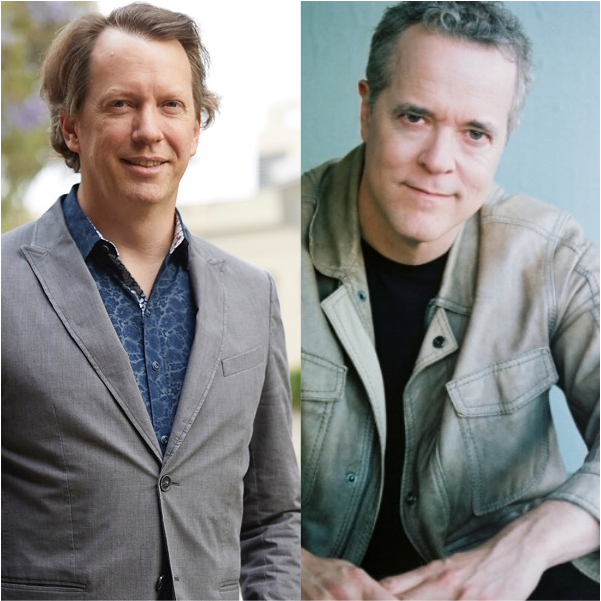
As you may have heard, I have a new book coming out in September, Something Deeply Hidden: Quantum Worlds and the Emergence of Spacetime. To celebrate, we're going to have more than the usual number of podcasts about quantum mechanics over the next couple of months. Today is an experimental flipped podcast, in which I'm being interviewed by Rob Reid. Rob is the host of the After On podcast, of which this is also an episode. We talk about quantum mechanics generally and my favorite Many-Worlds approach in particular, homing in on the motivation for believing in all those worlds and the potential puzzles that this perspective raises.
(Mindscape is in the process of joining the Wondery podcast network, so you may notice some minor changes -- format of the post titles, audio player design, etc. Leave a comment if anything seems to be broken.)
Support Mindscape on Patreon.
Rob Reid received his MBA from Harvard. He currently works as an author, entrepreneur, and podcaster. He was the founder of Listen.com, which was acquired in 2003 by RealNetworks. He has written nonfiction books about Harvard Business School and about the early days of the Web, as well as two novels. His most recent book is the science-fiction novel After On, which is also the name of his podcast.
Click to Show Episode Transcript
0:00:00 Sean Carroll: Hello, everyone, and welcome to the Mindscape podcast. I'm your host, Sean Carroll, and today it is back to quantum mechanics, one of our favorite topics here. It is going to continue to be a favorite topic this calendar year, since of course I have a book on quantum mechanics coming out September 10th, Something Deeply Hidden: Quantum Worlds and the Emergence of Spacetime. So I'm scattering a few episodes about quantum mechanics throughout the year. We've already had the discussion with David Albert, the philosopher of physics at Columbia, where David talked about his objections to the many worlds interpretation of quantum mechanics, which is my favorite way of thinking about quantum theory. And today I'm gonna give you the pro-many worlds point of view, but we're doing it in an interesting way. Today is a flipped podcast. It's not a solo podcast with just me talking, but I'm also not the interviewer. Rob Reid, who is a podcaster himself, is interviewing me, and this is going to be an episode of Rob's podcast After On.
0:00:58 SC: So Rob is an entrepreneur and an author. He's the author of several books, including a couple of novels. One of the novels is called After On, and his podcast goes by the same name. Now, ordinarily, if someone else has me on as a guest on their podcast, I would not qualify that as an episode of Mindscape. Maybe sometimes I will do that, but it would be very rare. The special circumstances here are that Rob and I really worked to shape the course of the discussion ahead of time so that it really would give me an opportunity to talk about the motivation and themes in my upcoming book, Something Deeply Hidden. So it's my pitch guided by Rob's questions as sort of someone who's not an expert in quantum mechanics. So hopefully I do not get too esoteric for people to know what's going on. So I try to give the basic picture of why you should be interested in many worlds, what many worlds says, etcetera. It's just a little taste, there's many more things to be said, but hopefully it'll be comprehensible.
0:01:55 SC: I do encourage everyone to take a listen to Rob's podcast, After On. He recommended three different episodes that Mindscape listeners might like to hear. One is Episode 21 with Mary Lou Jepsen, who is a serial entrepreneur and is trying to revolutionize medical imaging. Episode 6 of After On is with Sam Harris, and Sam and Rob talk about his novel After On and the themes of the novel, a little Silicon Valley, also a little bit about terrorism, lone wolf terrorism, which appears in the book. And then Episode 40 of After On is with Avi Loeb, an astronomy professor at Harvard. And Avi is an influential astronomer, but what they talk about is his ideas about Oumuamua, I think I'm pronouncing that correctly. Actually, I'm pretty sure I'm not pronouncing that correctly. But there was this visitor from outer space that flew through the solar system from interstellar space, and Avi examined the possibility that it could be an alien starship that was doing the weird things that Oumuamua was noticed to do. It's very unlikely that that's right, and I think that Avi is honest about that, but it makes for a fascinating scientific discussion.
0:03:04 SC: So we have a fascinating scientific discussion today. I'll try to make everyone a convert to my favorite version of quantum mechanics, or at least to convince you that quantum mechanics is something everyone should really care about. So let's go.
[music]
0:03:34 Rob Reid: So, Sean, thanks so much for having me over to your office. This is actually my very first time visiting Caltech, so I'm really glad that we're able to meet here. Before we dive into the spectral world of quantum mechanics, I thought it might be interesting if you could give us a quick survey of the two nodes of your professional career. It's almost as if your career is in a state of superposition.
0:03:55 SC: It's almost like that. Yeah, one thing I do, the day job, what pays the bills, is I'm a research theoretical physicist here at Caltech, which means I sit in my office or at Starbucks or wherever with pencil and paper, or these days with a iPad Pro and Apple Pencil, and scribble equations. And I'm trying to figure out the laws of physics, roughly speaking, grandly speaking, I suppose. So traditionally, I've done a lot of work in cosmology, field theory, gravitation, so things like what happened at the beginning of the universe, what's the universe made of, dark matter, dark energy, things like that. These days, it's more in foundations of physics, so foundations of quantum mechanics, for one thing, we'll be talking about today, but also statistical mechanics. So that's my research, write papers, put 'em in journals, have graduate students, the whole bit. And then when I'm not doing that, I have an active program that is more outward-facing. So part of that is writing things like textbooks, but part of it is writing things like trade books, so books that I've written so far on the Higgs boson, the arrow of time, the big picture, and now quantum mechanics.
0:05:02 RR: Yeah, so upcoming in September.
0:05:04 SC: That's right, September 10. It's called Something Deeply Hidden. The subtitle is Quantum Worlds and the Emergence of Spacetime. So "something deeply hidden" is a quote from Einstein. When he was a kid, young Einstein is given a compass and he holds it in his hand and moves it around and the needle always points to the north. And in his own retelling, this is what got him interested in science. He said there must be something deeply hidden going on that explains this weird phenomenon, and he stuck with that attitude for his whole life, that we don't simply in science accept results. We want to understand what's going on, and that turns out to be very relevant for our current conversation about quantum mechanics.
0:05:48 RR: And let's not leave out that you're a fellow podcaster.
0:05:50 SC: I'm also a podcaster, that's right, the Mindscape podcast. Yeah, I've been doing this for a little bit less than a year now, and having a great time.
0:05:58 RR: And I looked online last night. I am two episodes ahead of you, which means that you will pass me within the month because I only do a couple of episodes a month, and you keep up a very relentless week in, week out. You had five episodes in April, but I would say, anybody who enjoys either of these podcasts would enjoy the other. And you do a great deal of science but you range very broadly as well. You had a wine genius on just a couple of weeks ago.
0:06:25 SC: Yeah, that's part of the joy for me when I was writing my book, The Big Picture. Because of the broad scope of that book, there was neuroscience and philosophy and evolutionary biology involved. So, let's knock on people's doors and interview them, right? Jack Szostak who's a Nobel prize-winning biologist. I could call him up and say, "Hey, can I come visit and chat for a couple of hours? I'm writing a book." And when the book was done, that ability went away. I no longer had the license to do that, but now I have a podcast and I could do that.
0:06:49 RR: Yeah, I have a similar background, in that many years ago, I wrote a book about the rise of the Internet as a commercial medium, as it was happening. 1996, I was writing it. And that was pure license to talk to anybody, and I interviewed over probably 200 people for that book.
0:07:03 SC: Wow.
0:07:04 RR: And then, that license vanished for decades and then I started doing the podcast, and I was like, "Oh, wow, I get to do that again. This is really, really cool." So, of course, today we're gonna be talking about quantum mechanics, above all the many worlds interpretation of quantum mechanics, which you subscribe to and is a fascinating one in terms of its ramifications. Particularly for me, as a science fiction writer I'll add. And I'll just frame things by saying, my own fascination with quantum mechanics began when I first entered the tech industry. I'd studied Arabic and Middle Eastern History in college, so I didn't have a traditional Silicon Valley background, to say the least. And I quickly discovered that, essentially, every tech product in the world is enabled by quantum mechanics in that every single semi-conductor, starting with a very first transistor in 1947, has been designed around extremely well-modeled quantum behaviors and profoundly reliable quantum equations. And given how ubiquitous technology is, I think it's fair to say that probably most of what separates life today from life in 1947, sits atop this foundation of a partial mastery that we currently have of quantum mechanics.
0:08:14 RR: And what was bizarre about that to me was two things. First of all, I found the entire quantum realm to be so bizarre, and essentially impossible to understand, and even hard to believe in as I dove deeper and deeper into it. And the other thing was that, very few if any of my colleagues in Silicon Valley knew any more about the stuff than I did. If you weren't involved in designing semi-conductors, it didn't really impinge on your life. But given that this entire edifice, trillions of dollars in value, basically modern society and the bigger picture, tens if not hundreds of millions of lives saved or extended by products that sit on top of this. Anyway, the contribution of quantum mechanics to modern society is impossible to overstate, but I would imagine you might argue that all that is eclipsed by the contribution it has made to science and to our understanding of reality. Is that true?
0:09:08 SC: I would argue that quantum mechanics is important because it's right as far as we know. It is the way nature works. There's zero evidence ever done by an experimental physicist to say, "Well, maybe there's a flaw in quantum mechanics. Maybe we need to do better."
0:09:23 RR: So, two peculiar things despite that, starting with the simple fact that we really don't know how it works.
0:09:31 SC: Well, this is the weird thing, and this is the major motivation for writing the book. It's really embarrassing how physicists have let quantum mechanics go without being understood for so long. It's the best theory we have, and yet, there are these questions that anyone can ask about it, that modern physicists don't have the ability to give a consensus answer to, right? There's a famous quote from Richard Feynman saying, "I think I can safely say that nobody understands quantum mechanics." And that's embarrassing and even more embarrassing is that we don't admit it's an embarrassment. Rather than saying, "Look, this is a tremendous issue that we should devote enormous intellectual resources to," we say, "Ah, that's not important. We have other things to do."
0:10:12 RR: Equally fascinating as the fact that we don't really understand what's going on is the complete nonchalance about that, not just with the people at the local Starbucks, but in the theoretical physics community, something that I didn't realize until I learned that from you. And to me, it's almost like imagine, we are so good at predicting the weather that we know it a full year in advance, down to the number of drops in every storm. And we have these immaculate predictions that the entire travel industry, agricultural industry, wedding industry sits atop. But even if you go to a Nobel Prize-winning weatherman, and they'd probably have Nobels for weathermen if it was this well-understood. They'd say, "I don't know. I think it might be a thunder god," and another weatherman would say, "Well, some people think it's a result of conscious minds interacting with clouds," and another person would say, "Sun spots," and you'd ask 100 top weathermen, "Which one of these things is it?" And most of them would be like, "I just don't really care." That just blows my mind.
0:11:12 SC: It should. This is the scandal, the skeleton in the closet at the heart of modern physics. If all you cared about was making predictions about the future, we've got quantum mechanics pretty much sussed. But you can easily go up to a physicist and ask, "Okay, what's happening when we do this measurement of a quantum system?"
0:11:29 RR: Thunder gods or sun spots.
0:11:30 SC: It's just a black box. It's an oracle. It's not an understanding. We can get the answers out. We don't know why.
0:11:36 RR: And fascinatingly, that's enough for not just most of the people in normal life, but for most of the people working in theoretical physics. So, this is the third imponderable to me. A, it's so successful, yet we don't know how it works. B, most people in the field don't particularly care, but C, there is an outright hostility to probing that. You have a few good anecdotes in the book of people who have experienced this, including yourself, with some of the papers you've written and so forth.
0:12:03 SC: Yeah. There's story after story of brilliant physicists who tried very hard to understand quantum mechanics, and were either ridiculed or kicked out of the field. There's a famous example where the editor of the Physical Review, the major journal in physics, sent out a memo saying, "Don't allow any publications in the foundations of quantum mechanics." It comes in mild and more virulent forms. I've only felt it relatively mild. Literally, while I began writing the book, I was also in my other part of my superposition of what I do for a living, was writing a grant proposal or a group grand proposal here at Caltech to the Department of Energy, Theoretical Physics. And I'm writing what I do, that's what I was supposed to say.
0:12:46 SC: And I was told, "Leave out that stuff you do on the foundations of quantum mechanics," not just like, under emphasize it, but don't even mention it. It makes you look less serious. And brilliant people, John Bell, who's been one of the most influential people in the foundations of quantum mechanics was a scientist at CERN, who also did research in theoretical particle physics and didn't tell anyone of his colleagues at CERN that he worked on the foundations of quantum mechanics.
0:13:12 RR: So why does that bias exists?
0:13:16 SC: It's a really interesting historical development. It goes back to the 1920s when quantum mechanics was coming into shape and 1927 there was literally a single event, the fifth Solvay Conference, which is, the point at which we had quantum mechanics in its modern mature form, the same quantum mechanics we teach in textbooks today.
0:13:39 RR: It really has a birthday?
0:13:41 SC: It has a birthday, exactly. That was the setting for the famous Einstein-Bohr debates. So Albert Einstein, of course, Neils Bohr, the godfather of quantum mechanics, they were two of the grand old men at the conference, even though they were both in their early 40s at the time. And they debated about, do we have quantum mechanics? Is it done yet? They both believed it, right? And Einstein in particular gets a very bad rap as someone who was too old and set in his ways to really understand quantum mechanics, or be satisfied with it, he understood it better than anybody.
0:14:12 RR: And wasn't his Nobel for work that he did in quantum...
0:14:14 SC: Yeah, he helped invent quantum mechanics.
0:14:15 RR: Yeah, yeah.
0:14:16 SC: He invented the photon. He invented the fact that light is quantized, that's kind of a big deal.
0:14:20 RR: Kind of a big deal.
0:14:21 SC: But he said, "Look, we're not done yet. There are puzzles here that make no sense." And he tried over the years to sharpen those puzzles into a true logical inconsistency and never quite succeeded at that. But the other side was Bohr and his co-workers who said, "Look, it's good enough. Let's stop talking about what really happens. Let's just use the oracle, the black box and let's do work with it." And if you think about history, right, 1920s, okay? What happened soon thereafter, there's World War II, and in physics, there's the invention of nuclear physics, radioactivity, and soon thereafter particle physics, condensed matter physics, superconductivity. It's a really amazingly fruitful time in the history of physics, largely because quantum mechanics was invented. If you buy a new sports car, you could spend a year looking at the engine, and trying to understand it or you could take it out for a spin, right? So the last 90 years of quantum mechanics have been taking it out for a spin without really understanding the engine.
0:15:19 RR: And that poor Einstein debate persisted over many, many years after the Solvay Conference?
0:15:24 SC: It did and Bohr never really understood what Einstein was saying, but he won the PR battle. Bohr was an amazingly successful mentor, he had an institute, he had acolytes, he was personally enormously charismatic and charming, and his word was spread and Einstein was kind of a loner. Didn't really like to work with people. And very often when he did collaborate with someone he would stop talking to them soon thereafter, 'cause they did something that he didn't approve of, and so, his word never quite got out there in the same way. And he's Einstein, right? Like, it's not as if he was some little gadfly who no one had heard of.
0:16:00 RR: To set the stage, we're talking about quantum physics, just a very, very brief overview of Newtonian physics to give us a point of comparison, particularly the all-encompassing salience of two simple variables, position and velocity.
0:16:13 SC: Newton invented classical mechanics, as we now call it, in the 1600s. And it was really Pierre-Simon Laplace, circa 1800, who put his finger on this fact, that if you knew the position and velocity of everything in the universe, Newtonian mechanics lets you predict everything that will ever happen, and retrodict everything that ever did happen in the past, it's the clockwork Universe.
0:16:36 RR: Just those two variables.
0:16:38 SC: Exactly. So you need to know where everything is, where every particle or every little bit of fluid or whatever it is, and how fast they're moving. This is what we call the state of a physical system in Newtonian mechanics, the position and the velocity, 'cause that's the info you need to predict what will happen next.
0:16:54 RR: And towards the end of the 19th century, physicists might have been forgiven if they thought they were getting near the end zone, right? Because of the great depth of understanding of both particles and fields.
0:17:06 SC: What Newton gave us in the 1600s was a general framework. He gave us a paradigm, a way that physics could be. You give me stuff, and then you tell me where it is and how fast it's moving, and I tell you everything else. And so, the whole project of physics seemed to be trying to figure out what was the stuff of which the universe was made. And then you plug into the Newtonian cookbook and everything follows from that. Now, by the end of the 1800s, it seemed that there were two kinds of stuff. Everything is either a particle or a field. Matter's made of particles, the forces between the particles are mediated by fields. Those seemed to be a good general framework for doing physics. And then it was just a matter of what are the particles, what are the fields? And then yeah, circa 1900, it all comes crashing down.
0:17:48 RR: It all comes crashing down.
0:17:49 SC: Very, very roughly speaking, the road to quantum mechanics, which was not easy, it took 27 years and two things happened, we realized that particles had wave-like properties and fields had particle-like properties and this was very confusing. And ultimately, quantum mechanics unified the two things. So the thing that happened first was this idea that fields have particle-like properties, okay? So, James Clerk Maxwell in the mid 1800s pointed out that electricity and magnetism were two sides of the same coin. So we talk about the electromagnetic field and what we thought in the late 19th century was that we had finally understood light. It wasn't particles, it was a vibration and oscillation in the electric and magnetic fields. But there were a couple of little problems with that idea still hanging around. One is what was called black body radiation. Take a hunk of matter. It doesn't matter what it's made out of, anything at all, put in it in an oven. Let it sit there for a very long time, so it comes to an absolutely uniform temperature. Take it out, it'll be glowing, 'cause you've heated it up.
0:18:52 SC: Look at all the light that it's emitting. It's gonna emit some long wavelength light, some medium wavelength light, some short wavelength light. That's called black body radiation. So, as physicists you wanna say, "Okay, let's explain that form of radiation." And they did the calculations, and for the long wavelength light, they got it exactly right, everything seemed to work. For the short wavelength light, their calculations were very clear, everything you put in the oven should be emitting an infinite amount of short wavelength light.
0:19:18 RR: Of ultraviolet.
0:19:18 SC: Of ultraviolet.
0:19:19 RR: An infinite amount according to the wave calculations that existed.
0:19:23 SC: Yeah. That's crazy. So, they labeled it the ultraviolet catastrophe.
0:19:26 RR: Alright.
0:19:27 SC: And the problem was semi-solved by Max Planck, whose name I insist on pronouncing...
0:19:33 RR: Germanically.
0:19:33 SC: He would've pronounced it, even though I don't say Ein-shtein, so I'm not consistent. And Planck said, let's just imagine that when light is emitted by the glowing object, it comes in discrete packets of energy. So if you know what the wavelength is I will tell you how much energy there is in a single discrete packet. Long wavelength light has less energy per little packet, short wavelength light has more energy. And then he got beautiful agreement, he predicted a new form of black body radiation that agreed exactly with whatever had been observed.
0:20:06 RR: So the distribution of light intensities at different frequencies matched perfectly if you figured that light was traveling in packets.
0:20:12 SC: Planck didn't say light comes in packets, he said light is emitted in packets. So, Einstein in 1905 says, well, maybe that's because light can only come in the form of these little discrete energy packets which we now call photons, the particles of light. So the analogy I use is that Planck was like saying, I have a coffee maker that you only push the button and it makes you one cup of coffee, never makes half a cup of coffee or two cups of coffee, it comes in discrete units of one cup of coffee. And Einstein says, coffee only exists in one cup-sized amount.
[chuckle]
0:20:47 SC: So it's a much more dramatic claim, but it was consistent with everything and explained even more than what Planck had explained. Now, no one knew how to reconcile the fact that Maxwell had this really good successful theory of light as waves, and now Planck and Einstein are saying light's a particle, but okay. Then it's Niels Bohr who says, actually, particles have kind of a field-like behavior. By then, Rutherford and others had realized what the atom looks like. So the atom is a tiny little nucleus and electrons are orbiting. And every picture you see of an atom looks like a little solar system, like planets orbiting the sun. But again, physicists wanna understand this, so they say, well, wait a minute, an electron orbiting, that means the electron is moving in a circle or an ellipse. That means the electron is being jiggled back and forth. And we know what happens when you jiggle electrons back and forth, they emit light. That's what electrons do. Every photon that you see around you right now is because an electron was jiggling. So you can calculate what should happen to the atom if the electron in its orbit emits light. The answer is, the electron should lose energy and spiral into the nucleus in a tiny fraction of a microsecond.
0:21:52 RR: It should lose energy because it's emitting light, that uses its calories in a sense.
0:21:56 SC: Exactly. That's right.
0:21:57 RR: And it should crash into the nucleus and atoms shouldn't exist.
0:22:01 SC: Exactly. The atoms should be completely unstable. This is a completely clear, unavoidable prediction of number one classical mechanics, number two, the idea that atoms look like little solar systems.
0:22:13 RR: Electrons therefore had to stop being particles.
0:22:16 SC: In 1910 or 1912. All we know is that somehow electrons and atoms don't behave like they're supposed to. Bohr comes with this out of blue suggestion when an electron is orbiting an atom, there's only certain energies it can have. And so rather than spiraling down, there's a lowest energy orbit that the electron can have, and once it gets there it can't move anymore. And de Broglie, who came along afterwards, said, "I can explain why the electron has a lowest energy orbit, because the electron is really a wave, and it's much like the vibrations of a violin string or a guitar string. There's a fundamental and there's the first harmonic and second harmonic. There's a discrete set of wavelengths that a vibrating string can have." De Broglie says, "There's a discrete set of energies the vibrating wave of the electron can have." So Planck and Einstein say waves, fields are kind of partically, Bohr and de Broglie say particles like electrons are kind of wavy that's the 19-teens. And then in the 1920s, they reconcile it all, it's all quantum mechanics.
0:23:21 RR: So let's get to the heart of the matter, the measurement problem, the source of so much of this weirdness and confusion about what might be going on.
0:23:29 SC: To skip some very hard steps, the answer is it's all waves. Okay? That's the very short answer. There's really nothing partically about even electrons, photons, electrons, quarks, neutrinos, they're not particles at all, they're all waves. But when we look at them, they look like particles. And this took a long time to sink in, that there's something about quantum mechanics that you need to include some rules about what happens when we look at it.
0:23:58 RR: So the measurement problem, it's simple core?
0:24:01 SC: The measurement problem is just at heart, stuff is described by a quantum wave, but when you measure it, when you look at it, when you observe it, that's not what you see, you see a particle. That was never true in classical mechanics. There didn't need to be separate rules for what happened when you look at the classical system, you just see it. It has a position, it has a velocity, you measure those. Okay. So there needed to be separate rules when you observe the quantum wave function, here is what you will see. Now, number one why? Why do we need separate rules for what's a measurement? Number two, what qualifies as a measurement? Does it have to be a person doing the measurement? Would a camera count? And then the rules that we actually have tell us that when we observe the quantum system, its wave function changes instantly, dramatically and randomly.
0:24:51 RR: By dint of our observation.
0:24:53 SC: Yes. This is what fits the data that our observation changes the quantum state right away, called collapse of the wave function. So how quickly does that happen? Is it really instantaneous? There's a long list of questions about the measurement of quantum systems that the standard quantum formalism simply doesn't answer. The thing that we teach our undergraduates, the thing that is enshrined in textbooks, when you measure a quantum system, you will see the following thing with a certain probability. They will not say what it means to measure something, what happens, why it happens, how it happens, that's the measurement problem.
0:25:27 RR: So if an electron is not a particle orbiting a sun of sorts, what is it?
0:25:33 SC: It's a wave function. That's what it is.
0:25:35 RR: And it's a cloud of probabilities. How do you describe that, typically?
0:25:38 SC: Let me just say that the phrase wave function is the best we have and it's terrible.
0:25:43 SC: Terrible. Yeah.
0:25:43 SC: It is terrible, for one thing, ordinary waves, that we know about, exist in the three-dimensional space around us; at every point in space, there's a value for the electric field, the magnetic field, etcetera. The wave function you should think of as a sort of a machine. You ask it a question, "Where is the electron?" For example. And it will say, "With a certain probability you will find the following answers to your question." If all you care about is the position of one electron then the wave function at every point in space, it has a value and that value tells you the probability of seeing the electron there, so if the electron is in an atom the wave function is concentrated right there in the atom very close by to the nucleus and it fades to zero very rapidly as you go further away.
0:26:28 RR: So it's a probability curve of finding the electron at any given point?
0:26:33 SC: That's right, that's why I sometimes call it a cloud of probability. It really is this fuzzy thing. Now, there's one big caveat there. If you have two electrons, you don't have two clouds. [chuckle] And this is very, very annoying, but it's also the secret to quantum mechanics, if you have two electrons, rather than for electron A, I give you the probability of finding it anywhere and for electron B, I give you the probability finding it anywhere. Quantum mechanics says I need to give you the probability for both observations at the same time. So for every possible set of locations they could both have, there's a probability.
0:27:07 RR: Let's talk about Newton and the fact that position and velocity encompassed everything. When it come down to an electron, we can't talk about either of these things, but sometimes in certain cases, we can pin down a position. Let's talk about how that happens and how when we pin down the position, the velocity is completely inaccessible to us, and in fact it doesn't even exist.
0:27:30 SC: Right. Already in our discussion of quantum mechanics, we're at the point where there's nothing I can say that someone won't disagree with. This is how bad it is.
0:27:38 RR: We're getting into the part of non-consensus.
0:27:40 SC: Yeah, exactly, and it's not that you need to go into very advanced questions. All you have to say is, Well, what is the wave function? What does it mean? Is that what the electron is? Or is that just part of what the electron is? Or is it just our knowledge of what the electron is? Nobody agrees on these questions. Now, I have a point of view and from now on in the conversation, everything I say will be assuming my point of view. And that point of view is that, the wave function is what is real. That's what actually exists. It's not that there is an electron and we don't know where it is. All there is, is the wave function. The other point is more technical, which is, okay, When we talked about a particle in Newtonian mechanics you said there's a position and a velocity, and then when you were just talking about the wave function of the electron you said there's a probability for getting any position. What about the velocity?
0:28:30 SC: So it turns out that position and velocity are not independent of each other, anymore. So if you know, for a Newtonian particle's position, you know nothing about its velocity, right? It could have any velocity whatsoever. All you know where it is, but if I tell you the wave function for an electron, for every single position, the probability of seeing it there, you can figure out the probability of observing any velocity from the wave function given to you in terms of position. Roughly speaking, if the wave function is oscillating rapidly, then the velocity is likely to be a large number.
0:29:03 SC: Combining that philosophical point, the wave function is what is real, with that technical point, one determines the other, you end up with the uncertainty principle, which is that, in my language, all there is is the wave function, position and velocity are not properties that electrons have, they are possible things you can measure, so you can measure the position or you can measure the velocity but you're not measuring pre-existing things, you're getting a result with a certain probability, and the way wave functions work are, if the position is very, very localized near to one point, then you have no idea what you're gonna get for the velocity and vice versa. If there's a very certain velocity then the position is spread out all over the place. So the uncertainty principle says there is no quantum wave function for which both the position and the velocity give you definite answers.
0:29:52 RR: So when you have an observation, just sort of put it in simplistic language, by the act of observing you 'cause the electron to suddenly look like a particle. In a sense, you pin it down to one location, at that point.
0:30:06 SC: In a sense, yes.
0:30:07 RR: The act of observation makes it exist somewhere for that moment that you're observing, is that fair to say?
0:30:13 SC: That's as close as you're gonna get. Once you've observed it in one place, it's enormously probable that you're gonna observe it right there again.
0:30:19 RR: Yeah, there it is. So in a sense, the act of observation concentrates all the probabilities of where the electron may be to something close to one point.
0:30:29 SC: That's right.
0:30:30 RR: And instead of a cloud of possibilities we have 100% or something that rounds to that certainty that the electron is right here, right now, but by having done that, we've drained any ability to know anything about its velocity.
0:30:43 SC: Yeah, that's exactly right.
0:30:45 RR: And then the other thing that's vital is that it was not in any one place until your observation, in some way, coerced it into choosing a location.
0:30:54 SC: Yeah, that's right.
0:30:55 RR: And the term that's usually used is the collapse of the wave function.
0:31:00 SC: That's what happens when you observe.
0:31:00 RR: So when you observe it, it really collapses on whatever you observe.
0:31:03 SC: If you observe velocity, then it would collapse onto one velocity.
0:31:07 RR: You basically take two mysterious quantities, and you say, "I'm gonna know what one of them is."
0:31:11 SC: That's right.
0:31:12 RR: And that's the part of the wave function that has collapsed, momentarily, and had you not observed or had you not measured that would not have happened.
0:31:20 SC: That's exactly right.
0:31:21 RR: To give an example of how this plays out in the laboratory, well, actually it played out as a thought experiment for decades, but ultimately played out in the laboratory, could you describe complementarity and the notorious double-slit experiment?
0:31:35 SC: The double-slit experiment was a thought experiment that was cooked up to help people realize how weird quantum mechanics seems to our intuition. It was only fairly recently done in the last couple of decades. So the point is you have two slits in a screen and you shoot some stuff at them and then you observe what comes through the slits at some detector on the other side. First, imagine good old classical pellets, like a pellet gun, and guess what, if you shoot them through two slits, on the other side, you're gonna observe a pattern of hits of the pellets that look like two slits, because that's what they pass through.
0:32:11 RR: They basically represent the shape of the slit. The pellet has to come in on a trajectory that makes it through the slit. So let's say they're paint pellets and you have a big old canvas on the other side, you're gonna have two rectangle-ish looking shapes with a little bit of scatter pattern around them.
0:32:25 SC: Exactly right. Whereas if you take your two slits and put them in a tub of water and slap one side of the water and let the waves move out in a circle from where you're slapping, the wave can pass through either one of the slits.
0:32:38 RR: It breaks into two waves.
0:32:39 SC: It breaks into two waves and they will either constructively interfere, so they build up even higher than any one of the waves themselves.
0:32:46 RR: Two peaks hit each other and become a super peak.
0:32:49 SC: Or they can destructively interfere, so that where one is peaking, the other is troughing, and they cancel out and you get nothing.
0:32:55 RR: So you end up with a semi-regular pattern of high amplitude and low amplitude.
0:33:00 SC: That's right. So middle of the other side of the slits, you'll see a big peak and then you see littler peaks fading as you go further away from the middle.
0:33:08 RR: So a very, very different pattern on your canvas than you would have had with the pellet gun.
0:33:13 SC: Yeah, that's right. So then you try it with electrons.
0:33:16 RR: You shoot the electrons one at a time.
0:33:18 SC: Let's say, shoot the electrons one at a time, why not? The point is, you do detect them one at a time on the other side, you get a little splat, particle-like, because when you observe electrons, they look like particles, right? But you do this for many electrons but one at a time, like you said, and you observe the pattern of splats and you might think that they look like two slits, just like the classical pellets did. They don't. They look like the wave pattern that you got when you put water through the waves.
0:33:46 RR: So even though they're shooting out one at a time, they ain't waves in the traditional way of thinking about it.
0:33:51 SC: You wouldn't think that they're waves.
0:33:52 RR: You wouldn't think that they're waves, you're firing them one at a time, and over hundreds or thousands or however many you send out, they end up imitating this interference pattern of waves of water going through as opposed to actual single pellets.
0:34:07 SC: Every electron is interfering with itself, which is something that waves do, not something that particles do.
0:34:12 RR: Ah.
0:34:12 SC: Which makes perfect sense if you think that electrons are really waves and that you made an observation at the detector. So, so far, that's fine. But to drive home the weirdness, you can say, "Well, what if I measure which slit the electron goes through? Because if I believe the electrons are waves, it had to go through both slits. So now, I wanna see which slit it goes through, so I'm gonna put a detector there and measure, did the charge go through one slit or the other?"
0:34:40 RR: And you're expecting at this point that it's gone through both, 'cause it's a wave.
0:34:43 SC: Except you have never observed half of an electron anywhere.
[laughter]
0:34:47 RR: Right. When you observe it, you force it to be in one location.
0:34:51 SC: Exactly. The electron will go through either one slit or the other. You will never observe it going through both slits. And when you look at the pattern on the screen on the other side, the interference has gone away. Now that you're measuring which slit the electron goes through, it acts in a purely particle-like way, and you get the same kind of pattern on the other side that you got when you shot a classical pellet gun through two big slits.
0:35:14 RR: So again, as we were saying earlier, by looking, you have forced it into a position and this is manifesting itself on the actual photographic paper or whatever is on the other side that's detecting the pattern of the landings. And when this was first discovered, I suppose, that a lot of people thought, "Wow, does this mean there's something strange about consciousness? And the fact that we're observing this is having this clear impact on matter, and it knows when we're looking and it knows when we're not, and it behaves one way when we're looking and it behaves another way when we're not."
0:35:49 SC: Well, that was certainly an implication or a possible direction you could go down. As soon as it became clear that making sense of quantum mechanics required separate rules for the active observation or measurement, without specifying what that meant, the door was open for someone to say, "Well, look, observers are conscious creatures. I bet that human consciousness has some effect on the wave function of the electron that changes it when we observe it." And the double-slit experiment is just an especially vivid demonstration of that idea.
0:36:22 RR: Let's talk about spin, because that's in some ways a simplifying thing. An electron will essentially have two spin states, correct?
0:36:30 SC: That's right.
0:36:30 RR: And it's either up or down by the language.
0:36:31 SC: Yes, that's right.
0:36:32 RR: Yeah.
0:36:32 SC: So you have some magnetic field and you pass an electron through it, and it will either be deflected upward or deflected downward along the access defined by that magnetic field.
0:36:42 RR: This is again a situation in which you pin the electron down, and it either has to be up or down.
0:36:48 SC: That's right.
0:36:48 RR: And it's the act of observation that makes it up or down.
0:36:53 SC: Yup, exactly.
0:36:54 RR: Prior to that it was in superposition. Could you explain what superposition is, both when we're talking about spin and also when we're talking about location.
0:37:01 SC: The idea of a superposition is, the electron is in every possible position. That's what it means to say, the electron has a wave function. This is supposed to be two synonymous ways of speaking. You might say "It's a wave function. I could calculate the probability of observing the electron there," or I could say, "The electron is in a superposition of every possible position."
0:37:21 RR: It's in all of those positions at once.
0:37:23 SC: That's right. It's in some of them more...
0:37:24 RR: Than others.
0:37:26 SC: That means there's more probability for seeing it there.
0:37:28 RR: And notionally, before we measure the spin of the electron, it's neither up nor down.
0:37:33 SC: Just like we expressed the wave function of the electron as saying to every possible position we could observe, there's a probability. It's much simpler when we only think of the spin, because there's an infinite number of answers we could get to the position of the electron.
0:37:48 RR: Yes.
0:37:48 SC: But there's only two answers we can get to the question, "What do we observe the spin to be?" So the so-called wave function for the spin of the electron is just a number associated with spin up and a separate number associated with spin down.
0:38:02 RR: And is it 50/50 generally? 50%...
0:38:04 SC: No, it could be whatever we want.
0:38:05 RR: Before it goes through the magnet that causes it to make a choice, could you say, "These electrons here are 90% likely to be up and 10% likely to be down, whereas those are 90% likely to be down and 10% likely to be up?"
0:38:18 SC: Yeah, we can prepare electrons in whatever wave functions we want, so we can easily make them 90% up, 10% down.
0:38:23 RR: Oh, that's interesting. So, what are some of the popular explanations of what happens when we collapse the wave function and establish that an electron is up versus down?
0:38:34 SC: Well, first I'll tell you some version of what we call the Copenhagen interpretation. This is what became enshrined in 1927 and was taught to our undergraduates ever since, which is basically, don't ask that question. There's something called observation, there is something called measurement. It's not explained in terms of other things. It is a fundamental part of quantum mechanics, it is roughly compatible with what you'd think if you have a microscope or a particle accelerator or whatever, and the wave function just is a black box that tells you the probability, and wave functions collapse instantly when you make a measurement. If the electron was spin up plus spin down 50/50, if you measure it to be spin up, the spin down-ness of it went away once and for all, disappeared.
0:39:17 SC: Okay, many worlds, which was invented by Hugh Everett, who was a graduate student of Princeton in the 1950s, says the following thing, "If you look at what we're taught by our elders are the rules of quantum mechanics, there are wave functions, they evolve according to the Schrödinger equation."
0:39:33 RR: Evolution is that the probabilities ebb and flow at different places.
0:39:36 SC: That's right, according to a very definite equation. So classical mechanics, is the state of a system where its positions and velocities and they evolve According to Newton's laws, but then the rules of quantum mechanics tack on more rules. When you observe it, you get certain outcomes with certain probabilities, the wave function collapses. Everett says, "What if I just erased all of those extra rules?" [chuckle] What if the rules of quantum mechanics were just there are wave functions and they obey the Schrödinger equation?" By any sensible measure, that's a simpler theory. The rules are much more compact. The problem is it doesn't seem to match our observations 'cause wave functions seem to collapse, but Everett says, "Look, think about that spin measurement that you're doing, the electron is spin up or spin down. What you're forgetting is that you, the experimenter, live in the universe, and the universe runs by the rules of quantum mechanics, so you obey the rules of quantum mechanics. In particular, you can evolve into super positions just like electrons can. There's nothing special about you, you're made of electrons and protons and neutrons after all. So what happens to you when you measure the spin of the electron?"
0:40:42 SC: When the electron starts out in a superposition,4 a little bit of both, you are a little bit of both. There's a little bit of the universe that says, the electron was spin up and you saw it spin up and there's a little bit of the universe that says, the electron was spin down and you saw it spin down. The problem is, that's not how we feel. None of us has ever felt, like, "Oh, I'm kind of in a superposition of having seen the electron spin up and the electron spin down," and Everett, he said, "You are not the combination of both the person who saw spin up, and the person who saw spin down. When you did that measurement, the wave function of the universe went from describing one world to describing two worlds, one in which the electron will spin up and you saw it spin up. And the other in which the electron will spin down and you saw it spin down. They're both there. There are now two people. The universe has split. It has branched. And I have answered the measurement problem. What's a measurement? A measurement is whenever a tiny quantum system in a superposition interacts with a big macroscopic system and becomes entangled with it. This situation where there's an electron spin up and you saw it spin up plus there's electron spin down 'cause you saw it spin down, it's entanglement. The state of you is now entangled with the spin of the electron."
0:41:57 RR: So if I can put this in my own terms. I'm getting ready to measure the spin of a perfectly innocent unsuspecting electron.
0:42:05 SC: No idea what's coming.
0:42:06 RR: And the universe contains a single me and this ambiguous electron, from my standpoint. This electron with a mysterious spin state. Then I make the measurement. And now there is a Rob who has seen an electron that's spin up and somewhere else, there is a Rob who saw it in the spin-down state?
0:42:26 SC: Exactly.
0:42:26 RR: I got tangled up with that electron.
0:42:29 SC: In a very literal sense you became entangled with that electron. Yes.
0:42:31 RR: Because my observation forced it in a sense to make a choice, it actually didn't make a choice, it's still both things but now there have to be two of me in order to contain the two observations.
0:42:44 SC: That's right.
0:42:45 RR: And had I not made that observation that electron would still be in its ambiguous state, and there would still be one of me.
0:42:51 SC: Now we have a real, definite physical theory, so we can say, "What do you mean by making a measurement, How quickly does it happen?" etcetera. So we know what it means when it's you and the electron. What about if it's a video camera and the electron? And the answer came along in the form of what we now called decoherence, which was pioneered by Heinz-Dieter Zeh in the 1970s. So let's say that there's the electron, there's you and there's what we call the environment. Literally everything else in the universe. The electron can maintain its superposition without becoming entangled with the environment. The electron can stay in a superposition. You as a big macroscopic thing will become entangled with the environment. So now we can finally answer the question, when does a measurement happen. A measurement happens when the quantum system becomes entangled with its environment.
0:43:43 RR: A previously unentangled quantum system.
0:43:45 SC: That's right.
0:43:46 RR: So we have an electron that is isolated enough from the environment that it is in superposition. That it is, in effect, both spin up and spin down, and if it's teamed up with an atom, it is in effect in all positions at once to differing degrees based on probability. How hard is it to isolate an electron to that degree? It's impossible to isolate me, I'm getting hit by gazillions of photons at all times. Are most electrons inherently disentangled and it's a rarity that one of them gets entangled because they're so tiny and isolated?
0:44:20 SC: Once you have an unentangled electron, if it's only that one electron, not too hard to keep it unentangled from everything else, especially if the electron is in an atom, the atom is a contained system. To get entangled you need to have different parts of your wave function interact with the rest of the world differently. So to a large extent, things remain unentangled.
0:44:41 RR: So if I'm an electron, in let's say a carbon atom, there's a lot of electrons in a carbon atom. I'm one of the inner shells. Probably nothing's ever gonna perturb me. I will be in a disentangled state for perhaps billions of years.
0:44:53 SC: That's right, but I don't want to give people the impression that the wave function doesn't branch very often.
0:44:58 RR: Yeah, and for a lot of electrons, they may stay in superposition for billions of years but boy, are there are lot of electrons in the universe.
0:45:04 SC: But also there are things like nuclei giving off radioactivity. How much radio activity does the typical human body, give off? Do you have a guess?
0:45:13 RR: Like measuring what?
0:45:14 SC: How many times per second, does the radioactive decay happen in your body?
0:45:18 RR: Not being made of plutonium or uranium I would assume it's a low number, but the question you've asked suggests it's a shockingly high number. So I'm gonna go with 800 times per second.
0:45:29 SC: 5000 times per second.
0:45:30 RR: Oh wow, I was in the ball park.
0:45:31 SC: Yeah, you're in the ballpark.
0:45:32 RR: It was within an order of magnitude.
0:45:33 SC: Order of magnitude.
0:45:33 RR: But that's a lot per se.
0:45:34 SC: It's a lot. So the wave function of the universe branches into two 5000 times a second just because of radioactive atoms in your body.
0:45:42 RR: So that is a lot of universes.
0:45:44 SC: So in the universe, there's a lot of branches because every one of those 5000 is a yes or no choice. It did decay or it did not.
0:45:50 RR: So there's a branch in which it decayed, a branch in which it did not.
0:45:53 RR: Yeah, and then every human body, every planet, etcetera, etcetera. So there is a great deal of branching that is going on.
0:46:00 SC: Yes. That's right.
0:46:01 RR: The core mystery that needs to be explained is, why do things act differently when they're being observed, and why is it that macroscopic objects like us don't seem to exhibit these behaviors? But if you get down to the electron scale, they do. Are those the two questions that the competing explanations of which many worlds is one? Are those the two fundamental things that need to be explained or are there one or two other things that a non-scientific mind can grasp?
0:46:30 SC: There are a bunch of things that need to be explained, but you put your finger on two good ones, the thing that gets attention as the measurement problem. Now, you've mentioned this other problem, why does the world look approximately classical? Why isn't quantum mechanics very evident in our everyday lives? To me, that's a very good question that is under-appreciated even in foundations of physics circles. So let me give some of the other answers to the measurement problem, and you'll see what I mean.
0:46:56 SC: There are two other very respectable popular approaches to the measurement problem. One is called dynamical collapse. Dynamical collapse theories say the wave functions usually evolve according to the Schrödinger equation, but not always. For every particle, there is a chance every second that whatever its wave function is doing, it will spontaneously and randomly collapse. So we'll go from being spread out in position to being highly concentrated at one location.
0:47:26 RR: So once in a very long while, this will occur?
0:47:29 SC: About once every 300 million years.
0:47:32 RR: For any given electron.
0:47:33 SC: For any given electron.
0:47:34 RR: But given the number of electrons in my body, that would be happening all the time.
0:47:37 SC: Exactly. So 300 million years is chosen very carefully.
0:47:41 RR: Is it derived mathematically or did they pick an arbitrary number that was convenient?
0:47:45 SC: No, they checked the number that wouldn't be ruled out.
0:47:47 RR: Okay, got it.
0:47:48 SC: If it were once a second, then individual electrons in your lab would just be collapsing all the time and you would have noticed that a long time ago. If it were much longer, then even a relatively large system wouldn't collapse. So the beauty of dynamical collapse theories is that in any one object like a table or you or me, all the electrons are entangled with each other such that when one of them collapses, the others sort of jiggle along with it.
0:48:15 RR: And one of them collapses spontaneously. Therefore, all the electrons in this arbitrary object, the table, are also in sympathy or in domino effect. They, too, will momentarily have a specified position.
0:48:28 SC: Exactly right. So imagine you could take a bowling ball, and put it in a quantum superposition of being here, and being a meter away. Okay, two different physical locations. In dynamical collapse theories, if any one of the electrons in the bowling ball suddenly collapses either to here or to one meter away, all of the other electrons, and all the protons, and neutrons go with it. So we've sort of imposed classical behavior on the world.
0:48:55 RR: That sort of anchors large objects to behave in Newtonian manner.
0:49:00 SC: That's right.
0:49:01 RR: And they picked this once every 300-million-year number because that conveniently anchors anything big enough for us to see, but it's rare enough that if you decide to test it, you're gonna have to sit in your lab for 300 million years, so good luck disproving that.
0:49:15 SC: Or you make a collection of 100,000 or a million atoms, and you wait patiently.
0:49:21 RR: What about a collection of 300 million atoms, right?
0:49:23 SC: We need to keep them very, very cool, and isolated from the rest of the world, and not becoming entangled with the photons in the room or anything like that. That's very, very hard to do. So what people are actually doing is getting tiny sets of something very, very cool, probably liquid helium or something. And this process of an electron spontaneously collapsing will gently heat up the material, so it adds energy to the system, and that's observable, and they're testing that right now.
0:49:50 RR: So somebody is trying to test this?
0:49:51 SC: Oh, yeah, absolutely, right. And they're doing a very good job.
0:49:53 RR: Are there people doing it from the camp that generally believes in this, and would rather like to prove it or are they from the camp that is sick of hearing about this crap, and would like to disprove it?
0:50:03 SC: I'm sure they would like to prove it. Nobel prizes would be falling down on their head.
0:50:07 RR: Is GRW, is that what the series is called?
0:50:08 SC: GRW, Ghirardi, Rimini and Weber were three of the people who first proposed a version of this theory, but it's in this larger set of theories called dynamical collapse theories.
0:50:19 RR: So that's one approach. There's another called hidden variables.
0:50:23 SC: Yes. And this is more venerable. This is what Louis de Broglie had in mind, and what Albert Einstein had in mind, and even what Erwin Schrödinger had in mind back in the day. They said, "Look, I have light. It has wave-like properties and particle-like properties. Let me just do the obvious thing." Say, that that's because there is both a particle and a wave. And the theory was later discovered, and extended by David Bohm in the 1950s. So now, it's often called de Broglie-Bohm theory or even just Bohmian mechanics. So now, electrons are really particles. They had positions, but you don't know what they are. The probability in quantum mechanics just comes from your ignorance. You don't know where the electron is. Wave function is a whole separate thing. And the electron interacts with the wave function. And the wave that it interacts is, it gets funneled into where the wave function is big. So you are more likely to observe it where the wave function is big than where the way function is small. There are two elements to reality. There's the locations of the particles, and there's the wave function.
0:51:23 RR: So in your view of things, the electron simply does not have a position. In their view, the electron always has a position. We just don't happen to know what it is.
0:51:34 SC: That's right.
0:51:34 RR: And then one of my favorite ones, because I really love Picasso is QBism. Of course, that has nothing to do with Picasso.
0:51:42 SC: Nothing at all.
0:51:42 RR: But could you give us a quick zippy tour of what QBism says about this odd behavior?
0:51:47 SC: Well, Everett says, "Okay, there's a wave function, and it evolves smoothly, according to the Schrödinger equation." So how could that possibly not be the right answer? Well, one thing is there could be things beside the wave function, and that gets you in hidden variable theories. Another thing could be the wave function doesn't always evolve smoothly, and that gets you dynamical collapse theories. And the third option is, there's a wave function, but it's not the real physical stuff of reality. What the wave function is is an especially mathematically elaborate way of characterizing our ignorance. It's a way of being Bayesian about things. There's a probability of anything happening. You have a credence for any proposition you might wanna have. And the wave function is just a tool for calculating your personal credence that the electron will be seen to be spin up rather than spin down.
0:52:36 RR: So does this bring consciousness into the equation? Because there's something in QBism called participatory realism, which again, sounds like a form of painting.
[chuckle]
0:52:45 SC: Yes.
0:52:46 RR: So does human consciousness start getting integrated in QBism?
0:52:50 SC: Yes and no. And look, I have tried very hard to understand QBism and I don't. I'm not sympathetic so there might be some mental flaws [laughter] that are preventing me from doing it. What I can say is that if you ask a QBist to lay out the rules of QBism, unlike any of the other options that we've talked about, the idea of an agent who has experiences and makes observations is intrinsically part of the formalism.
0:53:16 RR: So it does kinda sound like consciousness and volition are part of it.
0:53:21 SC: You have to ask what is an agent. I don't know what the answer to that is 'cause I have trouble understanding these, right?
0:53:23 RR: Right, right. 'Cause you ain't no QBist.
0:53:25 SC: I'm not a QBist, but they are biting that bullet. And many worlds is obviously a radical view because of all those worlds that it implies, okay?
0:53:33 RR: Yes.
0:53:35 SC: Dynamical collapse is a radical view, because it makes the laws of physics truly and inextricably random. Hidden variables is probably the least radical.
0:53:44 RR: It just says there's stuff we haven't found yet.
0:53:46 SC: Yeah, it's the version of quantum mechanics that is closest to classical mechanics. It's the least crazy thing. Crazy not in a normative sense but just in a deviation from previous ways of thinking sense. QBism is the biggest crazy thing. It says we shouldn't be in the job of talking about reality. Reality comes into existence as a result of our observations, but it doesn't pre-exist. The job of physics is not describing reality, it's to predict observational outcomes. That is a hugely dramatic metaphysical shift...
0:54:19 RR: It is.
0:54:19 SC: In science and what we're doing here and I think it's too big a shift, it's unwarranted, 'cause we have perfectly realist versions of quantum mechanics that fit the data. And what's an agent, you know?
[chuckle]
0:54:30 RR: Right.
0:54:30 SC: Why is it that agents seem to agree on the world if it doesn't pre-exist then and things like that. So, it's really difficult for me to take it seriously. On the other hand, they find it difficult to take many worlds seriously.
0:54:41 RR: Right.
0:54:42 SC: There's a symmetry there.
0:54:43 RR: There is a symmetry there. So, if we took, let's say, a thousand academic physicists chosen entirely at random and asked them which of these theories do you adhere to? How many would say, "I don't know and I don't care. It just doesn't interest me, so none."
0:55:00 SC: I think that'd be the winner.
0:55:01 RR: That'd be the winner.
0:55:01 SC: If you ask that question at a cosmology conference or a quantum information conference, or a condensed matter conference, you're gonna get very different answers. There is sympathy for many worlds among people with cosmology or quantum gravity interests. In the quantum information theory community, where you're doing things like building quantum computers and stuff like that.
0:55:23 RR: Cryptography.
0:55:23 SC: Yeah, cryptography, stuff like that. There's surprising sympathy for QBism, and you can kind of understand that, that's what they're doing, they're measuring outcomes, they are agents getting experiences, calculating probabilities for them, that's what they do. And in the philosophy of physics community, dynamical collapse and hidden variable theories are the most popular ones and you can understand that as well, because they're perfectly well-formulated theories that don't have any metaphysical conundrums [chuckle] associated with them.
0:55:51 RR: The thing that just intuitively is most difficult to accept about many worlds is that these vast expanses populated by perhaps octillions of conscious systems are just propagating constantly. Just intuitively I think most people who are hearing about the theory for the first time would basically leave it at that and maybe to put it in more formalistic terms would say, conservation of matter and energy, this seems to be creating an awful lot of something out of nothing. Or a awful lot of something out of a lone universe.
0:56:23 SC: Yeah, and I think that's a perfectly valid first intuition to have, but then you gotta go through the math, and if you buy into many worlds, this current state of the universe you see around you, is just one branch of the wave function and that branch comes with what we call a weight. The wave function says, "Is this branch big or small, is it thick or thin?"
0:56:42 RR: Is it likely or unlikely? Is it a probability statement?
0:56:46 SC: No, it's there with a 100%. So, when you have the electron in spin up plus spin down and the universe evolves into a combination of both spin up and spin down, basically it's not like you're taking the universe and doubling it, it's like, you're taking the universe and slicing it in half. And now there's two universes, but they're each half the size of the original universe. Every time you branch the wave function, the total thickness of the wave function doesn't change.
0:57:12 RR: This thickness, this is not something that's easily measurable, I assume?
0:57:17 SC: Well, you can prepare something like the electron wave function in any superposition you want, like we talked about, right? 1% up 99% down, etcetera, so you know what it is. So then once you measure it, you know what the thickness is of the two branches that had been created, but once they've been created, you can't measure it.
0:57:35 RR: Yeah, and it just seems that whatever arbitrary thickness we assign to the universe, let's say in New Year's Day, midnight, 1950, it has an arbitrary thickness, it's a state at that instant. The number of times it's been split since then, it's not infinite, but God, it's a lot of times. I mean, if every single time there's radioactive decay in my body and that's 5,000 times a second, and there's all these bodies and there's all these planets, and we can only see 14 billion light years in either direction. It probably goes further than that. With all of those splittings happening, whatever thickness the world had in 1950, it is such a minuscule sliver of it. At some point, you kinda run into Zeno's paradox, don't you?
0:58:15 SC: Well, maybe, maybe not. And the one thing that we don't know, and this is sort of an embarrassing admission for an Everettian, we don't know whether there are an infinite or finite number of branches of the wave function of the universe. We don't even know that simple basic fact. And to be fair, in no version of quantum mechanics do we know whether there are an infinite or a finite number of different distinguishable wave functions. This is a deep question about quantum gravity and the wave function of the universe. So, there's physics we don't understand that we would need to know before we said, there's only a finite number of branches versus an infinite number of branches.
0:58:49 SC: But having said all that, there's plenty of room for lots of branches. You can ask yourself, if the universe just keeps branching at this fantastic rate, will we run out of room for branches? No, we're nowhere close. It's a really, really big number. If there are an infinite number of dimensions in what we call a Hilbert space, the space of all possible wave functions. Then, the question of how many branches there are in many worlds, makes no sense. It's always an infinite number. And what you should be asking instead, is what is the relative fraction of worlds where the electron was spin up versus the electron has spin down?
0:59:23 RR: And a quick aside, the term for someone who adheres to this school of thought. Do you prefer Many Worlds-er or Everettian?
0:59:31 SC: Everettian is fine.
0:59:32 RR: Everettian. Yeah, it has a nice ring. It sounds a little like the battery.
0:59:36 SC: Everett by the way, is a fascinating guy.
0:59:37 RR: Yeah, let's talk about him briefly, 'cause for somebody who had such a big academic idea, he did not stay in academia for long.
0:59:44 SC: He didn't even try, he didn't apply for jobs. While he was still a graduate student he wrangled a job in a sort of defense consulting firm and got his PhD and left. And it's unclear to me whether or not that was because he was put off by the bad reception that his theory got, 'cause it certainly did get a bad reception.
1:00:05 RR: It got a bad reception as he was writing his dissertation?
1:00:08 SC: Yes, that's right.
1:00:09 RR: This was in the '50s, am I right?
1:00:11 SC: '50s.
1:00:11 RR: Okay.
1:00:12 SC: His PhD advisor was John Wheeler, who was the most successful PhD advisor in the history of physics. Richard Feynman was his student, Kip Thorne was his student. And Hugh Everett was his student and plenty others as well. And Wheeler's mentor was, guess who? Neils Bohr. [chuckle] They'd worked together when Wheeler was a postdoc, and so forth, and to the extent that physicists worship each other, Wheeler worshiped Bohr. And so Wheeler was stuck in the position where his mentor was the boss of the Copenhagen interpretation, his student had just invented its primary competitor. So, Wheeler tried really hard to pretend that these two theories were not in conflict with each other, and the problem was that was obviously false. They were very much in conflict and Everett understood that perfectly. You read what he wrote and it's perfectly clear, he was a genius. He knew exactly what he was talking about. If he were alive today he would walk right into conversations about the foundations of quantum mechanics and fit right in. And so he saw that his theory was a competitor to Bohr, he saw all the problems with the Copenhagen interpretation, he laid them out. Everett left the field in 1957 when he got his PhD thesis published and then as late as the late '70s, Wheeler was still trying to get Everett back into academic physics.
1:01:28 RR: He died young, right?
1:01:28 SC: He died young in his early 50s. He was a smoker and a drinker, and an eater. His son Mark has become a famous musician. He is the band called Eels.
1:01:37 RR: Oh right, I think I knew that, yeah.
1:01:39 SC: And wrote a book, a little bit of autobiography memoirs and Mark Everett explained that he was very angry with his father when he died, 'cause he clearly didn't take care of himself. But then he said, "Since then I've realized a lot of people die for bad reasons, and my father lived the way he wanted to and had a good time. And there's a lot of worse ways to go than that."
1:02:00 RR: But that contribution, you still call yourselves Everettians.
1:02:02 SC: Yeah, it was clear who did the work.
1:02:04 RR: How many of you are there?
1:02:06 SC: I honestly don't know. The theory was completely ignored for a number of years after Everett proposed it. It was eventually Brice Dewitt who was a physicist at University of Texas who in the early 1970s he began to publicize it. He's the one who gave it the many worlds interpretation label, But it never became very, very popular. And then partly because of improvements in technology. Now that we have the ability to isolate individual quantum systems and ask what they do to each other, not simply measure them, but manipulate them without measuring them, without having them decohering. We need to understand the foundations of quantum mechanics better. So in the physics community, as a whole, there's been a softening of their stance that studying the foundations of quantum mechanics is a bad idea. And so all of the interpretations of quantum mechanics are getting more attention now than they ever did, including Everett.
1:02:57 RR: And roughly how many are taken seriously? Are there four or five rivals? Are there 15 or 16?
1:03:03 SC: I was on a panel at the World Science Festival a few years ago. Bryan Green was the moderator and there were four other people, and I was one of them, and we each held up the flag for an approach to interpreting quantum mechanics.
1:03:15 RR: You each had a different interpretation?
1:03:17 SC: Yeah, I was many worlds. Shelly Goldstein was hidden variables, David Albert was dynamical collapse. Rüdiger Schack was QBism.
1:03:26 RR: Now, was that by pre-arrangement that was the theme of the panel?
1:03:28 SC: That's right. And I think that that's fair. I think that those four approaches are the most popular.
1:03:34 RR: Okay, I'd like to talk about the self in many worlds, because that's one of the most intriguing things that pops out of it, the notion that there are octillions of me, quote unquote, out there.
1:03:47 SC: It is the right thing to think about, because it is where many worlds radically deviates from our previous experience with physics. If you believe what Everett says, then when I measure the spin of the electron, there goes from being one copy of me to being two copies of me, and it's natural to ask myself the question, before I do that measurement, which one will I end up being? The one who measured the spin up or the one who measured the spin down? There will be two of you, except, with a little footnote, they won't be of you in exactly the same sense. There are two versions of your future self, but they're separate people. And Everett introduced this analogy, it's like an amoeba.
1:04:24 RR: Yeah, it's a really good analogy.
1:04:26 SC: Right? Yeah, there's an amoeba and it splits in two and then there's two amoebas. And for the original amoeba to say, "Which one am I gonna be?" You're gonna be both of them. They're separate beings that came from the same original being.
1:04:38 RR: And they also have memories and memories of being the original amoeba and then thousands of generations of amoeba could all have equal claim to saying, "I'm the original."
1:04:48 SC: What does it mean to have a relationship between you now and you five minutes ago, or five years ago? 'Cause in some sense, you now is not the same you as five years ago. You're a slightly different person but in everyday life, we have no trouble relating ourselves. But if you sit down and carefully ask, "Well, what is that relationship between you now, and you five years ago?" You might say, "Well," like you said, continuity of memories, continuity of some physical aspects. There's a pattern that is maintained over time. So it's not that there's any problems with the issue of personal identity in many worlds, it's just different than what it would be in a single world theory.
1:05:25 RR: So let's say that I'm in the lab, and now I have a choice to make. I'm going to observe the spin up or spin down and know that as a direct consequence of that, there are gonna be twice as many mes, there's already a huge number, but there's gonna be twice as many mes going forward. And let's say, okay, I do that. And then there's the up me and the down me. That is such a trivial experience, and that's such a trivial factor in the way the universe is gonna unfold, whether that electron will spin up or spin down. It would seem logical that those two Robs would go on to live almost identical lives.
1:05:57 SC: Yeah, that's right. Unless they thought ahead of time, "If spin is up, I'm gonna ask her to marry me. And if spin is down, I'm gonna go and be single."
1:06:06 RR: And then went ahead and did that.
1:06:07 SC: That's right.
1:06:08 RR: Which brings us the app. Can we split the universe right now?
1:06:11 SC: We can.
1:06:12 RR: Let's split the universe and first explain what the app is.
1:06:15 SC: Yeah, this is some folks who actually worked for Walt Disney in their spare time. They made a little app which splits the wave function of the universe. So as we know, splitting the wave function of the universe happens all the time, because of radio activity or whatever. But you can do it intentionally. One good way of doing it intentionally, is sending a photon into what's called a beam splitter. A beam splitter is basically a piece of glass which is, sort of, halfway mirrored.
1:06:36 RR: Half reflective.
1:06:37 SC: Yeah, so there's a 50% chance the photon bounces to the left, 50% chance it just goes right on through.
1:06:43 RR: Since this is a quantum observation, by operating the app as we're about to do, you cause a photon that would not otherwise have been beam split to beam split.
1:06:54 SC: Exactly right. They found online a lab that had hooked up a beam splitter to the internet, and you can send it to query. You can say, "Please send a photon down and tell me whether it went right or left." And all they did was write a little front end for that thing where they call it universe splitter. And there are two options: There is a default which says, "Take a chance or play it safe." But you can edit those, so you can say, "Should I have pizza for dinner or should I have Chinese food for dinner?"
1:07:20 RR: Let's say snap once or snap twice. I'm snapping my fingers.
1:07:24 SC: Exactly.
1:07:24 RR: So, let's snap one or snap twice? And so you're entering it now.
1:07:29 SC: Yeah. And you basically click a button and it sends a little signal to this laboratory. It's in Geneva and it flashes, and it says that the photon did the thing which predicts that you should now snap twice.
1:07:42 RR: Alright.
1:07:43 SC: There you go.
1:07:44 RR: So that is a high consequence quantum event.
1:07:46 SC: The big macroscopic difference between the two branches of the wave function. In one of them, you snapped only once and the other one you snapped twice.
1:07:53 RR: Do you wanna talk about the 50 number string that you put into your book?
1:07:56 SC: Yeah, so to make this vivid I went online and found a quantum random number generator, and used it to generate a 50-digit binary number. It looks like I randomly typed in zeros and ones.
1:08:08 RR: It sure does. I can attest to that.
1:08:10 SC: I agreed with myself, my past self agreed with my future self, to whatever I generated in that random number I was gonna put in the book.
1:08:17 RR: And this was not a simple random number generator, this was a quantum number...
1:08:21 SC: Quantum random number generator. One confusion about many worlds is the idea that every time you make a decision, the world branches. That's not how it works. Any time a quantum system in superposition becomes entangled with its environment, the universe branches. This is very specifically a quantum random number generator, which takes a quantum system, measures it in a basis where it was 50/50 one way or the other. So 2 to the power 50 is the number of possible binary numbers I could have generated. And if you believe many worlds, there's that many branches of the wave function.
1:08:53 RR: Which is about a quadrillion.
1:08:54 SC: About a quadrillion.
1:08:55 RR: And so what's unusual about this is you allowed this quantum event to have an impact on the macroscopic world. All of your quadrillion compadres were committed to the same project. That means that there are literally quadrillion versions of this book in the metaverse.
1:09:13 SC: Yes.
1:09:14 RR: And it's probably unique in that, unless somebody else has done the same.
[laughter]
1:09:18 RR: One of my favorite stories about George Church, do you know George?
1:09:20 SC: I know who he is. I have met him once.
1:09:22 RR: He's certainly one of the most influential bio-engineers in the world, and when he wrote his book, he basically encoded it in DNA and then amplified it, to the point where there are more copies of it than any other book ever written, including the Bible.
[laughter]
1:09:37 RR: But next time I see George, I gotta tell him, "But there aren't quadrillion versions of it."
1:09:42 SC: The versions are all the same.
1:09:43 RR: Yeah, yeah, his versions are all the same.
1:09:44 SC: I forgot to actually do it. I thought about asking to put it on the title page. Where it says edition, I would convert that binary number into a decimal number, and say, it's this edition.
1:09:54 RR: How did you forget to do that?
1:09:56 SC: It's not too late. I'll try.
1:09:57 RR: No it's not, you're still in copy editing.
1:10:00 SC: Yeah, I'll try to get that in there.
1:10:00 RR: You really, really should do that.
1:10:01 SC: If you believe Everett once again, the vast majority of the copies of me, got a pretty random looking number, right? Mine was, I think, 24 zeros, and 26 ones, or something. What you would expect, right?
1:10:11 RR: Yeah.
1:10:12 SC: And if it were all zeros...
1:10:14 RR: And one of the quadrillion got all zeroes.
1:10:16 SC: One of them did.
1:10:16 RR: And one of the quadrillion got all ones?
1:10:18 SC: One of them got 01010101...
1:10:20 RR: You got a very repeated pattern.
1:10:21 SC: So, there are certain, tiny fraction of the quadrillion numbers that look weird to us. They're created equal in some broader sense, but they look weird to us.
1:10:29 RR: And since every single one of them, by definition, had to play out somewhere, there are some arms of the Sean Carroll branch whose life did diverge. Because they said, "This thing is not working."
1:10:40 SC: Right, "They said, Shit, I can't put that in the book."
[laughter]
1:10:43 RR: Yeah.
1:10:43 SC: They do the experiment again, and get another number, and overwhelming probability it would look normal.
1:10:47 RR: Well, let's say that the next thing you do, if you get all zeros, the one in quadrillion Seans says, "I better do it again."
1:10:52 SC: Yeah.
1:10:53 RR: Now you've got a quadrillion more who've done it again. And one of those guys definitely got all zeros, again.
1:11:00 SC: Exactly, that's right.
1:11:00 RR: Yeah.
1:11:00 SC: So this is one of the true conundrums of many worlds: Somewhere in the wave function of the universe, someone is gonna get the wrong answer. Someone is going to be misled about how the world works. It's a tiny, tiny, tiny, tiny fraction of people, but it will happen. The same exact thing would be true if our universe is infinite in space. So there's a lot of planets with a lot of businesses on them somewhere in space, there's someone who does the quantum random number generator over and over again. And get a weird answer, right? So that's just life in a probabilistic universe.
1:11:33 RR: Could you talk about the Russian roulette thought experiment? It's a little macabre, but since nobody actually did it, I think it's fair to talk about it.
1:11:42 SC: I think Hugh Everett believed in a version of it.
1:11:44 RR: Interesting.
1:11:45 SC: Sometimes called quantum immortality, right?
1:11:47 RR: Which sounds better than quantum suicide, which is what it's often called.
1:11:51 SC: It's one of those ideas, much like QBism, that I don't buy, so I do a bad job of giving it the sales pitch. But let's imagine you had a machine that was sort of like Schrödinger's cat-esque, where there is a quantum measurement with some probability, 50/50, that either nothing would happen to you, or you would instantly be killed. If it's spin up, it says, "Oh, you're lucky you got spin up." If it's spin down, you're instantly killed.
1:12:15 RR: You die instantly, you feel nothing.
1:12:16 SC: And it really has to be instant.
1:12:18 RR: Yeah, no suffering...
1:12:19 SC: Just instant death.
1:12:19 RR: Yeah.
1:12:20 SC: If that's possible, that's okay. It's a thought experiment.
1:12:22 RR: Okay, we saw The Sopranos. I'm convinced that's what happened in the last episode.
1:12:25 SC: Yeah, me too, actually. If you think that your future self is the set of all of your descendants in the wave function, of all the different branches, there's one branch in which there you are, there's a future descendant of you, still alive, spin up. But there isn't a version of you on the other branch 'cause that version died. In some sense, all of your future selfs are still alive.
1:12:45 RR: Well, in a sense. Yeah.
1:12:47 SC: In a sense. Yeah, in a sense.
1:12:47 RR: Yeah, yeah, yeah.
1:12:49 RR: That's interesting. Going forward from that point, the survivor is gonna branch so goddamn many times, because of the nature of the universe, there's still gonna be just gazillions of them.
1:13:00 SC: By construction, the branches where you exist are branches where you're alive, and so, and in some sense you never die.
1:13:06 RR: If you take the preposterous idea that your sudden death would have no impact on the well-being of your loved ones, then you might say there's no cost to me doing this, because I could sit in that machine, have the contraption go off a hundred times. So the odds of surviving, on one way of looking at it is, 2 to the 100th power. But my conscious experience is simply gonna be 100 misfires and then I go off and have my normal day.
1:13:33 SC: That's right. And when Tegmark discussed this, his point was the one who survived would have a good reason to believe the Everett interpretation of quantum...
1:13:42 RR: Right. But that was the thing that I thought was clever. If you did go through that experience, and the gun went off 100 times, then you would definitely be a committed many worlds person.
1:13:51 SC: I think that's the... Yeah, that was the idea. Yeah.
1:13:52 RR: At the end of it. Let's imagine a couple of changes to this scenario. First, let's make it more humane and there's not a gun going off. A horn sounds. So either the horn sounds or it doesn't sound. And then could we set it up in such a way that the odds are much more extreme? We could say, it's not 50-50, it's 1 in 1000. There's a 1 in 1000 chance that something very improbable is gonna happen to me, which is I'm gonna hit this button and hear a horn. I hit the button. It's a quantum event, so the universe cleaves into two. One of the two new mes hears the horn, and one of them doesn't. Now, what's weird to me about that is for the one who hears the horn, there was essentially a 50% chance that he was gonna have this exotic experience, this improbable experience. Because the universe cleaves into two, right?
1:14:40 SC: No.
1:14:40 RR: It doesn't. It cleaves into 1000?
1:14:41 SC: It cleaves into two, but that does not imply a 50/50 chance. Those two branches have very different thicknesses.
1:14:46 RR: They have different thicknesses. So tell me what that means now.
1:14:50 SC: Yeah, so this is a crucial point, because this is the single most respectable anti-Everettian argument.
1:14:57 RR: Really? I just came up with it.
1:14:58 SC: You just came up with it. Even for positions I don't hold, there are some arguments for them I find more interesting than others.
1:15:04 RR: This is a respectable one.
1:15:05 SC: This is the biggest problem, let's cast it that way. The biggest problem in Everettian quantum mechanics is that everything happens. It's not that some things happen rarely, and some things happen frequently. Every measurement outcome happened.
1:15:15 RR: There's only two, and there are disproportionate percentage possibilities. That's radically disproportionate.
1:15:21 SC: Yes, that's right. The question is in what sense is there a probability at all in Everettian quantum mechanics. In Copenhagen, when you observe the system, there's a probability given by the wave function squared. And anti-Everettians say, "Look, there shouldn't be any probability in Everettian quantum mechanics, everything happens with 100% probability somewhere."
1:15:41 RR: When I think about the 1000 to 1 split, we have caused something to happen in the meta-verse that has taken one observer and turned it into two, and the chance that either of those two observers, since the total number of observers is two, heard the horn in each case is 50%.
1:15:57 SC: No, that's just not right.
1:16:00 RR: And so that's where this thing of thickness is.
1:16:01 SC: Yeah, so the observers are not created equal. If I slice a loaf of bread into two, and I ask, "What is the probability that a certain atom is in one part of the bread or the other part?" It depends on where I sliced it. I didn't say I sliced it halfway in the middle, way over one edge. There's now two pieces of bread, that doesn't mean 50/50 probability.
1:16:21 RR: But if both of these descendants of the observer are in every way, shape, and form experience, opinions, what they're wearing, atomic configuration identical to one another, in what way does one have a thousand times the weight of the other? How does that manifest itself?
1:16:37 SC: They can't see it. Like we already said, you can't see what your amplitude is. You can't do a measurement to notice it, but if you believe the rules of quantum mechanics, and you knew what the wave function was before you did the measurement, you can know what that amplitude is.
1:16:51 RR: Yeah, but again...
1:16:52 SC: It's the one that makes the universe make sense, it's the amplitude that makes energy conservation work, that makes probability work, everything goes in exactly the same way.
1:17:00 RR: Okay, that's fascinating.
1:17:02 SC: I firmly believe it will all make sense and what I'm saying is true. On the other hand, I don't wanna denigrate the idea that this is weird and tough, and we should struggle with it. Like I said, it's the good worry to have.
1:17:13 RR: Good. Well, I'm glad I hit on the right one, then. Now, the other question that I have is a lot of the meta-verse theories that are out there, talk about there being some kind of higher dimensional space in which universes exist. You do not, specifically when we first talked about this several weeks ago, and I asked you where the various clone universes are. Your answer was nowhere.
1:17:36 SC: Yeah.
1:17:36 RR: Now, comparing that to the brane theory... And listeners, this theory spells brane B-R-A-N-E. It's short for membrane. The brane theory has it that our three spatial dimensional universe exists in a much higher dimensional space called the bulk, which contains lots and lots and lots of these branes, which can at times even collide with each other. And so there are lots of universes, but they are inaccessible to us. They're in a dimension that we cannot travel in. They're as remote as remote can be, but there is this notion of a higher dimensional space in which they co-exist. You don't believe that?
1:18:11 SC: Well, it's not that I don't believe that. It's that the many worlds is a completely separate idea.
1:18:16 RR: Within the many worlds' view, the cloned universe is, I think you said, is nowhere.
1:18:21 SC: Yeah, that's right. So very quickly, in the brane example, it's not that they exist in a much higher dimensional space. There's like a couple of extra dimensions, right? That's one way to have a cosmological multiverse, but it's not the only way. The most popular way is just there are regions of space far away in our three dimensions where things look very different.
1:18:40 RR: Really? I've heard of the notion of inflation creating universe of de facto infinite extent, and there being many clones of me at great distances. Does that version also hold that there might be different physical laws applying a different...
1:18:53 SC: Yes.
1:18:54 RR: Oh, I didn't realize that.
1:18:55 SC: That's right, it can. It doesn't have to, but it can. So, the string theory landscape, the cosmological multiverse, the anthropic principle, they all use that same basic idea. And actually, compared to many worlds, that's sort of a very down-to-earth way of having a multiverse. There's regions far away where things look different, whereas many worlds says there are a very, very large copies of exactly the same universe and they're being created all the time, they're in this room, and they exist, if anywhere, in an abstract mathematical space called Hilbert space, which is the set of all possible quantum states the universe could be in. And it has the structure of a vector space. It has a dimensionality. Space around us is three-dimensional, table top is two-dimensional, etcetera. In string theory, the number of dimensions of space is something like 10 or nine...
1:19:48 RR: Depending on the dialect.
1:19:49 SC: Depending on the version, exactly. Hilbert space has a dimensionality. It might be infinite dimensional at least. The minimum possible number for the dimensionality of Hilbert space is 2 to the 10 to the 122.
1:20:02 RR: Very large number.
1:20:03 SC: A huge number, which is why there's no danger of running out of room.
1:20:07 RR: That number, is that big enough if we think of the total number of particles in the observable universe is 10 to the 80th or something like that?
1:20:14 SC: Yeah, it's plenty big.
1:20:15 RR: So it would accommodate the collapsing of any wave function we could possibly wanna collapse...
1:20:20 SC: Yes.
1:20:20 RR: In there? And so one way of viewing this is that each of these universes takes up residence at some coordinate in Hilbert space.
1:20:28 SC: In Hilbert space, but Hilbert space is not space. It's just an abstract mathematical thing. So when you talk about two different branches of the wave function, you can't say, "Well, how nearby are they?" Rather, they're perpendicular to each other.
1:20:41 RR: They're fully isolated from one another?
1:20:43 SC: Even that is a little bit of exaggeration. They're very, very, very isolated from each other.
1:20:47 RR: Very, very, very. Not fully. And even though we've talked the two branches into a mathematical abstraction, the lived experience of a conscious system is going to be every bit as rich or poor or whatever it is. So if we did have this person who had the 1 in 1000 experience, even though their universe is very thin, they're going to go on to live every bit as meaningful of a life with as much complexity, etcetera, etcetera.
1:21:12 SC: Yeah, that's exactly the cool part of many worlds. That's not an objection to it, it's just a feature that is interesting that your lifespan has been a constant story of the weight of your branch of the wave function getting thinner and thinner. [chuckle] Less and less of the whole shebang is attributable to your branch of the wave function. But from your point of view, it looks the same. Yourself getting smaller, the world around you is getting smaller, it looks to you like the world is staying the same.
1:21:37 RR: When you were born it was already minuscule compared to how it had been a century ago or a million years ago or whatever it is.
1:21:42 SC: Or one second ago.
1:21:43 RR: Or even one second ago, yeah. Now, it's an important distinction as you had already pointed out that making a decision is not splitting the universe, it is simply this decoherence.
1:21:53 SC: Right.
1:21:53 RR: So unless the decision you make involves a decoherence, like objectively assigning it to the app in the phone?
1:22:00 SC: Exactly. As long as you realize the causality goes from quantum systems decohering to you, then you'll get it right. You making a decision does not cause quantum systems to decohere or anything like that.
1:22:12 RR: I could see some people drawn to a Sliding Doors-like view of the universe where every single decision I could have possibly made is manifested by some version of me somewhere, and therefore the totality of mes have lived all possible existences. That ain't the case.
1:22:29 SC: Well, it's mostly not the case. So again, there's always a quantum probability that weird things happen. Like you put a cup of coffee on the table, there's a probability in conventional quantum mechanics that the cup of coffee tunnels through the table and falls to the floor. It's incredibly tiny in the ordinary Copenhagen way of thinking, and it's also incredibly tiny in many worlds. The difference is that nevertheless in many worlds, a tiny fraction of the wave function in the universe has that happen, okay.
1:23:00 RR: And then that place that had the coffee tunnel through the table goes on to have gazillions of offspring filled with gazillions of people who witnessed that.
1:23:08 SC: Yes, but gazillions is nothing compared to the size of Hilbert space, but there are also gazillions of universes in which you made some really weird decision, okay. But you didn't make it and that caused the universe to branch. Rather, there's an extraordinarily unlikely coincidence between various atoms in your brain that cause various neurons to fire that cause you to make a certain decision. So there are all sorts of weird possibilities that are happening out there in branches of the universe, including ones in which it looks like you made a different decision, but the causality goes from the atoms in your brain to your macroscopic self, not the other way around.
1:23:43 RR: So in this interpretation, there can actually be many radically different lived lives for any given person, even though any one of these quantum decoherences is such a tiny and seemingly insignificant event?
1:23:58 SC: But again, you should always think of all these possibilities as being as if they have real probabilities of happening in a good old frequent dis-interpretation. So the unlikely ones, you should really think of as unlikely even though they're there.
1:24:10 RR: The other thing that intrigues me about it is oftentimes when people talk about decoherence they talk in terms of spin and splitting in two, 'cause that's an easy thing to wrap your head around. But if you're pinning down an electron's location in space, that's arguably cloning the universe an infinite number of times, right? If the wave function puts the electron in any one of countless positions, like if there's a smooth gradation of positions even around an atom, collapsing that wave function could create gazillions of universes, correct?
1:24:42 SC: If you can create a measurement apparatus with infinite precision.
1:24:46 RR: When we do the detections, when we do pin down the location of an electron in the lab, how precise do we get?
1:24:53 SC: Medium precise. [laughter]
1:24:55 RR: Precise enough to make thousands of universes or billions of universes?
1:25:00 SC: Yeah, I don't know the precision.
1:25:00 RR: Don't know that one? Okay, yeah.
1:25:00 SC: But again, there's plenty of room. There are 10 to the 88th photons in the observable universe, which is way more than there are protons or neutrons. Most of the particles in the universe are either photons or neutrinos. And most of those photons are just tootling along in the universe, they're not interacting and decohering, so they're not spitting the universe. But let's say that every single one of them is splitting the universe a million times a second in two, 2 to the 10 to the 88th every one millionth of a second. Plenty of room for that.
1:25:32 RR: In Hilbert space. Yeah, yeah.
1:25:33 SC: In Hilbert space. You're not even coming close to using up all of Hilbert space, even if that were as bad as it were. So, don't worry about the atoms in your body decaying or you making decisions. [chuckle]
1:25:41 RR: Oh, I'm not worried about any of it. No, I think on a practical level, this is not something that impacts one's daily decisions. Well, Sean, thank you so much for having me here.
1:25:51 SC: My pleasure, Rob. It was a great conversation.
[music]
I don’t know if many worlds exist, but I do know mine does. I do not agree with your thinking and I do not believe that many, mini, worlds “mumbo jumbo”. If you do…well! It’s distributing thoughts. But I know how to deal with it. I will not let the world disappear under my nose but if you do I can’t say I’m sorry. A former ten-year-old who knows more than some people.
Ps, some people have too much time.
George Wing
The new episode is not showing up in Google podcasts yet. Maybe an issue switching to the new host platform?
Good to hear from you, George. Happy to see that your skepticism is intact.
Not sure why the episode isn’t in Google yet, it seems to have successfully gone everywhere else. I’ll ask.
Two thoughts (any feedback appreciated):
1. I like to think about reality as many world, especially when imagining or explaining quantum computing. It is still possible to wrap your head around the spin up or down universe split, also when it comes to position or other non-binary particle properties where the possibilities can grow exponentially as Rob pointed at the very end (even if this scenario gives me hard time to visualize). However, I attribute a lower probability to the Everettian interpretation being the one compared to when I first thought about it. This is not for the single collapse event but because at the “same instant” the universe witnesses the collapse of multiple superpositions. If you do the permutation of the possibilities of all these contemporary collapse events in space per each instant and then reiterate per each single instant time started its flow, this number will end up infinite. It’s the same instant collapse events that make the number of branches unsustainable because you need to consider them intertwined. This and the fact that anything possible has happened and will happen are the reason for me attributing a low probability to this interpretation. Waiting for the book to make me change opinion 🙂
2. Thanks for explaining so neatly the dynamical wave function collapse. So far with all the interpretations I have always struggled regarding the inception moment of the universe. The moment when the first “observation” was made. It seemed like with no observer ever formed, there could have never been the first superposition collapse. With the dynamical wave function collapse we just need to give the universe time. It just does make sense to me how the collapse interplays with spacetime expansion.
Where can I find wave function collapse app that is mentioned in podcast?
App is here (iOS only): https://apps.apple.com/us/app/universe-splitter/id329233299
Episodes should now appear in Google podcasts! https://play.google.com/music/listen#/ps/Ijkgiamiy62wfs7buibvehp73ra
I appreciate you and Rob carefully explaining the issue–we don’t know/avoid quantum foundations (and those who can shut up and calculate)–and the Many Words answers. Before this, I didn’t see how MW could manage to be right. Despite what I’ve read/heard you say before, it seemed intuitively (dangerous, I know) unreasonable (oxymoronic, I know).The penny finally dropped for me hen you explained that (the abstract) Hilbert space has ten-to-the-holy-moly amount of “room” to contain all that branching. I get it. Wonderful. I look forward to reading your book.
(Did you manage to get that 50-bit version number on the cover?)
The “version number” will indeed be appearing on the copyright page.
First time commenter, long time reader here. Thank you for all you do in explaining these difficult concepts to us non-technical folks.
You touched on other multiverse theories at the end of your podcast, but I was curious as to whether your new book will dig deeper into the notion that the quantum many-worlds and the inflationary multiverse are one and the same. Several papers explicitly state it and you posted about it a while back, but I haven’t heard it mentioned in any public forums recently (apart from Max Tegmark’s book).
Correct me if I’m wrong, but from my little understanding, the story is that the inflationary multiverse isn’t really “out there” in a fundamental description. Instead, reality is fundamentally a single finite system with many possibilities, where the cosmological horizon acts as a boundary that encodes any information that hits it. However, you could effectively construct a cosmological multiverse by super-imposing what different spatially separated observers see into a single geometry, in similar fashion to what you could do with observers outside and inside black hole horizons. This is also consistent with the conjecture Nima Arkani-Hamed makes in his public lectures when he says that the many string theory solutions could be different ways of cutting a single finite object into observer/system splits.
Am I getting the details right? Is this notion gaining a wider acceptance among cosmologists? And if not, what are the major stumbling blocks? It seems to tie up a lot of loose ends like the measure problem and is also intuitively appealing to a general audience since there is some sense in which the Everettian “many worlds” exist if one were to travel far enough in space. So I’m kind of puzzled it isn’t discussed more, especially in forums geared towards a lay audience.
I very much enjoyed the first half of this podcast. The discussion of wave collapse was very clear and was a big help in understanding the process. The second half was a journey too far. Talk about preposterous universes! It seems far more rational to believe that consciousness shapes reality than to believe that every time someone observes a wave collapse, that same someone appears in an alternant universe making the same measurement and getting a different result. Where does the history of that alternate someone come from? It also seems clear that this theory is not amenable to testing, and will always be reliant on a mathematical construct.
Funny, I thought it got going in the second half.
Two things I need with Mindscape: speed control and convenient rewind. I can’t find speed control here, and rewind capacity is reduced.
Peter
The ART19 player doesn’t have those features at the present time, sorry. You can get them on other players (even for this podcast), e.g. on the web at Player FM (https://player.fm/series/sean-carrolls-mindscape-science-society-philosophy-culture-arts-and-ideas), or on mobile with an app like Overcast (https://overcast.fm/).
I enjoyed the beginning, middle, and end of this podcast. I didn’t know that “how QM works” was off limits. How strange that is. The business of conscious awareness constituting observation is something I’d like to hear more about – what exactly does that mean? I’ve always assumed that observation affected results by interfering with the process but it seems that simple awareness interferes. How was that determined? Thanks for the excellent podcast. I’m going to check out Rob Reid’s, too.
PS Always thought A. Einstein’s was at odds with QM and was glad to hear that he totally got it.
Peter, if you view Mindscape on Youtube, both features seem to work fine.
Two naive questions:
– if the many world interpretation could be confirmed, would that represent different behavior of physics forward and backward in time, ie measurements have a direction?
– how does the speed of light fit into this? Are xxx versions of me branching in every ectosecond due to splits in the other galaxies in the universe, but they are identically diverging trees until the remote photons arrive, or could they perhaps instantly diverge due to entanglement left over from the creation?
Hi Sean,
Posted this on Patreon but it disappeared (in moderation?). Is this where the action is?
New subscriber but OG listener here! Looking forward to being part of the Mindscape conversation.
This is not a question as much as a (long!) comment that the “respectable” anti-Everettian argument that’s made in this episode feels kind of meaningless. Here is the extract from the transcript:
“RR: for the one who hears the horn, there was essentially a 50% chance… because the universe cleaves into two, right? SC: No. RR: It doesn’t. It cleaves into 1000? SC: It cleaves into two, but that does not imply a 50/50 chance. Those two branches have very different thicknesses.”
And then here: “RR: There’s only two, and there are disproportionate percentage possibilities. That’s radically disproportionate. SC: Yes, that’s right.”
So you are allowing him to claim that the universe “cleaves into two” and agreeing that “there’s only two”. Since the wave function can be written as a superposition of arbitrarily many identical wave functions there is no meaningful way in which you can count wave functions, so it’s wrong to say there’s only two. You could just as easily say (as Rob did) that it “cleaves into 1000”, or a million or whatever. Or it didn’t cleave at all because it was already cloven everywhere, and all that happened is that some of the branches were no longer indistinguishable from others. The only relevance of the number “two” is in the sense of the number of empirically distinguishable outcomes. Also, this particular objection to MW is just as applicable to QM itself: if you insist on calculating probability by counting the number of empirically distinguishable branches of the wave function you’re going to have trouble reconciling with experiment. Furthermore, you are going to lose count, including all the branches where the coffee cup tunnels through the table. It’s pretty much just nonsense and not respectable at all!
Perhaps the “already cloven” perspective is the best way to understand MW. We can split the wave function *before* the experiment into the part that continues into up, and the part that continues into down post measurement. There is not one observer in the whole wavefunction, but one in every arbitrarily cloven part. Before the measurement, each observer doesn’t know what they will see post measurement so they are all identical. But then the measurement event occurs through which each component continues into its post measurement form via smooth and independent evolution of Schrodinger’s equation. Nothing and nobody splits. How Schrodinger’s equation accomplishes this feat without some hidden variable knowledge of the future outcome of the measurement is a bit of a mystery to me, I’ll admit. But it clearly must. I suspect it shouldn’t bother me too greatly, since in space-time the knowledge is “already” there: it’s just some non-local, beyond-the-event-horizon but not-particularly-hidden variables in the 4-D space: Schrodinger’s equation knows. Anyways, I’m sure this information is Somewhere Deeply Hidden. I’m looking forward to finding out.
Karsten
PS all of the above assumes that Hilbert space is continuous, and though you can measure it, you can’t *count* it like integers. If it turned out that it’s actually discrete and finite then you could count it, but then of course the counting would have to coincide with the weights. Actually it would make the explanation simpler.
I think I should have said “beyond our light cone” above rather than beyond the event horizon” (event horizon being a black hole thing only). Anyways with a little more thought I now have an actual question.
If I understand correctly, in Many Worlds each branch of the wave function simply evolves smoothly and independently of every other branch through the measurement event, following nothing more than the Schrodinger equation. Measurement is not special quantum mechanically; it’s just a particular configuration of the macroscopic wave function. But then in a quantum spin measurement there are two different post-measurement wave functions, both of which would have evolved independently from identical pre-measurement wave functions. How can Schrodinger’s equation evolve two identical states into two different states? Are they the same inside the measurement event light cone, but different beyond it, such that there is some information that arrives from the edge of the light cone at the moment of the measurement that causes each wave function to evolve differently? If so, since each wave function is locally identical before the measurement, but not globally identical, does this mean that measurement intrinsically involves non-smooth wave function configurations? Does the apparent measurement event state-cleaving intrinsically relate to our inability to configure the pre-measurement state beyond the light cone? Am I completely off track? That’s five questions, sorry.
Thank you for the wonderfully thought provoking podcast. I suspect there are thousands of listeners who, like me, get to relive the joy of an otherwise distantly fading physics education thanks to you.
Karsten
Princípios Gerais da Mecânica Quântica.
Sean Carroll, gostei muito de ler sua apresentação!
Bastante elucidativo, embora, claro, ficasse com algumas dúvidas!
Mau, seria se não ficasse! 😊😊
É um tema que me fascina!
Espero adquiri o seu novo livro “Something Deeply Hidden”!
Obrigada, Sean Carroll! Perfeitamente enunciado!
Hey Sean,
I tried to support you by ordering your book, just to find that it can’t be pre ordered.
That would be nice, you know. In three days I will forget that I intended to order it and then you will have a sale less.
Plus, because all pre ordered books are delivered the first week, your chances to jump into one of those bestseller lists are better with preorders than without.
By the way, a big compliment for your podcast. You have a great voice and interesting topics!
Andreas
I realise you did not say this, but I do suspect you’ve thought it: Is Many Worlds as experienced by us, the phenomenon of _time_? In other words, is entropy emergent from the vast number of wave function collapses?
I look forward to your comments on this. Especially as it might relate to special and general relativity.
I’m not sure DeWitt did Everett any favors by calling it “Many Worlds”. The idea of a global quantum wave function which includes the observer and environment seems to completely solve the problem. What advantage do we add by saying that decoherence splits the universe? What have we gained by saying that each branch as a “thickness” (to use Sean’s word)? Doesn’t the global quantum wave function already “contain” every possible set of quantum states (a.k.a. universe)? Isn’t the magnitude of the function at each state the “thickness” of that branch?
ARGUMENT AGAINST many-world approach.
Hi Sean, here is one argument against quantum many-world theory.
Every second the universe branches into 5000 universes as you mentioned in the podcast and each of those 5000 universes branches into 5000 more after one more second.
Now, consider an 80 year old person, he has lived close to 80*365*24*60*60 seconds, which is 2.5 Billion seconds. So, in his life time, universe has branched 5000^2522,880,000 times, which is unfathomably and uncomprehensibly large number. So, close to his death he has that many copies of him in different worlds.
Now, if you choose randomly a person existence, shouldn’t he/she find himself to be in the era where almost infinite copies of him exist which is close to his death. So, everyone person should find himself/herself close to his/her death with almost a probability 1 (0.9999999999099999…………)
We clearly see that is not the case, so many-world theory can not be true.
Looking forward for your comment on the merit of this argument 🙂
Thanks,
Sajid
Sean, what confuses me is the word observation.
Our commonplace use of the word hides the fact that in order to observe something we must interact with it.
You say in the podcast that when we try to observe which slit the electron went through the interference pattern disappears. But can’t this be easily explained by stating that the measurement particle or field disrupted the experiment?
You owe me bus money. I walked halfway across town listening to this, then walked the rest of the way across town listening to the David Albert episode, now it’s noon and hot and I need to get all the way back across town 😉 Really great conversations, thank you!