
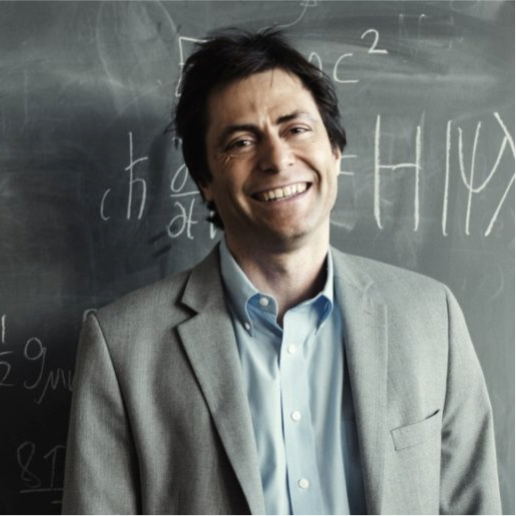
We've talked a lot recently about the Many Worlds of quantum mechanics. That's one kind of multiverse that physicists often contemplate. There is also the cosmological multiverse, which we talked about with Brian Greene. Today's guest, Max Tegmark, has thought a great deal about both of those ideas, as well as a more ambitious and speculative one: the Mathematical Multiverse, in which we imagine that every mathematical structure is real, and the universe we perceive is just one such mathematical structure. And there's yet another possibility, that what we experience as "reality" is just a simulation inside computers operated by some advanced civilization. Max has thought about all of these possibilities at a deep level, as his research has ranged from physical cosmology to foundations of quantum mechanics and now to applied artificial intelligence. Strap in and be ready for a wild ride.
Support Mindscape on Patreon.
Max Tegmark received his Ph.D. in physics from the University of California, Berkeley. He is currently professor of physics at the Massachusetts Institute of Technology. He has played an important role analyzing data from large-scale structure and the cosmic microwave background. He is the author of Our Mathematical Universe and Life 3.0: Being Human in the Age of Artificial Intelligence. He is a co-founder of the Foundational Questions Institute and the Future of Life Institute.
Click to Show Episode Transcript
0:00:00 Sean Carroll: Hello everyone, and welcome to the Mindscape podcast. I'm your host, Sean Carroll. And today is one of those episodes that brings you a guest who people have been hoping and expecting to get on the podcast for a long time; that would be Max Tegmark, cosmologist and physicist professor at MIT. I've known Max for a long time. In addition to being a physicist, he's also one of the co-founders of the Foundational Questions Institute, which we talked a little bit about with its other co-founder, Anthony Aguirre, a few podcasts back and also a co-founder of the Future of Life Institute, as well as a well-known author and public speaker. Max sort of made his bones, physics-wise, by studying the large-scale structure of the universe, and the cosmic microwave background. He's worked with some of the largest and most important experimental projects as an analyst, as a theorist, taking the data from these projects and asking what we can learn about the universe. But his interests are very broad; he's worked in the foundations of quantum mechanics and most recently he's been interested in artificial intelligence. His most recent book is called Life 3.0: Being Human in the Age of Artificial Intelligence, and we will talk a little bit about his most recent work in creating artificial intelligence that acts like a physicist.
0:01:12 SC: But his previous book was called Our Mathematical Universe, and that put forward a theory of a very very big multiverse; a bigger multiverse than most cosmologists ever think about, one in which all mathematical structures are somehow real. So that will be the focus of most of today's conversation, working up to from our universe to the multiverse, why you would think that, what it all means. The big cosmic questions that we like to dig out teeth into here at the Mindscape podcast. Remember, for those of you who don't know, there is a web page, preposterousuniverse.com/podcast, and there you can get show notes for all the episodes, including complete transcripts. You can also click on a link to go to Patreon and pledge money when every podcast comes out. The people who pledge money on Patreon get episodes without any ads in them, and once a month they get to ask questions that are answered in an Ask Me Anything episode, so it's a worthwhile way to spend your $1 per week on the Mindscape podcast. And whether or not you're a Patreon supporter, I'm always very grateful for all the nice comments, all the reviews, all the ways in which people have told me that they really enjoy the Mindscape podcast. So, let's go.
[music]
0:02:33 SC: Max Tegmark, welcome to Mindscape podcast.
0:02:40 Max Tegmark: Thank you. It's a pleasure to be here.
0:02:42 SC: Now, of the many things you're known for, the multiverse is certainly one of them. I just wrote a book on quantum mechanics in many worlds, so one of the very first questions I get I'm gonna give to you. What is the multiverse? What is the relationship to many worlds? What are all these words really mean?
0:03:00 MT: So before we start talking about other universes, let's be clear on what we mean by "our universe". We don't mean all of space. When we in astrophysics say "our universe", we actually just mean the spherical part of space from which light has had time to reach us so far during the 13.8 billion years since our Big Bang. And it's huge; it has 10 to the power of 78 particles in it, and huge numbers of galaxies, but certainly not infinite. And if you call that our universe, or observable universe, and space goes on for beyond that, which is what the simplest theory of what created our Big Bang predicts, the inflation theory, then there are other universes just like it. I call that Level One.
0:03:44 SC: So, but other universe in that sense it means more of the same, but further away out of contact with Earth.
0:03:50 MT: Exactly. There just could be other people living on some galaxy 100 billion light years away. When they look around, they don't see us because light from us hasn't reached them, and someone might say, "Oh, that theory you have that Earth exists with Sean Carroll is just philosophical BS."
0:04:06 SC: Unprovable, yeah.
0:04:08 MT: But it's all part of the same space. And then if you take seriously this inflation theory, the simplest versions of them actually predict that space isn't just big, and much bigger than we can see, but actually infinite. And moreover, that the distribution of stuff in space started out kind of randomly from place to place, which means that no matter how unlikely it is that the particles would have started out in such a way that Sean Carroll and Max Tegmark would come along 13.8 billion years later and have this conversation, the probability isn't zero since it happened. And that means if you roll the dice again an infinite number of times, it will happen again somewhere else. And you can even crudely estimate how far you have to go until you get to the nearest copy of this universe, it's about a googolplex meters, where a googolplex is one with a googol zeros, and a googol is one with a hundred zeros after it.
0:05:11 MT: It sounds pretty crazy, but actually much less crazy that what you'd conclude if you take this inflation theory seriously, because it actually says that there are parts of this space, most likely, which aren't just really far away and so we can't get there, but where the laws of physics you would learn in school will be the same, but what would you learn in history class would be different, because basically the particles started out differently so things happened differently, but where you might actually learn things in physics class too. I call that a Level Two multiverse, and the way you might get convinced to take that seriously is if you both trust people like Alan Guth and Andrei Linde who say that this inflation thingy happened, and you also take seriously the idea that the laws of physics might have more than one solution for what a uniform space can look like. We know that's the case for water; it can be solid ice, or a liquid water, or steam. String theorists say the space we live in might be like that too, except there might be more than three ways... Maybe more than a googol ways it could be...
0:06:24 MT: This is a pretty general phenomena in physics. If you have some complicated equations, they can have multiple solutions. And inflation is such a violent process that it doesn't just create a lot of space, but it's really sort of jostled things around so violently that it's quite possible that it created not just lots of one solution for how space can be, but huge amounts of many different solutions and we might be tricked into thinking that the solution that we live in is the only kind, because it's all we ever see. But that will be just as dumb a conclusion as if some fish in the Caribbean concludes that all water is in liquid form because it's all it's seen. If it swam up to Greenland, it would see icebergs and realize that, "Hey, there's more." So that's level two, multiverse. It's more diverse.
0:07:08 SC: Actually, let me dwell on something about the level one multiverse, because I think it does get glossed over a little bit. Level one multiverse, let's just imagine space is infinite. The universe is open and this is something that cosmologists have contemplated ever since we've been doing the expanding universe, right? And just from that one idea, it more or less follows that there's an infinite copy of people like you. [laughter]
0:07:33 MT: Almost, I would say.
0:07:34 SC: Almost.
0:07:34 MT: You could still have an idea which Newton and Einstein originally flirted with, that maybe space went on forever, even Euclid thought 2000 years ago. But there was only stuff in a small region of it, and then the rest is just as infinite void where nothing was happening. But inflation torpedoes that idea because it says actually all of the space is created with stuff in it, and it's also not just the same thing piled over and over again, but it starts out kind of randomly in such a way that all initial conditions get realized somewhere. So I agree with you, if you put together these two ideas, infinite space, and that you do all the possible initial conditions for them, then you're really forced into this conclusion that everything gets realized, which is quite shocking [laughter] when you first contemplate it. And because long before, if you trail onto space, we get to that other conversation between Sean Carroll, and Max Tegmark a googolplex meters away, but you get the other ones where you're interviewing Max Schmegmark and Max Pegmark about his golf playing. And also some other variations of our lives, and some people really don't like that.
0:08:49 SC: And this is a conversation that could've been had in the 1920s, right? This is not like modern super-duper crazy cosmology. The idea that open infinite universe could have been taken more seriously years ago.
0:09:00 MT: Yeah. And it was pretty violently attacked even before that. Anyone who listens to this, if you go to Rome, go to Campo de' Fiori and there's a statue there with Giordano Bruno who was burnt at the stake right there, the year 1600, for talking about an infinite universe, with other solar systems and so on.
0:09:21 SC: For doing a bunch of things including that. There's historians who wanna nitpick about exactly the reasons why...
0:09:28 MT: Sure.
0:09:29 SC: His tongue was cut out and he was burned at the stake, but that was definitely one of them.
0:09:32 MT: But I would argue that [chuckle] there were no scientific claims who should get burnt at the stake.
0:09:39 SC: Okay, but good. So level one already has some weird philosophical implications and this many copies of me. And level two is that there's also many different versions of the local laws of physics far away.
0:09:50 MT: And just to add to that, I think it's important to remember that the things that we were taught to be laws of physics as fundamental, the more we study them, we realize that a lot of those are actually not fundamental and information is more just part of your address, in the sense that if you have a t-shirt one day which has the Theory of Everything on it, which hopefully you, Shawn will discover one day, right? [chuckle] Would you expect to have a big eight on there? And if I ask you, "What's the eight for?" and you're like, "Well, eight, that's the number of planets in the solar system." That will be pretty weird, because you'll be like, "Max, there are all the other solar systems out there too, with two planets, five planets." So the eight isn't telling us anything fundamental about space. It's telling us something about our address in space.
0:10:41 SC: Right. You don't think that the average temperature of the air on earth is a fundamental quantity of nature.
0:10:45 MT: We don't.
0:10:46 SC: And environmental.
0:10:46 MT: We don't, but we did think for a long time that the number 1836 was kind of fundamental. That's how many times heavier the proton is than the electron, right? Oh, fundamental. And then a lot of our string theory friends tell us... Actually they have a googol different solutions and in one of them, it's 1836. They can probably come up with another one where that number is 2019. So maybe that's also just part of our address. In fact, there are, so far, 32 pure numbers that we've found. Dimensionless numbers with decimals that seem to describe everything we, in theory, can try to predict about our world. Maybe they're all just part of our address also.
0:11:33 SC: Yup. All right, good. We need a level three multiverse then, clearly.
0:11:37 MT: Yeah. So this one comes not from studying the very big, what's out there in our physical space, but from studying very small things. The elementary particles they were all made out of, where in 1950s, this Princeton grad student, Hugh Everett, came up with this incredibly radical suggestion. Earlier, people had already realized that electrons, for example, and other subatomic particles, seem to be schizophrenic in a way, in the sense they can be in many places at once. And people had really bent over backwards to try to explain that away. For example, the Danish physicist Niels Bohr said basically, there are certain questions you're not allowed to ask about nature. [chuckle]
0:12:22 MT: As a Swedish person, I am honor-bound to always make fun of the Danes and I think Hamlet was on to something when he said, "There's something rotten in the state of Denmark", but Everett said, "No, no. That's BS. What's actually going on is, sure, these particles can be in several places at once. But that means that since we are made of those particles, we can also be in several places at once." And then instead of just freaking out and having a stiff drink, he continued thinking through what it would feel like if it were really were that way. And he realized that, "If I make a measurement of a particle that's in two places at once and in advance, I've decided that if it's here, I'm gonna go for a drink, and if it's in the other place, then I'm gonna watch Netflix instead.
0:13:10 MT: What that's gonna feel like is that there are gonna be two different versions of Max now and one has a drink one watches Netflix and they're gonna be unaware of each other and it's gonna feel to them, that there was just something random that happened, they discovered the particle was this way or that way, and then life went on and we actually have known for many years, that things seemed to be kind of random in quantum physics and he said that is the explanation, Everett said randomness is just the way it feels subjectively whenever you get cloned, so to speak and people still argue fiercely about this as you know...
0:13:48 SC: I do know, yes.
0:13:49 MT: Over a hundred years after quantum mechanics...
0:13:50 SC: Mindscape listeners know.
0:13:51 MT: But I think it's important to realize that this weirdness is so fundamental it has nothing to do necessarily, even with quantum mechanics, 'cause if we just go across the river here to the MGH Hospital, they have a cloning device purely classically, where they just sedate you and then they make and actual copy, they put all these atoms together in exactly the same pattern and then, you're told in advance that the next day, one of you is gonna wake up in room one and the other copy's gonna wake up in room two, the next morning both of the Seans wake up and they go out of the hospital room and look at the number on their door, right. What do you predict that you're gonna experience? Do you predict that you're gonna experience a one or a two, what would you say?
0:14:40 SC: I would say it's 50/50, I have an argument for this but you know.
0:14:42 MT: It's gonna feel random to you though right?
0:14:44 SC: Yes, exactly.
0:14:45 MT: And there's gonna be nothing you can do to predict your subjective future experience, although the doctors would claim there was nothing random that actually happened, all they did was cloned you. I think personally that Everett was onto something here, it's quite likely that the, yet again, our reality is really bigger than we thought and that there is nothing truly random actually happening in nature and the things that seem random come from us having been cloned in this sense. Ironically, even if this probably sounds even weirder than the level one and level two, when you look at the kind of diversity you get in this, which I call the level three multiverse, it's actually smaller, or no bigger, than the other ones it's just that you get all of the same parallel worlds sort of all over again in a different way.
0:15:35 SC: You get them much faster in some sense, I mean it's happening all the time in this room, right, the universe is just branching off in pieces.
0:15:41 MT: Yeah and in some way you're also more connected to some of those parallel branches because if you are upset that you got a parking ticket, you might realize that there's another you that actually was identical to you up until maybe ten minutes ago and quite recently only branched out so you can take more solace maybe in the fact that...
0:16:03 SC: Does that make you feel better, really?
0:16:04 MT: Ah it takes the pressure off to get things right all the time.
0:16:08 SC: It doesn't make me feel any different but for better or for worse, but you know.
0:16:12 MT: It does, I reflected a lot on this before my first son was born 'cause I was hoping things were gonna go well and then I started thinking I have to try to align my emotions with my scientific views because what does... I even mean when I say I'm hoping, if there are parallel universes where things are gonna go great and things where they're gonna end in tragedy, right? So then maybe what I thought maybe what I'm really hoping is that I'm gonna be in a parallel universe where things go well with this birth but then I realized, no that's stupid because I'm gonna be in all of them.
0:16:47 SC: Yeah, exactly, there'll be a version of you in all of them.
0:16:49 MT: Maybe I mean that I hope the probability of, I hope that in most universes it's gonna go well but that's also BS because if you're really smart that's just a number you could calculate from quantum mechanics, what fraction of the worlds it goes well, so how can I hope for something, for some fraction being large, that's like saying "I hope that pi is bigger than three" or something, either it is or it isn't.
0:17:11 SC: But this is just a free will question, these would all be questions in a deterministic Newtonian universe where you just don't know what the future holds. Is there still the possibility of hope?
0:17:19 MT: So, I think in the end I ended up kind of where you are, it feels pretty cool to be in this universe and sometimes it's useful to have those heuristics like hope even if you know you're kind of on thin ice when you say things like that.
0:17:37 SC: Hope comes from imperfect information.
0:17:40 MT: Yeah.
0:17:42 SC: Okay, so that's level three that's the Everettian multiple worlds of quantum mechanics and that's separate from the level two cosmological multiverse where things are different and the typical speculative theoretical physicists stops at three but you will not be stopped, you're gonna go on, you're gonna say that there's a level four.
0:18:03 MT: That's right. So, of course, most people didn't even go to level one, Giordano Bruno got burned, and not just on the job market, but literally. That's become more normalized since, now that we can see so far with our telescopes and since inflation has caught on, even level two has gotten a bit more normalized and moved from the ridicule to taken seriously, albeit controversial. Even level three, it's interesting to see how it's gone from being first utterly ignored to being violently attacked to being actually regularly voted as one of the top interpretations if you talk to people who study quantum foundations, so it's sort of respectably controversial in the sense that people argue about it at conferences rather than just in bars, right? The level four on the other hand...
0:18:57 SC: Sorry we get... Now you've raise a whole other issue which I've gotta get right. So I, personally, would put a greater possibility on level three really existing than on level two, I think that there's better reason to believe in the Everettian multiverse than there is in the cosmological multiverse and I maybe very roughly 95% for Everett and 50% for the cosmological multiverse, do you have different credences yourself?
0:19:20 MT: With, at the risk of being boring, I think I would agree with you on this because there are fewer assumptions behind the Everettian one, really all you need is to assume minimalism, it's just the shorting of equations, of how they are in my office with no little footnote to the ifs and buts and this is not valid when someone observes it which we're not gonna define for you, it's just equation, boom. Whereas to get the level two multiverse you really need to assume both inflation and some fundamental string theory that has multiple solutions like string or loop quantum gravity and neither of those two are things that we are... That we should be anywhere near 90% sure of at this point.
0:20:02 SC: Okay, good, just checking, so we can get on to level four now.
0:20:05 MT: Yeah, so level four this is an extremely unpopular kind of multiverse which...
0:20:11 SC: This is your chance to convince me.
0:20:13 MT: Very few people who take it seriously?
0:20:16 SC: You have 100,000 listeners ready to be convinced.
0:20:18 MT: Yeah. So the idea here is that... So the way I got into this was, first of all by just being fascinated by the effectiveness of mathematics in describing the physical world so well, and many people in the physics community, especially theorists, like you, Sean will say, our universes is really accurately described by mathematics, approximated at least maybe it's even exactly described. But then you have to ask, what is the difference really, between being perfectly described by math and just being math. After all, mathematicians they also have this language of mathematics that they use to describe mathematical objects, Like the cube, sphere, like some Calabi-Yau manifold, whatnot. And what modern mathematicians have increasingly done is trying to strip out everything but just this brute formalism where they just described different kinds of mathematical objects. You can make a type of mathematical family tree, which I had fun doing in my book, all these different mathematical structures.
0:21:35 MT: Here are the integers. Here are the real numbers, the complex numbers, here is [0:21:40] ____, here is this three-plus one-dimensional pseudo money and manifold, you can go on putting things with all sorts of weird names, but, they're all the fundamentally the same kind of thing. Things that can be described purely abstractly, with mathematical symbols and no human sort of baggage. And if you look at the math that way, at math space in that way that there was this very disturbing question, which is why would, and Stephen Hawking's words, Stephen asked, why would God breathe fire into one of these equations and make a universe for them to describe and not others? Or what breaks the symmetry? Why is this particular one that's supposed to describe our world different from all the others? So the level four multiverse comes from this very radical conjecture that actually, there is none of that math metaphysics.
[laughter]
0:22:41 MT: There is no special fire breathing needed or whatever all of these mathematical objects exist in exactly the same sort of way. And we just happened to be living in one of them. One of them that's complex enough that parts of it can feel subjectively where what's going on there and so studying physics or to just break it down to plain English. What it's really saying is that we live in a mathematical structure, a mathematical object, which is something which has only mathematical properties and here... Are you have to stop and say well, that sounds completely nutty. What do I mean? You see the moose here?
0:23:24 SC: We have a moose on the table in front of us, a little moose doll.
0:23:25 MT: Yeah, I was given a gift today.
0:23:27 SC: Not a true moose.
0:23:29 MT: What prop... What do I mean? This has only mathematical properties. [laughter]
0:23:34 SC: Look at it's...
0:23:34 SC: It's made of cloth it's has colorful garb.
0:23:37 MT: It's squishy a little bit blue and moose like. [laughter] Those properties, I just described don't sound very mathematical at all. But when we look at it, Sean through our physics eyes, we see that it's actually a blob of quarks and electrons. And what properties does an electron have? It has the property, minus one, one half, one, and so on. We, physicists have made up these nerdy names for these properties like electric charge, spin, lepton number. But it's just we humans who invented that language of calling them that, they are really just numbers. And you know as well as I do that the only difference between an electron and a top quark is what numbers its properties are. We have not discovered any other properties that they actually have. So that's the stuff in space, all the different particles, in the Standard Model, you've written so much nice stuff about in your books are all described by just by sets of numbers. What about the space that they're in? What property does the space have? I think I actually have your old nerdy non-popular, right?
[laughter]
0:24:50 SC: My unpopular book, yes.
0:24:52 MT: Space has, for example, the property three, that's a number and we have a nerdy name for that too. We call it the dimensionality of space. It's the maximum number of fingers I can put in space that are all perpendicular to each other. The name dimensionality is just the human language thing, the property is three. We also discovered that it has some other properties, like curvature and topology that Einstein was interested in. But those are all mathematical properties too. And as far as we know today in physics, we have never discovered any properties of either space or the stuff in space yet that are actually non-mathematical. And then it starts to feel a little bit less insane that maybe we are living in a mathematical object. It's not so different from if you were a character living in a video game. And you started to analyze how your world worked. You would secretly be discovering just the mathematical workings of the code, right?
0:25:52 SC: Yeah, that's an intelligently designed environment. But yes.
0:25:54 MT: It is. Yep. I guess we can talk about the probability that we are living in a simulation also, later, but if that is in fact the case, that we're living in a mathematical object, then what about the other mathematical objects that happened to also be well defined? Why should we get on our high horses and say they can't exist as much as ours can, maybe they're mostly stillborn because they're not complicated enough or, whatnot. But you could say the same thing even about those other less controversial kinds of the universe. Anyway, so that's the level four multiverse, in a nutshell, it's the... It's simply the... It's math space, space of all mathematical objects that exist. And if this is true, the first prediction it makes is that all the properties of our universe even the ones we haven't yet been able to understand, to do with intelligence and consciousness for example, should ultimately also succumb to mathematical description.
0:26:57 SC: But just to be clear, maybe it sneaked under the radar there. We can imagine the space of all mathematical structures but you're making the extra statement that they're all equally real, and we just live in one of them. Is that fair?
0:27:10 MT: That's right.
0:27:10 SC: That's the level four multiverse.
0:27:11 MT: That's right. I really wanna strip out as much human baggage as possible from this and that saying that something is real or not. What does it even mean?
[laughter]
0:27:23 SC: I think it means something.
0:27:25 MT: Well, it means something if you have this sort of very pagan kind of idea that this moose is real 'cause it's made of stuff that's real, right? But then we come and looked as physicists again and just made of all the stuff is just these elementary particles, and what are their properties? They're all mathematical so you can... What is there here really beyond all these mathematical properties? I've yet to be convinced. I have a lot of... Usually, when people start trying to persuade me of things beyond that, it starts to feel very much like some sort of new agey thing. They just want there to be something fluffy and the fuzzy and non-mathematical 'cause they don't think mathematics is cool enough or they say things like, "Oh, I can't believe it's just mathematics." I object to that derogatory use of the word "just".
0:28:25 SC: Sure. I will definitely go along with that, but I do wanna distinguish... Maybe it should be phrased as a question, can we sensibly distinguish between the idea that our universe is just a mathematical structure, and that all mathematical structures are equally real, no matter what you might mean by the word "real", but at least there's no difference in the level of reality between ours and others, otherwise it's not really a multiverse.
0:28:51 MT: You're right, there are two separate questions there. First of all, does our universe have some non-mathematical properties or not? We don't know yet. If you had gone back 400 years and had Galileo on your podcast then it would have seemed, "Duh, of course, it has non-mathematical properties." 'Cause the only stuff that we could even predict at all with physics was motion. Galileo could throw a hazelnut then a grape and he could tell you that they're gonna move in this parabola-shaped Y = X squared. But he couldn't tell you why the grape was green and the hazelnut was brown 'cause that seemed non-mathematical. He couldn't predict why the grape was soft and the hazelnut was hard because that seem non-mathematical. It was to do with the mysterious nature of stuff, right? But then we got Maxwell's equations, which helped us understand light and colors. And even that part of reality succumbed to the mathematical description. And then we got quantum mechanics which explains now why the grape is soft and the hazelnut is hard. And we've gone from having a situation where the whole world seemed just mostly magical and the only thing we could predict about it was motion mathematically to a situation where we can actually apply math to almost everything except maybe intelligence and consciousness. They're the final holdout.
0:30:11 SC: Well I did have a podcast interview with Philip Goth who is a panpsychist and the name of his book was literally "Galileo's Error" 'cause he says that Galileo made an error in making things too mathematical. Now, we'll plug your book "The Mathematical Universe", which says the opposite, so people can buy both books and decide which one is more persuasive.
0:30:29 SC: I changed the title in the last second, from "The Mathematical Universe" to "Our Mathematical Universe", because I thought, saying "The" would be very arrogant. It's like you say, "The Solar System", it sort of implies that we're the only one, right?
0:30:41 SC: That's true.
0:30:43 MT: Whereas if you think seriously that there could be other universes, this is ours.
0:30:46 MT: Okay, wait. But we got distracted, because you were making a sales pitch for something I already agree with, namely that our universe is mathematical. But what about the others? The reality level of the others.
0:30:56 MT: How do you make this jump from saying there is... So there's one mathematical structure, which happens to be existing also physically, that's this one. How do you then get to the much stronger conclusion, that all the other mathematically ones also have a physical existence? So the first part, I call it "The Mathematical Universe Hypothesis", which is that our external reality out there, which I believe exists and will continue to exist even if we all died, that it is purely mathematical. And I... Sorry, I call that the external reality hypotheses that exists, and then I have an argument for why it should be mathematical, but then there's a separate logical step which you raise here. How do you get from that to the idea that actually all the other ones also exist? I probably shouldn't bore you with getting into that too much in this podcast, but what I argue in the book is you basically just have to add a whole... You can take some mathematical structure, and just study it very carefully. What are all the properties that it has, right?
0:32:07 SC: Mm-hmm.
0:32:08 MT: And you can say, this here is this thing, it's gonna be self-aware, it has information processing like this, and if you're really smart, you can figure out how AI works and consciousness and whatever. You could figure out even how the parts, some cells, where parts of this will subjectively experience themselves in there. And you might find one that looks just like ours, you might find some other ones and then you come to this question of, if you're gonna claim that this one here that corresponds to our universe exists physically also, and some other one doesn't.
0:32:46 SC: Yeah.
0:32:46 MT: What do you actually mean by that? You're positing that there is some additional property that this has which has nothing to do with the math, which is whether it exists physically or not somehow. But there is... This is nowhere to be seen in the math. It's a little bit like if somebody... You try to convince somebody that they have a soul, and they ask you, "Okay, does my soul weigh anything?" "No." "Can I measure its existence with these particle detectors?" and you say, "No." And then they ask you, "Well, does the soul actually push my particles around and make me act differently somehow?" And you're like, "No, the soul has no effect at all on your particles, but it still exists." Right? Then wouldn't you say that you're making yourself a little bit of vulnerable to Occam's razor?
0:33:35 MT: They could just say, "I'm gonna take everything you say Sean and just shave off the soul part 'cause it doesn't have any additional explanatory value." I feel that that... So just that someone might say that the soul there is like a little fairy dust that's been sprinkled on but that it doesn't really add anything explanatory. You could say the same thing about this idea that there's this extra magical property that a mathematical structure has called physical existence, but it doesn't have any effect on the mathematical relations it hold within it, at all. And I can ask you, "Well, does that say anything about whether these two lines that are parallel are gonna cross or not?", and you say, "No." "Does it have any effect on whether this self aware object here is gonna experience X or Y?"
0:34:21 MT: You're like, "No." So it has no effect on any other relations in there. That, to me, also, is just as vulnerable to Occam's razor now, 'cause it sounds like just philosophical BS really that has no consequences on any other mathematical relations. And I would just assume... My guess is that we, it is just philosophical hog-wash and we should just accept the fact that regardless of whether something is a computer simulation or exists in some other way, all that matters about it is how the, what the relations are within it, that's what determines how it feels like to live in it. So there you have it basically, a mathematical universe, and if you... This leads very naturally into this question about whether we're living in a computer simulation, also, because if... You and I were arguing about whether we're in a simulation right now, and I'm like, "No, there's no way, because this moose here, it's real."
0:35:28 SC: Feels real, right.
0:35:29 MT: It's physically real. And if we were in a computer simulation, the moose, would not feel real. How would you respond to my argument?
0:35:37 SC: Yeah, that's a dopey argument, right.
0:35:40 MT: I'm claiming that my argument is basically the same argument, but the way I experience the moose, Max, the computer game character here, has only to do with what the mathematical properties are of this computer simulation, has nothing to do with whether it's being simulated on a Mac or a Windows machine or a Unix machine, it's just internal mathematical properties of this simulation that matter. I would say it's the same with the mathematical structure. All that matters are the relations in it, not whether some philosopher says that it's sort of made of real stuff or not.
0:36:21 SC: So, I certainly delete, forget whether I buy it or not, that's irrelevant, but I understand the argument that it is absolutely a simpler idea to imagine that all mathematical structures exist, than to imagine that we can conceive of all mathematical structures and we are one of them. There's a lot of information that goes into pinpointing which one we are, which you're happy to get rid of. But then, I think, and at the risk of getting a little bit technical here, it would seem that to make sense of this idea, you need some kind of way of comparing the different kinds of universes, the different kinds of mathematical structures. There's so many that look like this, some many that look like that. And I would also think that once you had that way of comparing, there's far more universes that look like ours, and then explode into chaos a second later, then to keep up this very, very specific obeyance to the laws of physics. So, doesn't your theory make a prediction that we're all gonna cease to exist within a nano second?
0:37:24 MT: As a... Both my brain would. That's a very good question. I think the answer is no, for reasons I'll explain in a sec, but first of all, I'm totally open to the possibility that this idea is wrong and I'm very interested in testing it in various ways. I think to me, this idea is more of an inspiration for a research program to try to find more mathematical regularities 'cause we're never gonna find any if we don't look for them, right? If we say consciousness is off limits because it's not mathematical, we're not gonna discover any equations that might actually help explain and say. In terms of your question about whether the most generic thing we should expect is just random weird stuff taking place? I have a suspicion that just like in, at least in cosmology, when we study infinite spaces and so on, we stress out a lot about the so-called measure problem, to what... Which things exists sort of more often or to a greater extent than others, but there is something very similar to that unsolved problem here, and I think it has, it's gonna have a lot to do with complexity. In some sense, maybe very simple mathematical structures that are simple to describe get more weight. If you were just randomly bored and simulated different universes on your future super computer, the simpler ones would get a lot more attention than the more complicated ones, because they could be evaluated much faster, right?
0:39:06 MT: I sometimes wonder, this is a very quarter-baked idea, but if the reason why our universe seems remarkably simple when you look at the fundamental laws might have to do with that. That simplicity is very much favored and if that's true, then we shouldn't just expect that the past has been simple, but we should also expect the future should be kind of simple because it's much more complicated to write down... To define a simulation algorithm or a mathematical structure, where suddenly a pink giraffe appears randomly in my office right, then to just specify the standard model that we have today where that's probably not gonna happen.
0:39:46 SC: I'm worried that you are... I mean sure, as far as that goes, yes, if there were an additional principle that would somehow favor simplicity, you might be able to account for our universe. It's simple enough, it's a little complicated, but a simple enough, you might hope for that. But I do worry that that's another metaphysical principle that you are just trying to avoid mere moments ago. You've gone away from the pure pristine beauty of everything mathematical exists. That's all there is to it.
0:40:14 MT: So first of all, I try to be very humble. So I'm not saying I believe that, nowadays universities exist. My job as a scientist isn't to belief stuff. I'm happy to make bets though.
0:40:25 SC: One has credences. One's a good basis.
0:40:27 MT: And second, whether you feel that something is frivolous, and full of extra assumptions are complicated or not, depends a lot on what you mean by simple. Many people criticize any kind of parallel universe, as being wasteful because they waste a lot of atoms. "I don't buy this idea that space is infinite or bigger than we can see because, oh my gosh, there's all these extra atoms." A different perspective is that simplicity shouldn't be measured by how simple the mathematical equations are. It turns out it's much easier to write down some physics equations than to actually give us this big space and then to write inflation that makes a really small space, which is exactly as big as we can see, and then magically stops.
0:41:13 SC: Yeah.
0:41:13 MT: And it's the same thing we've seen in quantum mechanics, where it turns out to be much easier to have this Schrodinger equation that just has all these parallel worlds than to add in a bunch of extra stuff that's supposed to get rid of all the parallel worlds. And I feel in the same sense that the level-four multiverse is actually simpler. We were joking about a t-shirt earlier when you write down The Theory of Everything, right? So if you did that 2000 years ago, oh boy, would you have to have a small font. You'd have to say, "Well, now we're living in a system as a blah-blah-blah. And then this is what the garlic looks like, this is what a watermelon and this is copper, and the periodic table." If you just fast forward a little bit, they could... They wouldn't have to specify the whole periodic table, they could just write down this equation for QCD, quantum chromodynamics, and three numbers and from them you can compute the principle, the whole periodic table and books full of numbers about how atoms shine light in different colors and stuff.
0:42:11 MT: So more simplicity now and then I think by going to the level-two multiverse, you don't even have to write down numbers like that... Proton, electron, mass ratio of 1836 because that doesn't have to go on the T-shirt. It's your address. You find out if you wanna know where you're living, you go measure that, now you know what part of the level-two multiverse you're in. And the level-four multiverse economizes even more, because without it, you have to put on your t-shirt, at least the equations for string theory or a loop quantum gravity, or whatever the correct quorum gravity is. You have to put that. In the level-four multiverse, you could just wear a black t-shirt with nothing on it because all of the mathematical structures exist and you can try to catalog with a future computer program, exists and that's kind of all there's to it.
0:43:10 SC: I don't want to dwell on this too much, but it sounds a lot to me like Jorge's library, right? Jorge said, "What if there's this library that literally contains books with every possible sequence of symbols and somewhere in that library, are all the works of Shakespeare and the bible and for that matter, every book ever written in the future, right? The problem is finding them. The problem is that the card catalogue is the same size as the library. Most of those books are utter nonsense.
0:43:36 MT: Yeah, and there's another problem, there's really no structure in it. There is no sense in which simple books are more important than complicated books. So the average generic book is just pure garbage. What's so different about mathematical structures is it's actually very hard to write down the system of axioms and the theorem [0:43:55] ____ that are even consistent at all. So the great mathematician David Hilbert, one said that mathematical existence is simply freedom from contradiction. And it turns out to be it is really hard to do that. So there's some people like to say that, "You know something exists if you kick it and it takes back."
0:44:15 SC: Yeah. [chuckle]
0:44:16 MT: Mathematical structures are a lot like that. If you... If Plato, for example was really interested in regular 3D shapes and he discovered that there are five of them. They're called the Platonic solids the cube icosahedron, etcetra, right? And no matter how hard he tried, he couldn't just make up a sixth one, there just isn't one. He could make up names for them to... But he couldn't make up more. So in that sense, mathematics kind of kicks back. He discovered the dodecahedron, made up of 12 pentagons and thought that was so cool that they didn't tell anyone. They thought it had magic powers and you'd see it sometimes in art museums in the corner of some paintings. Discovering that shape was a little bit like when we discovered the planet Neptune. It's felt like it was out there all along and how we found it. So this math space is much more interesting than Jorge's library in the sense that there's a lot of stuff in it but it's... But that's actually not the case, it just everything exists. It's not like some people sometimes criticize Social Sciences for being very loose and loosey-goosey about things.
0:45:41 MT: If you just take some random mathematical structure and just add one more axiom to it often, like pops the balloon and the whole thing just collapses to nothing.
0:45:48 SC: So would it be... You're leaning on simplicity quite a bit. And you've also alluded to the idea that everything that we do see in our physical universe is just running on some computer somewhere in super advanced civilization, is that simpler or more complicated?
0:46:04 MT: I would actually bet against the fact that we're living in a simulation, not because I think it's impossible but because I think it's less likely. So Nick Bostrom, Bostrom, as we call him in Swedish, popularized this so called simulation argument. And what he basically said was, "We're building ever better computers. One day, we'll be able to have much more simulated minds than real minds. So therefore, we should expect ourselves to be a simulated mind." I claim that that argument is actually flawed in the last step, and you can see it sort of start falling apart already by just taking it one step further, suppose you agree with it. So we're simulated. There is some sort of basement universe with actual physical stuff, but we're not in there we're in one of their computer simulations. Nothing prevents us from making the same argument again, in our simulated world, we're gonna have more simulated computers, and they're gonna do doubly simulated minds and they'll outnumber us. So therefore, we're doubly simulated. And that we can do it again. We're tripoli simulated. Now you're simulated a trillion times, are you getting a sinking feeling at this point?
0:47:21 SC: [laughter] Well, I mean, go ahead and finish the argument. Is it just that we should be infinitely simulated? Is that the argument?
0:47:32 MT: That's what the simulation argument logically implies that we're basically infinitely simulated, which already feels a little bit fishy. And I think...
0:47:39 SC: I had the flip side of that argument.
0:47:41 MT: Uh-huh.
0:47:41 SC: Which is that according to that logic, the large majority of beings should be in the lowest resolution simulations, right? 'cause they're just the easiest to make, and it's a bit win win but empirically, we don't see. I mean, it's easy for us to make simulations. And so we could easily have lower resolution than what we see around us. Therefore, there's some logical flaw.
0:48:03 MT: I like that, too. And there was even an interesting paper a while back where they had tried to look for evidence that we're simulated, like finding weird noise and things.
0:48:10 SC: They didn't find any by the way, for readers out there.
0:48:12 MT: Yeah, but I think where the argument goes wrong, it's very interesting. What it's saying is you should have this basement reality. It has some laws of physics in it, where there's real stuff. And in that basement reality, if you can there make the argument that most minds in there are gonna be simulated. Sure, now you're onto something. Maybe but we don't know that we're in the basement reality, right? If we conclude in the end they were simulated, then we have immediately violated that assumption. And we have no idea in that case, what basement reality we're actually simulated in. So the thing that would matter, the only thing that could make this argument work is if you knew for sure that you were in the basement reality. So you can make some statements about what's actually probable.
0:49:03 SC: Yeah, but just to be very clear...
0:49:04 MT: And then you conclude...
0:49:05 SC: You're totally on board with the idea that maybe, maybe not everyone listening is on board. I'm on your side here. Life in a simulation would be just as real as life in the basement reality, right? I mean, you could simulate things. There's no substrate dependence. The people in the simulation could in principle, have all the hopes and dreams and consciousness that you and I have.
0:49:30 MT: I wanna be humble here. I mean, there are many people who think that there is more... There's something mysterious about intelligence. I'm thinking that it can only exist in biological organisms such as us that exists sort of in the basement reality but I am not to respond to that viewpoint. I call it carbon chauvinism. Yeah, the other you can only be smart if you're made of carbon atoms. I think it's in fact, exactly the opposite of carbon chauvinism is giving us the whole AI revolution. The opposite of carbon chauvinism is the idea that intelligence and consciousness are all about information processing. And it just doesn't matter whether the information is processed by carbon atoms in neurons and brains or by silicon atoms in today's technology or some other kind of particles in tomorrow's technology. And if you accept that, that it's all about information processing, then of course, an entity in a really good simulation, with the right kind of information processing is gonna feel the same way they would feel if that information processing happened on some other substrate right? And just like they will have no idea of knowing whether this simulated on a Mac or Windows machine or Linux machine, they will have no idea of way to tell whether they're actually simulated at all or living in an actual physical universe that has those laws.
0:51:02 SC: And so would you say, so not to put words in your mouth, tell me if this is accurate. It's possible, it's conceivable that we are living in somebody else's simulation. So among people who buy that there's the response that, "But I don't care." And there's a response that, "But I think it's unlikely for the following logical reason." It sounds like you're saying you think it's unlikely, but you would be interested in caring if you thought that it was likely.
0:51:28 MT: Oh, totally. I agree with all you said, I think we might be. I have not seen a compelling argument for why we are and I think there's a little bit of evidence, experimental evidence against since aren't... It seems like the quality of this one is a bit higher than it would need to be. Although sometimes when I pay attention to politics, [0:51:50] ____. But that aside, if you still have a lingering doubt that you are simulated, the advice is pretty clear. Just live a really interesting life. So, those running the simulation don't get bored and shut you down.
0:52:07 SC: How do we know it's interesting to them? This is the question. Also, let's flip it around...
0:52:11 MT: But you seem to be doing it right since you haven't been turned off yet.
0:52:15 SC: As far as I know. The thing about being in a simulation is they can always hit a save point and shut down the simulation and start you up years later. Who knows how many times that's happened in our lifetime, right?
0:52:27 MT: Indeed, indeed.
0:52:28 SC: The clock in our universe need not be the clock in their universe, this is where it gets scary. But let's turn it around, if the simulation theory is true, then there are super beings in the basement reality who have built a computer and are simulating us...
0:52:41 MT: And then the intelligent design that you despise so much is true.
0:52:44 SC: That's right, exactly. But then what about the other way around, what about us building simulations with AIs in them. I had Bellehany Mitchell in the podcast recently, a bit of a skeptic about AI's ability to reach human levels of intelligence, at least near term, not in principle but how close we are. What is your feeling to how close we are? 'Cause this is kind of what you're doing these days, you're doing more AI than cosmology.
0:53:07 MT: Yeah, my research group here at MIT, we've been doing AI research for the last bunch of years. And so if you look at minority papers, they're published in the AI journals and AI conferences.
0:53:19 SC: And by the way, is that more a response to the state of cosmology, or the state of AI or the state of Max?
0:53:25 MT: Oh, that's a good question. I think it's a little bit of both, the first two... Actually, ever since I was a teenager, I've been just really fascinated by the biggest questions. The bigger the better. And I remember thinking back then that the biggest mysteries of all were our universe out there and our universe in there in your head. So, I spent the first 25 years of my career around the outer universe, it's super exciting. And in recent years, I've just felt ever more intrigued by the second part. And I realized that not only that this pace is picking up so much that it's really fun now, but also that we physicists have a lot of contribute to that field in ways we can come back to... But to get me back on track, you asked a question before you asked that question...
0:54:15 SC: Sorry, what is your statement? What is your feeling about the state of the progress?
0:54:20 MT: What's more interesting than what I think is what AI researchers have said across the world in recent surveys, which is that most of them guess AI will succeed within the matter of decades, to get AGI, which is an acronym for artificial general intelligence, which means AI that can do all intellectual tasks at least as well as us. Super intelligence is something way beyond that, in turn. Are we gonna... Is that actually gonna happen? There's of course a lot of people who dismiss it and say, "Forget about it, it's not gonna happen ever, because it's impossible, because intelligence is something mysterious somehow," and all those people say it's about information or barking up the wrong tree. Maybe they're right. I would guess that they're wrong. And just as in any field, you have a genuine scientific controversy about how fast or slow things are gonna be, but I think it will be a mistake to dismiss it being... That it's possible. Sure. We have many embarrassing examples of scientists being over-optimistic of how quickly things are gonna happen. Remember when you and I were both starting grad school? Fusion was 40 years away.
0:55:38 SC: Oh yeah.
0:55:39 MT: It's still 40 years away.
0:55:41 SC: But on the other hand, we thought we'd never know the density of the universe.
0:55:46 MT: Yeah, now we know...
0:55:48 SC: Hard to predict the future.
0:55:49 MT: 1.68 times 0.7 squared times 10 ^ minus 26 kilograms square meters. And we've gone for about the age of our universe from arguing whether it's 10 or 20 billion years to arguing about whether it's 13.7 or 13.8, so that's progress. And so it's very dangerous to say something is impossible when you're on a planet with a lot of smart motivated people. For example, Earnest Rutherford, one of your physics heroes, father of Nuclear Physics, famously said that this idea of getting nuclear energy, moonshine. Do you know how long it took from when he said that in a lecture in London until Leos Lard invented the neutron chain reaction?
0:56:30 SC: It couldn't have been that long, a decade?
0:56:32 MT: Less than 24 hours.
0:56:33 SC: Oh, okay.
0:56:36 MT: So we have to be... The bottomline, I think, is you just have to have an open mind. It could happen in decades, it could be a bit sooner, it could be take much longer. But I think if it's a few decades away, that already makes it arguably even more urgent than thinking about climate change and your retirement because this is gonna be a much bigger deal, obviously, if it happens. If some human you don't like very much, think about your least favorite politician or unscrupulous business tycoon, has this and can use it to take control of earth and impose what they think is cool on you, you might not be so stoked about that, right? Alternatively...
0:57:20 SC: So sorry, just I don't want that to go by too quickly for the people out there. This is the worry of artificial general intelligence, that it will give either the AI itself, or the people controlling that AI some version of super powers that will be hard to control for the rest of us, and therefore we should worry a lot about AI gone wrong.
0:57:41 MT: That's right. And I think the reason I decided to start my AI book, Life 2.0 with a little fiction story was exactly 'cause of this. Hollywood gets us worried always about the wrong thing. There's always robots, 'cause they have to have something they can film, because it's a visual medium. Intelligence itself can confer a great power. Why is it that humans have more power on this planet than tigers? Is it because we have sharper claws or bigger biceps? No, it's 'cause we're smarter. And that means, of course, that if someone can amplify their intelligence with vastly stronger AI, it can confer enormous power on them, they can pretty quickly outsmart others on the stock market, and out patent them and out argue them on your blog and whatever and have a lot of influence.
0:58:32 MT: And is that good or bad? Well that entirely depends on how it's controlled and with what goals. I think like any technology, of course, AI will be a double-edged sword. People sometimes ask me if I'm against AI or for it? I usually counter by asking them if they're about fire, are they against it or for it? It's a dumb question. The interesting question is, what can you do to get the upside of fire but not the downside. It turns out there's a lot that you can do. That's why we have fire extinguishers and fire escapes and we teach our kids to not, blah, blah, blah, blah.
0:59:09 MT: That to me is the most interesting question, important question of our time, I think. How are we gonna harness this technology to make sure it gets used to cure cancer and lift people out of poverty and help life flourish like never before? Hopefully not just during the next election cycle but for billions of years and maybe not just on this planet, but throughout much of our universe. It could be awesome. On the other hand, you don't have to think too long to envision scenarios where it's not so great. For starters, you just again envision your least favorite politician using it to impose their will on everybody. You don't even have to get the things where the AI itself breaks out and takes over. Just a lot of people, you probably wouldn't want it to control you.
0:59:56 SC: So I had the following worry which I haven't really put in front of AI experts such as yourself yet. If it's going to be AI at all, it is gonna need the ability to learn and therefore to change itself. Isn't there an intrinsic issue with the idea of controlling it? You can tell it not to do something, but if it decides to change his mind, what are we gonna do about it?
1:00:21 MT: This is very active research in AI today, how to actually take deep learning systems which have learned stuff and where you don't really understand in detail how they work. Is there some way nonetheless by having a better architectures, who actually prove that they're always gonna do certain things. It breaks into three different nerd problems, which are all unsolved but which we all also face as parents, I would say. We want the AI first to understand our goals, and then adopt our goals, and then retain them. Our little babies first are too dumb to understand most of our goals. And then they're teenagers, don't wanna adopt our goals. But fortunately, our kids spend several years at this in-between period, where they're smart enough to understand our goals and hopefully malleable enough that we have a little chance at persuading them.
1:01:14 SC: They're weak enough that we can control them, yeah.
1:01:15 MT: Yeah, and that's what education... That's what parenting is fundamentally about. But even if we succeed in getting AI to understand our goals and adopt them, how can we make sure if they keep getting smarter, that they retain them, like, Philip and Alexander, you can see them on most pictures there when they were still small enough that they thought Lego was the coolest thing.
[chuckle]
1:01:44 MT: That was a big priority for them. Now, all those Legos are gathering dust in the basement because they're 18 and 20. If we create powerful AI that has this goal to really take care and protect humanity, we don't want it to become as bored with that as they got with Legos. So you would also like to have some sort of recursive algorithm where you're guaranteed that their certain goals, it's always gonna retain. And the interesting news here is that there's been a lot of technical progress actually. We put a big effort in five years ago where this future life is to bring together AI researchers and others at conference to talk about these technical questions and with a goal of mainstreaming that research so more of it would happen.
1:02:32 MT: And it's been very exciting to see actually how much is taking place. Stewart Russel for example, famous AI professor just has a new book out called "Human Compatible", where he actually doesn't just once again, lay out these challenges but actually proposes what he considers a cool solution. And the good news is, we still have time. Maybe we have a few decades to get this right. My message is, on one hand, you don't freak out and panic, but on the other hand, work hard on these technical questions now, so we can get the solutions when we need them, 'cause it might take decades. Rather than start working on them the night before someone switches on an AGI.
1:03:17 SC: Well, okay. We're running low on time but I do wanna give... This leads very well into you giving a little sales pitch for the work that you're doing now that I heard you talk about at the most recent Foundational Questions Institute, where you're training AIs to be theoretical physicists, to find the laws of nature by looking at big data sets. Not just find patterns, but really find quantitative laws. Tell us what that project is and how it's going.
1:03:42 MT: So we call it, my grad students and I, the Intelligible Intelligence Project. So, as you know, most of the progress in AI these days has moved away from this old paradigm where a human programs in the intelligence to a new paradigm where the computer just learns it itself, usually better, at the cost of you having no clue how the darn thing works.
1:04:08 SC: He just knows better than you do.
1:04:10 MT: And that's fine, if the stakes are very small, but if this is the thing flying your airplane, your Boeing 737 Max, or controlling the nuclear arsenal or something, you'd like to have a higher bar on really trusting the thing than just some dude telling you that I trained this on 15 terabytes of data, and it worked every time. And I'm quite convinced, actually that we can make a lot of progress. I think there's a common misconception almost like, people almost worship the mysteriousness of neural nets and say, part of the magic that makes them so powerful is that, they're inscrutable.
1:04:54 MT: I think that's not true. I think the power of them doesn't come from their inscrutability, but from their differentiability in nerd speak but in plain English, from the fact that they're basically a black box with a lot of knobs that you can continually tune until they work really, really great. So they can learn themselves from data. And what I would really like to see is where we combine the best aspect of this new paradigm of machine learning. We have the old school thing with little programs that, are human understandable and simple. We humans actually know it's possible 'cause we do it in our brains. If someone teaches you to play baseball or whatever, you get pretty good at it by training your neural network, but then if someone asks you, "How does the ball move exactly?" You can explain in English. You can say it moves in this shape called a parabola, here's the equation for it. And if we can do it, and if you don't think that intelligence is something mysterious, limited to bio-organisms, there's no reason we couldn't also develop AI tools that can do the same.
1:06:05 MT: We can first use this power of deep learning to figure out how to do stuff in an obscure unintelligent way. And then rather than stop at that point, do some additional things, try to simplify down to something that can be explained and understood. As you mentioned, we've had some progress doing this, through the simple physics problems. And if we could make more progress, I think there's a real hope here that we can get systems that we trust better. Trust for the simple reason that we actually can understand how they're working. The real threat from AI systems today is not that they're gonna turn evil like in some lousy Hollywood movie, but that they just turn very competent and accomplished things we didn't want them to accomplish because we hadn't fully understood them.
1:06:54 MT: Boeing put this very simple system into their 737 MAX things and they hadn't understood how it worked. Didn't work so well for them. Knight Capital had this trading algorithm that they hadn't fully understood, and it lost them 10 million dollars a minute. Kept going for 44 minutes until someone was like, "Oh, shut this damn thing off." So we're putting AI in-charge of ever more decisions and infrastructure that just effects people's lives and I think we should and can raise the bar in making sure that these are things we can actually understand. And since we were running out of time, can I say something a little bit optimistic? Since you've been tweezing me about the outsides.
1:07:33 SC: Please. I'd like to end always on an optimistic note.
1:07:38 MT: The risks get so much air time because of Hollywood movies and so on. And yes, there are very serious risks.
1:07:46 SC: I mean, you founded something called, "The Future of Life Institute."
1:07:49 MT: Which sounds a little that hopeful. Yeah.
1:07:50 SC: I don't know.
1:07:52 MT: Of course there are...
1:07:53 SC: It begs the question of whether or not life is something that we might not have a future for.
1:07:58 MT: Well, of course, if we create something that's more intelligent than us, you don't have to think very long about it, until you realize that, "Yeah. Someone we don't like could use it to do all sorts of bad things." Of course, things could go to hell in a handbasket. But that's just the nature of any powerful technology. The interesting question for me is not to quibble about whether you should worry or not. The interesting question is, "What can we do right now to maximize the chances that this goes well?" First of all, what we have to do is some nerdy work that I could discuss, for example try to build systems that we can trust because we can actually understand them better. Second, we have to really have a conversation about what kind of future we actually want. We're here in my office at MIT right in at this very table, I often have students coming in for career advice, I always start by asking them, "Where do you wanna be in the future?" And if she looks at me and all she can say is, "Oh, maybe I'll get murdered, maybe I'll get cancer." Terrible strategy for career planning. I want her to come in...
1:09:08 SC: Imagine.
1:09:09 MT: Her eyes shining and saying, "Max, this is where I wanna be." And then we can talk about strategies for actually getting there and all the pitfalls that she should avoid. And that's what we should do with the species also, but are we? No. We're doing exactly the opposite, we're doing precisely this sort of silly thing that's fortunately, I hope she won't do. We go to the movies and watch sci-fi about the future and it's almost always dystopian which makes us paralyzed with fear basically, and we really need to have a serious conversation about what kind of future, high-tech future are we that truly excited about.
1:09:48 SC: We also want to not get murdered along the way.
1:09:50 MT: Of course. But it has to start with a shared positive vision that's so cool that you can get people in China and in Russia, and in Kansas and in LA all onboard about it and saying, "This is the future for humanity that we all agree, we're all gonna be much better off. We would like this to happen." That fosters collaboration, and that's the time to start making lists of the things that can go wrong, that you have to then make sure you avoid. If you can't start by even giving the positive vision, they're not gonna want if you can feel it's a waste of time talking about those things. In 1945, people in Europe where I was born, looked at each other and said, "Oops, we screwed up again." And something really remarkable happened. Some people decided to see if they could come up with a really positive vision for a change, for how they were gonna use this ever-improving tech, for not just making ever more powerful weapons, but maybe create a society that was awesome where everybody could have free healthcare, free college education, free pensions and it's a society where everybody was better off, and I'm pretty sure that back in those days, they got a lot of, they got poo-pooed a lot. "Go smoke some weed. Hug a tree. It's never gonna work."
1:11:09 MT: But the positive vision was compelling enough and realistic enough that they got enough support that it started to happen in countries like Sweden, England, Germany and soon enough... And by now it's happened in all rich industrial countries except for the one that we're in. And that's the power of a positive vision. And I would like to see a new vision, which is much more ambitious that's powered by AI for how we can have a truly awesome future for everybody on the planet where we amplify our own intelligence, with artificial intelligence to solve all the problems that we're stumped on now, and we think hard about also how we're gonna not just make the tech but how are we gonna make sure that it's deployed and to help everybody? Rather than just to help me and Max, who owns all the tech, [chuckle] to take over and screw all the rest of you. If we can have such a shared vision, then I think it's really much, much more likely that we're gonna get it.
1:12:15 SC: Alright, I love it, I love the optimistic way to end, I do want to foresee the future where you and your students build little AI agents which get conscious enough that they can deny that we exist, and refuse to believe they live in a simulation.
1:12:28 MT: Would you invite them on your podcast?
1:12:30 SC: I would, I would love to have that. Alright, Max Tegmark, thanks so much for being on the podcast.
1:12:34 MT: Thank you.
[music]
Am already a fan of the MUH, so was mostly listening to hear why Sean doesn’t buy it. Didn’t get much of that unfortunately. Otherwise a fun, enjoyable podcast.
I found this discussion quite unsatisfying. Sean should have pushed Max more on what his theory actually is and why it even relates to our physical reality. The statement that everything that mathematically can exist also does exist is a tautology to a Platonist. What predictive power does this idea have? Does it help us understand anything at all? When Max made that joke about the empty T-shirt, I think he really admitted that his proposal (as laid out in the discussion) has simply no content.
Another issue I have with Max’s view, is that what physicists claim to be well-established theories actually don’t stand on firm mathematical ground: many of the concepts they use (eg: path integrals) are not based on solid mathematical theories. So physicists (even very theoretical ones) do actually operate and argue using tools that fall outside the realm of mathematics (or at least mathematics’ mathematics). This may be viewed as the opinion of a rigor for the sake of rigor mathematics, but; it is exactly the delicate points in mathematics which are the basis for Max’s point that many things simply cannot exist mathematically (like the sixth Platonic solid).
Although I think that Goff’s “everything is conscious” idea stems from a deep confusion (about why there is a hard problem in the first place), in my opinion, he at least laid out his ideas to such an extend that they become attackable. Max doesn’t bother with that. It leaves me with the uneasy feeling that he might just state this “viewpoint”, because it sounds superficially cool and might impress a bunch of people who don’t think twice to actually press him on his theory.
Digression: the true TOE may not contain the number 8, but it plausibly contains the code for DNA. 🙂
(Note that I’m going to use “theory” in the sense of “computable description”, and the view that theories are preferred if they take fewer bits to specify.)
Any theory of reality has to predict our sense impressions. This is easy to see by the fact that if it doesn’t, we can just write down the dovetailer (program that runs every program to completion) and be done with it – if it can be computed at all, our sense data will be *somewhere* in there. Obviously this does nothing for us. So any functioning TOE in the empirical sense will need at least two phases: first build a world model, and second predict our sense data from it. But to do that, it has to locate our position in the world data first, meaning it needs a key containing quantum branch and precise region of space of the sensor. In terms of bits, this key may be quite large – it would not be surprising if it was larger than the rest of the theory. So any additional computational rules that compress the key will lead to a strictly simpler theory. Sense data is predicated on a sensor, implying life (anthropic principle!). DNA is everywhere life is and nowhere that it isn’t, and it doesn’t seem all that hard to recognize from a fields-and-entanglements level view of the universe. So it seems quite plausible to me that the most compact theory that explains our perceptions will look something like “something something big bang something quantum gravity something and so in the area with lots of DNA molecules…”
I liked this episode. It was interesting to hear about the recent work of Tegmark. Only thing which slightly bothered was why did Max talk so much about the universe four, although he joked that the t-shirt of the equation of it would be most likely blank. I didn’t understand the rationale of that universe; I tend to see mathematics from Platonic point.
That part which was dealing with artificial intelligence, its possible future, and Boström simulation was especially good. There was that talk about Max’s future enquiries. I like your positive take on these matters, while not forgetting some darker tones.
That was an interesting and enjoyable conversation.
I kind of agree with “LET ME KNOW”‘s comment above. It would be good to push and develop this idea further and work out its implications.
For example, consider concepts such as infinity (and various “sizes” of infinities, continuum hypothesis, etc.), infinitesimals, real numbers, complex numbers, and so on. Sometimes they are useful tools in predicting aspects of reality, but what does it mean for them to be real?
Let’s take the real number and infinitesimals… There’s are a few questions that arise:
– Concept of reals: I can imagine a length of “pi” (circumference of a circle of radius 1/2). Is it physically realisable in our universe? Does there exist a universe where it’s realisable? If it’s not realisable in our universe (perhaps because length is quantised–I don’t know for sure), but it’s realisable in some other universe, then can we work out the differences between such universes?
– Concept of infinitesimals: If we look at calculus and reasons “why” the derivative of x^2 is 2*x, we have the concept of an infinitesimal dx that’s handy, and assume that dx^2 = 0. Why? One possible answer is that this assumption is perhaps needed for calculations to work in a way that corresponds to truths in our universe. In fact, the very same infinitesimal, dx, when dealing with stochastic integrals and time, challenges the assumption that dx^2 = 0; we substitute dx^2 = dt to “make the calculations work.” Work in what sense? Work in a sense that it helps us describe / predict aspects of our reality. Or work in the sense in that it’s the only way to not arrive at a contradiction?
– Concept of a measure: What would a universe that has unmeasurable sets look like? Does our universe admit unmeasurable sets? Is it necessary to restrict discussion to measurable sets if we want to talk about probability, whose concepts are commonly employed in quantum mechanics, and other theories?
I listened to this episode today. Always good food for thought.
As for the discussion of “everything that mathematically can exist also does exist” – the analogy that kept coming to mind was that of a computer program and a running instance of that program. The running instance may not tell you anything new about what the program code is/does, but that doesn’t mean that the two are actually the same thing. Likewise, the fact that a program exists doesn’t mean it’s actually running anywhere.
Hey! I am an old lady living in a care facility though I don’t need much care. I listen often to Sean Carroll’s programme because here, in this small universe I live in, intellectual ideas are not to be found. Much /many ot the ideas are beyond my comprehension but I trust that somehow they filter into my being/self/soul/brain/mind.
Thanks so much for all of the good thinking.!
Here’s a thought: there’s no general solution to the quintic because we live in a 4D universe.
from infinity times infinity
to division by zero and the unobservable
with the finite human mind
intersections probabilities superpositions
parallel & perpendicular to mathematics & physics
exist outside the confines of space and time
~ ★ ~
Loved this episode and Max’s book Our Mathematical Universe, thank you for the podcast Sean!
Muito interesante este diálogo!
Até ao “nível 3”, concordo!
Nível 4-nosso universo é matemático, eficácia da matemática…. bem, um pouco complexo!
Se teoria simulação, verdadeira, implica super seres responsáveis criação do computador, e, nos simulando??!!
Referente à inteligência artificial, e, seu possível futuro, gostei opinião positiva de Max Tegmark, não obstante, algumas nuances mais “negras”!
Obrigada Sean Carroll, por seus excelentes episódios!
Obrigada, Max Tegmark
The ‘mathematics is real’ conjecture is interesting. Others have raised reasonable concerns with the idea. I’d like to explore, a bit, down the path of assuming it is correct. Where my head is at is this – I assume that, as tedious as it may be, all the laws of physics could be fully expressed in the english language (even if we have to invent some new words to accomodate it all). Or in the Russian language. Or any human language. If my assumption is correct then I believe that, by Max’s argument, this implies that anything I say must also be “real.” Which implies that all the way-out myths, science-fiction, and fantasy stories we have told and written are realities somewhere (or someplace in time). And then actually everything I can imagine inside my mind must then have an instantiated (or instantiable in time) actual reality. Yes?
Let me try this as well: I invent [a hammer | a new branch of mathematics]. Is everything I can imagine building with my [hammer | new math] ‘real,’ and so really I didn’t “invent,” I “discovered?” Is it all ‘real’ even if I never build the things I have imagined?
So it all begs the question: ‘What is reality?’ (Tho I suppose that question is *the* beg of physics anyway!)