
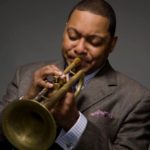
 Jazz occupies a special place in the American cultural landscape. It's played in elegant concert halls and run-down bars, and can feature esoteric harmonic experimentation or good old-fashioned foot-stomping swing. Nobody embodies the scope of modern jazz better than Wynton Marsalis. As a trumpet player, bandleader, composer, educator, and ambassador for the music, he has worked tirelessly to keep jazz vibrant and alive. In this bouncy conversation, we talk about various kinds of music, how they might relate to physics, and some of the greater challenges facing the United States today. Thanks to KentPresents for bringing us together.
(This and the next few podcasts were recorded on the road with headset microphones, and the sound quality isn't quite as good, sorry about that.)
Hailing from an accomplished New Orleans family, Wynton Marsalis was marked as a prodigy from a young age. He played locally before moving to New York and attend Julliard, and played and recorded with artists such as Art Blakey and Herbie Hancock. He has recorded numerous albums as a leader of small ensembles, big bands, and as a soloist with symphony orchestras. He is a multiple-time Grammy winner and the first to win in both jazz and classical categories in the same year, and in 1997 his oratorio Blood on the Fields was the first non-classical work to win the Pulitzer Prize for music. Marsalis founded and continues to lead Jazz at Lincoln Center, which is in residence at Lincoln Center along with such organizations as the New York Philharmonic, the Metropolitan Opera, and the New York City Ballet. He has won the National Medal of the Arts and the National Humanities Medal, along with numerous other awards and honorary degrees.
Click to Show Episode Transcript
0:00:01 Sean Carroll, Interviewer: Hello everybody, and welcome to the Mindscape Podcast. I'm your host, Sean Carroll. And I don't wanna waste your time with banter today because we have a very special guest. We're very happy to have Wynton Marsalis join us on the podcast. If you are in any sense a jazz fan, Wynton Marsalis is the proverbial guy who needs no introduction. He's been acclaimed as a trumpet player, of course, but also as a composer, a band leader, and also an educator, and an ambassador for jazz music worldwide. He's the winner of multiple Grammy Awards. He was the first jazz musician, indeed the first non-classical musician to win a Pulitzer Prize, countless honorary degrees, national awards, etcetera.
0:00:42 SI: He's recorded a huge number of albums as a leader of small ensembles, big bands, and in collaboration with a diverse group of people from Willie Nelson, to Eric Clapton, to traditional musicians around the world. He's also the founder and leader of Jazz at Lincoln Center, which joins things like the Metropolitan Opera and the New York Philharmonic in residence at Lincoln Center. Not only that, but he is a classical musician, who both composes and plays trumpet with symphony orchestras. He won a Grammy for that too. So you get the point. Wynton Marsalis is arguably the most important figure alive in jazz today, and certainly enormously influential in how we think about music. He and I got to meet at a nice event called KentPresents. This is an Ideas Festival in Connecticut sponsored by Ben and Donna Rosen, and we hit it off immediately.
0:01:35 SI: He's a very curious guy. He wanted to know about physics, and things like that. I wanted to know about jazz. So we have a wide-ranging bouncy conversation. And if you don't like jazz, or you've never heard of Wynton Marsalis, no problem. I would still recommend listening to this episode. This is not one of those conversations where we just name-drop our favorite musicians or artists from the past, or from the present. Wynton Marsalis is an opinionated guy. He always has been. That's been one of his trademarks all along, and he gives us some of his opinions, not just about music, but about the state of the world, the state of the country, the state of education in the United States. We talk about physics, we talk about time, and quantum mechanics. This is your chance to spend an hour with a brilliant, creative person with an open, fertile mind. We had a great time, and I hope you will too. So let's go.
[music]
0:02:30 SI: Wynton Marsalis, welcome to the Mindscape Podcast.
0:02:45 Wynton Marsalis: Alright. This is such a pleasure, Sean. Thank you.
0:02:47 SI: So I understand that your first paying gig was as a funk musician, is that right?
0:02:54 WM: That's right, that's right.
0:02:55 SI: This is the 1970s. This is the bell bottoms, the big hair, the whole bit?
0:03:00 WM: That's right. Early, early in that year, we played an elementary school dance.
0:03:03 SI: An elementary school dance, alright. Did you get recompense for this? Did you get paid?
0:03:06 WM: Yeah, we got paid. We got paid $100. It was five of us, so it was $20 a person.
0:03:11 SI: And what were you playing?
0:03:12 WM: We played just stuff that was on the radio at that time, but we had learned maybe 15 songs or 20 songs, or 20 songs three minutes. It was a dance for three hours, so after we played the 20 songs, we were like, "Okay, that's it." And everybody was like, "Hey, we still have two more hours to go," so we just played those songs...
0:03:31 SI: Play it again.
0:03:32 WM: In a loop.
0:03:33 SI: They could still dance. [chuckle]
0:03:34 WM: We played in a loop over and over again, so we always laugh about that, about that job.
0:03:39 SI: But there is something special about jazz, right? What in your mind is what makes jazz special?
0:03:46 WM: I think that the three fundamentals are the music, improvisation to some type of grid. So you can improvise, but you have some restraint. The swing, which means you're improvising with other people, and there are things that govern how you are, will interact with each other, but those things you also choose them. So if you're a heavy swinger, you choose to be in the groove, and you choose to give some points over to people. If you're not, you don't. And then the blues, which is an optimism in spite of all evidence to the contrary.
0:04:24 SI: Aha, so explain that.
0:04:25 WM: It's like in the words of a blues, "I went down to the railroad, put my head on the track. I went down to the railroad, put my head on the track. When that train came along, I snatched my fool head back."
0:04:40 SI: So there's something in there, so the blues is about living through life, not giving up.
0:04:44 WM: It's living, it's about an optimism that's not naïve.
0:04:48 SI: Right, right. And to say more about swing in particular, 'cause I've had talks with musician friends. I'm not a musician myself. I appreciate the music very much, but swing is... There's other genres of music that improvise. The blues is a genre all by itself, but swing is something that is uniquely jazz.
0:05:08 WM: Right, that's physics. It's relational, and it's quantifiable. It's the reconciliation of opposites. So if you look at swing as a concept, whatever it takes for you to get from the "I" consciousness to the "We" consciousness is swinging. Now when you embrace that in such a way that you're in a groove, and you make all the little adjustments that are required to make, to not just endure another person or to tolerate them, but you embrace them, then you're swinging. So when you look at it as a concept, it is a six rhythm, ding, ding, di ding, ding, one, two, three, four, five, six, one, two, three, four, five, six, one, two, three, four, five six against a four rhythm, one, two, three, four, one, two, three, four, ding, ding, di ding, ding di ding, di ding, di ding.
0:06:00 WM: On the micro level, where it shows up is if you start to play fast, so if you go ding, ding di ding, then you go doodle-doodle-diddle-doodle-doodle-diddle-doodle-doodle-diddle, you can't go, tacka-tacka-tacka-tacka-tacka, you have to go doodle-doodle-diddle. You're shuffling. So that's a two and a three also. So instead of it being da-ta-da-ta-da-ta-da-ta-da, it's ta ta ta ta ta ta ta, doodle-doodle-diddle-doodle-doodle-diddle-doodle-doodle-diddle. It's difficult to negotiate the feeling of though that odd and even, at the same time. The swing is the bass, which is the lowest pitch played in four, on every beat, matched with the drums, this in six, which the cymbal is the highest pitch, and the pitch that you can hear the most. So you have all these extremes.
0:06:42 SI: Sounds like the drummer has a tough job there.
0:06:44 WM: The drummer has a tough job, he's president. He can just choose to just bowl everybody over, but great drummers... They'll see a great drummer as kind. They use their power very intelligently, and sparingly.
0:06:56 SI: And it sounds like it's about... So much music is about tension in some sense, right? It's a competition between what you expect, the sort of natural, easy rhythm pattern, versus a little bit of what doesn't quite belong that drives you forward, right?
0:07:08 WM: Right. I'm interested in how you would see that in relation to something... Some concepts that you work on, where you have opposite things. They come together, and you say, "Man, these two things are together. I never would have thought these things come together too."
0:07:24 SI: Yeah, it's all over the place. Physics, science is driven by what we don't understand. We try to leap into the places that we don't yet understand. Science, professional scientists don't spend their time doing homework problems that the college students do. And so what is the way to make progress? It's to pinpoint two things that you both think are true, but they don't agree with each other, right? And that's where all progress comes from. So the big one right now in physics is we have quantum mechanics, and we have gravity, and they don't play well together, and they're in tension, right? And we're trying to figure out, is one of them better? Is one of them more fundamental? Or is it, we gotta start all over again? And it's sort of this force of creativity, a little bit, right? And then jazz seems to be much about creativity.
0:08:06 WM: Yes, about creativity at the point of impact. I was also interested in your comments about time, because in jazz, you live in the future. You progress from the future to the past.
0:08:20 SI: Oh, okay. Wait a minute.
0:08:22 WM: So that's like life. You're in the future, but you're going into the past. You're moving forward into the past, you don't move forward into the future.
0:08:28 SI: Now you're gonna have to break that down for me a little bit. [chuckle]
0:08:30 WM: You are in the future. Like now, the future's past. Okay? So we're all in the future.
0:08:35 SI: Good.
0:08:35 WM: The future, we're in that. Then we passed through the present, into our cognizance of that present, which is then past. So jazz is a mastery of a moment of presentness. So the future becomes what you think may perhaps happen with the form, at a given... In a given space and time. And the challenge of jazz, when you're actually playing it, is "How can I deal with it, with all of the entropic moments of this present, and give it organization and logic?" And give it organization and logic and form, with a group of other people who have no idea what they're gonna play until they play it.
0:09:12 SI: Well, that's... I wanted to ask you about this. So there's the individual improvising, and there's the group. Let's just do the individual first; I think that's probably easier to wrap our brains around, right? Do you go into an improvisation to a solo with a plan, or is it literally right there, what you're feeling?
0:09:27 WM: I never do that. Every person is different. I like to be present, so I don't have a plan. My one plan is to take thematic material, and develop it in some type of interesting way, to me.
0:09:40 SI: And is that the chords, or the melody?
0:09:42 WM: The chords are the playing field. It's like a football field, you know what it is.
0:09:48 SI: Yeah, the arena?
0:09:49 WM: That's the arena. So you know in a football field, the sidelines, the harmonies progress at a certain way, and there's some alterations, but they are the harmonies. And they're laid out in time. So like you look at a clock, using those 12 numbers, and you know where you are. When you look at those hands, you know that's how a harmonic form is. You know where you are by the progression of harmonies. And you also know...
0:10:08 SI: Right... Where you have to get back to.
0:10:09 WM: You know when you get back to the top. But the top may be different, but the harmony will... The harmony is basically the same. But it's because chords have different root notes, and they're also a way to substitute chords. It's kinda like the directions to your home: You give me 50 sets of directions, then incorporate different streets. And the general direction will be all the different ways you can express an equation with different numbers.
0:10:34 WM: We're playing on that playing field. So now we know that, then we have to be in time. And the concept of time in jazz is probably the most kinda physics-related, because you're not in time, like "one, two, three, four" time. You're in what we call "swing time". And it's not being on time, it's being in time. And that time is like a wave, 'cause everybody is tugging and pulling at it.
0:10:55 SI: Right. Yeah, when you mentioned how important it is in physics, that's exactly right. Like so much of physics is about waves and the resonance, the beating together, and the interference when they're going in different directions, right?
0:11:08 WM: What do... I'm more interested in what... Does the degree of interference determine something about the wave, or does a wave just continue the way it is?
0:11:19 SI: Yeah, it can be either way, right? So I think that physicists love to start with the simplest thing first, right? So the simplest thing is, yeah, the waves... If you have two different waves, and they're coming into the same place, they do their own individual thing, and then they keep going. And at that moment, they might interfere or constructively interfere, which is a sort of contradiction in terms. What it means: They add up together, right?
0:11:42 SI: So we teach our students that first, and then the next thing we teach is, "Well, what if these waves are talking to each other? What if they interact with each other?" And these days, we think our best theories of the world are quantum field theories, where the world is this collection of fields pervading all of space, and what we think of as particles are vibrations in these fields. And if you make a new particle, that's 'cause you... In fact, the analogy I use is, if someone's playing a piano, and there's another piano in the room, the other piano starts humming a little bit. That's how you create new particles in particle physics.
0:12:16 WM: Kind of sympathetic vibration.
0:12:18 SI: Exactly that, that's right.
0:12:20 WM: That's exactly what jazz is like. A lot of times, you can anticipate what somebody is gonna play, or you could feel him a certain way. And sometimes, they do the opposite, and that's okay too. Yeah, 'cause it's really... It's like super conversation.
0:12:36 SI: There's no wrong notes, right?
0:12:38 WM: Well... Yeah. There are actually no wrong notes. There are only awkward moments, and non-resolutions, and lack of confidence in... You have to hear your way out of problems. It's kinda given a conversation, somebody is...
0:12:53 SI: Oh yeah, awkward moments.
0:12:55 WM: Dealing with a awkward kinda... Yeah. But it's fascinating when you get a lot of people improvising who really can play, how they all hear and interpret the moments. 'Cause the successive moments of crisis, there's always a crisis. Every moment is a crisis. And when the band stops, it's a break, and only you play, then there's really a crisis for you. Because you have to maintain a momentum, and the identity...
0:13:17 SI: Can't lean on everybody else.
0:13:18 WM: No, they're gone. Then they come back in. So you... I think it's really about mastery of time. And the mastery of time is an individual thing on one level; but in the jazz sense and in the swing sense, it's mastery of the fluctuations of time with other people.
0:13:33 SI: Right. Yeah, and that's where swing comes in...
0:13:34 WM: That's what swing is.
0:13:34 SI: You're just pushing up and against the obvious regular beat, right?
0:13:38 WM: You're right. You have the obvious regular beat is a constant that you all know. But the swing is all of you all's interpretation of that constant, and how you can negotiate that constant, and make it feel good.
0:13:53 SI: And sometimes, these solos can get pretty long. You can go on for a long time. How much of it is conscious, would you say? Could you even remember the solo that you played?
0:14:02 WM: No. You can't remember, but it's conscious like when you speak is conscious. Like you weren't using notes when you would talk, when you lectured the other day, but you knew what you were talking about.
0:14:11 SI: I knew the general outline I was gonna say. But I had a plan going in, and to...
0:14:16 WM: Well, the form gives us a plan. So when I said, "I don't have a plan," the form gives you some type of plan. It's a... And then I tend to take things from the musicians I'm playing with. Like when they play stuff, I play things. And I think that in my solos, I try to really think about construction.
0:14:37 SI: Okay, what do you mean by that?
0:14:38 WM: I mean, how am I gonna get from this point by turning phrases around? Or how am I going to make a cohesive and coherent statement?
0:14:48 SI: You're telling a story.
0:14:48 WM: How am I gonna tell that story...
0:14:50 SI: Beginning, middle, and end.
0:14:51 WM: So that you can follow it? Right. And how can I get all these little subplots and interesting things, and change the emotions of different moments, and add things and...
0:15:00 SI: And it is usually in this group context, right? And as impressed and overwhelmed as I am with a master improviser, I'm even more impressed that people can do it together. And how much of it is... I see on the bandstand, people looking at each other, like the players, how much communication...
0:15:18 WM: It's a lot.
0:15:19 SI: Is it planned out? Is it really just, you sense it?
0:15:20 WM: No... No. There's so much communication, and that's what I love the most about playing, is playing with other people. There's so much communication, like shifting beats. Or you're getting ready to end your solo, is that really the chord you wanna play? Where are we... Oh okay. Are you gonna play rifted, or... It's so much of it. It's like, it's so innocent, very intense. It's like an intense emotional and mind game with other people, and it's all benevolent. None of it is... Because the swing is a reference, and it makes you... If you wanna swing, it makes you have a constant that you all agree on. It's kind of what the Constitution is supposed to be. You have to agree on something. Something has to have meaning in order for us to have a meaningful dialogue. And there has to be some arbiter, something that we both will be okay. Let's not...
0:16:13 SI: Otherwise, it's just noise, right?
0:16:14 WM: Let's not sell this to our kids.
0:16:16 SI: That's right. [laughter]
0:16:16 WM: Let's... Yeah.
0:16:19 SI: Yeah, yeah, yeah. And jazz is... You mentioned in the... For the podcast listeners out there, we just got finished with some remarks that Wynton made here on stage. And you also mentioned the America-ness of it, right?
0:16:34 WM: Yeah.
0:16:34 SI: There's something...
0:16:35 WM: Yes.
0:16:35 SI: And for better or for worse, mostly for better, but jazz is part of America, and America is part of jazz.
0:16:42 WM: Well I don't think for worse, but worse is a part of better. You can't... It's like what you were saying, when you gave us the examples of entropy. One is nothing, then it's some things, then it's... You're not gonna have one of all one thing.
0:17:00 SI: Right. If everything is too simple, nothing interesting has happened.
0:17:01 WM: Right. And that's the famous Shakespeare, to be or not to be, yes. There's gonna be one of those, or maybe. All the kinda greatest artists have that kind of dichotomous unity, they understand. That's why a Shakespearean villain is so great. He understands, there's something noble in this villain, there's a humanity in the villain, and that kind of simplistic way of looking at the world does not work well for democracy. And jazz, it came from the most maligned group, people that have been slaves, but they didn't play jazz when they were in slavery, they played jazz when they became free. And freedom is something that has not been guaranteed to people in the world throughout time.
0:17:43 SI: No.
0:17:44 WM: If you go throughout time, most groups of people have been dominated, or they have been beaten. To be subjugated to the will of a person or a group of people, it's not something that's only about the United States of America. Most of the greatest heroes that we celebrate are military heroes that defeated people, and engaged in absolute murder, concubinage, and slavery.
0:18:08 SI: That's why they don't like to talk about it.
0:18:10 WM: Right, that's why they were conquering people. America is the hope that we have to change. And it's hard, it's difficult. And it's challenging. And we, at this moment, appear to not be up to that challenge. But when we actually understand what the rest... What's going on in the world, and that democracy and even the thought that there is equality is not something that's guaranteed, your side is not guaranteed to win.
0:18:41 SI: No.
0:18:43 WM: There's a lot of power. And by that, I don't mean in the fear of another nation. I mean the fear of an ideology which says, "To hell with these people," which is what has dominated the world most of the time, and has even been dominant in our country's leadership, if not its people.
0:19:00 SI: But a democracy is a place where you can lose an election, and give up power willingly, right? You don't cling to it.
0:19:06 WM: You're supposed to.
0:19:06 SI: You're supposed to, yes.
0:19:07 WM: Yeah, you're also supposed to agree on a set of principles.
0:19:10 SI: Would you say that jazz is in some sense a democratic form of music, compared to others?
0:19:15 WM: Absolutely, no question about it, in every way. I could take you down the Constitution, and the separation of powers. All of the things that are the foundation of what we do, the ability to amend the Constitution, and the Constitution being a very simple framed document, that's shorter than every other state constitution, and the repetitiveness of the Constitution from the federal government to the state government, to the local government. But when you don't have an agreement on the humanity of other people, then you subvert the Constitution.
0:20:00 SI: Yeah. And in some sense, this is what liberal democracy is all about. I had a podcast about liberal democracy, the idea, you don't have to agree with your fellow citizens about values, necessarily. You can disagree about fundamental things, but there has to be something shared, right? There has to be something shared that you agree with, and you base everything on that. And a bunch of players up there improvising together have to be the same way.
0:20:25 WM: And many times, we're not. What is happening with our music many times is one person will solo all night, five people will solo forever. Mine, which was on the bandstand that allowed other people were playing all with them in it. The strongest on the bandstand dominating, the bass, turns the amp up to 15, then it's very difficult to play the music. And then another thing that happens after that is slavery. And the slavery becomes, "This system has too much freedom in it, let me figure out how to repeat things over and over again, so that we do away with some of this freedom." And that's the direction we will go in, if we listen to... If we check out the way systems are slowly beginning to dominate everything, and our systems, macro thinkers are very powerful. And we don't realize that when you play a system, a very intelligently designed system out to the furthest extreme of its efficiency, many of these systems don't include people. There has to be something else.
0:21:23 SI: It's just the machine.
0:21:24 WM: It's just the machine. We don't need you. Then after we don't need you, we don't want to see you.
0:21:30 SI: And so you're saying you can think of jazz as a little bit of a protest against this tendency, when it's at its best, even in jazz, right?
0:21:38 WM: A lot of it... Yeah.
0:21:38 SI: In any form of art, you can always denigrate into something...
0:21:41 WM: Right.
0:21:41 SI: Where it's a great man with an ego.
0:21:43 WM: Yeah. A lot of it though, a lot of the tenets and the best of it, the recorded history of it. And jazz is also not anti-the machine. It's not we are against the machine, we are against the abuse of tools, and we are for the basic principles of our way of government. And our music has a history that demonstrates that. Duke Ellington's orchestra demonstrated that, Benny Goodman's orchestra demonstrated that, Dave Brubeck's ensemble, John Coltrane, Art Blakey & The Jazz Messengers. We have people after people...
0:22:13 SI: Charles Mingus.
0:22:15 WM: Charles Mingus. And they were also able to express that, and did express it. So it's not something we're speculating on.
0:22:20 SI: Yeah, yeah, yeah, jazz has an interesting position in history in the United States, and right now. There's not a lot of radio stations out there that play primarily jazz. You've been as influential as anybody in not just keeping jazz alive, but keeping it vibrant, and making sure that people are educated about it. How important is that to you?
0:22:43 WM: It's very important for us to be educated about our country. We've stopped civics. We have to understand that for democracy to work, we have to be rabid about education. Rabid, not about propaganda, because I'm not a kind of left, right person. I laugh at all of that because for me, it's like subterfuge. It's like you and your friend start a fight in a store, and another one of your friends is going for the cash register. Now all you gotta do is get a black and a white friend, call each other a name. Everybody's looking at it.
0:23:16 WM: That's all fake. People are making money, and they're exploiting the... One of the biggest problems we have, and it happens in jazz, is the greatest players have to sacrifice for lesser players. Like the great Art Blakey allowed me to learn on his bandstand. I wasn't bringing anything to him, he had to be willing to sacrifice for me to learn. When you get the most educated class waging war on the uneducated class, you have a hard time. You're not gonna get the same thing that you get with the Ku Klux Klan, or somebody shouting and calling people names. You're gonna get contracts, you get the subprime loan scandal. You can get all the things that you see, that our systems, they play out on people who can't assess their position, their position in space.
0:24:04 SI: Were you... I probably know the answer to this, but how much of this was in your brain when you were 12 years old, and first learning to play the trumpet?
0:24:09 WM: A lot of it. I didn't know it was about playing the trumpet, but my mom and my dad were very conscious 'cause my father's a jazz musician.
0:24:17 SI: Just so everyone knows, you're from New Orleans.
0:24:20 WM: I'm from New Orleans.
0:24:20 SI: So you're a New Orleans guy.
0:24:23 WM: And my mother was very conscious about reading and staying on top of stuff, being engaged. My father was very conscious. So I would always just be around listening to all of them talk, and I didn't understand, of course, what I understand now, but I knew that you needed to know about the country, you needed to follow things, you needed to be... And that was in a time of consciousness. I was a kid through the '60s, so people were conscious.
0:24:46 SI: Yeah, it was something that was talked about, right?
0:24:49 WM: Talked... The pop music was conscious. Even if it was just Stevie Wonder's music, Marvin Gaye's music, What's Going On, for just the average kinda citizen that's out here, that doesn't have an artist father or mother, they were still engaged in making things better, and being a part of a larger thing. We lost that momentum of course over time because it's difficult to maintain that level of engagement with each other, without being predatory. We celebrate predators.
0:25:16 SI: Well, it's natural to devolve into conflict. We try to talk to each other, and try to disagree. Again, this is something that I hope the podcast helps to spread the idea, we can disagree, still be friends, go out for the beer afterward or whatever, but it becomes harder and harder especially in a very shouty age that we live in.
0:25:34 WM: A shouty, ideological age that is not respectful of any fact.
[chuckle]
0:25:40 SI: That's also true. That is right.
0:25:41 WM: There has to be some fact that we agree on. We're in Louisiana. Okay, that's a fact. Let's just start with that. And that's why I try to explain things in a human context. The musicians I knew, whether I argued with them or not, when we talk to each other, we're talking about human things, not my philosophy about this style of music. It was, "My momma is dying" or "My son told me the other day... " or "Can you believe that I was... " I always... I had dyslexia, and I was always ashamed. You know what I mean? It's human.
0:26:17 SI: Absolutely. When you try to be a communicator of science, even though science is based on facts, and you should all agree then, if you really want to get things across, you have to be likable. You have to relate it to people's interests, right? People care about what matters for their lives. That's not surprising at all.
0:26:33 WM: But that's what you're wonderful at. When I first talked to you, you're very approachable. I started asking you about entanglement, and will the universe just continue to expand, and you started giving me very concrete kind of breakdowns of what something was in a way that I could understand it, and you're friendly.
0:26:50 SI: I think it matters. Honestly, to give credit where credit is due, my wife gets a lot of credit for this.
[laughter]
0:26:55 SI: I'm a scientist by training, she's a writer by training. So she's helped me in the communication skills. So you went from this kid in a household where all these ideas were talked about, in a very musical household obviously, playing all sorts of things. Now you're the director of Jazz at Lincoln Center, and that's a responsibility, right? That's not... How do you think of that role? You're a musician, you play the trumpet, you're a composer, but then you're also an ambassador, right?
0:27:26 WM: Yeah, I'm honored to be in that role. I love people. I like to talk about the music, and to be a part of people's lives, and to recognize other people. Jazz at Lincoln Center, our basic tenets, so what we do, we entertain, we're educating, we advocate for jazz through performance, through education, and through advocacy. We try to bring people together around the music. We have a very simple kind of down-home type of welcome vibration. We have no generation gap...
0:27:58 SI: Oh, is that true? Okay, I was gonna ask about that. Yeah.
0:28:00 WM: No segregation. This is what we stress. No generation gap, no segregation, and all of our music is modern. We're not separated in the kind of time periods. We believe the music does have fundamentals. We don't believe everything, this horn is jazz, but we're not against things that are not jazz, we just are in favor of jazz. And we've been blessed to work with... We've collaborated with so many musicians of different cultures, and played with...
0:28:24 SI: Tell me some of your favorites.
0:28:28 WM: Man, I could just tell you a couple of stories. One is a great master drummer from Ghana, Yacub Addy. He passed away. I did a piece called Congo Square with him. It took me 10 years to write this piece. I used... Playing rhythms, I couldn't figure out because his style of music, they're playin' two times at once. So I'm counting, doing all Western, and then a kid who I had taught when he was younger, grew old enough, he started playing with the orchestra. His name is Carlos Henriquez, and he's from the Afro-Latin tradition, so he grew up playing on claves. So we're close enough. He's really like my little brother, so he's always in mind, so I said, "Man, why is this sad?" We put it on, and he started to interpret what the clave... "You're doing this. This is where one is, this is what we need to do."
0:29:10 SI: He could translate for you.
0:29:11 WM: He could translate for me, so he translated for me. And Yacub, one funny story is he was playing a rhythm. He said, "Ah, brother, this is a royal rhythm. A royal rhythm." I said, "It don't sound royal to me. I'm American, man. We don't have royalty." And he said, "That is why you will never play it correctly." [chuckle]
0:29:27 SI: He led you up to that, and you jumped right in.
0:29:29 WM: You know what I'm saying? And Kurt Masur was the conductor of the New York Philharmonic. He had grown up in Germany during the period of the Nazis, and he asked me to write a piece for the Philharmonic, and he said he wanted the piece to celebrate humanity and people coming together. And he told me, I'll never forget, he said, "You have no idea of how thin the veneer is," and how it can be pulled off, and people will cheerlead the very opposite. He said, "And you be mindful of how fragile all of this is. And when you write this music, be cognizant of the fragility, and be strong in an indictment of those things that are against human beings."
0:30:12 SI: Well, music speaks directly to our emotions, right? And that's for better, or for worse. It can excite us for the good things, and it can be used as propaganda for the less good things. What do you think about the state of jazz today? If that's not too grandiose a question.
0:30:27 WM: Well, I think most of the younger musicians are demoralized. They're mainly commercial music, they're interested in. It's like the state of our country. We are consumed with rampant commercialism, and a materialism that is destroying our human connections. It's out front, it's embarrassing, it's just kind of open corruption. And we have to get on track, and we're a long way away. It's not because of the President. He's, of course, a shining symbol of it, but it's not because of him.
0:30:58 SI: But it predates that. Yeah.
0:31:00 WM: It predates long before that. And I don't like when it's reduced to him because it keeps us from addressing the issue.
0:31:07 SI: There's deeper things going on...
0:31:10 WM: Much deeper.
0:31:10 SI: Than one guy. Yeah.
0:31:10 WM: Much deeper. Much deeper. And we have taught it to our kids, we've used them as a market. They're now being sold to, and exploited from a very young age. They can't defend themselves, we're not defending them. And music is a large part of the exploitation. And now pornography is a fact of kids' lives. It leads them into their rituals of courtship, and their development. Of course, I'm from an older generation, so I don't understand all of the nuances of it.
0:31:35 SI: The Tinder and everything. [chuckle]
0:31:37 WM: But no, it's not even so much a specific thing. It's just how many acts you can see.
0:31:43 SI: Right. Every generation lives in a different world.
0:31:46 WM: Yeah, well everybody says that, but it's like you're working on a heart attack till you have it. And you tell somebody, "Man, you'll have a heart attack," they say, "I haven't had one." Okay, you haven't had one, but there's gonna come a point where the kind of descent you're gonna reach... There's a thought that because there's always misinformation, and the conflation of fact, and there's always a kinda alarmist, the past is better. You touched on that, too. I love one thing you said. I took my notes, I could get it on my phone, but you said there are more... The gist of it is that there are fewer plausible pasts than there are possible futures.
0:32:29 SI: Exactly right. That's right.
0:32:30 WM: That's what you said. So I love that.
0:32:31 SI: That's right, yeah.
0:32:32 WM: The tendency is to always think the past was so glorious, and I'm not coming from there at all.
0:32:37 SI: Yeah, you've gotta be forward thinking... Yeah.
0:32:39 WM: Yeah. I'm just saying that kids are not a market, and our celebration of the market and of money has damaged our sense of the primacy of humanity, and that that should be first. It should be first in our education, left or right. It's not from the right, and it's not from the left; it's from all of it. And it's starting to rot. And we got to wake up.
0:33:05 SI: But it's tough, you gotta earn a living, if you wanna be a professional musician. Being a jazz musician is hard, right?
0:33:12 WM: Let it be hard.
0:33:14 SI: Yeah, you told the story about your father, could you tell us that?
0:33:17 WM: Yeah. I grew up watching my father just struggle, and not make money. He was always playing for three and four people, five, eight people in a room, and I just wondered over all these years, "Man, why do you keep doing this?" And he said, "Somebody's got to do this." But why? People need this, but nobody's here. The people don't want this. Why? His music has meaning, but to whom? Nobody is in here. It means something to me, and sometimes you have to be the one to say the Constitution has meaning. I am going to be civil, and I'm not gonna just let the fact that somebody's paying me some money affect my ideology, or affect that we're our... Somebody was given a tax break means that we should have policies that put people unjustly in jail. And it's not just a problem of those people. We're all those people. And that kind of super consciousness, we don't have that type of leadership. Not 'cause of the President.
0:34:17 SI: No, I get it, yeah.
0:34:18 WM: And in no way am I a supporter of the President's agenda, social agenda. In no way. You can't come from my background and support using people, Mexican people and Arabs and black people. You can't support that, coming from where I come from. But once again, I don't wanna pin a national problem on a figure that is actually doing the bidding of a large part of the nation.
0:34:47 SI: Yeah, and one of the ways I think about this is how hard it is to be generous, right? To be generous to someone who we don't agree with. How easy it is to declare someone bad or evil because they're not on our side, and how hard it is to work together with people who are against us in some ways.
0:35:04 WM: You ought to get in there, like you were saying, to get in there with someone who has a different point of view, who can help you. Sometimes you have a figure that you cannot work with, which may be the case in this instance. But for our nation, the divisiveness that attacks all of us, regardless of who the President is, on an atomic level, we're responsible.
0:35:26 SI: And you've written, you've composed many things, and you obviously have quite a discography. And sometimes instrumentals. Sometimes there's words in there. And your words are pretty unsparing. You don't mess around, right?
0:35:39 WM: No, I don't. I'm very direct, and I try to be as honest as I can be, as honest as I can be at the time with the information I have. And everything is not right, but it's as right as I can feel... When I write a piece that I think it's serious, and I don't care who doesn't like it. And I don't mind him expressing that they don't like it. That's one of the strengths of our way of life.
0:36:04 SI: We shall strive for that attitude. I would love to be able to do that. It's what I try to do. Yeah.
0:36:08 WM: Yeah, we can't stop them.
0:36:10 SI: Yeah, yeah. And do you see the younger people today, are they... Is there a jazz following out there?
0:36:17 WM: I don't see that much of a following with the younger people because the young people are marketing, we're trying to sell things to them. And they are large, their sexuality has been co-opted by visual images. And jazz is about music, and its quality. You have to take the time, and we are not interested in teaching our younger people how to take time, and to be a part of our way of life.
0:36:43 SI: I do think there's room for optimism in the sense that technology, etcetera has given people more room to be creators, to be innovators themselves. Is that too optimistic? Am I whistling Dixie?
0:36:56 WM: No, no. I think there's always a... I teach a lot of students, and I always tell them what they're gonna do, I cannot see that. I give them some information that they can use in what they're gonna do, but they have to do what they are going to do. And I try to... The biggest thing I see in my students is the ones who are really creative suffer the greatest failure of optimism, and of belief.
0:37:25 WM: It's easy for them to become cynical, and just say, "Man, I'm just gonna make some money. I'm just gonna dump my music down. I just... I need to get a public. I can't just be out here." It's hard to keep their belief strengthened, so that they can be innovative as musicians. Because the music they're hearing, a lot of it is like wallpaper, like it's being made by a person on a computer, and it's not a democratic... Music is not... The people are not even in the room at the same time, they're making an artifact, which can be very creative. Human beings are creative in anything we do. It doesn't matter. For jazz musicians, it's not optimal for us because our music is very much human.
0:38:07 SI: You're sneaking looks over the bass player, and the drummer, right?
0:38:10 WM: Yeah. Yes.
0:38:11 SI: What changes are you gonna do next?
0:38:13 WM: Yeah, it's about human beings, and how we interact, not about our tools that we have developed.
0:38:18 SI: You play obviously a lot at Lincoln Center, you played large concerts, but there is something romantic about being with one or two other people up there on a tiny stage, right?
0:38:25 WM: Yeah, I love it, but I love it in any context. Of course, when you're in a small place, it's also for me, it's how I grew up. So a small place with no people in it, I'm at home. I get down to that 2:30 in the morning, that's what I knew.
0:38:40 SI: Yeah, that's jazz time, as far as I'm concerned.
0:38:42 WM: Yeah, that's what I do.
0:38:44 SI: But it's not all you do. You've also been very successful in the classical music world, and how do you mentally make that leap, or do you even see a difference between jazz and classical music?
0:38:54 WM: It is a difference in the procedure and training, in the style of music; but classical music is one of the foundations of jazz. So I also love that music. I don't play as much, but I do write pieces for orchestras, and I use the experience I have playing for many years. I love playing in an orchestra, playing all the great orchestral pieces. And I do feel that that's a library that is so phenomenal, that we sell our library short. I always wonder... Never forget about the power of this library.
0:39:25 SI: So what are some of your favorite classical pieces?
0:39:27 WM: Man, I could start with any symphony of Haydn, all the Beethoven symphonies, Beethoven string quartets. All of Bach's music is great, doesn't even matter what you listen to. Palestrina, Pope Marcellus Mass. I like the name, but that's an unbelievable piece. Bartók, Concerto for Orchestra. Stravinsky, any... Whatever, you take your pick. Ligeti... You could just go on and on and on. It's fantastic Brahms. Fantastic library, Mahler, Strauss. I'm very thankful I was able to develop the ability to hear that library in high school because when I started, I couldn't hear that kind of music at all. And I thought it was only for white people, but to be able to overcome that ignorance and that prejudice and actually listen to the music, it's akin to a person who doesn't know what jazz is. If you can get to where you can hear John Coltrane's music, or Thelonious Monk, Duke Ellington, Count Basie.
0:40:23 WM: And it's a struggle, you have to work on it. But if you get to where you can hear it, there's so many unbelievable riches. And classical music is, man, you just... Shostakovich, Shostakovich, Seventh Symphony. If you can get to where you can hear that, I strongly encourage you to develop a taste for it because these were very, very serious people who sacrificed a great deal for music, and had extreme insight into the nature of many things.
0:40:50 SI: And there's also sort of a... Especially if you're a kid, there's just a coolness barrier. When I first started listening to jazz, sure, Miles Davis, John Coltrane, Charlie Parker. And it was years later that I started listening to Duke Ellington. And I was like, "Where have I been? What was I doing, man?" [chuckle]
0:41:06 WM: Okay, you know what's happening. Yeah, I was like that, too. I didn't like Duke, big band music, man like Geritol, old people.
0:41:12 SI: Well exactly, right. That's like your grandparents listen to that.
0:41:15 WM: Yeah, we have the same experience with it. And with that kind of quality music, I feel, of any tradition, it could be a tango music of a... I was listening to this, my man, I always forget people's names... I was checking out my tango orchestras from the 1950s and '60s, and I was like, "Man, listen to this." And the Brazilian music of Moises Santos. There are these figures in every culture that they would deeply engage with the music of their culture, and they created things that when we touch them... Horacio Salgán is the person I was looking for in tango music. And when you include them into your listening, they lift you.
0:41:56 SI: Yeah, and do you incorporate classical elements into your jazz composing, and vice versa?
0:42:01 WM: Sure. Yes, it's only natural, you would use contrapuntal elements that come from classical music, harmonic devices, orchestrational techniques, why not? That's what you would call metaphysical universe.
0:42:14 SI: No, I know it's all the waves, but would there be the kind of improvisation that you do in jazz, that would sneak its way? Sometimes pianists, right?
0:42:23 WM: Yeah, when you write for classical musicians, an orchestra, no, but I had an idea for one other... The other day, of how could you get everybody to improvise, not in a vocabulary that's jazz, like in a rhythmic vocabulary, and in a non-harmonic vocabulary? I figured out how I wanna write a symphony, that's all... With a lot of improvisation in it. You have to feel to figure out the improvisation, not in the jazz context.
0:42:51 SI: Right. Exactly.
0:42:52 WM: You can use the same forms, but you have to give the different sections 'cause you have 70 people.
0:42:58 SI: Well like you said, improvising multiple people at once. Actually, you said something earlier today that was fascinating about just two trumpet players up on stage, and the phrase you used over and over again was "sharing space". And that's the trick, right?
0:43:12 WM: Yeah, to share space. It's complicated. You and your wife, you and your brothers, or your sister, you and yourself. [chuckle] Can you make space for yourself? Now there's two of us, so there's less, and there's more at the same time. It's less fusty, but there's more.
0:43:31 SI: Right, yeah. There's more variety, there's more inspiration, there's more tension, creative tension.
0:43:35 WM: That's growth.
0:43:37 SI: Yeah. That's why so much improvisation is done in the soloing context. How often do we get five, six, seven people literally improvising?
0:43:47 WM: Well, very difficult; but if you get five or six different functions, you can get it. If five or six of them were playing in the same functional space...
0:43:55 SI: The same role.
0:43:56 WM: It's very hard for that to sound good, unless that's the point of it, then it can sound great, just be, "This is a texture of five or six people soloing."
0:44:05 SI: And you've also played with country artists, with rock-and-roll artists. I only found out last night when I was anticipating this interview that you did a whole album with Eric Clapton?
0:44:15 WM: Right, it was... And we were playing blues.
0:44:18 SI: Yeah, well, that's a common language.
0:44:19 WM: It's a common language. Our language is so much more common than the language we spoke with Yacub. Somebody like Eric, who loves blues, and he studied it and played it, he said we were gonna do King Oliver's band orchestration with blues songs. So some of the basis of rock and roll is blues. Rock and roll started as shuffles, the Count Basie's Orchestra would play, which became played by Louis Jordan's band. And then it, dum de dum de dum de dum de dum de dum de dum, went on to be that. Later, it became segregated in America, and it stood for white; but that had nothing to do with the music.
0:45:02 SI: I remember as I was growing up, '70s and '80s, just a little bit after you, and do you know Living Colour?
0:45:06 WM: Of course.
0:45:07 SI: And I was a huge fan, and I was shocked to learn that here was a rock-and-roll, hard rock band, they were all African American, and people objected to that. They were like, "What are these African Americans doing playing rock and roll?" I was like, "What? Where did you come from? Isn't that where it all originated?"
0:45:22 WM: Yeah, I don't even... There's so many different kind of people. I used to have a friend, you would say, "People say this," he'd say, "That's a lot of people."
0:45:29 SI: That's a lot of people. People say things. Yeah, they do.
0:45:32 WM: Yeah. I remember Vernon Reid, I think.
0:45:34 SI: Yeah, Vernon Reid was the guitarist for Living Colour, yeah.
0:45:36 WM: Yeah, I remember him doing New York in the '80s...
0:45:39 SI: That's right, exactly. Yeah. And now you waded into hot water recently, right? Talking about hip hop.
0:45:46 WM: It's not hot water to me.
0:45:48 SI: It's good to like the hot water, but so what are your feelings about hip hop, for those who...
0:45:52 WM: I was not speaking of hip hop as a field, I was talking about specifically the use of certain words that I don't like, to be mainstream words. I first thought of saying that in 1987, now is 2018. So the public has made its decision. They like that. They want that. Let's not forget the minstrel show lasted for 100 years, if you count 1840 to the end of Amos 'n' Andy. There's a taste in our country for that. I don't share that taste. So if it gets me in hot water because I say, "I don't share it," and you wanna truncate what I'm saying to be a blanket indictment of hip hop, and make it seem irrational, there's nothing you could do about that. I'm grown.
0:46:33 SI: You gotta say what you think.
0:46:34 WM: I'm a grown man. And I believe that those words are destructive. And they have been destructive because they've been out here for 30 years, they didn't just get out here. The nation has chosen, they like that. Okay, I have to live with that, but I don't have to like it.
0:46:50 SI: So you think it's a coarsening...
0:46:53 WM: I think what you think. We all think something. All we gotta do is look at it. We don't want to be attacked, but we all think something.
0:47:01 SI: So there is socially conscious hip hop, there's poetry in hip hop, but it's sort of not winning, right?
0:47:05 WM: I'm not talking about that kind. Yeah, I'm not talking about that kind.
0:47:08 SI: Yeah, exactly.
0:47:09 WM: And I'm not talking about it itself in a blanket, in any type of blanket, kind of crazy unintelligent way. Whatever it is, this unintelligent, it does not account for the fact that there are many different kinds of a thing. I'm not talking about that, I'm talking about what is in the mainstream from a linguistic standpoint. And I'm not even coming on it musically, which I'm qualified to, but I'm not. That's not what I speak about.
0:47:34 SI: You're not gonna comment right now? [chuckle]
0:47:36 WM: I'm not gonna comment about it. No, 'cause it doesn't matter. It's the direction that all of our music is going in, a kind of way of being produced, and a way of being treated as a product, and to segregate hip hop from everything else is unfair.
0:47:50 SI: That's a very good point. Hip hop doesn't create the universe around it, it's the other way around.
0:47:56 WM: No. But what I speak about is very specifically about certain languages that I did not like when it was first around. Then I was young. So sometimes I see the universe, "Well, you're just an old guy who was... " "Look, I was saying this before you were born." And once again, the nation has clearly spoken, it likes that; but I knew it liked it... My momma told me something, when she realized... When it stumbled into all of that, talking about the words I say I don't like, calling people "bitches," and all that. My mother said, "It's gonna get unlimited resources now."
0:48:29 SI: Yeah, I feel... I like hip hop when it's good. Of course, whether it's good is up to me, right?
0:48:33 WM: As it is for anybody, as it is for everybody.
0:48:37 SI: But some of the classic albums, some of the early ones, I can't listen to. It's harsh, and it's kind of a shame.
0:48:45 WM: It's up to each person. And once again, what we think about, it has no impact on who likes it. We're not judges. We don't have the opportunity or the ability to pass a sentence on it, and keep people from making their records, or... This is a democracy.
0:49:00 SI: Well, we can make them think.
0:49:01 WM: Maybe, but I've been talking about it for years. I don't think anybody thought about people are making money with it. And it's a national pastime, it's not just something to do with black people.
0:49:11 SI: Oh yeah, not at all. Not anymore.
0:49:12 WM: There's a tremendous national taste for this type of imagery.
0:49:17 SI: Yeah. And not just in hip hop obviously.
0:49:19 WM: Right, not just in hip hop. I'm not a fan of that. Not saying I don't think it should exist, I don't think it should be a mainstream. So I'm even qualifying it more, if you wanna go somewhere and get stuff, hey, we always had stuff that was like that.
0:49:33 SI: Kendrick Lamar just won the Pulitzer Prize in music. You were the first... Is that right, you were the first winner of the Pulitzer Prize in music that was not classical at all?
0:49:41 WM: I think so, yeah.
0:49:42 SI: Yeah, yeah, that was a great thing. And I don't know a lot about that world. To me, it's probably similar to the Nobel Prize, in the sense that there's a lot of bad things about people chasing prizes and things like that, the prize doesn't always go to the best person, but maybe it can help bring some attention to some good work.
0:50:02 WM: Yeah, I don't know the prizes. I don't... Prizes are as serious as the rigor in which people who hand out the prizes have about them. I think it's good for people to win prizes, and to celebrate other people, and to show up in shows with tuxedos on because it's fun.
0:50:25 SI: I totally agree. [chuckle]
0:50:25 WM: And it doesn't mean anything larger than that. I don't really look at it... I remember when I won two Grammys, my father and mother came out to Los Angeles, and there were many other people who should have won, could play better than me. So after the Grammys, I was in the room with my father, and my father said to me, he said, "Wow, the Grammys." He's not a guy who's Hollywood, kind of pop central. He doesn't care about any of that. So he looked at me before I went out in the street to party, he said, "Yeah, you won two Grammys. I'm glad you won. Winning is better than losing." Then he seriously looked at me, and said, "I hope you don't think that this means you can play." Okay, I was 21, I understood exactly what he meant.
0:51:01 SI: But I think the whole point of winning a Grammy is to impress your parents.
0:51:05 WM: I knew my father would not be impressed. And he also was not dousing me, he wasn't trying to... He was just saying, "Man, this stuff is not really about...
0:51:14 SI: And you know what? It's not.
0:51:16 WM: It's fun, but it's not about nothing. Like, "You need to learn how to play, son. You play okay, but you're not the best at anything." In his way, you'd have to know him. In no way was it a negative, or a dousing. I laughed. Actually, I thought... I said, "Man, I know better than this. We go out and party, and have a good time. Somebody's gotta win these awards." So I congratulate people when they win awards, and we keep it moving. There's gonna be another award next year, and it's not... I don't look at them one way, or not look at them. I'm not critical, or non-critical.
0:51:49 SI: What are your goals for your own music in the future?
0:51:52 WM: To become better, a better musician, write better music, become better at dealing with the orchestra, combine more forms, and do more things that are interesting and innovative with jazz music, and putting it... Become a better soloist, be more sophisticated in my understanding of different forms around the world. And I would just be more dedicated, and humble about my development.
0:52:16 SI: These are good goals for everybody, but I'll say also, we're here at this conference with... There's people talking about politics and science and everything, and you are one of the people up there on stage, but you were also one of the people in the audience. You were listening, so your mind is growing as well as your technique.
0:52:31 WM: Oh, I loved it. I loved your presentation, and I love a lot of... Personally, I took a lot of notes. I'll go back and study, read books people said. It's a luxury to be able to sit up, and hear unbelievably brilliant people talk. Everybody's dedicated. Think of all the dedication you've had, and your journey. And another thing you learned as a jazz musician is the creativity is all over the world. My father used to always say, "Man, there's many creative, great people who don't wear signs saying, 'I'm creative, I'm great, I'm smart.' And learn how to put your radar up... "
0:53:05 SI: You can find it.
0:53:05 WM: And listen." And believe me, I'm on it. I'm on this podcast we're on. I'm putting it on in the morning. I'm checking you out. No, I'm not just saying it 'cause I'm on it, I mean that. I'm gonna love being educated about the things that you talk about with the guests you have on. And I've thoroughly enjoyed myself, everything from new developing cities, to autism, to the MeToo movement, to what you were talking about, what Julie was talking about. It's all interesting, 3D copying.
0:53:35 SI: Did you have any, or have you had any special interest in science in general? Or is this just...
0:53:40 WM: I always loved science when I was growing up. I loved all of the sciences. I loved biology. I always did pretty good as a student. And chemistry. And yeah, I love the sciences. I told you, I read the Dancing Wu Li Masters years ago, and I am interested. I need to be educated.
0:54:00 SI: There's an infinite number of things that we all need to learn. We're not gonna run out of interesting things to learn about. But we were having this interesting conversation the other night about entanglement, quantum mechanics, and maybe there's a connection with jazz. Well, in fact, it's almost a cliche. I don't know if you know Stephon Alexander? Do you know that name?
0:54:21 WM: Yeah, I do.
0:54:22 SI: He's a psychics professor at Dartmouth, who wrote a book called The Jazz of Physics.
0:54:26 WM: He wrote a book, yeah, yeah. Yeah, The Jazz of Physics. I haven't read that book yet, but yeah, I know him.
0:54:30 SI: He is a saxophone player.
0:54:31 WM: Yeah, I know him. Yeah.
0:54:31 SI: Yeah, yeah, yeah. And part of me, we're trained, just like you're trained to be a critic in music, we're trained in science to be skeptical, so I wanna make some grandiose claim. So the claim would be that there is at least an analogy between how... We already talked about waves and waves bumping into each other. Clearly, that's part of music, rhythm and so forth, tone and pitch. But there's also randomness. There's probability, but it's not a mess. There's probability in quantum mechanics, things don't exist until you observe them, you bring them into existence. And maybe there is an analogy that's useful there between that unconscious solo that you're doing, that until you play the note, it wasn't there. You didn't write it out ahead of time.
0:55:21 WM: I think that repetition is a way that we control entropy. We have to repeat things. I was talking with an artist, and he was making me laugh. He said, "I see the world new every day, and I create new things every day." I said, "Well, I equate that with being on the run." [laughter]
0:55:36 SI: Can you stop and smell the roses a little bit? [chuckle]
0:55:42 WM: We all have things we're gonna do that we're touched on. We're gonna... That's part of being in the system that... But if you're running, you're not doing a lot of things that are the same.
0:55:54 SI: It's true. It's true. And I think that we even mentioned before, the balance between something different and something that fits in...
0:56:02 WM: That's right.
0:56:02 SI: Is sort of what you're looking for. And that goes into what I said about entropy, in the sense that we start with the universe that's simple, we end with the universe that's simple. Entropy's going up along the way, but it's in the middle, where entropy is middle, and complex structures are there, and you don't know what's gonna happen. It's not so simple, that's what fun.
0:56:20 WM: Right. And you were saying, you're trying to order them in a way that you can order them, to understand whatever you can understand.
0:56:25 SI: Yeah, we try to understand bit by bit.
0:56:26 WM: Right. But jazz gives you the opportunity to understand slices of reality, not just from your perspective. Now you understand it so much, I call it the speed of instinct. How fast is instinct? Man, it's fast. [laughter] You know what I'm saying? That's fast, that's speed. And you're playing on the edge always of instinct. Because there's always a present moment, present moment, present moment, present moment. And you're trying to come in that present like riding a wave. Now you're just going on that wave, and there's other people. The presence of other people make you all have... It's like a multi, it's like a hydra. And you're perceiving them, and you're perceiving the form, and you're perceiving the audience, and they're perceiving you. And it's all gonna, gonna, gonna, gonna, gonna, and then boom. Then that's only, then you can listen to it, and assess it. When you're playing it, you can't.
0:57:14 SI: Right. Do you ever just trance out? You're just like playing, you don't even notice what's going on?
0:57:19 WM: I'm always like that. I'm only listening. I'm listening so intensely, and trying to just... It's like you're just looking at something in the space. Dizzy Gillespie told me, he asked Louis Armstrong, called me once at 4 o'clock in the morning in Los Angeles, he said, "Are you up?" I said, "Of course, man. Of course, I'm up. It's only four."
[chuckle]
0:57:35 SI: It's only 4 o'clock.
0:57:35 WM: He said, "Man, I remember I went to the ophthalmologist, and he said, 'When you wanna play low, look low. When you wanna play middle register, play it. When you wanna play high, look up high.'" And then Dizzy told me, he said, "Man, I started doing that." He said, "Wow, I asked Louis Armstrong one time," I said, "Pops, why you always looking up high? What are you looking for?" And he said Pops told him, "I don't know brother Diz, but I always find it."
[laughter]
0:57:56 SI: He was looking for some high notes up there.
0:58:00 WM: He was looking under the haze, looking up there, where his stuff is. Sometimes I tease musicians when we're on the bandstand, and I'll see them looking at it, and I know what they're looking at. And I'll say, "Look at it, look at it."
[chuckle]
0:58:10 SI: Focus on that.
0:58:11 WM: 'Cause they're looking... When you're looking, you're looking at a point in space, you're not looking at anything, but you're trying to just hear and perceive everything that's going on, and order it, and figure out, "Where do I fit into this?" It's such an unbelievably exciting thing when it's done well.
0:58:25 SI: And it's... I wrote a book about time, and the nature of time, and how clocks tell time and everything. And our bodies are full of clocks. Our bodies are full of things that do the same thing in a rhythm over and over again, whether it's our heartbeat, or our breathing, or our nerves bouncing back and forth. And I think that really good music, whether it's jazz or classical or whatever, it feeds into that, and draws from it. It's like the rhythms inside us come out in some interesting way.
0:58:54 WM: I would love to see... I'm gonna get the book, but is it... You talked about all the different clocks that are in the body, if I looked at it, would it give me an understanding of what they are?
0:59:04 SI: No, but I have friends who know that stuff.
[laughter]
0:59:06 SI: Yeah, I'm just a physicist. But yeah, the body is far too complicated for me. But it goes into, some things can be taught, and some things are just in you. I don't wanna say they're inherited, but they come from places we don't understand.
0:59:20 WM: Instinctual.
0:59:20 SI: Yeah, it's instinctual.
0:59:21 WM: It's a thing. But in jazz, we called it a thing. Yeah, you got that thing.
0:59:26 SI: Did anyone ever... I sometimes heard the podcast interview neuroscientists. Did anyone ever try to put you in a brain scanner while you're playing, while you're improvising?
0:59:35 WM: No. Somebody was talking about doing it with a band, but we didn't do it. I would love to do it.
0:59:39 SI: Well, David Poeppel, who's a... I'll hook you up if you wanna do it.
0:59:43 WM: Good. I would love to do it.
0:59:44 SI: Because his thing is, there's different ways of looking inside the head to see what your brain is doing. This is stuff that we've developed over the last couple decades, so you don't need to do surgery to peek in at the brain. You can do an MRI, which will show you where in the brain things are happening, but it's very slow. So if you're... Even if you're just talking, forget about improvising, forget about playing fast, you don't know when it's happening. But what you can also do, what's happening in the brain are these chemicals zooming around, and they make little magnetic fields that pop outside your head. And they can measure those right away.
1:00:17 WM: Man, I would love to see that, what it would be like for a band really playing, and improvise. I would love my students to do it. And I told you, I want you to talk to my students; they would love it. I got great students at Juilliard.
1:00:30 SI: We'd love to do that, yeah, yeah, yeah. And I think it's coming because brain-computer interfaces. This is a common theme for me, but I think that one of the things that's gonna change the future is our ability to forget about our fingers, just go right from the brain to the machine...
1:00:46 WM: Yeah, like a telepathic...
1:00:48 SI: And go back and forth. And it might be very, very slow, and it might be 100 years from now, so that's okay, I'm a physicist. 100 years is nothing. But I think that, yeah, well it'll be interesting to see how we learn about music, or about what it means. Some people are less musical, like I can't sing a note, but I love listening to other people, so it's great. So Wynton Marsalis, thank you so much for this fantastic conversation.
1:01:11 WM: Man, it's such a pleasure. I have so much respect, and it's an honor and pleasure.
1:01:15 SI: And keep the journey going, yeah.
1:01:16 WM: Yes, sir. That's what we're both doing. [chuckle]
1:01:18 SI: Alright. Thanks, man.
1:01:19 WM: Yes, sir. Thank you.
[music]
Pingback: Sean Carroll's Mindscape Podcast: Wynton Marsalis on Jazz, Time, and America | 3 Quarks Daily
Music meets physics in coupled oscillation. Read Steven Strogatz on firefly coupling.
https://courses.cs.washington.edu/courses/cse481c/09wi/papers/MirolloStrogatz-TemporalSynchronization-SIAM1990.pdf
https://www.edge.org/conversation/steven_strogatz-who-cares-about-fireflies
As you guys are saying, it’s about waves & resonance, etc. How do you couple a triple pattern with a double pattern the 3-peat and the 2-peat have the same period.
And then you have a neuroscientist like the late Walter Freeman who talks of the nervous system as a bunch of complex oscillators. People who are making music together are coupled together into a single complex system.
As much as I will feel shame to admit this, the truth is, when I originally read the synopsis for this episode, my mind immediately felt that I wouldn’t find any interest (for me) in this episode. I appreciate music, I love hearing great music, but the truth is, I know nothing about reading music, creating music or understanding music. For that reason, I believed this episode would be better suited to those who do have an intimate understanding of music. I was completely wrong, and the questions, especially the answers provided by Mr. Marsalis, definitely provided interest for any listener. I appreciate all the work that Mr. Carroll and all his guests undergo to provide public education. I appreciate all of your podcasts. Thank you.
This was great. An inspirational discussion. I’ll definately explore Wynton’s music (I was a bit embarrassed not to know him before the episode, because I consider myself somewhat a jazz listener, though my listening experience is limited mostly in the big names of 50s to 70s like Coltrane, Miles Davis, Herbie Hancock etc.).
Dear Dr. Carroll,
Thank you for your excellent podcast. If I may, I’d like to suggest some possible future guests. A literature expert, perhaps specialized in someone like Joyce. A comparative religion/mythology expert. A meteorology expert specialized in the chaos math behind weather prediction. Just some ideas, keep up the great work!