
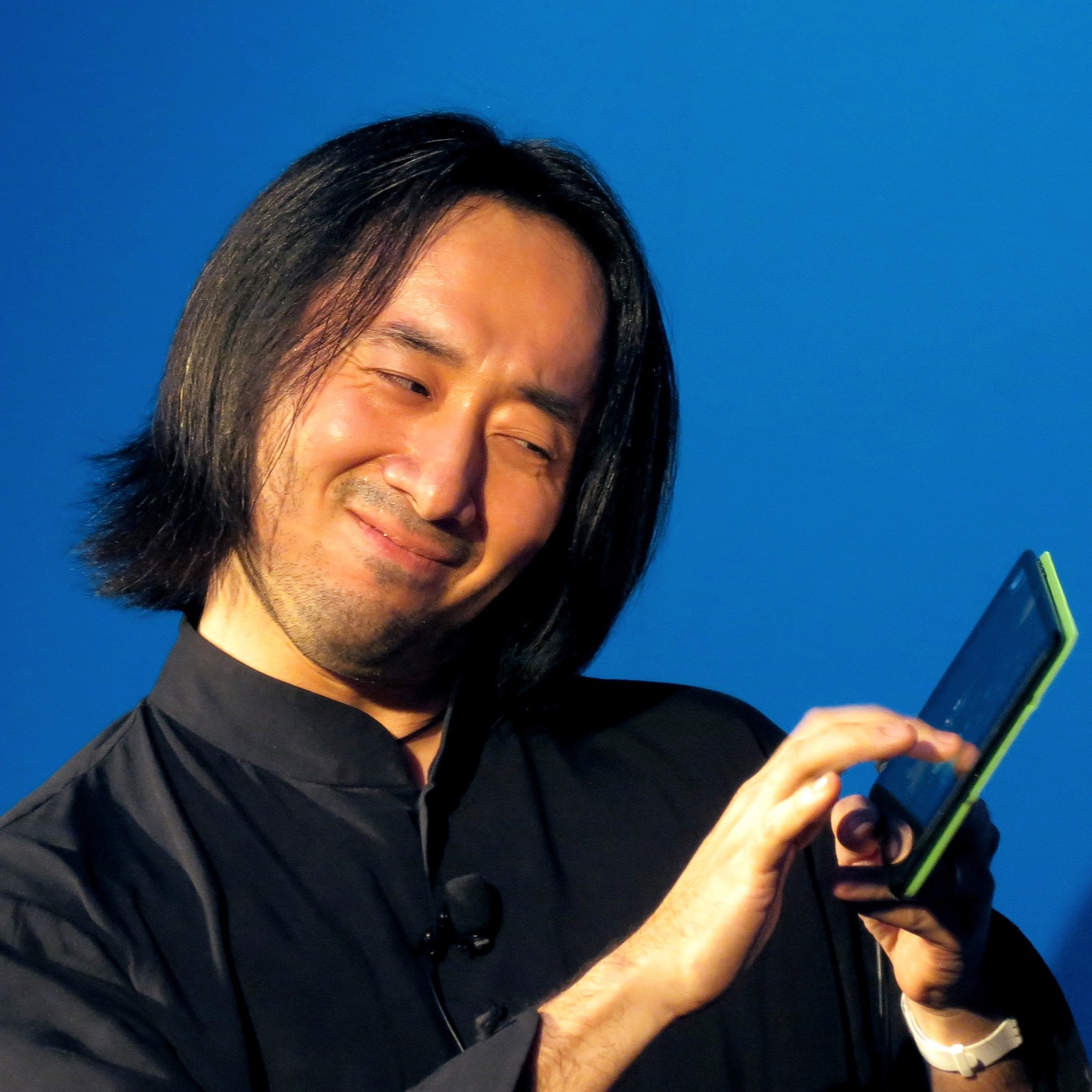
 Everywhere around us are things that serve functions. We live in houses, sit on chairs, drive in cars. But these things don't only serve functions, they also come in particular forms, which may be emotionally or aesthetically pleasing as well as functional. The study of how form and function come together in things is what we call "Design." Today's guest, Ge Wang, is a computer scientist and electronic musician with a new book called Artful Design: Technology in Search of the Sublime. It's incredibly creative in both substance and style, featuring a unique photo-comic layout and many thoughtful ideas about the nature of design, both practical and idealistic. We talk about what design is, how it can be artful, and in what sense it points us toward the sublime.
Support Mindscape on Patreon or Paypal.
Ge Wang received his Ph.D. in computer science from Princeton University, and is currently Associate Professor at the Center for Computer Research in Music and Acoustics at Stanford University. He is the author of the ChucK programming language for musical applications, and co-founder of the mobile-app developer Smule. He has given a well-known TED talk where he demonstrates Ocarina, an app for turning an iPhone into a wind instrument.
Click to Show Episode Transcript
0:00:00 Sean Carroll: Hello, everyone, and welcome to The Mindscape Podcast. I'm your host, Sean Carroll. And as I said before, one of the major motivations for me, personally, in doing a podcast project is to be able to explore things other than what I do for a living, mostly physics, a little bit of philosophy. So the podcast lets me talk to other scientists, neuroscientists, biologists, chemists, and it also lets me go beyond science; we've talked to poker players and movie directors and musicians and so forth. So today's podcast is definitely one of those examples of going well beyond my comfort zone.
0:00:32 SC: Ge Wang, today's guest, is actually a computer scientist, officially, a computer programmer at Stanford University, and that's my comfort zone, okay, but his specialty is computer programming of music. So he builds instruments that make computers into musical instruments, he puts on performances with Laptop Orchestras, things like that. Ge Wang has a famous TED Talk where he demonstrates an iPhone ocarina. You can actually, if you have an iPhone, go to the app store, download an app called Ocarina, which will turn your iPhone into a musical instrument. You don't need any extra hardware. You blow into the microphone and make beautiful music. We'll actually have a demonstration on the podcast today.
0:01:17 SC: However, Ge wrote a book that was not about computer programming or musical instruments, but about the general idea of design, Artful Design, designing anything, whether it's computers of musical instruments, but cups of coffee or pencil boxes or anything like that, the general principles that relate form and function, the human needs and the possibilities of the technology or the shapes you're doing, whether it's music or art or industrial design. I know nothing about this. I think it's a cool and important topic, so we had a great conversation. But this is definitely an example where we're learning new things. I bring no special predilections or pre-existing notions to this conversation, and therefore, we had a lot of fun. Design is everywhere in our lives. And thinking about it with someone who is also an expert in computer science and music was a great experience. So, let's go.
[music]
0:02:31 SC: Ge Wang, thanks for coming on The Mindscape Podcast.
0:02:34 Ge Wang: Thanks, Sean. Thanks for having me.
0:02:35 SC: Now, I'm gonna admit right away that this is going to be one of the more adventurous podcasts that I've done. You've written a book about design, which is something I know nothing about, not like even when I know nothing about things like neuroscience or whatever, I still have opinions about them, and here's something I don't even have opinions about. So hopefully, we'll have a wide-ranging conversation and you'll be able to guide me through the rough spots and so forth. But let's start with the fact that in some sense, you're a computer programmer. You're a computer scientist. Is that a fair thing to say?
0:03:07 GW: That is a fair thing to say. My PhD and undergrad were both in computer science, even though, now, I'm an associate professor in the music department, actually, in the Center for Computer Research in Music and Acoustics, CCRMA, or CCRMA at Stanford.
0:03:21 SC: But that's within the music department.
0:03:23 GW: Within the music department, it's called a courtesy appointment in computer science. So I'm kind of really ever... I'm kind of in both places and neither places. I actually don't know what I am exactly, but I think it's fair to say I'm a computer scientist.
0:03:36 SC: It's the best place to be, not knowing where you are, but you have to get to know where you are. I mean, did the computer interest come first or the music interest?
0:03:43 GW: You know, at some point, those were both interesting 'cause I loved building things, and I think the computer science eventually spoke directly to that. I could really realize things that I wanted to see how this works or... And then I always loved music as just this thing...
0:03:58 SC: Did you grow up playing instruments?
0:04:00 GW: I grew up playing the accordion at age seven.
0:04:03 SC: Wow. That's hardcore.
0:04:05 GW: And then my grandparents got me that, and then my parents got me an electric guitar for my 13th birthday, and that changed my world.
[laughter]
0:04:14 SC: Are you one of these people... 'Cause I know some people, they're handed an instrument, they never played it before, and within minutes, beautiful music is coming out, and I am completely the opposite of that, I don't know.
0:04:24 GW: I don't know about beautiful music, but I love just playing instruments, figuring out how they actually interact and how they work. And, yeah, some sounds will likely come out if you hand me an instrument, it may not be beautiful.
0:04:35 SC: And at some point... When did you realize that the computer side of things could have a musical component?
0:04:42 GW: Really, towards the end of undergrad. I was taking music classes, taking computer science classes, and then I took the class at Duke, it was where I did my undergrad from Professor Scott Lindroth, who's actually now the Vice Provost of the Arts at Duke, and I think he's been a life-long mentor. And I took this computer music class and I heard music that was just like I didn't hear anywhere else and felt, and realized I couldn't really hear anywhere else except in the medium of the computer, and that fascinated me.
0:05:12 SC: Were you already a computer science major at that point?
0:05:14 GW: Yeah, I was already computer science major.
0:05:15 SC: Okay, cool. And so then you go to your PhD and help write programming languages and things like that.
0:05:22 GW: Yeah. So I think having had that experience with electronic music and computer music undergrad, applied to grad school in computer science, but really kind of looking for programs that did computer music, and I was very fortunate to find, well, my advisor Perry Cook, at Princeton, he's in computer science, but he also was jointly appointed at Princeton in music. So he's actually was Princeton first joint hire across engineering and arts and humanities.
0:05:49 SC: That's very difficult to do, I know, yeah.
0:05:51 GW: Yeah. And so I ended up working on things like, yeah, programming language for generating music, it's called ChucK, and we're working on Laptop Orchestras.
0:06:01 SC: But Writing a programming language, that just sounds very hardcore. Are you... In there, is it an assembly language? How do you write a programming language? Or do you write it in a different language and then compile?
0:06:11 GW: So ChucK was written in C++. And the way I wrote it was, well I took a compiler class, and then I basically... Well, it's... I followed basically chapter by chapter of this textbook on basically how to make a compiler.
0:06:24 SC: Okay.
0:06:24 GW: In programming language. It's by Andrew Appel, who happened to be another professor at Princeton at the time. And I knew nothing about making programming language, so I literally just followed the textbook, but then I deviated when I needed to. And I think I designed it really backwards. I designed it backwards, I think, and I mean that in a good way, in that I kind of wrote down on paper the kind of code I wanted to write, and I wanted to get the kind of music I want. So I kind of said, "What do I want this thing to look like?" And now I went back and see if I can actually do it by writing code to kind of implement these...
0:07:02 SC: Are you telling me that form follows function? [laughter]
0:07:04 GW: Sometimes, yes, form often follows function, sometimes function follows form in a weird way, so...
0:07:10 SC: Right. Who was the guy who said that the first time?
0:07:13 SC: It was American architect, Louis Sullivan.
0:07:18 SC: Louis Sullivan, okay.
0:07:19 GW: Yes.
0:07:20 SC: Yeah. And of course, it's... He's trying to make a point, but in reality, like you say, there are two things, form and function, that go back and forth. And so is it safe to say that designing this computer programming language is one of the first ways you came into contact with that principle?
0:07:35 GW: Yeah. I mean, I didn't really think too intentionally and consciously about design at the time. I just wanted to build things. It was actually my advisor, Perry Cook, who said this cryptic thing to me and said, "You know Ge, whatever you make, whatever you do, do it with aesthetics," and I was like, I have no idea what that means.
0:07:53 SC: "No one ever told me that before, I'm computer science major."
0:07:56 GW: Right. No one... But it oddly made sense. And Perry still denies that he's ever said this. He doesn't remember he actually said this to me, but I was like this completely changed the way I do things, is things are not just pure functional things. We are not purely functional creatures, but we actually... You say that you don't know anything about design, but I would beg to differ, and I think we all have and cannot help but make aesthetic judgments on things...
0:08:25 SC: Sure.
0:08:26 GW: Not just what's pleasing, but what's beautiful, what's truthful, what's just, and what's just plain awesome. These are all, I think, aesthetic judgments.
0:08:34 SC: Well, that's good. I mean it's what... I wanna get into that at some point, but let me just back up a little bit because, despite being a computer scientist, despite having an appointment in music department...
0:08:46 GW: Yes.
0:08:47 SC: You didn't write a book about computer music. There's computer music in there, but you wrote... You took grander palette, right? You aimed for bigger fish.
0:08:55 GW: Yes, so I think... So Artful Design, well, it took me three years to write it, and I still don't know exactly what it's about at least, or any more I thought I did. It has a lot of computer music in there but I think it tries to address three questions, and I would say they are; what is the nature of design and the meaning it holds in human life? What does it mean to design well and to design ethically? And then how can this shaping of technology reflect our values as human beings? So those are the kind of these broader questions I try to tackle in Artful Design.
0:09:29 SC: Yeah, these a pretty big questions.
0:09:31 GW: Yeah.
0:09:31 SC: There's a lot of very interdisciplinary and also very grand, but like you say, everyone has some kind of design sense, right?
0:09:38 GW: Yes.
0:09:38 SC: Like I say for, scientists sometimes degrading philosophy, I always tell them, look, you can't not do philosophy. You can do it well or you could do it badly. And if you're not educated, then maybe you do it badly. Then maybe design is the same way.
0:09:52 GW: I love that. I think that's... I personally think that's absolutely right, is that just whatever... I think design is really you have an outcome or something in mind, and you go about very intentionally shaping or changing things to kind of achieve that outcome. You're kind of putting the pieces together and making them fit to actually get at some result or for a certain purpose. And when you do that, you're designing.
0:10:18 SC: And at what point did you go from... You have been designing, of course, computer programming languages, and we'll get into actual musical instruments and orchestras and so forth, but what is it that made you think that the book you should write should be about the idea of design rather than about these more specific examples of it?
0:10:34 GW: That's a good question. I think, a couple of things. For one, I think I was realizing what I was doing is like engineering, it's like art, but it's also not like engineering exactly, and not like art exactly, right? It embodies engineering precision. You do need to really get to the nuts and bolts of how you program, or how you do software engineering, or how certain technique or technology actually works.
0:11:05 SC: Yeah, and you build hardware things as well, right?
0:11:07 GW: From time to time. I'm mostly a software guy, but sometimes I dabble in hardware as well. And like art, there's a certain artfulness you can definitely bring into the things you engineer, not just in how it looks, but kind of how it actually works, and does the way of working actually reflect something you wanted to reflect these more, I think, tacit and intangible qualities of something that we clearly care about? If you just look at buildings, right?
0:11:36 SC: Right.
0:11:36 GW: People design buildings. And if we just cared about the function, we'd all be content living in warehouses...
0:11:42 SC: Yeah.
0:11:42 GW: And clearly, we're not. So I think that we know to do think about buildings in that way, but I think when it comes to things like software, tools, games, social experiences, these are... I think we're just learning to think more aesthetically about these things.
0:12:03 SC: It reminds me a little bit, I interviewed Scott Derrickson, movie director, for the podcast. And I was remarking to him that I'm very happy with books and words and pages, and also equations and figures and other physics-y things, so I could imagine in an alternate life being like a movie screenwriter or novelist or something like that. I couldn't imagine being a director, because there's a million other things you have to worry about, like the personalities of the actors, but also the design of the sets and the costumes and everything. And he said, which is sort of the obvious answer, but that's what he likes. He likes the fact that there's a little bit of everything involved. And it sounds like you were drawn to the fact that you were computer programming, but in a way that, given that it was music and instruments and so forth, design just became a necessary element, pretty obviously.
0:12:50 GW: Yeah, I think that's right. And I felt like design is really this universal thing that we all do, but only more recent times do we think about design as kind of a discipline or a thing onto itself. But I think we've always designed. We can't help but design. But I think... Well, like anything else, it's also possible to do well or do poorly.
0:13:12 SC: Right.
0:13:12 GW: And I'm really interested in how we can think about doing it well or doing it better.
0:13:17 SC: Obviously, Archimedes or Leonardo were designers...
0:13:20 GW: Yes.
0:13:20 SC: Even if they wouldn't have called themselves that.
0:13:21 GW: Right.
0:13:23 SC: Is it true, or we just fooling ourselves to think that there is a separate discipline called design, right? We design so many different things, from music to teapots, right? Are there common principles there?
0:13:38 GW: That's a wonderful question. I like to think that the design shouldn't be its own, actually, separate discipline. Actually, I think it's just something that all of us do, and there's a certain universality, I think, that actually does pervade design really everywhere. In Artful Design, I think I try to offer a few of them. One is this idea that I... In looking at the motivation. Design is all about purpose. It's like, what are you trying to do, and then how are you gonna go about doing it? And I would also add, why would you wanna do that? So there's all these different dimensions that I think that's common to any design. And then part of this why, I break it down into means versus ends.
0:14:23 GW: And what I mean by that is means as in means to an end. I do this because I wanna achieve some of the purpose. "Hey, I'm gonna make this thing to open a can for me," so that's a means to an end. But an end in itself, it's the other side, are kind of the more intrinsically interesting or valuable or beautiful things about a design. Form would fit into that.
0:14:48 SC: This is the idea we don't wanna all live in warehouses. We wanna...
0:14:50 GW: Exactly.
0:14:51 SC: Live in an aesthetically pleasing space.
0:14:53 GW: Yeah, aesthetically pleasing, but also things with meaning. Buildings aren't just pleasing, it's great when they are...
0:15:03 SC: Right.
0:15:03 GW: But also, buildings can serve as kind of symbols, can serve as meaning for the people or this... Even the city that it's in. And also, I think there's a certain, well for lack of a better word, truth that we can get at when we actually design things.
0:15:22 SC: Okay.
0:15:23 GW: Something that reflects who we are in kind of our values. And I think that for me is all kind of in this aesthetic dimension of design. So there is certainly this idea that, "Let's make things look and feel good," but I think it actually goes much deeper than that, and that we can... Is the tool... Even if you're building a tool, is the tool making people's lives better? Does it speak to your well-being? And what are the values that's actually at play here?
0:15:55 SC: Yeah, I think that this is... I mean, like I said, since I'm not an expert and I have no prior experience to the formal aspects of this way of thinking, I was trying to struggle with how to even grasp what the essence of design is supposed to be. There is an aesthetic component, obviously, but it's not just hanging art on your wall. It is this functional aspect of things, right? And so at the trivial level, there is this marriage between doing things or having things done for purpose and having them aesthetically pleasing, but what you're pointing at is that there's... I'm not sure if it's another dimension or an extra movement in the same direction of meaningfulness, and some connection with what it means to be human, is reflective in the best design.
0:16:37 GW: I think that's exactly right. I think it's this meaning, it can... There's actually a principle in the book that actually I was talking about AI and automation, and I think the principles are two-part. One, it says that which can be automated should be automated, except in cases where if something cannot be meaningfully automated, it should not be automated. So I'll give you an example.
0:17:01 SC: Meaningfully automated. Yeah, what's an example?
0:17:03 GW: Well, for example, this act of playing, to play. I like... We all like playing, hopefully, and to play, I don't... It does not matter how well I play, I just wanna play. And I don't ever want that automated 'cause the whole point of playing is to do it yourself, right?
0:17:20 SC: Right. You don't wanna build a computer program to play your video games for you.
0:17:23 GW: Exactly. And all these... A lot of things that are, well, experiential, for example, it's meaningful for us to do, and it certainly is... I can have a program or robot play in my place, but what's the point of that? It's possible but not meaningful. And at some level, I think this... For all the automation that's coming into our world with technology, I think humans, at some level, still have to be the arbiters of meaning. We have to determine what is meaningful to do, and what do we wanna do, and that gets back to this question of what's intrinsically interesting about certain activities?
0:18:05 SC: Well, good. So we have time here, so let's unpack this a little bit because I've had philosophers on the podcast and Will, and one of them, Alex Rosenberg, who I recently talked to, kind of is skeptical about the idea of meaning at all, but I think he's an extremist on one side. So let's go to the other side. What do you mean meaning? What is that... Is it just, "I care about that," or is there something deeper? Do you personally delve into the philosophical literature when thinking about these things?
0:18:34 GW: Not meaning per se, but I do delve into some philosophical literature. I think meaning is really, like for me it's actually not simplistic but simple in the sense that I think it is what we value.
0:18:50 SC: Okay.
0:18:51 GW: The meaning is... If it's meaningful to you, that means you find some value that... And I would say a more inwardly rewarding kind of a value.
0:19:02 SC: Okay.
0:19:02 GW: That's the meaning.
0:19:04 SC: So rather than, more bling, more money or whatever like your soul.
0:19:06 GW: Right. It's not the not...
0:19:07 GW: Exactly. It's more like your soul. And play, for example, I think is a good example of this is... It matters to me, it may not matter to anybody else, but the value of play is so fundamental to, it's something that speaks to this value of play is meaningful to me in that sense, so I think...
0:19:28 SC: And it is interesting to think about why play exists. Why through the process of natural selection this came to be. I have cats, I grew up with dogs. Certainly other animals are very playful in their own right, does it serve some function or is that is that is it just an offspring of other things that are useful?
0:19:46 GW: Well, I have thought about that a lot. I have no clear answers on that, but it leads me to think about other things like food and eating. I think that's a related thing to play, like eating. On one hand it's very functional. We eat so we sustain ourselves, so we don't die. But clearly, we are at a point where we also eat for its sheer enjoyment. And I think there is... And there's one thing we find, we actually have this dual purpose of one is very functional, one is very aesthetic and we clearly spent a lot of time and energy thinking about and going about making food, making sure there is food, and really cooking as an art.
0:20:29 SC: Right.
0:20:30 GW: So sometimes I wonder where aesthetics actually come from, the aesthetic of play, the aesthetic of food, the aesthetic of really of finding these beautiful or truthful, and do they arise from evolutionarily more functional things? I don't have... I'm not an expert in this, so I don't know if I can offer a good answer on this, but I think about this all the time, is that like, where does this... It's remarkable to me that we can experience things, period. And it's remarkable that we find things beautiful.
0:21:10 SC: And even if we knew the answer to the question of where it came from was, it wouldn't the fact.
0:21:14 GW: That's exactly right.
0:21:16 SC: That we find that meaningful and beautiful, right? I often end some of my talks, when I talk about the big picture, the book that I wrote, there's a lot of deflationary messages. We're bags of atoms. We live for a very short period of time. We're small compared to the universe. But then you show a picture of the universe, the Hubble Ultra-Deep Field with all these galaxies. And the point is we took that picture, right? Like we decided to spend millions and millions of dollars to take that picture. And it's not helping us feed ourselves or anything like that. We just wanted... We had the curiosity and the interest in the beauty that was brought out by that.
0:21:46 GW: Thats exactly right. And fundamental research, like theoretical physics, for me, it's I think of it more or less like Science and Engineering, but more as really, it's like the humanities, in a way, right? It's really getting at some fundamental truth about the world like with a capital W or what is there?
0:22:10 SC: Yeah.
0:22:10 GW: And also our place in it. And it's so human to want to understand like that just a little bit more...
0:22:17 SC: Yeah. I completely agree. Don't tell my colleagues I'm saying this. But it does have a lot to do with the humanity that's driven by curiosity, not by immediate practical interest. But as you point out, even the areas of discipline where you study that are driven by need to be practical interest, engineering, biology, medicine, they still have this aesthetic component. So maybe let's come back, ground ourselves a little bit. You got here through this journey of music and computers and so forth, so tell us about some of the design you've done in that arena yourself; the making of different kinds of musical instruments, orchestras and so on?
0:22:56 GW: Sure. I make tools, toys, games, and social experiences with technology for musical purposes. And I could give you a demo of one if you like.
0:23:08 SC: We would love a demo. That would be awesome.
0:23:10 GW: So this is an app I designed 10 years ago. I started a company called Smule. Smule's still around and...
0:23:17 SC: Okay.
0:23:17 GW: It's a way to make music socially together with people. I stepped down five years ago, but Smule is still going strong. I designed this as part of Smule 10 years ago and it's ocarina and it's an app for your phone. You play it by blowing into it. So actually...
0:23:35 SC: Okay, before you play it, is it coming out of that speaker?
0:23:37 GW: Yes.
0:23:38 SC: Okay, so we should put that in front of the microphone.
0:23:40 GW: Okay, so how directional is this.
0:23:42 SC: It's pretty darn directional? So yeah.
0:23:43 GW: Okay, so let's try that.
0:23:48 SC: There you go.
0:23:50 GW: You may have to edit, you may edit part of this app.
0:23:52 SC: Not really the same. We're gonna all the message, this is here.
0:23:54 GW: Okay.
0:23:55 SC: Yeah, brought more paraphernalia than any other podcast guest I've had so far, so this is awesome.
0:24:00 GW: So I'm holding my phone, but not in the usual way. I'm holding it like a sandwich and I'm blowing into the mic from the bottom. And I'm using my fingers on the screen to, there are these four circles that expands, contract when I press down on them and those control pitch. Accelerometer in the iPhone controls vibrato. So if I hold the phone flat versus tilting it downward, that's vibrato. You can play all kinds of little ditty with this.
0:24:45 GW: And it's a very physical use of the phone.
0:24:49 SC: And you haven't... There's no hardware enhancement to the phone. You didn't put a pick up or anything like that. How does you're blowing on the phone get registered?
0:25:00 GW: So I am blowing into the microphone. In there, there is actually a little software program that's tracking the strength of how hard I'm blowing into the microphone. When you blow in the microphone, not gonna do it here, but we get the... And from there, you can just basically do an envelope follower and see how much roughly how much energy is in there and then you map that to sound that's being generated on the device.
0:25:23 SC: Okay.
0:25:24 GW: And that's pretty much it. And then you're mapping the interaction from the multitouch and the accelerometer to different parameters in the sound synthesis.
0:25:34 SC: And this is called ocarina, 'cause it is very much like that existing instrument called the ocarina?
0:25:37 GW: Right. This is an instrument that's been around in various forms for thousands of years actually. And it's one of the more, I would say, one of the simpler instruments to start playing 'cause the interaction really is you blow into it and there is a few holes you can hold down to control pitch. And to answer your earlier question, yeah, this is no add-ons to the phone. The part of the design was say can we design something that required constraints that require no additional components. And in a way, and I talked about this in Artful Design, this is inside-out design. This is actually a function following a bit of form. And the form in this case being your phone.
0:26:16 SC: Yeah. You have a phone, what are you gonna do with it?
0:26:19 GW: We're gonna do with it what are the things that's on the phone and what makes sense. And if you go through this exercise, like well, a piano is like a little too big and the interaction, you have the keys, you have 88 keys, or guitar or drums. These are all... But a four hole English pendant ocarina is about the same size as the iPhone, and also the complexity of interaction is comparable.
0:26:45 SC: About the same. Yeah.
0:26:45 GW: So that was kind of...
0:26:47 SC: It's a perfect match.
0:26:47 GW: It's a perfect match and so this backwards. I'd say we designed backwards from really the end user's experience and we design backwards from the medium. In this case, the medium was the iPhone and all the things that's available.
0:27:00 SC: But you had in mind, number one, you wanted to make a musical instrument?
0:27:04 GW: Yes.
0:27:04 SC: And, number two, you had an iPhone available. And our listeners can go download this on the App Store?
0:27:09 GW: Yeah, ocarina is available. Look for Smule ocarina. And actually, there's another component to ocarina as well.
0:27:19 SC: Okay.
0:27:24 GW: This is a social component. There's a lot of visualization. And here, I'm actually seeing this double helix graphics coming out of actually southern California, playing Ode to Joy. Someone who calls himself a Belted Biscuit.
0:27:44 SC: Belted Biscuit, a classic.
0:27:45 GW: Who is this person? I have no idea, a classic.
0:27:46 SC: An undiscovered genius out there. Probably across the street, you wouldn't know. The physical space doesn't matter.
0:27:53 GW: Yeah, but you know roughly where they're coming from. Here's Amazing Grace, from it's London, Adam.
0:28:00 SC: Okay.
0:28:00 GW: And that's all you know about... Who these people are, the app is designed for you not to... It's a weird social network.
0:28:08 SC: So it's basically... All that's doing is other people are playing and we can listen to whatever they're playing.
0:28:15 GW: Yeah, that's all it is.
0:28:17 SC: When I play it, that means they can listen to me? 'Cause I might feel bad.
0:28:18 GW: When you're playing... The app is kind of taking in these little snippets, and then a few interactions, and sending those up to basically a server. And then that's... When someone's listening, they kind of randomly get served something in the recent past.
0:28:34 SC: Okay, so it's not quite in real time.
0:28:34 GW: Not quite in real-time, no.
0:28:35 SC: So this morning when I was just trying to make it work at all and not really completely succeeding, that is not probably sent today anywhere.
0:28:41 GW: That likely was not, but you can turn this feature on and off, but it's kind of anonymous listening. It's to say, in this social system, identity doesn't matter. It's about physicality, 'cause you're blowing to the phone to make music, and it's about this little sense of connection you have with someone if you're like, "Final Countdown coming from Korea," you would be like, "Who is that person?" And the app gives you no answers on that, but it does want you to ask that question.
0:29:14 SC: Yeah, that's cool. And is there some... This is probably not a fair question, is there follow-up? Do you do people make orchestras? Do they join together?
0:29:22 GW: Not in this app. There's no follow-up. And I think this is... I think of it as a logical end here. This is not a tool to study. It cannot help people make music. For me, it's not a...
0:29:30 SC: It's not a social network.
0:29:31 GW: It's not a social network. It's a place to feel a little connected with the... And that's the end. And so that's that. In that sense, to me, it goes back to this, like that's an end in itself. I just want people to feel connected. It's not here to serve another purpose beyond that.
0:29:48 SC: What I thought was a really good point about the fact that, let's say, 200 years ago, but maybe even more recently than that, what families would do in their leisure time is create music together.
0:30:00 GW: That's right.
0:30:00 SC: And we almost never do that anymore. We listen to music, and maybe 'cause it's just so easy to put it on the record or play Spotify or whatever, or Pandora, I should mention Pandora 'cause they're... My blog... My podcast appears on Pandora now. Maybe it's too easy, or maybe there's a skill. Are we just exposed to really, really good musicians so far that we're embarrassed about our own skills? That you wanna bring it back, the ability to, get around... Late at night, instead of watching TV, we can play music together.
0:30:29 GW: Yeah, I think it goes back to this question of meaning and values. I think music-making, to me, is a value. That's something that I think does a person good. And I don't know why, and I think it's probably a lot of different factors that's changed our relationship with music making. Technology, really, is the thing that's changed it over the last 100 years. Before household electricity, to get music, there was no broadcast, there was no Internet, there was no recording. You had to be where music was... You had to listen to music where it was made. And if you look, throughout human history, there's never been a civilization, or a culture that's been without either music or dance. So music has been with us. And of course we find flutes made out of bear femur and human bones even kind of dating tens of thousands of years. So music has really been with us, but only really in the last 100-200 years music has for better for...
0:31:34 GW: Often for the better, it can be recorded, it can be disseminated over long distances, and then we can capture the musicians that really speak to us, and we'd always have their sound, and I think that's a good part of it. Perhaps a possible side effect, and a possible downside, is that we might be making less music than ever before. And maybe it's because... I don't know, I refuse to believe it's because we hear people that are so amazing that we are intimidated to... I think sometimes they even inspire us, but I think it's really just now we just have so much that we could do that it's so much easier just to fire up a video game, which I do and I love playing, or to just watch a streaming video or whatnot, and it's all things I love to do.
0:32:26 SC: Yeah, but the CDs out there with a lot of music. And I don't know, I get your desire to not think that it's because we're intimidated by people who are better than us, but I bet that there's a lot of people who used to think they could sing, and now we can listen to Aretha Franklin and Freddie Mercury and go, "Well, maybe I'm not as good as them," or playing the piano or whatever.
0:32:46 GW: Well, I think that it gets back to, well, to this idea, I think, of the intrinsic value of making music. Again, I think play comes back. You're not making music to be good, you're making music because it enriches you, and just to learn. Amateur musicianship was a good thing. I hope it still is, 'cause to learn an instrument just because you wanna learn. And I think for this your intrinsic worth of knowing how to play the piano, play the guitar, and if you have a favorite song you wanna know to play that song. Are you doing this so you can be on stage performing for thousands of people? Not necessarily. I think that could be... That's good too, but I think if you take everything else away, just making music for yourself, there's something really awesome about that.
0:33:42 SC: I would say the same thing about making art, doing paintings. This is something that most people don't do, but it's not that hard. You can paint... You'll paint badly compared to an expert, but that's okay. The activity itself can be rewarding.
0:33:53 GW: Exactly.
0:33:54 SC: So do you think that the kinds of things you're designing will help bring back the actual personal creation of music to people?
0:34:03 GW: The hope is to help people realize that there's this intrinsic value to doing this. And I think what they do I don't know. For example, I don't think the apps that things I do are... Well, certainly, the apps on mobile phones they are not... I don't think of them as educational tools at all. I think of them more as personal expression windows for people to feel... You wanna lower the sense of inhibition, and for people to feel this joy of making music, to play in all sense of the word, play an instrument but also just play.
0:34:39 GW: The more... Things like Laptop Orchestra and things like ChucK, the programming language for music, those are, I think, for perhaps a different audience, even though they overlap somewhat. And those are more, I think, on a different side of research, what kind of tools can be built and what kind of instruments can be built for orchestras of laptops and humans.
0:35:02 SC: Yeah, tell us a little bit about the Laptop Orchestra project. Was there more than one, or is there a Laptop Orchestra?
0:35:08 GW: Yes, now there are more than, I think, I would say probably more than 70 worldwide, and most of them in academic institutions. The first one of its kind really started at Princeton. And while I was a grad student, this was started by my advisor Perry Cook and Dan Truman, who's still a music professor at Princeton. And they've been exploring how we can design instruments, but also design instruments that preserve some of the things we love about traditional instruments; one, how they emanate sound. If you were to play a violin in a room, the sound doesn't naturally come from a PA system, it comes from the artifact itself. And there's a certain sense of presence and intimacy that comes with that kind of sound radiation...
0:35:55 SC: Different concert halls have different feelings, right? Different sounds.
0:35:58 GW: It's a feeling, exactly. And so they've been looking at different ways to build speakers that capture the sonic intimacy. And this eventually led to the Laptop Orchestra, and this started at Princeton as the Princeton Laptop Orchestra or PLOrk in 2005. I graduated in '08 and started at Stanford, and then started the Stanford Laptop Orchestra, or SLOrk. And the idea is that for... In the Laptop Orchestra we have computers, of course, we have humans and also we have these hemispherical speaker arrays. Now, they look like the dome of R2-D2, and actually, they're made out of 11-inch diameter wooden salad bowls with holes drilled into them and we put speaker drivers in them. And the whole idea is that we pair each salad bowl with a computer so that the sound that the computer is making comes out locally to where it's being played. And then you have that multiplied by 20, and you can really have, you'll have an orchestra that can build a wall of sound.
0:37:07 SC: But the physical playing is tapping on the keyboard of the laptops?
0:37:11 GW: It varies. Today, we've designed more than probably 200 different instruments, and some of them are tapping on the keyboard, uses the mouse, some of them or using things Wiimotes, game controllers. We've used this thing called The Gametrak, which is like a... Basically, it was made to track your hand in 3D space, it was made for golf games.
0:37:32 SC: Oh, okay.
0:37:33 GW: And so it's tethered to this base that's on the ground and you have to wear gloves that the ends of the tethers are attached to. And that base... So it gives you the 6 degrees of freedom for where your two hands are.
0:37:46 SC: A little bit theremin like?
0:37:47 GW: You can make theremins out of it. Yeah. So you can basically have... You can move your arms around, your hands around, and you can translate this gesture into sonic gestures. So anything we can get our hands on can become a potential interface for music making in the Laptop Orchestra.
0:38:07 SC: Now, can I ask another unfair question? Is the music good?
0:38:09 GW: Sometimes.
[laughter]
0:38:11 GW: We've been trying to make good music. Sometimes it's... We're always trying to make music that's interesting, that kind of challenges or asks questions about how we make music or... This is being about a different way you think about creating an instrument or performing music. And certainly, to the best of our ability, we try to make music that's good, but the music is... That might be a matter of taste as well.
0:38:37 SC: Well, or is it just, first, it's remarkable you can do it at all, and down the road, people will start putting it to more artistic uses?
0:38:44 GW: I think it's definitely exploratory. Yeah, we're definitely in the early stages. But part of that, I think, has to do with the medium of the computer itself, as a thing you make instruments out of. And Perry had these principles, when you're designing computer music instruments, often you're making the piece, not the instrument, first and foremost.
0:39:07 SC: Oh, okay.
0:39:07 GW: You kind of figuring out what you want the piece to sound like.
0:39:08 SC: It sounds exhausting. [laughter] Every time you wanna make a new musical piece, you have to make new instruments.
0:39:13 GW: Actually, that's exactly what we end up doing, is that we have like 200, something like 200 instruments now on Laptop Orchestra, we have just about that many pieces. And we generally don't create general purpose instruments that can be used for a number of pieces, but we would think about what is the specific piece, and what is exactly the right instrument that we can craft to play that piece. And so we have these very specialized instruments and I think that speaks to the medium of the computer. It's possible in a matter of days sometimes to actually have an idea and actually prototype an instrument, and you have a piece of music that we've never heard before.
0:39:52 SC: And this is not supposed to bring music making into people's living rooms. This is just exploring a new kind of music that you could imagine playing in a concert hall and people coming and listening to?
0:40:00 GW: I think that's right, yeah, this is a different way of thinking about how to make music. This one's less about self-expression that's something like Ocarina is trying to do. This one's more like researching how we make music together, with this new medium of the computer.
0:40:15 SC: Have you... Have there been collaborations with professional composers or musicians?
0:40:20 GW: Yeah, PLOrk has done quite a few of these, and PLOrk has played with Zakir Hussain, who's the amazing tabla player and so percussion. And they've done some amazing things.
0:40:36 SC: Do they travel, is there a tour?
0:40:38 GW: I don't know if there's a tour. There was definitely a few concerts a few years ago that featured them, and it's really kind of... I think it's born out of curiosity, it's like, how do we... What kind of instruments are possible? The medium is very different than... So you probably get different instruments out of the medium and because the instruments are different, the music's gonna be different, and the way you perform. So it's this cascading cause and effect. Yeah, it's designed at every stage.
0:41:08 SC: Right.
0:41:08 GW: You design one... It's attributed to Marshall McLuhan that, "We shape our tools, and thereafter they shape us". So the Laptop Orchestra is that by the shaping things in every stage, the end result is gonna be really, really different.
0:41:23 SC: Well, I was gonna ask about the technological aspect here, the role of technology. It seems very technological if you're making a Laptop Orchestra or an Ocarina out of an iPhone but in some sense, every musical instrument is technology, right? They've been technology all along. In what sense are we exploring new music spaces because the technology is allowing us to do that?
0:41:45 GW: Well, the medium that... First of all, that's exactly right. Every instrument is a technology, whether it's vibrating strings or vibrating columns of air. I think, for computer music, we're exploring the very medium of the computer itself. And the thing that sets that apart, perhaps, from other mediums, is that, well, one, it's programmable. And two, in some ways... Well, I think of traditional instruments, it's really like form follows physics. Right?
0:42:14 SC: Yes, exactly.
0:42:14 GW: But with the computer, you... For better or for worse, have this completely compartmentalized way of thinking about instruments, like what's the input? What do you want it to sound like? Those can be very different. And then there's a mapping layer in the middle, then you map the input to the output and you can change the input without changing the output, vice versa. In practice, this doesn't always work well and you want it really design everything in a more... We call it in a more embodied kind of a way. But that's kind of the difference, is that this medium is something that, for better or for worse, frees you from the physics, the physical kind of nature of things, and into rules that are more governed in a more virtual realm, I suppose.
0:43:01 SC: Yeah, I'm interested also in how much we can formalize this, right? There's things you can do. So now that you have a laptop... When I was a kid... I was an undergraduate, this was the first laptop era, the mid-1980s, when IBM PCs and Macs were everywhere, and I definitely programmed our little IBM PCs to make, I would call them, noises more than musical sounds, but it's a very natural thing to do. So then how much after you've done that can you step back and say, "Oh, here are the principles"? I know you've mentioned Kranzberg's Laws of Technology. How intellectualized is this versus just kind of playing around and learning things?
0:43:42 GW: Well, that's a great question, and it actually goes broader to this whole idea of what principles can we capture about designing things in general, more specifically. And this is where design, and really computer music design, is... Well, it's not entirely formalizable, but I think it's more formalizable than, "It is if you say it is." I think there's some middle ground. And if I were to go back to Aristotle, he said something like the following, "We should not expect more precision than a topic naturally affords."
0:44:16 SC: Right. Actually, I love that quote in your book 'cause I was exactly thinking that. Should we... Is there the right answer to design? But Aristotle was saying, "No, that's not the kind of thing you should be looking for."
0:44:26 GW: I think sometimes it's valuable to say things generally or in a broad sense. And so design is really in this tacit dimension in between engineering precision and really full formalizability to kind of... I think there are things we can say, but there are more lenses to think with than recipes to follow.
0:44:52 SC: Right.
0:44:52 GW: And so Perry, for example, in computer music design, had these principles. First one is instant music, subtlety later.
0:45:00 SC: Okay, good.
0:45:01 GW: It's a way to think about... A great way to think about how you design an instrument. And he had a coffee mug that makes music, and you really pick it up, and the sensors on it enable you to start making sound and music immediately. But over time, you can learn it's his personality.
0:45:18 SC: The artful way to drink your coffee.
0:45:20 GW: Exactly. So I think the principles in Artful Design really was inspired by Perry's principle, which, to me, said that there is a level of specificity in precision, but only to the extent it makes sense. And if we expect too much, if we try to formalize it too much, it actually loses something of its essence.
0:45:44 SC: I should mention that there are a lot of principles in your book.
0:45:46 GW: Oh, yes.
0:45:46 SC: There's not like three principles.
[laughter]
0:45:47 GW: True.
0:45:48 SC: At the end of the book, it closes with one, two, three, four, five, six, seven, eight, nine, 10 pages of principles, with 15 principles per page. So that's a lot of principles. It is hard to remember. Do you remember all these? [laughter]
0:46:02 GW: No. [laughter] But I think when a situation arises, sometimes it's a way to think about it. It doesn't tell you what to do, but it gives you the principle of automation. It says that there is this membrane we can look for, beyond which it makes sense to automate, and on the other side, we should really be confident about what we don't need to automate, and what we ought not automate. And I think... So design is as much of how to automate, or how not automate, as it is figuring out where that little boundary is, and that's, I think, really a responsibility of the designer as well.
0:46:39 SC: Have you worked on the automation of the composing of the music? Do we have artificial intelligence writing scores for the Laptop Orchestra?
0:46:47 GW: Occasionally, we have had algorithmic components and generative components. I think it's still a pretty open problem, but also goes back to the question of meanings, like, "Why do we wanna do that?" And, if I may, I remember this conversation I had heading to grad school, and this is before I went... I was on my way to Princeton, and someone asked me, "What're you doing in grad school?" And I'm like, "I'm going to computer science, but I'm really doing computer music." And he's like, "Okay, what do you wanna do?" And it's like, "I wanna write a program for the computer to generate, to make music."
0:47:24 SC: Yeah.
0:47:25 GW: Right. And that person asked me, "What's the point?"
0:47:28 SC: Terrible question.
0:47:29 GW: And I was like, "Yeah, I don't have an answer for that." And so instead of actually working on...
0:47:34 SC: I am sorry. It is actually a very good question, but comes in a terrible place.
0:47:37 GW: It's a terrible question, it's a terrible... But I think there's a... It really changed the way I think about things, and I am really glad that person asked it 'cause I could not answer that 'cause I think the meaning... I realized that... So if instead of actually trying to build the world's most amazing algorithmic composition system, I want to make a tool with which others can actually get their hands dirty and build things themselves. And if they wanna make an algorithmic composition system, they can use ChucK, the programming language, to do it. So I have kind of taken one step back and designed something, like framed it completely.
0:48:17 SC: More facing, yeah.
0:48:17 GW: It's a framing issue.
0:48:19 SC: It reminds me a little bit of, in chess and Go, artificial intelligence not only is better than the best humans but comes up with new strategies. I wonder if, someday, it's a much harder problem, whether artificial intelligences won't be playing music in ways that humans never thought of, or kinds of compositions we hadn't yet hit on.
0:48:40 GW: I think it was somewhere in Chapter 8, I think a fellow colleague at Stanford, actually I capture this moment, she asked me, "Will we have robot musicians, really AI that play music?" And I said, "You mean as well as humans?" She's like, "Yes." And she's a philosopher so I gave her a kind of tongue in cheek answer which I happen to believe which was, "I think the day we have robot musicians, we'll have that day when we have robot philosophers."
[laughter]
0:49:10 GW: Right. I think, and she said, "Oh." So that means that maybe on that day the AI will have understood something more subtly human. And I think that's right. It's like I don't know what that really means, but I think robots need to have... It, again, comes out to the question of meaning, right?
0:49:29 SC: Well, even in the very most basic kind of pattern recognition tasks, which computers are getting very good at, it's still really easy to fool them just by putting things outside of their normal context, right?
0:49:43 GW: Right.
0:49:43 SC: I just saw this morning, for some reason, someone showing a photograph of a bus on a road and you ask the computer what it is and it says, "It's a bus." Then you just in Photoshop rotate the bus and 90 degrees and it says "Oh, now it's a snowplow."
0:49:57 GW: Correct.
0:49:57 SC: It doesn't say it's a bus in 90 degrees 'cause it has no background framing for that.
0:50:02 GW: Yeah. And some things are... I mean, for things like Go or chess and image recognition there are kind of what might be considered correct answers. And there are a lot of things, I think, in life that we value to have no correct answers like art, music. There are things that just aren't problems to be solved so much, but things that we clearly care about.
0:50:27 SC: You wanna do.
0:50:28 GW: You wanna do. Right.
0:50:29 SC: Right. So maybe this is not a perfect segue, but you wrote a book, and number one, it's a book. You didn't write an opera. You didn't write a musical piece.
0:50:42 SC: So you chose to write a book, that's a conscious decision. And secondly, it's a graphic book, but not mostly hand drawn, but photographs and overlaid text, and so forth. And I noticed on the cover page, on the title page, it says that you, Ge Wang, are the author and designer of the book.
0:51:00 GW: Right.
0:51:01 SC: So what made you think that a book was the right way to do this? After all, there's so much sound in your work and there is no sound in the book. And then what made you think that this graphic way of doing it was the right thing?
0:51:10 GW: That's a great question. I am still wondering that sometimes myself, but I'm really glad I did it this way as a photo comic book. And, well, I think it's a book about design, so I felt like I really wanted to very clearly and intentionally design it. And the medium... I think, design is really how you connect the medium to the message. And it absolutely changes how you write the book. So actually, I started writing what I thought would be a more conventional book about...
0:51:39 SC: Yeah, 300 pages of words and text wouldn't sell.
0:51:40 GW: Yeah. I was like, "It's gonna be great with some figures." And I thought, actually I have a lot of photos, so I was like, "Maybe it should have more photos and figures than normal." And then I was like, "What if there's some things that's easier to talk about if it's talked about not so formally, but also with visual guides, and also more of kind of a conversation. What if the pencil bag could talk?" These things suddenly... I think about comic books that I grew up with, including The Adventures of Tintin in Chinese, by the way. I was born in Beijing and I was... I grew up really reading Tintin. And then I was like, "What if half the book was a comic book?"
0:52:24 GW: At that point, I was like, "You know what...
0:52:25 SC: So yeah, let's do that, once you say that, yeah.
0:52:28 GW: So and then the whole thing... Then it was this commitment to just like, "What is this book really about and now that it's...
0:52:36 SC: And it seems to fit the idea that what your offering is not the single grand unified answers to what design is, but more of an invitation and a conversation and a set of ideas that work together in interesting ways, right?
0:52:49 GW: Thats the hope, yes, and the aim. Yeah.
0:52:51 SC: I mean, having pictures of you in the book talking to us using thought bubbles and speech balloons invites a conversational kind of response to the book.
0:53:01 GW: Yes. I think I wanted to make it feel like a kind of a face-to-face conversation. And I also wanna feel like I'm there for you through this inferno of design and kind of... And also, I think, it's a way to kind of offer certain truths in a more informal way.
0:53:28 SC: Yeah, and a little more accessible.
0:53:29 GW: More accessible, yeah.
0:53:32 SC: Anyone who sees a... It's not a graphic novel, 'cause it's not a novel... A graphic text? Comic book, do you just call it a comic book?
0:53:41 GW: I think... I just call it a comic book, yeah.
0:53:41 SC: Photo comic book, yeah?
0:53:42 GW: Photo comic book.
0:53:42 SC: It's kind of an interesting genre these days. I interviewed Clifford Johnson, who is a physicist, a string theorist, who did a graphic novel based on physics and string theory, and there've been these famous examples of graphic novels about philosophy, history, and so forth. It's a growing genre, it sounds like.
0:54:03 GW: I think so. I love comic books, and one thing more I can say about the fact that this is a photo comic book rather than a drawn comic book, is that, for me, design may reach for the sublime, and the sub-titles like technology and search and supply, may try to reach for the transcendent, but I think it's feet must be grounded in everyday life. And I think the photo aspect is to say this is... You don't have to parson this extra aesthetic layer of how stylistically it's drawn, but rather to say this is... I mean, it has it's own aesthetic, of course, but these moments happened. I think it's very different for a comic book of Spider-Man, probably... I prefer it to be drawn, 'cause it's fictional, it's not... And that gives my mind a different place to go. But aesthetically, if it's not drawn, but photographs, it'd be very strange if the Spider-Man comics were photo comics, 'cause then you'd be wondering who's acting as Spider-Man under the mask, and you kind of start thinking about these like... But here, it's non-fiction.
0:55:15 SC: Right. And you want it to be grounded...
0:55:17 GW: I want it to be grounded.
0:55:17 SC: You want it to be real, so everything you're describing is a thing you can take a picture of.
0:55:21 GW: Right.
0:55:22 SC: Right, and since I'm an author, I'm kinda tempted now to write a more graphic comic-booky physics book, but you are the designer of the book. How does it work? What is the actual process? What program are you using to make these pages?
0:55:39 GW: I think I horrified pretty much everyone that discover how I actually did this. I did this in an old version of OmniGraffle, which is an outlining program I was using since grad school to make figures for my papers, and I got really...
0:55:56 SC: There's nothing like familiarity when it comes to technology, right?
0:56:01 GW: Nothing like familiarity, yeah. So every page in the book, and of which there are 488, and many, many pages that never made it into the final book, and each one of those is a separate file in OmniGraffle. And I've learned to have a lot of these little tools of commonly used speech bubbles and other things, if I can incorporate images into this kind of... And I pull up those pages when I need to make a page. And I think I got pretty... At least after a year or two, I got pretty fast at doing this, and it really felt like this is, yeah, it feels good.
0:56:39 SC: I mean, maybe this is an impolitic question, but what does Stanford think about this? The university, not the press.
0:56:46 GW: I think Stanford... I don't know. I hope they like it. So far, people have really supported me. Actually, this book was supported by both the School of Engineering, and the School of Humanities and Sciences, which to me is like... I felt like, symbolically, that's awesome. This is a book that is at these intersections. It's not one or the other, but an other.
0:57:11 SC: Right, right. And was it very different, in your personal experience, in the sense that you've been doing so much music, and now you are being a visual artist in some sense?
0:57:21 GW: I've always been drawn to the visual arts, and also really the combination of the audio and the visual and the interactive. So... And I've always taken photographs, so I'm just kind of a hobbyist, amateur photographer, I guess, and...
0:57:37 SC: Just 'cause the audience is... This is an audio podcast, you can't see it, but it's way beyond just a set of pictures of you talking with some graphs. I mean, you really, obviously, put a tremendous amount of effort into the design, in terms of background images and fonts, and angles, and things like that. So it must've been a lot of fun.
0:57:56 GW: It was a ton of fun, it was a ton of work. And there are over 1600 photos in the book, 1300 of which I either took, or a few of them I generated, and there are like a few drawings in there. And the others came from public domain, Creative Commons, and that's shoutout to...
0:58:15 SC: I rely on Wikimedia when I write my books.
0:58:18 GW: It's so good.
[laughter]
0:58:21 SC: And it helps in your other design work even for the audio stuff, you also care about the visual presentation, right? It's all a part of... You emphasize the human aspect of design. And we're visual creatures as much as anything else.
0:58:32 GW: Yeah, I think we're trying to... I think it's trying for design to speak to all as much... Kind of all that we are. We're visual creatures. We are creatures that care about aesthetics, that have a sense of goodness and justice and all of these things. And so whatever those things are that make us who we are, I think design has this potential to address at least some... And they aggregate, hopefully, all of that.
0:59:00 SC: And even an ethical dimension? Where do ethics and morality come in to this discussion?
0:59:06 GW: So for me, I think of design as like, what is the function of the thing, and then what is everything else beyond the function of the thing? Ethics fall, for me, into, well, strange to say, it falls into the more of the aesthetic dimension of design.
0:59:20 SC: Okay.
0:59:21 GW: If we think of design as simply like, what are the pragmatics, and what are the aesthetics, and being... As in aesthetics is everything beyond the sheer functionality. And for me, I think the ethical dimension of design is that... Well, I think the argument from the book goes, "Design is all about choices. You're really just making this cascading series of decisions about what to build, how you build it, and who it's for, and all of these things." And if it's all about choices, then these decisions, they have implications for people that use them, the users. And if that's the case, then, yeah, making decisions as engineers, as designers, well, that's tantamount to actually taking action anywhere else in life. If we believe that, then shouldn't we, as designers and engineers, be held to the same moral, ethical framework as we would anywhere else? And so that's the argument. And then the next part of the argument is to say, but that's just is, there's no recipe to be moral or ethical, and in fact...
1:00:27 SC: At least we don't agree on what right one is.
1:00:28 GW: Exactly. And I think that's actually that we don't agree is why we have ethics, is that values come into conflict and we gotta try our best to apply different lenses to this to see how we can best... What does that even mean to resolve it, right?
1:00:45 SC: So in some senses, like we said about philosophy earlier, you can't not do it, you can do it badly, or you can do it well. And likewise, you can't fail to have ethical dimensions of your work when you're designing things, you can just pay attention to them or not.
1:01:00 GW: That's exactly right. And first law of Kranzberg's Laws of Technology, "Technology's neither good or bad, nor is it neutral," right, and has...
1:01:07 SC: But it has an effect.
1:01:08 GW: And it has an effect, and you can not pay attention to it, but that doesn't mean it doesn't have an effect, nor does it mean you're free from responsibility. You can't... A company can't say, "Hey, we built this platform. However people use it is not our problem."
1:01:23 SC: You're not thinking about any specific companies? [laughter]
1:01:25 GW: No, not any specific companies. [laughter]
1:01:27 SC: Certainly, physicists, historically, have done that; we did the atomic bomb, and chemists and doctors these days are facing up against the same thing. We're recording this only a week or two after it was announced that someone claims to have genetically engineered a baby. And there's science there, obviously, but there's clearly an ethical dimension as well.
1:01:47 GW: Right. So I think for engineers, I think to really be, not just capable engineers, but actually human engineers, that you got... You have to consider all of these dimensions. And if you build something that's useful, that makes money, but you've exploited people or you've done harm in the process, I don't think the thing is aesthetic. It's not beautiful. It's not truthful. And the other thing I will say is I think ethics... The world right now currently thinks of ethics largely as this kind of leash on technology, but I think I wanna offer an additional way to look at it. And I agree that there should be constraints, but what of ethics is really values? And what if those values are not the leash but the foundation of what you make in the first place? Like that should inform what you build, how you build it, and it's much more proactive than to say, "We've built this thing, how can we make sure it does no evil?"
1:02:46 SC: Okay.
1:02:47 GW: 'Cause at the end of the day, do no evil is, that's a rather low bar.
[laughter]
1:02:51 SC: I mean, it's a terrible thought to think like, "Oh, I can do all this cool stuff if it weren't for those pesky ethics," right?
1:02:56 GW: Right, but it's like... If you think about it in the other direction, it's like, what are my values? What are things I find awesome? And why do I find the awesome? And then you can get so excited about building something, and you've kind of... And the ethical considerations are kind of built in from the get-go, and not as this checkpoint that you have to... Just like aesthetics, you can't add... An aesthetic is not something you can slap on at the end, nor is ethics some module you install into your system just to make it ethical suddenly. It doesn't work like that.
1:03:35 SC: Do these different aspects... Do they come to your teaching at Stanford when you talk to your students? Is this part of a course on design?
1:03:42 GW: Absolutely. So I've started using Artful Design as a textbook. And in fact, at some level, I think it was written as a textbook. It's a very strange textbook.
1:03:51 SC: There's no exercises. I didn't see any problem sets.
1:03:53 GW: There are no problem sets, and there are, what I call, etudes, kind of like...
1:03:57 SC: That's true.
1:03:58 GW: That people could try to do. They're not... Yeah, you're right, they're not problem sets, but they do try to put some of the ideas into motion. And I've designed a new course in this coming winter quarter, in 2019, called Design that Understands Us. And in this course, we're actually gonna look at the shaping of technology but really in this full broad spectrum, broad perspective way. And in here, we're gonna bring to bear really the aesthetic dimension, the ethical dimension. I wanna look at everything from social network to artificial intelligence, to instruments, to toys, to games, to really anything that we find in our everyday lives.
1:04:41 SC: You say... One of the things, I mean, maybe to close this up, maybe this is a good final topic, the title is Artful Design, the title of the book, but then there's a subtitle, "Technology in Search of the Sublime", and Sublime is in a different color and underlined, and then since you're designing it, these are not random choices, right? Why is sublime the word you chose there?
1:05:03 GW: I think it reflects a certain optimism that, as builders, as engineers, and engineering itself, is something that can be more than "simply a problem solver", that it can be something that is beautiful, truthful, can be just, can be ethical. And I think when you talk about those things, we're really talking about kind of these... Something closer to the transcendent. And for me, the sublime is kind of this window into looking at the transcendent. I think it's... You were talking earlier about how, at the end of your books, we are just kind of... We're basically just these molecules, and we're these insignificant things in this rather unremarkable, in the grand scheme of things, rock and space...
1:06:01 SC: Yeah.
1:06:01 GW: Part of our solar system in this arm of this one of hundreds of billions of galaxies. And beyond that, who knows what's out there? And I think you know more than I do, but we, we're...
1:06:15 SC: None of us knows very much.
1:06:17 GW: None of us know very much, but yet, we're non-zero. We exist. And if you think about how small we are, but also that we're actually here and we are experiencing things, I find that to be miraculous. And that gives me... When I think about that, it's sublime, because it reflects a certain truth, a truth that I also find incredibly beautiful.
1:06:42 SC: Well, I wouldn't... I mean, how careful should we be? Because you're using words like sublime and transcendent and miraculous, that are often associated with something beyond the natural world. Are you... You mean to imply that, or are you just taking it as part of the human condition that...
1:06:55 GW: The human condition.
1:06:56 SC: We have this inner feeling that is hard to articulate, but we feel it, right?
1:07:00 GW: I think what's sublime for me is that the natural world is that, is that this is... There's not... It's just like... It's insane. It's like, why do we... Why are we... There's a truth out there that we clearly do not fully understand. We don't even know how to frame it, perhaps. Why are we... We do not understand how we come into being, or if there's a purpose, and that's... And I think the universe is preposterous, to quote. It's in a really horrifying, terrifying, but also in just an exquisitely amazing and beautiful way. And I think, actually, the natural sublime is, you're standing in front of this huge canyon and you feel this, both a sense of awe and this twinge of fear, right? And... Well, I think if you think about the universe, for example, yeah, I think I get both of those feelings. It's just... But it's not the kind of fear that makes you run, it's the kind that makes you still...
1:08:08 SC: Right.
1:08:09 GW: And it makes you reflect. And I think technology, back to technology in search of the sublime, is getting at that same thing that I think... I don't know, I think for me, like the arts, humanities, fundamental research and science, is all trying to get at in different ways is get at this truth, the truth of things, and both out there and also in ourselves, like who are we, and it's so human to wanna understand ourselves just a little bit more than before. And that was actually my question for you, and I don't know if there's an answer for this, is that I don't really see a difference between what's out there and what's in here, but both seemed really hard to do. And I was gonna ask you, what's harder? Or is there like even a...
1:08:58 SC: I'm very, very quick to say that physics, cosmology, things like that, are easier than anything involving human beings, because precisely the success mode of physics and cosmology is that we reach for the simplest manifestations of the natural world. Right? It doesn't mean they're easy in any objective sense. They're still hard. They seem even harder than they are because we can make so much progress so quickly that we're led into these abstruse realms of equations and phenomena that our everyday life does not equip us to deal with, but we can still figure it out. And now we've figured out about physics is amazing, even given how much we haven't, whereas even though we figure out human beings, it's still a little bit sketchy, right? Complex systems are the hard systems to understand, and as far as we know, we human beings are the most complex systems in the universe to date.
1:09:49 GW: I love that. You are a physicist, philosopher, humanist, all of that in one.
1:09:55 SC: Well Ge Wang, thank you so much for this conversation, this was great, and I was wondering if maybe we could end by you playing us out on the ocarina, if you have a tune ready.
1:10:03 GW: Oh, yeah. I play a little [1:10:05] ____ here.
1:10:07 SC: We don't usually have musical accompaniment but...
[music]
Pingback: Sean Carroll's Mindscape Podcast: Ge Wang on Artful Design, Computers, and Music | 3 Quarks Daily
Great episode!
Pingback: Monday Musings | Knightly Builds
This brings up a question (or few) I’ve had for a long time and would be very grateful if you could answer: when a string of a musical instrument vibrates, it creates a fundemental frequency, as well as (I believe only) whole-integer multiples of that frequency called overtones; why does that happen, and why are those limited to whole integer multiples? Is that in any way similar to electron excitment or the photon distribution associated with the double slit experiment? Why are computers able to produce sound without its associated overtones?
Great episode by the way, happy to see the amount of depth you manage to put into Mindescape
What is design again?