
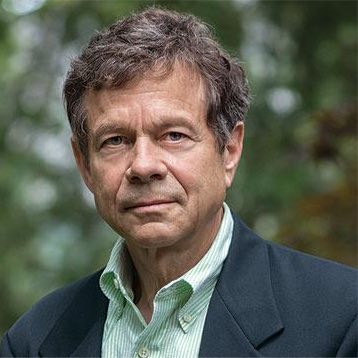
Let's say, for sake of argument, that you don't believe in God or the supernatural. Is there still a place for talking about transcendence, the sacred, and meaning in life? Some of the above, but not all? Today's guest, Alan Lightman, brings a unique perspective to these questions, as someone who has worked within both the sciences and the humanities at the highest level. In his most recent book, Searching for Stars on an Island in Maine, he makes the case that naturalists should take transcendence seriously. We talk about the assumptions underlying scientific practice, and the implications that the finitude of our lives has for our search for meaning.
Support Mindscape on Patreon or Paypal.
Alan Lightman received his Ph.D. in physics from the California Institute of Technology. After a number of years working as a theoretical astrophysicist specializing in black holes and high-energy processes, he scored an international bestseller with his novel Einstein's Dreams. Increasingly concentrating on writing, he moved from Harvard to MIT, where he became the first professor to be jointly appointed in the sciences and the humanities. He later was made the John Burchard Professor of Humanities at MIT, which he has subsequently stepped down from to devote more time to writing. He is the recipient of numerous awards, including the Gemant Award from the American Institute of Physics. He is also the founder of the Harpswell Foundation, which supports young women leaders in Southeast Asia.
Click to Show Episode Transcript
0:00:01 Sean Carroll: Hello everybody, and welcome to The Mindscape Podcast. I'm your host, Sean Carroll, and today we're gonna talk about a topic that no one has ever really disagreed about before, which is the relationship of science and religion. Actually, I'm just kidding, just have to say that, 'cause it's the Internet, right? That's the sarcasm. People have disagreed about this before. In fact, people have very strong opinions about it, so I'm sure the people who listen to the episode will bring those opinions to the experience. The person I'm talking to is Alan Lightman, who's a professor of writing at MIT. Alan of uniquely positioned to think about these kinds of issues, because he was a successful professional physicist, who transitioned into being a successful writer and Professor of writing. You may know him from the very famous and celebrated book, Einstein's Dreams, which was a novel in the form of a number of different scenarios that Albert Einstein might have been thinking about when he was inventing the theory of relativity.
0:01:00 SC: So he's really a successful example of someone who has mastered both sciences and the humanities. And actually in this discussion, I think it's safe to say, we don't disagree that much. There's little tiny differences of emphasis here and there, but we're both naturalists, were both atheists, and we want to be firm about that, but also to carve out some space for talking about experiences where you might feel connected to the universe; experiences of transcendence and meaningfulness and so forth, without saying that these are evidence of anything supernatural whatsoever. But how should we think about these? What should we say about them? How can we talk about them? And also how should we talk to people who have different points of view than we, do about the existence of supernatural stuff, whether it's God, or spirits or anything else?
0:01:48 SC: I think both Alan I are generally pretty polite, conciliatory kind of people. We want everyone just to get along, and there's lots of atheists out there who are not of that cast of mind. So I tried my best to find some little areas of disagreement here and there, but mostly we agree. I think that everyone, including myself, will disagree a little bit, even with things I said, because my mind changes about this, but it's a great starting point for thinking carefully about how to be secular, atheist, scientific, in a world where most people are still believing in other things.
0:02:20 SC: So it's a great conversation, I hope you enjoy it. Let me also say, as usual, you're welcome to go to the website, preposterousuniverse.com/podcast, and support Mindscape through Patreon for recurring donations or PayPal for one at a time donations. I should say, by the way, for the PayPal donations, for people who have donated money over PayPal, I don't have any easy way to thank you. On Patreon, we have the, Ask Me Anythings every month, if you're a Patreon supporter, and I can say thanks there in the comments and so forth. So just let me say right here, let me take this opportunity to give my great appreciation for everyone who has supported the podcast over PayPal. I really do appreciate it. It helps keep the podcast going, helps keeping me energized. And with that, let's go.
[music]
0:03:14 SC: Alan Lightman, welcome to the Mindscape Podcast.
0:03:27 Alan Lightman: Nice to be with you, Sean.
0:03:29 SC: So, I like to have a variety of guests on the podcast. And I'm a physicist, so of course, there's perhaps an over-abundance of physicists represented, compared to the average intellectual landscape. But you're a physicist, but who has an interesting career. Tell us about how you started as a physicist, and you've moved into other things.
0:03:52 AL: Well, I was interested in both the sciences and the arts from a young age. On the science side, I did homemade science projects. I built rockets and remote control devices and things that a lot of budding scientists do. I also like to write poetry and short stories and read a lot. And so I had this dual interest in the sciences and the arts from young age. I didn't have any too many role models of people who became both scientists and writers, but I did realize that I should get myself well grounded as a scientist first, before I began forays into the nether world of the arts. I knew of a few scientists who had later in life became writers like, CP Snow, but I didn't know of any writers who in later life became scientists.
0:05:00 SC: Have you subsequently learned of any?
0:05:01 AL: I have not learned of any yet.
0:05:03 SC: Alright.
0:05:03 AL: If you know any let me know.
0:05:05 SC: Well, it's a challenge for the young people out there.
0:05:07 AL: Right. So it appears that science is a young person's game, especially in physics. The greatest accomplishments in physics have been one done by people who are younger. So I decided that I would get myself well established and rolling in physics first, so I got my undergraduate and graduate degrees in physics. But I continued writing on the weekends and evenings. And then I would say, around in my early 30s, or mid-30s, I began spending more time with my writing, and by the time I was 40, my research career in physics was beginning to slow down a bit, and I began putting more time into my writing. I had been on the faculty of Harvard, and then at some point, I moved to the faculty of MIT, where I actually had a joint professorship in both the sciences and the humanities, or the arts.
0:06:23 SC: Which is a weird thing. How did you ever convince them to even offer you such a thing? And universities are a little bit sticky about this kind of procedure.
0:06:32 AL: Well, I talked to people, both in the Physics Department and in the Writing Department. At that time it was part of the Humanities Department at MIT, And I don't know how I convinced them. I guess, I must have hoodwinked them in some fashion. But I had a little bit to show for myself, I suppose, a physicist and a writer at that point. This would have been around 1988, about 30 years ago, and I was very fortunate that they were willing to consider this odd appointment.
0:07:11 SC: And I think it's safe to say that your breakthrough was the novel, Einstein's Dreams, which remains a really remarkable accomplishment in many ways. Tell us just a very little bit about what that book is and how in the world you came to have that concept for a novel.
0:07:28 AL: Well, the novel is a bunch of short vignettes, and each one is a fictional dream that Einstein might have had as he was working his way towards his theory of relativity, which is a theory of time. And in each chapter, Einstein tries on a different version of time, and one world time moves backwards, and another one it moves in a circle and another people can't remember their past. Some of them are more physical and some are more psychological. I think the idea occurred to me partly because I've always been interested in the tension between our scientific side and our artistic side, and that represented by Einstein as the representing the scientific, rational side and our dreams representing our more intuitive, artistic side. That was the theme. I have always loved the magic realist writers like Borges and Gabriel García Márquez and Italo Calvino.
0:08:56 SC: Sure.
0:08:56 AL: And those writers were, I think, influential on me as well.
0:09:02 SC: Was there ever a time in the conception of that book when you thought it was gonna be a non-fiction book, more straightforward?
[overlapping conversation]
0:09:09 AL: No, it was always going to be a fiction book, and not only that, but as I conceived of each one of the 30 dream worlds in the book, corresponds to the actual theory of relativity. And all the other ones are totally made up and do not correspond to physical reality at all. But when I was conceiving and writing each of the dream worlds, there was a temptation to try to make it scientifically plausible, and I resisted that temptation, because I thought it would weigh down the book.
0:09:47 SC: Right. You're welcome not to answer this question. But while you were writing it, were you thinking to yourself, "Boy, I got something good on my hands here." Or were you like, "Oh my God, people are gonna think I'm crazy."?
0:10:00 AL: No, I didn't think of any of those things. When I began writing the book it was like I went into a dream myself. It was an incredible, incredibly intense experience, where for the first three or four months, I was just living in this book. And it was like one intense rush of adrenaline that lasted three months, and I wasn't thinking about anything regarding myself, or whether I had a good idea or what the reception of the book would be. I was just in this dreamscape, this creative space. I guess, some people call it, the zone, or whatever. And so I was not thinking about anything outside of this imaginary world that I was in.
0:10:56 SC: But it's a wonderful example of the interaction between science and the humanities, because whether or not you wanted to make each one of those worlds physically plausible, there's certainly a very close similarity to the invention of those worlds and what a real theoretical physicist does; trying to invent a system.
0:11:16 AL: Right, that's true. And sometimes I wonder whether a non-physicist could have written that book, and I think maybe so, but I do think that some of the ways that I thought about time, or at least how to construct it, were certainly aided by my background in physics. Of course, each of those dream worlds, you have to match a conception of time with a human story that illustrates that idea.
0:11:46 SC: Yeah. And this is a great segue actually, because this idea of being in the zone, of losing yourself, feeds directly into your most recent book, which, I'm not gonna get the title exactly right. Sorry, I don't have in front of me. You must know the title, right?
0:12:01 AL: Searching for stars on an island in Maine.
0:12:04 SC: There you go. And you tackle a subject no one has ever written about before really, which is the relationship between science and religion and spirituality.
0:12:15 AL: Well, I'd imagine that some people have written about it before.
0:12:18 SC: Yeah, no, I'm just kidding about that. It seems to be something that a lot of people are very interested in. And everyone has their own little take. And I think, just to warn both you and me and the audience, probably you and I agree on many of the issues here, and yet I suspect that our conversation is going to feature a bit of the narcissism of small differences, because the small differences matter in something like this, right? This is material that is very, very important and subtle and hard. So it's okay to get into the weeds about what you think is right and wrong.
0:12:49 AL: Certainly. Certainly. And I wouldn't expect us to agree completely on everything.
0:12:52 SC: So what was the inspiration for writing this book?
0:13:00 AL: I've always been interested in the dialogue between science and religion, and I think that those two institutions are the most powerful forces, the two most powerful forces in the development of our civilization. And I always wanted to write a book that was located in this island that my wife and I spend every summer on for the last 30 years, so I combined the two. I did not want to confront the subject of science and religion head-on. As you've said, there have been many, many people have written on it, and scholars who know much more than I do. So I wanted to take a more tangential approach, and I wrote the book like an extended meditation as I'm wandering about this island in Maine.
0:13:57 SC: You had this wonderful very specific story that I'm sure you told many times, but let's tell it for the listeners, they might know it, about being right off that island in your boat and feeling something.
0:14:07 AL: Yes. I was coming back to the island one night in my boat, and everybody who lives on the island, all the families have their own boat, because it's a remote island and it's not connected by bridges or ferries. I was coming back to the island in my boat when night, after midnight. It was very quiet and it was a dark sky, and I decided that I would turn off the engine of the boat, and it got even quieter. And then I turned off the running lights and it got even darker. And I lay down in the boat and just looked up at the sky. And with all of those wonderful sharp stars up there, and I felt like I was falling into infinity. I felt like I had lost all sense of my body or time or space, and I was just part of the cosmos. I felt a connection to something much larger than myself, and I felt that the infinite expanse of time before I was born, and the infinite expanse of time after I will be dead, all of that seemed compressed to a dot. It was a totally amazing experience and I'm sure that you and other people have had experiences like that.
0:15:29 SC: And yet, coming out of that experience, you maintained firmly convinced in your materialist view of the world, right? You did not leap from this experience to the existence of something outside the natural world, but you wanted to try to understand how we reconcile naturalism, physicalism, materialism...
0:15:47 AL: That's correct.
0:15:47 SC: Lived experiences of this sort. So how do we do that? [chuckle] What lesson do you draw?
0:15:53 AL: Well, the experience that I had was something that I call the transcendent experience, and I know other people have used that word, that terminology as well. And for me, the transcendent experience, in a nutshell, is feeling that you are connected to something larger than yourself, that there's some order in the universe. And the transcendent experience does not need to involve God. In fact, I am pretty close to an atheist myself, as I imagine that you are as well. But I think there was still something very powerful about that experience and something that cannot be studied quantitatively. It's not reducible by usual methods of science. That is, I think if you had connected every neuron of my brain to a giant computer during that period of time where I was lying down in the boat looking up at the stars. If you had the electrical readout of every neuron in my brain, I think it still would not have qualitatively conveyed the experience that I had. And I think those sorts of experiences, to me, represent the spiritual world.
0:17:23 AL: And I believe that we, that all of us have had experiences like that and we need to recognize them. They're not easily analyzable by the methods of science. But it's another very, very valid way of being in the world, and I think that it's part of this very, very long history of people, human beings, connecting with the cosmos. I think you can see it in the Cro-Magnon cave paintings in France, and you can hear it in Beethoven's Ninth Symphony. Its an emotional connection to the cosmos. So the recognition of those kinds of experiences, and the honoring of them and acceptance of them, which may or may not involve a belief in God, is the way that I think that spirituality and science are reconciled.
0:18:32 SC: Yeah, I think that one of the issues that one always faces here is the fact that, just like in doing science, we talk about these concepts using vocabulary that has been handed down for hundreds of years.
0:18:45 AL: That's right.
0:18:46 SC: And it's freighted with certain connotations and so forth. So, there's always... And free will is another area of debate where that comes in. So, in particular, you seem to be willing to use the word, spirituality, but at the same time, you're not actually saying you believe in spirits, right? So what convinces you that might not be the right vocabulary to use?
0:19:07 AL: Well, it may not be the right vocabulary. And I don't wanna get hung up on words. I think that the description of the experience that I had in the boat, lying up looking up at the stars, and I've had other experiences like that, and I imagine that many of your listeners have had experiences like that. That a description of the experience itself, and the feelings that you have during such experiences, is much more accurate than trying to them up in a word like spirituality. So, when I use a word like that, and I'm aware that it has a lot freight with it, as does the word, God, that the word does not contain the experience. So I'd rather talk about the experience, and we can give it, when you and I talk about it in this conversation, we can give it some short-hand, we could call it number 17 or number 18, or the letter Gamma. We can refer to it in any way that we want as long as we know what we're referring to.
0:20:19 SC: Good. So let me give you an example, I mean, sorry, let me give you an opportunity, 'cause you've written this wonderful book full of specific examples. So rather than, like you say, debating the word, which I don't really wanna do either. Why don't you just offer a couple of more examples of what you mean by this? 'Cause I think that we are talking about universal human experiences, but different people have different examples they would turn to when they talk about this kind of idea.
0:20:45 AL: You want me to give other examples from the book?
0:20:48 SC: Or not, or from anywhere. Just let's sort of surround the concept. Falling in love. Music. Looking at the stars. Art. Do you think science comes into that matter?
0:21:00 AL: Well, I think when you listen to a piece of music, that you are often carried away to some kind of emotional space that you can't describe. Certainly, falling in love is probably the most mysterious interaction between two human beings. And I think it's really unpredictable, whether two human beings are going to fall in love with each other. You can look at their CVs ahead of time, and that was not going to tell you whether they're attracted to each other. I can give one other illustration of a specific thing that happened to me if you want. It'll take a couple of minutes to describe.
0:21:54 SC: Please. Yeah, go ahead.
0:21:55 AL: And it also happened on this island in Maine, but not all of my number 17 experiences happen on this island. But there was an osprey's nest about 100 feet from our house, and every year for many years, for a couple of decades, there was a family of ospreys that came every summer, and the parents would come in the springtime and lay the eggs, and then the eggs would hatch around the beginning of June, and the babies would grow up over the summer. The mother would stay on the nest and the father would go out and catch fish to feed the birds. And my wife and I used to watch this nest every summer and observe the life cycles of these birds. And we got to know them pretty well, at least know the calls that they make. And one summer I had been watching these birds and I was standing on a second floor deck of our house, and it's a circular deck, and I was looking at the nest and they were looking at me.
0:23:09 AL: And so the baby birds who have been growing up over the summer, they don't take their first flight until the end of the summer, and they're just growing bigger and bigger all over through the summer. And even a baby osprey is a pretty big bird. I don't know how many of your listeners are familiar with ospreys, but they're the second biggest bird after an eagle, and they have a giant wing span, and they have a very powerful claws. So I had been looking at these adolescent ospreys over the summer, and they'd been looking back at me, and to them it must have looked like I was in my nest, because I was on this circular deck that was about eye level with their nest. And finally, the time came for them to take their first flight, and this was the beginning of August. And so, we'd been looking at each other all summer long, and they took their first flight. And the two adolescent birds, who were quite big by this time, they did a big loop, like about a mile in diameter, and then they turned and they headed straight for me, as I stood on this circular deck, heading for me at great speed, and their claws were out.
[laughter]
0:24:34 SC: This doesn't sound very transcending to me. This sounds like...
0:24:41 AL: It's anti-transcendent. So my first instinct was to run back into the house for cover, but they easily could have ripped my face off. But something made me hold my ground and I kept standing there, and the birds were coming towards me at great speed. And when they got about 20 feet away, I mean, they were so close, I could hear the wind moving around them, they suddenly did an upward acceleration at about three Gs, and swooped and went over the roof of the house, but they had never flown before.
0:25:23 SC: They'd never flown before, these are novice birds.
0:25:26 AL: But for about a half a second, or a second at most, before they did this 3G acceleration, when they were about 20 feet away, they looked me straight in the eye, and I've never had any eye contact with any animal, with any human animal, with my wife, that was equal to that. It was about a half of second of profound eye contact. And I felt in that half second that they were talking to me, and they were saying, "Were brothers. We share this land together, and we have shared this land together and we're connected." I felt...
0:26:18 SC: "And we have decided not to rip your face off."
0:26:19 AL: They did not rip my face off. And I felt all of that conveyed in that half second of eye contact. That was a transcendent experience for me.
0:26:32 SC: Yeah, no, this is very good. I'm glad that you did tell the story, because it helps to ground a little bit what we're talking about. And I think that other people would have stories that we can also relate to. I haven't had anything just like what you described, but I think I get it when you describe it, right? Some other people might refer to experiences on psychedelics, or in meditation, or in a trance state. And one issue is, some of these people who do this, the language that we use of being connected to something else, whether it's something vast and cosmic, or whether it's another creature right in front of us. Is that evidence for something? Is it evidence-for something beyond the natural? And I think you want to say, "No." And is it evidence for something that is still within the natural world? And maybe you wanna say, "Yes." But then how do we talk about what that thing is?
0:27:22 AL: Right. Well, those are very good questions. And I think some people would say that it is evidence for something beyond the natural world. Some people would say it's evidence for a realm what we might call my Heaven. Some people might say it's evidence for the existence of a creator, that some people might call, God. For me, it's evidence of an acute sensitivity of human beings for certain kinds of emotional experiences. And it's related to the experience I had lying my back looking at the stars in Maine. It's related to looking at a Rembrandt painting or listening to a Bach fugue. I don't know what kind of language we can use, other than that it is an acute sensitivity to certain kinds of emotional experience. It's a receptivity. You have to be receptive. You have to be open to experiences like that. And I think that's a key fact.
0:28:38 AL: There's a concept in Hinduism, which, and I'm trying to remember. It is something like Dhaka and I think I'm mispronouncing it. And what it means is it's an openness to the sublime, and the sublime may or may not involve a deity or not, but it's the openness to these kinds of experiences.
0:29:09 SC: So you're my second podcast guest who's talked about the sublime. The first one was Ge Wang, who is a design professor and musician at Stanford. And both in a perfectly secular context. And I like the word sublime more than the word spiritual, because I think that it doesn't have quite as much baggage. But nevertheless, I think that what's important here is your... So we're both on the same side in the sense that we certainly agree there are experiences like this. We don't see any reason to take them as evidence for something supernatural in any way.
0:29:42 AL: Right. That's right.
0:29:44 SC: But I think that you made a claim, that it was a little provocative, and I wanna dig into it, about the idea of opening up your brain and measuring all your neurons. And you want to claim that such a extremely hypothetical procedure would never reveal what's going on in experiences like this. Is that a fair way to say it?
0:30:03 AL: Well, I think it would reveal what's going on at the microscopic level. I think that it would reveal all of the electrical output of the neurons and you can measure the chemical flows between synapses. I think it could reveal all of that in tremendous quantitative detail. The question is; after you had all of that data, would you be able to understand the sensation that I felt? And it's close to the same question as, "What is consciousness?"
0:30:36 SC: Right.
0:30:37 AL: It's very similar, because all of these experiences are related to consciousness, and the experience of consciousness.
0:30:44 SC: Are you familiar with the idea, the concept of supervenience? Have you heard your philosophy friends talk about that?
0:30:49 SC: Supervenience?
0:30:49 AL: Yes. [chuckle]
0:30:51 AL: No. I haven't heard that before.
0:30:53 SC: It's a way of talking about this fuzzy area where something depends on something, but you can't necessarily see it there. So, something supervenes on something else if there's a higher level supervening on a lower level. What that means is that if the higher level were different, it would necessarily be the case that the lower level would also have to be different, right? The higher level's not just some extra stuff. But derivability is a much stronger concept than simply supervenience.
0:31:27 AL: Right. It sounds similar to the concept of emergent phenomenon.
0:31:33 SC: That's right. But emergence, which I love as a phenomenon, again, has many different subversions of it.
0:31:39 AL: Right. Okay, yeah.
0:31:40 SC: So it's an attempt at making it a little bit more precise what's going on there.
0:31:42 AL: Okay. Alright.
0:31:44 SC: But I think that what you're getting at is very similar to the thought experiment of Mary the color scientist, which I'm sure you do know about. Frank Jackson had this idea that we would raise this woman Mary in a black and white room, but we would teach her everything there is to know about color, so she literally knows every fact about photons and a human color perception or whatever, but she has never seen anything red. So the question is, when she leaves the room and sees red, does she learn something new? And what he said originally, he later changed his mind, but what he originally said was that, "Of course, she learns something new. She learns what it is like to experience the color red." And so that's a very Thomas Nagel kind of talk, where there is some separate category for what it is like to experience something that is over and above the obvious sensory inputs that we can easily figure out just by looking at your neurons.
0:32:41 AL: Yeah, yeah. That all makes perfect sense to me. And of course, the whole concept of experiencing something, it is inseparable from the experience of consciousness.
0:33:00 SC: Right. But I wanna push back a little bit because is it... Are we giving up a little bit too soon? Is it just that it's hard, or it wouldn't be hard, even if we had the output of every single neuron in your brain or the state of every single neuron in your brain? That might be very, very difficult to figure out, "Oh, you know, you're experiencing something transcendent." But maybe it's just hard. If someone gave you the ones and zeros in a JPEG file, it would be very difficult to look at a string and ones of zeros and tell you what it was a picture of, but it could be done in principle. So is it that kind of distinction?
0:33:39 AL: Well, I would never say that it couldn't be done in principle.
0:33:44 SC: Right.
0:33:50 AL: It may be that you could look at the output of all of the neurons, the electrical output, and you could feed that output to another person, let's say you fed all the ones and zeros to another person who was not in the boat in Maine.
0:34:09 SC: Yeah.
0:34:10 AL: But just plug it into their neural cortex, it might be that they could have exactly that experience. I mean, I do think that the world is ultimately all material, I am a materialist. And it's a trick to reconcile 100% materiality with these experiences that we have. The experiences are rooted in material things. I mean, just like I think there's nothing in the brain except material atoms and molecules. I don't think there's any magical essence. But the experience of consciousness, which is some higher level, or what is that word? Supervening?
0:35:00 SC: Yeah.
0:35:02 AL: Phenomena, that sensation that is brought about by all of these electrical signals, that that is so hard to get our hands around, and we know that this is called, the hard problem, in philosophy. That it's very difficult to say to what extent we will eventually completely nail this qualitative phenomenon.
0:35:29 SC: Yeah. And I think that there is the question, as you allude to, of how far we will get in the future. But I think also, this is getting to the important part of the discussion in the sense that there is operationally a lesson to be learned now, in your view, from the fact that it's very difficult right here and right now, to talk about this experience in a reductionistic way.
0:35:51 AL: Yes.
0:35:51 SC: So you would go so far, I think, as to say that, there is a kind of knowledge or a kind of, I'll say knowledge, you can correct me if there's a better word, kind of knowledge we get from these, that is in some sense importantly different than the kind of knowledge we get from science.
0:36:10 AL: Yes. I would say that, and I would be surprised if you did not agree with me on that.
0:36:16 SC: Well, it's not that I don't even agree. It's that I'm not sure what you mean. So I want you to tell me a little bit more about the sense in which this is knowledge. I don't actually buy Nagel's or Jackson's original argument about Mary the color scientist, or what it is like to be a bat, etcetera. I think there are two things. There's the totality of the physical world. And then the second thing is the many, many, many ways that we talk about what's going on in the physical world. Right?
0:36:50 AL: And experience the physical world. So the word, knowledge. You were commenting earlier that a lot of words that we use in our vocabulary are freighted and ambiguous, and perhaps knowledge is one of those words.
0:37:05 SC: Sure.
0:37:06 AL: Probably every single word that we're using right now in our sentence is freighted.
0:37:10 SC: Weighted down nicely.
0:37:13 AL: I remember that Kurt Gödel, who was a member of the Vienna circle, in the 1930s came to the point of view that he didn't understand how anybody understood what anybody else was saying at any time, because of the ambiguity of every single word in a sentence. So, I would rather use a word like experience than knowledge, which also is fuzzy. Because knowledge seems to me to be more freighted even that experience, or feeling. There's an experience, a set of experiences, or a set of feelings, I believe, that do not lend themselves to analysis by science. And that is right now, with what we know right now. That doesn't mean at some point in the future we may not be able to do a better job at this, but I would say that right now they do not lend themselves to analysis by science. And so the question is, if you agree, and you may only partly agree that there are such experiences. What should be our attitude towards them? We are a scientific and technological society, but we also have the arts, and we have the humanities. And how do we place these other feelings and experiences that are not analyzable by science into the full context of being human? And I think that we should honor them. We should recognize that they're experiences that we have, and feelings, that do not lie within the scientific domain, even though they may be ultimately rooted in atoms and molecules.
0:39:14 SC: Right. So I would say, I think, that I'm definitely sympathetic to the idea but I do have some issues with the vocabulary. I know that there are some scientists and philosophers, for that matter, who really actively think that the humanities would be better if they were subsumed into the sciences, and I don't think that is true, as just a strategic fact about how to understand the world. If I were to make a sales pitch to those people, I would say something like, "Look, biology ultimately depends on the standard model of particle physics, right? You don't think that biology involves laws of nature that the contradict our best understanding of quantum field theory, etcetera. But we all agree that the best way to do biology is not to start with the standard model of particle physics, I mean, come on."
0:40:03 SC: And I think that one can make a very similar case for the humanities, and I don't quite want to sign on to the language of; not analyzable science, because that does sound a little more definitive, and metaphysical than I want it to be. I wanna say that the best way that we have of understanding certain thing, of learning certain things, of gaining certain forms of wisdom, is more like reading books and falling in love and listening to music, rather than by collecting data and fitting curves.
0:40:33 AL: Yes, I would agree with that. And when I say not analyzable by the methods of science, I mean, at the current time.
0:40:41 SC: Yeah.
0:40:43 AL: It could be, to go back to your particle physics, biology metaphor, it could be that at some point in the future, we know all of the laws of particles and forces in physics, and we have some master computer, and we can just plug in, or input, a particular biological situation, and the computer will spit out the answer by going all the way down to the bottom of particles and forces. That could happen in principle.
0:41:20 SC: But even then, even if that could happen, I think that... Now I wanna go take on the other side, the...
0:41:27 AL: It wouldn't be the best tool, necessarily.
0:41:28 SC: It wouldn't be the best tool, exactly. I think that Daniel Dennett makes this point very well, that there is a simple, computational, algorithmic improvement when you understand things at a higher level. You can get more out for less than if you just did the brute forcing of the lower level micro-physics. And I think this is an important part of how the world works that could have been otherwise, right? I mean, we might have been in a world, where in order to understand anything you needed to understand what every atom and molecule in that thing I was doing, right? Happily, we're not in such a world. There are other vocabularies we can use that give us enormous understanding of what's going on.
0:42:09 AL: Yeah, and also it depends on what you mean by the word, understand.
0:42:13 SC: Also true. Yes. Very, very much. But good, so I think we're quite close on this issue, and the other one that I wanted to... One of the other ones. I have other things to say.
0:42:24 AL: It would probably better if we weren't close, right?
0:42:25 SC: I know, yeah.
0:42:26 AL: We would have a more interesting conversation.
0:42:29 SC: Well, we'll get there.
[laughter]
0:42:32 SC: You also have said, in the context of conversations like this, you said some words that get certain people's ears perked up about faith and science. In the sense that even scientists need a certain kind of faith. So, let you make the pitch for that, and then I think I'm gonna disagree with it, but we'll see if we don't smooth it out.
0:42:56 AL: Okay. Well, what I mean by faith is, belief in something that we can't prove. That's what I mean by the word faith. So I'll begin by defining that word. And I believe that we scientists take it as a working hypothesis that the world is lawful.
0:43:23 SC: Yeah, I do. [chuckle]
0:43:25 AL: Yes, I do too. And that the laws that we discover here on Earth apply elsewhere in the universe, and we take that as a given, and then go about solving our equations or doing our experiments. And the reason why I think that I consider that to be a question of faith, is because it's the belief in something that we can't prove. We can't prove that the universe is lawful a zillion light years away. We can't prove that. And we can't even prove that the universe will be lawful tomorrow. We can't prove that there may not be an experiment that we do tomorrow that defies all of the laws that we discovered. Of course, it could be that there's a new law that we just haven't found out that explains that phenomenon. It's a question of matter of faith in the belief of these things, in the way that I use the word faith. I'm ready for you to disagree and we'll get into another discussion.
[chuckle]
0:44:40 SC: Good, yeah. So I think that our disagreements are small. I disagree in two senses. One is, this is an example where the word is too freighted by other connotations. I mean, you even, sort of, gave away the game a little bit when you said, when you were explaining it, "We have provisional hypotheses." If you say that science has provisional hypotheses, then no one is gonna disagree with you, right? But the word faith does have connotations that get in the way. And I think there's a substantive difference, because I can imagine scientists have this provisional hypothesis, for example, that the laws of physics are the same from day to day, right?
0:45:24 SC: Like, that we cannot solve David Hume's problem of induction, but we can make an assumption that it's not a big problem. That things, that the patterns from the past are a good guide to the future. But I could imagine them changing their minds about that, right? Or I could imagine that scientists think that their sense data is a relatively accurate reflection of what's happening in the world, but I can imagine them changing their minds about that if new data came in. I think that it's not so much a matter of faiths as it is prior probabilities, and a Bazian sense, which could easily be updated in a way that most religious people who talk about their faith probably would not allow for.
0:46:02 AL: I agree with you, mostly, but I don't think that any scientist would ever say that there's some part of the universe that is intrinsically not lawful. And when I say lawful, I mean, that a base cause and effect relationships that obeys ultimately some equation that you can solve, that can be used to predict the phenomenon. I think that, I don't know. Well, actually... [chuckle] I do know of a couple of scientists who don't believe that. Yeah, I do know of a couple of scientists who believe that. But I would say that the majority of scientists do not and would not question the assumption that the universe is a lawful place; with lawfulness defined in the way that I've just done. And you can say whether that's... I don't think that that's provisional. I think that that's an uber-assumption. It's not provisional in the sense that Einstein's theory of general relativity is provisional, because we know that it doesn't include quantum effects.
0:47:19 SC: Yeah.
0:47:20 AL: And ultimately, there will be a quantum theory of gravity, which we just don't happen to possess at the moment. It's not provisional in that sense. It's an underlying uber-assumption that we make when we do science, that the universe is a lawful place.
0:47:37 SC: Well, let's make it a little bit more specific. Let's make it more concrete and down to earth here. Do you think that the methods of scientific investigation could, in principle, in some world or another, lead scientists to believe that God exists?
0:47:52 AL: Okay. Well you have to define what you mean by God.
0:47:54 SC: Yeah, supernatural, all powerful, omnipotent being who created the universe and cares about the lives of human beings here on Earth.
0:48:03 AL: I think it's conceivable that we could prove that such a being exists. Yes. I think that if such a being existed, and made itself known in some way, and scientists did various tests, I think it's possible they would convince themselves, "Yes, this is the real deal." And I think that that's not impossible.
0:48:38 SC: Yeah, okay, good. At the end of the day, I think that we're both describing a way of understanding the world that is good Bazian/empiricist, right? Of course we have some background assumptions, but I try to warn against ever setting the credence we give to almost any proposition to either zero or one, because that means that no amount of information would ever change your mind.
0:49:07 AL: Right, right.
0:49:08 SC: And I think most good scientists don't do that. We'll say that something's never gonna happen, but what we really mean is, we just think it's really, really unlikely, right?
0:49:15 AL: Right. I totally agree with you, yep.
0:49:18 SC: Okay. So I think that given that our metaphysical and ontological differences are rather small, and maybe our differences are zero anywhere, but there's a whole another set of issues that comes in here, which is the more strategic questions. Like, how should we engage publicly, and for that matter privately, on issues like this? And I suspect that part of your motivation, you'll correct if I'm wrong, for writing a book like this, is to push back a little bit on the public efforts by some scientists and others to be not just atheist, but anti-religion, and you think that's going too far. Is that fair?
0:50:01 AL: I do think it's going too far. Anti-religion, yes. Yes, I think that's going too far.
0:50:09 SC: So how do you think the scientists should talk to, or talk about, religious belief in the public sphere?
0:50:16 AL: Wonderful question. I think that the physical world is the domain of science. And I think that any statements about the physical world, such as, how many years ago the Earth was formed, are in the domain of science. And I think that those kinds of statements or questions must be subjected to the kind of inquiry that we do to scientific inquiry. If you have a belief in a world that lies outside of the physical world, then I don't think that science has that much to say about such a belief. And an example of that would be, if you believed in a supreme being who created the universe, but a being who does not subsequently enter the universe and interfere with it, or do what we commonly call miracles, then that belief to me is compatible with science, because your supreme being is not entering or interfering with the physical world. And I think that those kinds of beliefs should be respected. I think that people who have religious faith should be respected, even people who have a belief in a God that does intervene or is supernatural, I think that you could argue with them and say, "Well, I think that the physical events are part of the physical world and have to be subjected to the methods of science." But there are a lot of intelligent people who have such beliefs, and now I'm talking about belief in an intervening God.
0:52:33 SC: Absolutely, yeah.
0:52:35 AL: There are a lot of intelligent people who have such beliefs. And I think that we politely disagree with them. When I say, we, I mean people like you and me, who have very similar views. We politely disagree with them, but we don't condescend to them. We respect their beliefs. I mean, I can respect a person's belief that I don't agree with. I can respect them as a person. And what has disturbed and upset me about the group of scientists in recent years who have used scientific arguments to try to disprove the existence of God, this group of people that we sometimes call the neo-atheists. What bothers me about them is any statements that appear to be dismissive or condescending to believers.
0:53:33 SC: Well, just to be very clear, this will come up I'm sure. The idea of respect is an important one and a crucial one, and it's worth getting it right, because you gone back and forth between saying we should respect certain beliefs and we should respect the people who have them. And I know some people are gonna say, "Well, wait a minute. I can respect the person who has them, but I don't do them any favors by anything other than ridiculing their belief, if I think it's nonsense."
0:54:03 AL: Well, I said that I think you can disagree with them. There are Republicans and Democrats who disagree on the role of the federal government and managing things at the state level, and those are, they're valid intellectual discussions, and it's probably issues that will never be solved, and the ongoing conversation is healthy. Certainly, we should respect the people who have those beliefs unless they have some kind of misbehavior, other kinds of misbehavior that lose our respect. But on the belief itself, I think that we're all entitled to believe what we believe, and to defend it by what other arguments we have. People who believe in a God that intervenes in the physical world and performs miracles, I just don't believe that, and I will argue against that using all of the knowledge of science that I have. But in the end, I'm not going to say that that person is a fool or is it non-thinker.
0:55:23 SC: Sure. But are there some beliefs that don't deserve respect? What do we do with people who are steady staters or homeopaths or anti-vaxxers or astrology buffs? Do those... Because I would still like to respect the people, if they're respectable, if they're good people. And if they're charitable or whatever, but is that a different category than believing in an interventionist God?
0:55:47 AL: Well, I think that that's similar. People who, if someone had came and told me that they believe that every night while I'm asleep that the moon turns purple. And then it turns white again when I wake up, I would just say, "Let's do an experiment and test that view." So that's my attitude towards people who have beliefs about the physical world that I consider nonsensical. I would say, "Let's do the experiment and find out." And I think that some years ago, Richard Feynman, did something very similar to this with magicians. There were magicians who claimed that they had ESP or, I can't remember what are the words are when you have...
0:56:43 SC: Telekinesis maybe?
0:56:44 AL: Telekinesis yes, telekinesis. I think this was in the 1960s. And he actually had serious conversations with such people and said, "Let's test this scientifically." And I think that he actually had an open mind. I'm sure that he had an opinion about the way it was going to turn out. But he actually did experiments with such people. And that I thought was a very respectful way to such people and their beliefs.
0:57:19 SC: At the end of the day, how much of this just comes down to one's personality? I think that some people just kind of take joy in being a little feistier, to be polite about it. Be more combative, and that's people on both sides. I mean, obviously...
0:57:39 AL: Yeah, yeah, no, I agree with you. I think it's partly a matter of personality.
0:57:44 SC: Yeah.
0:57:44 AL: I totally agree. Yeah.
0:57:48 SC: I know in politics, this is certainly true and probably in talk about religion it's also true, and there's this tendency we all have to have a favorite way of doing things, and then to believe that that favorite way of doing things is also operationally the best, right? If you're a far leftist, you say like, "No, being far leftist will actually get us more votes." And if you're centrist, being more centrist or being far right or whatever. How do we know, if we say there are certain things that we all want to be true? We want the people to be rational and evidence-based and believe in science. How do we know whether we attained those goals by having the strategy of talking in more respectful ways about their beliefs, versus just coming out and saying, "No, come on, that's just nonsense."
0:58:42 AL: Well, that's a great question, and I don't know the answer to that. And I suspect that the optimum strategy would vary from one individual to the next. That is, I think there are some people that you and I might consider have crazy beliefs, crazy in our opinion, that would be susceptible to leading them through a rational argument. And I suspect there are other people who have the same crazy beliefs, but just different people, who would not be receptive to leading them through rational arguments. So I really think that it depends on your zip code, your local zip code.
0:59:26 SC: Yeah.
0:59:27 AL: Your really local zip code. And I think that it's not a situation where one size fits all. I think that in dealing with people who think that climate change is a hoax, for example, that we can't lump them all into one category, that we need to find out more about those people and why they have their beliefs, and tailor our argument or our dialogue with them to the people. Or another strategy might be to put out all different strategies and hope that the people will be, that the individual people with their own zip codes will be swayed by the particular strategy that appeals to them.
1:00:20 SC: Yeah, I think that I can make arguments on both of this one personally, and I have. I think that, on the one hand, a really full-throated insistence that God does not exist, and we should be more scientific and so forth, like we get from Richard Dawkins most famously, has had a very salutory effect on the public discussion. I think that 20 years ago it was considered less respectable to be atheist in public than it is today. So I think that that's had a good effect. On the other hand, it's had a bad effect in the sense that there's a community of people who really just enjoy patting themselves on the back for being more rational than their fellow human beings, right? In a way that is maybe not productive and more about point scoring than about making the world a better place.
1:01:15 AL: Yes. Well, I think that Richard Dawkins could have had pretty much the same impact that he had, the salutory impact that you were referring to, without having the ridiculing, dismissive, condescending attitude towards believers that he's had. I don't think that that was a necessary ingredients of the cake.
1:01:41 SC: It's possible, part of me wonders whether or not that's like telling someone, if they tell you a story about how they went to Vegas and they were playing blackjack and they were up $50,000 and they lost it all. And you say, "Well, you should have quit after you'd won $50,000." And I feel like saying, "Well, but the kind of person who would quit after they won $50,000 would never have won $50,000 in the first place." [chuckle]
1:02:05 AL: Well, yeah, yeah, yeah, yeah. That's a good point. Yeah, it's possible that you could create Richard Dawkins in a version that did not include that aspect. The ridiculing and the condescension and so on. So that's a fair point, I can't argue with you there.
1:02:22 SC: And I think that the forward-looking question is, how do we fit in the real implications, or potential implications, of religious belief on to how we act in society, coming from essentially, atheist scientific perspective? I remember once I was at one of these gatherings of many people from many different disciplines and so forth. And I was put on a panel to discuss the relationship between religious belief and public policy. And it was like 10 people on the panel. And I was the only atheist, and I was really there as like a little entertainment.
1:03:05 AL: A foil.
1:03:05 SC: Right, yeah, yeah. And indeed the only question I was asked was, "What is the best argument you have for religious belief, even though you don't have it yourself?" And I think that we're not there yet, in terms of not just... I think that atheists now have a seat at the table in a way they did it before. But they don't have a lot oomph, they don't have a lot of juice, when it comes to really saying, "Look, as a naturalist who thinks that the laws of morality are not handed down by God, here is the implications that I draw for how we actually live here in the world." Do you have thoughts about how we can be better?
1:03:43 AL: Well, the first thought is just that, not to ridicule believers, that's thought number one.
1:03:52 SC: Yeah.
1:03:53 AL: To respect their intelligence, because there are many, many believers who are quite intelligent people. I think, that we can talk about morality, which is one of the aspects of religion, without invoking God or supernatural events. I think that we don't need God to give us a code for moral behavior. The golden rule, do unto others as you would have them do unto you, which to me has always been the supreme guide for moral behavior, is found in all religions. It's also found in Buddhism, which doesn't even believe in a supreme being. So I think that there are ways that we can talk about ethical and moral behavior that don't involve the supernatural realm. I don't know whether I could say a lot more than that. Yeah.
1:05:05 SC: Well, I certainly agree with you there. I guess my question is more, given that, where can we get some of the moral authority that our society tends to give on priests and faith-based people.
1:05:23 AL: Yeah. It's a great question. I think that you can get some moral authority by referring to non-believers, who are unquestionably very moral, ethical humanitarian people. And just as we sometimes refer to people like Mahatma Gandhi as being a spiritual leader, who provides us with some kind of moral compass. I believe that there are atheists in the world, they might not be card carrying, burn the house down atheists, but quiet atheists, and I think you're probably a quiet atheist, who by their own behavior demonstrate principles of morality and human humanitarian behavior and caring for other human beings. So that's the best way that I know of accumulating moral authority outside of the standard religious platform.
1:06:41 SC: Yeah. I do think that the idea of just being a good example is underrated when it comes to trying to influence things. We're trained to have rational arguments, but rational arguments as an actual strategy to change the world to take you so far, but it doesn't take you as far as you might wanna go.
1:07:01 AL: Yes.
1:07:01 SC: So to wrap up, I think the last thing I wanted to ask you, we talked about morality in a naturalistic context, but coming back to your book, there's also the question of meaningfulness in a naturalistic context, right?
1:07:16 AL: Oh yes, that's a wonderful question.
1:07:18 SC: Yeah, there's a lot of people who are gonna say like, "I don't care about the argument from design, or the fine-tuning arguments or the ontological arguments for the existence of God. What I care about is the fact that it gives my life purpose to believe that there's a bigger thing out there, that there's a reason why I believe this." Do you think it is a relationship between this kind of transcendent experience that you focused on in the book and how secular people can find meaning and purpose in their own lives?
1:07:47 AL: Well, it's interesting that you asked this, because a couple of nights ago, I was at an event at MIT, sponsored by the organization called, Veritas.
1:08:01 SC: Oh yeah. I've done that too.
1:08:03 AL: You've done that too? And there was a philosopher from Notre Dame, Megan, I can't remember her last name. We were talking about meaning, and she argued that a meaningful life is found by doing things that are valued by God.
1:08:26 SC: Right.
1:08:27 AL: And since God provides permanence in eternity, that we are connecting our values, with things that are permanent by fastening ourselves onto God. And during the next part of the conversation between me and her, it was an onstage conversation, I asked her. "Well, suppose you're an agnostic or an atheist, then are you out of luck?" And I think that the assumption here, is that meaning, the assumption that I want to question, is whether meaning requires permanence. Do you have to have some scaffolding that is permanent or eternal, which of course of God provides, if you are to find meaning? And if you don't believe in God, as you and I don't, that scaffolding of permanence doesn't exist. And even as you know very well, our entire universe will end or go into a emptiness at some point in the future. So there's really nothing that's permanent in the physical universe, and if God doesn't exist, then what is there? And I've worried about this a lot myself, and the conclusion I've come to is that you are making a fallacy when you start off with the assumption that meaning requires permanence.
1:10:11 AL: And I've come around to the point of view, which is very hard to do, but I believe in, that you have to find meaning in the present moment. This also is a Buddhist view, although the Buddhists do have their Nirvana, which is permanent. But just enjoy and be open to every moment, and experience every moment for what it is. And I think that that's where meaning lies for me.
1:10:46 SC: Yeah. No, I am completely on board with that. There's a reason why in my last book, The Big Picture, where I talk about these things a little bit, I emphasize the fact that we're all gonna die. [chuckle] In a chapter called, Three Billion Heartbeats, 'cause that's the average number of heartbeats in the human lifespan. And I think it's a crucial thing, I think that, as much as atheism or naturalism has increased in popularity and acceptance over the past few decades, there's a lot still remaining for atheists and naturalists to do in getting their worldview all together, right? And part of that is that the most atheist and naturalistic among them still implicitly cling to some standards that have been handed down by religious belief. And I think you pinpointed one about the permanence, right? Like if something isn't permanent then.
1:11:41 AL: Right. Yes, yes.
1:11:42 SC: And I think the same thing for morality. There's a lot of people who think that unless you have rock solid, absolutely objective moral guidelines you have nothing. And I think that the secret implication of naturalism and atheism and science is that you have to buy into temporariness, and fuzziness and contingency and perspective, and some things are just not there effectively and permanently, and that's okay.
1:12:13 AL: Yes. I totally agree with you.
1:12:18 SC: So I guess the very final question is, this is not a small question. But are there programmatic things that a naturalist can do to find or improve their hold on meaning and meaningfulness in the world? Is it meditation? Is it going to music? Is it having an island in Maine retreat? Or, what can we all do?
1:12:42 AL: This is something that you can do for your just yourself. This is a personal activity for your personal meaning.
1:12:51 SC: Let's say. Sure.
1:12:52 AL: Let's say. We're not talking about trying to write impactful books to affect hundreds of thousands of other people. We're talking about, what can you do in your own life to give meaning to your own life, if you are, let's say an atheist, or atheist or a secularist.
1:13:11 SC: Well, as part of my meaning pluralism, I think that some people will very naturally be inward looking when it comes to meaning, and some people will be very naturally outward looking, and I think either one is okay if that's where they find it.
1:13:24 AL: Yeah, right. Well, I think that the first thing to do is the recognition that there's no cosmic meaning, that you're not gonna find meaning and the recipe to lead a meaningful life written on some tablets out there in outer space.
1:13:46 SC: Yeah.
1:13:47 AL: And it's important to recognize that, that's a very important first step. And every person has to find meaning for themselves. And what is meaningful to you, may not be meaningful to someone else. It might be very meaningful to you to go out and have a quiet dinner with friends and a nice glass of wine and talk, and for someone else that might be a total waste of time.
1:14:19 SC: A date of boredom, yes.
[laughter]
1:14:22 AL: Right. Worse than a waste of time.
1:14:25 SC: Yeah.
1:14:28 AL: But that other person might find something very meaningful, sitting at home listening to a Bach fugue, and I think Aristotle wrote about happiness and said; That you never know when you're happy when it's happening, it's always in retrospect, that you don't know at the moment. And it may be the meaning is like that, that you try to do experiences that you feel are worthwhile and they make you feel good. And it may be that it's only later in retrospect that you say, "That was a meaningful experience."
1:15:22 SC: Yeah. I do tend to wonder whether or not those of us who feel moved to talk about meaning in some careful way might not to prejudice Bach fugues over going to baseball games. I think that we probably need to do a better job of bringing meaning to a more universal level. But we agree, I think, that it's personal and different people are gonna find it different ways and that is a not a flaw in the system.
1:15:53 AL: Right. That's not a flaw in the system. And that's a key insight into this discussion, I believe.
1:16:00 SC: Yeah, absolutely. Alright, this has been very helpful, very meaningful. Hopefully people will find some transcendent experiences in the last hour or so. Alan Lightman, thanks so much for being on the podcast.
1:16:10 AL: Thank you Sean. Great to be with you.
[music]
Resumindo, e, concluindo : é sempre enriquecedor ouvir/ler, sobre opiniões de alguém que consideremos inteligentes! Respeito, por todos (inteligentes, menos inteligentes)! Interessante, e, principalmente, a conotação de muitas palavras, que poderão induzir em conclusões não apropriadas. Gostei! Nada é garantido, até que seja provado! Ciência, e, sobrenatural.
An extremely interesting and important podcast. For me, an atheist, a memorable spiritual experience was the moment when I read in The Grundrisse the words “free time, i.e. time for the full development of the individual”. Grundrisse: Notebook VII .
I felt that I knew the total project that Marx had in mind, including the books on Socialism and Communism that he never managed to write; and that he was right. I believe that anyone who reads the paragraph from which that statement is taken, with an open mind and who fully understands it, would believe that he had laid down the fundamental basis for social organization.
RE: altered states of consciousness, this seems one department where it seems beneficial to make the distinction. We can describe these states empirically, but in most cases the significance of them is what is experienced subjectively–which can only be conveyed lyrically, at best. Indeed, even if we were to describe the entire process at the fundamental physical level, and then replicate it in an all-powerful computer, it is the significance (SIGN-ificance) of it to the end user that matters? Or would the act of perfectly simulating /replicating an experience also encompass its significance?
I take this “different ways of talking about…” approach it as coming close the much-deplored “separate magisteria” argument, which Alan seems to endorse, but does it also relate to Wittgenstein’s concept of “language games”?
Interesting thoughts in the podcast re: the coupling of meaning and the assumed need for permanence. Good question: What do we mean by “meaning”?
It is really interesting that he mentioned Beethoven’s 9th Symphony. There is a scene in the movie “Immortal Beloved” where the movie suggests that Beethoven’s inspiration for Ode to Joy came while he was a child, laying on his back in a pond, looking at the stars. It is a beautiful scene.
A very interesting discussion about science, materialism and reality. It seems to me that on this topic, one should ask, is materialism sufficient to explain all of reality? We are carbon based creatures consisting solely of natural elements, yet carbon has become aware that it is carbon. Carbon speaks. Do materialistic forces draw words out of carbon? It may be that questions such as these have led to panpsychism which is the theory that all natural elements have a spark of consciousness, but this, of course, interjects the inclusion of something non-material into the natural world. As for me, I think that is highly improbable that our inner subjective experiences could emerge solely from material elements no matter how they are organized. Of course, I could be wrong.
I liked the beginning of this interview; Alan Lightman was likable and interesting but the longer it went the more it seemed he, for some reason, had an affinity for religion — Why would he use the word “faith” to describe what scientists do? Why does he think someone who believes nonsense should be respected? (what does respect mean, then?) Why does he think it’s significant that a read-out of his neurons wouldn’t provide an understanding of his #17 experience when it wouldn’t even provide an understanding of basic consciousness (but may some day)? Why does he think that criticism of religion is inappropriate when religion is obviously a major source of disruption and fouled-up behavior around the world (anything but a private matter as so many seem to think)? My sense was that he and SC were not close but miles apart.
The experience of transcendence obviously spans different cultures and time periods. If a human being had a transcendent experience two hundred thousand years ago or perhaps even twenty thousand years ago she could enjoy it and simply be happy it happened. By five thousand years ago she would be tempted to describe it to others, in words, and would perhaps attempt to convince others (who pointedly did not have the experience) that she then knew something they didn’t, and was special in some new way because of it. Using words! Since this transcendent experience (which actually couldn’t be described in words, then or now) was so powerful and her words so forceful she would perhaps be successful in influencing others, hence, some sort of religion would be born. But the others would not know the original experience, just the words describing it. They would become followers (something perhaps we’re programmed to do given our social nature and ad hoc brain development). Sadly, by following, with words, the followers cut off or greatly reduced their own chances of having such experiences themselves! Because words are little points of discrimination. The experience of transcendence is that it doesn’t discriminate at all, it makes whole cloth of everything. That’s how it’s described by everyone who’s had such an experience, including Mr. Lightman, as he so eloquently stated. The dreadful mistake that humans made, in general, is that they personalized such experiences and they become exclusive to me/us/our group (religion) and not to others. But humans then did not understand the consequences of doing that, of excluding others, consequences that are all too obvious today.
Sean asked how we could influence the debate, provide more oomph? What is the best argument for religious belief? That it is a natural consequence of a natural experience capable of being experienced by all humans, and perhaps by some animals, that went tragically awry through ignorance. I think that a good explanation. Basically, we didn’t know what we were doing, like we didn’t know so many things then. Religions themselves have a history of ad hoc development, it seems. I think the Buddhists come closest to understanding the experience, and make it more accessible, by de-personalizing it into “conditions were right, therefore it happened”. Now, if we could just depersonalize religion into…oh, never mind!
I enjoyed the episode.
Just finished the podcast. How can you be a “naturalist” but yet understand how intelligent people can believe in a supernatural being? I do not believe in magic (like Harry Potter magic not presdigitation). Anything supernatural must be magic! As you have described in The Big Picture we have described all the forces of nature. There is no force for ESP, telekinesis, angels or mystical intervention by a supreme being.
I can understand that this is something one grows up with and that it may provide solace and comfort but it can not be “real”
Curt Nelson asks why Alan Lightman would use “faith” to describe what Scientists do? The 20th Century Christian existential philosopher Paul Tillich held that one’s ultimate concern is a form of faith. “Everyone has an ultimate concern, and this concern can be an act of faith…even if the act of faith includes the denial of God.” Tillich also wrote that “God is not a being, but the ground of all being.” The ultimate concern for scientists is to discover and elucidate the secrets of nature, and the scientific method is the tool that they use. However, history tells us that our greatest achievements, as a species, are the intellectual giant steps we have taken in the understanding of nature. The mystery of human understanding may be the greatest challenge to scientific inquiry, and more and more resources are being directed to this effort. There are scientists who think that it is not likely that our brains will ever understand how they understand. But there are also scientists who have faith that ultimately they will know how this phenomenon occurs, and are willing to devote their professional lives to this effort.
In my opinion, naturalism is a religion just like the religions it is trying to do without. It is a belief, originated by passion, feeling, delusion just like any other belief. There can be no equation nor theorem that constitute proof of the non-existence of supernatural. A believer will see plenty of signs of supernatural events in our world. Naturalists don’t see any, because they don’t want to. Moreover, naturalist ethic is grounded in human nature only. Scientists determined we belong to Homo sapiens genus. In reality our genus is ferox, assassin, stupidus, anything but sapiens. Just have a look to current global warming, caused by human greed and the insane pursuit of well being.
Glad to have had the opportunity to hear from Lightman.
I recently interviewed two scientists who started the 500 Women Scientists movement (500womenscientists.org). I suppose I shouldn’t have been, but I was a little surprised that, by way of promoting both science and social justice, they instructed me that one of their messages is that science is not the only “way of knowing.”
When I pressed them on this issue, asking, for example, whether or not they personally would subscribe to “other ways of knowing” (i.e. religion, perhaps the transcendent sense that Lightman has experienced), over science in any situation, they seemed ambivalent. Then they recommended I read Lightman (beyond ‘Einstein’s Dreams,’ which I have read).
Having listened to Lightman and Carroll, it seems to me that the former is simply more willing to ascribe some — if I can use the word — mystical interpretation of what some have called “peak experiences” (of which I’ve had a handful, in both vivid and more mundane circumstances, from the tops of mountains to riding my bike down a country road). What Lightman doesn’t do successfully, in my opinion, is offer an explanation of why such peak experiences cannot, or should not, be attributed to physical functions in the brain, or why they should be considered differently than, say, a profound episode of grief at the loss of a pet or friend.
I love nature and wildlife, and have been in particular fascinated with ospreys for many years (thank you, David Gessner, for your book “Return of the Osprey”). I would love to have been in Lightman’s perch when two juvenile ospreys dive-bombed him; that must have been a remarkable experience. I talk to animals all the time, including snakes, birds, alligators, though I don’t expect that they understand me and I know it’s for my benefit. But Lightman seems ready to propose that his interpretation of that peak experience is a fact, and not merely his wonderful, creative human brain striving at poetry to describe a remarkable experience. In other words, he seems too willing, it seems to me, to give that experience more objective meaning than it probably had (and surely he doesn’t believe that the ospreys shared that experience; if he does, that’s a whole other area where I think we would disagree).
In the end, I’m suspicious of “other ways of knowing,” because I don’t know how that is supposed to work. A religious believer says, “I know there are miracles and I see evidence of God every day in the world.” Fair enough, but should we simply accept this assertion at an “other way of knowing,” or can we legitimately say, “Let’s try to examine this through methods we know to return reliable results, based on overwhelming evidence, i.e. the scientific method.” If the answer is, “Nope, it’s an ‘other’ way of knowing, so it lies beyond science,” then I don’t think it’s worth very much as a “way of knowing.” It becomes an assertion and a claim, and I really don’t think we should operate on the basis of undemonstrated assertions or claims.
So when scientists are the ones asserting that there are “other ways of knowing,” I find myself somewhat disturbed. That attitude would seem to open the door to any and all “knowledge,” whether or not it reflects reality or not.