
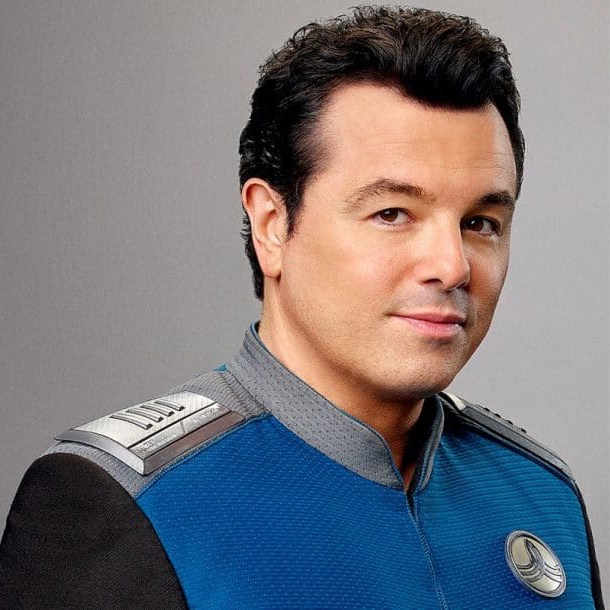
Fiction shines a light on the human condition by putting people into imaginary situations and envisioning what might happen. Science fiction expands this technique by considering situations in the future, with advanced technology, or with utterly different social contexts. Seth MacFarlane's show The Orville is good old-fashioned space opera, but it's also a laboratory for exploring the intricacies of human behavior. There are interpersonal conflicts, sexual politics, alien perspectives, and grappling with the implications of technology. I talk with Seth about all these issues, and maybe a little bit about whether it's a good idea to block people on Twitter.
Support Mindscape on Patreon.
Seth MacFarlane is a screenwriter, director, actor, producer, and singer. He is the creator of the animated TV shows Family Guy, American Dad!, and The Cleveland Show. He wrote, directed, and starred in the films Ted, Ted 2, and A Million Ways to Die in the West. He created and stars in the live-action episodic TV show The Orville (which will be moving from Fox to Hulu for its third season). He has recorded several albums as a jazz singer, and was the host of the Academy Awards in 2013. He is an executive producer for the reboot of Cosmos. His honors include several Primetime Emmy Awards, an Annie Award, a Webby Award, a Saturn Award, and a star on the Hollywood Walk of Fame.
- IMDB profile
- Wikipedia
- Allmusic profile
- The Orville: IMDB, Wikipedia, YouTube
Click to Show Episode Transcript
0:00:00 Sean Carroll: Hello everyone and welcome to the Mindscape Podcast. I'm your host, Sean Caroll. And people who like science, it's very natural often also enjoy science fiction. We like to think that science fiction is the literature of ideas, right? That science fiction takes us places, puts human beings in situations where ordinary fiction, which is constrained by reality might not let us go. So, there's opportunities within science fiction to ask questions and to examine existing questions in ways that would otherwise not be possible.
0:00:32 SC: So, today, we have an interesting angle in the science fiction universe. We're talking to Seth MacFarlane, the actor, director, writer who's famous for, of course, things like Family Guy, the animated show, movies like Ted, and Once Upon a Time in the West. And Seth also has albums, he's a singer and arranger of music, but the project that he's working on that I'm most interested for this conversation is The Orville. This is a, as you might know, science fiction TV show that appears on Fox, had just completed its second season. The third season will be upcoming. And it's basically Star Trek with some comedic touches. I think in the early days, people were a little confused about what The Orville was supposed to be. It had dramatic elements and comedic elements and it took about half a season, I would say, in season one to find its feet really. But now, to be honest, not just because Seth is on the show, I think this is one of the most interesting TV shows out there.
0:01:25 SC: They are really using the medium of science fiction to talk about issues that are very, very relevant to us here on Earth right now. So that's what Seth agreed to talk about. And we had a very interesting thoughtful discussion about how you come up with these scenarios, how they do relate to what's going here on earth, how the real world cannot help but affect your science fictional drama that you're writing, and hopefully backwards, how thinking about these new things in the science-fictional setting can give us new handles on the problems we have here on earth. So, I think it's a very rewarding conversation. Also, the first thing that comes up, and everyone admits it's true, is that Seth has a really wonderful voice for radio or podcasts. So that's always makes it a pleasant experience. I think you're gonna like this one. Let's go.
[music]
0:02:30 SC: Seth MacFarlane, welcome to Mindscape Podcast.
0:02:32 Seth MacFarlane: Thank you very much.
0:02:34 SC: So, you seem to be able to keep busy. Seem to have a lot going on. I know you have had TV shows and movies, various forms of talking animals and talking stuffed animals. But I really wanted to concentrate on The Orville, this science fiction show which I've become a big fan of. Why don't we say what the show is for the few of us in the audience who don't know?
0:02:56 SM: The show is kind of a classic style episodic sci-fi adventure series that sort of adheres to the traditional sci-fi method of storytelling, which is to take elements of our society, whether it be social or political or scientific, and find ways to tell stories about those things in an allegorical fashion through the lens of sci-fi. And, for me, I grew up with episodic sci-fi. I grew up with things like the Twilight Zone, and obviously Star Trek. And I miss that style of storytelling, which I could see a self-contained show that was based around an idea as opposed to a twist. And I think in the age of...
0:03:53 SC: Oh, that's a good way of putting it. Can you give an example?
0:03:55 SM: Well, in the age of streaming shows where you're dealing with a story arc that lasts throughout the season, it's kind of hard to explore a lot of different areas of... It's hard to tell... The diversity of stories becomes less in that format, and it starts to become about how can I surprise the audience with a crazy twist rather than what used to be the case is what new idea can I present to the audience this week. And you really can only do that with self-contained stories, I think.
0:04:32 SC: Yeah, and certainly I'm a big fan of a lot of the cable prestige, drama long series, but there's absolutely a place for...
0:04:38 SM: But that's all we're getting now.
0:04:39 SC: I know. Exactly.
0:04:40 SM: That's the problem.
0:04:40 SC: I miss procedurals and monsters of the week and whatever.
0:04:45 SM: Yeah. Yeah. I mean, it's nice to... One of the mission statements of the Orville is that, within reason, we do like to reward our fans for sticking with us, but it also should be something where you don't have to commit to an entire season right off the bat if you don't want to, you can watch one hour and we'll tell you a story that doesn't require you to have followed every soap-opera twist that's come before it and that's... There's no television show you can watch now, where the first episode doesn't insist that you stick around for the next 8 or 13. It's like the things paying off...
0:05:25 SC: No one has that kind of time. Yeah. Does it create pressure on you or the writers to come up with a new plot every week?
0:05:31 SM: Yeah, it's a different kind of... Obviously, to map out a serialized arc throughout the course of a season is a lot of work, but I do think that at the end of the day that's one idea, that's one story that you're telling over the course of 8 or 10 episodes. To come up with a brand new idea every week... I have such renewed respect for guys like Serling. Particularly at a time when there was nothing to really... There was no template to work from. He had to reinvent the wheel. That he was able to bring a brand new idea every week and not just for 13, for 22.
0:06:16 SC: And the Twilight Zone was obviously one of the inspirations, even more obviously Star Trek was an inspiration. So let's just tell the audience. You have a spaceship, you're on the bridge, there's aliens.
0:06:26 SM: Yeah, it's interesting that the idea of a... What is in effect a naval ship in space rather than on the waters is something that's been around since probably since before the 1930s, but obviously in film that seems to be where it emerged in the most memorable way with the serialized films that come from that era. Star Trek was the first franchise to really solidify it as a... Kind of work out the kinks. And it's interesting, if you watch Star Wars or Buck Rogers and these subsequent shows and they're all kinda taking cues from the original Star Trek. Star Wars uses the term cloaking device. That's something that they got from Star Trek.
0:07:19 SC: Tractor beams.
0:07:20 SM: Yeah, yeah, yeah, tractor beams.
0:07:20 SC: Photon torpedoes.
0:07:21 SM: Absolutely. Yeah, they just... They...
0:07:23 SC: There's a whole toolbox there.
0:07:24 SM: They wrote the book for all of us. And it's really just how you wanna use it. And I think, for us, if the Star Trek franchise was doing that particular thing at this point in time, then there might not be a place for The Orville. But because they're not, they've gone more of the streaming serialized direction. It's left this big wide opening that we've been able to step into with our show and we've been having a blast.
0:07:52 SC: So I take it, you were a Star Trek fan growing up. Were you science fiction fan in general?
0:07:56 SM: I was. Yeah. I was kind of picky and choosy about the sci-fi that I never really got into Blade Runner, Battlestar Galactica or this kind of hard sci-fi. And, really, I was a big fan of Star Trek, big fan of The Twilight Zone. I enjoyed some Ray Bradbury. Some of it got a little too heady for me when I was a kid.
[laughter]
0:08:21 SC: So it was reading as well as TV movies.
0:08:23 SM: Yeah. Yeah, I used to...
0:08:25 SC: I was a Heinlein guy myself at that age, but also as Marvel and Sturgeon and Zelazny...
0:08:30 SM: Yeah. Sturgeon... It's interesting, I bought a collection of his short stories and they're really out there. It's interesting, there's a lot of comedy in his writing. It's a lot of mixing sci-fi and comedy. And some of them are very much of their time, but others are... Have these little snippets of wisdom that are applicable to ours.
0:08:54 SC: How long have you been thinking about doing a sci-fi show?
0:09:01 SM: For some time, this show emerged... Originally, The Orville was gonna be... I've written as sort of a feature idea, and then very quickly decided, "No, there's nothing like this on TV right now." The initial version of it was very comedy-heavy. And when I look back at it, I realize that that wasn't really the show that I wanted to do. Since we've kind of veered... We've taken that pressure off ourselves and veered more towards into... Veered more towards traditional science fiction without the pressure of having to have that comedy frosting on it to such a degree. I've been having a lot more fun. I've realized this is... Even more so than writing Family Guy. It just comes flowing out. It's easier. So, maybe I never should have been a comedy guy in the first place.
0:10:02 SC: [laughter] We discover ourselves.
0:10:03 SM: Yeah. [chuckle]
0:10:04 SC: You're not done yet.
0:10:04 SM: Yeah, but it's a blast. And it's gratifying to see that people were... Fans were willing and ready, in many cases, eager to see that from us. I think a lot of it initially was fear that no one would take me seriously if I wrote a sci-fi show, and I've been pleasantly disproven.
0:10:31 SC: Well, I thought it was very interesting, the initial reaction to the show, not just what it was but from whom. If I'm getting it correctly, like if you go on to the professional critics season one reviews, they were not good.
0:10:47 SM: Yeah.
0:10:47 SC: But the audience loved it.
0:10:48 SM: Yeah.
0:10:48 SC: And season two, it's caught up, right? And part of that, was it the evolution of the show or do we educate that?
0:10:54 SM: I think some of it was the evolution of the show. I think the smaller portion was the evolution of the show. I don't think the show changed that much, because we did... One of the episodes, we did show the critics initially was about a girl episode about Bortus's baby.
0:11:12 SC: That's a big one. Yeah.
0:11:14 SM: And that gets pretty... For season one, that gets pretty dark.
0:11:20 SC: Intense. Yeah.
0:11:22 SM: I think what happened was it took them a minute to realize that we weren't trying to do the serialized format that everyone else is doing and that the whole point was to let the story dictate the tone. And I remember on the original Star Trek, you see a lot of that. There are episodes that are very dark, very dramatic. There are episodes that feel more like a comedy and...
0:11:51 SC: And Trouble with Tribbles, right?
0:11:52 SM: Yeah. Yeah, and I see it as... Look, life is that way. You have one day where it's your birthday and you fall in the swimming pool by accident, and another day where you lose a family member. Those days have very different tones and it's all the same life, but it feels very different. And there's television... Television can reflect that and the characters have to be consistent and they have to be your anchor, but beyond that, I think there's no reason that the story can't dictate what the tone is if you're telling an episodic story that self-contained. And I think that's what threw the critics, I think with three episodes that they felt like this thing was disjointed. Look, for whatever reason, they always come out swinging when I do something new anyway.
[laughter]
0:12:47 SM: Yeah. Yeah.
0:12:47 SM: There's a little bit of that. Like there's a little bit of the reviews being written before the thing came out, but I was... You try to ignore it, but at the same time, it's gratifying when you see that nice big fat round tomato and that 100%.
0:13:01 SC: That's right. That does feel good.
0:13:02 SM: I don't hate it.
[laughter]
0:13:04 SC: You do read the comments in other words, right? I have my little podcast and I try not to, but I... It's a social thing that we're doing.
0:13:13 SM: Yeah, for television, it's... For a podcast as well, I imagine you're doing something for an audience, so there is a partnership between you and the audience.
0:13:20 SC: Yeah, you care.
0:13:23 SM: With...
0:13:23 SC: And most of it, by the way, is great.
0:13:45 SM: And a lot of what you do thought is science-based, right?
0:14:01 SC: On the podcast, not quite 50%, less than 50% but...
0:14:07 SM: Yeah, yeah, 'cause that's where it gets dicey is that... This idea that, "Can't we just all just have different opinions?" Well, you can on this but not really on that. With entertainment, with something like The Orville, it's very... I'm very... I read as much as I can. I read, sometimes it's torture, but I'll read Reddit, I'll read YouTube comments, I'll read Twitter, I'll read Instagram. I'll just get as much information as I can just 'cause it's fun to see people talking about it. And sci-fi fans are so passionate about what they like and what they don't like. And you try to balance it between your own vision of where you want the show to go and what it is they wanna see because... And I think if you can thread that needle, you're doing something right. I think you can't let them guide you completely but at same time you can't ignore them.
0:14:26 SC: No, but you can learn something, like they're not idiots all of them, right?
0:14:28 SM: Yeah. No, no. It's interesting. The Isaac two-parter that we did our second season was something that was a big question mark for us. It was dark and it was big and it was pure sci-fi, and I had no idea whether people were gonna respond to that or not. And not only they responded to it, it was the most popular set of episodes to date for the series. And the rest of that season kind of put The Isaac's story on hold because we had written them all in advance and I didn't realize it was gonna be that successful. But reading as much of what I did online, I discovered, "Oh, people wanna know what the aftermath of this is." And so we...
0:15:17 SC: It came back.
0:15:17 SM: I hear 'em and we're dealing with that in season three.
0:15:20 SC: And probably when the show first came out, there were expectations. You're a comedy writer.
0:15:25 SM: Yeah.
0:15:25 SC: I think some of the marketing made it look more like Galaxy Quest...
0:15:28 SM: Very much, yeah.
0:15:28 SC: Or a parody show, right? And then people were a little... Do you know what to think?
0:15:31 SM: It's a lot of fear, it was a lot of fear on both sides. And I think the second season marketing piece that Fox did was terrific. I really thought they did a great job. The first season, from their end and from my end, there was some fear. And look, I credit Jon Favreau for being my conscience when he directed the pilot, and he pointed out to me on a number of occasions, "You have this joke here and I feel like you're disrupting what is a really good scene." He said, "You should trust that what you have here, I'm into it. I read the script and I didn't put it down. I wanna know what happened, I was in it. I like the story, the story works, and you don't need the crutch of all these jokes." And that was from... I respect him enormously. And so to hear that, was kind of the first step toward me making the realization that, "Alright, maybe I can do this show that I really wanna do and I don't have to pack it with pies in the face and people will still watch."
0:16:36 SC: And yeah, I think it seems to evolve to a place where it's different than a typical sci-fi serialized, or even episodic show because of the jokes but it's still story and character and setting-based.
0:16:49 SM: Yeah, and the jokes tell you where they wanna appear. The two-parter with Isaac was virtually... There was a couple of jokes in there but that's about it. And it was where they show up these days, is just comes more from the casualization of life on board a spaceship, rather than hard jokes. It's just the behavior of the characters.
0:17:12 SC: It's a little more realistic in some sense, right?
0:17:13 SM: Yeah, yeah. And it...
0:17:14 SC: People are not quite a stiff as you might see in the TV shows.
0:17:16 SM: Yeah. Well, yeah. And it has to be for... It's a tricky line to walk because you want people to care about what happens, you wanna be able to tell a story with big stakes like we did in Identity. And oftentimes that means giving up the shtick. If this is serious, your characters have to treat it seriously, and you just gotta embrace that. And so it was nice that the audience went along with us there.
0:17:43 SC: And there's also another slightly different thing that we don't have in Star Trek is, your ex-wife is your second in command?
0:17:50 SM: Yeah.
0:17:51 SC: And there's a lot more of the personal lives of the characters, a lot more socializing.
0:17:55 SM: Yeah. Well, that's the part of science-fiction that I don't see enough of. I loved... It's no secret that I loved The Next Generation for their, among other things, for their production design. It always made sense to me that if you were in space for that amount of time, you would have to live somewhere that was comfortable and...
0:18:19 SC: They had a bar. That was a huge upgrade over the original Star Trek.
0:18:21 SM: Yeah, it was like the sci-fi version of the apartment on Friends.
0:18:25 SC: Yeah.
0:18:26 SM: You wanted to be there every week, you wanted to go back. And that's something that is absolutely absent from science-fiction today, all across the board. Everything is grim and dark and looks like you're on a submarine, and it's cool to look at but it just doesn't... It's not a place that you wanna live in.
0:18:45 SC: Yeah. It seems a little bit less human. I know what you mean.
0:18:47 SM: Yeah, and it's...
0:18:48 SC: And again, there's a place for it but there's also a place for this slightly lighter...
0:18:53 SM: Yeah, I just... I think you should be able to... On a good sci-fi, so you should be able to accommodate all of that. Your characters should be strong enough that even if there's no sci-fi plot, you should be able to tell a dramatic story that week that just deals with their lives.
0:19:14 SC: So when you started planning out the show, presumably you had the idea there would be a starship, there would be crew, some of them would be aliens, like how much... Was it fun or kind of torture to sit down and go, "Alright. What are the alien races? How are they different?"
0:19:28 SM: A little bit. Because there's so much science-fiction now, it's hard to find...
0:19:33 SC: Low-hanging fruit has been picked.
0:19:35 SM: Yeah, yeah. It's hard to find things that haven't been dealt with. As you go and as you start to break your stories for the series, what's nice about it is those races kind of pop up in the midst of... Look, for both The Simpsons and Family Guy, it happened with our characters. I remember asking... God, was it, Greg Daniels, who used to run King of the Hill, used to, I think, wrote on The Simpsons like, "Wow. Where did all these characters come from, this populace of characters in Springfield?" And he said, "They just kinda popped up as we went along." A character would emerge in the middle of a story and...
0:20:19 SC: Like, "Oh, that's good. We need to develop that."
0:20:20 SM: Yeah, it'd be a funny character, so let's make that person a part of the town. And eventually, the same thing happened with Family Guy. These characters popped up as we were telling these stories, and with The Orville, it's been the same. We will tell a story and an alien race will emerge as part of the narrative and it works, and so we keep them around.
0:20:45 SC: So there are... It seems extremely explicit, at least to me, that you are taking advantage of the idea that science fiction can comment on our current state, our current problems in various ways. You wanna mention some of your favorite? I have a long list here of different things you've done, but...
0:21:00 SM: Yeah, that's a broad question. In other series or what, as far what we've done?
0:21:07 SC: No, on The Orville. What I'm thinking of is the obvious example is Bortus when he basically develops a porn addiction, right? [chuckle]
0:21:15 SM: Yeah, yeah.
0:21:16 SC: On what is equivalent of a holiday.
0:21:17 SM: Yeah, yeah, yeah, yeah.
0:21:19 SC: But that was not an alien worry, that's a very human worry.
0:21:24 SM: No, it's... Yeah, I think that episode was the only time we ever got a standards note in the history of the show. By the way, it's...
0:21:34 SC: That's pretty good.
0:21:35 SM: For me to have that experience, it's like, "Oh, that's right, there's a Broadcast Standards Department." We never hear from them. It's ironic that I have one show that's been virtually condemned by the Parents Television Council and another that's been roundly endorsed. I'm not sure how many people can say that in their career. But yeah, that was an episode that, yeah, just dealt with the psychology of, look, in the age of the internet when you're walking around with a little device in your pocket that can access naked pictures 24 hours a day, and that's gonna affect relationships, that's gonna really fuck with people's heads, and there has to be some kind of fallout for that, and that may be a little bit... I probably sound like a conservative with that. I'd be a...
0:22:36 SC: Well, that was pretty mellow. Yeah, yeah.
0:22:38 SM: Yeah, there has to be...
0:22:39 SC: There are issues.
0:22:39 SM: Yeah.
0:22:40 SC: It doesn't mean ban it, right? It doesn't mean don't let it happen, but we should face up to the changing reality and so how we interact with things.
0:22:47 SM: You just have to be aware of how... Of what your relationship is with technology, and Twitter is the best example. We're all on Twitter and I fucking hate it. I don't know about you.
0:22:57 SC: I kinda love it. I really do.
0:23:00 SM: You do?
0:23:00 SC: I do, yeah. I block people a lot and that's what makes it tolerable.
0:23:03 SM: Yeah. But isn't that a tricky thing, because it's... I used to do that. I still do it from time to time just 'cause I don't wanna deal with it, but it's almost like people take it as a tacit acknowledgement...
0:23:17 SC: A victory. Yeah. No, they...
0:23:17 SM: Yeah. They wear it as a badge of honor, and it's like, "Well, you don't really wanna give them that."
0:23:20 SC: Let them have their victory. I thought that for a long time. I muted people who I didn't like, and what convinced me was friends who said if you mute somebody, then the rest of the people reading the comments on your tweet still hear them. Only you miss them. Whereas, if you block them, then they just can't interact and...
0:23:36 SM: Right.
0:23:36 SC: Twitter's a weird thing because you're broadcasting to everybody, right?
0:23:41 SM: Do you think there's any positive at this point? And I think, initially, obviously Twitter was this charming little platform that was new and fun, and we would each write a joke every day...
0:23:54 SC: Yeah. And it was funny, yeah. [chuckle]
0:23:56 SM: Do you think there's any upside to Twitter at this point in time?
0:24:00 SC: I invited you at this podcast over Twitter. [chuckle]
0:24:02 SM: Okay. Well, beyond that?
[laughter]
0:24:04 SC: No, I've made good friends over Twitter. I have... I've met people who I otherwise wouldn't have met, people who've become friends in real life. I learn about things, I can follow people. I was just joking with this... We were talking with a friend of mine last night about this, I tried really hard to follow a bunch of conservatives on Twitter, and I found that the only ones who I could really follow without degrading my state of mind were ones who hated Donald Trump.
0:24:30 SM: Yeah, yeah, yeah.
0:24:31 SC: So there are those principled conservatives, but then there's a whole swamp out there, crazy people who I try hard to avoid.
0:24:39 SM: Yeah, yeah. Yeah, it is tricky, 'cause I have a lot of liberal friends. Obviously, I live in Hollywood. I do have a fair number of conservative friends and yeah, there is a difference between your conservative friend who votes for Mitt Romney and your conservative friend who votes for Donald Trump. Those are two different types of people. Maybe there's more crossover than we'd like to think, and I try to not let that keep me up at night.
0:25:06 SC: Well, I think Twitter is... Twitter and Facebook and all these things, we're just in the beginning, right? There's a technology that's changing everything. I do believe that we're gonna have implants in our heads before too long that will let us do this without the intermediary of the phone, and there's lots of science fiction stories being written about this.
0:25:23 SM: And it's interesting. There is a fear... I'm actually somebody who does not subscribe to the fear that... I think this... As much as I grouse about Twitter and the early forms of this technology, I do think there's a lot of, at the moment, destructive power that they seem to have much more so than constructive, but... You look at... You talk about implants in your head. Look at something like evolution, which is real, let's just establish that.
0:25:58 SC: Yeah, it's the official Mindscape position that evolution is real.
0:26:00 SM: But it's just this staggering brainless moronic thing that makes its way through the millennia, having no... And stumbles on us by accident.
0:26:13 SC: Yeah.
0:26:14 SM: Like at a certain point, you do kind of think to yourself, "Boy, we could do a better job."
[chuckle]
0:26:17 SC: Yeah.
0:26:18 SM: And there's a dystopian...
0:26:19 SC: And we're...
0:26:20 SM: There's a dystopian onus that goes along with that.
0:26:22 SC: Those among us are trying. Yes.
0:26:23 SM: And I don't... And I think that it's time to kind of maybe revisit that idea. Because if you could... God, if you could just tweak some things in the human body that... God, look at eating.
0:26:40 SC: Yeah.
0:26:40 SM: It's your body...
0:26:41 SC: It's disgusting, right.
0:26:42 SM: Evolution still thinks that I'm out there with a spear in my hand, trying to hunt a boar.
0:26:46 SC: Yeah.
0:26:46 SM: It doesn't realize that, "No, there's like a McDonald's right there."
0:26:49 SC: Well, I think that that's the thing because we focus a lot on AI and computers, but I think that the making human beings more automated and changing them, editing them... I've talked on the podcast with synthetic biologists who are building cells from scratch.
0:27:04 SM: Yeah.
0:27:04 SC: And yeah, that's why I say we're just at the beginning of what these changes are gonna take us to.
0:27:09 SM: And I think that really but how different is that from using a drug to save your life if you have an infection?
0:27:18 SC: In some sense it's not, right? But then... So the thought experiment is, "But what if I invent a drug that just makes you happy all the time but you never leave your chair? Is that an improvement in your life or not?"
0:27:26 SM: I think it's called Jack Daniels.
[laughter]
0:27:29 SC: You have to leave sometimes.
0:27:30 SM: Yeah, no, that's... And that's... Yeah, that's a concern.
0:27:35 SC: Yeah, brave new world. We're gonna be seeing some...
0:27:36 SM: Yeah.
0:27:37 SC: And I'm a huge believer that science fiction helps us just go a little bit toward thinking these things through ahead of time.
0:27:44 SM: Yeah, that's... Well, that's... That's a big job then.
0:27:48 SC: So Bortus, for those who have not seen the show, Bortus and Klyden are members of this race, the Moclan and we're told there are only men. Only male Moclans, but they manage to give birth somehow. Which makes me think that there are really only female Moclans. But so I'm not quite sure what the definition of male or female is.
0:28:08 SM: I think we've struggled with that a little bit. The storytelling value that that species gives you as opposed to the logic of the biology. What we've kinda landed on is, "Alright, their definitions are a little different than what ours are."
0:28:22 SC: They're very masculine presenting, right?
0:28:24 SM: Yeah, yap.
0:28:25 SC: They're pretty macho.
0:28:26 SM: Because it is... At the end of the day you can always fall back on, "Well they're aliens, it's different."
0:28:32 SC: That's right.
0:28:35 SM: But yeah, it's an interesting... It was a dynamic that I hadn't seen before. These two very stoic, kind of classically science fiction aliens who were... Who were a pair. Who are mates.
0:28:54 SC: Yeah.
0:28:54 SM: And have this kind of domestic life going on and it's... Those two actors are just gold. Chad...
0:29:00 SC: You're fantastic, Chad.
0:29:02 SM: Chad Coleman who I think also does The Expanse.
0:29:06 SC: Oh yeah, he was Cutty on The Wire.
0:29:07 SM: And Peter Macon obviously as Bortus are... They're my favorite couple on TV.
[chuckle]
0:29:17 SC: I can endorse that. You could do a lot worse. But then... So I'm gonna mention in the introduction that we're spoiling everything, so that's okay. But they have a child.
0:29:26 SM: Yeah.
0:29:26 SC: It is female, this is a scandal, and the cultural expectation is that there will be a sex change to turn it into a boy.
0:29:34 SM: Yeah.
0:29:35 SC: And that is heavy stuff to be tackling right there in season one.
0:29:38 SM: Yeah, well, it's... What always fascinated me was... And again, the specifics of that episode and that conflict are arguably less pertinent than the more general conflict that's at play in there. And that's... If you have another culture that does things their own way, that doesn't stack up with your morals and your code of ethics but it's still their culture, at what point do you... At what point do you respect their ways and at what point does that get so insane that you can't justify it in your own mind or live with yourself and it becomes time to be galaxy police?
0:30:31 SC: And Claire, I guess, is the doctor.
0:30:32 SM: Yeah.
0:30:32 SC: And she originally... So her question was... She is also one of the treasures of the show, by the way. That actress is amazing.
0:30:37 SM: Oh, she is great. She is great. Yeah.
0:30:40 SC: She wanted to know was it... She worked through the ethical dilemma here.
0:30:47 SM: Yeah.
0:30:47 SC: Who is benefiting from this? Is it medically necessary or is this just a cultural thing? And I don't think there's obvious answers to these questions.
0:30:55 SM: Those are my favorite kinds of stories. And look, as much as I love... As much as I think there is an absence in television of noble people who just wanna do the right thing, everyone's an anti-hero, and I do miss the simplicity of Gary Cooper saying, "Damn it, I just got married but I gotta turn around and go fight this bad guy." I do think that that's not a good thing that that doesn't exist on television. That I... When I was a kid, I had... It was fiction, but there were people like Pickard. And it was...
0:31:33 SC: Yeah.
0:31:35 SM: People who were... People who were just out to do... Even the super heroes. The Super Friends for God's sakes. They were so wholesome. But these were people who were just out to do the right thing. And I think at the end of the day, to see people struggling with what the right thing is, but yet coming from a noble place and coming from a virtuous place but not being able to find a clear answer, those to me are the most interesting kind of stories that I can latch on to. I get a little weary of, "Oh, this guy is a murderer and a drug addict and all this, and I'm supposed to sympathize with them." It's at a certain point, it's just... I'm just watching terrible people do terrible things.
0:32:15 SC: It does wear you down a little bit.
0:32:19 SM: I love the Handmaid's Tale, but at a certain point, I start to get tired. This girl getting kicked around. It's just not...
0:32:24 SC: I read the book. I couldn't bring myself to watch. Have you seen Fleabag?
0:32:27 SM: I haven't seen Fleabag.
0:32:29 SC: It's really, really good. But in the beginning, it's just hard, because there're just so many bad things. [chuckle]
0:32:33 SM: Yeah, yeah, yeah.
0:32:34 SC: Dead people.
0:32:35 SM: But it is... That's the most fun stuff to write, is those stories that don't have a clear cut, and that's what we're always looking for on The Orville. The stories don't have a clear cut what's right and what's wrong and things that where you have to weigh the rights of the individual against the needs of the society, it's all interesting stuff, and it's all stuff that science fiction is arguably more equipped than any genre to address, and I have a blast writing those kinds of stories.
0:33:10 SC: We had a thought while watching some superhero movie that... Every superhero movie is a trolley problem basically. It's like the choice between being nice to my friend who I know or saving the universe.
0:33:20 SM: Yeah.
0:33:21 SC: And, of course, because it's a super hero movie, they usually figure out how to do both.
0:33:25 SM: Yeah.
0:33:25 SC: But these are the real dilemmas and they play out in infinite number of different ways.
0:33:30 SM: Yeah, it's fun to leave that stuff... Look, there are certain stories where you... It is clear. This is right and this is wrong. You may disagree with me, but I'm pretty confident in my ethics. I find a lot of what we do on The Orville is we struggle along with the characters. It's a tough thing to... That story is a good example. This is their society, but what they're doing is really fucked up. And look, it's... Saudi Arabia is a perfect example. It's their culture, but look how they treat women. At a certain point.
0:34:14 SC: Yeah, I'm not personally...
0:34:15 SM: At a certain point, when do you walk in there and say, "Hey, you're gonna stop doing this, and you're gonna start doing things this way"? People have differing opinions. I happen to believe that in that scenario, there is an argument to be made for being a little bit of a hero and helping out the oppressed, but not everyone agrees with that. Some people would say it's their culture, it's not your business.
0:34:45 SC: Yeah, I'm on your side in the sense I do think sometimes you're gonna try to intervene, but I certainly, historically recognize that there's plenty of times when societies have talked themselves into the idea that they were the virtuous ones, and in fact, they were just imposing their own views, right? [chuckle]
0:35:01 SM: Yeah, yeah.
0:35:02 SC: We've had crusades and colonies and the whole bit.
0:35:04 SM: Yeah.
0:35:06 SC: Did you get pushback from that episode by people who have interests one way or the other in gender reassignment or gender identity?
0:35:13 SM: We didn't, we... No, certainly not from the company. What's interesting about Fox is for all of their conservatism on the news side, I've never once been censored in any way with anything that I've done. I will say that for them. And when the episode aired, there was... There were mixed reactions, and there was a lot of passionate things written about the story and, again, there was some things that I read that educated me a little bit and some things that I thought w were a little bit... Maybe not so correct in their analysis of the show, but it's... Overall, the reaction that I found to that show, and it was gratifying was that, "Hey, at least somebody's talking about this on a network."
0:36:13 SC: Yeah, yeah, and you'll reach a different set of audiences than the one that are very passionate on Twitter about these things, right? Well, sexuality is definitely going to be an area where science fiction can talk about things that are a little out there, and you've done it, right? You've had your human characters have sex with Androids, or with robots, with gelatinous blobs, and some of that was very brave like the scene where Claire was having sex with a gelatinous blob.
0:36:38 SM: Yeah. [chuckle]
0:36:38 SC: That's never gonna leave my brain.
0:36:40 SM: Yeah, that was... Yeah. Again, God bless Penny, man. She's just... She's game for whatever you throw at her.
0:36:48 SC: And I think that it makes the audience think about if I do find this icky, why do I find this icky, is that something you're intentionally going for or...
0:36:56 SM: Yeah. It's a... There's no right way to answer that. It's, "Do I find the icky? Would I wanna have sex with a gelatinous blob?" Probably not, and that's okay. [chuckle]
0:37:13 SC: A gelatinous blob played by Norm Macdonald. [chuckle]
0:37:14 SM: Yeah, yeah, yeah. But yeah, it leaves the door open for interpretation in a lot of cases.
0:37:23 SC: But in contrast, when she fell in love with Isaac, the robot, it was not played for laughs in any way, right? It was actually very tender.
0:37:32 SM: Yeah. Well, the... This... The idea of the artificial intelligence that's trying to understand and trying to communicate, that's always...
0:37:40 SC: That's a classic.
0:37:41 SM: It's a classic, because it's convert... It's both warm and fuzzy and funny. There's a lot of different colors that you can play with with a character like that like. Those... The non-human characters trying to grasp human culture is always a great... And it's always a rich source of sci-fi writing. But yeah, to me, I don't know, I thought why not? It's... At a certain point it's reasonable to assume that an artificial intelligence is gonna reach the point where it achieves consciousness, I would think. Maybe it's happened already, I don't know, but presumably at some point, that's not a crazy thing to think will happen, and so, what... Is that off limits? He's a person.
0:38:35 SC: Well, we're getting there. There's... The sex robots are definitely coming and then the sex robots will be easier than love interest robots.
0:38:43 SM: Yeah.
[chuckle]
0:38:43 SC: But they're gonna happen, sure.
0:38:45 SM: And then, of course, the question of rights. It's like you can't really have a sex robot that's sentient.
[chuckle]
0:38:51 SC: Yeah, yeah, yeah.
0:38:51 SM: That would not be moral.
0:38:54 SC: Yeah.
0:38:54 SM: But it's... Yeah, that story was interesting because it's... I don't know... In that I just wanted to tell sort of a classic Hollywood love story that ended with singing in the rain, [laughter] and these two very, very different people who... What's the version of emotion from somebody who can't feel?
0:39:17 SC: Right.
0:39:17 SM: And the best example of that that I can think of is... Was Alan Jay Lerner's solution to "Pygmalion" when he was writing the lyrics for "My Fair Lady" is that song, "I've Grown Accustomed To Her Face." [chuckle] It's like that was his solution to a love song that's not a love song, because Henry Higgins was not a... This was not an emotional character, I mean, not in that way. It was very... You know, a lot of histrionics, but he wasn't... He was very cold and unfeeling and so, it made no sense for this guy to sing a love song. So what he latched on to was that he had just become used to her presence and that was... I took a little bit of that and applied it to Isaac in trying to determine what it is about him that would fit with his machine mentality, but would still acknowledge her absence from his life.
0:40:12 SC: We can't really help but tell these stories from a human-centric point of view.
0:40:16 SM: Yeah. It's very hard to... 'Cause your audience is human.
0:40:21 SC: Yeah, they are mostly human [laughter] and they're gonna...
0:40:23 SM: Mostly human.
[chuckle]
0:40:24 SC: Mostly human and therefore, there will always be this hint or this implication that the emotionless robot can learn something from us.
0:40:32 SM: Yeah.
0:40:32 SC: And maybe there hasn't been enough of us learning something from them.
0:40:35 SM: I completely agree. It's funny, when I used to watch the original Star Trek I used to have that thought about Spock. There was always this nagging thing in my head that would scream, "This guy kinda has it figured out." [laughter] Like, it seems like...
0:40:50 SC: Once every several years he goes crazy, but okay.
0:40:52 SM: Seems like this society is a lot more peaceful [laughter] than what we have going on.
0:40:55 SC: We developed science and everything, yeah.
0:40:58 SM: But, no, I think absolutely, that's true. I think that's... Look, in a perfect world, where the Terminator doesn't come true, you do reach a point where in the distant or not so distant future, if artificial intelligence is an element that's a day-to-day part of our lives that we do learn from each other.
0:41:19 SC: So you also talk about religion on the show. You have the Krill who are highly religious, basically religious fanatics, right? Do you... But it didn't seem like it was an element of the show, but it wasn't like an in-depth investigation of the pros and cons.
0:41:32 SM: Yeah. Yeah. And in the third season, we're expanding, we're broadening that culture a little bit, so it's not just that one note. It's... I don't wanna give anything away.
0:41:45 SC: Sure.
0:41:45 SM: But it's an element that... I don't know, it's... Whenever I write the Krill, I have like... There's always a different idea of who they are in my head. Are the Krill... Are they terrorists? Are they us? Are they... [laughter] There's always...
0:42:06 SC: Are we the real terrorists?
0:42:06 SM: I can never really figure out where it is they land. And they're always sort of a metaphor for something.
0:42:14 SC: Well, other than robots, it seems implausible that an entire race of creatures would be evil.
0:42:22 SM: Yes, I agree, completely, yeah.
0:42:23 SC: So they're gonna have good aspects and bad aspects.
0:42:24 SM: And that's where Teleya is... Teleya is one of my favorite characters that... Michaela McManus was... Came in to do a guest spot on this one episode and she was so amazing that we just ended up deciding this is gonna be a character we're gonna see over and over. But it's...
0:42:44 SC: She was the Moclan? Am I remembering correctly?
0:42:46 SM: She was the Krill who... The Krill woman who Gordon had...
0:42:50 SC: Oh, the teacher.
0:42:52 SM: Yeah.
0:42:52 SC: Yeah.
0:42:52 SM: And in the second season, we brought her back. And again, that's another one of my favorite go-to sci-fi stories, is the enemy mind idea where you look for that commonality in the enemy and it's always there, it's always there.
0:43:10 SC: Yeah.
0:43:14 SM: Almost always, right? Probably Hitler didn't have it, but... [laughter] But for the most part...
0:43:18 SC: Hitler had a mother.
[laughter]
0:43:20 SM: Yeah. There is a... There's a commonality. There's... That's the extreme version. I do think that there's a... When you sit down with Conservatives, even hardcore Conservatives, you do find that you have a lot more in common than you thought. Nobody's going into it wanting to be the bad guy. Everyone wants to believe that they're doing the right thing and that idea of no matter how... As you said, like, no matter how bad the race is, it's kind of irresistible that eventually you meet one that is... That turns out to be somebody that you can relate to.
0:44:07 SC: Surprise you in some way.
0:44:08 SM: Yeah.
0:44:09 SC: Well, and going back to Twitter, one of the things about our current moment is, we can demonize whole groups of other people because we hear about them all the time without interacting with them, right?
0:44:18 SM: Yeah, exactly.
0:44:19 SC: They're somewhere else and so, we can hold this cartoon of them in our brain.
0:44:22 SM: Yeah, yeah. And look, I think that happens... I think that's happening with... Look, Fox News made a whole career of that. Fox News made a whole... A brand in that rather. It's...
0:44:33 SC: There was this article recently like, "How Fox News destroyed my family." Have you seen that one?
0:44:37 SM: I didn't see that, no.
0:44:39 SC: It's basically, "When I used to go home and my parents whatever would have slightly reactionary opinions, but we could talk, but now they think that all my friends are the devil."
[chuckle]
0:44:48 SM: Yeah, yeah. It's too oversimplified. Look, Fox News, there's no getting around it that, that network is, it's one of the instigators. Some would say the biggest instigator of that kind of thinking. When they all started the network, it was about storytelling, it was creating heroes and villains. These are the good guys and these are the bad guys. People wanna see, they want that simplistic narrative.
0:45:23 SC: They were talented at telling those stories.
0:45:24 SM: Oh yeah, oh yeah. They still are. It's, as destructive as it is, you can see the formula. It's about us and them. And I never saw that from the other side until the emergence of social media. And my God, you make a mild observation and conservatives, liberals, they'll all come after you.
0:45:53 SC: So am I mistaken or is there... I haven't seen any social media on The Orville.
[chuckle]
0:46:00 SC: Is that gotten rid of in the future?
0:46:01 SM: It's... Oh. Oh, on the show. I was gonna say, "Our marketing people really aren't doing their job then, are they?"
0:46:06 SC: The other way around, I've seen The Orville on social media, not social media on The Orville.
0:46:09 SM: Yeah, it's something that we felt was better addressed as something that is elsewhere. The social media episode in season one was I think a much more effective use of... It's hard. There are certain things that are... Cultural things are really hard to depict in science fiction without looking silly.
[chuckle]
0:46:39 SC: Or looking dated five years later, right?
0:46:40 SM: Or looking dated, yeah. Technology is easy. The uniforms are easy, the ships are easy. But when you get into... People ask me all the time, "How come they never listen... How come the music that they listen to... How come the pop culture is always of our time?" And I always have to say, "Have you ever heard future music in sci-fi that doesn't sound so fucking stupid?" There's no way, you can't predict it. If I could predict that, I'd be a billionaire in the music industry.
[laughter]
0:47:10 SC: So why not get a joke out of it, right? Why not have Billy Joel be there all the time?
0:47:15 SM: It's just a sensible... Those are things that are not... We're not there to do that job. That's for the futurists.
[laughter]
0:47:24 SC: So I also like, beyond big themes, like social media, religion, or whatever, you've had some interesting episodes just about personal anxiety and imposter syndrome, roughly speaking. John, I guess it was, we learn at some point he's actually super smart and genius IQ, but has been hiding it in a way that many people can probably relate to. And is that, again, where does that come from? Is that personal experience on the writers or is there a mission to sort of tackle questions like that?
0:47:57 SM: That was sort of a... It was a little simpler than that. Look, impostor syndrome is... I think a lot of people in Hollywood feel it. It's this idea that you're a fraud and you're not really making anything great and...
0:48:12 SC: We have that in academia too.
[laughter]
0:48:14 SM: Yeah, yeah. [chuckle] I tend to look back at things that I've written or even things that I'm in the process of writing and beat myself up, and somehow convince myself that I should get out of the business and do something completely different.
[laughter]
0:48:33 SM: But that was more of a result of the need to give that character something more to do. You have a helmsman and a navigator side by side and we had made this whole deal about Gordon being the best pilot in the fleet. And there's John sitting next to him.
0:48:51 SC: There's nothing compensating.
0:48:53 SM: The two of them are great together, but beyond that, we wanted him to have his own identity. There was a little bit of a sacrifice, because they're so good together that you no longer have them sitting next to each other and you lose a little bit of that. But what we gain was an identity for this character that really ended up, A, giving us a story and B, being the anchor for this kind of rogues' gallery in engineering that this...
[laughter]
0:49:21 SC: It's a wild world down there in the engine room, yeah.
0:49:25 SM: And he's kinda the Steve Martin Roxanne character who's gotta kinda corral the fire department.
[laughter]
0:49:32 SC: Well, that, I think it's very interesting for, as an audience member, probably we attribute much too much intentionality and planning to everything that happens in the story in the episodes, but in fact sometimes like there's a problem and you have to fix it, and that leads to new story options, right?
0:49:47 SM: Yeah, it's interesting reading... There's times when they predict things well and they figure it out, and they're right that we have thought this out. The Isaac turning on the crew was something that was in our minds from day one. That was all part of the plan. But there are other things that I will read and I'll react in such a way...
[chuckle]
0:50:13 SM: I'll say to myself, "They think that we're way smarter than we are. This is way overthought."
0:50:20 SC: Is there either a danger or an opportunity to get ideas by reading other people's tweets?
0:50:25 SM: Yeah, I think that's... You never wanna be in a position where you're stealing something from somebody, but if somebody says something about the show like, "Hey, boy, I'd love to see this," or, "I'd love to... " That's all fair game. That's all fair game. That's just responding to your fans. And yeah, that's hearing what the audience wants. So I do pay attention to that stuff.
0:50:51 SC: You've definitely been... It's a science fiction show but you're also a science fan, for its own sake. I think that the first time I saw you in person was at the Science and Entertainment Exchange Lunch event.
0:51:01 SM: Yeah. Yup, yup.
0:51:02 SC: My wife Jennifer was the director of the Science and Entertainment Exchange.
0:51:04 SM: Oh fantastic. Yeah. Yeah, yeah, yeah.
0:51:04 SC: She was the first director. Yeah. And that's an organization that does a great amount of good here in town definitely.
0:51:09 SM: Yeah, absolutely.
0:51:12 SC: So how much do you care about the science of your science fictional universe?
0:51:18 SM: It's important... Well, look, I have to acknowledge that the whole reason the Science and Entertainment Exchange was created, to my knowledge is that so many people get their science from fiction. They get their medical science from ER and Grey's Anatomy.
0:51:35 SC: Their law from Law & Order.
0:51:38 SM: And they their law from CSI or whatever, Law & Order. But so I think there is a responsibility to be right. Andre has been doing this for years.
0:51:52 SC: Andre Bormanis, yeah.
0:51:52 SM: Andre Bormanis has been doing this for years. If there's something that I'm hazy on, I'll pick up the phone and call Neil Degrasse Tyson, or in many cases I'd walk across the hall to Annie Druyan's Office, who works in Cosmos, and not technically a scientist, but my God she sure talks like one. And you do try to do your... My God, I was in a session with my psychiatrist and I stopped in the middle to take some notes about a story that... Let me ask you this, if alien did this, and he came in here and he sat down on this couch, how would you react? And so... Or if I'm at a... I go for my annual physical and I have a medical question that relates to a story we're telling, I do try to get it from the right sources. You can... Time will only allow so much of that, but you do try to be responsible. If it's something that's a story that's just too damn good that requires us to stretch it a little bit, then we will, but where it's feasible, we do try to be scientifically responsible, yeah.
0:53:00 SC: I'm a big believer that the science serves the story in a fictional environment. The science should be of the form that it makes you not go, "Oh, that wouldn't happen."
0:53:11 SM: Well, it can't ever feel like magic. And there's one area that Brandon Braga and I have talked about this, this one area that we both struggle with when we're writing aliens. Is that the idea of a... The super strength from a planet with high gravity, that I can get on board with that. The one that I always struggle with is telepaths. That's the one that always I can never wrap my brain around how that doesn't feel like magic. How you're basically writing a psychic. If you employ technology into the mix, then I start to kinda see it but...
0:53:50 SC: But you don't even have a teleporter machine, a transporter machine.
0:53:53 SM: We don't.
0:53:54 SC: Was that a conscious decision?
0:53:55 SM: It was a conscious decision for two reasons, one, that it's obviously so emblematic of Star Trek, but two, if you study the science of it, you know this.
0:54:04 SC: I do, but go ahead.
0:54:06 SM: You're killing yourself, basically.
0:54:08 SC: You're not the same person.
0:54:09 SM: If you're not the same person.
0:54:10 SC: Yeah, it's a different copy of you.
0:54:12 SM: You're committing suicide and being reformed as a copy.
0:54:15 SC: And that bothers you?
0:54:17 SM: It just seems like just dystopian enough that it didn't need to be... The shuttles do just fine.
0:54:23 SC: Yeah, you can shuttle people around. It's actually, it can be a little bit more dramatic thing.
0:54:27 SM: And it's... You get cool shots, the orchestra gets a chime. Obviously, in the '60s they did that because it saved money.
0:54:35 SC: Yeah, right now you just shuttle.
0:54:36 SM: But now you can show the ships leaving, those shots the shuttle leaving the bay, it's nice, and it's like it makes the world seem real, and this is a big deal when we launch one of these things, we're going down to a planet and isn't that fun?
0:54:52 SC: I do have to ask though about time travel. We've introduced time travel in last few episodes of season two. As soon as you allow yourself time travel there's a million choices you need to make storytelling wise.
0:55:04 SM: Yes, yes.
0:55:05 SC: So were there a lot of arguments, discussions in the room about that?
0:55:09 SM: We recognize we're opening a can of worms. It's surprising how many fans of sci-fi do have an aversion to time travel, they just really don't want you going there.
0:55:19 SC: It's a dangerous mixture.
0:55:21 SM: It's a dangerous mixture. It's always, to me it's always fun. I'm a big fan of time travel stories, I'm a big fan, I loved that 11/22/63 that Stephen King talked about the JFK assassination.
0:55:34 SC: Oh, I never saw it.
0:55:36 SM: I was, loved it. You need only look as far as back to the future to recognize the narrative value that time travel serves in fiction. It's you just have to be careful, you just have to be careful of... It's a lot to think about, and I think we filled all the holes in that story but I'm not sure.
0:56:00 SC: Well, did you see Avengers Endgame?
0:56:03 SM: I haven't.
0:56:04 SC: So there's a line in there where Paul Rudd...
0:56:05 SM: I have to find six hours out of my life.
0:56:07 SC: Yeah, that's true. Where he says, "Wait," 'cause there's time travel in there. And he goes, "Wait, you mean Back to the Future was just bullshit?" And I think that might be partly my fault. I was an advisor on Endgame, and I explained in detail why Back to the Future was bullshit to the writers. Because...
0:56:26 SM: Yeah, I'm sure there's a lot... All the paradoxes in Back to the Future are undeniable. But it's also a conflict.
0:56:31 SC: Well, there's paradoxes, I get that. What really I cannot stand in Back to the Future, it's a brilliant movie, like a cinema, it's fine, wonderful. But Michael J. Fox does something in the past, and then in real time we see photographs changing in the present. How does it know...
0:56:47 SM: Yeah, well, did you ever see Frequency? A Dennis Quaid movie where he cuts off...
0:56:52 SC: No, I never did.
0:56:52 SM: He cuts off the guy's hand in the past and then in the future the guy watches his hand disappear.
0:56:57 SC: Oh, I didn't see that. Looper has the same thing.
0:57:00 SM: Yeah, it's a little silly. It's a little silly.
0:57:00 SC: Has a very similar thing. Yeah, it's more than a little silly. But I think narratively, yeah, as far as I could tell you're consistent.
0:57:05 SM: It's really hard to tell stories though with that... There was an episode of Star Trek that did it very well, called Yesterday's Enterprise, that was, everything changed instantly and that was... You were just in the new timeline and that was it.
0:57:19 SC: Science-wise, it's all actually bullshit though.
0:57:22 SM: Is it?
0:57:22 SC: Yeah.
0:57:23 SM: Yeah.
0:57:23 SC: That's not what would happen, even if time travel were possible that's not what would happen.
0:57:27 SM: What would happen?
0:57:27 SC: The most sensible way to have time travel is you can travel to the past but you cannot change it.
0:57:32 SM: But... Oh, that's interesting. So that's sort of what Stephen King used in his book. But so certain elements of the universe presumably seeming as if they are... The laws of physics would forbid it.
0:57:44 SC: That's right.
0:57:45 SM: In some fashion, like a tree would fall before... So that's really...
0:57:51 SC: It is... Yeah, I think that there's... I've actually made small efforts to make this happen. I think there's a wonderful TV show to be made about a time traveling detective.
0:57:58 SM: Yeah.
0:58:00 SC: Who can go back and learn things about the past, but not change it. And sometimes there's a murder or whatever. You would really, really want to change it, but literally, you know you can't. And therefore, if you tried...
0:58:10 SM: But how would that manifest itself?
0:58:11 SC: Well, you don't know ahead of time, all you know is that you will fail, right? So if you try to change the past, there's a danger that you'll get killed or something like that, 'cause you know it won't succeed 'cause it didn't happen that way.
0:58:21 SM: But does that make the universe seem almost like a conscious entity that's out to stop you?
0:58:26 SC: It just means that there are laws of physics.
0:58:27 SM: Yeah, yeah.
0:58:28 SC: That we're all obeying, right? And so when I try to this pitch this, people are like, "Well, it's not interesting if you can't change the past." I'm like, well, CSI is interesting, detective shows are interesting. They can't change the past, you just learn things about it, and if you were there, you'd learn it in a much more dramatic way.
0:58:46 SM: So, okay, but even just by visiting the past, aren't you changing the past? If we're really talking...
0:58:54 SC: No because you were always there.
0:58:55 SM: If we're talking about the butterfly effect...
0:58:56 SC: You were always there.
0:58:57 SM: You were always there.
0:58:57 SC: That's the point, and they put it well in Lost. Whatever happened, happened, right?
0:59:02 SM: Yeah, yeah.
0:59:02 SC: If you went there... Heinlein tells the story where a character is his own mother and father, [chuckle] right?
0:59:09 SM: Yeah.
0:59:10 SC: But everything's completely consistent.
0:59:11 SM: That's an interesting story that... That's so funny, we were playing with something like that last season, and that's always an interesting story, but that's a hard one to crack.
0:59:20 SC: Oh yeah.
0:59:20 SM: The logic of that is always... Like you gotta work your brain into pretzels.
[chuckle]
0:59:25 SC: But okay, but...
0:59:25 SM: And I don't know how entertaining it is to watch. [chuckle]
0:59:27 SC: Yeah. The standard thing to do is have multiple timelines. That's what we talk about, and even maybe in quantum mechanics, that's actually plausible, no one really knows, but we do it anyway. But then here is the... I have not a science issue with that, but a moral issue with it, like when you have, as we've had at the end of season two, a separate timeline and things are bad, okay, so you send someone back to fix it. Now you're back on the good timeline. Does that mean you just killed billions of people in the other timeline?
0:59:56 SM: Yeah, probably.
0:59:58 SC: You ended their lives.
1:00:00 SM: Probably, yeah.
1:00:00 SC: You're the world's greatest monster. [chuckle]
1:00:01 SM: Yep, yep, yep. It's that cold, calculating, "Do the needs of the many outweigh the needs of the few?"
1:00:07 SC: You made a better universe...
[chuckle]
1:00:09 SC: But there's a whole universe that you got rid of.
1:00:11 SM: Yeah, yeah. That's a very good point.
[chuckle]
1:00:16 SM: I think that's where you're faced with a choice and neither one is... Look, those are the... Again, those are the best kinds of stories. It's like the choice were neither one is really ideal but you have to make a decision.
1:00:31 SC: No, I know, and it's so much fun. Time travel, I get it. It's irresistible fun.
1:00:35 SM: Yeah. You get to put on the costumes and all. [chuckle] But yeah, no, that is an interesting... That's an interesting premise that the universe will protect itself at all costs.
1:00:50 SC: Yeah, that's right. Now, in the case when you can change the past and fix the timeline, probably this will just be ignored going forward, but won't there be a forever temptation whenever anything goes wrong to go to the past and fix it?
1:01:02 SM: Yep. Here's the question for the... I'm not a scientist. I once read somewhere that time travel to the future is possible and time travel to the past is not.
1:01:12 SC: Yeah, that's basically true. Right. The way I joke about is yesterday, I traveled 24-hours into the future and here I am. Right? But you move it one second per second. Einstein says you can go faster in the future, but you can never come back.
1:01:26 SM: Right, right, right. Well, then we don't have to worry about it.
1:01:30 SC: Brian Greene wrote a booked called Icarus at the Edge of Time. He wrote a children's book, and I was a little surprised that this counted as a children's book because, Icarus's spaceship that traveled close to a black hole, and Icarus, the young child, was stranded near the black hole and then rejoined the rest of civilization later, but because of time dilation, hundreds of years had passed, and his family was dead and everything. I'm like, "That's a pretty dark children's book." That you've just...
[chuckle]
1:01:57 SM: Yeah.
1:01:58 SC: What is the lesson for learning here?
1:02:00 SM: Roald Dahl territory.
1:02:00 SC: Yeah. [chuckle]
1:02:02 SM: What if a sci-fi fan is looking to expand their education, as far as legitimate science? You've written a bunch of books.
1:02:12 SC: Yeah.
1:02:13 SM: What's like the first Sean Carroll...
1:02:17 SC: I have a book coming out in September called Something Deeply Hidden about the many worlds of quantum mechanics, about the idea... Which I actually thing is true, not science fiction, that when you observe a quantum system, the world branches into multiple copies in each of which you've got a different outcome, and sadly, you can't talk to each other, right? The different... But I could easily imagine science fiction scenarios that were just very slight variations on that theme where you could talk to each other or influence, right? Like make different choices.
1:02:47 SM: You're talking like parallel...
1:02:48 SC: They're parallel universes, yeah, and like I say, I think this is actually real. I don't think that this is science fiction.
1:02:53 SM: Yeah, and so...
1:02:53 SC: We don't know for sure.
1:02:54 SM: They would have to be infinite, obviously, right?
1:02:56 SC: At least a very large number, not necessarily infinite. We don't know.
1:03:00 SM: 'Cause everything is the same except this water bottle is a little further to the right...
1:03:04 SC: Yeah.
1:03:04 SM: In that other universe.
1:03:05 SC: So, in your body, for example...
1:03:06 SM: Yeah.
1:03:08 SC: A nuclear decay happens 5,000 times a second, so that means, and every one of those decays...
1:03:15 SM: That's why I've been so tired.
1:03:16 SC: I know. Every one them makes a new universe, right? So 2 to the 5000 universes are created every second just 'cause of you decaying, so that's not infinity, but it's a very large number [chuckle] of universes, yes. And there's an app on your iPhone where you can split the universe intentionally and then do different things depending on what the outcome was.
1:03:34 SM: Oh, well, that's great.
1:03:35 SC: So yeah, that's coming out in September, and yeah, I think the influence that science has on science fiction is a mixed bag, right? It could easily hamstrung you... Hamstring you, but it can also inspire you.
1:03:53 SM: That's the big... And it's interesting, that's where, I think, Hollywood is a little off track right now, because I think there's a heavy, heavy focus on fear, the fear of science and the fear of science gone wrong, and a lot less of the potential. I remember kind of in the '90s, it was completely the opposite. Every sci-fi television series was about, "Hey, we figured this out," even a terrible show like seaQuest.
[chuckle]
1:04:22 SM: Look at that, they figured that out. It was about the positivity of it and the adventure and the striving, and now it's just...
1:04:31 SC: We all love The Expanse, but it's a little depressing sometimes.
1:04:34 SM: Yeah, we...
1:04:36 SC: Black Mirror.
1:04:37 SM: You have to have that in storytelling or you just... You really start to... It just becomes a drag and that's kinda how it is right now, it's like everything is a drag.
1:04:44 SC: One of the great classic sci-fi themes was always competence, right?
1:04:48 SM: Yeah.
1:04:49 SC: These people were super smart, they could solve puzzles and...
1:04:51 SM: Yeah, they're people you wanna be like.
1:04:52 SC: Yeah, and I think that there's plenty of satisfying stories to be written about people doing good things for good reasons. [chuckle]
1:04:56 SM: Sure, yeah. Cool.
[chuckle]
1:04:58 SC: Alright. I hear you have other things going on, we'll briefly mention those, right?
1:05:02 SM: Sure. [chuckle]
1:05:03 SC: You have an album coming out? Is that true?
1:05:06 SM: Yes, yes, yes. Yeah, that's the... Yeah, once in a while, that's out. You don't have to do this 'cause my publicist told you. [laughter]
1:05:12 SC: Well, there might be people in the audience who care. They might be interested.
1:05:17 SM: Yes, we've a handful of orchestral albums that we recorded at Abbey Road that are out on iTunes that are... That are...
1:05:25 SC: Abbey Road, that's exciting. That must be...
1:05:27 SM: Yeah, yeah. It's if you like...
1:05:29 SC: Well, it's pressure, I guess.
1:05:30 SM: If you like orchestral jazz that's... It's a good place to look.
1:05:34 SC: Okay.
1:05:34 SM: Yeah.
1:05:36 SC: Very very good. And congrats, Orville Season 3 is gonna happen obviously?
1:05:39 SM: Yeah, yeah, yeah.
1:05:39 SC: So what stage of the process are you in now?
1:05:42 SM: We're in writing mode. We've written about... We've broken about five... We have our season pretty much mapped out. We've broken about five stories and we're deep in the writing.
1:05:52 SC: It's another 13-episode kind of thing?
1:05:54 SM: As of now it's another 13. Yeah.
1:05:55 SC: Yeah, that's the standard these days.
1:05:57 SM: Yeah. Well, it's...
1:05:58 SC: When I was a child, it was 26 episodes per year.
1:06:00 SM: Yeah, I don't... Honestly, I don't know how they did that. And granted, part of it is that television... The television viewer expects more now, they want... Cable and streaming have made... As Rick Berman used to say, "Made people relatively spoilt." Like they want it to look like a movie every week, and that's fine, but it just takes time and it means you can't do as many. Things don't move faster just because of technology, you still have to film actors doing things. You still need those pieces, in the editing. And so 13 is usually... In production, I will say, from my standpoint, 13 episodes in is usually when I start to come apart. When I start to kind of stare at myself in the mirror and go, "I don't know, I don't know if I can go a second longer." Inevitably, for the end of both our first two seasons, that was when I just hit the wall.
1:06:53 SC: And I have... I'm not in this very deeply, but I have this feeling that for features, there's often this feeling like, "We'll film a bunch of stuff and then make the movie by editing them together in the right way." Whereas for your... For a weekly TV series, you better know what you're doing ahead of time.
1:07:10 SM: Look, honestly, that's a... That happens in both television and movies. Sometimes the director understands editing, sometimes... To me, the best directors really have a sense of... They know enough to know that your editor is as much a director as you are. If you can shoot with an idea towards how you're gonna edit this thing, you're a lot better off, because also editors hate it when directors will say, "Let the editor figure it out, just give him all the stuff." They like to... At least the ones that I've worked with, they like to have some sort of a sense that there is a vision, that there is a shape to this, and you're not just asking him to clean up your mess. Jon Cassar, who directed, god, the lion's share of 24, is our come-in, on-set EP Director for the Orville. And he's just a fantastic...
1:08:13 SC: Well, yeah, sure.
1:08:14 SM: Director when it comes to editing. He just has it... Has it in his head and you get into that edit bay and it's just all there.
1:08:24 SC: But as someone who's been... You've been on both sides. Is there more discipline on the TV side just 'cause of the scheduling?
1:08:30 SM: Not necessarily. There's some really great directors in television and some really bad directors in television, and it's the same for film. It's... And it's because it's... God, when I directed TED, I got on-set and I was... I had no idea, I'd written a script, I kinda knew what I wanted this thing to look like, I'd worked years in animation, so I had some sense of scene composition and all that. But I was relatively green and it occurred to me that, there must be a lot of people like this who show up on set in the director's chair and really don't belong there yet.
1:09:08 SC: Yeah.
1:09:09 SM: I had to ask my director of photography, "Okay, so what's a 50-50? What's an over?" And he was, "Over is when you have the back of one character, and you see a piece of them, and then, here's the other character over here."
1:09:21 SC: Did you go to film school at all?
1:09:22 SM: It's so... I did, but I... I majored in... It was a concentration in animation.
1:09:27 SC: Okay, I see.
1:09:29 SM: But even then, I don't remember the Hollywood terms being bandied about, and it's... And I think there is... Look, there's a lot of talent and there's a lot of fraudulence out there.
[chuckle]
1:09:43 SM: And you're just... You hope that you get... I've been lucky enough to work with a lot of talented directors but there are some where the editor has to clean up the mess.
1:09:54 SC: Well, we're all looking forward to season three. I'm very excited. When does it premiere? Do you know?
1:09:58 SM: Premiers... It's looking like fall of 2020. It might be a little sooner.
1:10:04 SC: Okay.
1:10:05 SM: But yeah, I know, it seems like a long time.
1:10:08 SC: It does, yes.
1:10:09 SM: But don't quote me on that, that's not in stone.
1:10:11 SC: No, no I understand, but yeah...
1:10:11 SM: It may be sooner but it's... That's the last thing that I heard because we can't get it done in time, with all the work the show takes, we can't get it done in time for January. And if you're on a network it's either January or the fall.
1:10:26 SC: It's a crazy town we live in here.
1:10:28 SM: Mm-hmm.
1:10:28 SC: Yeah, a lot of fun things going on. Alright, Seth MacFarlane, thanks so much for being on the podcast.
1:10:30 SM: Thanks so much.
[music]
Thanks so much for mentioning my friend and mentor Theodore Sturgeon. I also appreciate Seth incorporating
pheromones in an Orville episode. Other than Star Trek’s episode, the Empath, Rob Lowe as an archaeologist exuding pheromones was thought-provoking.
Thanks for a very interesting podcast about the value of science fiction. Toward the end you mention the theory of many worlds. I am fascinated by this idea, but it is so hard to believe the numbers of other worlds that would flash into existence every second. Are these virtual worlds or real worlds with pasts and futures? Is the world we inhabit the only one with a past and a future? How many universes would be created to accommodate the new earths? So many questions. Perhaps I will find the answers in your new book.
First, I pre-ordered your new book, Something Deeply Hidden, on Amazon, plus two others.
Second, I know your book tour will be soon underway and you will be quite busy, however, if you could do a podcast sometime with Daniel Freedman, now at Stanford, who just won a Physics Breakthrough Prize with Ferrara and Van Niewenhuizen for their work on supergravity in 1976(!) that would be so interesting.
I am patience, of course, but someday?
@James Wade: Have a listen to number 55 about the Many Worlds interpretation of Quantum Mechanics
Is it me or did the podcast run the end music to play off Seth at the end of the podcast? lol
Bem, Sean Carroll, diálogo muito divertido!
Nao sou fã, filmes ficção científica. No entanto, achei muito interessante alguns tópicos, como:
Personagens humanos terem relações sexuais com Android, robôs, e, bolhas gelatinosa! Está demais!!!! Robôs sexuais mais fáceis, que robôs de interesse amoroso-ausência de vida, emoção, sentimento! Ok!!! 😊 Prevalência da hipótese de aprendizagem do robô sem emoção, de aprender com humanos!
Síndrome do impostor!
E, evidente, viagens no tempo, e, leis da Física, muitos mundos!
Obrigada, Sean Carroll
Another great episode. Inspired me to watch the second season of The Orville. Terrific series. Looking forward to Season 3. Thanks guys. Really enjoyed this conversation.