
Memory takes different forms. Memories can be encoded in the strength of neural connections in our brains, but there's a sense in which photographs and written records are memories as well. What did people do before such forms of memory even existed? Lynne Kelly is a science writer and researcher who specializes in forms of memory in the ancient world, as well as a competitive memory expert in her own right. She has theorized that ancient structures such as Stonehenge might have served as memory palaces, encoding social knowledge over extended periods of time. We talk about how to improve your own memory, the origin of religion, and how prehistoric cultures preserved their know-how.
Support Mindscape on Patreon.
Lynne Kelly received her Ph.D. in English from La Trobe University. Originally trained as a computer scientist, she has worked as an educator before transitioning into science writing and memory research. She is an Honorary Research Associate at La Trobe University. She is the author of a number of books, including The Skeptic's Guide to the Paranormal. Her work on memory methods and ancient societies was published as an academic book, Knowledge and Power in Prehistoric Societies: Orality, Memory, and the Transmission of Culture, as well as in trade form as The Memory Code: The Traditional Aboriginal Memory Technique That Unlocks the Secrets of Stonehenge, Easter Island and Ancient Monuments the World Over. Her most recent book is Memory Craft: Improve Your Memory Using the Most Powerful Methods From Around the World.
Click to Show Episode Transcript
0:00:00 Sean Carroll: Hello, everyone and welcome to the Mindscape podcast, I'm your host, Sean Carroll. And if you're anything like me, you have been frustrated at times in your life with your inability to remember things once you get to be a certain age, you're allowed to blame your lack of memory on your advancing age. But I think that all of us, at any age, are frustrated by the fact that we would like to be able to remember things that we have been through, have experienced, is a famous fact in psychology that human beings have terrible memories and they can be overwritten, and you can think that false memories are very true and so forth.
0:00:34 SC: So, nevertheless, there are people out there who are super-duper memorizers. You may have heard of these memory competitions that people have, and this technique called memory palaces where you basically associate some incredibly long complicated list of information with physical locations, either real physical locations in your house, or in your yard or whatever or made up physical locations. You build a palace in your mind and that's... We kind of have some reasoning as to why that's true; in the brain we know memories are about associations between different neurons and one of the strongest things that the brain is able to do is locate ourselves in space, so associating different facts or figures with different locations in space is a great way to remember them.
0:01:21 SC: So today's guest is Lynne Kelly who has a broader, much more interesting take on this idea and the usefulness of memory palaces. She's a memorizer herself, she's a multiple-time champion for the seniors division memory competitions in Australia, but Lynne has had a very interesting career. She got her undergraduate degree in engineering, she did a lot of work on information technology and education and teaching, and then decided that what she really wanted to do was become a writer, she got her PhD from La Trobe university in English as a non-fiction writer, she's written a bunch of books on popular science and skepticism and things like that. She became fascinated with how pre-historic, pre-literary indigenous societies were able to pass down information so accurately even though they couldn't write it down.
0:02:12 SC: So she began to relate this idea of memory palaces and the great memorizers that we know about to constructions that were built by these cultures before they were able to write, sort of in-between when they were nomadic cultures wandering around and didn't really need to remember that much about the local terrain, and when they had developed the technology to imprint knowledge and keep it for a long time.
0:02:36 SC: So Lynne has a theory, which is becoming discussed in archeological anthropological circles that monuments such as Stonehenge are actually ancient memory palaces that the tribal elders or professors, as I would like to call them, would be able to associate different pieces of crucial knowledge about how to live, the laws of the society, and so forth, with the different individual parts of Stonehenge and other monuments. And it's not just a speculative idea, it's a theory that makes predictions and there's different aspects that she says must be true, and she's been able to argue that these kinds of ancient memory palaces are found everywhere across the globe in all sorts of different cultures.
0:03:22 SC: So it's a fascinating topic that we discussed, both how you remember things and what it teaches us about ancient societies and then also what the implications are for us here and now. Lynne's most recent book is called Memory Craft. It's a how-to-book, it's how you can use these techniques to remember things better. She's previously written an academic book on the subject called Knowledge and Power in Prehistoric Societies as well as a non-technical popular book called The Memory Code, and it's a wonderful combination of ancient history, anthropology, psychology, neuroscience and education right here, right now. So this is a fun one, I hope you're going to enjoy this podcast. Let's go.
[music]
0:04:19 SC: Lynne Kelly, thanks for being on the Mindscape podcast.
0:04:21 Lynne Kelly: It's my pleasure to be here.
0:04:24 SC: I will mention something, this is a bit of an unusual, sorry, you are a bit of an unusual guest for me in some sense because I had not heard of your work previously, and I heard of it first through a commenter on the internet, Adrian Morgan, who both on Twitter and Reddit was very persistent in suggesting that you'd be a great guest for Mindscape, and more than just suggesting your name, he actually made the case, he had an excellent pitch for why talking to you would be a fun topic. So I just wanted to do a little shout out to him and then thank him for suggesting your name.
0:04:55 LK: Thank you, Adrian.
0:04:56 SC: Yeah, and so I was... Since I didn't know about you, and since probably many listeners also don't, but that'll be different after this, a little bit of background might be helpful. I just have to let people know that according to your CV, you got your bachelor's degree in 1972, and your PhD in 2013...
0:05:16 LK: Yes, there's a bit of a...
0:05:16 SC: Which if my math is correct...
0:05:17 LK: And one's electrical engineering. I start in electrical engineering, I go through teaching and computing end in up in arts and humanities.
0:05:26 SC: Yeah, no, I just love fun trajectories for people that are a little bit different than anything else. If my math is correct, that's a 41-year gap. And I presume you were not in graduate school for 41 years?
0:05:38 LK: No, I taught for about 40 years, so I taught senior physics and maths and computing and read and wrote and did lots of things. So it's a gradual trajectory. People think that it's all disconnected, that what's engineering got to do with indigenous knowledge systems and memory. It all makes sense, and there's a book on spiders in the middle there, another great passion of mine. It actually all makes sense to me. It's all about asking for logical explanations for things that some people find irrational, and certainly a fear of spiders is irrational, and living in the Australian bush, I can't avoid them.
0:06:22 SC: I have that fear, I know it's irrational, but I still have it anyway. [chuckle]
0:06:27 LK: I don't. I overdid the cure. I adore the creatures. All my work does make sense to me, but other people see it as bitsy, but it's not.
0:06:37 SC: Well, yeah, so it's good. That's a good segue because we want to talk mostly about your work on memory and the anthropology of it and what it says about ancient societies, but as I'm sure you recognize, if all you told someone was that we're going to talk about Stonehenge, now ancient cultures had a form of wisdom that we've lost, there's a certain new agey woo-ish slant that comes to that. I want to give you a chance to let people know, you've written an entire book about the skeptical point of view that we should have about paranormal phenomena.
0:07:11 LK: Absolutely, I am a rigorous scientist through and through, hardcore. I'm a foundation member of the Australian Skeptics, and that's why I keep asking these questions, because if I can't find a logical explanation, terrific, I have to change my views, and I have had to change views over time, and that's what's fun when your thinking gets knocked about. And my thinking on indigenous cultures got thoroughly knocked about when I did the doctorate, but I always come at these things from a "there is probably a rational explanation"-type logic first, and then I'll question otherwise. And frankly, the logical explanation is always there.
0:07:55 SC: It's always the one. Yeah, I was going to say, when it comes to your work on ancient societies, you're claiming that you found logical explanations for these wonderful artifacts that we've found everywhere.
0:08:03 LK: Absolutely.
0:08:05 SC: And it has to do with memory and you also... You're putting your money where your mouth is there too. You've become a bit of a memory champion at the applied level as well as the theoretical level. Tell us about that.
0:08:16 LK: Yes, I get my hands dirty on everything I do. So when I did the Skeptics Guide, I was doing psychic readings and things just to try and understand the mindset, 'cause I don't believe that people are stupid, I believe that they're vulnerable or trusting and trusting and gullible, frankly, I don't know the difference. So when I came to these memory systems, I stumbled over the fact that indigenous cultures, and I'll start with Australian aboriginal, but also I've worked with Native American, these indigenous cultures are memorizing vast amounts of practical information. Everybody thinks in terms of that they've got some kind of paranormal ideas about gods and things, and they don't understand science. It's absolute bunk.
0:09:02 LK: And so, once I started realizing when they know about animals, we're not just talking kangaroos and birds, we're talking invertebrates, in hundreds. So one study on the Native American Navajo, shows that they can classify 700 insects, in very scientific-type classification with behavior and habitats and all the rest, all stored in memory. And that's just insects. When I stumbled over that, given that my own memory is naturally extremely weak, my logic's good, my memory's poor, I started asking the question, "How the hell are they doing this?" And that derailed my PhD topic, derailed the book I was supposed to be writing, and set me on a completely new trajectory.
0:09:53 SC: So what does it mean to be a memory champion? There are competitions? It's like a spelling bee?
0:09:57 LK: I lost your question there, didn't I?
0:10:00 SC: That's okay. It's my job.
0:10:00 LK: So I started putting these methods in practice, but I also entered the Australian Memory Championships as a senior. I'm 67 now, I think, yes, that's about right. And so, in a Memory Championship you memorize shuffled decks of cards, strings of numbers in decimal but also binary, 1-0-0-1, which is my favorite event, which is really weird, names and faces, which is something in practice I have a lot of trouble with, so I've developed systems for that, and lists of words and so on, and you memorize them under time pressure. And I've taken out the Australian senior memory title twice now. And I have trouble with the stress. The competition goes over two days, and I don't handle the stress very well. Others seem to be able to stay quite calm. In America, it's slightly different. The competition by the end is done on stage and eliminates down to people, which would be more stress than I'd ever handle.
0:11:06 SC: Oh, okay, so the Australian Championships are not in front of a crowd?
0:11:10 LK: No. And the world ones aren't either. It's only America that...
0:11:14 SC: Only America...
0:11:15 LK: Decides to add this extra level of pressure.
0:11:20 SC: That's what makes this a special country that we're in right now. So, before we get to the ancient societies that I think will be our main focus here, but I think that probably many listeners are aware that there is something called techniques for memory, for memorizing either huge amounts of information or very long texts, or whatever, they might even have heard of the idea of a memory palace. But sketch out what we should have in mind when you say that you've developed these techniques, and so have other people, to memorize huge amounts of information very quickly.
0:11:55 LK: This is what's astounding. Until I did it, I could not believe that I was capable of memorizing these vast amounts of information. So, a memory palace is basically a set of locations that you're very familiar with. So the best to start with is your house. And at each location you place a piece of information and the brain, the neuroscience of the brain and the research on place cells and grid cells, naturally associates information with location. So, for example, I've got all the countries of the world, the 242, but that's protectorates as well, otherwise we lose Puerto Rico and places. So you at start the front door. So, that's China, 'cause I do them in population order, not alphabetical, 'cause I know what letter they all start with. I want more information.
0:12:42 SC: More information.
0:12:42 LK: So, I start with China and I imagine at the front door, a Chinese meal being delivered, hot. I happen to love Chinese food.
0:12:50 SC: Now you're making me hungry. Yeah, go ahead.
0:12:52 LK: And the guy's delivering it in full Chinese outfit. I think the outfit I've got him in is from about 500 or 600 years ago, but let's not get too fussy. And so that image is very strong. I move on to the next location, and I have India and there I have a book case and I look under the book case, I've actually laid down once to watch a full Bollywood production going on down there. Now, that stupid action only done once has got India in firmly, and then I can add all sorts of things. Third one is America which is where I'm sitting right now, I have Donald Trump sitting opposite me. He permanently sits at a table in my kitchen.
0:13:33 SC: This was a sad choice that you made.
0:13:35 LK: It used to be Barack Obama, and I wish he'd stayed there. I won't get into politics, but it seems to change when the presidency changes.
0:13:44 SC: We do that, yeah.
0:13:45 LK: And so on. So, I have a location that's associated. Now, if I want to add, say, the states of America, I would create a story or use other things. I'm looking around where I am now, because I've got the states around me. And so these methods work much more powerfully than just a pneumonic; you know, My Very Earnest Man just shows nature's path to the planets. People have different versions of it. I can't add more information to that, but this location I'm sitting at for America, I've got a tablecloth, I've got the legs of the table, I can add endless amounts of information. So that's known as a memory palace. The great Greek and Roman orators, Cicero, Augustine, back to Homer, all used this method, because you then imagine yourself walking around your palace and you will withdraw whatever information you want, it's unbelievably powerful. It's always been associated with the ancient Greeks.
0:14:45 LK: My PhD research showed that this is exactly the same method is developed by all indigenous cultures long before the ancient Greeks. Our Australian aboriginal cultures, and there's about 300 of them, currently, date back to 60,000 years ago. And we have strong evidence of these stories being stored this way associated with the landscape, at least 10,000 years of landscape changes at the end of the Ice Age. It's amazing research, it's coming out of America as well. These stories are unbelievably robust, and they're using memory palaces.
0:15:27 SC: Yeah, and so I guess, I've learned something just by reading some of your stuff because, I'm sure it was just my fault, but I always thought of memory palaces as being metaphorical, as being sort of imaginary places that you built in your mind and associated with things, but you're talking about using real physical locations and all the different aspects of them, to help you memorize long lists of things.
0:15:50 LK: Absolutely. Some people can use them purely virtually and create them in their mind. I can't, I've tried. I don't think my imagination, or ability to image is good enough for that, but I learned first from indigenous cultures, from Aboriginal cultures before I knew about the Greek and Roman memory palaces, so I actually came at it from using... Aboriginal people will talk about country and they're on country. Country is sacred to them, and sacred shouldn't be seen as purely religious. And as Nungaray... I don't know, your audience are all over 18, aren't they? Nungaray is a Walpiri woman who helped me a lot with this research, said to me, "The elders were pragmatical buggers." And in our terms, buggers is a term of endearment, but for stubborn. So, I'm not being rude.
0:16:44 LK: She said, "The elders are pragmatical buggers. We wouldn't have survived if they weren't." And she pushed me to look at this knowledge. These stories that we're told sound superficial and childlike. That's because they are, because you don't get the detailed stories until you're initiated. And so we're hearing what the children would hear. So you're grounding the information in the physical landscape. It's so much more robust, and then as you get initiated, you get layer upon layer of complexity.
0:17:21 SC: And how much do we know about... You mentioned place and grid cells, the neurobiology of this. One thing that's been interesting to me over the course of the last year as I've been doing the Mindscape podcast is several times in several different ways we've been getting this message that thinking and the action of our conscious self, cognition and so forth, is not just located in the brain, it's not just a computer, it's sort of spread out throughout our bodies, in some way, right, but nevertheless, there are different neurons doing different things. Is the phenomenon of a memory palace understood from the neuroscientific point of view, or is that still a frontier?
0:18:00 LK: It's still a frontier in some ways, but it's fairly well understood. And I'm working with neuroscientist Dr. Jenny Rodger at the University of Western Australia and she's looking at the neuroscience, I'm looking at these memory palaces and how they match, and the neuroscience is absolutely compelling, that when we think of some memory or think of some knowledge, we actually lay down a physical neural pathway at that moment, every time, it's extraordinary. But it won't hang around. You need to repeat that thought and that association for it to build up and become robust, and some things become much more robust than others.
0:18:43 LK: Music is one that stays very robust, so you'll see people with really quite severe dementia that have not responded to anything; play familiar music and they will respond. That's right deep in our memory systems through the hippocampus and the long-term memory. Place is the other one, and the 2014 Nobel Prize for Medicine went to the scientists who looked at the relationship between place cells and grid cells and so on and the way we memorize. So if we look at this table and think "America," I'm doing what's called in neuroscience a temporal snapshot. I am putting two things at the same time, and therefore they're associated. So you get a lot of parents who'll say, "When did that happen? Oh, my child was about six," and work it out that way. It's because you've got a temporal snapshot. So instead of letting it happen naturally, using memory palaces you're actually forcing your brain to do what it does naturally and then reinforcing it.
0:19:48 SC: It makes sense that our brains would be very good at remembering where we were in space and therefore associating things with that. I sometimes wonder, not in this context, but it's appearing to me now, has the invention of computers ruined our ability to figure out how the brain works? Because the computers that we build work in different ways, right? In a computer, the ability to remember a file has nothing to do with an association with some other set of information, but our brain naturally does that. It kind of makes sense in retrospect.
0:20:21 LK: Oh, my poor brain wants to go two directions at once at this moment. Firstly, Socrates worried about writing. He warned... I hate to think but he would have thought of Google. But he warned that writing, and Plato wrote this down, 'cause Socrates, we have no written records from Socrates, but we have Plato writing down these arguments. And he argued that if we relied on writing, we would stop using our memories and stop learning how to do it. And so that warning comes from way back then, but memory palaces were taught... Obviously, all indigenous cultures teach these methods, and it was taught in classical times in Greece, medieval, Renaissance, all taught formally, and then we dropped it. Now, if you add technology as well, we are relying on secondary memory storages all the time.
0:21:14 LK: There's another whole aspect to this. If you use Google or something, and I love the Internet and Google, don't get me wrong. But you are narrowing down to what you already know to look up. I didn't understand 'til I used this how a memory palace would change that. So if you just take... I've got 10 kilometers of memory palaces in action now...
0:21:36 SC: My goodness.
0:21:37 LK: But we'll stick to my countries one, which is one of my shortest. I've got all the countries. And as you walk around, you start to ask questions, 'cause I've got it in population order. So China, India, America, Indonesia, Brazil, Pakistan, Bangladesh. Bangladesh is coming in just with Russia, before Japan, before Germany, America... Not before America. Before all the European countries that have had so much impact on our history and that we know so much about. If you compare Italy, Italy's right up the garden and Bangladesh is down here. So instead... My brain starts saying, why do I know so little about Bangladesh? Why with this massive population hasn't it had a massive impact, colonized other countries? So you start asking all those questions. Now, it's a much younger country and it hasn't got the resources, it's been at war all the time. But I didn't know any of that. It's getting this big picture that has started me doing that. Now if I listen to the news and anything comes up about any country, like some much smaller country, I know about its population, I can guess its population approximately. But I've got a hook. And so I'm suddenly interested in all this stuff that would have just passed over before.
0:23:01 SC: And this is certainly a lesson, because I think that some people are going to think, well, memorizing long lists of things is a parlor trick. But one of your points...
0:23:10 LK: No.
0:23:10 SC: Is that making all these associations is really a form of knowledge, not just something that replaces a Wikipedia page.
0:23:18 LK: Absolutely, because you start seeing patterns, which the brain does naturally, but you've got a ground of information. So I've got all my countries in the world. I also walk through history. I started 4,500 million years ago. I'm pointing now, which is no use to you, but still, pointing at the front wall, which is the Hadean era. And do you realize it took me about four years of doing this before I realized I should call that Hadean's wall. Which is...
0:23:44 SC: Oh, there you go.
0:23:46 LK: You start making these associations. Some people are a bit quicker than me. I walk right around the block one way and end up back here at 1000 BC. And then I walk the other block, I've got it all time scaled out, and get back home at today. Well, at 1900, then I go round the garden and end up with today. So I have a location for every moment in time and every place on Earth, and I hook them on. But things will get hooked into more than one location, and you start messing around with it, and then there's all sorts of other methods. It all starts meshing. And when people think of these memory methods in terms of just the competitions, they have it very neatly categorized, but indigenous cultures don't neatly categorize. They mesh everything together. So your landscape memory palace... Song lines, they're called in Australian, pilgrimage trails in America, ceremonial roads in the Pacific. They are one form, but then you sing and dance and perform in ceremony, which is a knowledge reinforcement, reinforcing those neuropathways, which is why indigenous ceremonies are so important to be repeated. And so lots of methods get meshed together.
0:25:06 SC: Yeah. I mean, part of it is the association with places. But like you're saying, the song... I presume that other senses, right, touch and scent and so forth, might be associations we could take advantage of when trying to remember things?
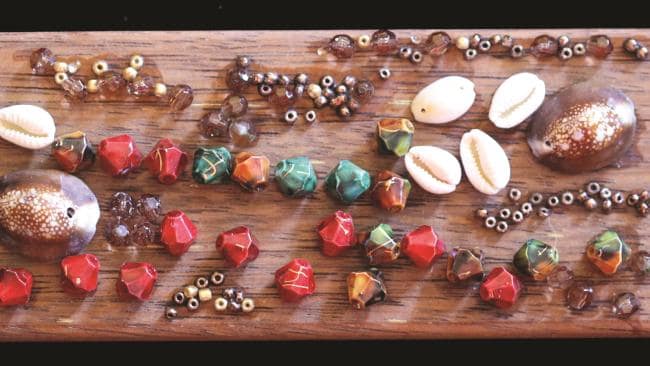
0:25:22 LK: Okay, now I'm going to bring out a prop. This is a really, really good one. But you'll have to describe it, or I will. This is... You can describe what you see. This is actually a model of an African lucasa from the Luba people of the Congo. There are none of the real things in Australia, but America has a couple in museums and I examined one at the Brooklyn museum in New York and this is based on it, but adapted for my knowledge. So what it is, do you want me just to describe or?
0:25:58 SC: So you're holding up something that is more or less the size of a book and there's some backing material that you've decorated. Tell us what the backing material is and what the decorations mean.
0:26:07 LK: Okay. The backing, it's carved and that's tortoiseshell pattern. And the Luba people, it's well documented, used that as a memory aid, but the front is carved with different carvings, and shells and beads are nailed on. And in the research, I read that they encoded to this little bit of hand-held wood, they encoded a complete history, geography and essentially a knowledge system, an encyclopedia. And I thought well, I'm a skeptic. I don't believe this sort of thing.
0:26:41 SC: Show me, yeah.
0:26:41 LK: At the time, I didn't know enough about it, so I grabbed a bit of wood and now I'm holding up a different bit of wood, which is actually a bit of wood from just a square bit, a rectangular bit from when they were building out veranda, which I'm now pointing to, which is again useless to you, and I just glued a whole lot of shells and beads onto it to see if this would work. And I started encoding a field guide, I've got it upside down, a field guide to the Victorian birds. [laughter] That doesn't matter for your image, it does for me describing it. So I then started encoding the 412 birds, native birds of my state of Victoria.
0:27:18 SC: So we have a block of wood in front of us. I'll show a picture of it on the vlog post for the podcast if people want to see it, and you've glued... It looks like something that you would sell in a store or as a souvenir, of the local color, but you're saying there's a code there.
0:27:34 LK: Absolutely.
0:27:34 SC: And to you, there's an enormous amount of knowledge encoded in those shells glued on that piece of wood.
0:27:38 LK: Right. I start with the emu at the top, but I'll go to the second bead. What you won't be able to see is that there's a little tiny speck on it. When I look at that, I can see a duck tail wagging, so this bead represents all the ducks. And I can't look at that and not see the duck tail wagging. And there's a little gnat next to it, another little speck, which in my mind is a gnat, and gnat a day are the ducks. There's 16 ducks to be memorized. Now, the first one relates to a magpie goose, about the fifth is the swan. Magpies and Swans are two of our main football teams, so I have a story linking them all of a football match that goes wildly out of control. So the Australasian shoveler is burying all the dead. The musk duck, these are Australian birds, the musk duck's off in the bushes using his musk scent for matters we won't discuss. The hardhead's bashing everyone up. So I've got a story that gives me all the ducks. Now, I don't believe at all that the shoveler really buries dead, but that story gives me the list and then I can start linking more and more on. I could not believe how effective this is, and a lot of people have tried it since reading my books and are finding the same thing. And we're using this with kids of 4 and 5.
0:29:03 SC: Now, does this mean that you choose which shell to glue on there because you're going to want it to represent something specific or is it a case where almost any noticeable thing about the shell, you could turn into an association with what you want to remember?
0:29:18 LK: You can. I just did this randomly. I hadn't at that stage even decided what I was going to encode to it. When I did it properly the second time with the one that looks like the real lucasa, I did lay out, this is a history of writing, from proto writing right down to contemporary scripts, and that is laid out. That little thing there's an Inca khipu and not a cord device. That was laid out and that makes it an absolute fludge. But even if you stick to something that has no patterns linked with it, it will still work very well because your brain will make those links. So up here I dribbled the glue down the side, 'cause I'm not really good at craft. That happened to be where our lyre bird is, and that's Menuridae. So that looks like a man's urinated down the side of my board.
0:30:09 SC: There you go.
0:30:11 LK: Vulgarity, violence will always work well as memory devices.
0:30:16 SC: The brain remembers those things, yes.
0:30:18 LK: Which is why mythology, which are actually encoding pragmatic knowledge, that's what a lot of my research is about, mythology has these wild characters, vivid stories, lots of violence and sex and vulgarity because the brain, unfortunately I have to admit, memorizes those things very well.
0:30:39 SC: None of this seems like it would be helpful in memorizing a deck of cards with a bunch of ones and zeroes on it. Do you have to be a little bit different when you're doing these real-time competitions?
0:30:48 LK: Not really. Abstract objects like numbers and cards have no action, no meaning, no emotional response, so what you do is you give a character to each of the cards. My ace of spades is Homer, my two of spades of Pythagoras. Now, Homer and Pythagoras both wear togas, so that became a problem, so I converted that over to Homer Simpson.
0:31:11 SC: There you go.
0:31:13 LK: Now I've got Homer Simpson as my ace of spades. My two of spades Pythagoras measuring out triangles and things. Let's just take the eight of diamonds is now a snowman for me. If I get those three in a row, I will have Homer Simpson measuring a snowman. I've now got an active image and I place that in the first position in the memory palace. When you're memorizing a deck of cards, you're creating characters as a story, and characters, if I can get nothing across more than this, if you add character and create character out of abstract objects, that makes them come to life and you can then create memorable images.
0:31:58 SC: And the Greeks clearly did this. Do we know that they did this because they said that they did this?
0:32:03 LK: Absolutely.
0:32:03 SC: Or they... We have records of the Greeks explaining how to memorize big things?
0:32:07 LK: Absolutely. They wrote... Cicero in particular wrote quite a lot on memory and at the time he was very famous for his writing on memory. Yes, Grammatica was the character that taught grammar and bashed you if you didn't get your commas right and things, except I don't think they used commas, spelling right and so on... So, yes. They created characters for all these, and those memory booklets and pamphlets and that, have come down to us, and were used right into the Renaissance. The same memory palace methods for using palaces, characters, stories, and so on. So, absolutely. They didn't use...
0:32:46 SC: Before it became...
0:32:48 LK: Hand-held devices, but that's really just a miniature memory palace. It works in my brain exactly the same. I don't take this with me when we go birding and I memorize, listen. So for example, we see a honey-eater and we're not quite sure which one it is, honey-eaters are our biggest group of birds here, there's 36 of them, I can reel off the 36, so we can do it by process of elimination. But I don't take this with me. I know it so well, that it's with me in my mind all the time.
0:33:21 SC: And Cicero's techniques maybe fell out of favor once printing and reading became more widespread, once we had books to download our knowledge on to?
0:33:30 LK: Once you've really got printing and that they stopped being used as much. But in the medieval times when books were very rare, they were used all the time and books were designed by this principle. That's why the medieval manuscripts which were designed to be memorized have all the fancy stuff around. They left space to add comments in all the time, to keep interacting with it, to add little drawings. If you look at Tibetan mandalas and Chinese narratives scrolls, you've got a whole lot of ways where the memories are put into images. Now, I can read a page of a book when I'm studying, and at the same time be working out what I want for dinner, and what I want for dinner will stay there, the page of the book is gone. I can write notes without engaging with them, because there might be words I don't know. I cannot convert that into a story or a picture, or an attachment in a memory palace without actually engaging with the information, because I have to shift the mode of information.
0:34:35 LK: So that's exactly what they were doing, these cultures all over the world, transferring into art. So you may have got the hint from me now that I believe that art and music should be at the heart of our school curriculums, not the peripheries, and should serve the whole curriculum. And my teaching was all physics and maths and IT. So it's not that I'm promoting my own subjects. I'm promoting something that I wish I had known earlier.
0:35:02 SC: Well, so the Greeks did us the favor of handing down this knowledge to us. But a lot of your work has been advocating the idea or discovering the idea then exploring it that many, many other cultures did this as well. So tell us about how you began to think that a lot of things that archeologists thought of as monuments or works of art and so forth, really had this functional purpose of helping primitive societies remember things.
0:35:31 LK: I don't know if you know about obsessions, but when you're obsessed with something, your brain won't think anything else. I had no interest in archeology, but my husband Damian was really into archeology and had just finished an archeology degree, his third or fourth degree, he likes collecting them. And we went to England, I was researching indigenous animal stories. He wanted to go to Stonehenge. So, I traipsed along and I'm standing there looking at this circle of stones. In people's minds, when I say Stonehenge, they'll think of those great big sarsens, the huge ones, but they didn't come for 500 years. At first Stonehenge was a circle of stones of about 60-something stones, 100-meter across circle. Are you happy with meters? I can't convert.
0:36:20 SC: Meters are good, yeah.
0:36:21 LK: Meters are fine. Oh, good.
0:36:21 SC: I'm going to demand that my listeners be able to use meters, that's okay.
0:36:26 LK: And there's a thousand circles, big and small, of this all over Western Europe. But you've also got different versions in America, the circles at Cahokia, wooden circles, but they're the same dimensions, at Poverty Point in Louisiana, there's timber circles because there weren't big stones. So it's not the material that matters, it's these set of locations. So as I go to Stonehenge, I'm thinking, oh, that's clever of them. They're no longer moving around the landscape, and the people moving around the landscape, hunting and gathering, and doing some land management and that, were not nomadic, they were mobile. They moved from location to location and knew their landscape well. So we're not talking nomads. We're talking mobile cultures.
0:37:16 SC: Sorry, what is the difference between a nomad and a mobile culture?
0:37:19 LK: Nomads wander, all over the place, not systematically. Mobile cultures move. So our aboriginal cultures, depending on where they are, might move between two or three camp sites, or even only one over the year down south, but a lot more depending on resources. So they know their landscapes.
0:37:39 SC: Right, it's a bit of a trajectory, seasonal and so forth.
0:37:41 LK: Yes, exactly. So they know that landscape really well. If they're going to settle for farming, you can't just say, "Okay, I'll settle today and start farming." You're going to starve very quickly. So there's evidence in the archeology, which I can waffle on for hours, on how they gradually moved down. But these circles of stones and circles of timber that are all over the world, only appear in that transition time. So, at Stonehenge, there's the cursuses beforehand, like the Stonehenge cursus, C-U-R-S-U-S, which is a huge area that they... Ceremonial area. And it gradually got smaller, until you get Stonehenge with these circle of stones. So if you think of that as a memory palace, nothing is going to work better, because stones... And they brought blue stones over from Wales, and it looks like it was actually Welsh cultures, but the blue stones are very mottled in that. And, you know, if you look at a stone or a cloud or anything, you will see whatever you want to see there. And they were all different. So they were actually setting up a memory palace, that was what my brain said.
0:39:00 SC: So before you thought had that thought is... I'm not a Stonehenge expert. My impression is that people have the idea that it was some sort of astronomical or crop planting device. And you really have a totally different theory of why it was put there.
0:39:19 LK: What you're saying is absolutely true. But my theory encompasses all this, because they must have some way of timekeeping. If you're going to plant crops, you must know where you are in the season. If you're going to hunt resources, and they must have still been collecting wild resources while they developed these agricultural skills. So, time-keeping is essential. And we know the indigenous abilities to use the sky and astronomy over the year for time-keeping. The American Pueblo people are really top-notch astronomers, and Western astronomy is learning a lot from them. Our Australian aboriginal cultures have a very strong tradition of astronomy. So that's one of the 10 points I look at, at any of these monuments, of whether it would be used as a knowledge center. The spiritual stuff's all there too, I'm not denying that, but you're not going to be able to be spiritual if you're not eating.
0:40:25 LK: So those ideas of the practical knowledge, which is my field, is all there. Here, you've got a memory palace, a line to allow you time-keeping with ditches around it, with flat bottoms. Nobody before has explained why is the bottom of these ditches flat. So the ditch around Stonehenge, it varies in different bits around it, but about 2 meters deep. Now, the weather in England is appalling. And we know that the major ceremonies were held mid-winter, and there's a whole lot of evidence for that. And if these ceremonies... The imperative is to perform them or you lose that information. Two meter deep in chalk, with a flat bottom, you can cover that with... There's evidence of how they did that, cover that with hides and so on, and ensure that you perform that ceremony. In white chalk, the resonance would be beautiful. The reflections of the torches, and a flat bottom, allows you to perform.
0:41:31 LK: If you look at the associated, Stonehenge didn't stand alone. So let's start with Stonehenge with its circle of stones, and about 500 years in that circle's moved into the center and the great big sarsens that we're more familiar with, the huge stones with the lintels on the top, are put around them. Indigenous cultures all have a lot of secrecy and restricted knowledge. The reason they have restricted knowledge is that otherwise you've got the Chinese whispers effect, and the knowledge will be ruined, lost, corrupted. Now, we've got the stories here as I've mentioned from 10,000 years ago that are held accurately. You've got the same from Native American and Africa, a lot of my work comes from Africa, too, on this accuracy, you must have secrecy, in order to only the people who are trained in the songs that store the information can actually, have to be tested constantly and they will not share that.
0:42:35 SC: So, in some sense, if you are just casually knowledgeable about these particular memories you might distort them a little bit and it would get degrading over time. Entropy, the Second Law of Thermodynamics would kick in, which we're both familiar with. And so what you're saying is that there's a technique by restricting the knowledge to those who are really dedicated to it. You could maintain its purity in some way and keep it, as you said, over thousands of years which for a pre-written culture is pretty impressive.
0:43:09 LK: It's astonishing. One of the best studies I looked at was of the corn stories of the Pueblo people. Now, that they have about 17 sub-varieties of corn, done in different colors. So the corn maidens and the corn mothers are the different colors of the corn. Now, corn cross-pollinates like you wouldn't believe. They have kept these pure, we know for centuries, probably a lot longer, by having all these ceremonies restricted, so that the yellow corn is planted at a particular time from the white corn from the other corn, kept at a given distance. And then the ceremonies that people... The elders in charge of the corn will select the very purest kernels to be kept. Because you have a mono-culture in... The southwest of the United States is a harsh climate, say you put all the yellow corn, and isolate one in, and you had a season that was really bad for yellow corn, you just wiped out your whole population. So they had this whole set of clever use of corn, that ensured maintenance of a culture. It's brilliant stuff.
0:44:25 SC: So you could remember things... The culture, the tribe or whatever could remember things, events and how to deal with them, even if those events had not happened in the memory of any living person.
0:44:37 LK: Absolutely, and therefore it's put into ritual and stone and rules and ethics and behavior of the culture, that absolutely enshrines these methods and keeps their corn pure. It's just brilliant stuff.
0:44:52 SC: And so they didn't have books, or they didn't maybe even have epic poems, I'm not quite sure what they had, but you're saying that at a place like Stonehenge, the elders or, I don't know, the professors, whatever.
0:45:03 LK: Elders is the... Elders, professors, yes.
0:45:05 SC: Elders. They would go at regular intervals and do these rituals and that would do... Perhaps they're teaching their apprentices also.
0:45:13 LK: They will be teaching, yes.
0:45:14 SC: And so you can imagine that there is this association of song and movement with the different parts of the memory palace to keep this cultural knowledge being transmitted safely.
0:45:25 LK: And you would perform those rituals at the appropriate time in the year. So there's one part of Stonehenge where in the ditch there's piglet skeletons, nine-month-old piglet skeletons, and we know from all the agriculture that that's midwinter, which was when they had the main ceremonies. Now, a piglet skeleton was buried and then hundreds of years later another one was put into the wall of the ditch, so that would have been the time where all the husbandry of pigs and possibly other animals was taught. And so those skeletons would have been used as part of the ritual, but part of teaching.
0:46:08 LK: But then it gets amazing, once you've got these big sarsens in, I had a problem then, because one of my conditions is there must be public performance spaces and restricted performance spaces. And Stonehenge became entirely restricted. But up the road at that exact time, exact archeologically, within years, though, we're not talking long time, Durrington Walls was built. And this is walking distance up the road, this massive henge, and the ditches weren't two meters deep, they were 10 meters deep, and they don't have any tools other than stone tools or deer antlers, red deer antler, and the ditch goes for a kilometer. You're talking a million work hours and up 'til now people have not had a reason why they would do this. Now, indigenous people do not do things for no practical reason. They're incredibly practical. So if that's the performance side, can you imagine the acoustics and vision of it? It's like a bathroom, 10 meters deep. The resonance and acoustics and visual. I want a henge ditch. I desperately want one. I've nagged my husband. He refuses to dig me one. But it must have been extraordinary. And then you've got post circles, you've got all... And hand-held devices. That's the other thing.
0:47:32 SC: And does it matter what the particular shapes of the stones that form Stonehenge or anything like that, are, or as long as all the stones are different, you can imagine associating them with different memories.
0:47:43 LK: It's the difference that matters. So if you look at Avebury, which is the biggest of these stone ones in England, which also has the massive ditch in there, the archeologists note how they seem to... They called them male and female, but the stones next to each other are as different as you will get. But I also took the fact that these hand-held devices, the African lucasa, Aboriginal churinga, I started to put these together, and found them in every culture. So my logic said therefore they must be in the British neolithic as well. And yes, there's chalk plaques. They're called enigmatic decorated objects. So chalk plaques are little lumps, hand-held, not that little, of chalk, with inscriptions... You know, decorated, abstract decorations work better because you could add more meaning to it.
0:48:38 LK: Up north in Scotland there's carved stone balls. So these are stone balls, the right size to be held in the hand with knobs and carvings and things on them, and nobody had a theory for them. I showed a picture of the most elaborate one, the Towie ball, to an aboriginal elder, and he said, "Oh, they've done their churinga in spheres. Isn't that good?" Now, let me tell you... Here's one of the great mysteries of the world, no one has been asking indigenous people what these objects might be used for. American archeologists do, but in the British [0:49:11] ____, British they don't have indigenous cultures hanging around to chat with.
0:49:17 SC: Yeah, yeah, and it does seem to be, from what you've said, what you've implied, pretty universal. There's somehow a natural thing for people and societies to do, building these kinds of monuments, this combination of big monuments, with small hand-held things to pass down knowledge from generation to generation.
0:49:40 LK: Yes, you'll find that all over the world, in that transitional stage, early agriculture. As soon as you get a big society, really big, your skills set, your knowledge elders, your professors start to get specialists. So, knowledge is then shared between them. So in order to hold power you then need to claim some connection to the supernatural that ordinary people don't have. And you start to get a priest class emerging, which you won't find in indigenous cultures. So they don't talk about worshipping these ancestors and Kachina, the Pueblo Kachina and so on. They talk about learning from them, the stories they tell. They're really like the Greek gods gone back a bit more. They have much more depth and character and flaws and everything, that we can learn from. So you then get that... And the monuments all just disappear. Stonehenge wasn't knocked down or anything. It just stopped being used. The same with the big circles at Poverty Point in Louisiana and the big mound... Mounds are used a lot in places that don't have big stones.
0:50:58 SC: I had a wonderful podcast with Marq de Villiers on the origin of the idea of hell, and he was partly having fun, 'cause hell is a fun topic to talk about, but you're suggesting something pretty dramatic, if I'm not over-interpreting it, so let me restate it and you can tell me if I'm on the right track. Back in the day when it was important to remember things for a very, very long time, but we didn't have writing or anything like that, we constructed these tools, memory palaces and hand-held artifacts to help us remember things, and we would attribute this knowledge to our ancestors, since they came up with it, and we would pass it down for many generations. But then over time as our society gets bigger we begin to mythologize those ancestors and even supernaturalize them. Before it was just, "Yeah, our ancestors told us this, they were really good, thank you." And then it becomes where we're almost worshipping our ancestors, and maybe this is the origin of religion in some broad sense. Is that okay?
0:51:55 LK: I have thought that way and there's others who have suggested it before. I haven't used that in my doctoral research and my books because that's adding a level of controversy. And at this stage, I don't want to do that because...
0:52:10 SC: That's why podcasts are good.
0:52:11 LK: Yeah, and I think that's definitely... There's plenty of evidence for that. There's actually examples from Native American and from Māori. The Māori can trace everything back 800 years, they did things a little bit differently from everyone else, I'll get to that in a moment, the New Zealand Māori. This is a universal thing, and I think that you can trace religion back that way, and you can see in particular in the Greek and Roman myths where they associate things with landscape, the gods all live on particular mountains and things, but they gradually start to worship them, that this changed there. And I think you'll find it's to do with power.
0:52:51 LK: My PhD thesis is titled When Knowledge was Power. Unfortunately, these days, I think violence and religion and money is power, but we won't get into politics, just this moment. Most cultures use the landscape, and then add in complex genealogies. And this is an area that has been too complex for me to replicate. I've managed to replicate most of the others, but our Australian aboriginal cultures will relate every single person in their culture, and everyone that comes in from associated cultures into a complex genealogy map. Māori do it the reverse. They use the genealogies as the basic indexing system. This is what Google... If it's not indexed on the internet, you won't find it. All these systems are indexing systems, knowledge systems, with a complete link. Anything that's not linked to a stone is going to get lost. So the Māori use...
0:53:51 SC: I can see your computer science background peeking through here.
0:53:54 LK: It's actually an information technology theory. Stonehenge is a database structure with the data all stored in memory. It just happened to be human memory that died. So that's really what it is. And I do have an information technology background. So that's the way I look. If you don't have information indexed, you'll lose it, you must. So, the Māori index on genealogies, they can go back 800 generations. So when you look at the mythology there are examples from the Pueblo and the Navajo and from Māori of how those are living ancestors. Go back far enough, they become mythological. So the question, are the ancestors biological or mythological, is a question that can't be answered. That's a Western question, because it isn't a significance to the indigenous cultures, because they're both. So we've got stories of the Pueblo adding in a Kachina, a priest, the priest killing Kachina who wanders around with a priest's head, telling the story of the Pueblo Revolt and when they beat the Spanish trying to take over their lands. The Pueblo are still on their own lands, that's why there's such a valuable culture and their knowledge is so important.
0:55:16 LK: So they will add in stories. They will add in characters. With time they may become mythological. It's a division that doesn't matter. So, I've got Donald Trump sitting here for America for me, but he will become mythological. It's not the real Donald Trump.
0:55:35 SC: It's a technique. Yeah. It's part of a story. In post-European cultures, in European cultures, and the ones we're descended from, we always lament the loss of the great library at Alexandria. But what you're saying implies that a lot of these European explorers and conquerors, as they wiped out these artifacts from primitive civilizations were destroying libraries in a very real sense.
0:56:01 LK: Absolutely. In Australia, if you use the term primitive referring to aboriginal cultures, you would be in big, big trouble. So, we'll non-literate or oral.
0:56:11 SC: Yeah, tell me that. I want to do it right. So please tell me, yeah.
0:56:13 LK: Because, especially what I'm trying to say is, these were extremely intelligent. They had the same human brain and still have as we have, but they stored information differently. If we're talking Australia 200 years ago, the British came here, and took land, they were doing exactly that, burning down the encyclopedias. So the cruelty, physical cruelty to aboriginal people and the massacres and so on was horrific. The intellectual cruelty was just as horrific. They would put fences across these song lines, and shoot anyone who came in because it was agricultural land now. So we know from the Yanyuwa people, right up the Australian north, that there's very few elders left now, so this is knowledge that is very hard to get, but they have 800 kilometers of song lines mapped out. An elder can sing 800 kilometers of locations, can navigate them, and can associate all that information with it.
0:57:19 SC: Say a little bit more about what a song line is in particular, as a particular technique.
0:57:23 LK: A song line is a memory palace in the bush. But it's sung because song is more memorable. So, there's sung knowledge tracks. Native American sing and dance because these are more memorable events, so they will sing these tracks through the bush. Now, people who come to Australia and decide to go out hiking in the bush can get lost and die 10 meters from a path because our bush is very dense. And any bush, you've got proper wilderness there. In England, it's a bit harder, 'cause they don't have any proper wilderness left. But to navigate 800 kilometers and there's navigation paths right across the whole of Australia. We're talking 10,000 kilometers. No, 1,000, let's not get ridiculous. You've got these navigation tracks that go all over Australia, sung from memory. So they can teach somebody else to sing the track and navigate from a song. So that's why they're called song lines.
0:58:26 SC: Yeah, it makes me wonder, what are the kinds of things that were being remembered this way. Clearly, maps and locations and probably plants and animals are obvious ones. What other kinds of knowledge? Were there more social kinds of knowledge like customs and laws that were passed on?
0:58:42 LK: Absolutely, but you've also got a lot of other things like water holes. In Australia, the driest continent on the Earth, they go right across the desert, so you want to know where the water holes are, how to find the best flint for napping and so on. But there's also all the cultural. There is a huge base of ethical laws. And I have read so often that philosophy and ethics and everything started with the Greeks and started with literacy. That is highly offensive to indigenous cultures, because they have very detailed ethical cultural responsibilities, which keep them going, without them. So you've got stories, you talked about some of the scary stuff, the bunyip stories here and the scary, that stops children wandering from the camp, because you can't fence them. But if you've got stories of the bunyip out there, they're not going to leave mum and dad.
0:59:40 LK: So although there are all these other aspects to being a scientist, I focus on the absolute pragmatic, and there's so much of that I haven't run out of stuff to research.
0:59:52 SC: Well, you had this wonderful example that I saw of the loon, or the red-billed loon, maybe, that helped sailors or helped people out on the ocean find their way back?
1:00:01 LK: Okay, it's the red-throated loon, or...
1:00:02 SC: Red-throated loon, that's close.
1:00:05 LK: Yes. Some cultures call it the diver, but the Native American up on the Northwest... I'm just checking my geography... Northwest Coast in Canada have these loon... And they have totem poles, including the loon pole. Now, the loon is a particularly interesting bird; it's not particularly interesting to look at, it's not a pelagic bird. Now, pelagic birds are water birds that will go out, like albatrosses and so on, and stay out at sea forever. The loon will always come back to land at night. So if you do your hunting magic, and I hate that term because it implies it's non-rational, when they... Before the cultures that used the loon, and it's used right across the north of the world, they will sing the call of the loon before they go out, and say that that saves lives, because it does. If there's a storm comes in, and all the water birds will be making a racket, if you can pick out the loon call and follow that exact call, you will get back to land. It might not be where you want to get, but you will get back to land and be saved. And it calls... The red-throated loon in particular, there's other loons that aren't quite as good. So if possible get the red-throated because it will not stop calling the whole way back.
1:01:27 LK: So before, say, our aboriginal people go out hunting, they will dance the behavior of the animal they're hunting, like a kangaroo. Because without guns you have to get fairly close, and you don't want to alert it, and you don't want to yell out, "Hey, Fred, the roo's over there." So they have all sorts of communications systems which they dance before they go out on the hunt to get their strategies ready, and their survival techniques ready. It's incredible stuff.
1:01:57 SC: This is the kind of knowledge, the sort of local knowledge, that you absolutely need that you can imagine should be passed down from generation to generation.
1:02:04 LK: Yeah. It has to be reinforced; you can't just teach a kid and then let it go and think they're going to remember it when they need it 30 years later.
1:02:13 SC: So it seems perfectly reasonable to me that structures like Stonehenge were used to keep information; they were libraries of a sort. But presumably, I'm going to guess, there are people who don't agree. How do we know, or at least how do we judge, whether that was it? Is it a sort of consistency check? Is it a matter of being able to fit other pieces of data into the picture that makes us go, "Yeah, this is probably on the right track?"
1:02:39 LK: I haven't had anyone who doesn't agree. Some people think I overstate it, which I probably do, because there will be all the other aspects, and indigenous ceremonies do have all the spiritual and that, which I tend to say, "Yes, they do," and then ignore it. So I am overstating that, so I'm saying this is their primary purpose, not their entire purpose; it's a consistency. I've got a set of 10 in my Cambridge University Press book on PhD thesis. There's a set of 10 tests, and if I don't get 9 out of 10, it goes. Just because some don't have cave art and some don't... But then there must be acoustics, astronomical alignments, a set of [1:03:26] ____. And I've got tests for dismissing it. If you can find a single set of standing stones in the British neolithic that do not follow a pattern that you can easily navigate, because it must be a sequence, a set of timber circles anywhere that are used in Europe, but also right across the Americas, that can't be navigated in sequence, the sequence is not vis... The theory falls apart. But that has never happened yet.
1:03:57 LK: So what I want is all these different indicators to be in place, and that consistency is everywhere, and it's only in early agricultural non-literate cultures. So it is a set of consistency, and that same consistency with non-literate cultures all over the world, so I've worked with linguists. And one of the scariest seminars I ever gave was with a group of linguists specializing in recording the languages of these cultures, and if any of these cultures did not follow these same patterns all over the world, the theory would fall apart, and not one person in that room would argue. But then when you look at the neuroscience, we're just matching the human brain. In evolutionary terms I'm talking probably only 10,000 years; I mean, Stonehenge is a mere 5,000 years, it's just a baby. So no, if I find an inconsistency then I'll worry.
1:05:00 SC: Do you know about the Extended Cognition thesis? Have you heard those words?
1:05:02 LK: A little bit, but...
1:05:04 SC: You know, there's Embodied Cognition, which claims that when we do cognition, when we do this sort of higher-level abstract thinking, it's not just in our brains, it's in the rest of our bodies as well. Extended Cognition says we should include our notebooks and our tools and our environment in literally the raw materials of how we think. And, you know, spiders off-load pieces of knowledge into the designs of their spider webs, and so forth, and so this is a form of that. Like, really, these things that we do to the environment, whether it's a hand-held artifact that we make, or a large-scale monument, this is part of our thinking capacity.
1:05:45 LK: Yes. I wasn't sure whether you were going into the New Age collective consciousness-type thing, or...
1:05:50 SC: No, no, yeah, I was not. [chuckle]
1:05:52 LK: So that's why I was hesitant. Absolutely. There's research in education that a child with a computer is in fact more intelligent because they've got more knowledge available to them. So yes, absolutely, except that if you rely on it entirely, a computer, or some way of off-loading your memories, you haven't got something to play with information. So, there's high levels of Bloom's taxonomy, and that goes up into creativity and theorizing. I couldn't imagine that I could do so much of that until I had this base of knowledge in there to play with. So for education, I'm advocating we bring these methods back, but I'm not advocating changing the curriculum, because if you put them as our [1:06:47] ____ arts, so for mathematical tables, which people need to know instantly, not calculate up to them.
1:06:54 LK: Because what I see kids doing now, if they want six eights, they calculate up through, two eights, three eights, four. If you create an image with a story, and we're using... In the schools that I'm working with, we're calling them rapscallions, 'cause we can't call them Kachina, these characters, and take the Pueblo, or ancestors or anything, 'cause that would be culturally most inappropriate. We decide to call them cheekies to give them character until we googled it and got a lot of bottoms. So we went over to rapscallions. So, say for tables, for six eights, 48, you want an instant image.
1:07:29 LK: So all sixes are sticks, all eights are gates, all fours... 40s are naughty. So the kids each had their own rapscallion, and that gives them an emotional attachment. They have to create an image of sticks and gates are naughty gates, so the rapscallion picks ups, skip six, leans on a gate, and the gate knocks them flying. Something like that, which they paint. That time commitment to the single table, makes them bring it back instantly, and you don't need to do the whole six eights, and eight sixes are the same. So that's got rid of half of them. 10s, 11s and ones you don't need to do because of the patterns. So that commitment in time will get every table instant.
1:08:15 SC: So you're saying that, that there are implications for early education, but like you said not changing the curriculum, but introducing some new techniques. And again, it takes us back to the point that it's not just a parlor trick to memorize things, it helps. If done correctly, presumably, it helps solidify the foundation of the kinds of knowledge that we have.
1:08:39 LK: Yeah, I'd take out the early education, we've done research with senior secondary. So the periodic table is the obvious one. You whack it in a memory palace. Every fifth location, the ancient Greeks said make every fifth location a sequence, so they can get the number, the atomic number easily; every noble gas, they would bow to. So when the kids come up to number 10, neon is a door, because it's a 10th. They need it and then they bowed and apologized because it's noble gas. Kill themselves laughing. Neon noble gas number 10 is in. And from that, because they've got it as a noble gas they can go forward and backwards, and get its position and its behaviors. They sing the lanthanides, la-la-la-la lanthanides. They act out the actinides, which gets very explosive 'cause they're all radioactive. Protactinium they keep thinking as a prostitute. I wish they wouldn't add that in. It's very interesting. So that sort of thing. For seniors, we've done it with art stuff.
1:09:48 LK: You've got an American world memory champion the, Alex Mullen, M-U-L-L-E-N. He and Cathy Chen, his partner, are medical students and their website Mullen Memory shows how they're using all these techniques in studying medicine at university and so on. So this is everywhere and it's right through life, because how much of dementia... There's a whole lot of dementias. But how much of dementia is that we stop laying down memories and identity. So instead of singing, "I love you, I love you, I've lost you, I can't live without you," which we tend to sing non-stop why aren't we singing knowledge as indigenous cultures do? And that music is one of the last things to go. Why aren't we creating devices that are a sequence of our life? So that there is our identity, and we've been doing this with some people here. And you know how kids object to, "Granny, I've heard that umpteen times, that story umpteen times before," if you've got it on a memory device and they point to it, the kids want to tell you the story. And you're creating an heirloom.
1:11:00 LK: And the ones we're using here in workshops here are based on the Native American winter counts of the Lakota people, where they did history done on hides. They work wonderfully. So it's early education, yeah, and let's keep it going right through life.
1:11:15 SC: And, okay, so for someone like me, you know, I'm a physics professor, I've not really used these techniques very well. I think that I remember in one of the things I've read about you, you claiming that before you learned these techniques, you were not very good at memory. It was really, this...
1:11:32 LK: Appallingly bad is the answer.
1:11:33 SC: Appallingly bad. So, I'll give you the chance to make the sales pitch. If there's one thing, one thing that would help convince me that this is a set of techniques that I should study going further, is there something in particular I should try to either learn or help myself with or just give a whirl to?
1:11:55 LK: I think grounding the definitions is really important. So, I did a physics experiment with a whole group of kids that force was the topic that they were to do, all of them, and then, we're talking five-year-olds up to 12-year-olds, because of the way rural schools work here and the curriculum. So they did all the experiments with balloons going everywhere, and so on. And at the end I quizzed all 70 students, said, "Do you remember doing force in science?" "Yes." "What is a force?" Three out of 70 told me it was a push or a pull. Lots told me it's when parents make you do things you don't want. Some told me it's what makes the balloon go across the room and half of them said, "May the force be with you." And as a physicist, you will know that is not good physics.
1:12:43 SC: We hope it's not the first answer they give. Yeah, that's disappointing.
1:12:46 LK: Right. Which means as those teachers are going on saying force this, force that... Those kids are not basing any of that information on firm foundations. So the music teacher took the imperial march from Star Wars, and created a little song saying a force is a push or a pull, push or pull. I can't do it without the actions. As you can see, I'm doing the actions. The kids sang it in music, and then assembly, then not mentioned for a week, 70 kids. The same wording of the question, "Do you remember doing force in science?" 70 out of 70 told me it was a push or a pull, did the actions and started laughing. Therefore, I'm not saying we sing everything. We sing, or dance or perform or memory palace, the absolute things we need grounded. We must know what a force is or else everything we do from then on is based on sand.
1:13:39 SC: Well, it's a good message. There's still room for the human mind and brain and memory recollection possibilities. Even a world where we can all type questions into Wikipedia or Google very, very quickly.
1:13:51 LK: Absolutely, and they're fun. They really are.
1:13:54 SC: And they're fun. That's the best part. Okay, Lynne Kelly, thanks so much for being on the podcast.
1:13:58 LK: It's an absolute pleasure, Sean.
[music]
This was a terrific podcast — I’m an educator, a historian, and a science geek, and so many aspects of this conversation are right up my alley! Thank you!
Fascinating podcast – I first realised the brain’s natural tendency to match information with location when I started listening to audiobooks and podcasts while walking. I discovered that walking in the same places later brought back memories of what I’d been listening to there months previously – stuff that I’d never have remembered if asked. I now find that simply visualising a particular walk will bring back snatches of the material I listened to. An involuntary memory palace…
Great listen, and interesting how the swirling symphony of consciousness seems to work, with memory in this case. My impression is that many of humankind’s esoteric practices across the board involve the deliberate association of disparate elements (sensory, spatial, etc.) to “shape” consciousness (which would necessarily be subject to natural selection pressures, like everything else). Great point on extended cognition.
Guest suggestion: Would really like for Sean to interview James C. Wathey, who has written on the biological roots of the religious impulse, which could complement some of the points raised here.
I loved this episode – thank you!
I had been wondering about the use of plays as mnemonic devices and found this interesting paper connecting Hamlet with the Ars Memoria. I think it’s relevant to this discussion so I thought I’d link to it. Thanks again Lynne and Sean for the great information!
Hamlet as Emblem: The Ars Memoria and the Culture of the Play.
https://www.jstor.org/stable/27793757?seq=1#page_scan_tab_contents
I loved this episode (even more so than the regular mindscape episode) because it gave very good explanations to things I had previously wondered about, not always consciously, among them:
* Why indigenous people cling to their land and their sacred places so much. Even though I know the thought was patronizing, I always had a “couldn’t they just move elsewhere?” in the back of my mind. Seeing the land as an index to knowledge and cultural history makes it much clearer why they *cannot* give up the particular piece of land they grew up in, without giving up much of their culture.
* The question why certain structures were built was often answered with “must have been religious” when no practical value was apparent. The memory palace theory seems to be a much less intellectually lazy explanation, and somehow more convincing.
* Inventing god-like sagas around distant ancestors always felt silly to me. No more after listening to this episode.
So, huge thanks for this one, especially for answering questions to which I wasn’t actively searching answers anymore!
Just finished Dr Kelly’s mindscape episode and then listened to the NYT’s podcast “The Daily” about how the. Presidential candidates use music to get across their message and cement their message in peoples minds!!
Fascinating stuff
Thanx
Ron Goren
This was fascinating. I’ve played around with mnemonics and various memory techniques but had never taken it to the level she describes nor did I realize that these techniques have been used by so many civilizations around the world for thousands of years.
Pingback: Remembering the memories of our ancestors - Adam Olsen, MLA
Muito interessante!
Sean Carroll, não posso deixar de ler seus episódios! Sempre enriquecedores de conhecimento, associado a algum humor, sempre positivo!
Palácios de memórias, preservação conhecimentos culturais pré históricos, muito interessante o aspeto origem da religião (possibilidade), combinação/relação cerebral de informacoes com localização geográfica (pessoalmente, várias experiências, e, já o admitia, sem qualquer duvida) cognição estendida, e, uso da música!
Obrigada Sean Carroll, e, Lynne Kelly!
Great interview! I’ve read two of Ms. Kelly’s books, and I’m a fellow mental athlete, as well as a big fan of Sean Carroll. The importance of memory in our history cannot be understated. I’ve been thrilled at what I’ve been able to accomplish through proper techniques and practice (126 Names in 15 minutes, for example). Thank you so much for having Ms. Kelly on and highlighting her amazing research and enthusiasm.