
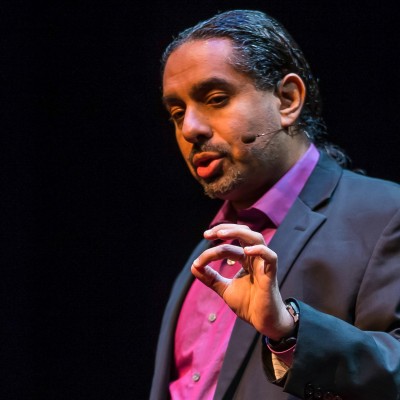
The Earth is heating up, and it's our fault. But human beings are not always complete idiots (occasional contrary evidence notwithstanding), and sometimes we can even be downright clever. Dare we imagine that we can bring our self-inflicted climate catastrophe under control, through a combination of technological advances and political willpower? Ramez Naam is optimistic, at least about the technological advances. He is a technologist, entrepreneur, and science-fiction author, who has been following advances in renewable energy. We talk about the present state of solar, wind, and other renewable energy sources, and what our current rate of progress bodes for the near and farther future. And maybe we sneak in a little discussion of brain-computer interfaces, a theme of the Nexus trilogy.
Support Mindscape on Patreon.
Ramez Naam worked for 13 years at Microsoft, helping to develop early versions of Outlook, Explorer, and Bing. He founded Apex Technologies, which develops software for use in molecular design. He holds 19 patents. His science-fiction trilogy Nexus was awarded several prizes. He is chair of Energy and Environmental Systems at Singularity University.
Click to Show Episode Transcript
0:00:00 Sean Carroll: Hello everyone, welcome to the Mindscape podcast, I'm your host, Sean Carroll. We've all heard that the Earth is getting warmer, that we're in the middle of global climate change, and that climate change is being caused by human beings and their effects on the globe, whether it's farming, or fossil fuel burning, transportation, etcetera. So, it's a depressing prospect, because it is very real and it's going to hurt us in very important ways. But nevertheless, there's still room for bits of optimism. Maybe we can do something about it. Maybe there is reason for hope that the human race will actually figure itself out and get this right before we completely destroy the planet.
0:00:39 SC: Today's guest is Ramez Naam, who is a professional technologist, investor, also a science fiction writer, he's the author of the Nexus Trilogy, which is a wonderful set of books I encourage you to read. And it's about a future where we have brain implants that let us communicate with the internet wirelessly, something I'm very, very interested in myself, but in his professional capacity he's thinking mostly these days about our energy future and especially the future of renewable energy.
0:01:06 SC: So in today's podcast, we sort take the optimistic view on climate change and energy generally, we say is it conceivable that we will be able to free ourselves from a dependence on fossil fuels and get to a point where we can still enjoy the high energy consumption that drives our society right now, without destroying the atmosphere or leading to global climate change? So Ramez is optimistic by nature. And he's pretty convincing, he knows his stuff, he lays out a case that at least it's possible to be optimistic. We might do terrible things to the planet, but it's not absolutely necessary. And of course, at the end of the podcast, I do take a little bit of time to ask about brain implants and other crazy science fictiony things. So it's a very fun conversation, a little bit of reason for hope in the midst of this doom and gloom.
0:01:56 SC: Remember that there is a website for Mindscape, preposterousuniverse.com/podcast and on the website you can find information about going to the Patreon page, supporting on Patreon if you want ad-free versions of the show, and if you want a monthly Ask Me Anything episode. And with that, let's go.
[music]
0:02:31 SC: Ramez Naam, welcome to the Mindscape podcast.
0:02:33 Ramez Naam: Sean, it's an honor.
0:02:34 SC: So I asked you on because I'm fascinated by what things you've said and done about clean energy and the future, but in looking over the very things you've written and spoken about, this overwhelming sense of optimism comes through about technological progress and the future and so forth. And I've met more optimistic people even than you, but I would definitely say that you're a 90th percentile optimist about the future...
0:03:00 RN: That's about right.
0:03:01 SC: Of humankind. So why don't we help the audience a little bit, place you in some kind of context, 'cause you have this fun trajectory where you came up as a computer scientist, then you wrote fiction, and now you're proselytizing for clean energy.
0:03:14 RN: I'm Ramez Naam and I don't know what I'm going to be when I grow up. Yeah, I spent 13 years at Microsoft, did stuff with cloud services, email, search, big data, machine learning. I have written three science fiction novels about neuroscience, sort of cyberpunk e-novels that people seem to like, the Nexus Trilogy. And now I'm a clean energy wonk. I wrote a book about how to save the planet, basically. And that led me to becoming the co-chair for energy and environment at Singularity University. So I project the future of clean energy, how fast the prices are dropping. And I do a lot of speaking about how that gives us some hope for climate change.
0:03:56 SC: And since your message does seem to be mostly there is reason for optimism, I do want to say, I'm sure that this optimism is driven mostly by facts, by research, by data...
0:04:07 RN: Yeah, I hope so.
0:04:07 SC: By things you can back up. But in my experience with humankind, it has also been a strong intrinsic personality component, do other people want to look on the sunny side or the dark side of things. So would you say that you are in addition to being driven by the facts and reality-based that you're an intrinsically optimistic person?
0:04:24 RN: I am intrinsically optimistic, and I think it's probably genetic. I think that also optimistic just because of the numbers about human history. I'm in the Max Roser, Steven Pinker camp of look at the numbers, all the bad things, hunger, child mortality, disease, warfare going down and good things, life expectancy, education, etcetera, etcetera going up. So that also sort of gives me context for my optimism.
0:04:55 SC: Yeah, I do think that I'm basically on that side in the sense that in many very quantifiable ways, things are getting better. If I want to channel the devil's advocate point of view here, I would say yes, but our capacity for doing great harm is also increasing. So maybe the trend line is upward but fluctuations around the trend line are broadening rather than shrinking. So it's very possible that everything gets better and better and better until we destroy ourselves, right, whether through climate or nuclear war or whatever. So how strong is your concern about those kinds of existential worries?
0:05:34 RN: I'm a concerned optimist, and not just about the existential worries, inequality worries me, and I believe that being an optimist doesn't mean you should be complacent, and I think we should be doing more faster. And climate change, for instance, I think we're not on pace for 2 degrees Celsius, for staying below that. Now, it used to be that business as usual was 6 degrees. We've bent that curve, and now I think we're tracking for two-and-a-half to 3 degrees, but we should do more.
0:06:03 SC: Two degrees, to people who are completely not following the discourse on climate change, maybe 2 degrees doesn't sound like a lot, but it kind of is really a lot, right?
0:06:12 RN: It kind of is a lot. Yeah, it's, it would be warmer than the planet has ever been since humanity existed as a species. And if you think the middle of the last ice age was only about 4 degrees Celsius colder than it is now, so 2 degrees is a lot. At the same time, it's not a threshold where the world ends. It's not the case that 1.9 degrees is just hunky-dory. And it's not the case that at 2.1 degrees, you get Armageddon. So, I think in addition to people underestimating how fast we're going to replace fossil fuels with clean energy, I think people also underestimate our adaptability as a species, and the many ways we'll have to us adapt to a warm planet.
0:07:01 SC: Usually, I take as part of my... I invite people who I think have interesting and important and true things to say. And then I try to mildly disagree with them because this is my job as the podcast host. But maybe we should just let the optimism flow for this podcast. I will have other people on to talk about the doom and gloom scenarios for climate change one way or the other, or for AI or for whatever, so that we can be optimistic a little bit with a footnote that everyone should decide for themselves. Why should we be so optimistic? What is it about energy production that makes you happy right now?
0:07:34 RN: Well, the case that we're going to switch over more rapidly is an economic case, which is that the cost of clean energy, solar, wind, batteries, electric cars has just been in free-fall. If you look at solar panels themselves, look at the price you pay for a watt of solar panel. In 1977, it was 77 bucks. And today, it's in the 20s of cents, 25 cents, maybe, let's say, like a 350 times cost reduction. That's insane. In just the last decade, the cost of electricity from solar, counting everything, the land you need to buy, the labor to deploy the panels, the other hardware that you need, and operating it, keeping them clean, has dropped by a factor of 10. And so now we have places where not only is solar and wind, not only are solar and wind cheaper to build new solar and wind than to build new coal or gas, but it's cheaper to build new solar and wind and storage in some places than it is to keep existing coal power plants. And in some cases, existing natural gas power plants running.
0:08:44 SC: I'm old enough to remember when Jimmy Carter put solar panels on the top of the White House. And as soon as Ronald Reagan got into office, he took them down, like just out of spite, as far as I can tell. There's certainly a component of people who resist, I mean, maybe it's falling now because the obviousness of climate change is much more clear now than it was in the '70s and '80s. But there are definitely people who don't want us to go in that direction. How much of your optimism is based on the reading of what human beings want to see happen?
0:09:15 RN: It's actually really interesting. Surveys in America, and America is the only country that's even like this, show that climate change is hugely divisive, and that hasn't really changed. I mean, younger generations are way more bought into the science, but it's still highly, highly polarizing. So that's not why we're making progress. We are making progress because clean energy is universally loved, almost, not quite universally. But super majorities everywhere say that solar is their first choice for energy source for their community, wind is their next, natural gas is like 20 points down from that, and coal is down at the bottom. So that I think informs all of the politics. Obviously a lot more gets done in blue states than red states. And a lot more gets done when Democrats are in charge at a federal level than Republicans, but some actually got done in 2015 when Republicans had both houses of Congress, and even in 2017 they could have torn down a lot of stuff federally, and they really left the clean energy incentives and policies in place federally.
0:10:20 SC: Do you personally have solar power?
0:10:23 RN: I do. I'm in Seattle, which is one of the least...
0:10:25 SC: Oh, my goodness.
0:10:26 RN: Sunny. Pieces, parts of America, but I have, I got a solar installation on my home last year.
0:10:33 SC: What was that like? What was the process like? Has it been rewarding?
0:10:37 RN: It's really easy. I mean, basically, my bills are just going down, I have a separate bill for the solar. The utility bill has gone down by more than the bill for the solar, even in Seattle, certainly in the summer months.
0:10:50 SC: I'm in LA, we definitely want to do it, with the only thing holding us up is that we're... I'm in a townhouse with a homeowner's association that plans to completely redo the roof in two or three years. So I presume that solar panels will get in the way of that, so we're probably going to wait for that, but just bought my first electric car, and I can imagine the new future finally.
0:11:12 RN: Yeah, it is coming, it's coming fast. I mean, solar is just growing like gangbusters, and it'll fluctuate a bit, but really it's economics. For the most part will people will buy the cheapest energy possible. And so now that solar and wind are usually the cheapest, they have an increasing ability to win in power market auctions that we have. And now really, it's just introducing market mechanisms to lots of places so that they actually do have the chance to go head to head against coal and gas.
0:11:45 SC: So I think it is unimpeachable that the cost has fallen. So why has it fallen? Let's pretend that we actually think about the technology a little bit. Is it... It's not just that we think harder about it, and everything becomes cheaper, right? I mean, there must be specific technological improvements that have come into play.
0:12:03 RN: There is a magical, not magical, but there's a philosophical question really about why it's fallen. Because if you look at the decline in the cost of solar or wind or batteries, they all follow what's called the learning curve or they have a learning rate or what's sometimes called a Wright's law. Wright was a World War II economist who studied the production of airplanes, and found that every doubling of manufacturing of the same model airplane brought down the price by a fixed percentage, by 16%.
0:12:36 SC: 16%.
0:12:37 RN: Yeah, and solar, every doubling of scale has brought down the price by on average 30%. And so why is that? It's mostly not that the panels are better, though that's part of it. It is mostly that the manufacturing process gets better. And people criticize the solar industry 'cause the solar industry only reinvests 1% of revenue in R&D. But it's not the stuff on the R&D budget that's bringing the price down, it's actually factory efficiencies. So they learn how to have a higher labor productivity, how to get more work done with the same number of people, they install bigger machines that cost more money, but have a lot more output. They automate things that humans used to do. They slice the silicon wafers that turn into solar panels more thinly. There's less silver per watt of solar. I could go on and on, the temperatures after reaching the ovens to turn silica into silicon wafers are lower than they used to be, they've gotten more efficient. So that's what's really going on, that's driving us. And the same at the whole project level, the labor it takes to deploy solar across a big deployment of many acres has gone down, we've gotten more efficient. The inverters they use to turn DC electricity into AC have gotten cheaper and more efficient. Across the board people are finding economies that are leading to lower cost.
0:14:04 SC: So that is kind of fascinating. I actually didn't know that. I would've presumed that it was advancements in the fundamental technology, but you're saying we're just getting better at doing what it is we should've been doing all along. So there is...
0:14:16 RN: The technology is getting better too, but more slowly than the cost is dropping.
0:14:20 SC: Yeah. And so how far can we extrapolate that? I always... I do have part of me that shivers whenever people mention exponentials 'cause as a scientist I know nothing's really exponential other than the expansion of the universe. It's more like a sigmoid kind of curve where it'll look exponential for a while before leveling off. And the question's always when will it level off. Do we see an end point, a steady state, new normal for solar costs?
0:14:45 RN: So I think in the growth of solar, and how much solar we deploy, it is going to be sigmoid. Because we've entered a phase where solar... Phase one was all of history to about 2014, 2015 solar had to be subsidized. Suddenly around 2015 you had places in the world where new solar was in sunny places just cheaper than new coal and new gas, which is amazing. And same with wind and windy places. And then, we're at the very edge, maybe a year or two away really from the point where building new solar or new gas... Or new solar or new wind is cheaper than running existing coal, existing gas. And then I think the growth rate accelerates. But then you do hit headwinds and you hit that top of the sigmoid as more and more of your electricity of solar and wind that are intermittent. It gets harder and harder just by deploying more of them. We have to deploy other stuff instead to shift the load around and so on.
0:15:46 RN: But that's different than cost. It's not clear to me if cost really has an end point or not. But every... It's every doubling brings down the cost by 6% and every doubling is physically more stuff. So if you look out about four doublings, solar's only 2% of world electricity. So it's still tiny, still in its infancy.
0:16:06 SC: Plenty of room.
0:16:07 RN: Yeah. Four doublings it gets to 32%. At that point we're talking about sunny parts of the world, really sunny parts of the world having one cent per kilowatt hour of solar. And that compares to like five cents from natural gas, five to 10 cents from coal, depending on where you are in the world. And that's just like a really, really amazing price. [chuckle] That gives you the freedom to do things like over-build your solar by a factor of two so that even in the winter months when it's not very sunny, you have enough electricity. Now...
0:16:39 SC: I love the fact you've already mentioned that at some point it becomes cheaper to build new solar production than to just run your existing coal plant. I don't think many people appreciate that.
0:16:50 RN: Yeah. That's the disruptive phase. That's what I think of as the third phase of clean energy. Phase one had to be subsidized, phase two competitive for new electricity, phase three cheaper to build new solar wind or storage than to keep existing coal or gas running.
0:17:05 SC: And that's what we're on the cusp of right now.
0:17:07 RN: Yeah. So we saw it... Last year, the CEO of NextEra said that would happen in the early 2020s. So a think tank called Carbon Tracker said it would happen in the early 2020s. And then in October of last year, this utility in Northern Indiana called NIPSCO announced their five year road map, their IRP, their resource plan, and they are currently 65% coal-powered, they're in a red state, went for Donald Trump by 19 points. And they said that it would save their customers $4 billion for them to shut down all that coal and replace it with solar, wind, batteries and flexible demand. So they're saying it's here now, at least when they look at their five year window, their window out to 2023 or so.
0:17:51 SC: Yeah. That's pretty good. When we say solar production... We were just talking about solar panels on our roof, but there's also giant solar farms. Is there a proper mixture, or is one obviously dominant over the other?
0:18:03 RN: Most of it is anywhere in the world almost. Most of it is giant solar farms. In the US it's about 70% of our solar. And that probably does really have the highest value to the grid, though as we get more distributed storage, putting a battery in your town home as well as solar, the value of solar on the edge of the grid at your home goes up, actually. So it's hard to say exactly. Generally, most models find that centralized solar is just higher value, you can deploy it more cheaply and get the economies of scale than putting it on lots of individual roofs. But the stuff on the roofs adds value too.
0:18:44 SC: When we drive to Vegas we go past these solar farms. I forget the names of them, but right on the border of California and Nevada there are these huge fields of mirrors shining brightly on to a tower. And I'm not sure what actually happens inside those towers. Do they boil water? What... How do they turn that?
0:19:01 RN: So that's an older form of solar called solar thermal or concentrating solar. And yeah, they concentrate the sun's heat on a small area and heat up, usually water, which turns a turbine. Or more recently people are building projects like that with molten salt instead of water as the working fluid. And then you get 12 hours of energy storage along with the solar because the salt just has so much thermal momentum, it just stays hot for so long...
0:19:36 SC: Heat condensing, yeah.
0:19:36 RN: That you can keep turning a turbine over night.
0:19:39 SC: Could we convert the existing farms to molten salt?
0:19:42 RN: No. So there's actually not that many concentrating solar farms in the world. What's really overtaken it is solar PV, solar photovoltaics, materials, mostly silicon-based, that convert a photon into an electron effectively.
0:20:00 SC: And that's similar to what we would have on the roof, right?
0:20:01 RN: The same tech is on your roof, that's what is dominant in large utility scale solar deployments also.
0:20:07 SC: And you can... And you should just put it wherever it's sunniest and...
0:20:11 RN: You put it wherever it's sunniest and you pick sites that have the best sun, which your house may or may not. And they use trackers which people don't on your house, so they can track the sun, keep the solar PV focused on the sun to maximize its energy production.
0:20:29 SC: And of course, the big puzzle is where you store the energy. When you have fossil fuels you can burn them on demand when you want them. The sun is going to shine when it wants to shine, and so batteries or something like that are crucial. I presume that we've had similar technological and cost advantages/improvements with the battery situation?
0:20:49 RN: Yeah, between 2010 and now, batteries, lithium-ion batteries, the kind in your cell phone, your electric car, and that we use in the grid, have dropped in cost by a factor of nine. So that's really surprising; actually, it's really shocking to a lot of people when you say that. Energy storage is still actually really expensive, but there's other battery chemistries. Lithium-ion's going to drop in price another factor of three to five, and that'll actually probably be enough to get it to where we have really good cheap grid storage. But there's other battery chemistries like flow batteries that are more suitable for the grid, and I think this is the year, or maybe next year, where we'll really start to see commercialization of those, and that's a step function down in cost over their lifetime.
0:21:34 SC: Could you explain what a flow battery is?
0:21:37 RN: Yeah, so a lithium-ion battery moves a lithium ion through an electrolyte from a positive electrode to a negative electrode and back again. A flow battery moves electrolyte through a membrane. And so, in that either one direction of flow is producing electricity, the other direction of flow is sucking in electricity. And the thing that's really nice about that is you can separate... In a true flow battery you can separate the size of the tank that contains electrolyte from the membrane in the power stack that controls how much power you can output. If you want to add more hours, these tanks are just injection molded plastic, and the electrolytes, at least in some battery chemistries, are super cheap. Like with the one that I'm involved with, it's really just iron and salt, basically, and so you just build a bigger plastic tank and put in more of this iron and salt solution so you can increase the hours that you store really, really cheaply.
0:22:44 SC: And is the future, once again... I know I'm just asking you to extrapolate into the future, but is it that the power companies have gi-humongous batteries or that we all have batteries in our garage?
0:22:54 RN: Right now in the US the battery segment that's growing the most rapidly is behind the meter, but in commercial buildings, not in people's homes.
0:23:04 SC: Okay.
0:23:06 RN: So I think this will be different than solar is. We'll have maybe half and half. We'll have a lot of solar, or a lot of batteries at the solar plant, at the wind farm, in a centralized location for the grid. We'll also have a lot at the edge. And the reason is that at the edge, in your home, in the office building, in the mall, it has other benefits. And those benefits are things like if there's a power outage, it keeps the power up. And maybe it does for the neighborhood. We'd also have it at the sub-station, right? And keep the whole neighborhood up. It has other benefits like the electricity lines that run to your home in your neighborhood, they're probably pretty close to full at 4:00 PM to 8:00 PM but they're empty at midnight. So we can fill up the battery in your region at midnight with wind power ideally or maybe hydro, and then drain it down at the peak of the day. So you get additional flexibility by having... It's a lot like in software we have caching at the edge of the network, it's a lot like that, actually.
0:24:11 SC: Yeah. Okay, good. And does this improvement in battery technology extend to cars as well? I know that's a big issue with electric cars right now, is the range.
0:24:22 RN: Well, I think it's more a psychological issue than anything else. You look at a Tesla Model 3, there's a 325 mile range version, right? So I think we're getting to the point that range anxiety is more about psychology than about the vehicles themselves. That said, what we're going to see in electric cars is the batteries get cheaper and cheaper and cheaper. And that means that in a couple of years, maybe two years from now, maybe three, a new electric car will be the same price or cheaper than... A new electric car with a 200 mile range or more, will be the same price or cheaper than an internal combustion car that's very similar, and it'll cost a quarter as much to keep running. The maintenance cost is a quarter, the energy cost per mile is a quarter. So it's just going to make it more and more of a non-brainer, a no-brainer for people to deploy. Now, increasing range is harder. Historically, price has come down really fast and capacity, energy density, how much energy you have per unit of weight, so the capacity is what you would call it, it has gone up more slowly. So since 2010, the price has come down by a factor of nine, the energy density by weight has gone up by maybe 60%-70%
0:25:39 SC: And that's consistent with what you said earlier about the price improvements coming from economies of scale. You're kinda building a version of the same thing, but you're building it better, but the thing you're building is still limited.
0:25:49 RN: That's right. It is learning by doing, which is a little different than economies of scale. But yeah, the manufacturing process gets better a lot faster. Elon Musk says this thing of, "Look, one engineer working to improve the battery factory is worth 10 engineers working on improving the battery technology."
[chuckle]
0:26:07 SC: Alright, but at least I think you're making a pretty persuasive case for an optimistic electric future in the sense that we can make it using solar, we can store it in batteries locally and elsewhere. What about the wind component here? It always seemed weird to me that wind and solar, which are two utterly different technologies, should be in any way comparable. Why are they relatively the same kind of cost?
0:26:33 RN: Well, the ni... Solar is going to be just cheaper than wind, but the nice thing about wind is it's counter-cyclical to solar, roughly. The sun only shines during the day, and if you see sun at night, check with your doctor.
[chuckle]
0:26:50 RN: Wind statistically is faster at night than it is during the daytimes. The solar peak, almost every continent on Earth is summer. And that's the wind trough, that's when wind is low. And conversely, wind maximum is... Really it's spring, but it's quite high in winter as well, and that's when solar is at its bottom. So across a continent size, which is the right size for grids, you get a real complementarity. And you can actually get maybe 70%, or even 80% of your electricity from solar and wind and some smart software controls of consumption without any storage if you build really a continent-sized grid and put the solar and wind at ideal complementary locations.
0:27:35 SC: Do you see any future for more wild speculative ideas like solar collectors in space that would beam the power down or is that just something that's not even really necessary?
0:27:45 RN: It's not necessary. It does have advantages. There's island nations and places like Taiwan or South Korea that would benefit from something like that. But the launch costs have to drop a couple of more orders of magnitude for that to really pencil out.
0:28:00 SC: Yeah, I didn't think it would be a near-term thing, but I just wondered. We're talking only about electricity, there are other things we need power for also, right? Once we have solar and wind taking over most of our electricity are we still burning fossil fuels at a tremendous rate?
0:28:18 RN: So David Roberts is an amazing reporter on the climate change beat at Fox. He says, "Look, the plan is this. Electrify everything and make the electricity all clean." So that's basically what we're trying to do as a first order approximation. And what you have is electricity itself is a quarter of emissions. Another quarter, roughly, a little less than a quarter, is transport. The cars and trucks we know how to do. Ships and planes are hard. They're both small. They're each 2% of global emissions right now, so we've got some time. We'll figure it out. Then you have industry, which is... Well, you have building heat, is like 6%, and we have heat pumps starting to become viable. They're still more expensive than just burning gas, but there's a future for them and they are getting cheaper and more efficient. And then you have industry, making the steel, making the cement that goes into buildings. And so there are people that are trying a whole lot of things. There's a whole lot of science, and a lot of startups, and investments by people like Bill Gates in startups that have ways to make steel and cement and plastics without producing carbon emissions. And they're...
0:29:30 SC: And then maybe, I suppose, just going into why does producing steel result in carbon emissions?
0:29:35 RN: So that industry part... So steel making, it's really, there's two separate things in industry. One is in most of these processes you need a heat source. And just burning natural gas or burning coal is a cheap way to get heat. And renewables like clean electricity has to get down to a cent and a half a kilowatt hour to compete with that. Now, there are advantages. You look at electric arc furnaces, which is how we recycle scrap steel and turn it into steel for reuse, and they electrified a long time ago 'cause it let them build the mills much smaller, get rid of a lot of equipment that they no longer needed to use. So there are advantages of electrifying anyway. That's one half. The other half is what we call process emissions. So in steel, iron ore contains a whole lot of oxygen and you can't have oxygen in your steel, so you have to have a reducing agent that takes the oxygen out. And right now, you burn coal and it supplies both the heat and the carbon atoms that combine with the oxygen and they turn into CO2 [laughter] and...
0:30:40 SC: Good for your steel, bad for the atmosphere, yes.
0:30:42 RN: Yeah, so people are playing with using hydrogen as the reducing agent. Thyssenkrupp, that's one of the world's biggest steel makers, has a project doing that at big scale. And then the hydrogen reacts with the oxygen and turns into water, which is not so harmful to emit. It's still a lot more expensive, but people are going to try to get the costs down.
0:31:03 SC: Well, but also when we think about saving the planet, there are people who focus on individual virtue, right? Conservation and just using up less fossil fuels. There are others who focus on policy. For the solar and electricity part, you paint a picture which renders both of those irrelevant. It will happen just because of economics, just 'cause it's cheaper, right? Just as it's cheaper to use solar. But for the steel, it sounds like even if we can make it more cleanly it will always cost more money.
0:31:38 RN: So what we need to do in steel, and cement, and planes, and ships, is do what started us off in solar and wind, which was policy, actually. So imagine that these learning curves exist, every doubling of scale brings down the cost. Why did anyone deploy solar when it had to be subsidized? Well, because they put subsidies in place, because they thought if they did that the industry would get on its own two feet and bring down the cost, and it did, better than anyone expected. So Germany, one of the least sunny countries on Earth, actually less sunny than most of Canada, for Americans, [chuckle] Germany really started this solar revolution by deploying huge amounts of solar and wind in the 2000s when it cost more than 10 times as much, in a country with the sunlight resources of Canada, but that started the industry scaling and it went on through many doublings. Before we even got to half a percent of electricity being from solar, it went through many, many doublings and each of those brought the price down.
0:32:38 RN: So what we need to do is do that with the sectors that we don't yet have price competition for, is we have to say, "We're going to have a mandate. X percent of the cement, maybe in California, X percent of the cement used in new buildings has to be carbon neutral. X percent of the steel that comes into California in the form of cars or beams for buildings has to be carbon neutral." And that will create a market, that will allow the startups that have technology that can do that to raise funding and do more R&D. That'll get them bought up by big industrial companies, or they'll scale themselves, that can scale them, and that scaling will start to bring down the cost as well. And then hopefully, at one point, at some point, that cost is below the cost of the old way we did it.
0:33:22 SC: And are these policies being pursued?
0:33:25 RN: No. I've got a to-do list item to look at it. [laughter] To make a proposal for what California should do, actually. [laughter] It's been busy lately. So Gavin Newsom, if you're listening to this podcast, I just told you what you should do. And Facebook and Google, if you're building big buildings right now, you should build them with carbon-neutral cement. There are actually efforts in Europe. They're not being driven by policy quite yet, but there is big investor groups that are pushing these companies like Thyssenkrupp to say, "It's time to deal with steel. You guys need to start working on this." The problem is that Thyssenkrupp doesn't have customers, because their customers are like, "Oh, we'll take the cheaper stuff." [chuckle] So there's gotta be some policy to bootstrap the market for this stuff in the early days and drive it down in cost.
0:34:16 SC: Yeah. I think awareness that coal and oil burning is bad for the atmosphere is pretty high, but maybe awareness that steel and cement are also big drivers is lower. It seems like a low-hanging fruit for policy makers to really make an improvement.
0:34:30 RN: Yeah, and I think it's also just the case that what looks like very incremental policy can do a lot. California, I don't know what the first renewable portfolio standard was in California. I think it was 25% or 20% by a certain year, and now it's 100%. But getting up to 20%, that doesn't sound crazy. If we said 20% of cement and steel coming into California, or Washington, or New York, has to be clean, that doesn't sound unachievable. But that would be a gigantically larger market for carbon-free steel, or carbon-neutral steel and carbon-neutral cement than exists today, and it would help those industries scale a lot.
0:35:09 SC: And then we have the cows belching and creating methane, right? That's a whole other kettle of fish.
0:35:15 RN: So the last quarter is what the IPC calls agriculture, forestry and land use. And that's also a quarter of emissions, probably. It's hard to get really accurate numbers on deforestation. And it really comes down to livestock, mammal livestock, and deforestation, primarily. And there's some other stuff like nitrogen fertilizer decomposing on fields, manure from those cows decomposing on fields. Cow burps, not farts, cow burps of methane.
0:35:44 SC: Yep, cow burps.
0:35:47 RN: Are about 4% of global emissions. So they're as big as planes and ships put together, but they're not...
0:35:52 SC: Yeah, 4% sounds small, but it's big if it's the fraction of all global emissions.
0:35:57 RN: Yeah, it's bigger than all aviation and all shipping. [chuckle] But really, cattle emit the most methane and they're what we have the most of. Pigs are a part of it, but it's overwhelmingly cattle. And cattle are historically the number one drivers of deforestation. Though I think palm oil also has a big role to play right now in Malaysia and Indonesia. Deforestation used to be... The big hot spot was the Amazon, and there it came down a lot. Though it's rising now under Bolsonaro in Brazil, still nowhere near where it was, but we want to get it down to zero or negative. We want to be planting trees in the Amazon, growing the Amazon, not shrinking it even a bit. But now deforestation has shifted to Indonesia and Malaysia, where a lot of it is planting palm plantations to produce palm oil that goes to Asia. Nigeria, Sudan, Darfur was partially caused by deforestation, you'd say, countries like that in Africa. And there cattle is actually a fair bit of it. Agriculture overall is a fair bit of that deforestation, and probably cattle, mostly.
0:37:08 SC: And the deforestation sounds bad because forests are good, but is it also just taking away these sinks of CO2 in all the plants? Is that a major part of the problem?
0:37:17 RN: Takes away a sink, and more than that, the carbon that's already in that forest, that's in the trees and plants, gets emitted into the air, alright? And so, you produce an immediate emission that's quite large. There was times... There have been times in the past few years, days anyway, where the fires in Indonesia or Malaysia, 'cause there people labor... Using a saw to chop down a tree is a lot harder than using fire. So in Indonesia and Malaysia also, in particular, people are poor, like poor farmers that have small lots typically light fires to try to clear land, and the fire got out of control. And there were times in the past years where those fires were putting more carbon into the atmosphere on a given day than all of the economy of Japan. And then you have less of the sink, as well.
0:38:10 SC: So what are we going to do about this, exactly? [laughter]
0:38:13 RN: This is a really hard one. This is what keeps me up the most at night. Cows scare me more than cars.
0:38:18 SC: And just to put it in perspective, 'cause I'm sure you know, but maybe most people don't. The number of cows alive on Earth today is preposterous compared to what it ever used to be, right? Human beings...
0:38:30 RN: It's two billion.
0:38:31 SC: Yeah, human beings are...
0:38:31 RN: Yeah. No, actually it's just... Last I looked it was just over one billion head of cattle, which is still a lot.
0:38:38 SC: We like our cows. There was never that many cows. We...
0:38:40 RN: They out mass us, our cows out mass us.
0:38:43 SC: Yeah, there's more... [chuckle] More pounds of cow on Earth.
0:38:46 RN: Don't aggravate them. [laughter] The cow revolution will not be pretty.
0:38:49 SC: So we can fantasize about Impossible Burgers taking over and synthetic meat, but is that really the best medium-term solution?
0:38:57 RN: I think things like the Impossible Burger and things like stem cell meat have a chance. I'm not that bullish on them, but I think when you look at processed meat where you don't have the original texture, I think they have a chance to go into that. But I think...
0:39:14 SC: So we'll get Impossible pepperoni before we get Impossible T-bone steaks?
0:39:18 RN: That's right, yeah. Or stem cell pepperoni before we get stem cell T-bone steaks. And so I think there is a real chance there. And really, it's primarily beef that matters, right? So, although there's a case for... There's a company, Finless Foods, doing Impossible tuna, basically, or stem cell tuna. And there the case is conservation of tuna, that we're overfishing.
0:39:45 SC: Yeah, okay.
0:39:46 RN: But from a climate perspective, it's not enough. So we have to figure out, A, we have to protect forests, just done. America has a lot of cattle in it too, but guess what? In America and Europe, forests are growing, not shrinking. Why? Because we've protected land and because the land that's privately owned for logging, the loggers all have commitments to replant faster than they chop down. That's not the healthiest forest, it's not the most bio-diverse forest, but it's still a forest. And as it gets older, if it's been 50 years, like there is some serious biodiversity in those. So we...
0:40:20 SC: I did a podcast interview with Joe Walston, who's a conservationist, and he makes the case that we are at an inflection point in the sigmoid curve of human population and it's mostly because of urbanization, and we can imagine a new normal where most people live in cities and there's still plenty of room, even if there's 12 to 20 billion people on Earth, for a lot of nature out there to flourish.
0:40:42 RN: Definitely. That's right. Agriculture is the dominant form of our land use, right? It uses... A third of the land area of the planet is agriculture, a third is unusable, mountains, deserts, so on, and a third is forests, more or less. I mean, cities are like... Human habitations are like 2% or 3%. It's not very big. So densification, shifting people out of agriculture economy into an urban economy that's around industrial stuff or services, and taking away, giving them alternate ways to produce revenue instead of chopping down forest, and then intensification of agriculture. The yields of agriculture, how much food you grow per acre in the US are twice the global average and four times what they are in a place like Bangladesh. So as farmers in Bangladesh get tractors, fertilizer, pesticides, or GMOs which they're also prohibited from getting, more or less, their productivity goes up. And that means that you can then pass laws to spare the forest, protect what's left, while still pulling these people up out of poverty and producing enough food to feed yourself. So we've gotta do that, and we've probably gotta improve the cows somehow so they don't burp as much. [laughter] Or what we feed them, one or the other.
0:42:08 SC: I bet synthetic biology can do that, right?
0:42:10 RN: So right now the rage is additives, there's multiple potential additives. Very famously, there's a red seaweed that in very small experiments, when cows ate it, massively cut their methane production.
0:42:26 SC: Really?
0:42:27 RN: And the... When a cow's emitting methane, when it's burping it, that's energy leaving it. So the people that have these additives, which are very limited so far, there's one startup I know that has one that's different. What they claim is that if you feed a cow this stuff, not only does it produce less methane, but that energy, methane is a very high-energy molecule, that energy gets turned into more productivity. Either the cow puts on more mass or produces more milk. So that's what I'm hoping is true. I'm not convinced yet, there has not been enough skeptical science done on it. But if that's true it gives us a path to maybe help farmers in a way that also helps the planet. And if that doesn't work, then I think you're talking about synthetic biology. It's really the cows' microbiome that does the work, that makes the methane. So maybe we can just engineer the microbiome and not call it a GMO cow.
[laughter]
0:43:20 RN: Who knows?
0:43:22 SC: It's always a race, right? Between technology making messes and technology trying to clean them up. And I don't think there's a rule of thumb for who wins in these.
0:43:31 RN: No.
0:43:31 SC: I think that it does... There are reasons to be optimistic. But I look at them not as reasons that everything will be okay, but that there are things we can do to make things better.
0:43:43 RN: Yeah. That's right, that's right. I think, like I said, we're not currently on path to 2 degrees Celsius, and there are tail risks, there are positive feedback loops that most models say are unlikely to kick in at 3 degrees C. But, they could. Right?
0:44:00 SC: Are we talking about things like melting of permafrost and so forth?
0:44:03 RN: Yeah, I mean, the permafrost melt gets a lot of press today, relatively speaking, it's still a tiny contribution to atmospheric methane. But you know, there is reason to expect some non-linearity there, and most models, again, show that it's still going to be... That even at the much faster than expected pace that it's happening, it's still a very small contributor to atmospheric methane. But you don't like to see non-linear things headed in the direction that you don't like.
[laughter]
0:44:31 SC: Especially if they're unpredictable a little bit, I mean there's...
0:44:33 RN: Yeah.
0:44:33 SC: There's a reason to be cautious. But your example of the Bangladeshi farmers is a reminder of how interconnected all of these different concerns are, not just the environment, but the conditions of people around the world. And it reminds me, before I forget, I want to just mention the weird fact that some, not huge but still too large fraction of our global energy consumption is Chinese Bitcoin farms. Right? [laughter]
0:44:58 RN: Yeah.
0:45:01 SC: But if you're right that solar power will eventually be cheaper than coal, then even if they're crazily mining Bitcoins, they won't be destroying the environment. Does that make sense?
0:45:09 RN: In fact they'll be driving down the cost of solar by scaling it and putting it through the learning curve. So I actually think that crypto curren... Any... I think that an increase in electricity demand, if you can put your electricity demand application anywhere on Earth, is just good for the planet. 'Cause it allows us to scale solar and wind faster, 'cause they're least cost, and that drives them down in cost faster. Now, the reason people mine Bitcoin in China is because they're trying to escape Chinese money controls. So it's not necessarily the case that they're going to... They can't put their project in Chile, where you have the best sun in the world.
0:45:44 SC: Yeah. [laughter]
0:45:44 RN: Or even in China, in the far west, solar's like... It's hitting unsubsidized prices. The first unsubsidized solar plants in China were really built this year, and the whole industry is expected to be unsubsidized in two years.
0:45:57 SC: Right. But all these interconnections, again... So I go back to the Bangladeshi farmer, or kids in Somalia or something like that, are being rapidly technologized. I don't know if that's the word, but maybe you can talk a little bit about this, 'cause I think this is an underappreciated thing. There are places in the world that are still desperately high levels of poverty, but things are changing there pretty rapidly. This is part of your optimism portfolio, right?
0:46:24 RN: Yeah. I don't believe in the singularity, but I do believe in the synchularity when everyone is connected. And I think the synchularity is here right now, more or less. Or it's happening as we speak. And that's amazing. And the reason it's happening is really simple, a cell phone is cheaper than a toilet. And a cell phone and a cell tower is cheaper than a toilet and plumbing and a waste processing system. So you have this leapfrogging happening where people, particularly in India and Sub-Saharan Africa, are getting smartphones, getting access to the internet, getting cameras and apps and music and a device and whatever it is they do, they might not even be very literate. They're getting that even though they don't have an improved water source or plumbing system that we would recognize as modern. And that's fascinating. And then the hope is this, the hope is that device... In the US, we say the phone is the third screen. Right? Screen one is a TV, screen two is a laptop, screen three is the phone.
0:47:29 RN: It's the first phone for most of the planet. It's the first screen for most of the planet. So that becomes the platform for education, that becomes the platform for transparency and taking a picture of a corrupt official in your area. That becomes the platform for knowing market prices instead of having to walk to market and see what's the price for your crop today, you can check on the internet and see should you sell or not. It's the platform for financial inclusion, all of it.
0:47:58 SC: Weather forecasting, cooperatives.
0:48:00 RN: Weather forecasting.
0:48:01 SC: Actions. Yeah.
0:48:01 RN: I was just talking to somebody... Somebody that's a software guy, wants to do something to improve climate and agriculture. I said, "Make an app that tells farmers in Africa when to plant their stuff." That doesn't sound that hard. I'm sure it's really hard. [laughter] But nevertheless, it's like if you're a software guy here's what you can do. So that changes a lot. And it's happening... We're in the five year window now. Across Africa, I think smartphone penetration is maybe... Cell phone penetration is in the high 80s to 90s among adults. Smartphone penetration is somewhere in 15% to 20%, except South Africa where it's like 35%, let's say, and it's going to race. In the next three, four or five years it's going to get to smartphones being ubiquitous in Sub-Saharan Africa. And then what happens? I don't know, then everybody has mobile money. That solves a lot of the problems for how can you pay for solar on your roof. Everybody has an educational platform. And then does that produce more economic gains as well as people start to be able to earn a living in different ways? I hope so. And I think that might ultimately be one of the greatest poverty-reducing things on planet Earth.
0:49:12 SC: Well, I was going to ask if you have smartphones but not toilets, do we have any data on how much that can really help you get ahead? But maybe the answer is no, because it's just happening too quickly and we haven't seen it yet.
0:49:25 RN: It's hard to get the data. I mean, we have case studies of how it affects, you know, farmers' incomes go up when they have smartphones because they have access to the market. We do know that... So having mobile money of some sort allows you... Is the key to getting solar on the roof of your home in Africa. Because it's too expensive to send somebody around every place to collect cash. But if you have mobile money, the solar panels are literally software controlled. If you haven't paid... They're pay as you go, if you haven't paid they shut down, so you're motivated to pay. And the mobile money in some places, the telcos or banks are holding it back, but once everybody has a smartphone they can't hold it back, clicking an app. So that facilitates people getting solar on their roofs much more easily, and that creates lighting, and lighting, there are conflicting studies, but there's at least a good chunk that show that it leads to better educational outcomes 'cause the kids can study at home.
0:50:23 RN: And it leads to more family income, because they can have a little small business at home where the wife is doing some clothes mending, the dad is doing some woodworking, something that allows... It allows them to be industrious at hours they can't be industrious, and it saves them money. In almost all of these countries, if you have mobile money, solar on your roof is actually cheaper than kerosene and cleaner and safer. So that starts to look like a domino effect that leads to some income growth and economic growth.
0:50:56 SC: Yeah, it definitely sounds very exciting. And Africa of course has struggled for generations now. But it sounds from the picture you're painting that the next few years are going to be a whirlwind of transformation there. Is this something where the governments in Africa are encouraging it, or at least not trying to stop it?
0:51:14 RN: It varies from country to country. I'd say... Kenya did some very smart things. And you see Kenya are really thriving. Nigeria is also... Nigeria's the most populous country in Africa, and the fifth most populous country in the world, maybe fourth, even fifth. I think. But Nigeria's economy is really based on a resource extraction. And so that's probably less long term sustainable. So you just see different things happening, but places like Rwanda, Ethiopia, East Africa, Uganda, East Africa in general, I think you see a lot of economic growth based on agricultural productivity, based on light industrial work, that sort of thing.
0:52:00 SC: And is it something that suggests strategies for well-meaning Western governments or individuals, charities, to help things along?
0:52:10 RN: Yeah, you want... You don't want to just give people stuff. You want to bootstrap industries. And the aid literature is beyond me. There's deep debates in the aid literature, the foreign aid literature, of what works. But we know that just handing out money, or just handing out food... Handing out money is better. Handing out food in an emergency, for instance, is terrible, 'cause it suppresses the local prices of food, the farmers can't make any money, it drives the farmers out of business. Right? So you don't want to replace what's there, you want to provide seed capital and advice for people to be able to build businesses on the ground that can keep operating, and you want to...
0:52:50 SC: I can imagine that in the aftermath of a hurricane or an earthquake, bringing food is good, but it's not the long term thing just because a region is in poverty. You want to build some infrastructure there.
0:53:00 RN: Give them better seeds instead of giving them food.
0:53:01 SC: Yeah.
0:53:02 RN: Teach the farmers better agricultural techniques, build them a fertilizer factory, maybe, that's within their means to maintain. Yeah, but also corruption is a big inhibitor of growth, and the lack of markets is a big inhibitor of growth. You want a government that says, "We're going to have a relatively free market." Most of the things are totally free. "We have competition, we have access to capital, we don't nationalize companies all the time because that makes investors very scared to put money in, we pay our debts, we don't overspend too much." You can spend... Debt spend some. "And we're not corrupt, we don't have... "
[laughter]
0:53:44 SC: That's a tricky one.
0:53:45 RN: "We pay our civil servants enough money that they can live on it. And we hold them to accountability that they don't get in the way of people doing stuff."
0:53:55 SC: The optimist would say that if everyone can talk to each other on their smartphones that might help ferret out corruption and other various ways in which governments don't perform as efficiently as they could. I don't know if that's an empirically testable thing either.
0:54:11 RN: I think you'd say that in the US it has not been as big an effect as we would like, but cell phone videos of police brutality have exposed a form of corruption in the US, and have probably started some small, but some steps towards reforming that system. And so I do think if somebody has the power to take a picture of a corrupt official getting a bribe, or to walk in and surreptitiously record if somebody says, "No, you can't have this permit unless you pay me a bribe," I think that's only good. How much good it is? I don't know.
0:54:45 SC: And if cell phones are this transformative in lesser developed regions of the world, what's the analogous technology that will be disruptive and transformative in the developed regions? I know that you've thought about human augmentation and brain computer interfaces quite a bit.
0:55:03 RN: I think it's also cell phones, actually.
[laughter]
0:55:05 SC: Still cell phones, okay. Smart phones, yeah.
0:55:09 RN: Well, my novels imagine tech that's in your brain that can transmit it wirelessly, and people are really working on that. Elon Musk with Neuralink, Bryan Johnson with Kernel, Mary Jepsen with OpenWater. People are really working on next generation of brain-computer interfaces, but it will be slow. I think the layer between, or the step between smartphones and directly in your brain is probably some combination of augmented reality and speech and natural language. So at some point, it's not really that soon, but at some point, maybe it is 10, 15, 20 years away, walking around with a pair of glasses that show you relevant data, don't spam you, and being able to speak and have your system... Basically having Alexa with you at all times, but way better.
0:55:57 RN: And being able to say, "Hey, what's that over there?" Or, "Check this out." Or, "Hey, oh, shoot, I didn't pick my seat for my flight tomorrow. Can you make sure I get an aisle?" Or, "Remind me, what time is my daughter's recital?" I think that's the human augmentation, is when wherever you are then you can talk to and can talk back to you a la her, but also show you some digital stuff. And who knows, maybe it's just your cell phone and speech and it doesn't involve augmented reality. But it's pretty cool if the thing can also see what's around you and show you visual information.
0:56:31 SC: Yeah, I mean, my computer does a pretty good job of reminding me of upcoming things, podcast recordings, and so forth. But it's also, my computer in particular, like some people's, is a little bit too open to the world, it's too easy for the rest of the world to butt in sometimes. I think that we haven't yet figured all of that out. And if it were directly into my brain, obviously, that would be even more avenues for abuse would open up.
0:56:56 RN: And I get to have some fun with that in the novel.
0:57:00 SC: Yeah, exactly.
0:57:00 RN: Anything that you can hack you, anything connected can be hacked, fundamentally.
0:57:03 SC: Well, so Google Glass got a lot of abuse, but it always, I always thought the abuse was a little bit misplaced. I mean, the Apple Newton got a lot of abuse when it came out, right? And that was a proto Blackberry smartphone kind of thing, which has now changed the world. We need some stumbling first steps to get where we want to go. And the idea of a wearable somehow that helps you interface with the world in a smarter way. I get why people are afraid of it or skeptical, but the potential seems pretty big to me. I think it's going to happen.
0:57:39 RN: Yeah, I think it's really quite interesting, actually. And it seems to me that's going to happen as well.
0:57:43 SC: Have you? Did you try ever Google Glass or anything like that?
0:57:46 RN: I think I put one on at a conference or something, it did... What I want is when it can actually, I'm wearing glasses right now, when the text or the animations whatever can actually appear on my glasses for me to see, or be projected onto my retina. I don't want to have to look up in the corner. I want it to like highlight the thing. I want to look at a thing, and it do eye tracking and know what I was just trying to focus on and say "What's that over there?" That sort of thing. I want to look at somebody's face and know, that it knows where I'm looking and have it present the information right over their head of, here's their name. Last time you talked to their kid.
[laughter]
0:58:24 RN: I'm just really bad at that.
0:58:26 SC: I'm very bad at names. I'm terrible at names. I had a dream last night of sitting next to someone who I know very well. And I didn't know their name. But obviously privacy and things like that worries, right? How worried are you about such things? If you're wearing glasses that can literally face recognize anyone whether you've met them before or not, it's not an unalloyed good.
0:58:51 RN: It's not an unalloyed good. And I'm not all the way to David Brin who says, "Look, privacy is dead. We're going to have a surveillance society no matter what." It's just who controls it, the people or powerful shadowy figures. I'm not all the way there. I don't think privacy is dead. I think we'll negotiate a new social contract, and I think it'll be messy. I think you'll have places where devices like that can't operate, or can't record at any rate.
0:59:25 RN: And wearing a device that is hacked to be able to ignore those signals will be considered very socially faux pas at a minimum, and maybe worse than that. It will still be possible. But there's a lot of things that are possible that don't happen often due to social convention. It's possible for me to take my car, which is a 2000-pound missile, and drive it into opposing traffic or into a crowd. And we're so shocked when that happens because it doesn't happen very often. And so there is a very strong social convention around that in a sense that you're going to suffer if you do that sort of thing. So I think we'll eventually get there on these privacy issues too. But how, what the path is from here to there, I don't know.
1:00:10 SC: Well, the obvious worry about that analogy is that people don't make a lot of money off of you driving into opposing traffic. Whereas people could make a lot of money out of all sorts of privacy violations. And I tend to be on Brin's side here. I haven't actually read his opinions about this, but looking at young people and how willing they are to share things online, I wonder if the idea of privacy won't just become antiquated, kind of something you don't...
1:00:36 RN: I don't think young people have gotten out of the idea of privacy. Young people very much understand privacy and they're maybe more into it than adults. Ask a young person about anything about their relationship to sex and you'll find out how they feel about privacy. They want to choose who they communicate things to.
1:00:54 SC: Yeah.
1:00:55 RN: Right? And they might be willing to share more with the world on some topics or with their friends on some topics, but they very much understand that there's things that they don't want to communicate or they learn over time.
1:01:07 SC: As a no longer young person, I'm probably being unfair to the young people 'cause I do see people over-sharing on the internet, but it's probably just a unrepresentative slice of people, right?
1:01:15 RN: The kids these days.
1:01:17 SC: Yeah, the kids these days, they're on my lawn. I wish they would get off it, but is there anything... Okay, what about the optimistic side of things? I can kind of see in my everyday life where facial recognition would be useful. Is there something big... It's always hard to predict what the killer apps are going to be. When we get better at communicating directly with our computers, is there something that becomes much easier right away?
1:01:42 RN: I mean, I think in a way, it amplifies our collective intelligence. And let me make a case for that. In history we have inventions made by individual famous people. That's probably an exaggeration, that's not really how it happened. But now, it's less and less how it really happens. You know this very well, in your field it's giant teams of people working with giant instruments that were designed by giant teams of people that do the work. And so that's collective intelligence. We have to collaborate to do that. So if we have more intuitive ways to share ideas, knowledge, questions, designs, whatever with each other, I think that reduces the friction and increases the bandwidth between us and probably allows groups like that to work more effectively. I think, look at Slack. This is a bit of a tangent, but why do people love Slack? A, it reduces their email. Slack sometimes drives you crazy with notifications...
1:02:45 SC: Tell people, some people out there don't actually even know what Slack is. So maybe you should tell them.
1:02:49 RN: Slack is like internet-relay chat of the '80s re-imagined on the web as a team collaboration tool. But it's a team collaboration tool where you have your company, or your startup, or your group has a channel and inside of it, there's multiple rooms, multiple channels inside of your space or whatever. And so the team that's interested in marketing can go in the marketing team area, and anybody who joins the marketing team can go there. And unlike email, all of the history of the marketing team conversations is right there, and their documents, and whatnot. And I might be a dev or I might be on sales, but I might pop over to marketing just to see what they're talking about. They can lock me out if they want to, but they probably don't. So it's a new way to collaborate that has, it's not perfect, but has a lot of advantages over email and the idea is it reduces friction and makes people more productive together, right?
1:03:42 SC: Yeah, over and above the ability to calculate the tip instantly 'cause you have a direct connection to some slow calculator. I personally wonder, and maybe this is optimistic, I'm not sure. I think that once you have... People are underestimating the video capture element here. If I have glasses that are looking at the world or something built into my brain that is accessing my visual cortex, and let's just say it records an image once every five seconds of what I see, I think that totally changes the world, not just in sort of surveillance state ways, but just in memory ways. Like what did I see at that thing that happened five years ago? I can instantly pull it up. I think that changes human cognition in an interesting way.
1:04:26 RN: Yeah. I'll run with that, there's something else that happens, I think. These videos tap into human empathy. If you read a stat about police brutality, it's one thing. If you watch some of the videos, you're really there. And a second thing that would increase empathy is automatic real-time speech translation. So if you watch some, Iran we have tensions with today. If you watch the statements from Iran or a news briefing, you're like those weird people, looking weird, talking funny, just to be honest.
1:05:03 SC: Vaguely threatening, yeah, right?
1:05:03 RN: Vaguely threatening. If you hear it in real-time, translate it into English with the speaker's voice, those news conferences might still seem threatening. But you can find other Iranian content. What if you watched Iranian movies because they weren't subtitled, they weren't even dubbed. They were just translated in the guy's voice to you. What if you could have an Iranian pen pal that you like just talk to and it just works instantly. I think that might increase our sense of empathy.
1:05:34 SC: Yeah, I'm very much in favor of that, I did have a podcast with Paul Bloom, the psychologist who's anti-empathy. He thinks that empathy gets in the way of our rationality. I think the opposite, I think that we trick ourselves into being rational by thinking of things a certain way and not recognizing that there are other ways to think, or other facts that matter, or other experiences of the world that have completely shaped our everyday lives. And so I'm going to optimistically agree with you that our ability to experience things as other people in a more visceral way might help the world come together a little bit. I'm sure there'll be people who are going to disagree about that, but we're being optimistic today.
1:06:13 RN: And rational is not the default state of a human, tribal is, and empathy dissolves tribalism or at least expands your sense of who the in group is and that's what we have to do with global problems, I think, speaking as a techno hippie here.
1:06:27 SC: Yeah, techno hippie. And I do want to wrap up, you did write this science fiction novel trilogy. So first tell the audience who has not read the Nexus trilogy, which I've read the first book. Sorry, I didn't get to the next two yet. Tell us what it's about. It's idea-heavy work, but also a rollicking yarn, as they say.
1:06:46 RN: Thanks. So Nexus is a fast-paced techno thriller set in 2040, so not that far in the future, 21 years. Where we've invented a brain tech, you can swallow it, you swallow a vial of a metallic fluid, it's still sold as a party drug. It gets into your brain, it's little nano machines that cross the blood-brain barrier, attach to your neurons and transmit what your brain is doing via WiFi. And so, if you and I both have it, we've both taken it and we're in close proximity, it creates, Cory Doctorow called it a weak telepathy. We can see out of each other's eyes, feel what the other person is feeling and so on. And it's a story about freedom versus control.
1:07:31 RN: My protagonist is a young scientist and he and his buddies and friends think this stuff is awesome and they want to make it a platform and make it permanent in the [1:07:40] ____, and build apps on top of it, and give it to the world. So it's sort of cyberpunk but unlike William Gibson's view where only the elite had it, the question is, we could give this to everybody, who gets to make that choice. And then there's a cold war with China and cloned soldiers and maybe an uploaded AI and lots of explosions, and a lot of it takes place in Thailand, at a Neuroscience Conference with Buddhist monks talking about the connection within Buddhism, science and technology and they also like Nexus.
1:08:12 SC: Yeah, slightly parenthetically, but I read it very close to when I read The Windup Girl and I'm like apparently all the great science fiction is set in Southeast Asia these days, that's just where things are going to happen.
1:08:24 RN: Paolo Bacigalupi, I love the guy, he's a friend of mine. We talk at least on Slack, actually, pretty often. I love The Windup Girl, also another amazing novel set in Thailand.
1:08:33 SC: And yeah, by authors with Egyptian and Italian last names. So I was wondering whether there's a connection there or not, but it is. There's things going on. But why did you write science-fiction novels? I'm very tempted to write fiction myself, but I never quite screwed up the courage/time to do it. But you made a conscious decision. Is it because this is the best way to work out these ideas? Is it this the best way to reach an audience? Or is it just it sounded like fun?
1:09:00 RN: I read science fiction as the dominant thing that I read growing up, and I thought... I think science fiction is the literature of ideas, it's the literature that really has ideas about the big picture. And then frankly, I was writing, I wanted to write my book on how to save the planet, called The Infinite Resource and my agent didn't like it. [laughter] And so I was just like frustrated. Scott, if you're listening to this, you're the reason I have a science fiction career, thank you. And so I like, I said, "Okay." Well, I had, I'd written a non-fiction book before about human augmentation. I'd written a chapter about brain-computer interfaces. I'm going to take that and make it a novel. And I just did it. And along the way, then we found a formulation of the book on energy and climate and resources that my agent did like and we sold that book too and so then I had two books to write. That was a busy year.
1:09:45 SC: Did you find it challenging to write fiction? Do you know... There's people, there's relationships. The whole bit is very different genre.
1:09:53 RN: I think I got a lot better by doing it. I got a lot of advice. Most novelists really keep it close to the heart, and don't share a lot of what they're writing. They just give it to their editor. Maybe four people. I had 55 people read different drafts of Nexus, friends of mine, and give me copious feedback. They were just friends. And I said, "Will you read it?" And I took some advice from David Brin, actually, first I asked him, "Where did you put the book down? Where were you bored enough to put the book down? Please tell me that page number. I'll tighten it." But I would ask them a whole bunch of other questions and then I'd invite them over for a discussion of what they liked and didn't like. And I would say my first draft was a hot mess and not very good, and probably offensive in some ways. And by the fourth or fifth draft is what you read. It had gotten a lot better. Thanks not just to me but collective intelligence of my editors.
1:10:45 SC: There you go, old-fashioned collective intelligence, yeah. And aside from the personal reward of doing it, do you think it's been effective? Are you happy with how people responded?
1:10:54 RN: Yeah, people love the book. I mean, the people who read it. It found a certain audience among people that are in tech and science, and neuroscientists like it, which is the best compliment to me. So it's awesome. It's been a A, nobody ever emails me and says, "Man, your non-fiction of that blog post about solar economics kept me up 'til 3:00 AM." But occasionally somebody will be like, "Man, I was up 'til 3:00 AM reading your novel." And that's a treat. And so I do think fiction narrative is a super power, actually, because human brains did not evolve to be irrational or data weighing or what not, Paul Bloom is wrong. We evolved to...
1:11:36 SC: Well, sorry. To be fair to Paul, he's not saying that we are rational, he's saying that we should work to maximize our rationality and empathy gets in the way.
1:11:44 RN: I retract him being wrong. But we're not rational. And it's not even empathy, it's just narrative. And so if you can tell a narrative, be very responsible with it, because it slides past rationality and penetrates a deeper level of the reader or listener and they can start to believe things. And so I do think that fiction is a very powerful tool to change opinions.
1:12:08 SC: Alex Rosenberg, who was another previous guest, he's a philosopher who rails against how stories can be used to make people believe things rather than deliberative argument. And he was failing in getting this message across, so he began to write novels to illustrate his point. And they've been wildly successful, so there you go.
1:12:31 RN: There you go.
1:12:31 SC: Do you have future plans for more fiction?
1:12:35 RN: As soon as we have finished the energy transition... No, it's not going to be that long. That's going to be a while. Yes, but I don't know when. I definitely have more novels in me to write. But the clean energy thing is sort of all-encompassing right now.
1:12:48 SC: It's a pretty big thing, yeah. But when you write a novel or when you anticipate writing a novel, do you... Is it the idea that is there first and you want to illustrate it or do you get a plot in your head or characters and want to put them in an interesting situation?
1:13:04 RN: I get vignettes and themes. There are things I look around and I'm interested in. I'm interested in tech unemployment, I'm interested in AI, I'm interested in the belief, which I think is totally mistaken, that AIs will be killer AIs that want to take over the world. I'm interested in uploading, I'm interested in all the stuff happening with fake news. I'm interested in the future of empathy, I'm interested in AR and VR. And so there's things that sort of bubble up in my head and then I think about what could the world look like. What's an interesting world, and what's the conflict going on, what's the mystery or the conflict that pulls you through?
1:13:40 SC: Yeah. Lots of novels to be written. Well, good, so I think we've done a pretty good job of being optimistic mostly or at least giving people a feel for optimism. Is there any parting message you want to leave that maybe action items, like what can we do to even improve the chances that the optimistic timeline comes to pass?
1:13:56 RN: That's a good question. Well, I would just say this. When you read the news, go look for a stat, go look for a number. When you hear about any bad thing that happened, go look for the context of the larger number that's in it. Because the news exists to get your clicks and that's their business model, they know that outrage works. And so, I love great news media, but the real news is science and numbers. And so keep hope, because the story that gets the most revenue for news media is the most negative story. And so shit, go find the ways the world is getting better and tell people about it, 'cause it'll lift them out of their malaise and it'll motivate them, not make them complacent.
1:14:40 SC: Yeah, my version of that is that I think that new stories should be much more filled with rates and frequencies and fractions of things, rather than just things happening. Even in Vox, which I really do like in many ways, there was a story about buffet restaurants and how there was a salmonella outbreak. So I'm like, "Okay, well, what is the rate of that compared to salmonella outbreaks elsewhere?" I think that's a little cognitive improvement that we could adopt very widely.
1:15:06 RN: Totally.
1:15:07 SC: Alright. Ramez Naam, thanks so much for being on the podcast. This was a very uplifting fun message.
1:15:11 RN: Sean, thank you so much. It's been a blast.
[music]
.
it’s dishonest to discuss all the positives of renewable energy without touching on the toxicity and pollution of lithium ion batteries – you should have covered this in your podcast – otherwise i enjoyed it very much
It was an interesting interview but…
1] Sean Caroll introduces the podcast with: “Maybe there is reason for hope that the human race will actually figure itself out and get this right before we completely destroy the planet.”
Completely destroy the planet? Where does this come from? Almost no climate scientist thinks this is even remotely possible.
2] Ramez Naam said: “It’s not the case that 1.9 degrees is just hunky-dory.”
Of course it would be perfectly fine if the temperature rose to 1.9 degrees by 2100. The 80 years of advances in every area will make that even better than most imagine.
3] A podcast on future energy can’t cover everything, but I was surprised that there was no mention of nuclear power including the real possibility of nuclear fusion sometime after 2030.
Pingback: Remaining optimistic in a climate emergency - Adam Olsen, MLA
Who’s dishonest, Mike? Lithium-ion batteries a pollutant? How? Batteries are rather allowing us to move forward off of actually polluting means of energy. So sure, mining and transporting the raw materials does currently emit some pollutants, because they rely on OLD polluting tech, however ALL of those stages are subject to electrification rather soon, leaving even the supply of raw materials for cells and batteries free of emissions in the near future. This is already the case for the production and assembly steps inside some renowned factories – using green electricity. This just isn’t possible with fossil fuels. It isn’t even possible with biofuels, since they still emit a large range of air pollutants when burned by engines and can never be truly net zero carbon, which will become a requirement at some point in the future. Also, biofuels seems to be somewhat of a ruse. There’s no way near enough supply of waste products to make biofuels at scale. For any foreseeable future, biofuels seems to need to be complemented heavily by fossil fuels. It quite simply isn’t sustainable, even if it looks good on paper (while discounting the reality of supply constraints). And still, air pollution does not lessen in any way with bios, there are rather ways for biofuels actually compounding air pollution other than carbon. Electric is the ONLY way we know of that is sustainable for real. An electric motor doesn’t emit air pollution and Lithium-ion batteries are the best way we know of today to power those motors. Even with todays mining and production practices, a battery-powered car will emit less carbon during it’s entire lifespan than a fossil-burning car will do during its first six months on the road. Lithium-ion batteries are thus hardly a pollutant compared to combustion engines, and will soon enough not be a pollutant at all.
Lithium-ion batteries toxic? Are you going to eat them? Lithium is an abundant element found everywhere on Earth. It isn’t toxic. Unless you eat it in too a large quantity; it is actually used as the active ingredient in some medications. So don’t eat your batteries, Mike. Stick to the meds.
Amiga 3000. 1: Figure of speech, don’t take everything literally. 2: 1.9 degrees will displace hundreds of millions of people, literally, regardless of future advancements of technology. 3: Fusion is not a given and thus not something we can bet our hand on. It’s not playing it safe, which we’re not doing otherwise either, but. If it comes, great, then we can drive our battery-electric cars on fusion power, but don’t rely on it. Also, the fusion-reactor in the sky already works great, we just need to hook up to it some more.
Thanks for the podcast, Sean. Please don’t buy in the confusion about electric cars. Great you got one. No other technique allows your car to be replenished with green energy and start every morning with “a full tank”. Commuting without polluting is the best.
I think you would do a service by inviting climate scientists who can present a real view on what’s happening and what’s about to happen. Also the lid needs to be pried open on air pollution, which kills millions today and will continue to do so until we ban combustion processes altogether. All advancements discussed are fantastic, but are at risk to be a bit too little and a bit too late. Our future is in real danger, maybe spreading awareness helps us buy some time.
A FELLOW PHYSICIST:
” 1: Figure of speech, don’t take everything literally. ”
No, non scientists seriously believe climate change will cause catastrophic destruction or the end of humanity when nothing remotely close to that is possible.
“2: 1.9 degrees will displace hundreds of millions of people, literally, regardless of future advancements of technology.”
Again, nothing remotely approaching hundred of millions being displaced would happen in 2070 to 2100. Where does this estimate come from?
” 3: Fusion is not a given and thus not something we can bet our hand on. It’s not playing it safe, which we’re not doing otherwise either, but.”
I didn’t write that we should depend on nuclear fusion. I wrote that I was surprised that on a podcast devoted to the threat of climate change and future energy that there was no mention of either nuclear fission or nuclear fusion.
If you wanted to go deeper into the impact of agriculture on the environment and what can be done to improve it, a good guest to have on would be Joseph Poore. He co-authored a large meta analysis on this subject that was published in February.
Interesting podcast, however subscribing to this RSS-feed does not work with VLC- media player; there seems to be a a problem associated with redirecting from Podtrack to Art19. Well, it works eventually, but takes several minutes to connect. Just an observation.
Pingback: Renewable Energy | Reasons For Optimism – How I See It
Could anyone mathematically vigilant please clarify this:
SC: “I do have part of me that shivers whenever people mention exponentials ’cause as a scientist I know nothing’s really exponential other than the expansion of the universe.”
Is SC saying here that all the science which uses exponentials is merely appropriating it from the de-facto expanding universe law of nature that just so happens to obey the exponential rule?
Or is SC saying here that all the science which uses exponentials is wrong because it somehow ignores the other/latter part of the (sigmoid) process?
Or perhaps something else altogehter?