
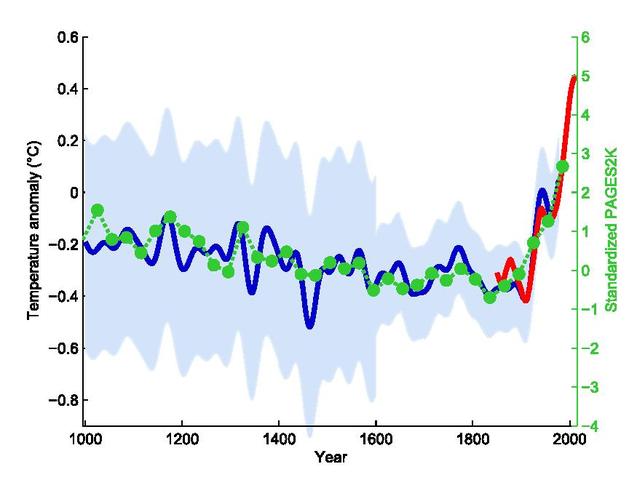
We had our fun last week, exploring how progress in renewable energy and electric vehicles may help us combat encroaching climate change. This week we're being a bit more hard-nosed, taking a look at what's currently happening to our climate. Michael Mann is one of the world's leading climate scientists, and also a dedicated advocate for improved public understanding of the issues. It was his research with Raymond Bradley and Malcolm Hughes that introduced the "hockey stick" graph, showing how global temperatures have increased rapidly compared to historical averages. We dig a bit into the physics behind the greenhouse effect, the methods that are used to reconstruct temperatures in the past, how the climate has consistently been heating up faster than the average models would have predicted, and the relationship between climate change and extreme weather events. Happily even this conversation is not completely pessimistic -- if we take sufficiently strong action now, there's still time to avert the worst possible future catastrophe.
Support Mindscape on Patreon.
Michael Mann received his Ph.D. in Geology and Geophysics from Yale University. He is currently Distinguished Professor of Atmospheric Science at Pennsylvania State University, with joint appointments in the Departments of Geosciences and the Earth and Environmental Systems Institute. He is the director of Penn State's Earth System Science Center. He is the author of over 200 scientific publications and four books. His most recent book is The Tantrum that Saved the World, a "carbon-neutral kids' book."
Click to Show Episode Transcript
0:00:00 Sean Carroll: Hello everyone and welcome to the Mindscape podcast, I'm your host, Sean Carroll. And I'm doing something a little bit unusual in the podcast today, in the sense that I like doing unusual things. We're always trying to experiment here, but usually every episode is completely different in topic than the previous episode and the following episode, but you can think of this week's episode and last week's as sort of a matched set.
0:00:23 SC: Last week, we talked to Ramez Naam about the optimistic view on our energy future, how we can switch to renewable energies and really combat global climate change. Today, I'm talking to Michael Mann who is a Professor of Atmospheric Science, he's the distinguished Professor of Atmospheric Science at Penn State University, one of the most informed and most well-known experts on the bad part of climate change, that is to say how fast it's happening, the evidence for it and the deleterious effects it's going to have on our world.
0:00:53 SC: So I think that because climate change is so challenging, this is the right order to have these podcasts. As optimistic as we want to be, it's really, really important to keep the challenges in mind. Mike Mann, of course, is famous or infamous for being involved in all sorts of political controversies in climate change. Not really his fault, if you look into the information, but he and his co-authors were the author of the original hockey stick paper and graph where you could see over hundreds of years how the Earth's temperature had been more or less static and then was zooming up in recent times, the so-called hockey stick graph. That got him the ire of all sorts of well-financed opposition people. So we talk a little bit about that, but honestly we spend most of our time in this episode talking about the science.
0:01:39 SC: Mike was actually a Physics undergraduate major, and so he knows that I'm a physicist, so we dig in a little bit to the physics of how the Earth's climate is changing, how we know that it's changing, and what we might do about it. Even though this is sort of the pessimistic of the two shows, there's still some reason for optimism here. Basically, it's in our hands what we want to do. That's always true, but for climate change, it's an especially urgent message.
0:02:06 SC: Remember you can go to the website, preposterousuniverse.com/podcast to get transcripts, show notes and links. Also links to our Patreon page. If you want to support the podcast you can get ad-free versions of the episode as well as monthly Ask Me Anything episodes. And with that, let's go.
[music]
0:02:40 SC: Mike Mann, welcome to the Mindscape podcast.
0:02:42 Michael Mann: Thanks, it's great to be with you, Sean.
0:02:44 SC: I presume that everyone who's listening has heard of the fact that our climate is changing a little bit, might be warming up, there's storms and things like that, but because of all of that stuff that we're already inundated with, I thought it'd be fun just to start with taking a step back, remembering what's going on here, remembering that there's something called the greenhouse effect that we've known for a very long time. So why don't you give us your version of the quick and simple here is why things are changing, and why we should care.
0:03:13 MM: Yeah, so you're absolutely right. The basic science here, the science underlying human-caused climate change, goes back nearly two centuries. Those of us who were trained as physicists of course appreciate the name Joseph Fourier and we're familiar, of course, with his fundamental contributions to mathematics, the Fourier series or the Fourier transform, the law of heat conduction through solids, Fourier's law. Well, Fourier actually understood, he hadn't worked out the details, but he understood that there must be a greenhouse effect, because the surface of the Earth is warmer than it should be, given the output of the sun and our distance from the sun.
0:03:51 MM: And so, essentially over the past two centuries, we have been refining our understanding of the basic science, but it's nearly two centuries old. So this is an old... This isn't new, controversial science, it's science that goes back farther than the theory of evolution. Moreover, we would not be able to explain basic observations like Venus, why is Venus as hot as it is and why is Mars as cold as it is, without understanding the greenhouse effect. So the basic science behind human-caused climate change, the greenhouse effect, is irrefutable. In fact, in the absence of any greenhouse effect at all, Earth would be a frozen minus 18 degrees Celsius.
0:04:39 SC: Yeah, I think it's a very important point, it's not like the greenhouse effect is something that we're bringing into existence, it exists, and we're tinkering with it a little bit.
0:04:48 MM: Right. And we should be thankful to the greenhouse effect because Earth would be a frozen and almost certainly lifeless planet in the absence of the natural greenhouse effect: Natural gases in the atmosphere, water vapor being important among them, carbon dioxide, methane that have this warming impact on the surface. They absorb some of the outgoing heat energy that's trying to escape to space and they send some of that energy back down towards the surface of the Earth. And so that warms up the Earth and it brings it to the relatively balmy 18 degrees Celsius or roughly 58, 59 degrees Fahrenheit temperature that the planet actually has, a habitable planet. The problem, of course, is...
0:05:34 SC: Sorry, Mike, let me just stop you very quickly, because as a physicist, I just have to dig into this a little bit. The amazing thing here is that, of course, these same gases are perfectly transparent to visible light. We get light from the sun, but then we sort of process it a little bit and guess what, the entropy increases. This is one of my favorite facts about the universe. And so, we radiate it back as infrared light at a different wavelength, different frequency, and these same gases are opaque to that, that's what causes the heat to be trapped. Is that fair?
0:06:09 MM: No, that's right, and this goes back to some of our early, the early semi-classical physics we studied as undergraduates. I believe Wien's law, the temperature of an object determines the amount of black-body radiation it produces through the Stefan-Boltzmann law. And so the sun, which has a surface temperature of about 6000 Kelvin, I believe through Wien's law that tells us that the center of the distribution, of the radiation it's producing is in the visible. And so we see the sun, we see the visible radiation coming from a 6000 Kelvin object. Whereas the Earth is about 288 Kelvins, and the same law, Wien's law, tells us that the peak of the distribution of radiation that the Earth is producing, the black-body radiation the Earth is producing, is centered in the infrared, a completely different part of the electromagnetic spectrum.
0:07:09 MM: And what these greenhouse gases do, they can actually absorb those wavelengths of radiation. So if we were wearing infrared-sensitive glasses and we were looking up at the atmosphere, it would look relatively opaque to us, because those greenhouse gases, water vapor, which is natural, CO2, some of which is natural, but we're increasing it by fossil fuel burning, those molecules, because of their vibrational and rotational modes of freedom are able to absorb and emit radiation in the red part of the spectrum, roughly 0.5 microns wavelengths of radiation, and that is indeed why they act as greenhouse gases and they warm the surface of the planet.
0:07:57 SC: You must have been a Physics major back in the day. This is great.
0:08:02 MM: I look back fondly on those days and, in fact, I often find myself drawing upon my training as a physicist in the work that I do today.
0:08:12 MM: And did for Fourier... Or it wasn't Fourier, but someone back in those days did point out, we're burning fossil fuels. I don't know if they called them back then, but we're probably putting new CO2 in the atmosphere. So the idea that we're increasing the greenhouse effect is also pretty venerable.
0:08:28 MM: Yeah, that's right, and in fact, I believe it was actually Arrhenius... It's amazing, these sort of Renaissance people of science back in the 19th century, who could work on so many different important problems. Arrhenius, of course, is known for giving us one of the prevailing definitions of an acid in the field of chemistry, but he also recognized that there was a greenhouse effect, of course, that had already been established, and that we were probably increasing it by burning fossil fuels. He didn't think that that would be that much of a problem, but he was aware of the basic science behind it.
0:09:14 SC: Okay, so he turned out to be right. Now, of course... We'll go in, I think, a little bit more to the details there, but let's just very quickly say, of course there are also complications. It's not quite that simple. That is the simplest basic story, and then there are things that work in extra influences in both directions.
0:09:32 MM: That's right, and physicists we like to start out with assumptions, assume a spherical planet, well, actually, that's a good assumption...
0:09:40 SC: That's a pretty good one, yeah.
0:09:42 MM: And the sun. So those assumptions are pretty good, but we have to make, of course, all sorts of other assumptions when we speak of the problem at this level of simplicity, because there always are complexities. We can, for example, abstract the Earth as a point in space, and we can simply work out the radiative balance of that point in space of the Earth as if it was just a mathematical point in space and we would be balancing the incoming what we call the short wave radiation, that high frequency ultraviolet and visible radiation coming in from the sun, and we have to balance that with the outgoing, what we call the long wave, that is the infrared radiation being emitted by the Earth, taking into account this layer of greenhouse gases, and we can construct it a very simple zero-dimensional model that, literally a model where there's no latitude, there's no longitude, and there's no altitude.
0:10:42 MM: The Earth is just a point in space, but we do account for the fact that there's an atmosphere through our treatment of the greenhouse effect. And using such a simple model, a zero-dimensional energy balance model, you can come up with a pretty good answer, you can actually estimate the temperature of the Earth very accurately using the parameter, the emissivity that measures the greenhouse effect of the atmosphere.
0:11:09 MM: You can go further than that, you can actually use a zero-dimensional energy balance model to model the response of the global average temperature. That's all this model can tell you, it can't tell you the temperature in the Arctic or the temperature at the Equator or the temperature up in the troposphere versus way up in the stratosphere, it can only give you a single number, the average surface temperature of the Earth, but it does a good job with that, and you can actually model changes in the average temperature of the Earth. Back in 2014, I published an article in Scientific American where I used a simple zero-dimensional energy balance model.
0:11:45 MM: It's one of the simplest differential equations you could hope to write down, a first order linear differential equation that you can solve analytically, or numerically, if you like, and I use that model to demonstrate the response that we can expect of the average temperature of the planet to various scenarios of increasing greenhouse gas concentrations. And the numbers I came up with are virtually indistinguishable from the numbers that climate modeling groups using the most elaborate three-dimensional climate models of the ocean and the atmosphere and the stratosphere and the carbon cycle and the clouds and everything else you can imagine that are run on supercomputers. They come up with pretty much the same answer that I come up with using that zero-dimensional energy balance model in that Scientific American article and in fact in the supplementary link, you can go there and download that program and run it yourself on your PC, if you like, you could never do that with a full-blown global climate model.
0:12:49 MM: But the zero-dimensional energy balance model isn't going to tell you anything about changes in rainfall patterns or ice sheets or sea level rise or shifting wind patterns, the El Niño phenomenon, what's going to happen to rainfall in Central Pennsylvania where I live, or out in California where you live. All the questions we would really like to answer, that model's not going to give us the answers we need. So we go to increasingly more elaborate models that incorporate, that account for more of the processes in the system. There's a hierarchy of models. And we see this of course in physics. Physics is well-known for... You start out with a simple conceptual model or even a good Duncan experiment, and you build up from that, but that's where you derive your intuition about a problem and it can guide our interpretation of the problem.
0:13:42 SC: It's absolutely interesting to me that the answer is so close. I have a great deal of confidence that the simple model should be in the ballpark and then you can tweak it, but we know that there are other effects that do push-in both directions. And is there some physical intuitive explanation for why they either, do they balance out or are they just all just smaller than you would think?
0:14:06 MM: Yeah, so I was a bit glib in the way I characterized it. In reality, you have the advantage in a simple model of this sort that you've got a small number of tunable parameters, if you will, parameters that you can tweak, and you have the freedom to choose those parameters in such a way that you get the right answer. So probably the most important parameter in that regard is what we call the climate sensitivity. How much warming do you get for a doubling of CO2 concentrations? And our best estimates are that that's probably somewhere in the neighborhood of 3 degrees, 3 degrees Celsius, so a little less than 6 Fahrenheit warming if you double the concentration of carbon dioxide in the atmosphere. Pre-industrial levels were about 280 parts per million, so we will hit that doubling of about 560 parts per million in a matter of a few decades, if we continue on the course that we're on.
0:15:06 MM: And one of the key metrics of climate change is this so-called climate sensitivity. Now, in a full-blown coupled ocean atmosphere ice sheet, the most elaborate climate models you can imagine, that is an emergent phenomenon. You can estimate that from actually putting all of the, representing all the processes and seeing what answer you get. In the zero-dimensional energy balance model, that's just a specified parameter. So all of these feedback processes that we know are important associated with the melting of ice or the evaporation of water into the atmosphere or changing vegetation, there are lots of feedback processes, responses of the climate system itself to the warming that modify the warming.
0:15:52 MM: And so they are positive or negative feedbacks that have to be incorporated if you're going to describe the full nature of the response of this system. In the zero-dimensional energy balance model, we can summarize all that with one parameter, it's the climate sensitivity, even though we're not representing the ice sheets or the carbon cycle or any of the things that actually end up determining that sensitivity.
0:16:13 SC: No, that's actually very helpful, and I love that you called it an emergent phenomenon. It's actually very reminiscent or in fact exactly the same as what we would call the renormalization group approach in fundamental physics, where there's a lot of stuff going on underneath the surface, but for the net effect on large macroscopic scales, you can sum it up in sort of one simple parameter.
0:16:35 MM: Right, exactly, yeah.
0:16:38 SC: But nevertheless, there's still complications we do care about. One that I just gotta get out of the way right away is what do we even mean when we talk about the global mean temperature, right? The temperature here where I live in Los Angeles isn't even the same as it is in Pasadena, what a 20-minute ride away where my office is. So how do you go about doing that average? What really counts when you say here is the temperature of the Earth right now?
0:17:02 MM: Yeah, so it should really be thought of as just a... Again, I suppose a metric, it's a measure of climate change that is useful in characterizing certain global scale responses. For example, sea level rise, by and large, is a function of the average temperature of the planet. There are various other attributes. The total amount of water vapor in the atmosphere is essentially a function of the average temperature of the planet. But as you allude to, we don't live in the global average, we live in particular locations. Land turns out to warm faster and more than oceans when you increase the greenhouse effect, and that has to do with a number of processes, but oceans have more thermal inertia, a greater heat capacity, so they respond more sluggishly to the increasing downward flex of heating from increased greenhouse gases, whereas the land responds more quickly.
0:18:06 MM: And so there is a very large amount of regional variation. If you shut down the North Atlantic ocean current, known as the conveyor belt, sometimes called the Gulf Stream. Although technically speaking, the Gulf Stream is something a little different, it's really a wind-driven gyre. The North Atlantic drift is this water that continues north on into near Iceland and Greenland and then eventually sinks, because it becomes cold enough and salty enough to sink and it forms this so-called conveyor belt, this relatively warm surface current that flows north towards Iceland and Greenland and Europe. And if you shut that current system down, you can actually get a cooling in certain regions. This was popularized, of course, in the film The Day After tomorrow, and I wouldn't be surprised if you actually reviewed that film. I know you...
0:19:02 SC: No, I stay away.
0:19:03 MM: Yeah, it's one of those. It's fun when Hollywood and science intersect to talk about, you know, what they get right and what they get wrong, they get a lot wrong. You have to get a lot wrong to take something that would play out over a time scale of decades to a century and have it occur in a matter of days, and so it's a caricature of the science. But what happens in that film, there is a grain of truth, as there always is, to the scenario. And if you were to shut down the North Atlantic drift or the conveyor belt ocean circulation you could get a cooling, for example, in Iceland. And so you do have to understand these regional responses, changes in ocean currents, changes in wind patterns, all of that. For California, for example, what happens to California when it comes to drought? We've seen epic drought over the last decade. A little bit of a relief over the last year or two.
[chuckle]
0:20:06 MM: Yeah, well, relief if you want to call drenching floods...
0:20:10 SC: Only relatively, yeah, but yeah. Yeah, we got a lot of rain here in LA, but I'm not even sure if we're technically out of the drought yet. I think we finally are but it's not exactly as if it's a tropical rainforest around here.
0:20:21 MM: No, exactly. I was actually looking just the other day at the drought map, the current US drought map, and there's the very faintest yellow, which indicates a very slight drought in a little corner near San Diego. But otherwise, the rest of California is white, which is to say neutral, it's sort of neither in drought or having, experiencing an excess of rain. But we've seen epic droughts, and they will likely get worse, more pronounced and more extended as we continue to warm the planet. And why that happens, some of it has to do with the warming of the soils, and you get more evaporation, but a lot of it has to do with changing atmospheric circulation. The sort of belt of deserts is located in an area where you have sinking motion in the atmosphere, it's part of a circulation cell where you have rising motion near the equator and sinking in the subtropics and that sinking air is warm and dry, and it's why large parts of California and other areas in the subtropics tend to be relatively dry.
0:21:28 MM: In the winter, you get some of these mid-latitude storm systems, the fronts or the trailing edge of the fronts coming down into the region, and that's where you get most of your rainfall. Well, what the models predict is that all those patterns shift poleward. So the dry subtropical deserts shift poleward, and the mid-latitude storms, the mid-latitude cyclones that bring rainfall with them, those shift poleward as well. That means that California, an increasingly large part of California, will find itself well within the core belt of deserts and missing a lot of the rainfall that it used to get in the winter from these trailing storms systems. But how bad that will get, how quickly that will happen, that all depends on getting the weather right, getting these weather systems and their behavior right in these models, and that can be a tricky thing, because weather is really complicated, there's a lot of chaotic behavior, non-linear dynamical behavior, things that are sometimes difficult to capture in a model, for example, that's too coarse in its spatial resolution, that doesn't get all of the detailed the regional processes, right.
0:22:50 MM: So there are real wild cards, question marks when it comes, for example, to what will happen to rainfall in California, there's still uncertainty about precisely what will happen there, even if we can say California will warm up and that there'll be less snowpack and more evaporation from warmer soils, all of that favors drought. But what happens to these storm systems, that's still sort of up in the air, no pun intended.
0:23:18 SC: Yeah, no, I definitely want to get into that, 'cause I have some serious questions. Not serious like I'm doubtful, but I don't understand. But first, I think that my actual question was a little bit simpler. I Just wanted know what it means to say the global average temperature. I mean, if the air has different temperatures, both latitude and longitude-wide, but even in altitude, what is the thing that we are defining if we imagine having a thermometer at literally every point in space in the atmosphere and then taking the average, or is it something dumber than that?
0:23:48 MM: Yeah, you put your finger right on it. It's literally, if we had a thermometer everywhere over the surface of the Earth and, as you allude to, reduce that thermometer measurement to sea level, because obviously you... That elevation is going to be colder, so implicit in that is the notion that you could define a surface that would be at sea level, covering the entire planet. And if you could do that and if you could make measurements everywhere on land at the ocean surface and at elevation reducing those temperatures. There are various ways to do that, but a dry atmosphere cools at about 10 degrees Celsius per kilometer, we call that a lapse rate, and so you can reduce temperatures to sea level. That's the number that you would theoretically come up with. It by the way, is the only number that is estimated in a zero-dimensional energy balance model, so that model is envisioning a temperature that's measured precisely in the way that we just described.
0:24:49 SC: Okay, so there's some more or less agreed-upon procedure for taking the data we have about the temperature at different locations on Earth and converting that into a best fit number that we would call the global mean temperature.
0:25:01 MM: Yeah, that's right.
0:25:03 SC: And you got your start, as far as I understand it, in actually trying to push this idea backward in time, trying to figure out what it had been over time. So tell me how you got into that and how we do that.
0:25:16 MM: Sure thing, yeah. So early on in my PhD studies, I was interested in understanding, came in as a physicist, and I was interested in constructing models for describing the natural variability of Earth's climate. I wasn't really looking at climate change, I was interested in natural cycles in the climate that have to do with oscillations in the way the ocean and the atmosphere interact with each other. The most well-known of these is the El Niño-Southern Oscillation or ENSO.
0:25:49 SC: No-one denies that the climate does change even without our help.
0:25:53 MM: Absolutely, and even... And when we talk about natural climate change, there are two types of natural climate change. They can be externally driven by changes in solar output or volcanic eruptions that have a cooling influence on the planet. There are various natural... On longer time scales, the ice ages are driven by changes in Earth's orbital geometry relative to the sun. So there are these natural external drivers, and then there's the fact that the climate, like the weather, is a chaotic system. And in fact, one of the claims to fame of our field, field of atmospheric science, is that that is where our modern conceptual understanding of chaos actually arose.
0:26:38 MM: It was in a set of equations that my PhD advisor, in fact, Barry Saltzman, back in the early 1960s, he'd been studying these equations. These equations described sort of, it was a simple system for describing weather, and it consisted of three coupled partial differential equations. And he noticed that these equations were giving rise to very unusual behavior. He thought it was some sort of numerical instability. His former MIT colleague Ed Lorenz recognized that there was something more fundamental going on here and Lorenz was trained in the earlier the work by Poincaré in the early 20th century into non-linear dynamics and understood that this was in fact a real system exhibiting what had been theorized, a chaotic behavior.
0:27:34 MM: So the atmosphere and weather exhibits chaotic behavior, but so does the climate. The El Niño phenomenon, which Californians, of course, are intimately familiar with, that is a non-linear interaction between the tropical Pacific Ocean and atmosphere. We understand the physics of those interactions pretty well. And when you model those interactions, they are described by a set of non-linear couple of differential equations that give rise to chaotic behavior. So there's this chaotic component to the climate that even if you weren't changing any of the external parameters, just leaving the system to run on its own, it would vary in this chaotic manner, just the same way that the weather varies chaotically over time. But in this case El Niño is a three to seven year cycle. The weather, mid-latitude weather systems, have timescales of days to a week. The El Niño phenomenon, because of the longer timescales of the tropical Pacific Ocean, those oscillations happen on timescales of years, three to seven years.
0:28:44 MM: I was interested in potentially longer timescale oscillations in the climate system, related for example, to mid-latitude ocean gyres, the Gulf Stream being part of them. These are ocean circulation systems that sort of have intrinsic decadal timescales. So if there's an oscillation, it could have decadal or longer timescales. I was interested in the extent to which those oscillations exist and it turns out you run into a problem. If you're interested, for example, in multi-decadal solutions like 50-70 year cycles, there's some evidence that they may exist, then you've only got a century of widespread thermometer measurements, so you're sort of stuck. That's basically one cycle, you can't really identify an oscillation, you can't do a Fourier, you can't do a Fourier, transform a spectrum, you can't estimate the spectrum of a 100-year data set and hope to isolate a peak that has a timescale close to the length of the data set.
0:29:50 MM: So that led me to become interested in other types of climate data that could take us farther back in time, so-called proxy records, like tree rings and corals and ice cores, and that's what led me on this sort of journey which ultimately led to an estimate of temperature changes over the past thousand years and the so-called hockey stick curve that placed me right at the center of the very contentious battle over climate change. But the questions that motivated that work actually had nothing to do with climate change itself.
0:30:25 SC: That is hilarious. I didn't realize that it came from the Lorenz and the initial forays into non-linear dynamics and chaos, but it makes perfect sense in retrospect.
0:30:35 MM: Yeah, and it's interesting, the interplay between atmospheric science and meteorology and physics, it really goes back to the origins of to some extent of both sciences. So there is this very nice interconnectedness, which is appealing to me because, again, I got my start in physics.
0:30:58 SC: And so a thousand years, I presume that's a non-arbitrary number. There's some reason why that's the regime in which we can accurately measure the global temperature, is that right?
0:31:08 MM: At the time, in fact, in 1998, we published our first estimate, and that only went back 600 years. Then based on the analysis of other records, we found that there were enough longer records that we could actually obtain meaningful results a thousand years back. And there are sort of internal diagnostics that you can look at, it's a statistical problem, and there are statistics that you can look at that tell you whether or not your prediction or your estimate is likely to be meaningful or not. And so you can look at the time of that first study, 1998, those statistics told us we couldn't go back any further than 600 years with the data we had and get a meaningful answer. But by digging into some additional longer records, we were able to extend it back a thousand years.
0:31:56 MM: Now, scientists have literally extended these sorts of estimates millennia back in time. There's one tentative estimate of this sort that now goes back well into the last Ice Age, 20,000 years back in time. And now we understand that the spike of warming that we've found in our study which demonstrated the warming of the last century to be unprecedented in a thousand years, well, these studies now show that it's unprecedented in tens of thousands of years, and potentially, although we don't have the data to conclude that, it's likely that the warming spike we're seeing now is unprecedented in hundreds of thousands of years, if not longer.
0:32:40 SC: And what, is there some particular proxy that is the best? What is the best way to figure out what the temperature was a thousand years ago?
0:32:47 MM: Yeah, so if you if you want to go back... The nice thing about the time frame of the past thousand years or so, is that you do have a number of annually resolved records, which is to say you've got corals or ice cores, or tree rings that have annual layers, and so you can get an annual chronology. And that's actually very helpful when you're trying to calibrate these data against modern records, that you can literally align them and you can do a statistical calibration. If you want to go back farther than that, you start to become reliant on sort of lower resolution records, sediment cores and pollen. These are things that can be dated, but not annually. They could be radio carbon dated, or there are other methods of dating that provide rough timescales, but you lose that annual resolution, which creates additional challenges when you're trying to calibrate the records against the modern temperature.
0:33:48 SC: And what is the... What is the answer? You alluded to the hockey stick, the fact that right now, in the last century, the temperature is zooming up which, of course, if you plot it at the same time as you're plotting the CO2 concentration in the atmosphere, that also zooms up and it's exactly what Fourier would have predicted, I suppose.
0:34:07 MM: That's exactly right, Sean, I'm glad you put it that way, because it's really important for people to understand that that's how science works. It isn't that we've found a warming spike, it was that, "Ah hah, well, what else is going on? Oh, fossil fuel burning, that must be the cause then." It's just the opposite. We have understood for so long that increasing greenhouse gases have to warm the planet and these observations and these temperature reconstructions are simply confirming what more fundamental science pretty much tells us has to happen, and that's really important for people to understand, because it's one way in which science is often misrepresented.
0:34:47 MM: It's easy to create a straw man. These scientists were just looking for a cause and the two things happened to correlate. That's not how it works.
0:34:56 SC: Well, and also one of the popular responses among climate skeptics is that there are many natural ways for the climate to vary and of course that's true, but nothing like the timescales we're seeing here. And correct me if I'm wrong, but investigations such as yours have helped us understand things like the Medieval Warming Period and the Little Ice Age and these are real but they're more gradual, and we understand them. Is that fair?
0:35:22 MM: No, that's absolutely right. And those past climate patterns, we now understand quite well those past climate anomalies, if you will, the Little Ice Age and the Medieval Climate Anomaly. In fact, we've moved away from calling it the Medieval Warm Period, because it was actually quite cold in a large part of the tropical Pacific.
0:35:40 SC: A little euro-centric there to call it the Warm Period, yeah.
0:35:43 MM: That's right. And we now understand a good deal of that, what's going on with these past natural changes, unlike the warming that's happening right now, which is pretty much globally ubiquitous. There's warming happening just about everywhere over the surface of the Earth. These past periods, you might have warmth in Europe, but cold in the tropical Pacific, cold in parts of North America. And what's happening is you're seeing the response to changes in ocean circulation patterns and wind patterns. Those are things that tend to cancel out in a global average. You're not changing the overall radiation budget of the Earth, like you are with greenhouse gases, you're just sort of shifting heat around. And increasingly, these past periods very much appear to reflect those sorts of changes, regionally cancelling, so that if you look at the global average of the Little Ice Age or the Medieval Climate Anomaly, there are changes in global average temperature of a couple of tenths of a degree Celsius that are consistent with the drivers, changes in solar output, volcanoes, those can warm or cool the global climate.
0:36:57 MM: They can change the global average temperature. But they also interact with these climate modes, like El Niño, or the pattern known as the North Atlantic Oscillation, how the jet stream varies over North America and Europe. These forcings, these radiative, these external changes can interact with modes of climate variability, leading to large regional changes that largely cancel in the global average. And if you do the global average you find that it's consistent with how the underlying factors are changing the global radiation budget of solar or volcanic forcing.
0:37:34 SC: So it's kind of the difference between heating things up overall and moving the heat around from place to place, which at any one place might seem like a dramatic shift.
0:37:43 MM: Exactly, and that's where the modeling and the observations have really come together because in this area of science, in all areas of science, there's always theory and modeling, and then there are observations, and observations are king in the world of physics. Observations in our field can be a little tougher to deal with, they're not quite as precise as the measurements that you're able to make and in particle physics often we have large error bars on our observations, but the observations and the theory work hand in hand in this field, as they do in physics, and that's when you start to have a comprehensive foundation for understanding a phenomenon, when the observations and the theoretical modeling really align and agree with each other. And we've seen the science move in that direction when it comes to our understanding of the Little Ice Age and the Medieval Climate Anomaly.
0:38:50 SC: So let's... Good, let's drag it back then to the present day and what's going on. So obviously we're dumping CO2 and other greenhouse gases into the atmosphere, primarily from fossil fuel burning? What is the relative rate of other things? I know that cows burping has a lot to do with it too.
0:39:07 MM: I'm glad you you didn't misrepresent the cows. They've been much maligned.
0:39:13 SC: I know which end of the cow the methane comes out of.
0:39:15 MM: Yeah, that's the end it comes out of. The cows aren't nearly as...
0:39:23 SC: Flatulent.
0:39:23 MM: Exactly, as they're sometimes implied. So that's part of the problem. There was a report that just came out, an IPCC special report. The IPCC comes out with their major climate reports roughly every five years and the last one came out a few years ago. There'll be another one in a couple of years, but in the meantime, they often publish these interim reports on specific sort of areas of the science, and in this case they were focusing on land. And part of that was focusing on the role of agriculture and livestock in generating greenhouse emissions. And it got a lot of play. And it's sort of interesting and the topic of the book that I'm actually working on right now is sort of about what are known as deflection campaigns. If you're the fossil fuel industry, it's very convenient to point at those poor cows and say, "No, they're the problem," or to point at us and say, "You're the problem, 'cause you're eating beef and you're eating meat." And the problem is on us, is on you, rather, it's not the burning of fossil fuels. We've seen these sorts of deflection campaigns many times in the past when it came to the beverage industry and bottle and can litter, the tobacco industry and many others.
0:40:45 MM: Well, we're seeing that to some extent with the fossil fuel industry, where there's a grain of truth. Some of those emissions do come from agriculture and livestock, but beef is responsible for only, I believe it's 6%, 6% of total carbon emissions are associated with beef livestock and the eating of beef. That's a pretty small piece of the pie. We also hear a lot about flying, a lot of criticism of well, flying is 2% of the carbon emissions. It's not zero. And personal responsibility is part of the solution and we should all try to do everything that we can to minimize our own personal carbon footprints, and often those are sort of low-hanging fruit, they're no regrets decisions on our part because they save us money, they make us healthier, they make us feel better, and they reduce our carbon footprint, so we should all do that.
0:41:43 MM: But when it comes to the main source of the problem, the lion's share, or roughly just about two-thirds of the carbon emissions are from the burning of fossil fuels for energy and transportation. And we have to keep our eye on the ball because we as individuals can't reduce those emissions if we don't work for systemic change that changes our entire energy infrastructure, our transportation infrastructure, our energy infrastructure. And to do that we need policy and we need politicians who are willing to support policies that are good for us and the planet rather than the policies that might make huge profits for the fossil fuel interests who fund their campaigns. And so, in my view, that's where we really need to be focusing, but let's not lose sight of the fact that there are things we can do in our everyday lives and reduce our carbon footprint and these things are synergistic. When we do that, we send a message to others, it puts us on a path of engagement where we become more committed to doing more and trying to influence policy, for example, to solve this problem.
0:42:58 SC: Yeah, I'm actually a huge believer in solving these kinds of things or tackling them mostly systematically, mostly through government or international cooperation. Personal virtue is great, but it can... It is great. Honestly, I shouldn't say that sarcastically, but it also can be an excuse to sort of not worry about the real bigger thing. I did have... I did a podcast interview, I'm going to publish these back-to-back, with Ramez Naam. Do you know Ramez?
0:43:29 MM: Yeah, absolutely, sure, yeah.
0:43:31 SC: So he gave the optimistic side of the story, 'cause he's all about how renewables are coming and we're going to be driving electric cars and it'll be great, and I'm counting on you to remind us that it's not automatic and if we don't actually make an effort to do it then really bad things are going to happen. So I don't want to say that you're the pessimistic side of the story, but a little bit of a realist ingredient in the cocktail here.
0:43:55 MM: Yeah, well, my mantra these days is urgency and agency, so...
0:44:00 SC: Good, very good.
0:44:01 MM: Yeah, we have an urgent problem and we need to act and it's not going to solve itself, the solution isn't going to happen on its own, but there are things that we can do and there are reasons for cautious optimism. It's not too late to make the changes necessary to avert the worst impacts of climate change. So I imagine that he and I probably agree somewhat on the bigger picture, but perhaps I'm more likely to emphasize the need of dramatic policy change now. And in particular, holding the feet of bad actors to the fire, taking to task bad actors and the politicians in their pay who are blocking efforts, literally trying to make it more difficult for us to shift towards renewable energy. They're blocking incentives for renewable energy, they're doing everything they can to throw a monkey wrench into the works and we need to make sure that they don't get away with doing that.
0:45:04 SC: I do want to talk specifically about the politics and the policy, but one more important science thing that I want to be clear on, which is the relationship of the overall increase in warming with the sort of local features of the weather, right? I mean, more dramatic weather events have been happening or at least perceived to be happening. It seems like there are more droughts and floods and hurricanes now than there were a few years ago. It's not obvious to me that there's a connection there with warming, but there seems to be. So, hopefully you can explain this to us.
0:45:38 MM: Yeah, thanks, I'm so glad you asked that, Sean, because it actually relates to some the research that I've been doing in recent years. I'm best known for the paleoclimate work and the hockey stick that I did decades ago, but my research these days focuses to some degree on the impacts of climate change on extreme weather events. In fact, last March I had an article in Scientific American about the research that we have been doing that, interestingly enough, taps into my physicist training and background. Because some of the mathematics that you use to solve this problem, you actually use the WKB approximation, which...
0:46:20 SC: Oh, nice. All of my physics students listeners, their hearts just fluttered when you said that.
0:46:25 MM: Well, yeah, and it's delightful, of course, when I encounter an opportunity to actually draw up on my training, even in quantum mechanics. Who would have thought that the of the behavior of matter at the smallest scales could have implications for our understanding of global scale atmospheric patterns? But the mathematics work out to be similar because it turns out that there's a phenomenon, a resonance phenomenon in the atmosphere, we've seen this in recent summers. So if you think about these really persistent extremes like we've had in California where you have one of these blocking patterns, a ridge, a high pressure system just parked over California for weeks at a time, not budging, or back East, we've had the opposite. We've had a low pressure system, a tendency to get these low pressure systems that just remain locked in place.
0:47:18 MM: Normally, these weather systems sort of move along from west to east with the jet stream, but as the jet stream slows and as you change temperature patterns in the atmosphere, you can actually create a resonance effect where these systems become stationary and they grow greatly in amplitude. So you get these really deep highs, and they sit over the same place like California for weeks on end and that's when you get record heat and drought and wildfire, and because of the waviness of the jet stream, if you've got one of those deep ridges, high pressures parked over the West Coast, there's a good chance you've got the flip side of that sinusoidal wave, the low pressure parked over, say, the Eastern US, which is exactly what we saw last summer, and we had unprecedented rainfall and flooding.
0:48:11 MM: Now, what our research shows is that as you change the pattern of temperature with latitude, so it turns out that the jet stream owes its existence to the difference in temperature between the subtropics which are warm and the polar regions which are cold, and that north-south change in temperature actually drives east-west variations in wind strength, through something known as the thermal wind, and it's a combination of the hydrostatic balance in the atmosphere and the so-called geostrophic law, that involves the coriolis force and pressure gradient forces in the atmosphere. So...
0:48:55 SC: Sounds sciencey, I like it.
0:48:57 MM: Yeah, it's really, it's fascinating science. And it tells us why the jet stream is located where it is and it also tells us that if you reduce those temperature contrasts, for example, if you preferentially warm the Arctic and you don't warm the subtropics as much, you're going to reduce that temperature gradient, that north-south temperature gradient, you're going to reduce the strength of the jet stream. And that means that systems are more likely to stay parked, they're not getting moved along as quickly, but they grow, they can grow in amplitude because of this resonance effect. And it turns out that happens through essentially a wave guide phenomenon, where the mid-latitudes are acting as sort of a wave guide where the undulations in the jet stream, which are these weather disturbances, we call them Rossby waves or planetary waves, typically they lose energy, they radiate energy, both vertically, but also latitudinally, they lose energy radiating to the south and to the north.
0:50:00 MM: But under certain conditions, when the north-south temperature variations are just right, the atmosphere behaves as a wave guide, there's basically a wall at sort of the subtropical end and at the subpolar end and these Rossby waves are funneled through a wave guide with minimum loss of energy. And it turns out the mathematics to solve for the dispersion relation, it requires the use of the same WKB approximation that was used in quantum mechanics in the early 20th century, yeah.
0:50:33 SC: That's great. And so...
0:50:34 MM: Early 20th century, yeah, sorry.
0:50:37 SC: So in some sense... The atmosphere is not unstable in the traditional sense. Like it doesn't... We poke it and it runs away to either zero or infinite temperature, but it sounds like the sizes of the fluctuations that it undergoes when it tries to stabilize itself, the amplitude might be increased by the increasing temperature overall.
0:51:02 MM: That's exactly right. This is one mechanism by which you can get these larger amplitude weather disturbances. Now, obviously, there are other mechanisms that come into play, so they're limiting... There's a limit on how much of that strengthening can happen, and it turns out in this case, it's because what we call the simple theory, the barotropic theory, which is sort of like a vertically uniform atmosphere, ultimately breaks down because the atmosphere isn't barotropic and so these eventually, this condition breaks down and so it doesn't reach infinite strength, just like hurricanes don't reach infinite strength. There are dissipating, mechanisms that kick in when they become strong enough, but the upper limit as to how powerful they can become, whether it's hurricanes or the amplitude of these weather disturbances, does appear to be increasing because of climate change.
0:51:54 SC: Yeah, so I was just going to say exactly that and hope that you would agree with me that it's fair to imagine that we're going to get more droughts, we're going to get more hurricanes, we're going to get more floods, we're going to get more extreme events, as well as an overall increase in temperature.
0:52:09 MM: That increasingly, no pun intended, appears to be the case. And it's another area or it is an area where the science has progressed. I would say a decade ago, if you had asked me this question, these things were very much up in the air. But the models have become far more sophisticated and realistic. Our observations, every day we're getting new observations, and we've really refined our understanding of these connections quite a bit, to the point where I think one can say there is now an emerging consensus that we will see more extreme weather events, and we will see more intense hurricanes and tropical systems as a result of human-caused climate change.
0:52:56 SC: And you can't point to any one hurricane, and say, "Oh, this is because of climate change," but you can point to a lot of hurricanes over a period of time and say, "Yeah, this number definitely has something to do with how we're messing up our atmosphere."
0:53:08 MM: Yeah, that's right, and in fact, we can even point to some of those individual hurricanes and talk about how, not that climate change caused, we can't say climate change caused the short wave disturbance. Again, it's a chaotic system, and you can run a model 10 different times and get a different result of whether or not a hurricane forms are not in each of those simulations because it is fundamentally chaotic, but once it does form and it begins to strengthen, we know that a warming atmosphere, warmer ocean temperatures, there's more evaporative transfer of heat from the ocean surface, which is the energy that drives and strengthens these storms. In fact, a colleague of mine, Kerry Emanuel of MIT, I think now more than two decades ago, worked on a very elegant theory for tropical cyclones. You can actually model them as a Carnot cycle.
0:54:03 SC: Oh, nice.
0:54:04 MM: There's a cold temperature reservoir at the troposphere, at the boundary between the troposphere and the stratosphere, which is the lid on the rising motion associated with these systems, and the surface of the tropical ocean is the warm reservoir, and the efficiency, the work done, which is a measure of how intense, in fact, the hurricane can become, is a function of the differences between those temperatures in terms of a Carnot... Yeah, it's a very elegant theory and it's essentially right. And so what happens is that upper temperature, that cold temperature reservoir pretty much stays the same. But the warm temperature, the surface of the ocean is increasing, and so the efficiency increases, more work is done. These hurricanes become more powerful and so we can talk about how with a given hurricane, it was likely more intense, had more water vapor in it, because that's... The amount of water vapor in the atmosphere is another nice simple physical relationship known as the Clausius-Clapeyron equation.
0:55:08 MM: Basically, the evaporation rate increases as an exponential function of the temperature, so a warmer atmosphere, for each degree Celsius the atmosphere holds about 7% more water vapor, and so we can say that these storms have more moisture in them, that means more moisture to turn into record flooding rainfalls, like we've seen over the last two years, we've seen the two worst flooding events on record for the US. That was with Harvey and then with Florence.
0:55:39 SC: Well, okay, so why don't we just remind our listeners of all of the terrible things that are going to happen. Again, I'm not necessarily, I want to get later to the policy, soon to the policy, because we can do things to change things, but it is good to keep in mind how bad things will get if we don't change anything. So there's extreme weather events, there's also rising ocean levels, there's changes in crops and farming. What are the things that you fret about when it comes to climate change the most?
0:56:15 MM: Yeah, the things that keep me up at night are the things where there is uncertainty, right. Too often. We hear uncertainty offered by the critics as a supposed reason for inaction. Oh, well, we're not sure, so why should we do anything? Well, from a risk management standpoint, it's just the opposite of that, and it's especially true, that's especially true, because the uncertainties have been cutting against us. If you look at the projections, say, a decade ago, and you look at where we are with respect to the melting of the ice sheets and the rise in sea level, or many other measures that, the loss of sea ice in the Arctic, we are seeing changes that are at the upper end of the uncertainty ranges that we had put for it at every juncture.
0:57:03 MM: And what that tells us is that uncertainty has not been our friend. As we've resolved that uncertainty, it's turned out that the processes that we hadn't represented very well, when you get those into the models, they actually tend to, for example, accelerate some of these processes. A good example is ice sheets. In the old day, an ice sheet was treated as just a huge mound of ice. But we understand they're very dynamic. In fact, you can use a modified sort of set of fluid dynamics equations to describe the flowing of ice, and the constitutive behavior of ice. It has a complex dynamics to it. Ice can collapse, you have ice cliffs that can collapse, you have ice shelves that provide buttressing support for the ice sheets. You have cracks that form in the surface that allow melt water to rush to the bottom of the ice sheet where it lubricates the base, it allows the ice to surge more quickly out to sea.
0:58:09 MM: And so as we get more of the physics into these ice sheet models, we're finding that they're more dynamic and that they can collapse faster and we're seeing that and we're seeing sea level rise faster because of it. So uncertainty is not our friend. And that's what keeps me up at night. It's the fact that there is uncertainty, and certainly can take the form of the known unknowns, as infamously once described by a political figure, there are the known unknowns, and the unknown unknowns, and the things that keep me up at night are the unknown unknowns, that are lurking out there. We know they're out there, and we just haven't discovered them, because the known unknowns have worked out to not be in our favor. That's likely to be true for the unknown unknowns as well.
0:59:00 SC: Well, but what about the known knowns? We know the sea level is rising. I'm sure that you're safe in central Pennsylvania, I did check that here in LA our height above sea level is enough that even if all the ice on Earth melted we would still not be underwater, but some of my friends on the beach are not going to be quite so lucky. Is that going to be worse overall for the planet than the simple fact that the temperature is going up? Or does it just depend on who you are, where you are?
0:59:28 MM: Yeah, well, sea level rise is certainly proceeding faster than we expected, and it's true, if you live in Jersey Shore, Pennsylvania, you'll be fine. There's a town called Jersey Shore in the middle of Pennsylvania that I drive through whenever I drive east.
0:59:45 SC: But if you live on the Jersey Shore of New Jersey, it's going to be a different story.
0:59:50 MM: When I was growing up, and I had grandparents in Philadelphia, we would go to the Jersey Shore in the summer. And if you live on the Jersey Shore you're familiar with it, or anywhere along the Mid-Atlantic coast, New York City, for that matter, we're already seeing... Miami Beach, it might even be the best example. There is increasing talk about managed retreat. We may be essentially beyond the point where there are any adaptations, building levees or other means of preserving some of our large coastal cities. We have to literally retreat from the coastline, and obviously, as there becomes less land available, and that can be true because of sea level rise literally eroding our coastlines, reducing the amount of coastal land or the amount of total land, and you've got the tropics becoming potentially too warm for human beings to occupy. And so you're talking about seven-and-a-half billion and growing people competing for less space, less food and less water. Now, if that doesn't keep you up at night, you're not thinking about it, because this really represents a potential crisis from a security standpoint, from a conflict standpoint.
1:01:25 MM: That's where the scenarios that we, that even... Our military experts have gamed out some of these scenarios, and some of them don't look unlike the post-apocalyptic, the dystopian futures that Hollywood has depicted that of what our future could look like if we don't get our act in gear.
1:01:51 SC: And what is your feeling about the currently on the table political solutions, the Paris Agreement and so forth? Solution is not the right word, but at least, strategy for trying to do better. Is it enough? If we actually all did what the Paris Agreement said we should do, would that be enough or is that just a little stop-gap?
1:02:12 MM: Yeah, it would get us about halfway to the emissions reductions we need to avert warming of 2 degrees Celsius, which most scientists who study the impacts of climate change will tell you if we warm the planet more than 2 degrees Celsius, a little less than 4 Fahrenheit, that's where we start to see some of the worst impacts, irreversible impacts of climate change increasing.
1:02:35 SC: And how much have we warmed it already?
1:02:36 MM: We've warmed it about 1.2 degrees Celsius already. When you hear... There's a lot of talk these days about the 2 degrees Celsius target, but also a lower 1.5 degrees Celsius target. Because if you're a low-lying island nation, that's already catastrophic warming. We will probably lose many of our low-lying tropical island nations and other coastal regions, we may lose the Great Barrier Reef, at a warming of 1.5 degrees Celsius. So, there are credible arguments for saying that 2 degrees Celsius is too much, we shouldn't let it get above 1.5 degrees Celsius, but already...
1:03:19 SC: But of that 2, we've already done 1.2 of it.
1:03:21 MM: 1.2. So that tells you there isn't a whole lot of wiggle room left, is there...
1:03:25 SC: And if someone put a gun to your head, when would you predict we would hit the 2 degree Celsius warming mark?
1:03:31 MM: They don't have to put a gun to my head. In my 2014 Scientific American article using that zero-dimensional energy balance model, I made a prediction of precisely that. It's sort of business as usual, if we do nothing, then by 2036 or so, we hit that number. And so that tells you, that's 2 degrees Celsius, 1.5 degrees Celsius comes earlier We're warming the planet at about, almost 0.2 degrees Celsius per decade. So if I tell you we're at 1.2, and actually more like 0.25 per decade, and we're at 1.2 and we're trying to avoid 1.5, we get there even sooner.
1:04:16 MM: So in fact, yeah, we're warming closer to 0.2 degrees Celsius, I should say. And so, we got 0.3 degrees Celsius to work with there, and we're warming up 0.2 per decade.
1:04:30 SC: And the US, I think the US is the worst, I forget which way it goes. The US is the worst per capita or the worst overall?
1:04:37 MM: We're the worst per capita. The average carbon footprint of an American is about 20 metric tons of carbon, that's the weight of two large African male African elephants, that's the mass of CO2 that the average American is putting into the atmosphere a year. And carbon footprints are literally orders of magnitude smaller than that for most of the developing world. Increasingly, countries like China and India as they industrialize are approaching a more American sort of sized footprint, and that's obviously a big part of the problem as well. Arguably, that's why those of us in the West, the US and Europe who built our economies on two centuries of free access to dirty energy, we obviously have a major responsibility if we're going to tell other countries like China and India that they don't have the same right to that cheap energy to build their own economies, if we're going to tell them that they don't have the right to do that, we've got to have her own house in order.
1:05:54 MM: And that's part of why it's so important for the US to lead on this issue. Of course, under the current administration, and I'm not sure how much you want to get into the politics of this, we, of course, lack that leadership and that's a real problem.
1:06:08 SC: Well, I think we can state objective facts. Our current leadership has essentially said that we're just not going to follow the Paris Accord that we agreed with, right?
1:06:17 MM: Well, in fact, the current occupant of the White House has characterized climate change as a hoax perpetrated by the Chinese. Obviously, that's not a good starting place for a meaningful conversation about solving this problem.
1:06:34 SC: But do you think... Do you get a feeling, 'cause I'm sure that you are involved in a whole bunch of international events here, do you think that worldwide people are gathering the determination, the willpower to try to do something about this or is it maybe a little too little too late, kind of feeling?
1:06:51 MM: I do, and part of why I'm optimistic is the way that our young folks are sort of taking control of the public discourse, the youth climate movement, and there's going to be a huge march next month in New York City, Greta Thunberg, this this famous 16-year-old girl from Sweden. But there are other prominent figures in the youth climate movement who have sort of really helped to reframe this in the manner that I think it needs to be reframed. This is a matter... It isn't just science and economics and policy, this is ethics, this is a matter of intergenerational ethics, our ethical obligation to not leave behind a degraded planet for our children and grandchildren, for future generations. And it's the fact that young folks are now speaking up about this, I think that's a game changer. I think it's reframed the conversation. I think it's a big part of why we are going to act in time.
1:08:03 MM: We don't have a whole lot of wiggle room, as I already said, and it's the 11th hour. But we're also seeing a lot of progress, we're seeing the reframing of this problem in the way that it needs to be reframed, as an existential threat and an ethical obligation to act now, and we're also seeing remarkable changes in sort of the energy marketplace. We are seeing exponential rise in renewable energy, electric vehicles, California, of course leading the way, but providing a blueprint for what the rest of the states can do. And I think we're going to do it. I'm encouraged by the progress we're seeing, but I'm still fully cognizant of the uphill challenge, the uphill battle that we face here, that we really do need to get off fossil fuels quickly, if we're going to avert catastrophic warming of the planet.
1:09:04 SC: Well, there's also the issue that is closely related to this, of course, but the issue about how science is done and how the discourse over science is done. I know, I'm sure you have a long set of things to say about this. You've been heavily politicized in your... Probably, was it completely out of the blue, when you were attacked in various ways or did you sort of see it coming as soon as you started working on climate change?
1:09:30 MM: Yeah, I can tell you for certain that when I double majored in Applied Math and Physics at UC Berkeley and went off to Yale to study Theoretical Physics, I didn't think that I was on a path...
1:09:41 SC: You rabble-rouser.
1:09:42 MM: Of contentious political debate, but when I moved into climate science and really when our work started taking us in this direction, when I realized that our work on paleoclimate did have implications for climate change, with the publication of the hockey stick curve back in the late 1990s, it became clear to me at that point that I was probably, given the history of how other scientists who were prominent in the climate change arena had been attacked and vilified by fossil fuel interests and front groups and the hired hands that do their bidding, I sort of started to suspect that I might have to deal with some of those attacks. And ultimately, when the hockey stick did become this icon in the climate change debate, because it tells this simple story, you don't have to understand the physics of the climate to understand what it's telling us, that there's a dramatic change that's afoot and that we're responsible for it.
1:10:49 MM: That was a threat to the powerful vested interests that don't want to see us move away from our addiction to fossil fuels. And I realized pretty soon that I may find myself in their sights as a central target of their effort to discredit the science. And so, that ended up taking me in a completely different direction from the one I imagined when I, again, when I started off in Physics, it isn't what I envisioned a life in science looking like. But, that having been said, ultimately, I've come to embrace the opportunity that that's given me. It isn't the role that I chose, it isn't the path that I signed up for, but it's given me an opportunity to help inform the societal conversation about perhaps the greatest challenge we face as a civilization. I feel privileged to be in that position.
1:11:44 SC: I did do a podcast interview with Naomi Oreskes, and it was Merchants of Doubt. It was quite an eye-opener. I hadn't actually been familiar with her work. And this is the thing that I think that we don't understand if we don't follow these things closely is that these controversies don't just organically appear all the time. I mean, if billions of dollars of profit and income are at stake, where there are vested interests, it just makes perfect sense that there will be a concerted effort to affect the way these things are talked about. And the most bizarre thing to me is the idea that people seem to push with a straight face that somehow climate scientists are financially benefiting from pushing a global warming story. Clearly these people have no idea how science actually works.
1:12:35 MM: No, that's exactly right. And part of the problem here is scientific literacy and the fact that the public doesn't really understand what scientists do, how science works, and so it's possible for bad actors to put forward these narratives that we know are silly and they know are silly, right? People making these arguments know it's silly, but it sounds credible to somebody who doesn't understand that, oh, your grants, they don't go into your pocket they fund your research program and your publications, and it's really easy to take advantage of a relatively scientifically illiterate society. It's interesting, I was just reading a book about the life of Carl Sagan, Carl Sagan: A Life, by Keay Davidson. It's a fascinating read and Sagan prophesies this.
1:13:28 MM: He worried about precisely the future that we're now in, where we have a public that's so poorly informed about basic matters of science that they are vulnerable, especially vulnerable to the forces of pseudo-science, which was Sagan's primary worry, but moreover of anti-science, concerted efforts to misrepresent science, and to confuse the public and policymakers about science and its implications. We're living in that world now, it's the very world that Sagan feared we might find ourselves in. It's really a chilling prophecy, it's chilling to read what he had to say about these matters decades ago, because his worst fears are sort of coming true. And this is a manifestation of that, if the public doesn't understand how science works and if there's a concerted effort to discredit science, to attack the integrity of science and scientists, and we've seen those efforts, that's an effort to undermine the trust that the public has in scientists and what they have to say.
1:14:46 MM: So I think we have to recognize that the challenges we face, whether it's in climate change or in science writ large, are part of a larger problem, which is sort of the lack of good faith in our public discourse and the emergence of true fake news and alternative facts and the challenge that represents to those of us who deal in a world of facts.
1:15:15 SC: Yeah, I think, no matter how depressing it gets that certain people are resistant to facts, people are not rational, there's tribalism, there's confirmation bias, there's a whole bunch of things, but at the end of the day, we have correctness and truth on our side. I think that's a very, very powerful weapon. So, I insist on being optimistic about where things are going to go, as long as we get our act together.
1:15:37 MM: I agree with you. I think that that is... Ultimately I think that that will win out, but in the meantime, we have a real challenge ahead of us.
1:15:47 SC: Alright. Michael Mann, thanks for fighting the good fight and thanks very much for being on the podcast.
1:15:51 MM: Thank you, Sean, it was a pleasure.
[music]
What a great podcast- informative, subtle- I loved it, may listen again. I am on a ‘personal responsibility kick, like a lot of people. I don’t want to eat meat, My home is insulated, I drive less. I buy used clothes. The carbon footprint of the very rich- me and almost all of those reading, including middle class, count as very rich compared to 7.4 bn average. I also fly less. The only negative on this is the perspective of plane travel.
“Those who defend the sector point out that it currently produces “only” 2.4% of the world’s emissions. But this is because just 20% of the world’s people have ever flown. In terms of individual impact, taking a flight, because of the quantify of fuel it uses, inflicts more harm on the living planet and its people than anything else you are likely to do.” Georges Monbiot, “Grounded”
Sean
Another great podcast thank you. I am a meat producing farmer who spends a lot of time with my family thinking about the future and ethics (climate related) of what we do. We live in hope that the technical solutions to methane production from ruminants become scale-able soon.
I am fascinated in the human response, or lack of, to climate change risk. We understand that the majority of people are either too high on the hierarchy of needs to be able to respond or not well enough educated to care. There must also be a component of it being too big a problem for an individual to feel they can make a difference. I wonder if a good topic for one of your podcasts might be around the way to influence the human race to take more positive actions.
Can you help me please, in that I am a Patreon supporter of the podcast but still get ads. I get my podcast directly to an app on my phone. (It was okay until the kitty litter ad. Unfortunately feral cats are a big problem in our world with their impact on native birds and animals so unlike you, I am not a great fan)
Richard– There should be a link to a personal RSS feed on your Patreon page. Instructions here: https://support.patreon.com/hc/en-us/articles/212055866