
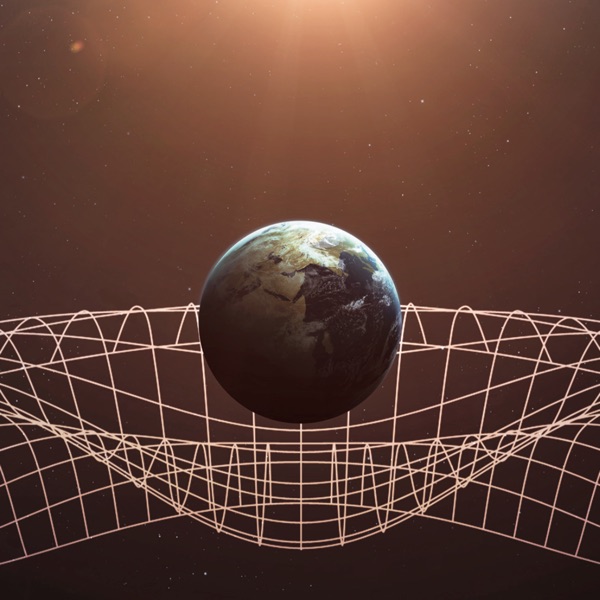
I suspect most loyal Mindscape listeners have been exposed to the fact that I've written a new book, Something Deeply Hidden: Quantum Worlds and the Emergence of Spacetime. As I release this episode on Monday 9 September 2019, the book will officially be released tomorrow, in print, e-book, and audio versions. To get in the mood, we've had several podcast episodes on quantum mechanics, but the "emergence of spacetime" aspect has been neglected. So today we have a solo podcast in which I explain a bit about the challenges of quantum gravity, how Many-Worlds provides the best framework for thinking about quantum gravity, and how entanglement could be the key to showing how a curved spacetime could emerge from a quantum wave function. All of this stuff is extremely speculative, but I'm excited about the central theme that we shouldn't be trying to "quantize gravity," but instead looking for gravity within quantum mechanics. The ideas here go pretty far, but hopefully they should be accessible to everyone.
Support Mindscape on Patreon.
The end of this episode includes a bonus, a short snippet from the audio book, read by yours truly. Audio excerpted courtesy Penguin Random House Audio. And here are links to some of the technical papers mentioned in the podcast.
- Something Deeply Hidden: Quantum Worlds and the Emergence of Spacetime
- "Thermodynamics of Space-Time: The Einstein Equation of State" (Jacobson)
- "Space from Hilbert Space: Recovering Geometry from Bulk Entanglement" (Cao, Carroll, and Michalakis)
- "Bulk Entanglement Gravity without a Boundary: Towards Finding Einstein's Equation in Hilbert Space" (Cao and Carroll)
- "Mad-Dog Everettianism: Quantum Mechanics at Its Most Minimal" (Carroll and Singh)
Click to Show Episode Transcript
0:00:00 Sean Carroll: Hello everyone, and welcome to the Mindscape Podcast. I'm your host, Sean Carroll. Regular listeners will know that we've been doing a lot of quantum mechanics discussions here at Mindscape. We talked at great length with David Albert about his skepticism about the many-worlds interpretation. I had a flipped podcast with Rob Reed, where he asked me questions about the many-worlds interpretation. We did a little bit on the history of quantum mechanics in the 20th century with Adam Becker, and of course, we mentioned quantum mechanics when we talked to people like Leonard Susskind or Roger Penrose. All of this has a purpose. As you might know, I have a book coming out. In fact, I'm releasing this podcast the day before the new book is due to be published. It'll be called, "Something Deeply Hidden: Quantum Worlds and the Emergence of Spacetime", arriving wherever books arrive on September 10, 2019.
0:00:52 SC: And so, I've been getting people excited about quantum mechanics. Quantum mechanics is an intrinsically awesome thing to talk about, but there is a hidden agenda here that I'm not keeping very hidden. So today's podcast, today's episode, is the capstone of that effort. It's gonna be a solo podcast, just me talking, and I'm going to focus on this issue of how spacetime emerges from quantum mechanics. So I've talked a lot about many-worlds already, and that's most of the focus of the book but in the book I wanna use many-worlds, I don't wanna just say, "Here it is." I wanna make the case that it really helps us as physicists to take seriously the foundations of quantum mechanics, and how we make progress on difficult issues like reconciling gravity with quantum mechanics really can depend on what our favorite formulation is. In particular, I wanna argue that if you believe, or at least put a high credence in the many-worlds version of quantum mechanics, you can come up with the philosophy that we shouldn't be quantizing gravity at all. What we should be doing is finding gravity within quantum mechanics.
0:02:00 SC: Quantum mechanics is a more fundamental theory than general relativity, than Einstein's theory of curved spacetime. So a quantum mechanics first perspective might help us solve this nutty problem. Now, this is very very much recent research, cutting edge stuff, and it's research that I've been involved in, so I have a personal perspective, I'm not completely unbiased. And also of course, there are many questions that are unanswered. Everything that I say might, not be completely wrong, but be completely useless in figuring out, ultimately, how to reconcile gravity with quantum mechanics, but we don't know yet. That's why we have to try it. That's what theoretical physics is all about. I'm very hopeful that we'll get lessons for how the universe works, regardless of whether this particular approach to quantum gravity and emergent spacetime turns out to be the right one. I should also say that there are no prerequisites here, okay? If you haven't been following our other discussions of quantum mechanics or anybody's discussions of quantum mechanics, I will still try to make it so that everyone can understand what's going on in this episode of Mindscape. It is pretty mind-bendy stuff. In some sense, many-worlds generally, and this particular emergent spacetime perspective are really as quantum as you can get, in the sense that they do not hang on to any relics from our classical, intuitive version of the world as a starting point.
0:03:28 SC: We start purely quantum mechanical and we try to derive, emerge all the classical real world stuff around us that requires an ability, not to be an expert in physics or anything like that, but to put yourself in the position of imagining that the world is fundamentally different than you think it is. Of course, like I said, that might not actually be true, but that's the attitude, the philosophy that we're pursuing today. So that's why I think that it's still useful to do, even if our particular ideas that don't turn out to be the right ones, it's very helpful, very good exercise to get your brain into a point where you can imagine a world that just seems utterly different than the world we're familiar with, and to be able to see how the familiar world can emerge out of that. So, let's go.
[music]
0:04:33 SC: I promised that you wouldn't need to know anything about quantum mechanics to follow this podcast, but I'm gonna be talking about quantum mechanics quite a bit. So I suppose I should start by telling you what quantum mechanics is. Now sadly, we immediately hit a problem when we're trying to explain what quantum mechanics is. It's the problem of what is often called interpretations of quantum mechanics. But that's a very bad label. It's more like formulations of quantum mechanics. Quantum mechanics is the most spectacularly successful theory that physicists have ever devised, and yet we don't understand what it actually says. We have a recipe. We have a cookbook for using quantum mechanics in certain particular situations. But if you ask, "Okay, but what is really going on?" Physicists do not agree.
0:05:21 SC: And we have multiple very, very different formulations of quantum theory. Quantum theory and quantum mechanics and quantum physics all mean the same thing. We have multiple different formulations which all lead to the recipe; they match in other words, our experimental predictions for what quantum mechanics says, but they're fundamentally different when they answer questions about what's really going on. So, since I'm not going to be comparing and contrasting all the different formulations of quantum mechanics here in this episode, I'm just going to be talking in the context of my favorite interpretation, which is the many-worlds interpretation.
0:06:00 SC: Now, many-worlds was formulated by Hugh Everett back in the 1950s. It has a bad reputation in some places, because you say, "Well, there are all these worlds." The many-worlds interpretation of quantum mechanics literally does say that whenever you observe a quantum mechanical system, the wave function of the universe, which is the way that quantum mechanics describes all of reality, branches. It splits into multiple copies and there are now multiple copies of you, one in each different universe, and those universes don't interact anymore, they go on their separate ways. So that's a little mind-bendy all by itself, that's not gonna be our real focus here today.
0:06:39 SC: The point I wanna make is that this idea of many universes, many worlds of quantum mechanics, that's the label given to the theory, but it's not the central point of the theory. Everett, nor anyone else, didn't start by saying, "Well, maybe there are many worlds; maybe that makes everything make a lot more sense." Rather, he took the fundamental ingredients of quantum mechanics and stripped them down to their bare essences. So let me explain what those fundamental ingredients are, and then you will see how many-worlds pops out of that. This is going to be very, very quick, but I think it will be enough to understand what's going on. When we talk about explaining quantum mechanics, we always go down to elementary particles. Pick an electron, one of those little particles that orbits the nucleus to make an atom. And the reason we do that is because that's where quantum mechanical effects are most obvious. The whole world is quantum mechanical; you and I obey the rules of quantum mechanics, but we don't notice. Classical mechanics, the rules set up by Isaac Newton, f=ma, there's positions and velocities, and on the basis of the forces acting on a system you can predict what's gonna happen next; Newtonian mechanics is a really good approximation to the world we see. It only fails to be a good approximation when we look at microscopic systems, like individual elementary particles.
0:07:58 SC: And the point is, that in classical mechanics, in Newtonian mechanics, if you had a particle, what is that? That's an object that is point-like; it just has a certain location in space, and Isaac Newton would say it also has a velocity through space. And if you tell me the position and the velocity of a particle, you're telling me the state; you're telling me all the information I need to know to predict what will happen next. If you know the other forces acting on the particle caused by other particles out there, or fields or whatever, you can predict the entire future of the universe. This is called the Clockwork universe, Laplace's demon if you've ever heard of that concept. Laplace, Pierre-Simon Laplace, the French mathematician and physicist, said that if there were a demon that knew everything about the current state of the universe, he could predict the future and retrodict the past with perfect accuracy. He didn't actually say demon, he said vast intelligence, but you know what we mean.
0:08:56 SC: So that's the Newtonian classical universe, how is quantum mechanics different? You might think that quantum mechanics adds a certain fuzziness to the classical picture. Quantum mechanics says that when we predict the outcome of an observation, we don't know exactly what we're going to see. Everyone agrees on that; that is definitely part of the quantum mechanical story. So unlike classical mechanics, if I knew exactly the position and momentum of a particle, I could predict what's gonna happen next, and I could tell you what measurement outcome I would get; in quantum mechanics, I cannot, even in principle, make absolutely reliable predictions for any observation I want to make. So if you started your brain with a classical intuitive perspective, there are particles, they are moving in some way, you might think about quantum mechanics as just adding some uncertainty, some fuzziness, to that; and that's a big part of the popular picture of what quantum mechanics really says. But it's actually deeper than that. And the many-worlds perspective, this is where it comes in.
0:10:01 SC: In quantum mechanics, the position and velocity of a particle, it's not just that you don't know what they are, or you can't predict what you will measure them to be, it's that they don't exist. Positions and velocities are not what quantify the state of a particle in quantum mechanics. What does quantify the state of a particle is something called the wave function. And we think about the wave function as kind of a cloud of probability that is concentrated in certain regions. And the wave function is the answer to the question, "When I observe a particle, what's the probability going to be that I see it doing different things?" In fact technically, there's something called the Born Rule in quantum mechanics, which says the probability of a measurement outcome is the wave function squared. So intuitively we might think that the wave function is somehow capturing our ignorance; we're not exactly sure where the particle is or how fast it's moving. But if you're hardcore about it, if you're a many-worlds-er, you say, "It's not about ignorance. It's not about us not knowing something about the particle. The wave function is the entire state of the particle." Again, other formulations of quantum mechanics will disagree about that, but many-worlds is pure. It's lean and mean and austere; it says there's a wave function and there is nothing else.
0:11:20 SC: So the fundamental feature of this version of quantum mechanics is that what you see when you measure a quantum system is very very different from what really exists when you're not measuring it. What you see is indeed a particle with a location, with a velocity; those are the possible measurement outcomes. But what's really there is this spread out wave function, this cloud of probability. And the rules of quantum mechanics tell you how to relate what's really there, the wave function, the spread out thing to the possible observational outcomes. Now, as human beings, we struggle with this. We don't want there to be a distinction between what we see and what really exists; we privilege what we see, what we see seems real and tangible to us. And that's why some of these alternatives to many-worlds have been proposed, they try to make the connection between what we see and what is real much more vivid and direct. So even though many-worlds is extremely austere and pure and simple, it's a big distance between the formalism of many-worlds and the reality. Many-worlds is just a statement that there are quantum wave functions, that's what reality is, it's a quantum wave function, and those wave functions evolve according to an equation, which we call the Schrödinger equation, named after Erwin Schrödinger.
0:12:41 SC: So it's exactly like Newtonian mechanics, there's a state. In Newtonian mechanics, the state is the position and the velocity, in quantum mechanics, the state is the wave function, and there's an equation. In Newtonian mechanics, there's Newton's laws, which tell you how particles move; in quantum mechanics, there's the Schrödinger equation. The difference is, that if you take the Schrödinger equation seriously, you find, as Hugh Everett pointed out, that the world branches, it splits into multiple copies. That did not happen in Newtonian mechanics, it necessarily happens according to the Schrödinger equation of quantum mechanics.
0:13:16 SC: Now, you might think, "Well, if that were true, why isn't every version of quantum mechanics a many-worlds theory?" And the answer is that other versions of quantum mechanics work hard to get rid of the other worlds. The other worlds, the multiple copies of the reality around us are clearly predicted by the existence of wave functions in the Schrödinger equation. That was not put in by Everett, it pops out of the formalism. Other formulations of quantum mechanics say, "No, we don't like that. That's not what the world seems like to us, so we will get rid of the other worlds, one way or another." Everett's move is as much therapeutic as it is physical. He says, "Look, it's okay that there are other worlds. We live in one of them at any one time, and we should deal with that." And therefore, the fundamental underlying formalism of Everettian quantum mechanics is way simpler than any other possible theory. But it raises a challenge. If the fundamental nature of reality is some abstract quantum wave function, it's not stuff with positions and velocities, then how do you go from that abstract quantum wave function to the world we see? After all, for hundreds of years, classical mechanics served perfectly well to describe the world. You don't need quantum mechanics to fly a rocket to the moon, the moon is there, you can see its position, its velocity, and you can get there.
0:14:43 SC: So there's this huge question that becomes important if you become an Everettian which is, why does the world look classical at all? Why was ordinary Newtonian mechanics ever thought to be a pretty good approximation to what the world does? So, there's a slight shift of emphasis here that professional physicists will perhaps appreciate, but the person on the street might not, exactly because we're so used to the classical world, even after we've been taught quantum mechanics, even after we've taught our students what it means to do quantum mechanics and do the calculations and so forth; we still can't help but being classical deep in our bones. When we construct a quantum mechanical theory, whether it's a theory of a single particle or the standard model of particle physics or whatever you wanna think about, we typically start with a classical theory and then we quantize it.
0:15:40 SC: There is a procedure, there are different procedures actually, that are sort of complementary to each other, but there are ways of starting with a classical description and constructing the analogous quantum mechanical theory of it, that's called the process of quantization. Now, we can do that, right? We can do that, it might be hard, it was hard for quantum electrodynamics, that's why it took a lot of time and people like Feynman and Schwinger won the Nobel Prize, Tomonaga. There can be subtle issues that arise when you start with the classical theory and start to quantize it. But if you are a good Everettian, you think that even that very first move is probably kind of wrong-headed because the world isn't classical. Classical mechanics is not there at the foundation of reality, the world is fundamentally quantum.
0:16:27 SC: What we should be doing is not starting with some classical description of the world and quantizing it, what we should be doing is starting with a quantum description of the world and extracting some classical approximation, that's where the word emergence comes in, and when we talk about the emergence of spacetime, it's not emergence like a little baby bird emerges from its egg, it's not something developing over time; it's the fact that we have a fundamental description, in this case, a wave function of the universe, and there's an approximate description that describes what happens under certain circumstances and we call that the higher level emergent description. So, even though the fundamental rules of Everettian quantum mechanics are very simple, the task that it faces us with is very hard. You're given something very abstract and hard to conceptualize, a wave function of nothing at all, just the abstract idea of a wave function and then you're supposed to figure out afterward what that is a wave function of. In other words, what is the best way that we can talk in somewhat classical vocabulary about this quantum mechanical theory that we have.
0:17:41 SC: So when we look around us, we see a world, like I said, that looks pretty classical. There are people, there are tables and chairs, there are planets and stars and so forth. Not only do we look and measure that these things have positions and they have velocities but those positions and velocities, more or less obey Newton's laws, they obey more or less the classical description that Newton came up with. Why is that true? I will pause to parenthetically mention here that when, as professional physicists, when we teach quantum mechanics to our students or undergraduates, who typically take quantum mechanics in their second or third year as Physics undergraduates, we completely lie to them. We do a very, very bad job of explaining how the classical world emerges from the underlying quantum description. And part of that is that even we Physics professors still think classically. The emergence of a classical description is sort of natural to us, so we don't try very hard to justify it, right? It's not a surprise that classical mechanics work, we see it working all around us all the time.
0:18:50 SC: So, consider a single electron, that's what we do when we do quantum mechanics, we take single particles. As I said, there's a wave function for that electron. In principle, it could be spread out anywhere, but you can say let's start the wave function of the electron so it's localized somewhere, there's a place in the universe where the electron more or less is. If you wanna say it this way you could say, "Were I to observe it with very, very high probability I would find it localized in this particular place." And you can ask if the electron is not bound inside an atom or anything like that, What is the prediction for how the electron should behave? If it were a classical particle, you would say, "Tell me its position, tell me its velocity, I will trace out its trajectory through space." Like throwing a baseball, seeing it fly through the air. The Schrödinger equation is the analogous quantum mechanical equation that says how the wave function of the electron will change. And the answer is it spreads out everywhere, it does not travel on some well-defined classical-looking trajectory. This was of great disappointment to Erwin Schrödinger himself. He was hopeful that his equation would predict that wave functions would be kind of particle-like in their behavior. The truth is the opposite, wave functions want to spread out all over the place.
0:20:11 SC: So for a single electron, there's kind of no such thing as a classical limit, single electrons by themselves do not act classically at all. What we teach our students is, "Okay that's fine, but if you get together a large number of particles, if you get a macroscopic system like a grain of dust out there in interstellar space that has many, many atoms in it, then once you get that large number of particles things begin to act classically." That is a complete lie, at least as we say it. It's true that things do act classically but not just because there's a large number of particles in there. When you have that dust grain out in the middle of interstellar space, you could easily analyze that dust grain by thinking of its center of mass, basically the position of the dust grain, and its center of mass velocity, and then all the jiggles of the individual electrons and nuclei within the dust grain. And you can ask from the Schrödinger equation, what should the center of mass of the dust grain do? And the answer is, it should spread out all over the place. It's not that it should follow some classical trajectory at all.
0:21:20 SC: So why in the world, if all that's true, and we lie to our students, why in the world do things look approximately classical? Why does the moon follow its classical Newtonian trajectory orbiting around the Earth? The answer is that the moon or the dust grain or the electron is not out there all by itself, that there are many, many things in the universe. And this is a crucial feature of quantum mechanics that is fundamentally different from the classical picture of the world. In the classical picture of the world, there can be many things out there in the universe, there can be many atoms and electrons and photons and so forth, but you can treat them all one by one. You can treat them all individually. You can say, well, this atom is doing this, this particle is doing that other thing. Sometimes they will interact with each other and bump into each other and that's fine, but the state, the intrinsic nature of each particle is a separate thing. In quantum mechanics that is no longer true. You might guess, well, here's an electron, it has a wave function, here's a proton it has its wave function, there's another electron with its wave function. No, that is not how quantum mechanics works. There are not separate wave functions for every particle in the universe, there is only one wave function.
0:22:36 SC: If we wanna be grandiose we can call the wave function the wave function of the universe, but the wave function no matter what kind of system you're looking at is of the entire system all at once, okay? So if you think of the wave function in the classical pre-quantum mechanical way of asking questions, if you said, well, what the wave function does is it tells me the probability of observing different measurement outcomes, then the wave function of the universe says, "If I were to observe everything in the universe all at once, what is the probability I would get different measurement outcomes?" Okay? And if you just simplify your life by saying, okay, let's forget the whole universe, let's just take two particles, right? So you could have one particle that has a wave function, that you might think has a wave function, it could be a little bit of a probability to see it over there, a little bit of a probability to see it over here. And there's another particle likewise that has different probabilities.
0:23:31 SC: But the combined system can be entangled. The word entanglement is crucially important in quantum mechanics. And what it can say is, you, if you were to observe the positions of these two particles, you might not know ahead of time what you're going to observe, there might be a probability of seeing this over here or over there, but the wave function of the whole system can have the property that if you observe one particle in a certain position, then you know exactly where the other particle is going to be. If you observe the first particle in a different position, the second particle would also be in a different position, they're entangled with each other. You can't predict exactly where either one will be observed, but you know when you observe one, where the other one will be. This is a feature of the fact that they don't have separate quantum states, there's just the quantum state, the wave function for the entire universe, okay?
0:24:26 SC: This seems like maybe a bit of a technicality, like sure it's true, everyone who knows quantum mechanics appreciates that what I just said is true, and yet we don't really emphasize it when we teach quantum mechanics to our students. You can take an entire one-semester introductory course in quantum mechanics, and never really hear about entanglement. And I think that that is a crime. Personally, I think this is a disaster. I think that we do our undergraduate students an incredible disservice by de-emphasizing the role of entanglement in quantum mechanics. And this is why one of my many ambitions for the next few years is to write a new textbook for quantum mechanics for undergraduates, because I think that entanglement should be absolutely front and center, entanglement more than anything else is what makes the quantum world different from the classical world.
0:25:16 SC: So let's get back to our little dust grain, our little dust grain floating through empty space; why does it seem to follow a more or less classical trajectory? And important, we can't go through all the details, sorry about that. There's equations involved. I'm not gonna be able to do everything. What I wanna emphasize right here is that an important part of the answer to that question comes from the fact that the state of the dust grain becomes entangled with the rest of the world. In particular, there are photons filling empty space such as the cosmic microwave background photons left over from the Big Bang. These photons keep bumping into the dust grain, and when they bump into the dust grain, the state of the photon becomes entangled with the state of the grain.
0:26:01 SC: So we are not keeping track of the state of all those photons, we do not know the position or the wave function of every single photon in the cosmic microwave background, we're ignoring the effects of the photons, they don't change the momentum of the dust grain a lot. The dust grain is a big massive thing, the photon is a little tiny ignorable thing, but the dust grain rather, is constantly being monitored, it's constantly interacting with the set of all of these photons all everywhere in the universe that are bumping into it, and that constant monitoring branches the wave function of the universe, and on every one branch it will look to a very good approximation like the dust grain is following a classical trajectory. This monitoring, this fact that the macroscopic system, the dust grain becomes entangled with its environment as we call it, all of the other photons or all the other things you don't keep track of in the universe, that's called decoherence. The reason why the world often looks approximately classical is because what should be a wave function spread out all over the place is monitored by the environment and decoheres and different parts of the wave function go their own separate way.
0:27:20 SC: So rather than treating the dust grain as something that is in some sense spread out everywhere, on every branch of the wave function, on every individual part of reality, it looks to us like the dust grain is following a single classical trajectory. And that's true for you, or me, or the moon, or the stars, or any big thing in the universe, any big macroscopic system in the universe; we are constantly being monitored by the rest of the universe, by the environment. And in every one part of the wave function, every world, things look approximately classical and it's all ultimately because of entanglement. Okay, rant over, that was just me trying to get it off my chest complaining about how badly we do when we teach people quantum mechanics as undergraduates. Let's get back to the task at hand which is trying to understand how the natural world, the world that we observe with our eyeballs emerges out of this abstract quantum wave function.
0:28:20 SC: Clearly, decoherence and entanglement are going to play a huge role, but there's many different ways that different quantum mechanical systems can become entangled with each other. Again, let's be a little bit more specific and home in on why we see this particular kind of world. And the answer, I wanna give away the answer and then we'll justify it, is basically because of the feature called locality. Locality in this sense says, when two parts of the universe, let's say two photons or two electrons or two particles of any sort, when they interact with each other, they interact with each other when they bump into each other or at least when they're very, very nearby in space. That might be... Let me just step back a little bit. You might think, "Well, look, the Sun is far away and yet the Earth feels its gravitational pull so we're not right next to each other, what is this feature that you're calling locality?" And that's true, but there's a gravitational field that stretches from the Sun to the Earth. The Sun does not interact directly with the Earth. The Sun interacts with the gravitational field at the position of the Sun and that interacts with the gravitational field just a little bit further away from the Sun, which interacts with a gravitational field just a little bit further away than that all the way up to the Earth.
0:29:39 SC: The field theory that we use, the theory of the gravitational field is of course Einstein's General Theory of Relativity, that's the best theory of gravity we have right now. Einstein says that space and time kind of have a life of their own, they have a geometry and that geometry changes over time. In the famous words of John Wheeler, "Matter tells spacetime how to curve and spacetime tells matter how to move." So there's a give and take between matter and energy in the universe and the gravitational field around it as specified by the curvature of spacetime. So even the gravitational force obeys this idea of locality. You interact with something when you are at the same position as that other thing is. And you might think, "Well, how else could it be?" And you're like, "Where else would it be when you interacted with something?"
0:30:30 SC: But think about that Newtonian version of the world, think about classical mechanics. I told you that the state of a particle is its position and also its velocity. But two particles interact when their positions are the same or nearly the same, they don't interact when their velocities are the same or when their velocities are opposite, so that they add up to zero or anything like that. Velocities have nothing to do with it. There's something special about the idea of position, position is the thing that determines the fact that interactions happen when things are nearby to each other. In other words, position determines whether two things are going to interact with each other directly or not. A good example of this in the quantum mechanical context is the famous Schrodinger's cat. You've all heard of Schrodinger's cat. Schrodinger says you put a cat in a box, you hook up a complicated quantum mechanical experiments so that there is a probability that poison gas will be released and kill the cat. And there's absolutely no reason why it needs to be poison gas, in my discussions of Schrodinger's cat I like to make it sleeping gas, so we can just put the cat to sleep, there's no reason to kill the cat, we don't need to be violent in our physics thought experiments.
0:31:46 SC: But the point is, everyone agrees, who does quantum mechanics, that if you have some radioactive source, let's say, that is going to either admit a particle or not, that's a probabilistic statement, but really what the quantum mechanical description says is that there is a wave function, and part of the wave function says this nucleus of an atom has emitted a particle, it's radioactive or it hasn't emitted a particle yet. And the thing about quantum mechanics is, the thing about wave functions, is that you can exist in a superposition, that's why a wave function is not just a wave characterizing our ignorance, it's not that you don't know whether the nucleus has emitted a particle or not, it's that quantum mechanics says, the state of the nucleus, the state of the wave function of the universe is that part of it describes a nucleus that has emitted a particle and part of it has described a nucleus that has not emitted a particle and both parts are real. And in other versions of quantum mechanics, part of the wave function goes away magically, somehow. In Everettian quantum mechanics, they both remain real, there becomes a world in which the nucleus has emitted the particle and a world in which it has not.
0:33:00 SC: So in the Schrödinger's cat thought experiment, what Schrödinger was trying to do was to bring into question whether or not quantum mechanics made sense. You might think, "Look, Schrödinger is one of the founders of quantum mechanics, of course he thinks quantum mechanics makes sense." But Schrödinger, like Einstein, always wondered whether or not quantum mechanics was really the final story, it seemed to lead to some kind of weird counterintuitive results. So what Schrödinger does in his thought experiment is figure out a way to get that wave function of the nucleus, that is gonna either radioactively decay or not, and amplify the uncertainty in it, amplify the superposition to include a macroscopic system like a cat. So if you're on the branch of the wave function where the nucleus decayed, then the hammer fell, the gas is dispersed through the box, and the cat falls asleep because it's sleeping gas now. And in the other branch of the wave function, none of that happens and the cat is still awake.
0:34:00 SC: So Schrödinger says, in the box, before I open it up and look, there's a superposition of the cat, the cat is neither asleep nor awake, it's in a superposition of both possibilities. And then again, Schrödinger says, according to the conventional rules of quantum mechanics, when I open the box, I observe what's inside, and crucially, I never observe a cat in a superposition of being awake or asleep. I either observe the cat awake or I observe it asleep. The traditional formulation of quantum mechanics says, "That's because the wave function collapses when you observe it." "Yes," it says, "the wave function was in a superposition of awake cat and asleep cat before you opened the box but when you opened the box, you looked at it, you performed an observation, and the wave function changed suddenly and unpredictably." This is in complete contradiction to what the Schrödinger equation would say happens.
0:35:03 SC: This idea of the collapse of the wave function upon making an observation is at the heart of what's called the Copenhagen interpretation of quantum mechanics and it is what has bothered physicists and physics students for generations now. After all, what do you mean, "make an observation" of what's inside the box? Does it have to be a human being making the observation? What if another cat observed it? Does the cat in the box observe itself? Does that count? What about a video camera? What if you didn't observe it very accurately?" There's all these questions that are left completely ambiguous in the conventional Copenhagen interpretation of quantum mechanics.
0:35:42 SC: So, what's the alternative? Well, whatever it says is that indeed the cat can be in a superposition of awake and asleep, but you, the person opening the box, are also a quantum mechanical system. You are part of the wave function of the universe and what happens when you open the box is that not the wave function collapses, but rather that you become entangled with the cat. There is part of the cat, the part of the cat's wave function that says, "The cat is awake," and there's part of your function that says, "I have seen the cat be awake." There's also part of the cat's wave function that says, "The cat is asleep." And there's part of your wave function that says, "I have seen the cat asleep." And those different parts of the two different wave functions are entangled with each other in the big wave function of the universe. So there's one branch in which the cat is awake and you saw it awake and there's another branch in which the cat is asleep and you saw it asleep, and both of those branches are absolutely real. And again, the existence of these two branches is simply predicted by the Schrödinger equation. It's not made up, it's not added in in any way. It just results from taking the Schrödinger equation seriously and taking the fact that you are a quantum mechanical system and can become entangled with the cat also very seriously.
0:37:00 SC: So, that's fine as far as it goes. But now that we've talked a little bit about decoherence, we can do a little bit better at that description. The wave function of the universe didn't really branch when you opened the box, it branched as soon as the cat became entangled with its own environment. After all, in the box, there's all these photons and there's these air molecules and so forth, parts of the environment we don't keep track of. As soon as the cat became entangled with that, which is right away, which is incredibly fast then the universe branched into two different pieces, and you were already on one branch or the other even before you opened the box, even though you didn't know it. So that is how an Everettian would describe Schrödinger's cat.
0:37:44 SC: Why am I pausing to describe Schrödinger's cat in the middle of talking about entanglement and the emergence of spacetime? Because we can still ask the question, why is it that when we open the box we see either the cat only awake or asleep? I've said it's because we become entangled with the cat. But why do we become entangled in that particular way? There's either a cat awake, and I saw the cat awake or a cat asleep and I saw the cat asleep. In quantum mechanics, if I'm just doing the math, if I'm just writing down what the wave function could be, there are awake cats, there are asleep cats, but there's also any superposition of awake and asleep. I said before we never see superpositions, and so now we can start confronting the question, "Well, why not? Why can't we just obey the rules of the universe, open the box and see the cat in a superposition? Or for that matter, why can't we believe ourselves to be in a superposition?" The wave function collapses would be the traditional Copenhagen answer. The wave function branches is the Everettian answer, but it branches in a very particular way.
0:38:56 SC: So why is it, in other words, that on individual branches of the wave function, we either see an awake cat or an asleep cat, not some combination of both? And the answer is, it lies in two things we've already discussed, one is decoherence and the other is locality. So think about those particles in the box, the photons, the atoms, that we said keep bumping into the cat and therefore decohering its wave function, branching the wave function of the universe. Well, if the cat is asleep there's a certain way that certain photons in the box will bump into it. When you take a picture of your cat, what you're actually taking a picture of is the photons that have bumped into your cat and entered your camera or your phone or whatever. And they would bump into the cat in a different way if the cat was awake and walking around. If you take a picture of your cat awake, you see it somewhere different than if it's asleep. That's not of course strictly true. Now the cat metaphor is getting away from us a little bit because an awake cat can look very, very much like an asleep cat.
0:40:00 SC: Let's imagine for the purposes of this thought experiment that the awake cat is up and meowing and wants to get out of the box, and there's asleep cat is in a different position lying on the floor of the box peacefully snoring. So, the thing about the awake cat and the asleep cat is that they describe different positions in space and therefore the photons that bump into them are different. A photon bumps into a cat when it arrives at the position of the cat or at least the position of the cat's fur, or something like that. And the set of photons which bumps into the awake cat will be different than the set of photons that bumps into the asleep cat. That is why it's these two versions of the cat that are observable. You will see an awake cat or you will see an asleep cat, you will never see a combination of both. If the cat was in a superposition of awake and asleep, as soon as any photons hit it, they would know. Did I hit the awake cat or did I hit the asleep cat or both or neither or whatever? And the universe would branch. But on any one branch, when I have a cat that is asleep, all the photons are hitting in the same way. There's not further extra branching over and on top of that.
0:41:13 SC: So the reason why, according to Everett, or at least according to Everettian quantum mechanics, the reason why you see the cat as either awake or asleep is because those are the two possibilities that are spatially coherent. Those are the two possibilities that describe a system that has a well-defined configuration in space. And why is space so important here? I'm talking not about outer space, I mean the space in which we live, the three dimensions of space, up, down, left, right, forward, backward. Space is important because interactions, such as the interactions of the photons with the cat, are local in space. So there is a deep, deep connection between locality, which is a feature of the laws of physics, and the emergence of the classical world. The emergence of the fact that when we open boxes we see cats awake or asleep, but not a superposition of both. It's locality and the process of decoherence that together make the world look approximately classical to us. So that's a crucially important fact, that's what locality is doing for us, it's helping decoherence proceed in a particular way to give us a particular classical world.
0:42:29 SC: Now, all of that, of course, does what I said we really don't wanna do. It starts with classical notions, like locations in space and uses those to develop this picture. We ultimately want to go the other way around. We don't wanna presume the existence of space and particles or anything like that because in the fundamental way that we have of talking about reality, according to Everett, what the world is, is a quantum mechanical wave function.
0:43:00 SC: The world is not particles and fields spread throughout space. Those are what we see when we observe the world. But the world is much richer than that. The world is this quantum wave function in this very abstract high-dimensional mathematical space, okay? We want to make the journey from this abstract quantum mechanical wave function to the world that we see. What we're arguing is that a crucial role is played by the fact that interactions are local in space. But that's a cheat a little bit 'cause we're using the notion of space and we're supposed to be deriving the notion of space. That's okay. The trick is to just reverse the logic. Rather than saying interactions are local in space, what you should say is space is the property with respect to which interactions are local. Okay? There's a little bit of a mind-bender right there, but that's gonna be the fundamental driving idea that lets us talk about how space emerges from the wave function. In other words, we have some abstract quantum mechanical thing. We don't even have the vocabulary for this thing in ordinary natural language, in the English language. We have a quantum wave function.
0:44:13 SC: Technically for the mathematically inclined out there, it is a vector in a gigantic mathematical space called Hilbert space. And when I say gigantic, you know how we have three dimensions of space around us, up, down, left, right, forward, backward, any vector space has a certain number of dimensions. The number of dimensions of Hilbert space is at least 10 to the 10 to the 122. That's a very, very big number, okay? A one followed by a number of zeros, and that number of zeros is 10 to the 122, which is one followed by 122 zeros. That's a huge number, and maybe Hilbert space is actually infinitely big. We don't know about that. But we wanna go from this incredibly abstract mess to the specific idea of particles moving in space and what we're saying is that in the emergent space, the thing that makes space special is that interactions are local in it.
0:45:08 SC: So what we wanna do in other words is say of all the different ways there might be in principle to describe this abstract crazy quantum state, this wave function, there will be certain special good waves. The good waves are those that make manifest the idea that different parts of the wave function interact with each other only when they are nearby. And again, I'm reluctantly even saying those words because we're gonna be defining nearby to be when the things can interact with each other, okay? So let me stop a little bit to give one little footnote here. This is already abstract and hard to follow enough. I mentioned that Hilbert space, the space of all possible quantum wave functions, is very, very high-dimensional. It might be infinite, it might be 10 to the 10 to the 122, or it might be some number in between, but I will be assuming further more that it's finite, okay? This is a big assumption. This finite... The number that is finite is the dimensionality of Hilbert space, the number of completely independent quantum wave functions that we can possibly contemplate. It's a huge number, but it's still a finite number. That is by no means settled as a true fact about reality. Physicists do not know whether Hilbert space is finite-dimensional or infinite-dimensional. We do not know whether there is only a finite number of different possible quantum wave functions that are independent from each other or whether there's potentially an infinite number, okay?
0:46:40 SC: The reason why you might think there's a finite number... This would take a whole 'nother podcast to talk about, and I did talk about it a little bit with Lenny Susskind, but it all comes down to the entropy of black holes. Black holes, Stephen Hawking pointed it out all the way back in the 1970s have an entropy. And entropy, you know, is a way of characterizing the messiness, the disorderliness, the randomness of a system. And the black hole entropy, like the entropy of any other quantum mechanical system, in some ways is telling us the number of different possible arrangements of that system that are contributing to the macroscopic reality of the system, all the different possible arrangements that matter for this particular thing.
0:47:24 SC: So, there's two things about black holes that are very important. One is they are maximum entropy configurations for any one region of space. If you take a region of space and try to fit more and more entropy into it, eventually the more entropy is associated with more energy and the whole thing will just collapse to make a black hole, and the black hole will always have equal to or more entropy than the stuff you made it out of. In fact, it always has more as a matter of fact.
0:47:53 SC: So if you try to fit more entropy into a region of space than a black hole would have, all you do is get a bigger black hole that doesn't fit into that region anymore. So this seems to be telling us that according to gravity, which is necessary for making black holes, there's only a finite number of different states that you can ever have in a region of space which we turn quantum mechanically into the statement that there's a finite-dimensional Hilbert space. There's only a finite dimensional set of different quantum states that could possibly describe what is happening, okay? So that finite number of degrees of freedom, if you wanna call it that, a finite number of things that could go on in any particular region of space, that is a completely different conclusion than you would reach in conventional quantum field theory.
0:48:44 SC: And you know, those of you that have been listening to me talk for many years know that quantum field theory is the way, the best way that modern physicists have of describing the world. If you wanna talk about the standard model of particle physics, the Higgs boson, quantum electrodynamics, quantum chromodynamics, these are all quantum field theories. They start with the idea there's a field in space and they quantize that idea. They follow this paradigm of starting with a classical description, fields moving through space, and quantizing it. It is always true when you quantize a quantum field theory, the resulting space of wave functions is infinite-dimensional. There are an infinite number of things that can go on when you have a field theory because literally the field has a different value at every point in space and there's an infinite number of points in space. It's really just that simple.
0:49:33 SC: So I want you to figure out what is being said here 'cause it's kind of big and important. On the one hand, our best current way of describing the world is using quantum field theory. Quantum field theory directly implies that there are an infinite number of degrees of freedom in any one region of space. There's an infinite dimensional Hilbert space that you need to describe all the possible quantum wave functions. On the other hand, remember, gravity doesn't fit into quantum field theory. Gravity, Einstein's general theory of relativity, is the one part of modern physics that doesn't seem to be able to be described by an ordinary quantum field theory. And furthermore... I mean, the reasons why that's true is because they're both technical problems, things blow up and become infinity, and also there's conceptual problems.
0:50:23 SC: Typically in quantum field theory, you say things like I just said, right? There are fields that have values at every point in space. If you try to quantize gravity... Now gravity describes spacetime as having curvature, and if you quantize gravity, presumably that means that there's a superposition of different geometries that space and time could be in. But if that's true, we don't know how to describe "a point in space." What you might finger as a single point in space around you right now might be in a different location or might not even be mappable to a single location in some different part of the wave function of the universe.
0:51:06 SC: This is my feeble attempt at making understandable in real language the fact that quantum gravity makes locality very, very hard to talk about because points in space can't be singled out in any simple way. Anyway, the point of all that was to say there are both technical problems and conceptual problems with quantizing gravity. That means that quantum gravity is not well described by a quantum field theory. So on the one hand, quantum field theory says there are an infinite number of states possible in every region of space. Gravity seems to say there are only a finite number of things that can possibly happen in any region of space. And the number 10 to the 10 to the 122 comes from the fact that our universe only has a certain observable part of it, right? Our universe is expanding and the expansion of the universe is accelerating. So if a black hole has an entropy and therefore a finite number of things that can happen inside, that's because there's a horizon around the black hole, and the entropy of the black hole is just the area of that horizon in Planckian units.
0:52:12 SC: Well, guess what? We, in the universe are inside of a horizon. Because our universe is expanding and accelerating, there is a horizon around us, and there's an entropy of our observable universe that turns out to be about 10 to the 122 when you go through the numbers. So if this gravity hint is pointing us on the right track, the observable universe only has a finite number of things that can possibly be happening within it, a finite number of degrees of freedom, a finite-dimensional Hilbert space. That's very different from the quantum field theory story, and to be perfectly honest, this presents a fork in the road for physicists who would like to quantize gravity. One fork in the road says, "Well, the hints from black hole entropy that the number of degrees of freedom is finite in the universe, are just wrong. They're misleading. Quantum field theory is more successful than anything we know about gravity. We should follow down the road of quantum field theory and imagine there are an infinite number of things that could happen in any region."
0:53:18 SC: But there's a whole 'nother way to go which says, "No, quantum field theory is only a pretty good approximation. Quantum field theory takes space very seriously, puts it front and center. Fields exist throughout space. Quantum gravity can't take space nearly as seriously because space is gonna be in a superposition of doing many different things. Therefore, we should take the hints from black hole entropy as foundational, as central here. And in that case, we should be dealing with finite numbers of degrees of freedom in quantum gravity, finite-dimensional Hilbert spaces."
0:53:53 SC: We don't know which road to take in this fork in the road, which direction to go in. I'm going to choose to go down the road that says there's only a finite number of degrees of freedom in every region of space, okay? That quantum field theory is not the final story, that there's something deeper than quantum field theory and in some sense, simpler, right? A finite number of degrees of freedom is simpler than an infinite number of degrees of freedom. So maybe that's a good thing. There are problems that come up. We'll talk about what some of those problems are, how you map onto the successes in experiments of quantum field theory if you only have a finite number of degrees of freedom to play with. But there we go. That is the assumption I'm going to make. So where does that leave us? Where are we? We imagine that the universe is described by a wave function. At least the observable universe is described by a wave function in a finite-dimensional Hilbert space, and we want to take advantage of the idea that locality determines how the laws of physics work. That is to say, space, locations in space, are the things with respect to which interactions between different parts of the universe look local, okay?
0:55:10 SC: Local... I think I probably messed that one up. Space is the thing with respect to which interactions look local. So that might just seem like a happy motto to put forward but very difficult to deal with in practice, and it is. It's hard. So the task before us is to go from this abstract quantum wave function and find the universe within it, find the universe that we know and love. This is not a task that has been getting a lot of attention in the history of physics, right? Like I said before, no matter how good you are at quantum mechanics, the traditional thing to do has always been to start with a classical theory and to quantize it. This whole project of starting with a true quantum mechanical description and seeing how the classical world emerges has simply not been the focus of anyone's research for generations now.
0:56:03 SC: So we are finally beginning to take this question seriously. So we're... It's baby steps. It's right at the beginning of something that is very exciting but not yet fully developed by any stretch. So a little bit of progress was made just a couple of years ago by a group of students at Stanford University, Cutler et al, I'm gonna forget all their names, sorry about that. So they said the following thing: Let's imagine you really did have the most abstract description of a quantum system you could have. So it's not the quantum system of particles moving in space or of springs or of spins or anything like that, it's not the quantum mechanical description of anything, it's just a quantum theory all by itself. You have wave functions and you have Schrodinger's equation. The Schrodinger equation says, "Here's how the wave function evolves with time."
0:56:55 SC: And they asked the question: Given only that information, could you reverse engineer? Could you go backwards? Could you figure out what this was a quantum mechanical description of? Could you figure out sort of the precursor classical-looking theory that had you quantized it, would have given you this quantum mechanical description? And in particular, they focused in on the question of locality. So you have a wave function. As I said, wave functions are typically, even if they're finite-dimensional, the number of dimensions is very, very big. So you can divide it up. You can choose to consider this wave function to be the combination of many, many little subsystems interacting with each other and becoming entangled. And what locality means in this context is that the different subsystems will interact with their neighbors but not interact with other things. In fact, if you don't even wanna prejudice it by using the word neighbors, different subsystems will interact with only a small number of other systems in the bigger wave function and those other subsystems will interact with just a small number of other subsystems, etcetera.
0:58:07 SC: That is the way that locality can emerge. Rather than saying this little piece of the universe only interacts with its neighbors, you say this little piece of the universe only interacts with a small number of other pieces of the universe which we will then call its neighbors. That's what it means to be a neighbor. Rather than saying two things interact when they're neighbors, two things are neighbors when they interact. And what Cutler et al., were able to show is that for a given abstract quantum system, usually there's no way of doing that at all. Usually there's no way of taking an abstract quantum system and dividing it into a bunch of little local subsystems just talking to their neighbors. But sometimes there are, and when there are, when there is, that way is usually unique. In other words, there's not multiple ways of dividing the big quantum wave function into many little local subsystems. There's more or less one way, and there's certain footnotes about what more or less means in that context. But the point is, and this is just really important and exciting and crucial, that you don't need to start with space and locality.
0:59:15 SC: You can start with an abstract quantum mechanical system. Ask yourself the question, "Is there any way of describing it so that it looks like a bunch of things interacting locally in space?" And the answer is... When the answer is "Yes," there's a unique way more or less of doing it. You can take away function and chop it up into local pieces, okay? That's how space, in the sense of things that are next to each other or far away, etcetera, can emerge from the quantum mechanical wave function.
0:59:47 SC: Now, that's a good step. That's I think... Like I said is I think it's crucially important. It's fascinating. It's going to be the basis for a lot of work going forward, but it's just a very first tiny step. These folks were not thinking about gravity. They were thinking about space, but they were not thinking about the much richer set of things that happened in Einstein's universe. Einstein says not only there is space, but space is part of spacetime and that spacetime is dynamical and it moves around and it warps and it has geometry and that geometry gives us the force of gravity as we know it. So we wanna go from simply the notion of locality and interacting in space to the much richer notion of a dynamical, curved, spacetime geometry. How do we do that? The answer you will not be surprised, again if you've been listening to my rants over the years, is to be found in the notion of entropy, okay? No big surprise.
1:00:43 SC: Entropy is the answer to everything, is the short motto for all of my discussions about, just about everything. Where does that come from? What does entropy have to do with anything? I breezed over the idea that black holes have entropy and that that somehow tells us how many degrees of freedom there are in a region. But let's be a little bit more specific, okay? Remember we said that entanglement between different parts of the universe, different subsystems of the universe, is at the heart of quantum mechanics. So let's forget about our ambitions for the moment to talk about emergent spacetime and so forth. Let's go back to our quantum field theory way of thinking about things. Or even better, let's, what we call, regularize our quantum field theory, which is to say let's take apart the infinite number of things going on and imagine a lattice. Imagine, literally, some network of little quantum mechanical degrees of freedom, maybe electrons or something, that are interacting with each other in some lattice structure, okay? And you let it settle down. So you imagine that this system is in what we call its vacuum state, its lowest energy state.
1:01:48 SC: There's an amazing thing that is true. You can take some subsystem, some region of space. So there's some degrees of freedom inside and there's some outside. They're going to be entangled with each other. This is a generic feature of quantum field theory that degrees of freedom in any one location in space are entangled in the vacuum state with degrees of freedom all over the place, everywhere else in the universe. They are highly entangled with other nearby degrees of freedom, and they are only a little tiny bit entangled with degrees of freedom far away, but everything is a little bit entangled with everything else. And you can go through the math, okay? You can say I have a region of space. So there's an inside, an outside and there's a boundary between this region. The region has a volume and the boundary has an area, okay? That's how things work if space has three dimensions. Remember we are assuming space for the moment just to get some lessons to build on later down the line. It turns out that the entanglement between what's inside the region... Inside the boundary and outside the boundary gives rise to entropy.
1:02:55 SC: The entanglement entropy of a system was described by John von Neumann early on in the days of quantum mechanics. It's basically because, you know, if you think of entropy as saying there's something I don't know, something that the system I'm describing is in a superposition or a combination of many different possibilities, even if you know the entire wave function of the universe, if you only keep track of what's going on on one side of a boundary, the inside or the outside, then for all intents and purposes, you don't know what's going on on the other side, and you can describe, you can assign that lack of perfect knowledge and entropy. So unlike classical systems where entropy really comes from some ignorance, ; there's something you don't know, in quantum mechanics, there's a new kind of entropy, an entropy that just arises from entanglement. That's the von Neumann entropy or the entanglement entropy, okay?
1:03:52 SC: And furthermore, you can calculate what it looks like, and in the system that we're describing where there's a region of space with an inside and an outside, it turns out that that entropy of the region inside is proportional to the area of the boundary, which makes perfect sense, right? Because if there are degrees of freedom that are deep in the interior of the region, they're mostly unentangled. I should say, they're entangled but only a little bit with degrees of freedom very far away. Most of the entanglement is between nearby degrees of freedom, which means most of the entanglement is happening just across the boundary, and therefore, the bigger the area of the boundary, the more entanglement there's gonna be and the more entropy there's going to be. So this is a very general feature, that has nothing to do with gravity yet. This is just a feature of quantum field theories or theories on lattices that you could then take the limit as the lattice gets very, very close together to make a quantum field theory. Regions of space have an entropy, that entropy is proportional to the area, at least when the system as a whole is in its vacuum state, in its lowest energy state.
1:05:00 SC: That's a crucial footnote actually, because I could invent different states in which the entropy was much higher because I said, different parts of the system are entangled with each other with their nearest neighbors mostly, and only a little bit with things further away. I could invent a different state where things inside my region are highly entangled with things far away. So if I didn't have gravity, if I just had a fixed spacetime and I took a region of it, the maximum entropy I could put in that region is not proportional to the area of the boundary, it's proportional to the volume of the region. Because that's how many degrees of freedom are inside, sort of one per every little part in space, one per every cubic Planck length or whatever it is, okay? So without gravity, the maximum entropy in a region goes like the volume of the region, but the actual entropy when the whole system is in its vacuum state goes as the area.
1:06:00 SC: Now, in 1995, Ted Jacobson, who is an ingenious theoretical physicist at the University of Maryland, made a bold suggestion. He said, "Well, what if you do that kind of discussion, take a region of space, calculate its entropy, but you turn on gravity? You say that gravity is important." And of course, we know how gravity works. Einstein gave us an equation, okay? Einstein's equation tells us how spacetime responds to matter and energy. What Jacobson suggested... And this is how theoretical physics works; you make up an idea, you make a suggestion, see where it goes. He said, maybe there's something special about gravity which makes it work like the following thing. In the non-gravitational context, the entropy of the vacuum state is proportional to the area, but in principle, it could be much higher. What if in gravity, the entropy of a region is always proportional to the area of its boundary? In other words, I could imagine trying to increase the entropy of a region by increasing the entanglement of things inside with things outside. But Jacobson suggests what that amounts to is also increasing the amount of energy inside the region.
1:07:16 SC: And we know from general relativity that if you have energy in a region, the geometry of space is going to change and that includes the area of the boundary. So Jacobson says well, look, maybe in general relativity or at least in a theory with gravity, there is a feature, there's a new law of nature that says that the area of every region is proportional to the entropy of the region inside. So even if you try to excite or change a system in a certain region of space, spacetime has a geometry that adjusts to make sure that the area of the surrounding boundary is always proportional to the entropy inside. Okay, that's a suggestion. You can imagine something like that. But what Jacobson showed is that if you take that suggestion at face value you can derive an equation relating the entropy to the geometry, and then you could derive another equation relating the entropy to the energy and by doing that, you get an equation relating the geometry to the energy, which is exactly what you have in general relativity.
1:08:22 SC: And in fact, Jacobson argued it is exactly Einstein's equation for general relativity. So, Einstein, in some sense, simply assumed his equation, he proposed it. He said, "What if the geometry of spacetime is related to energy and matter in a certain way?" What Jacobson says is, "What if the geometry of spacetime is related to entropy in a certain way?" And he claims that he can then derive Einstein's equation from that new assumption. This is a program called thermodynamic gravity or entropic gravity. Erik Verlinde and others have worked on later versions of entropic gravity, basically imagining that even if we don't know what's going on in quantum gravity, there are some degrees of freedom in the universe that interact with each other in some particular ways, and from the properties of entanglement and entropy of those degrees of freedom, we can derive the geometry of spacetime. And the natural thing for that geometry to do is to obey Einstein's equation. This is just a wonderful idea, very creative and very novel and has very far-reaching potential consequences. Even though it was 1995, so it's over 20 years now, pushing 25 years, my goodness, it's still something that physicists have not quite yet come to terms with.
1:09:46 SC: We're thinking about it, we're trying to get our brains around it, this basic idea that from entropy and area we can derive all of gravity. Okay, now, Jacobson of course, wasn't doing quantum gravity. You might think he was 'cause we're talking about quantum mechanics and we're talking about gravity, but he assumed that there was a spacetime, that there's basically a classical spacetime and that spacetime was responding to quantum mechanical matter living within it. So this is what is called semi-classical quantum gravity. It's not true quantum gravity. In true quantum gravity, spacetime itself should be quantum. But in Jacobson's theory, spacetime was classical and matter was quantum. So what we would like to do, the ambition now is to derive spacetime itself from something purely quantum mechanical. And we now know from Cutler et al. That we could imagine that the idea of space itself could emerge from the quantum mechanical wave function.
1:10:45 SC: So what if we basically took these two sets of ideas, locality and position emerging from the wave function, and the geometry of spacetime being driven by the entropy of different degrees of freedom and combined them? This is essentially what was done in a couple of papers that I've written with Charles Cao and Spiros Michalakis. Charles and Spiros and I wrote one paper, and then Charles and I followed up. Spiros, his name, you might know, like me, he has served... Not only is he a mathematical physicist, but he's also served as a consultant on movies. He was, in particular, a consultant on Ant-Man. And it's Spiros' fault that there's something called the quantum realm that plays such an important role in the Marvel universe, 'cause he got Ant-Man to start talking about the quantum realm and it was all over once that happened. Okay, but when he's not palling around with Hollywood celebrities, he's a physicist, and Charles was a graduate student who is now a post-doc at the University of Maryland.
1:11:46 SC: And we put together this idea of spacetime emerging from Hilbert space. So space... In fact, we didn't really talk about time that much, to be perfectly honest, but the geometry of space emerging from an abstract quantum mechanical description. So, basically, what we said is, again, if you think about how things work in the simple cases where we understand what's going on, in the vacuum state of a quantum field theory, you have this idea that two degrees of freedom that are nearby will be highly entangled, two degrees of freedom that are far away will be less entangled. Cutler et al. Showed that you can use that kind of thing and turn it around. You can define what you mean to be a nearest neighbor by having a lot of interaction. What Charles and Spiros and I suggested is you can extend that. What you can say is, you can define the distance between two parts of the universe, between two parts of the wave function of the universe, to be inversely proportional to the amount of entanglement. So if two degrees of freedom are highly entangled, they are nearby. If they're not very entangled, they are further away.
1:12:58 SC: In the follow-up paper that Charles and I wrote, we did this much more respectably, in a much more respectable mathematical way, really looking at areas that you can define in this emergent spacetime and connecting them to entropies. Basically, there's math here, you can read our papers, I encourage you to do that, but the point is we asked if you let not just a notion of locality emerge from the quantum wave function, but a full-blown geometry of space. Let that emerge from the wave function. There's a natural way to define it. And then you could follow Jacobson's logic, and you can say, "What are the equations that should be obeyed by this geometry?" And guess what? You find Einstein's equation, you find the same equation relating geometry to matter that Albert Einstein proposed back in 1915.
1:13:47 SC: Now, I need to immediately jump in here and point out that I don't wanna overclaim, because it sounds amazing, and it is amazing, but it's amazing with a lot of footnotes, okay? We made a lot of assumptions, and the biggest assumption was we only worked in the weak field limit of distortions of the geometry of space, so a mild, not very noticeable gravitational field, not like a black hole or the Big Bang or something like that, okay? So we showed that under certain very explicitly delineated assumptions, in the situation where gravity was weak, the relationship between entropy and area that defines geometry naturally led to Einstein's equation in a purely emergent spacetime. So, unlike Jacobson who started with spacetime and then got Einstein's equation, we start with a quantum wave function, and we say that the natural geometry to be defined on the space that naturally emerges from the quantum wave function naturally obeys the equations of gravity as we know and love them.
1:14:51 SC: This is... I think it's as exciting as it sounds. I think it's very, very interesting because nowhere there, nowhere in that description did I use words like "string theory" or "loop quantum gravity" or "causal sets" or any of those things. All of those ideas, which may very well be important and relevant to the final answer, but all of them start from some classical description of the world and then quantize them, okay? That is what everyone has done at every other attempt to quantize gravity in the history of quantizing gravity. We are really doing something different by trying to start with the abstract wave function, and rather than quantizing gravity, we are finding gravity within quantum mechanics. Even if our current understanding of how to do that is very primitive and limited, I think that the prospect for doing that is extremely exciting.
1:15:41 SC: Now, one of the reasons why it's limited is because, in fact, it's not just we haven't done it yet, but the thing that we've done cannot possibly be the entire story. And I think that our papers have been noticed and people have cited them, but they've not lit the world on fire. And I think I know why, I do know why, because... There's a couple of reasons why, but the big one is, one of the things we do think that we've learned about quantum gravity over the past 20 years is that locality is not fundamental. Everything that I said over the past, whatever it is, 20 minutes, about finding the emergent spacetime geometry within the wave function of the universe is based on this idea of locality, based on this idea that you can define a position in space using the fact that degrees of freedom can only interact when they're at the same position or at least right next to each other in the space. And that seems to be an absolutely crucial part of quantum field theory, but not of quantum gravity.
1:16:42 SC: So in the weak field limit, Einstein's theory of general relativity looks very much like an ordinary classical field theory, but when things become strong, such as when you have a black hole, the locality that we know and love from field theory seems to break down, seems to be somehow avoided in certain very, very subtle ways. And this is not something we understand very well and it might even go away, but I think it's right, I think it's on the right track.
1:17:11 SC: So the basic idea involves words like "holography" and "complementarity." So let me just give you the very, very briefest introduction to what those words mean in this context. We said that a black hole has an entropy and the entropy is proportional to its area, okay? So back when people first started thinking about this, they were surprised by that. If instead of a black hole, if you have a box of gas, a box of gas has an entropy that is proportional to the volume of the box of gas. If you increase the volume while keeping the density of gas inside the same, the entropy goes up with the volume going up. So they were confused as to why the entropy of a black hole went as its area. Now, with the story I've just told you, with entanglement and degrees of freedom and nearby locality, etcetera, it is less surprising to you that the entropy of a black hole goes as the area of its event horizon, but they were surprised back then, okay?
1:18:09 SC: So, we thought a lot about how to make sense of this idea that somehow, a black hole was a maximum entropy state, and yet its entropy only went as its area, not as its volume, okay? And it was suggested by Lenny Susskind, among others, Gerard 't Hooft was one of the other ones, that there was something holographic going on in the following sense; that you think that the interior of a black hole is three-dimensional, let's forget about extra dimensions of space or anything like that; a black hole is a two-dimensional event horizon around a three-dimensional interior. And so, the theory, the sort of physical description of what's happening inside the black hole, you might think, describes different objects, different things that fall into the black hole, bumping into each other in this three-dimensional space.
1:19:03 SC: But the holographic principle says there's another way of thinking about the black hole, which just sort of puts everything on the boundary, imagines that what is really happening inside the black hole can be entirely 100% described simply by giving information that is located at the two-dimensional boundary of the black hole. In other words, rather than thinking of the black hole as a set of degrees of freedom scattered throughout the three dimensional volume inside, you should think about the black hole as a set of degrees of freedom scattered across the two-dimensional horizon, the boundary between the inside and the outside. That's the idea of holography. And maybe, the idea goes, this extends far beyond black holes. Maybe all of reality that we think of as three-dimensional is somehow encoded in some two-dimensional thing, we don't know where that thing would be, or what kind of surface it would be, but it would be like a hologram, a two-dimensional hologram, when you shine a light on it, gives you a three-dimensional-looking image.
1:20:09 SC: Maybe, the holographic principle suggests, the whole three-dimensional world around us is just a reflection of, or an emergent phenomenon from some underlying two-dimensional description. There's still a lot we don't know about holography. There is one context in which it's extremely well-understood, which is the anti-de Sitter space/conformal field theory correspondence, the AdS/CFT correspondence. I don't really wanna go into the details about that right now. I did talk a lot about it with Susskind on our Mindscape conversation. But basically, it's a model for quantum gravity, where you have an N-dimensional boundary, where there's a theory without gravity, and there's an interior with an N+1 dimensional spacetime. So it's a duality, a relationship between an N-dimensional spacetime without gravity, and an N+1 dimensional spacetime with gravity.
1:21:03 SC: That's holography in action, there's just no question. This is a very vivid, calculable, useful laboratory for exploring the ideas of holography. The problem is, and rather than extolling the virtues of the AdS/CFT correspondence, I'm gonna go right into the problem with it, it is not the real world. This spacetime that has gravity in it in the AdS/CFT context is a spacetime with a negative vacuum energy, a negative cosmological constant. That's why it is called anti-de Sitter space. De Sitter, who was a collaborator of Einstein, was the one who first really sat down and thought about the cosmological ramifications of a positive vacuum energy, a positive cosmological constant, and he found a solution to the equations that were given by Einstein, which we now call de Sitter space. If you have a negative cosmological constant, you get anti-de Sitter space and people figured that out.
1:22:00 SC: The problem is, anti-de Sitter space uses a negative cosmological constant, that's the context in which we best understand holography, but the real world seems to have a positive cosmological constant. We discovered in 1998 that the universe is accelerating, expanding faster and faster, that corresponds to a positive value of the vacuum energy. So, even though anti-de Sitter space is crucially important as a worked example of holography in action, it's not the real world. And I do get... I do feel like maybe, I say this very hesitatingly, but I do feel like maybe we're spending too much time, as a field, investigating and exploring the implications of anti-de Sitter space.
1:22:46 SC: It's because... You know the old joke, I say this in the book, it's the old joke about looking for your keys under a lamp post, right? You meet a drunk guy, he's lost his keys, he's looking for his keys, and at some point you're helping him, and you don't see the keys anywhere, and you say, "Are you sure you lost your keys here?" And the drunk guy says, "Oh no, I lost them over there, but the light is much better here under the lamp post." So, anti-de Sitter space is a really bright lamp post when it comes to holography and quantum gravity, but it's not where we lost our keys, it's not the world we live in. So, what I'm doing with Charles and Spiros and I and other people are doing, is trying something that is harder than anti-de Sitter space, in some sense, it's less well-defined, but at least it's the real world. We are not taking advantage of the negative cosmological constant the AdS/CFT relies on so heavily.
1:23:36 SC: Anyway, that was one thing, holography, the other thing is... So, sorry, to complete the thought, AdS/CFT is evidence that locality can't be purely fundamental. You have two different descriptions of the world with different numbers of dimensions of space. I mean, how different could that be? Something that is local in one description on the boundary, let's say, is widely non-local in the other description, and vice-versa, but they're both equally good. So, one person's locality is another person's non-locality. This is a reflection of the fact that locality can't be quite as central and fundamental in quantum gravity as it was in quantum field theory.
1:24:17 SC: Complementarity is an idea that takes that one step further. Complementarity arises from the idea that we want to allow black holes to evaporate, to give off Hawking radiation and disappear without destroying the quantum information that falls into them. This is the black hole information loss problem. Another thing that I don't wanna get into right now, it's in the book, I talk about it with Susskind and I think that little bit with Penrose, but it's hard to get the information out of black holes. You throw a book into a black hole, it falls into the singularity. If you don't want to allow that information to be destroyed, somehow the information in the book needs to escape in the outgoing radiation. And there are very good arguments that that simply cannot happen if locality is 100% respected. If the book has a location in space, you can follow it, it's gonna hit the singularity, its information is not going to escape into the radiation.
1:25:17 SC: So Susskind again, and collaborators, suggested this idea of horizon or black hole complementarity. Complementarity was used in this context first by Niels Bohr back in the pioneering days of quantum mechanics, and complementarity refers to the idea there's two different ways of looking at something, and neither one of them is right or wrong, they're both true, but they can't both be true at the same time. So, what Bohr would say is something can have a position or it could have a velocity, but it can't have both at the same time. Something could be a particle, or it could be a wave, but it can't be both at the same time.
1:25:54 SC: What Susskind wants to say is that what's going on in the black hole could be described by ordinary local quantum field theory inside the black hole or it can be described by a set of degrees of freedom scattered across the boundary, the event horizon of the black hole, but not both at the same time. In particular, if you fall into the black hole, you don't notice anything when you fall across the event horizon. Everything looks normal and ordinary and three dimensional to you, but according to complementarity, from the point of view of an outside observer, that's not what they see. In fact, they never even see you cross the event horizon. They see you just get red shifted and move more and more slowly, and what Susskind says is what they see is your quantum information becomes spread around the event horizon. You get sort of smeared onto this two-dimensional surface. So things look like local three-dimensional quantum field theory to the in-falling observer, but it looks like a two-dimensional membrane just outside the black hole from the point of view of someone outside the black hole. That is what is called horizon complementarity.
1:27:06 SC: Now, again, even compared to AdS/EFT, we have much less understanding of how to make this evocative idea into something specific and rigorous and quantitative. People have done work on it, made progress, etcetera, but it's still a little handwavy, a little vague, but the lesson seems to be clear. If you buy any of these arguments at all, and again, not everyone does, I do, I tend to believe they are on the right track, if you believe these lessons from black hole physics, what they seem to be teaching us is that the idea of describing reality as a set of degrees of freedom with definite locations in space is not the final answer. It's not the fundamental once and for all way of thinking about the emergence of the universe from a quantum mechanical wave function. So, this is big news if it's true, right? This says that where you are in space is not a fundamental thing in the best theory that we have of reality, okay? That's a little bit hard to wrap our minds around and this is why we're still struggling with it. But that seems to be the implication.
1:28:12 SC: The stuff that Charles and Spiros and I and others have done to think about the emergence of spacetime and the emergence of gravity all assumes that you can describe the emergent spacetime using locality, using locations in space as a fundamental building block, but it only works in the weak field limit of gravity, when gravity is not that strong. A black hole is exactly where gravity is very strong. So there's no inconsistency with what we've done and what we want to do. What we want to do is extend our philosophy of starting purely with quantum mechanics and deriving the emergence of a semi-classical spacetime from nothing other than the entanglement properties and the intrinsic quantum properties of the system, and we want to be able to do that not only when gravity is weak, but also when gravity is strong.
1:29:08 SC: There's no barrier to doing this in principle. This is one of the wonderful things about quantum mechanics. The different ways of observing a quantum system can get you different looking answers, right? So the idea that a system might look three-dimensional if you look at it in one way and look two-dimensional if you look at it in another way, this is very natural from a quantum mechanical point of view. It takes the idea that we observe something very seriously and puts it front and center. This is a perfect system to think about in terms of Everettian quantum mechanics and the emergence of spacetime from something more fundamental. There might be more than one way to chop up spacetime to make it look local depending on how you're doing your observations.
1:29:52 SC: So that's the frontier. That's what we're working on right now to try to take this idea of emergent spacetime from entanglement, the geometry of space as something that is defined ex post facto from how different degrees of freedom are interacting with each other and extend it away from weak fields to the whole universe to include the Big Bang, black holes, etcetera. There are a large number of challenges here, right? This is not built on firm ground. This is built on a chain of speculations and guesses, and it could blow up at any time. That's life in the fast lane, theoretical physics-wise. But we'll see where it goes. Let me just mention the most obvious failure mode for this whole picture, which comes back to this idea that there are only a finite number of quantum mechanical degrees of freedom in any one region of space, in every region of space, for that matter.
1:30:46 SC: Again, I said that that idea that's there's only a finite number of degrees of freedom is in conflict with what we would expect from quantum field theory. In quantum field theory, there's always an infinite number of degrees of freedom in every region of space, and quantum field theory wasn't just a guess. Quantum field theory is in some sense the natural, maybe even arguably the unique way to reconcile quantum mechanics with special relativity, right? Special relativity came 10 years before general relativity. Special relativity says that there's spacetime but it's all just one thing, okay? And he doesn't, in special relativity, Einstein does not let spacetime be curved. There's spacetime but it's flat.
1:31:28 SC: Special relativity is the theory where you say you can't go faster than the speed of light. And also, it says that there's no such thing as an absolute velocity through space, right? There's a relative velocity of two different objects, but there's no such thing as your absolute frame of reference. Everyone's frame of reference is equally good. And if that's true, if those basic features are true, you can kind of see why you need an infinite number of degrees of freedom. It's a little bit of a leap, but you can get there. Because imagine that you say, well, I imagine a quantum mechanical theory where there's a fundamental distance of scale, right? There's a shortest distance past which nothing can exist. There's a minimum distance between any two points in space.
1:32:13 SC: Well, according to special relativity, the actual size of that minimal distance will look different to different observers moving at different speeds with respect to each other, right? Lorentz invariance is this idea that distances change and times change as you move at different velocities, and they exactly cancel out so that the speed of light is the same to everyone. And so if one person's long distance is another person's short distance, the only way to make that 100% completely compatible is if distances can be infinitely short because speeds can be infinitely close to the speed of light without quite getting there. So there seems to be an incompatibility between the basic fundamental ideas of special relativity and the simple idea that there are only a finite number of degrees of freedom in any one region of space.
1:33:07 SC: That was the handwavy way of saying something much more specific and rigorous and mathematical, but it's the same ultimate upshot which is that if you have a finite number of degrees of freedom, it's very hard for special relativity to be exactly true. And special relativity is very important to us, right? It's very foundational for everything that we do in physics. So you might think, well, this is just a killer. This says that your ideas are on the wrong track. However, there's an optimistic spin you can put on this. You can say, well, like anything else, no matter how charmed we might be by a certain idea in physics, the amount that we accept that idea should only be proportional to the evidence we have for it, and that should never be 100%. Maybe special relativity is just a really good approximation but not exactly true. Maybe Lorentz invariance is approximately a feature of nature but not a precise 100% feature of nature.
1:34:04 SC: What that implies is a possibility of future experimental tests because Lorentz invariance is something that has been very precisely tested in experiments both in laboratories and using astrophysical data. So it's absolutely possible if we're gonna take this lemon and make some lemonade out of it to say that maybe a feature of this particular approach to quantum gravity is that Lorentz invariance is not exact, and that will be observed in some future experimental test. There's a huge problem with quantum gravity in that gravity itself is extremely, extremely weak and therefore it is very difficult or may be impossible to imagine an experiment that we could conceivably do in the near term which would manifest both quantum mechanical properties and gravitational properties at the same time. It's very difficult to get direct experimental constraints on quantum gravity, but maybe we can get indirect constraints.
1:35:02 SC: If you say a feature of gravity is that it means there's only a finite number of degrees of freedom and a feature of finite numbers of degrees of freedom is that Lorentz invariance is only approximate, then that opens up an experimental window and maybe experimental quantum gravity will be one of the frontiers in the future. Furthermore, there are implications of this, not just experimentally, but conceptually for hard questions like, "Where did the universe come from?" "What did happen at the Big Bang?" We don't know. There are different people, including myself, who have different ideas, but let me just put out one idea that follows from this emergent spacetime picture. There's always been a problem, a puzzle, a sort of mild discomfort in the way that we think about cosmology if you think about it in terms of quantum field theory.
1:35:52 SC: In quantum field theory, you have fields filling all of space, and these fields vibrate, and you imagine that there are modes of the field which is just a fancy way of saying vibrations of a certain wavelength, and as the universe expands, those modes expand along with it. So like a photon in the cosmic microwave background gets stretched by the expansion of space. It goes from a short wavelength to a long wavelength in the rest frame of the universe. But that's weird because you need to imagine there are an infinite number of such modes, and each of them starts infinitesimally tiny and then gets stretched to microscopic sizes as the universe expands. So, everything that you see around you right now, if you took its wavelength and shrunk it down to when the universe began, it would be shorter than the Planck length, this hypothetical length at which quantum gravity becomes very, very important.
1:36:47 SC: So it sounds as if somehow new degrees of freedom are coming into existence as the universe expands. It stretches degrees of freedom from below the Planck length to above the Planck length. That just sounds weird. It's not in direct conflict with anything, but it kind of makes us uncomfortable, okay? This picture of a finite-dimensional number of degrees of freedom changes that and gives us a new way of thinking about it. The new way says, look, what spacetime is, is a number of entangled degrees of freedom, entangled in such a way as to define this emergent semi-classical spacetime geometry. So maybe what we mean by the expansion of the universe is not new degrees of freedom coming into existence, maybe the degrees of freedom were always there in some finite number of degrees of freedom, but what happens is that they were initially unentangled with the universe.
1:37:42 SC: If you have a degree of freedom that is unentangled with everything else, then for all intents and purposes, it's not part of spacetime. And in this picture, as space expands, what that means is that the degrees of freedom that were originally unentangled with everything become entangled, join the spacetime continuum and become part of the geometry of spacetime all around us. In fact, I wrote a fun little paper with some collaborators called "Quantum Circuit Cosmology." You might know that now that we do quantum computers, there's a whole burgeoning industry in quantum circuits. Just like regular computers have circuit diagrams, you write down an algorithm in terms of AND gates and NOT gates and so forth, you can do all that with quantum computers.
1:38:28 SC: And it's a very natural way of thinking about the evolution of a quantum system if that quantum system is number one, finite-dimensional, and number two, has some notion of locality built into it so that one part of the system doesn't interact with everything else, it just interacts with some nearest neighbors. We are saying that the universe is exactly like that, and therefore you can think of the whole universe as a quantum circuit, and the evolution of the universe through time is the action of all sorts of generalized versions of AND gates and NOT gates and so forth. Is that a useful way of looking at the universe? I really don't know. We'll have to find out. This is again very, very early days, but I think it's an exciting prospect to truly change the way that we think about cosmology at a fundamental level.
1:39:15 SC: So the lesson of all of this... You know on the one hand, we have some specific suggestions for how quantum gravity works and how spacetime emerges from the wave function, but also I think there's an even deeper lesson which is the need to take the foundations of quantum mechanics seriously when you think about hard questions in ordinary physics. You know as we talked about with Adam Becker, it's a remarkable feature of 20th century Physics that quantum mechanics was at the center of it and yet ever since roughly 1935, physicists had this agreement, mostly unwritten agreement, but sometimes written down explicitly, to not pay attention to the measurement problem and the questions of the foundations of quantum mechanics.
1:40:01 SC: I really do think that this choice that's been made by the Physics community as a whole, has held us back enormously when we're looking at questions that are as hard and as fundamental as quantum gravity and the emergence of spacetime. In fact, it's interesting to think that Hugh Everett when he invented the many-worlds interpretation was inspired by the problem of quantum gravity. So this is back in the 1950s. They already knew general relativity. They could try to quantize gravity and there're technical problems that immediately arose, but there's also these conceptual problems, and one of them was if you only had at your disposal the Copenhagen interpretation of quantum mechanics, then an important crucial part of quantum mechanics is that there is an observer. The observer measures the system and the wave function collapses and that's a crucial part of quantum mechanics. And Everett said, "Well, what if my system is the whole universe?" Right? Then there's no observer observing it. It's just evolving all by itself.
1:41:02 SC: And that's what led him to say, "If we just have wave functions evolving all by themself, we don't have collapses or anything like that, what do you get?" And the answer was many-worlds. So the beginning of many-worlds as a formulation of quantum mechanics was inspired by quantum gravity. Maybe quantum gravity will help... Maybe I should say... Maybe many-worlds will repay the favor. Maybe thinking about quantum mechanics from the many-worlds perspective will help us solve quantum gravity. After all, if we know that it's very difficult to find the right theory of quantum gravity and we agree that it's been very difficult to find the right theory of quantum mechanics, maybe we shouldn't be surprised. Maybe we shouldn't expect to get the right theory of quantum gravity until we fully understand quantum mechanics. I for one am ambitious, optimistic, willing to think that we are actually going to do this if only because finally we're taking these foundational questions very, very seriously. Let's see where it goes. Thanks for listening.
[music]
Wonderful podcast! And I’m fairly sure it’s likely to be a wonderful book! Thank you.
Is it possible to download the transcript? I download the audio by hitting the obvious hint, but, other than cut and paste, I am unsure of a quick step for the transcript’s download, which I love.
Thanks
This is an amazing solo podcast Sean. You are so good at explaining what science is all about. Fantastic podcast.
Is the new book going to be avaible via Audible? I certainly hope so. Nothing is showing on the Amazon/Audible UK site.
Another point-of-view: https://www.edge.org/conversation/julian_barbour-the-universe-is-not-in-a-box.
Wonderful podcast. I’m looking forward to reading your book. I’m a big fan of your podcasts.
This afternoon I purchased a copy of your new book, “Something Deeply Hidden”, and am looking forward to a better understanding of the ideas you are presenting. I must admit, however, that it does seem preposterous that there may be untold numbers of me out there in different universes that I create every time I make a decision. Is their history also my history, and is their future also my future? If so, then each of them is also creating new universes and new copies of me every time they make a decision. What do I not understand about my decisions creating duplicates of me in other universes?
These podcasts are amazing, Sean. Can you post a link to the Cutler, et al. paper? Not being familiar with your field I can not determine which paper is the exact one you are referencing. 🙁
Very interesting. I have a difficulty with the idea of space-time emerging from neighbouring elements of the Hilbert space. Isn’t the Hilbert space a space of wave functions? If so then what are the wave functions functions of? Isn’t their domain space-time?
At1:35:52 the episode transcript prints:
In quantum field theory, you have fields filling all of space, and these fields vibrate, and you imagine that there are modes of the field …
Should we strike off the s on fields the two times it occurs?
Hi Sean, could you please comment on this issue with many-world approach.
Every second the universe branches into 5000 universes as you mentioned in one of the podcast and each of those 5000 universes branches into 5000 more after one more second.
Now, consider an 80 year old person, he has lived close to 80*365*24*60*60 seconds, which is 2.5 Billion seconds. So, in his life time, universe has branched 5000^2522,880,000 times, which is unfathomably and uncomprehensibly large number. So, close to his death he has that many copies of him in different worlds.
Now, if you choose randomly a person’s existence, shouldn’t he/she find himself to be in the era where almost infinite copies of him exist which is close to his death?
So, everyone person should find himself/herself close to his/her death with almost a probability 1 (0.9999999999099999…………to infinity)
We clearly see that is not the case.
Looking forward for your comment on what is wrong with this argument 🙂
Thanks,
Sajid
Terrific discussion. While degrees of freedom make my head spin, I think I grokked what you are trying to do. The book is in my possession and I’ll read it on vacation. thanx
I am just grasping the beginnings of understanding the connection between QM and the emergence of SpaceTime nad other things. My question is, classically I associate Space and Time with measurement, so we need some fabric to stitch coordinates and measure events. On the other side, before the emergence of spacetime, you have a state, wave function, that somehow I understand they use, no matter if it is on Hilbert space, some kind of coordinate system, stitched to “something” that apparently is not spacetime becasue it hasn’t emerged yet. Am I in a wrong interpretation or is some kind of paradox?. Thank you.
Brilliant Podcast
@sajid Well, for one thing you can’t randomly choose a random person from a random point in time from a random universe, so that’s an experiment that can’t be done. For another thing, when the universe branches it doesn’t literally create more universe. Remember, the Schrodinger Equation is time-reversible — if you run it back in time, every future has a past but those pasts become identical as we approach the Big Bang. So, if you fill a giant bucket with sand, and then empty the giant bucket into two big buckets, and then empty each big bucket into two medium buckets, and then empty each medium bucket into two small buckets, then choose a random grain of sand, you don’t have eight times as much sand to choose from in the small buckets than you did in the giant bucket. (P.S. I’m no physicist but I’m confident that the gist of what I’ve said is right.)
@Axel Krüger
Thanks for that very current link. The point with the box (because thermodynamics was developped in the context of the steam engine) and inflation reminded me of Bob Doyle (1936-…), who also emphasises the importance of inflation for resolving certain (quantum) puzzles. Not that I would understand that part, I mostly read his stuff because he is historically very accurate (like most philosophers, and contrary to the typical habit of physicists to “rationalize” history to better fit the story they want to tell) and provides many original reference documents. I wondered whether he is still alive (since the last entry on his blog is from Jan 2018), and was delighted to find out that he has published a new book in March 2019 (http://www.informationphilosopher.com/books/einstein/).
Enjoyed the podcast, as always.
Are the concepts of dimensionality of Hilbert space and the number of degrees of freedom of the wavefunction related?
This podcast made me wonder if the non-locality of entanglement is the same non-locality as in the holographic principle; so that the entanglement of two particles widely separated in 3D space is the result of them remaining ‘local’ in the 2D holographic representation…
I’ve wondered for years whether entangled particles might be local in some other way of describing spacetime.
@Jim Wade
The wavefunction doesn’t branch when you make a decision, it branches when two quantum systems interact and decohere by becoming entangled with the environment. So there will be vast numbers of ‘you’s, but they won’t differ in their decisions. No what-if’s, no regrets 😉
Mr.Caroll,
Enjoyed the podcast ! I am currently reading your book ‘ The big picture’ and cant wait to read your latest book.
Domain Rider:
Since our Brains consist of atoms, they are also quantum entities. When I am walking and approach a corner, I could choose to cross the street straight ahead or turn and cross the other intersecting street. If I choose to turn, there is another me in another universe that crosses straight ahead. When the wave function collapses, the decision is made, both outcomes are realized. Sean, am I an idiot or is this consistent with the many worlds theory.
Have you read “Dark Matter” book by Blake Crouch ? Maybe an idea for a future podcast about science and science-fiction of multi-verse 🙂
Really liked this solo episode, can’t wait to read your new book.
Truly inspiring to see work done in the foundations of quantum mechanics! Great work!