
Welcome to the August 2025 Ask Me Anything episode of Mindscape! These monthly excursions are funded by Patreon supporters (who are also the ones asking the questions). We take questions asked by Patreons, whittle them down to a more manageable number -- based primarily on whether I have anything interesting to say about them, not whether the questions themselves are good -- and sometimes group them together if they are about a similar topic. Enjoy!

Support Mindscape on Patreon.
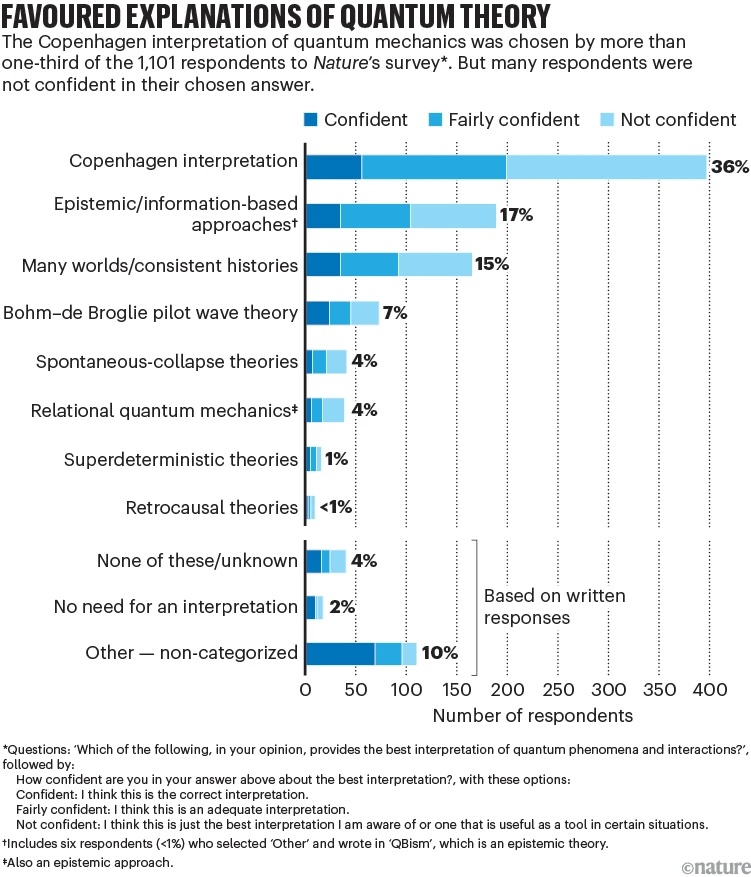
Here is the Nature survey on physicists's attitudes toward the foundations of quantum mechanics, with this figure showing the high-level responses.
Click to Show AMA Questions Only
AMA questions August 2025
Lishan Aklog
You have engaged in thoughtful, vigorous public debate over the existence of God, so I’m genuinely curious why you think the simulation hypothesis has had a seat at the table of respectable scientific discourse. It strikes me as Creationism recast in sci-fi narrative terms—trading a mythical divine Creator for an equally mythical cosmic coding Creator. What am I missing?
Coyohma
There's an understanding that some infinities are larger than other infinities, and I'm struggling to understand it: The most common examples I've seen regard changing values diagonally of known numbers, ultimately resulting in a new number.
It's not clear to me how this new number makes that infinity 'larger' than if one simply added one more natural number toward infinity. My more mathematically-inclined friend suggested asking why infinity - infinity != 0 or infinity/infinity != 1.. Any thoughts would be appreciated!
Xavier
PRIORITY QUESTION
As someone in their 20s, I’ve found myself unexpectedly overwhelmed by Ray Kurzweil’s vision in The Singularity is Nearer—a future of radical longevity, post-scarcity economics, and incomprehensibly expanded consciousness. I struggle to find compelling reasons—barring extinction—why this “techno-singularity” shouldn’t occur. And yet, even the possibility of such a future has deeply shifted how I think about meaning, ambition, and mortality.
What credence do you personally give to the idea of a techno-singularity and how should someone my age—given that even many conservative timelines place this well within my lifetime—begin to emotionally and philosophically grapple with such a potentially transformative horizon?
Alexander Knochel
I've often wondered - the CMB (and we along with it) posesses a special rest frame, at least locally, since we can for instance tell from the cmb dipole that we are moving relative to it. The inflaton seems to be an invariant scalar field. My question is how and when it is decided that the reheating of matter in the universe after inflation prefers particular rest frames. Is that related to what the preferred time coordinate in FLRW cosmology is?
Alyx Dubrow
You often suggest that we’re fortunate to live in a universe where emergent levels of description exist. But how can we be sure this isn’t a necessary feature of complex systems in general, rather than a contingent one? Maybe emergence is an inevitable aspect of how complexity arises in the first place.
************************************
Mike Briggs
In a recent Scientific American interview, Gerard 't Hooft sounded like he is on your side when it comes to seeing the need for more study of the fundamentals of Physics. Is he with you on this issue?
Barry V Bye
In the latest issue of Scientific American, Gerard 't Hooft gave an interview in which he said things like:
"Quantum mechanics is the possibility that you can consider superpositions of states. That's really all there is to it. And I'd argue that superpositions of states are not real. If you look very carefully, things never superimpose." He believes that the "real world" is classical, even at level of quantum particles. And that's the direction research should be taking. What do you think?
************************************
Zach McKinney
Are you aware of any researchers or frameworks that distinguish between different *levels* of substrate dependence of a
given phenomenon [such as, but not limited to conscioussness], in a manner analogous to distinguishing between weak and strong emergence?
…For example, a weak form of substrate dependence may be little more than a restatement of physicalism, stipulating that the material properties of a given system are important in enabling its behavioral dynamics, in a manner that can be replicated in other materials with similar properties — whereas, the the strongest form of substrate dependence would posit that the system behavior is *uniquely* dependent on its material properties, such that the behavior cannot be replicated in other materials.
Nick C.
What do you believe are the long-term implications of cuts at NASA and NSF and other US government funding for STEM in the US? Some are saying that if one is a STEM researcher one should probably plan to pursue one's career abroad (especially in the case of a more junior researcher). What's your view?
Keith
Has the recent emergence paper you wrote received any good feedback or thoughts at the folks at Sante Fe or elsewere?
Sergei
In your discussion with the constructor theory proponent Chiara Marletto you never pushed back against the assertion that "the most fundamental way of formulating the laws of physics, which is to use a dynamical law with some boundary condition or initial condition", and even agreed with that. And yet nearly all interesting solutions in General Relativity were not found that way (e.g. Schwarzschild or de Sitter), and many cannot even be theoretically formulated that way (e.g. Godel universe). As you well know, the initial value formulation of GR took decades to work out. This "non-constructor" approach is not unique to GR: Kepler's laws do not talk about initial conditions and dynamical laws and were only recast in that form by Newton. What am I missing here?
Mike VR
thank you for the excellent solo episode on complexity.
From your perspective, could a comparison of the thermodynamic cost of persistence for a star, a storm, and a bacterium reveal a fundamental tipping point where the most efficient solution for maintaining a stable pattern shifts from one based on managing energy flow to one requiring an investment in the capacity to model the environment and act upon what is significant?
Owe
You've mentioned a few times in podcasts and in The Biggest Ideas volume two that things which appear dynamic (such as the inside of a nucleon) are in fact static solutions to the Schrödinger equation. I've never quite followed how that solution is static. Even for a singular quantum object, becoming less localized at one point over time seems dynamic, since it's changing with respecting to time?
anonymous
You often qualify your advice to grad students with something like “of course, if you’re a genius, that might not be necessary”. How often does that actually come up? I’m trying to get a sense of the distribution. Is the professor hiring process like the NBA draft (superstars focused), or are professors in a given department all at pretty much the same level?
David Sotolongo
I am curious about your thoughts on Peter Singer's 1971 essay "Famine, Affluence, and Morality," in which he asserts: "if it is in our power to prevent something very bad from happening, without thereby sacrificing anything else morally significant, we ought, morally, to do it."
One famous example is of a rich man in expensive clothes who sees a child drowning in a pond. Singer, and most people, would say it would be wrong for the rich man not to save the child just because he would ruin his expensive clothes.
Singer then goes on to say that there are millions of starving people across the world, and that it is just as bad for the rich man to have spent money on luxury clothes in the first place rather than donating it to prevent starvation, than it would be to not save the drowning child in front of him.
Scott Collins
In pro wresting, the term “Kayfabe” refers to the practice of pretending as a group that something is real that everyone knows is not. Do you think that all of the AI Armageddon talk (promoted mostly by the AI companies themselves) is a kayfabe? All of these executives talk about malicious AI all the time and promote specious studies that alarm the public, even though they know that’s not how AI works? How can we have a reasonable discourse about the impact of AI when the discourse is dominated by BS?
Baldur
PRIORITY QUESTION:
I'm married, having two children, work as a utility technician in mid-western Germany, and have no academic background—just a layman's interest in philosophy and science.
Both our kids are diagnosed with ADHD and autism spectrum disorder. Supporting them revealed my own likely—though undiagnosed—autism, alongside diagnosed depression. Everyday life feels like a minefield, especially for my neurotypical wife.
Mental disorders are often framed as “neurodivergence,” implying we all lie somewhere on a neurological spectrum. But our children return from school overwhelmed, in stress—emotionally lashing out or withdrawing—desperate to process the day’s load and feeling isolated from neurotypical peers.
So my somewhat philosophical question is:
Does labeling mental disorders as “neurodivergence” truly honor the suffering of affected persons, or does it whitewash public perception and mask its disfunctional reality behind well-meant respect?
To me it feels like calling heart disease “cardiodivergence”.
Dela Quist
You often highlight that coherence in physics - and meaning in mind, both hinge on the right invariants.
So my….. "PRIORITY QUESTION" is:
If selection leaves an irreversible trace, turbulence isn’t “random” - it’s what happens when a system evolves without an anchored boundary condition.
And if that’s true, doesn’t the same logic apply to consciousness. That experience itself isn’t emergent complexity, but the irreversible trace of choice?
Kunal Menda
Do you vibe code? What impact has vibe coding had on physics research?
Patafikss
I've noticed that a lot of fields are covered in mindscape (even clothing style) but apart from the episode 156 with D'Ignazio, there is seldomly the mention of feminism. I also wonder about your stance on socially enforced gender roles, and about their stereotypes. Do you find this topic at all interesting and worthwhile?
Ercan Serteli
Given that the fundamental laws of physics are time-direction-agnostic, what if we place a human in an isolated room and wait until the only thing left in the room are randomly floating particles, then at one instant, reverse the momentum of every particle in the room, would the inside of this room play itself back, recomposing a human who lives backwards and gets younger over time?
S Sanders
Thank you for your excellent conversation with Jacob Barandes! I get the sense that you are most skeptical about the fact that his approach allows you to work with a particle ontology, because particles are poorly motivated in light of QFT. However, I think his theory is pretty agnostic (arguably vague...) about its ontology, and would also allow you to just start with a field ontology so long as it obeyed the indivisible stochastic dynamics. Assuming you went with fields from the start, would you still have misgivings about his theory? If so, what are they and why do you have them?
Pete Harlan
How do you handle errata for your popular (non-textbook) books? I.e., do ebooks get automatically updated with minor fixes as they are discovered, and/or do you publish errata online, or do these things wait for a new edition, if any? I don't have any errata in mind, I'm just curious.
mark slight
In your solo about emergence, you suggested a way forward on how to possibly modify the standard model, for those who wanted to look for strong emergence. But any such strong emergence could be mathematically encapsulated and as such, no matter how surprising, it would still not be any threat to materialism about the mind. Is that correctly understood? Or am I missing something?
*************************************
Mikkel Bennedsen
In the study of emergence, is the coarse-graining map subjective, i.e. is it different for different observers? How is the coarse-graining map decided on and what effect does the choice of coarse-graining map have on the subsequent analysis?
Julian Voitl
is complexity as well as entropy "only" a coarse grained concept for dealing with incomplete information (and quantum mechanically can not, even in principle, obtain complete information)?
Elias
How do you choose a coarse-graining for a given microscopic theory - is there a procedure that can be formalized?
Thinking about some examples from your recent podcasts,
1. the cream-and-coffee model,
2. averaging digits of long numbers, and
3. the entropy of the universe,
it seems clear that there's a happy medium between "too fine" and "too coarse".
Tim Gianitsos
You mentioned in a minutephysics video that complexity is a distinct concept from entropy. Whereas entropy only increases, complexity usually increases but then decreases.
I believe that the observation of entropy increasing is because of how we coarse grain phase space over time, and if there was no coarse graining, there would be no entropy increase (Liouville's theorem). If I'm right about this, then my question is whether the same thing applies to complexity; if there's no coarse graining, would complexity be constant? Would it be zero?
Paul Cousin
I have talked to a potential master's thesis supervisor and he has very Mindscapy interests. One of his remarks struck me, and I'de like to hear your thoughts on it. He said something along these lines: entropy can only be understood from the standpoint of intelligence, since only intelligent beings can coarse-grain. I think you would say that once a coarse-graining is defined, entropy is a matter of fact, whether or not there is intelligence in the Universe. What is the most fundamental definition of entropy? In your view, is it as divorced from intelligence as other physical quantities?
Ara
Boltzmann's equation S = k log W is considered fundamental, and it is defined in terms of microstates and macrostates. But is not a macrostate a human perception? Humans happen to perceive multiple microstates as the same macrostate. Should not a fundamental law be independent of human sensory scale?
************************************
Chris Roat
For some definition of what it means to be genetically alive (or human), do you know how of methods to estimate how much of the space has been sampled by life, and how uniformly? How much has been measured by medical science? If only a small corner of the space is known, as one might naively suspect, how does that hamper our ability (even with AI, which is limited in extrapolating) to develop breakthroughs in treating/curing disease.
Jamie
When the USSR tried to have a centralized economy, economists theorized that a free market is much more efficient at setting prices, deciding what to manufacture, etc. than central planning — information flows more freely. This practical superiority then got mixed up with the moral idea that free markets aren’t just better, but also more RIGHT. Now we see companies (Uber, and many others) use “algorithms” to set prices, create incentives, and do all sorts of centralized information gathering and planning. Do you think technology could get to the point that Soviet-style centralized planning of the economy could be superior, in a practical sense, to free markets? And if it was better, do you think it would then be immoral for there to be free markets?
Marcin Chady
What happens to all the photons emitted by black holes in the heat death of the universe?
*****************************************
Albin Varghese
At the fundamental level, how do you view the flow of time?
Is it meaningful to think of time as a sequence of quantum states in Hilbert space transitioning together like falling dominoes moment by moment?
Nobody Feels Time
my relationship to time is variable. It must be my brain that creates this variability due to processing more intense scenarios with higher attention or focus while time passes imperceptibly while I sleep. How do you feel time as a human in terms of physics as well as in terms of philosophy?
Dan O'Neill
In your Mindscape podcast with William Egginton last year the two of you talked about Kant's and Hume's theories of mind, contrasting Hume's reductionist view—where the mind is just a succession of sense impressions—with Kant's idea of the transcendental ego as the "something" that must endure through time to register those impressions. I know you don't believe in a metaphysical mind or self, but I wonder how you think time and the extension of brain activity through time might factor in an eventual biological account of consciousness?
Sandro Stucki
Your solo on complexity and the universe was great and made me think a lot. One question it prompted is about the connection between life and the arrow of time: could we imagine some form of life existing in the absence of a (local) entropy gradient? More abstractly, can we imagine any kind of system that processes and takes advantage of information without such a gradient? Is life-like complexity intimately linked to the arrow of time?
******************************************
Brendan Barry
Can you discuss how MW localizes the measurement of distant entangled particles. Is it wrong to think of the wave function as branching when the particles become entangled?
If MW does make entanglement local, shouldn’t the non-locality of other QM interpretations, shown in tests of Bells inequality, be large experimental evidence in favor of MW?
Perry Whan
Is there an age to any of the four forces? For example, is gravity "older" than the strong or weak forces? If so, and gravity is 10^whatever weaker than the other forces, does that mean gravity is 10^whatever 'clicks of the universal clock' older?
P Walder
In your answers you frequently use the term ‘Good Bayesian’ when referring to how people should acquire knowledge. Intuitively, it does seem that, even when people don’t explicitly use Bayes theorem, a Bayes-like process is used to gather information which brings progress in terms of an increased confidence that truth is being approached (although never actually getting to truth statements). Popperian epistemology, as I understand it, suggests that, whilst a Bayesian approach might frequently be useful, it ultimately has to ‘give way’ to conjecture and refutation as a truth seeking process because Bayesian based processes can themselves be traced back to an original guess or conjecture which forms the prior in the Bayesian process. If this is the case can you give your thoughts on whether, a greater emphasis should be placed on processes based on conjectures and refutations rather than induction. Alternatively could Bayesian approaches be considered as part of the critical process required of conjecture and refutation ?
Ben Lloyd
I tend to agree with you that the llm architecture alone will never reach any “agi” level of intelligence. And I also agree with you when you say that reaching agi is totally possible. But I’m wondering, for you, why are you pretty confident that it is possible? What’s your reasoning behind that? I agree with you but I’m interested into why you, and also most other experts in at least somewhat relevant/related fields to that question, also say it is possible.
Eric J Rundquist
Since (as far as I understand) you don’t think consciousness is an epiphenomenon, what’s your best hypothesis for how consciousness affects physical events in the brain? In other words, what do you think could be the physical mechanics by which consciousness does something, rather than just being “along for the ride”, as people like Annaka Harris see it?
Paul O
"In Space no one can hear you scream", but does Dark Matter scream as it gets sucked into a black hole? I am using pejorative terms here for dramatic effect. We know normal matter can emit huge amounts of energy in the region of black holes (e.g. quasars). But what about Dark Matter?
Jacob
I came across an article on Hawking radiation that references the work of Michael Wondrak, Walter van Suijlekom, and Heino Falcke. The topic was that Hawking radiation does not require an event horizon, and can arise in vacuums under different geometries of curved space. Is this something that is generally understood among experts or rather some new interpretation of Hawking’s theory? If true, does this imply we could maybe hope to detect it without needing a black hole?
BlakeStern
What repeat killer in Columbo is your favorite:
1. Jack Cassidy
2. Robert Culp
3. William Shatner
4. Patick McGoohan
5. George Hamilton
Miron Mizrahi
In the episode with David Tong you said that you were teach yourself the algebraic approach to quantum mechanics. I am taking myself thru Susskind's Theoretical Minimum lectures. I recently finished the QM one and his approach was - what I understand to be - algebraic. He spoke of state vectors, expectation values (which he did not like as a term), eigen operators, etc. Wave function was not even mentioned until lecture 6 or 7. In contrast I had - in the past - tried to go thru Allan Adams' QM course at MIT OCW. there it was hardcore math, wave functions, fourier transforms from the get go.
To me it felt like Susskind in focusing on actually understanding how the system ticks whereas Adams was focused on practicalities for physics students and I never quite 'got it' like I did with Susskind. Why so different for same topic? what is your approach? which would you prefer and why?
Henry Jacobs
What is the relationship between moral constructivism and moral relativism?
Aaron Frankel
Priority Question
I love your AMAs. Would love to hear about your process for preparing to do these shows. I have heard you talk about how you pick the questions, but do you plan out your answers in advance or just do it all on the fly in one take?
Patrick Lardieri
In the June AMA you answered a question from Michael Bright about the evolution of the wave function of a single photon. In your response you made the claim "... when your telescope detects a photon that was emitted by a quasar billions of light years away, until you detected it, it's wave function was spread out all throughout the universe." This got me wondering which if the following applications of the Born rule to this event is correct. Do the Born probabilities generated from the said photon's wave function determine the chance ot the telescope detecting the photon at its location? Or do the Born probabilities determine where the photon will be detected across the entire volume of its wave function once detected by the telescope? The first case seems likely to me but I am not sure.
Alexi Kostibas
Is there a point at which a deterministic system scales beyond what we can call "practically" deterministic? LLMs (of course!) might be an example of something starting to get to that point: while we know exactly how they work in principle, analyzing their state to determine why they do certain things is incredibly difficult. If you incorporate a self-feedback mechanism, that gets even more difficult. I suspect a scientist would just call this a measurement problem or something, but it feels like a useful thing to admit.
Wonder
Favorite Jane Austen novel?
Doug Eltoft
I understand how the free energy from the Sun enables life on Earth. Was there free energy in the early Universe that enabled the creation of the Mass that formed into stars? What was the process that created the first mass and or energy?
Sid Huff
In your Reflections of Bryan Van Norden’s appearance on Mindscape, at one point you used the label “BC” (i.e., Before Christ) in reference to the era of Aristotle and other early philosophers. I also noticed that Bryan himself at one point in the podcast discussion used the secular label “CE” (common era), rather than “AD” (Anno Domini, the year of our Lord). Do you think that these small but noticeable labelling differences are important to emphasize?
Steve Bonner
I’ve read that protons and neutrons contain three quarks—one of each color—and a sea of quark-antiquark pairs. The term “sea” suggests a large number. Do we have any idea how many such pairs there are?
Eric Coker
How much has the popularity of mindscape grown through the years?
Andrew Goldstein
When you ponder a new or existing hypothesis, mathematical model or new fundamental law of nature, how much credence, if any, do you give to intuition, by which I mean feelings that guide a person without fully understanding why?
Niles Dhar
Do you think the constants of nature are truly fundamental? Or might they someday be derived from deeper principles? It’s always interesting to me when the universe seems to “tilt” in a certain direction.
Kyle Stephens
My friend is a self-described anarcho-communist. I feel it’s an untenable position because there seem to be no viable paths to anarcho-communism, as centralized government and capitalism both seem like attractors of sorts. It seems that we would need to either abolish private ownership and travel through communism, or abolish the state and travel through anarcho-capitalism, both of which are strong attractors that would prevent us from reaching the end goal of anarcho-communism. Is my intuition correct here? Is this something you have thought about in writing your book on physics of democracy?
John T
Sarah Walker asserts that according to assembly theory nothing above a certain incredibly low level of complexity can just spontaneously pop into existence. This seems to contradict the idea that given enough time every possible structure will form from random fluctuations. It also seems to suggest that there is a non-randomness to the universe, otherwise random fluctuation would be enough to create everything… eventually.
Scott Collins
I get annoyed with people when I feel like they are just saying whatever pops into their head without giving it any thought. Especially when they dig in afterwards. After listening to the episodes with Kristof Koch and Annika Harris, and to her Lights On audio book, I realize that we are basically all doing that all the time and then justifying it ex post facto. Certainly, thoughtful carefully considered ideas are more than blurtations of the subconscious. How do you understand the difference in quality and value of expressed thoughts in this light?
John Campbell
What makes energy so special? Lagrangians have lots of symmetries, but energy seems to be the "most important" for understanding systems. What gives?
Dale Addison
If you had kids, would you tell them Santa Claus is real, or be honest from the start?
Sam Harris has argued that parents shouldn’t lie about Santa, since the potential sense of betrayal and loss of trust isn’t worth the added excitement. He sees it as a small but meaningful deception, one that promotes magical thinking over critical thinking and may undermine a child’s relationship with truth, reason, and trust.
Ted Farris
PRIORITY QUESTION.
Everett’s “many worlds” interpretation assumes a deterministic universe.
The universe we ourselves see is a probabilistic one where the uncertainty principle prevents us from knowing the path of an electron, although we can predict how a probabilistic distribution will fall in a range of outcomes. If the assumption you make in your argument for many worlds that the universe is deterministic is wrong, and the universe is in fact probabilistic as it appears to us, would you give up on the many worlds hypothesis? And, what is your basis for assuming that the universe is deterministic?
Jeremy Dittman
How is the QM textbook going? Specifically, you mentioned in your episode with David Tong that you are opting to introduce QM both from the Schrodinger eq point of view and the qubit approach, and I’m curious if you get into spin right away for whichever 2D Hilbert space example you have chosen to dig into. As an undergrad physics student, I remember how difficult the concept of spin was since it couldn’t be thought of in terms of macroscopic spin concepts but still mysteriously shared the same symmetries, vector properties, etc… as classical anglular momentum. Just wondering if you have developed an intuitive approach to spin or if its just one of those tough things about learning QM.
Emerge Holographic
The other day I saw a video of Dawkins and Krauss comparing gender identity to “healthy obesity”, as concepts nobody should entertain.
I’m transgender and fat; Both their work inspired me at points in my life, so needless to say it’s frustrating to see influential scientists harming people who they don’t understand, due to misplaced atheistic authority. We often see this happen disproportionately with marginalized groups, especially indigenous practices
As you’re someone who can see the world from multiple emergent levels, what do you think it is that empowers brilliant minds to reductively redefine and dismiss the human condition of strangers?
jms547
I really enjoyed your episode with David Tong. In it he mentioned solitons in QFT. He described solitons as topological structures, and drew the analogy with smoke rings. As no stranger to QFT yourself, you might be able to answer: does this conception of a soliton have anything to do with solitons in integrable systems e.g. the KdV equation, nonlinear Schrödinger equation, Toda lattice etc? Lax pairs, inverse scattering transform, nonlinear Fourier spectrum, balance of dispersion and self-focusing, and all that? If so are techniques from integrable systems used in QFT?
Eric
In your March 2024 solo episode, “The Coming Transition in How Humanity Lives,” you made a compelling point: as price efficiency and economies of scale increase, consumers often become less happy and feel less able to influence large institutions.
Do you think this growing sense of powerlessness is a key reason why so many people today feel like things are worse than they used to be—even if, on paper, life has improved in many ways?
Is this loss of agency an unavoidable side effect of system optimization, or are there ways to reconcile the individual’s well being with the efficiency of the broader system? Is this an inevitable consequence of capitalist democracy?
Richard Graff
I enjoyed your recent solo episode on complexity. In it you discussed how complexity arises from systems that are highly, but I assume not completely, ordered. My question is can a system be completely, 100% ordered, and if so can complexity arise from such a system?
yazan al hajari
As an artist drawn to Gödel’s incompleteness theorems, I wonder what they tell us about the ultimate limits of human knowledge and consciousness. Do you see any natural connections between Gödel’s work and the puzzles of quantum theory—or even with the idea of “perfection” and unavoidable contradictions in a hypothetical perfect being?
Ryszard Sommefeldt
I have aphantasia: the inability to voluntarily create mental images of the things I’m thinking about. Do you think that inability could be an advantage when it comes to thinking about and understanding physics, by forcing the mind to map and understand concepts without any innate imaginary visual substrate to build on, or do you think that ability is fundamental to understanding physics deeply?
Neil Wallace
I’m a creative person, a graphic designer by trade. I naturally picture things, scientific models particularly, in a visual way — sometimes abstract, yet still imaginable to me.
However, it seems I have no way to visualise the infinity of our universe.
As a scientist, do you use any pictorial methods to consider this most beautiful of enigmas?
Stephen Bryant
It is thought when life began on Earth conditions were very different - no free oxygen, for example. Suppose there were a large, isolated, lifeless system with today’s conditions. Is there any reason to think that life could arise spontaneously, or any reason to think that it couldn’t?
Tim Converse
I get it that there must be some facts that are "brute" - otherwise there would be an infinite regress of explanation.
But I find myself uneasy with the idea of genuinely brute facts that seem both complicated and arbitrary, like "There are exactly X different things of type T", where X is a small integer that is not, say, 2 or 3. 🙂
As an example, suppose that some version of string theory were true, and it required there to be exactly d=11 spatial dimensions - no more, no less. Why 11? That's just the way it is. I would crave some further explanation, even if it's landscape-multiverse style (d could have had other values, but in our universe d=11).
The universe doesn't have to respect my feelings of uneasiness. But with regard to your own credences, does this kind of seeming arbitrariness of a fact reduce your credence that it could ultimately be a brute fact?
Michał Brzozowski
Even when we finally transition to renewable energy, we will have warmed the planet by at least a couple degrees. What are our hopes of reversing this within the next 50 years, by sucking out the excess carbon or other climate engineering methods? Is any such technology on the horizon?
Gary Miller
I’ve listened to countless hours of your podcast and it’s always been a one way conversation, you speak, I listen. One time I met you at a book signing in LA. You kindly signed my book and then asked if I was a Physics fan. I was dumbfounded, in all of our “conversations” I was never expected to respond, suddenly I was tongue tied. 🙂 Are there people (scientists, authors, celebrities) who you have met and suddenly found yourself a bit off your game or at a loss for words?
Click to Show Full Transcript
0:00:00.0 Sean Carroll: Hello, everyone. Welcome to the August 2025 Ask Me Anything edition of the Mindscape podcast. I'm your host, Sean Carroll.
0:00:08.0 SC: Not a lot of news to report since the last AMA a month ago. The life in the summertime of a college professor trying to get papers written and books written, does not really create a lot of adventures to relate. But that's okay. Sometimes, the adventures are in the mind. That's important also. There was a fun article that came out in Nature. They tried to figure out what physicists really think about the foundations of quantum mechanics. This is something that happens every so often that we try to take a poll of a bunch of physicists, and ask them what they really think. The problem is with that kind of approach, that it's going to be very, very biased depending on who exactly you are polling. You're polling your friends, you're polling the people whose emails you happen to have, you're polling people at a certain kind of conference. Those sets of people might be very different in the kinds of quantum mechanics that they like. So I actually consulted a little bit with the authors of the piece, to try to figure out how to get the largest cross section of physicists. They went through people who had published on Quant PH, which is the archive category for quantum mechanics, and a bunch of other people as well.
0:01:17.8 SC: Anyway, the results are, more or less, I think, what one expects. One might not like the results, but they're more or less consistent with what one hears. The Copenhagen Interpretation, received more than twice as many votes as any other particular interpretation to the question, "What is your favorite explanation of quantum theory?" And it still received only 36% of the total votes. And they asked, not only, "What is your favorite explanation?" But, "How confident are you in it?" And it was a tiny number of people who were voting for Copenhagen that said they were confident in it. Likewise, for all the other approaches to the foundations of quantum mechanics, they weren't very popular, nor were people very confident in them, even when they believed them. Second place was taken by epistemig/information-based approaches. Third place by many worlds. And then with less than half that many votes, pilot wave theory, de Broglie-Bohm, and then even smaller number of votes for spontaneous collapse, relational quantum mechanics, super determinism, etc. Jacob Barandes' favorite stochastic approach was not popular among the recipients, but then again, it's very new. There are predecessors to it that are still just not very popular. So it didn't get a lot of explicit votes in the poll, but you know, who knows, maybe it will catch on.
0:02:40.6 SC: There's a lot, I think, to be frustrated about in this particular kind of vote. The obvious thing to be frustrated about is that we don't agree on what the foundations of quantum mechanics are all about. I don't think that's really... Like, I do complain about that, that we don't agree. But it's not really the problem. There's plenty of things we don't agree on just because we don't know the answer, right? We don't know what the dark matter is, for example. That's not a real reason for complaint. It's just that the experiments haven't told us the answer yet. So there you go. In the case of interpretations or foundations of quantum mechanics, the thing to complain about is that we're not trying to get the answer. And this is really what was driven home when the article came out. On social media, of course, it got a lot of attention, people talking about it, and other people asking, how important is it that we teach our students about different foundational theories of quantum mechanics. And in my bubble, where I talk to people who are very, very interested in these questions, we all know why it's important to truly understand quantum mechanics. And we tend to forget that most physicists just don't. They don't think it's important to understand quantum mechanics. They are slightly insulted or offended by the suggestion that we should care about understanding quantum mechanics at a deep level. The, "Shut up and calculate," attitude is really quite strong out there. It is not going away. I think it is going away, actually, but the timescale for it to go away is not years. It's decades. So it will take a while.
0:04:08.6 SC: I did have a little thread on Bluesky trying to convince people why it was important. The most important reason, just to make a long story short, is that there are things we don't know about physics. There are unanswered questions that are at very deep levels of our understanding about fine-tuning, or quantum gravity, or the vacuum energy, or things like that. And it's very, very possible that different approaches to the foundations of quantum mechanics will suggest different ways of trying to answer those questions. So as a methodological question, I think it's very important that we try to figure it out. As a normative question, I think that we should try to figure it out. That's our job, right? Our job is not to just calculate things. Calculate what? Why are you calculating this rather than something else? What is your reason for caring about calculating things? Maybe you just want to build a better gizmo, and that's fine. But my reason is I want to understand nature better. And I think that getting to the foundations of quantum mechanics is part of that.
0:05:07.1 SC: The other depressing thing is that the people who are so convinced in the Copenhagen Interpretation, which obviously is hilariously not even defined very well, so it absolutely shouldn't even be included among the respectable interpretations, much less the leading one, are just not educated about what the alternatives are. They're, sort of, proudly ignorant of what the possibilities for thinking about the foundations of quantum theory are, and they don't want to know anymore. And I think that's also something that the physics community, as a whole, should be embarrassed about. Maybe it's changing. Maybe we'll do a little better. Maybe we're nudging them gradually in the right direction. Certainly here at Mindscape, we're doing our part, but it's a big world out there. It takes a lot of effort to change it in any noticeable way.
0:05:55.0 SC: Reminder, that these Ask Me Anything episodes are brought to you by Patreon supporters of Mindscape. You can become a Patreon supporter. All you have to do is go to patreon.com/seanmcarroll, and sign up to throw a dollar or so, toward every Mindscape episode. You get ad-free versions of the podcast, plus the ability to ask the questions that I choose to answer here on the Ask Me Anything episodes, with little tiny bonuses, like, once in your career as a Patreon supporter, you will get to ask a priority question that I guarantee I will try my best to answer. Also I do little reflection episodes, little five-minute long reflections on what we just talked about for every episode. Not for the AMAs, I just talk for three hours. You don't need me talking anymore after that. But that's a little Patreon bonus for our supporters. So it's painless and fun to support. You should do it. And thanks to everyone who does support on Patreon. So let's go.
0:07:08.9 SC: Lishan Aklog says: "You have engaged in thoughtful, vigorous, public debate over the existence of God, so I'm genuinely curious why you think the simulation hypothesis has had a seat at the table of respectable scientific discourse? It strikes me as Creationism recast in sci-fi narrative terms, trading a mythical divine creator for an equally mythical cosmic coding creator. What am I missing?"
0:07:32.0 SC: I'm actually... I'm missing something in the phrasing of the question. The fact that, I, "... Have engaged in thoughtful, vigorous, public debate over the existence of God," is evidence that I think that the hypothesis that God exists deserves a seat at the table of respectable discourse, whether you want to call it scientific or otherwise. So if you think that, and if I think that, then it makes perfect sense I would also think that about the simulation hypothesis. I understand why you... One, you or other people, would group them together, in the sense that you're imagining, that our observed universe is created by somebody outside. You can call that 'Creator,' supernatural or theistic. You could call it a very advanced civilization running a computer program. But in many ways, they are parallel. My view is all of these ideas deserve a seat at the table. You should evaluate them. That's why I gave the title, 'God is not a good theory,' to a talk that I gave that you can find on YouTube, because there's two controversial parts of that title, 'God is not a good theory.' One, is that God is not good at being a theory. But the other is that God is a theory which I absolutely believe. It is a hypothesis about how the universe could be, that we should judge in the same way we judge all these other hypotheses. And I think the simulation argument is the same way. We should judge it as we judge all these other hypotheses, and what that means is thinking hard about asking the right Bayesian questions, updating your priors. But of course, people can have very different priors, so the real work is calculating your likelihoods. If this hypothesis were true, what would you expect the universe to look like?
0:09:19.0 SC: I have not that much expectation for what the universe would look like, if it were a simulation. I think it's actually easier to imagine what it would look like if God existed. In both cases, it doesn't really look anything like the universe that we observe, therefore, I think that these hypotheses have very low credibility. But I think it's important to have a whole bunch of big-idea hypotheses on the table, when it comes to thinking about how the universe could be created. The one reason why one might not want to give a particular hypothesis a seat at the table of respectable discourse, is if the hypothesis itself is not put forward in good faith. Back in the early days of the blogosphere etc, in the early 2000s, there was still a lot of debate going on about Intelligent Design, and Creationism, and things like that. And Intelligent Design was very explicitly invented in order to disguise Creationism as science. That was a very explicit agenda that they had. So they were not working in good faith. There might be people, who, in good faith, think that the universe was intelligently designed, that's completely possible. But there was a movement to, sort of, twist Creationism, which is very explicitly religious, into something that seemed scientific exactly so that it could get into public schools. And that was not done in good faith. So that particular version of Creationism, doesn't deserve a seat at the table. But in general, I'm in favor of thinking about all of these different hypotheses, and taking them seriously, and then moving on once we've judged that that hypothesis is not working very well.
0:10:55.7 SC: Coyohma says: "There's an understanding that some infinities are larger than other infinities, and I'm struggling to understand it. The most common example I've seen regard changing values diagonally of known numbers, ultimately resulting in a new number. It's not clear to me how this new number makes that infinity larger, than if one simply added one more natural number toward infinity. My more mathematically inclined friend suggested asking why, infinity minus infinity is not zero, or infinity divided by infinity is equal to one. Any thoughts would be appreciated."
0:11:29.8 SC: I don't want to cast aspersions on your more mathematically inclined friend, but those are not good things to think about if you're trying to understand why some infinities are bigger than others. Why, infinity minus infinity is not equal to zero, is something to think about even if both versions of infinity are the same size. Because that's a weird feature of infinity. The fact that infinity can have different sizes, of course, was really established by Georg Cantor years ago. And the basic idea is kind of simple, you know, for any of these ideas, when you're thinking about infinity, and there are deep philosophical and mathematical questions that come up when you do that, so it helps to start with finite amounts of things. Think about really explicitly, how you would establish truths about them. And then ask, "Does that work for infinity, or do I have to modify it? Or pick some version of it that works for infinity?" So for finite-sized quantities, how would you decide that one quantity is bigger than another? How do you decide that seven is bigger than five? Seven objects are bigger than five objects, okay? Well, one thing you could do, is try to put them into one-to-one correspondence. You could take the group of five objects and the group of seven objects, and you could label them one, two, three, four, five; one, two, three... Well, let's say A, B, C, D, E, F... Is that right? A, B, C, D, E, is all you need for five, and then label the group of seven objects one, two, three, four, five, six, seven, and put them into correspondence. So you have object A is in correspondence with number one, object B with number two, all the way up through E and five. And then you have two objects left over in the group of seven objects, right, numbered six and seven. So you say, "Voila, I put everything into a one-to-one correspondence, and I have more things left over in one of the collections rather than the other. So that collection is bigger." You might think this works just as well with infinite numbers, but it doesn't. Think about the integers, the numbers 0, 1, 2, 3, 4, etc, and also, -1, -2, -3, etc. But then, also think about the even integers, so the numbers 0, 2, 4, 6, 8, and, -2, -4, -6, -8.
0:13:44.3 SC: It's always dangerous doing these AMAs in real time, like I'm gonna count wrong, or something like that, from speaking extemporaneously, and it's gonna look very bad, and it's gonna be preserved forever. But we persevere anyway. So it looks like I can put the integers and the even integers into a correspondence where a lot are left over. I could literally put the number 2, in the integers into correspondence with the number 2, in the even integers. Likewise, with 4, 6, 8, and -2, -4, -6, -8, etc, and then I have all the odd integers left over, right? So you say, "Aha! I have proven that there are more integers than even integers," which does make some kind of intuitive sense, if you're not sufficiently familiar with the subtleties of infinity. The problem is, I can invent a different one-to-one correspondence that puts them into exact correspondence with nothing left over. I can set up a correspondence where the integers 0, 1, 2, 3, are put into correspondence with 0, 2, 4, 6, etc. That is to say, I multiply the integer by 2, and then the integers -1, -2, -3, are put into correspondence with -2, -4, -6, etc., okay? That's a perfectly good correspondence that is exact and covers everything on both, the integers and the even integers. So the first big discovery is that the number of integers is the same as the number of even integers, even though there's clearly odd integers that are not in that latter set. So this is a subtlety of infinity. I can take an infinitely big set, the even integers, I can add an infinite extra set of elements to that set, the odd integers, and the size of the set that I get, isn't any bigger than what I started with. So that's kind of remarkable, and that makes you think, can there be any set with more elements than the integers? And the answer is yes, there can be. And this is what Cantor proved.
0:15:51.3 SC: Take the real numbers, okay? Again, there's, sort of, naively, more of them than the integers because between every integer, there's a whole bunch of real numbers. Real numbers here, just means the whole number line, from minus infinity to plus infinity. But it turns out, we can skip this step, but the number of real numbers, is equal to ,the number of numbers between zero and one. You can kind of imagine that... I even talk about it, I think, in, 'The Biggest Ideas in the Universe, Volume I.' That you can put the numbers into one-to-one correspondence, perfectly. And you can argue about whether that's sufficient, but it illustrates the fact that you can draw a function where x goes from minus infinity to infinity, and y just goes from zero to one, and it covers every number once and no more than once. Okay, so I claim then that the amount of numbers, the cardinality, as we call it, the size of the set of numbers between 0 and 1, the real numbers, is bigger than the size of the set of integers. And how do you do that? Well, this is what Cantor did. This is what you're having in mind when you say, "... Regards changing values diagonally of known numbers," okay? Try your best to come up with a one-to-one correspondence that maps every real number between 0 and 1, in one-to-one correspondence, with every integer, or vice versa. If it's one-to-one correspondence, it doesn't matter. You're guaranteed to fail. This is what Cantor proved. The thing that you're thinking of by writing down a bunch of numbers and changing the first digit in one, then the second digit, then the third digit, etc., in all the numbers. So the first digit in the first number, the second digit in the second number, the third digit in the third number, etc., what you're proving is that your best attempt to put the integers into one-to-one correspondence with the set of real numbers between 0 and 1, fails. So unlike the even integers and the integers, which can, if you want to, be put into one-to-one correspondence, and therefore have the same cardinality, the real numbers between 0 and 1, cannot be put into one-to-one correspondence. There's no map that does that. That's the proof.
0:18:07.5 SC: Obviously, we're being very, very glib about what the proof actually does. You have to be more careful about it, but that's what the proof is supposed to establish. So the criterion for infinities being of different size is, one infinity is bigger than another, if the bigger infinity cannot be put into one-to-one correspondence. Any attempt at putting them into one-to-one correspondence, leaves elements left over uncorresponded to, in the bigger set.
0:18:35.3 SC: Xavier asks a priority question. Remember that priority questions are ones that every AMA... Every Patreon supporter is allowed to ask once in their life, a priority question, and I will do my best to answer it. So Xavier says: "As someone in their 20s, I found myself unexpectedly overwhelmed by Ray Kurzweil's vision in, 'The Singularity Is Nearer - A future of radical longevity, post-scarcity economics, and incomprehensibly expanded consciousness.' I struggle to find compelling reasons, barring extinction, why this techno-singularity shouldn't occur. And yet, even the possibility of such a future has deeply shifted how I think about meaning, ambition, and mortality. What credence do you personally give to the idea of a techno-singularity? And how should someone my age, given that even many conservative timelines place this well within my lifetime, begin to emotionally and philosophically grapple with such a potentially transformative horizon?"
0:19:32.7 SC: I am not a fan of Kurzweil's version of thinking about the technological singularity. I talked about this, and there was a solo podcast where I did talk about the idea of the singularity in its more respectable forms. I do think that there are respectable forms of the singularity idea, and what they say is not that we'll live forever, we'll have no scarcity, and our consciousness will be expanded, because none of those are very justifiable, honestly. I mean, they're conceivable, right? They're not against the laws of physics, necessarily. The post-scarcity stuff is a complete fantasy, but the other things are just sort of technology problems. But there are versions of a singularity hypothesis or scenario, whatever you want to call it, which really come down to, kind of, a phase transition perspective, where the modes of life that we have right now, will dramatically change because of some new capacities that we get technologically. Like that kind of singularity, which is a little bit fuzzier, you will notice, is very much plausible. And the big difference is that in the more respectable versions of the singularity argument, the idea of the singularity is, mathematically, that you have some quantity that is important to you, like how many cycles of computation can you do per computer chip or whatever, and you plot it... You plot the maximum capacity as a function of time. And the singularity is not exponential growth. It's faster than exponential growth. It's a 1/x kind of thing. If you think about 1/x, as x approaches zero, it goes to infinity faster than an exponential does. So if there is 1/(x-x'), then there is some value of x, x', where the whole thing blows up and becomes singular. That's the singularity. And of course, to establish that something like that is happening, is strictly speaking, impossible, from before it's happened. Because you're trying to extrapolate things into the future, right? You're trying to extrapolate the performance of computers, or human lifetimes, or whatever. That's hard to do into the future because you don't know exactly what's going to happen. But okay, put that aside. Maybe you can show that certain quantities are, at least for the moment, following a trend that seems to be well modeled by singular behavior of that form. We can be open to that possibility. That might be a clue that we are approaching something singular.
0:22:05.9 SC: But to do that, you need a well-defined quantity that you can measure, and you need to plot it against time. And Kurzweil doesn't do that. He sort of makes up lists of technological innovations, and sees them piling up, and it's all very hand-wavy and not very convincing. People like Jeffrey West, and other people who have done this more carefully, have looked at quantities you can actually measure, right? And those quantities that are looking singular in the future, do not include things like the lifespan of human beings. In fact, it's very much the opposite. If you actually look at the data, the average lifespan of human beings is going up, but the maximum lifespan of human beings is really not going up. We have, you know, been able to double the average human lifespan in less than a century, I think... Or maybe two centuries. But the maximum lifespan has not crept above 120 years, even though that's still what it was a long time ago. I'm completely open to the idea that we could dramatically improve human longevity. I talked about that a couple times with different people on the podcast, but it's not something that we can see is happening by extrapolating our current knowledge. It's just sort of crossing our fingers and hoping, okay? So I'm not someone... I would not advise being swept up in that particular vision. Having said all that, and as I said in the podcast, you know, it's one of these things where there are respectable versions of the idea that get hard to talk about when the disreputable versions of the idea take over. So thinking about the possibility of a phase transition in modes of human life in the relatively near future, is something that is 100% respectable to do. I just don't think... Don't think of it in terms of post-scarcity economics. I mean, come on! We're always going to have scarcity. I know that science fiction authors talk about post-scarcity sometimes. I'm a huge fan of Iain Banks', 'Culture,' novels, which are set in a post-scarcity society. But the point is that what does scarcity mean? Scarcity means that there's less stuff than what people want. That's all it really means. And people's wants are unbounded. You know, what if I want my own galaxy, right? Is that going to happen in the next 20 years, that everyone is going to have their own galaxy? I don't think that that's really very feasible. Scarcity is going to be with us for the foreseeable future.
0:24:39.2 SC: The consciousness-expanding stuff, I think people are not taking nearly as seriously as they should, how much we don't know about consciousness. You know, they think it's going to be, more or less, a simple engineering problem to upload ourselves into a computer. That's just not paying attention to how the brain works, how the mind works, what consciousness is, anything like that. Not because it's not possible in principle, but because we have no idea how to do it. And to think that something like that is near, is just completely unsupportable by what we know, I think. So I don't think you need to, emotionally and philosophically, grapple with it. Maybe our descendants will... And maybe I'm wrong, for that matter. That's always possible. And people always do that. You know, we just did a rewatch of Season 2 of The Wire, set in my hometown here in Baltimore. And they're undergoing a phase transition. For those of you who have seen Season 2, it's all about the dock workers in Baltimore. And the life of a stevedore is changing dramatically. This happens, right? Technology displaces certain ways of life and replaces them with other ones. That's always a struggle, and it's something that, on the one hand, helps the world as a whole. On the other hand, hurts certain sets of individuals. And I don't think, as a society, we've really dealt with that problem very well. But I'm not going to deal with it right now. It's something worth thinking about.
0:26:04.0 SC: Alexander Knochel says: "I've often wondered, the cosmic microwave background possesses a special rest frame, at least locally, since we can, for instance, tell from the CMB dipole that we're moving relative to it. The inflaton, that means the field that is hypothetical that is supposed to drive inflation in the early universe, seems to be an invariant scalar field. My question is, how and when it is decided that the reheating of matter in the universe after inflation prefers particular rest frames? Is that related to what the preferred time coordinate in FLRW cosmology is?"
0:26:39.0 SC: So what's going on here, is you probably have heard that the laws of physics don't know how fast you're moving. There's no such thing as an absolute speed. This is something going back to Galileo. In the more modern world, we often give Einstein credit for this because he put it into the relativistic context, the principle of relativity, right? There's no absolute rest frame in the universe. And interestingly, as Alexander says, there is kind of a rest frame in cosmology given by the microwave background radiation left over from the Big Bang. You can absolutely measure your speed relative to the microwave background. These two statements are not in conflict, because one statement is about the laws of physics, the other statement is about a particular set of photons that are coming into our vicinity from all directions, okay? So it's about two different questions. But nevertheless, you're perfectly allowed to ask, Who, or what, set the rest frame of the cosmic microwave background? Now, Alexander goes on to talk about inflation. In inflation, you imagine that there's some really fast accelerated expansion in the early universe driven by this inflaton field. And during that period of accelerated expansion, it's almost as if there is no rest frame. But there still is actually a rest frame, if you look at it carefully. People have looked at it carefully. There was a paper... Oh, years ago, in the 1980s by... I think it was by Bob Wald and some collaborators. In fact, Tony Rothman might have been a collaborator. He was one of the authors on a book that I just reviewed for the New York Review books, which was fun to do. Anyway, they wondered, in the most popular versions of inflation, this scalar field slowly rolls down a potential. And of course, you approximate what the field is doing by saying it's constant in space and it's evolving in time.
0:28:41.8 SC: But the words, constant in space, assume the existence of some preferred rest frame, right? And again, that doesn't violate the laws of physics. It's a choice of configuration of the field, and it's perfectly compatible with the laws of physics. And once that is set, once you know how to slice spacetime so that any one slice has the feature that the scalar field is the same value everywhere at that moment of time, then everything happens. And that sets, ultimately, the rest frame of the cosmic microwave background because that inflaton reheats into matter and energy, and there you go. So it's interesting because, to a good approximation, there's no rest frame during inflation. But clearly there is a rest frame, and it, kind of, matters. The approximation is not sufficient to capture everything that is going on. So you're very much allowed to ask, who, or what, in the initial conditions picked out that rest frame. I mean, there's literally an infinite number of rest frames you can pick out. There's an infinite number of velocities that you could have with respect to that rest frame.
0:29:42.5 SC: The short answer is, no one has any idea. That is completely unknown. This is a very good question. It's one that I personally think that cosmologists should worry about more. It's exactly one of those questions that cosmologists, sort of... They know the answer. They know what the microwave background looks like today, so they kind of don't worry about the details of the question. I don't know. I don't know who or what set that at early times. And yes, it is completely 100% related to what sets the preferred coordinate of time in cosmology. In cosmology, you choose a time coordinate and spatial coordinates so that at any one given moment of time, the universe is more or less uniform. There are plenty of other ways of slicing up spacetime into space and time, even in our universe, that would have the feature that at different points in space at the same moment of time, things don't look uniform at all. But there's one way to do it where they do look uniform. That's the one that we use in cosmology.
0:30:40.2 SC: Alyx Dubrow says: "You often suggest that we're fortunate to live in a universe where emergent levels of description exist. But how can we be sure this isn't a necessary feature of complex systems in general, rather than a contingent one? Maybe emergence is an inevitable aspect of how complexity arises in the first place."
0:30:56.8 SC: Yeah, maybe. That's completely possible. This is something that we don't know. The only thing I will say here that is useful is, it's very, very tempting, but I think, not quite right, to mix up complexity and emergence like that. They are very different things. Emergence goes along with complexity in very, very many cases, but it's not the other way around. You can have very, very simple notions of emergence, right? The favorite one to use is the air in this room where I'm sitting right now, is made of particles, atoms and molecules, but can be thought of as a gas with pressure, and density, and velocity, and things like that. That's an emergent relationship, right? The fluid description of the gas in the room is emergent from the underlying particle description. But the description of the fluid is very, very simple. It's more or less the same temperature, the same density, the same pressure at all the different points in the room right now. So you can have emergence without complexity. But the more general question is, given some microscopic theory, is it always going to be true that there are emergent macroscopic descriptions? In other words, are there always ways to coarse-grain... We're going to have a lot of questions about coarse-graining later in the AMA... Is it always possible to coarse-grain and throw away a huge amount of data, and nevertheless, get an interesting non-trivial description of the remaining data that you have? My feeling is, probably not. But I don't know of any careful, rigorous results, theorems, proofs, one way or the other.
0:32:33.7 SC: I'm going to group two questions together. Mike Briggs says: "In a recent Scientific American interview, Gerard't Hooft sounded like he is on your side when it comes to seeing the need for more study of the fundamentals of physics. Is he with you on this issue?"
0:32:47.6 SC: And Barry V Bye says: "In the latest issue of Scientific American, Gerard't Hooft gave an interview in which he said things like, "Quantum mechanics is the possibility that you can consider superpositions of states. That's really all there is to it. And I'd argue that superpositions of states are not real. If you look very carefully," this is 't Hooft talking, "things never superimpose." He believes, the quote is now over and now we're back to Barry... He believes that the "real world" is classical even at the level of the fundamental of quantum particles. And that's the direction research should be taking. What do you think?"
0:33:19.8 SC: So Gerard't Hooft is an extraordinarily accomplished theoretical physicist, Nobel Prize winner, played an absolutely central role, especially in the 1970s, establishing both details of the standard model of particle physics, in both the strong interactions and the weak interactions, and also just proving a lot of things and establishing a lot of results about quantum field theory in general, for things like solitons, and monopoles, and so forth. An absolutely brilliant, creative guy. And he has recently... One slows down, as one gets older. And for the last decade or two, he's been thinking about black holes, and also about the foundations of quantum mechanics. So the two questions from Mike and Barry, sort of point in opposite directions in terms of my agreement with 't Hooft. Mike says, "It looks like 't Hooft agrees with you about the importance of the foundations of physics." Yes, I absolutely think he does. He cares deeply about the foundations of physics, in particular quantum mechanics. He really wants to under... He thinks it's important to not just, 'Shut up and calculate,' to really think about what's going on in quantum physics.
0:34:29.7 SC: His answers to all those questions are radically different than mine, as should be evident from Barry's question. In fact, from this quote... I haven't actually seen the Scientific American article. From this quote, he's closer to Jacob Barandes, in the idea that there is some fact of the matter about where the particles are, that is sort of somewhat classical. It's just that their dynamics are different. I'm not familiar with that aspect of 't Hooft's thinking. I do know that he is a fan of super determinism. Super determinism is a bad name for a bad idea, if I can editorialize a little bit. Determinism says that if I give you all the initial data at one moment in time, the laws of physics deterministically tell me what the universe will be doing in the future, okay? Super determinism... How could you be more than determinism, you may ask? Well, it says not only that if you know the state in the past, you can predict what it will be in the future, but there is some restrictions on what the state could have been in the past that prohibit some things from ever happening in the future. And it's all set up in order to get around Bell's theorem and the Bell inequalities, which rely on.... You know, Bell's trying to say that you need non-locality to explain the correlation of observations of entangled particles, even if they're very, very far apart. And he proves that there's no local theory of hidden variables that can reproduce the predictions of ordinary quantum mechanics.
0:35:58.7 SC: Now, any proof requires assumptions, and Bell knew that he had assumptions. One of the assumptions is, I can do whatever experiment I want on these two particles. I can make any measurement I want on these two particles. The super determinism loophole is, I am a quantum mechanical system myself. I'm determined by the evolution of the physical system, just like the particles are. Maybe, the combined initial condition of the universe, for me and the particles, predicts that I will not make the observations that could have revealed that it is actually failing to reproduce the predictions of quantum mechanics. Seems like a little bit of a cheat to most of us, but he is a much smarter guy than I am, Gerard't Hooft, and he's thinking about it. So as I always say, with these ideas of the foundations of quantum mechanics, I want people to do it, even if they don't agree with me. I think that the ideas that I think are most promising, are absolutely not set in stone. You know, my personal credences are not the final word on this. I want a lot of smart people pursuing a lot of radically different ideas in this area. I'm glad to see him doing it.
0:37:12.1 SC: Zach McKinney says: "Are you aware of any researchers or frameworks that distinguish between different 'levels' of substrate dependence of a given phenomenon (such as, but not limited to, consciousness) in a manner analogous to distinguishing between weak and strong emergence? For example, a weak form of substrate dependence may be little more than a restatement of physicalism, stipulating that the material properties of a given system are important in enabling its behavioral dynamics in a manner that can be replicated in other materials with similar properties. Whereas the strongest form of substrate dependence would posit that the system behavior is uniquely dependent on its material properties, such that the behavior cannot be replicated in other materials?"
0:37:53.8 SC: No. I am not aware of anyone trying to do that. I'm not even... I suspect that it's not... I suspect there's not a lot of sympathy for that latter view, this, what you're calling, "the strongest form of substrate dependence." So the idea here, the background here is that people want to know, when you're conscious... It usually has to do with consciousness, but there's other questions you can ask. For consciousness, could we, let's say, reproduce it on a computer? Is the feature that you call consciousness, is it something that is intimately tied to the biology of your brain, or is it more about information processing in a way that doesn't really depend on what it's made out of, and therefore you could put it on a computer. By the way, parenthetically, this is not quite getting at Zach's question but I think it's super interesting, Anil Seth, who's a speaker at the recent Natural Philosophy Symposium, and also, of course, a former Mindscape guest and an important thinker about consciousness and neuroscience, published a very interesting paper recently, where he tried to make the argument that you shouldn't think about consciousness, or even cognition, maybe, in terms of information processing. There is information processing that goes on, but he says that's a very weak claim. And there's this idea of computational functionalism which says... Or at least kind of tempts you into believing, that all that matters for what the brain does, including its state of consciousness, is how it processes information, how it does a computation, right? The computational functionalism, the function that it has is to do a certain computation. And Seth says, Maybe that's not right. Maybe there are aspects of consciousness that go into all the other things that are happening in your brain, including its biology, including the fact that we need to eat, we need to sleep, we are embedded in bodies that have certain properties. You know, the cells of our bodies die and regenerate in certain ways. And there's a whole bunch of things going on other than just doing a computation. Why can't these be important for what we call consciousness?
0:40:10.8 SC: And it's one of those cases where I started out very skeptical, reading the paper. And by the end I'm like, yeah, he kind of has a point. This is something that I'm not sure if he's right, but he makes a very good argument that this is an attitude that should be taken seriously. He gives the attitude the name, 'Biological naturalism,' which I worry is not the most descriptive, or immediately informative label. But I think the idea should be taken super seriously. And so this would be a... And by the way, Anil Seth is 100% a physicalist. He's not saying that there's any, like, 'spooky essence' going on. He's just saying that biological materials are different than computer chips. Maybe those differences matter. That is the question that he is asking. So that's a version of the question, Are you dependent on the substrate that you're made of? And I think that Anil would agree... I'm not so sure about this... But I think that he would agree that, in principle, you could model the brain in a perfectly accurate way on a computer with some mechanical apparatus. This is very, very different than what we're actually doing right now. We're not modeling the brain perfectly in an LLM or any other AI attempts, but maybe he would say that you could. But the argument would be that if you really did that, if you really took seriously, modeling the biology of the brain, you would just end up reinventing biology. You would not... It would not look like gear wheels. It would look like real neurons, you know, in a real brain. So I don't know whether that's true or not.
0:41:43.6 SC: But anyway, to actually Zach's question... So the reason why I picked Zach's question to answer is to tell that story, even though I don't actually have anything very clever to say about Zach's actual question. In my experience, people do not distinguish between different levels of substrate dependence. I think it's a perfectly good thing to think about. I'm guessing that the reason why it's not a popular thing to think about, is because people either think that consciousness really is substrate independent, or they think it's really not. And so the usefulness of distinguishing between different levels of substrate dependence has not really been emphasized. But, you know, one could try to do it. And also, it's very possible people have done it. I'm just not aware.
0:42:31.6 SC: Nick C. Says: "What do you believe are the long-term implications of cuts at NASA and NSF and other U.S. Government funding for STEM in the United States? Some are saying that if one is a STEM researcher, one should probably plan to pursue one's career abroad (especially in the case of a more junior researcher). What's your view?
0:42:50.8 SC: I think it's super complicated. Look, the long-term implications of cuts at NASA, NSF, and other scientific agencies, if they continue to go through, are absolutely devastating for science in the United States. These are... You know, entropy goes in one direction. It's much easier to tear down a building than it is to build a building. And right now, the government is tearing down a building that's taken a couple hundred years to construct. And it doesn't take long to tear it down, and it will take a long time to reconstruct it. So if things go, for the next three-and-a-half years, as they've gone for the last six months, science in the United States will be decimated in a very real way. That doesn't immediately say that you're better off going to another country. It raises the probability that you'd be better off going to another country. But look, number one, other countries have their problems. Number two, the United States does have a lot of infrastructure built up, and a lot of smart people live here, etc. And number three, even thought the cuts are completevely devastating, they're not entire. Like, we still have universities, and labs, and researchers, and so forth.
0:44:00.2 SC: So it becomes a subtle, difficult question. I think the answer is that if I were... Knowing what I know now, but being at a just going into grad school, or just going into postdoc level of my career, I would take... I would look much more seriously at pursuing a career in another country, whether it's Canada, or Europe, or Asia, or whatever, than I did at the time. I think it's much better reason to think that other countries will be doing better relative to the United States, than they are now. But again, there's plenty of other considerations that go in. So it's not anything like an absolute notion that you should just go to another country. You should keep that in mind and do your best to try to predict the future about what could happen.
0:44:50.3 SC: Keith says: "Has the recent emergence paper that you wrote received any good feedback or thoughts from the folks at Santa Fe or elsewhere?"
0:44:58.7 SC: This is a paper I wrote with Achyth Parola, a student at Johns Hopkins. Yeah, generally people have liked it. I've been pleasantly surprised that people are paying attention to it. It gets cited, things like that. You know, this is not an area where people's minds are going to change instantly. And for that matter, it really is a philosophy paper, the one we wrote. We did not prove any theorems. We did not suggest any new models, or anything like that. The goal of the paper... The paper was called, 'What Can Emergence Possibly Mean?' And it was doing the philosophical work of clarifying different conceptions of emergence and what their implications would be for physical theories, or for scientific theories, I should say. We did not try to say when does emergence happen. We did not try to say, here's how to coarse grain, or anything like that. We did not build a model where emergence was evident, or anything like that. So I don't expect, or never would expect, that it would cause any sort of revolutionary changes in people's opinions about things. What I'm hoping is that over the course of the next few decades, it gives people a way of comparing what it would mean to say something is strongly emergent, or weakly emergent, or non-locally emergent, or trivial or whatever, all those ideas. And so hopefully, it seems that at least enough people know about it that there's a chance that that will happen.
0:46:21.6 SC: Sergei says: "In your discussion with the Constructor Theory proponent Chiara Marletto, you never pushed back against the assertion that the most fundamental way of formulating the laws of physics, which is to use a dynamical law with some boundary condition or initial condition, and you even agreed with that. And yet nearly all interesting solutions to general relativity were not found that way (like Schwarzschild or de Sitter), and many cannot even be theoretically formulated that way (eg. The Gödel universe). As you well know, the initial value formulation of GR took decades to work out. This non-constructor approach is not unique to GR. Kepler's laws do not talk about initial conditions, and dynamical laws were only recently, only recast in that form by Newton. What am I missing here?"
0:47:01.6 SC: Well, I don't know if you're missing anything or not. You might not be missing anything, but I think that you're very much overemphasizing certain features of general relativity compared to what a typical physicist thinks of them as. General relativity 100% does work by the principle that you can put initial conditions down, and then you can use a dynamical law to predict what happens in the future, or retrodict what happens in the past. The restriction is that the future and the past might not be the future and past of all of spacetime, okay? So there is something called the domain of dependence of the initial data that you put down, and you can predict... Even in special relativity, much less general relativity... You can predict what the spacetime is going to be only within that domain of dependence. And for things like the Gödel universe, the domain of dependence does not cover the whole manifold. So that means it's not globally predictable as an initial value problem, but in any region of spacetime that works, that idea works perfectly well.
0:48:03.7 SC: The other thing that you point out, completely correctly, is that it's very often the case that solutions to Einstein's equations, or other kinds of equations, are not found by that procedure, are not found by the procedure of you give me initial data, and then I use dynamical differential equations to evolve it forward or backward. Sure, that's fine. That doesn't mean that it's not true that I could do it that way, it's just that that's not always the most convenient way to do it. Kepler's laws are actually a really good example. Kepler found Kepler's laws without knowing an initital value formulation, but I can prove, using the inititial value formulation of classical Newtonian gravity, that Kepler's laws are obeyed in the right circumstances. So it's never been a claim that the only way you're allowed to find solutions to equations is by working with the initial data and integrating them forward, very often, some global method is more useful. But nevertheless, it is true that you can put down initial data, and that does determine what happens, in some region in some region which we call the domain of dependance.
0:49:14.1 SC: Mike VR says: "Thank you for the excellent solo episode on complexity. From your perspective, could a comparison of the thermodynamic cost of persistence for a star, a storm, and a bacterium, reveal a fundamental tipping point where the most efficient solution for maintaining a stable pattern shifts from one based on managing energy flow, to one requiring an investment in the capacity to model the environment and act upon what is significant?"
0:49:38.7 SC: Yeah. I absolutely think that that's true. I mean, that's something I tried to get across in that episode. I do think that that is true, but all of those words, love them though I do, are kind of vague, right? The job of a scientist is to take an idea like that, that there are, sort of, tipping points, or phase transitions, or whatever you want to call them, where the survival mode, or persistence mode, of some well-defined physical system, shifts from one way of persisting to another way of persisting. And in this particular case, we have examples where the mode of persistence involves free energy and information transfer from the environment etc., so you have to turn those into some models, or equations, or something like that, to actually have a scientific theory, not just a good idea. And so I have a feeling that that's exactly right. And by the way, of course, people have tried to do this and people have put ideas forward, so I'm not saying that it's like a completely empty field out here, but I don't think that we have the general theory that is agreed upon by everyone that says under what circumstances these kinds of things actually happen. That's ongoing research. That's the fun of it.
0:50:52.5 SC: Owe says: "You mentioned a few times in podcasts and in, 'The Biggest Ideas, volume II', that things that appear dynamic (such as the inside of a nucleon) are in fact static solutions to the Schrodinger equation. I've never quite followed how that solution is static. Even for a singular quantum object, becoming less localized at one point over time seems dynamic since it's changing with respect to time?"
0:51:17.9 SC: So I'm not 100% sure what you're asking about here, but I think I have an idea. So I'm going to guess based on my idea, and then hopefully it hits the right... Answers the question that you have in mind. So when you talk about something like a proton, okay. A proton is a stable configuration in the standard model of particle physics. And sometimes, informally, in popular science discussions, we draw it as a little ball with like three quarks in there zooming around in orbits and things like that. And my point is, that's not what is really happening. There's nothing zooming. If there were things zooming, you could slow them down and get a lower energy configuration, and that would be a lower mass particle than the proton with the same conserved quantities of charge and baryon number, and things like that. And there is no such thing. The proton is the lowest energy configuration of that particular kind of collection of quantum fields. So there's nothing in there to slow down, in any real sense. Now, I think that what you're getting at is if I think of the proton as a point particle, if I forget about its inside, if I just think of it as a particle, which I can do in a certain approximation, right, and I think about the wave function of that particle, and I imagine that it's in empty space so there's no magnetic fields confining it or anything like that, I can imagine a bell curve wave function that says it's most likely to be at this point, but then there's some chance I would see it outside. And over time, that wave packet, the bell curve, will expand. It will spread out over time. The answer, the uncertainty in the position that you would measure the proton to have, increases as a function of time just as a consequence of the Schrodinger equation for a particle in empty space allowed to do whatever it wants to do. So you're right, and to that extent, I am being sloppy when I talk about it.
0:53:13.1 SC: That was not what I had in mind. And what you do in quantum mechanics is you sort of separate out, when you can, the behavior of different physical quantities. So there's one physical quantity, which is the center of mass location of the proton. The wave function of the center of mass location of the proton spreads out over time. But then there's separately, the wave function of all the quarks and gluons inside the proton. That can be independent of where the proton is, of what the center of mass wave function is doing, okay? It's that part, it's the part of the wave function of the proton that describes the quantum fields of the quarks and the gluons, that's stationary. That's not changing over time. That's just the same quantum state from moment to moment, unless you, like, poke the proton and then you excite it and then maybe it'll go into an excited state. And this is something that atomic or nuclear physicists and particle physicists know very well how to do. They do it all the time.
0:54:13.0 SC: Anonymous says: "You often qualify your advice to grad students with something like, "Of course, if you're a genius, that might not be necessary." How often does that actually come up? I'm trying to get a sense of the distribution. Is the professor hiring process like the NBA draft (superstars focused), or are professors in a given department all at pretty much the same level?"
0:54:33.0 SC: Well, the short answer is there's no sense in which professors in a given department are considered to be on the same level. There's absolutely a feeling in academia, of where you are on the hierarchy of how good you are. This is, to me, one of the downsides of academia. I love academia overall, but there is a relentless judging of how good people are. And the sense of goodness is kind of vague, right? But there's absolutely a hierarchy, who has tenure, who is in the National Academy of Sciences, who's won the Nobel Prize, whatever it is. And that goes right to the level where you're trying to hire people. You make an offer to someone and you think to yourself, Well, we're going to make an offer to this person, but they might not come because this is the kind of person who's going to get many offers because they're a superstar. Or you might make an offer to someone and say... I would never say this, of course... But the department might say, You know, it's a bit of a gamble, but we'll see how it works out. We're not offering them tenure anyway. I've heard exactly those words said in faculty meetings. But to the question, to the issue of why I always say, "Of course, if you're a genius, that might not be necessary," that's not really me trying to say that there's this hierarchy of who gets hired. It's just because I'm giving advice about how to improve your chances at having a successful academic career. And there's no advice that you could give, there's no strategy that you could pursue, where someone has not had a successful academic career doing the opposite of what you are saying. Usually, it's because they're a genius at it, right? It's just that they're able to do whatever they want, and they're just so good at doing research, discovering new things, that they're going to get hired anyway. So I do like to keep reminding people that you can't look at the most successful people in academia, as the paradigm for what you should do to be successful in academia, unless you are like them. Unless you are a genius just like them, then great. But there's going to be different strategies that different people have to pursue to maximize their chances of having a productive and successful academic career.
0:56:42.5 SC: David Sotolongo says: "I'm curious about your thoughts on Peter Singer's 1971 essay, 'Famine, Affluence, and Morality,' in which he asserts, "If it is in our power to prevent something very bad from happening without thereby sacrificing anything else morally significant, we ought, morally to do it." One famous example is of a rich man in expensive clothes who sees a child drowning in a pond. Singer, and most people, would say, it would be wrong for the rich man not to save the child just because he would ruin his expensive clothes. Singer then goes on to say that there are millions of starving people across the world, and that it is just as bad for the rich man to have spent money on luxury clothes in the first place rather than donating it to prevent starvation, than it would be to not save the drowning child in front of him."
0:57:26.9 SC: Yeah. I'm familiar with this argument. I've never actually read the original essay, but the argument is famous enough that I've heard it repeated various times. I do not agree with this argument at all. I've said in various forums that this is part of the reason why I'm not a utilitarian. It seems like a very sensible argument when Singer puts it that way, but of course, every argument makes assumptions, has premises, and you can argue against the premises. The premise here... And Singer is a utilitarian, I'm not going to speak for him... But utilitarians have this idea that there is something called utility. This is one of the motivating ideas behind utilitarianism, that there is a quantity, called utility, which is basically like how much a certain thing, or life, or experience, is worth, and our job is to maximize utility in the world, or in the universe, or at the present time, or something like that. You can imagine there's many different kinds of utilitarianism because precisely what we're supposed to maximize is a little bit vague, so you have to think about it. But very often, you will have some kind of assumption that utility is a universal quantity. Not that it's the same quantity everywhere, but that everyone agrees objectively, or should agree if they knew all the details, on what utility is. And so the suffering that one person is undergoing, or the joy that one person is experiencing, comes with an objective number, the utility you attach to that, and you're trying to maximize the utility. That's what utilitarians tend to think.
0:59:02.1 SC: And it follows from that that an argument like Singer's is right. That if you think it's worth ruining your clothes to save the child in front of you, you should think it's worth ruining not having the clothes in the first place to save a child across the world, because the utility gain by saving a child is exactly the same, whether the child is right in front of you or whether the child is across the world. I think that that's just not true, either philosophically or practically. I think that it's not true that there is something called utility that everyone should agree on, nor that our job is to maximize it. And I also don't think that actual morality, at a practical level, can really be based on treating the people who are right in front of you the same as the people who are very far away. That's not to say we should ignore people who are very far away, but I think that as a human being, it's okay to care about the people who are literally and figuratively close to us, more than people we've never met who are far apart on the other side of the world. Again, it's not to say that we should ignore the people on the other side of the world, it's just to say that we don't care about them equally, and I think that that's just true. I think that it's 100% true. I don't think there's anyone who acts otherwise than that. And I think it's okay for our moral philosophy to admit that feature of human nature. And if everyone tried their best to be nice to the people who are nearby and slightly less care about the people who are not quite as nearby but still some care, etc., the world would be much better off. I think the real problem is not that people don't care enough about people far away, it's that they don't even care enough about the people nearby, to be perfectly honest, right?
1:00:48.1 SC: I remember Steven Weinberg went to a workshop I organized. Some of you know about this: I organized this workshop called, 'Moving Naturalism Forward.' You can find all the videos online on YouTube, all the discussions we had. So Steven Weinberg was there, a bunch of philosophers were there, a bunch of other people, scientists, philosophers, all of whom didn't believe in the existence of God and had spent lots of time arguing against religious people, and I got them in the room to argue amongst themselves about, Okay, we don't believe in God, what do we believe in, how do we move forward, things like that. And Weinberg, who is obviously one of the smartest people around, he was the one person at the meeting where some very smart people were at the meeting, like Daniel Dennett was at the meeting, for example. But Weinberg was the one who impressed everybody. He was a little intimidating, until he says, you know, he wanted to speak about morality. We had different topics that we were talking about each day, and Steven Weinberg asked if he could say something about the idea of morality. And of course, we said, sure. And what he said was he didn't believe in morality. And we're like, what do you mean by that? And he explained that, if there was a promising young physicist who applied for jobs... Speaking of the previous question... At various departments, including the University of Texas, where Steven Weinberg was a professor, he would try his best to recruit that promising young physicist to be a professor at the University of Texas. And we're looking at him like, yeah, sure, why not? And he says, but that's even if it would not maximize the utility of the world, even if it doesn't maximize the ability of that person to do physics, or the total amount of physics being done, or the total benefit for students or whatever, he would still try to recruit that physicist to the University of Texas because he's at the University of Texas and he wants to be selfish that way.
1:02:41.9 SC: And the philosophers tried to explain to him that that's perfectly okay. There are absolutely varieties of morality that are not utilitarianism that work pretty well. The problem with utilitarianism is it sounds good at first blush, and then it just gets into huge problems once you try to actually apply it. If you're too strict about it, you end up being the bad kind of long-termist. We talked to Will MaCaskill a while ago on the podcast about long termism, the idea that not only do lives far away in space matter just as much, but lives far away in time matter just as much also. So if you really start thinking that way, you get into this mode where something I can do right here and right now, that increases the chances of humanity existing for another million years than it otherwise would by 0.001%, even if it kills a few people here on Earth right now, it's okay because enormous benefit of having humanity exist another few million years. Obviously, these calculations are impossible to do. You're just fooling yourself into thinking that you're actually having some number called 'utility', that you're calculating and applying it in that way. So long winded way of saying, I'm not convinced by Singer's argument. I do think that people should, on average, do much more than they actually do to help people who are very far away from each other. But I don't think that this kind of overly simplistic utilitarianism is the way to get there. And I think that empirically, it doesn't work in convincing people that they should do that.
1:04:18.9 SC: Scott Collins says: "In pro wrestling, the term, 'kayfabe,' refers to the practice of pretending as a group that something is real that everyone knows is not. Do you think that all the AI Armageddon talk (promoted mostly by the AI companies themselves) is kayfabe? All of these executives talk about malicious AI all the time and promote species studies that alarm the public, even though they know that's not how AI works. How can we have a reasonable discourse about the impact of AI when the discourse is dominated by BS?"
1:04:46.9 SC: I do think the discourse has certainly a lot of BS in it. I don't think it is kayfabe. And I think that it's actually sort of a strategic mistake to suspect that it is. I think that your first... One's first guess should be that people who are saying things like this are completely sincere. I think a lot of people who have gone into AI research are completely sincere in worrying about it. It's kind of a weird thing, obviously, because you ask people, If you really think AI is potentially super dangerous, why are you trying to build it? But you can sort of see, ex post facto, the journey that they took. They're like, "Oh, this is interesting. Oh, this is really scary and bad. Oh, I should try to do work on this and understand it better so I can prevent it from being scary and bad. Oh, I will get a job working on this. Oh, I'm going to build the scary bad thing that I was worried about." Each step kind of seems logically inevitable in some way. And so I'm very happy to believe that the people who are AI company executives, really do believe this. There's plenty of people who are not AI company executives who really do believe that there's an existential threat from artificial intelligence.
1:05:58.5 SC: Now, of course, there is also an incentive structure built in, and you're completely correct to think that under certain circumstances, AI executives are incentivized to get people to think that AI is all powerful. And one way to do that is to warn them about its dangers. But that also brings them up into a problem. If people really get scared of AI, maybe we'll pass legislation saying you can't do it anymore. So it's not perfectly obvious that they're benefiting from this talk. So I think that taking them at face value is the first thing to do until you get enough evidence that that's not the right thing to do, in which case, you're correct to change your mind. Finally, I think that the bullshitty aspect of the AI discourse is not that people are too worried about AI being super malicious, it's that they're... The worries that we should have about AI are not the worries that we talk about having. You know, the idea of super intelligence is not actually the worry, but there are also worries. And so my worry is that we're not paying attention to the real worries when it comes to AI or anything else.
1:07:06.5 SC: Baldur asks a priority question. He says: "I'm married, having two children, work as a utility technician in Midwestern Germany, and have no academic background, just a layman's interest in philosophy and science. Both our kids are diagnosed with ADHD and autism spectrum disorder. Supporting them revealed my own likely, though undiagnosed, autism alongside diagnosed depression. Everyday life feels like a minefield, especially for my neurotypical wife. Mental disorders are often framed as 'neurodivergence', implying that we all lie somewhere on a neurological spectrum. But our children return from school overwhelmed, in stress, emotionally lashing out or withdrawing, desperate to process the day's load and feeling isolated from neurotypical peers. So my somewhat philosophical question is, does labeling mental disorders as 'neurodivergence,' truly honor the suffering of affected persons, or does it whitewash public perception and mask its dysfunctional reality behind well-meant respect? To me, it feels like calling heart disease cardio divergence."
1:08:08.4 SC: This is a super important and really good question. You know, I'm glad you asked it. I think that we're going to have to accept the complication, and subtlety, and difficulty, of questions like this. On the one hand, it does matter what words we use to talk about things. But on the other hand, the words we use are never going to be perfect. They're never going to completely capture the reality of a complicated situation. So talking first about the situation, I do think, you know, as Nicole Rust said or as Camilla Pang said, who is autistic herself when we talked to her a while back, there is a spectrum of... In fact, there's a very high dimensional spectrum of mental properties, and abilities, and capacities, that different people have. You can be a little bit ADHD, or autistic, or Asperger, or whatever. Sometimes that can be beneficial in certain cases. Sometimes, if it's bad enough, it can absolutely be detrimental, and it is absolutely correct to think of it as a disorder of some sort. I've known... I have friends who have children who are autistic, and they would not be very patient with you, my friends, if you said, Oh, that's not a disorder. It's just something different. Like, no, it can really be a very, very bad disorder that needs treatment in order for people just to live their everyday lives.
1:09:34.0 SC: On the other hand, there is discrimination and bad treatment about people who have some of these conditions, because we simply want to label it as a disorder and move on. You know, throughout history, we have been very, very quick to label things as disorders worth... Or requiring treatment and change, sometimes to degrees of remarkable cruelty, and other times just kind of pointlessly, right? I'm sure many people, presumably, have seen these graphs of the fraction of Americans who have been labeled left-handed over time. And it used to be very, very small, 200 years ago, and now it's relatively sizable compared to that. It's still a minority. But it's not because there is any genetic change in the proclivity for people to be left-handed. It's because it used to be that being left-handed was considered a flaw, a problem, a disease, and it would be beaten out of you, literally or figuratively. You would try to be cured of being left-handed, right? And now we put up with it. Yeah, okay, who cares if you're left-handed or not? Maybe you need some special tools or something to help you through the day, but basically, you're fine. And I think exactly the same thing goes for a lot of mental conditions, one way or the other. We realize, Oh, it's just different. It's not actually worse. That doesn't mean that some mental conditions don't make you worse, okay? So I think that it is complicated, and I think this is one of those cases where you can't brush the complications under the rug. You're completely correct, I agree with you, that there is sort of a do-gooder impulse that says, Let's not admit that any mental conditions are disorders, right? They're all just differences, okay? Philosophically, that is a respectable position to take. You know, let's just not think about mental conditions as having the property of being disorders or not, okay? That's a philosophical stance you could imagine taking. And, you know, treat everyone the same. But then that has a practical impact, as you're saying, that maybe you could have used some help, either possibly fixing your mental conditions, or giving you aid that would help you live a typical, relatively rewarding life without any special accommodations or anything like that.
1:12:03.6 SC: What I want is for everyone to be happy and live a rewarding life. You can't actually make everyone be happy because, into each life a little rain must fall, and people are going to be sad sometimes. But you want to make society be organized in such a way they have the opportunity to be happy, and different people are going to need different kinds of accommodations to do that. And I think that's what we should focus on. The words that we attach to it are always going to be sometimes well-intentioned, sometimes badly-intentioned, never perfect. But just being aware of the complications is, I think, a big step in the right direction.
1:12:39.5 SC: Dela Quist says: "You often highlight that coherence in physics, and meaning in mind, both hinge on the right invariants. So my priority question is, if selection leaves an irreversible trace, turbulence isn't 'random'. It's what happens when a system evolves without an anchored boundary condition. And if that's true, doesn't the same logic apply to consciousness, that experience itself isn't emergent complexity, but the irreversible trace of choice?"
1:13:06.6 SC: So, I know this is a priority question, but I have to say, I have no idea what I'm supposed to answer to this question. I do not... You know, it's one of those questions that starts, here are some premises. Now let me ask a question based on them, but I don't know what the premises are trying to say. I don't know if I've ever said that coherence in physics hinges on the right invariants. I'm not sure what that means. When you start by saying, if selection leaves an irreversible trace, I don't know what that means. Do you mean natural selection, or do you mean like making an observation of something? In quantum mechanics, making an observation creates a certain property in the quantum state that is in a state of definite observable value. Maybe that's what you mean. But then you say turbulence isn't 'random,' and random is in quotes. I don't know what that means either. I'm sorry. I literally can't quite figure out what to say about this. So, sorry. I do think that emerging complexity is underlying what we think of as consciousness, one way or the other, but there's so many steps to actually making that an understanding of what consciousness is that I have nothing very deep to say about that.
1:14:18.0 SC: Kunal Menda says: "Do you vibe code? What impact has vibe coding had on physics research?"
1:14:24.2 SC: Yeah. I hadn't even heard the phrase, 'vibe coding,' or maybe I had but just ignored it until fairly recently. There was this kind of infamous video that was going around where a tech CEO... I don't know the person's name... But he was one of the founders of Uber, was on camera admitting... I wouldn't say caught on camera, but he wasn't caught on camera. He was bragging about it, saying that he would use AI to do 'vibe physics.' He would just sort of like ask a physics questions, and he said he was coming up with ideas that you couldn't come up with without the help of the large language model, and he was really reaching the level of super important breakthroughs in fundamental physics. So people were making fun of him for that because no, he was not. He was just being told by a large language model how brilliant he was, which is a lot lower on the importance scale. But so apparently, there is an analogous thing in computer programming called, 'vibe coding.' He was doing vibe physics. Vibe coding is just, You don't worry too much about what the code is organizing to do, or how exactly it's written. You're just talking with the LLM and letting it code things and seeing how it goes, right? This is one of the examples of what I was just talking about, about the potentially disastrous impact of artificial intelligence.
1:15:46.7 SC: Again, we shouldn't even call the current versions of large language models, etc., artificial intelligence. They're something else, but who cares about that particular argument. My point is, what LLMs are good at is sounding human, as we've said before. And what they're good at is doing things that seem human-like, including computer programming. But we don't always know exactly what it is they're doing or why they're doing it. And when you're just chatting, that's okay. Look, I use LLMs all the time. They're super useful to someone like me to help learn new things that I don't understand. But you don't trust them, right? When it tells you something, it's very easy to see that sometimes it's making mistakes. It's very easy, when you do ask it about things you know something about, to see it doesn't always know what it's talking about. Other times, it's super useful because it can abstract a huge amount of very specific knowledge from an amount of material that would be infeasible for a human being to look through for the little particular nugget of knowledge that they were looking for. But letting a system like that write computer programs that are important for anything, and not knowing how they work, those computer programs, this is the kind of trade-off of convenience for security, that is going to get us in huge trouble down the road. As long as whatever your program does, whatever your code is supposed to do, doesn't matter, as long as it's just for fun or just to have a good time, then by all means, vibe code away with your friend, the LLM. But if it's actually for something that matters, I would never do that.
1:17:30.4 SC: There's another thing that was going around social media about this poor guy who was using an LLM to... I don't know exactly the details. He was using it to write code for some database of some sort, and he left it alone, asked it to do something. When he'd come back, it had deleted the entire database. And he was very upset about this. And the internet was not very sympathetic to his problems.
1:17:53.6 SC: Patafikss says: "I've noticed that a lot of fields are covered in Mindscape (even clothing style), but apart from episode 156 with Catherine D'Ignazio, there is seldomly the mention of feminism. I also wonder about your stance on socially enforced gender roles and about their stereotypes. Do you find this topic at all interesting and worthwhile?"
1:18:14.5 SC: Yeah. The topic is very interesting and worthwhile. I am not in favor of socially enforced gender roles. I think that it comes over pretty clearly that I am in favor of pluralism and diversity in these areas, and let people do whatever they want to do. It's not the kind of thing that I often like to talk about on Mindscape for the same exact reason that I often don't like to talk about politics or things like that. There's a difference between an intellectual pursuit and an activist pursuit. And neither one is good or bad. They are both have having their place. But activists try to change the world. Remember the famous quote by Karl Marx in his 'Theses on Feuerbach.' He says, the philosophers have tried always to understand the world. The point, however, is to change it. Well, that is a point, to change the world. But there's also the point of understanding it. And Mindscape is about understanding the world, not about changing it, for the most part. There's nothing absolute here. Sometimes we'll talk about changing the world for the better. But there are certain topics where most of the people talking about them, on either side of a debate, are more about changing the world, more about taking on that activist stance rather than simply stepping back and understanding the world. There's plenty of feminist scholarship, or anti-feminist scholarship, for that matter. But it does blend into the activist side of things. I thought that actually talking with Catherine D'Ignazio was great because the title of her book was, 'Data Feminism.' It was really about digging into data and seeing and understanding these questions of how men and women are treated differently in society and so forth. When we talked with Sally Haslanger, the philosopher, she was really digging philosophically into what gender is and how it works, and things like that. And that's the kind of thing I'm very happy to talk about on Mindscape. I'm happy to talk to political scientists, much happier than talking with politicians, right? Politicians want your vote or want to get something done. Political scientists are trying to understand what is going on. So that's, more or less, the reason why certain topics pop up more often than others.
1:20:31.8 SC: Ercan Serteli says: "Given that the fundamental laws of physics are time direction agnostic, what if we place a human in an isolated room and wait until the only thing left in the room are randomly floating particles? Then at one instant, reverse the momentum of every particle in the room, would the inside of this room play itself back, recomposing a human who lives backwards and gets younger over time?"
1:20:53.8 SC: So there's two issues here that prevent this from being quite correct. It's close to correct. One is that the world's not classical, right? So if the world were governed by the rules of classical mechanics, this would have a chance of being correct. The real world is governed by quantum mechanics. Now, you probably have heard me said that whether quantum mechanics is actually time direction agnostic, depends on your fundamental view of quantum mechanics. And as we said in the intro, some people don't have a fundamental view or don't want to have a fundamental view. In views like Everett, or Bohm, or something like that, the fundamental laws are completely reversible, as long as you have access to the entire wave function of the universe and the positions of the hidden variables. You never do, but if you did, since we're doing a thought experiment, then you could play that quantum thing backwards. If you lived in a world where... Well, certainly if you lived in a world where there was truly stochastic wave function collapse, either caused by an observation or just randomly likely to happen, then you could not play that video backwards. In something like Jacob Barandes' view, you could not play that backwards because there's stochastic things going on that don't work the same forwards and backwards.
1:22:12.7 SC: The other problem with this question is, you ask, would you recompose a human who lives backwards and gets younger over time? Presumably, even by the rules of the thought experiment, we start with a human outside the box. We didn't make the human in the box, right? Like we put the human in the box. That's what you said, If we place a human in an isolated room and then wait, it doesn't matter if there's a human in the room or not. What matters is there's a physical system made of atoms and particles, or quantum fields, or whatever, in the room. And to the extent that it obeys reversible laws of physics, its entropy will go up. And if you froze it and knew exactly the microstate at some future time, if you played it backwards, its entropy would go down. But its entropy would only go down to the point where you put them in the box. It would not continue to go down after that, because it would have different interactions with the rest of the world than it had when it was outside the box. So you can't actually make a person younger, even in the thought experiment sense, by doing something like this.
1:23:18.5 SC: S. Sanders says: "Thank you for your excellent conversation with Jacob Barandes! I get the sense that you are the most skeptical about the fact that his approach allows you to work with a particle ontology because particles are poorly motivated in light of quantum field theory. However, I think his theory is pretty agnostic (arguably vague), about its ontology and would also allow you to just start with a field ontology so long as it obeyed the indivisible stochastic dynamics. Assuming you went with fields from the start, would you still have misgivings about his theory? If so, what are they and why do you have them?
1:23:51.4 SC: Well, let's be clear about the problem with particles and fields here. I don't think it's at all straightforward to take a kind of idea like Jacob's and just do it with fields, rather than doing it with particles. That's the point of the example of QED, Quantum ElectroDynamics, quantizing the electromagnetic field. The fact that I can quantize the electromagnetic field using completely conventional means, okay... It goes back to Heisenberg, he was the first guy to do it... And what pops out are particles, should, in my mind, make people very, very skeptical of any ontological moves that tries to make particles fundamental. Whether it's Bohmian mechanics, or indivisible stochastic mechanics, or whatever. In quantum field theory, there aren't any particles fundamentally. Particles are emergent out of the quantization of the fields, okay? And so we know where particles come from. You don't need to do something different. You don't need to invent a new theory for that. They come from fields. And to say, Oh, I'm going to start with particles, even if it's just for matter particles, then you also have fields. Tim Maudlin said, Yeah, maybe fields are classical and particles are quantum, or something like that. Or maybe bosons are fields and fermions are really particles in Bohmian mechanics. Like, man, you're trying so hard to answer a question which the rest of us know the answer to and have known for 95 years, or something like that, you know?
1:25:24.6 SC: So I just don't get it. I don't see why are you creating such much work for yourself to answer questions that have already been perfectly well answered. That attitude of mine, is by no means an airtight argument. After all, maybe we have a cheap and easy answer to the question, but there is a subtle and difficult answer that is actually more correct at the fundamental level. So by all means, go and try to figure it out. But just to emphasize, people have been trying to do quantum field theory in the Bohmian context, in the pilot wave hidden variable context, for decades now, and none of their efforts are really very convincing in that line. I suspect that some theory, like Jacob's, is going to have the same problem. But also, I don't like the non-Markovian aspect of it. Like, that also seems like a huge step backwards. I don't like that there's basic questions, Like why don't hydrogen molecules radiate, that are unanswered by these questions. I think that people who don't take wave functions as physically real, really underestimate the importance of the fact that wave functions being real is responsible for the stability of matter in atoms and molecules, and tables and chairs, right? Can you somehow recover the stability of matter even if wave functions don't represent reality? Maybe. But again, you're solving a problem that the rest of us have already solved a long time ago. So, given that I don't have any worries about calculating probabilities or things like that in Everett, I am unmotivated to go down this road.
1:26:55.2 SC: Pete Harlan says: "How do you handle errata for your popular (non-textbook) books? That is, do e-books get automatically updated with minor fixes as they are discovered? Or do you publish errata online? Or do these things wait for a new edition, if any? I don't have any errata in mind, I'm just curious."
1:27:10.9 SC: Yeah. That's a good question and a bit of a sore point because, the first couple books I wrote, I was really very conscientious about keeping online records of the errata. And I've become less conscientious over time just because I have too many other things to do and I'm less good at it. Happily, the last few books have not had a lot of errata. If there is something very bad, like, Oh, that was really a big goof, like in, 'From eternity to here,' I did a sort of basic goof about calculating the amount of time that would be measured by a clock if it were going on an orbit around the Earth in a circle, versus up and down through the center of the Earth. Like, that's an embarrassing goof. And in those cases, we do actually try to update in future editions, or in electronic editions and things like that. And I would try to put that one online. But I'm just using this opportunity to confess that I'm less good at that than I used to be. Hopefully, maybe in my age, in my dotage, I will get better at it once again.
1:28:11.3 SC: Mark Slight says: "In your solo about emergence, you suggested a way forward on how to possibly modify the standard model, for those who wanted to look for strong emergence. But any such strong emergence could be mathematically encapsulated, and as such, no matter how surprising, it would still not be any threat to materialism about the mind. Is that correctly understood, or am I missing something?
1:28:30.4 SC: Yeah. No. I think you understand it perfectly well. I'm not trying to be a threat to materialism about the mind. I'm pointing out, we are pointing out, that strong emergence can, in principle, be encapsulated in a purely materialistic, physicalist context. We're trying to make sense of what it means to be strongly emergent or to be weakly emergent. Thus, again, the title of the paper, 'What Emergence Can Possibly Mean.' So we're not trying to give solace to people who just want to use magic, or non-material methods, to understand consciousness. We're trying to see how it could play nicely with the laws of physics. As I've often said, so I'm not going to go into great detail here, the problem with non-materialism is the interaction problem with materials, right? That whatever non-material stuff that you're going to invoke, either pushes around the material stuff, in which case you gotta tell me how, and maybe something like our view of strong emergence can help. Or you say it doesn't push around the material stuff, in which case I don't care. I truly don't care. If you're saying that you invented something that has absolutely no effect on how any human being behaves, or talks, or writes, good for you, but I'm not going to pay a lot of attention to it.
1:29:47.7 SC: Okay. I'm going to group a whole bunch of questions together. There was, for some reason... You never know exactly why this happens, but the idea of coarse graining was super important to the AMA questioners this month. So let's try to see if I can talk about all of them together.
1:30:04.9 SC: Mikkel Bennedsen says: "In the study of emergence, is the coarse graining map subjective, i.e. Is it different for different observers? How is the coarse graining map decided on, and what effect does the choice of coarse graining map have on the subsequent analysis?"
1:30:20.4 SC: Julian Voitl says: "Is complexity as well as entropy only a coarse grained concept for dealing with incomplete information (and quantum mechanically, cannot even in principle obtain complete information)? "
1:30:33.0 SC: Elias says: "How do you choose a coarse graining for a given microscopic theory? Is there a procedure that can be formalized? Thinking about some examples from your recent podcast, the cream and coffee model, averaging digits of long numbers, the entropy of the universe. It seems clear there is a happy medium between 'too fine' and 'too coarse."
1:30:51.5 SC: Tim Gianitsos says: "You mentioned in a MinutePhysics video that complexity is a different concept from entropy. Whereas entropy only increases, complexity usually increases and then decreases. I believe that the observation of entropy increasing is because of how we coarse grain phase space over time, and if there were no coarse graining, there would be no entropy increase via Liouville's theorem. If I'm right about this, then my question is whether the same thing applies to complexity? If there's no coarse graining, would complexity be constant or would it be zero?"
1:31:22.5 SC: Paul Cousin says: "I have talked to a potential master's thesis supervisor, and he has very Mindscape-y interests. One of his remarks struck me, and I'd like to hear your thoughts on it. He said something along these lines, entropy can only be understood from the standpoint of intelligence, since intelligent beings can coarse grain. I think you would say that once a coarse graining is defined, entropy is a matter of fact, whether or not there's intelligence in the universe. What is the most fundamental definition of entropy? In your view, is it as divorced from intelligence as other physical quantities?"
1:31:55.6 SC: And finally, Ara says: "Boltzmann's equation, S = k log W, is considered fundamental and is defined in terms of microstates and macrostates. But is not a macrostate a human perception? Humans happen to perceive multiple microstates as the same macrostate. Should not a fundamental law be independent of human sensory scale?"
1:32:16.9 SC: Okay. So what do all these questions have in common? When we talk about either, entropy or complexity, or for that matter, things like temperature and pressure and so forth, we imagine there is a microscopic fine-grained description, and also a macroscopic coarse-grained description. What this means is we have two different ways of talking, the microscopic language and the macroscopic language. And there is, typically, if all goes well, and we can be careful about this or not... But there's typically a map from the space of all possible microscopic goings-on, microscopic states, to the space of macroscopic states, that is coarse-graining in the sense that many different, or at least several different microstates, get mapped to the same macrostate. Like, if I give you a box of gas and I tell you the temperature, the volume, the density, or whatever, that's not enough to tell you the position and velocity of every single molecule, okay? There are many different configurations of both, the positions and the velocities of all the molecules, that would be consistent with that macroscopic description. And it's from this kind of coarse-graining, that you're allowed to talk about entropy, temperature, other thermodynamic quantities. When Scott Aronson and I, and our friends, defined, what we call, 'apparent complexity,' for the 'cream and coffee model,' that also used exactly the same kind of coarse-graining map. And so, there's a bunch of questions that come up with this, roughly centered around the question, who picks the coarse-graining map? Is it given by nature? Is it given by God? Is it given separately by different human beings? Could we choose different ones? Is it subjective, etc., okay?
1:34:04.3 SC: And let me just say some true things and then I'll go through the individual questions. If you were Laplace's demon, if you could absolutely precisely follow the microstate of the theory, there'd never be any reason to coarse grain, to talk about macrostates. You wouldn't need to have words like entropy, or complexity, or temperature. You would just have what the system is doing at any moment of time. But we're not Laplace's demon. I think I literally rarely get through a three-hour AMA without reminding people that we are not Laplace's demon. So we have limited capacities, and that's why we coarse grain. It's a good thing. It's an inevitable thing for us to do. And that makes it sound like it's somewhat subjective, like it's up to you. I could coarse grain one way, and someone else could coarse grain another way. But... That's true, but it's far from saying that the coarse graining is arbitrary. If someone had... You know, let's put it this way. I could imagine a gas or a fluid, let's say, made out of two different substances with exactly the same density, and exactly the same color. So if I personally looked at a transparent glass, or jar full of these two fluids, I would not be able to tell you whether they were mixed together or whether they were separate, whether they were low entropy or high entropy. I would put them in the same macro state, from the point of view of my observations. But maybe, these two fluids have different properties in ultraviolet light. And in that case, someone who could see ultraviolet light would be able to tell, Oh, they're all mixed together, or they're all separate, or whatever. They would coarse grain a little bit differently, perhaps. There you go. There's an example. But who cares? That's very, very rare that that actually happens, because typically, what you can see about the system is not set by your personal attitudes. It's set by the laws of physics. Or more carefully, it's set by the ways that you as a physical system, interact with the physical system you're trying to characterize. And other observers of that physical system are typically going to be constrained by very similar considerations.
1:36:23.5 SC: There's no robot, or no alien, that could come down and look at a cup of cream and coffee and see all the molecules. There aren't enough photons there to see where all the molecules are individually. There's not enough storage capacity in a brain to keep track of all those molecules, okay? There is a commonality given by the laws of physics, given by features like locality, and observability, and etc., that suggests to us certain right or good ways to coarse grain. And that's why, despite this ability to slightly change the definition here and there, there's still a robustness to the underlying behavior. Entropy goes up, complexity goes up, and then goes down, okay?
1:37:07.1 SC: All right, with that in mind, let's skip through the questions. Mikkel's question says, is the coarse graining map different for different observers? A little bit, but not enough to really worry you, is the short answer there. Julian says, is complexity only a coarse grained concept? Yes, it completely is, because if you're Laplace's demon, you have the entire microstate. You never need to use extra words like complexity. Elias says, how do you choose a coarse graining for a given microscopic theory? It depends on what you can observe about it. You would, in principle, have to tell me what is making observations about it, and what is observable by the interactions. To be fair, there's an extra complication there that I should be very clear about, that I left out. Sometimes, what you care about is what you can observe about the system, and then what I just said is completely true. Other times, what you care about is, can I build a higher-level emergent theory of the system, right? And then, you want your macrostates to not only be what you can observe, you also want them to characterize the system well enough that you can write down autonomous equations that tell you how the system behaves without knowing the microstates. It is a feature of the world that largely these two desires overlap. They're satisfied by the same ways of coarse graining. The things that you can see macroscopically, give you the information you need to construct autonomous higher-level emergent theories. Is that necessary? Is that always true? Is that some deep provable feature of the world? I truly don't know. I think that's a very, very interesting question. I've thought about it. I have not yet made a lot of progress.
1:38:52.4 SC: Tim's question, is again, about, is complexity depending on the coarse graining? And the answer is, yes. If you had no coarse graining, complexity would be ill-defined. You wouldn't have to define it at all. Paul's question is about, does intelligence required to talk about these coarse grainings? You know, intelligence invents them. If there's no intelligence at all, like the opposite limit from you being Laplace's demon and knowing everything, is that there's no intelligence and you know nothing, then it's hard to ask the question, do you need any description at all? Because there's no needing involved around either. There's no agents doing the thinking, or whatever. It is certainly true that the world offers us ways to think about it on the basis of dramatically incomplete information. The existence of those higher level emergent theories, is a completely objective fact, whether or not there are intelligent agents around to use those theories. And finally, Ara again says, is a macrostate a human perception? In some ways it is, but in some ways it's more than that, as I hope I've convinced you.
1:40:04.5 SC: Chris Roat says: "For some definition of what it means to be genetically alive (or human), do you know of methods to estimate how much of the space has been sampled by life and how uniformly? How much has been measured by medical science? If only a small corner of the space is known, as one might naively suspect, how does that hamper our ability to develop breakthroughs in treating/curing disease?"
1:40:31.0 SC: Yeah. The space of possibilities that has been sampled in what makes a living organism, is incredibly tiny compared to the entire space. You know, if you just think about it, this is something scientists are always going to do, right? We're going to look for something we can quantify, even if it's not exactly something we can care about. You can quantify how many... All the space of possible genomes, for example, right? If you think of a DNA strand as a set of base pairs of DNA, and there's four different base pairs, then if you have 'n' base pairs in your DNA, then the number of possible arrangements is four to the power n, okay, which is very large. Now, just for fun, I once did a calculation of, if you put all of the matter in the universe to work arranging itself in the form of different base pairs of DNA, and you cycled through them incredibly quickly, a billion times a second, and you judged the fitness of the resulting organism... Which obviously you can't do, that's entirely implausible as even a thought experiment... But in the lifetime of the universe, you would get up to genomes of a length of about 150 base pairs. Not 150 million or anything like that, just 150 base pairs, okay? That's nucleotides, I suppose I should say. That's a very tiny genome. So you cannot possibly have sampled, in the history of the universe, the fitness of more than genomes of length 150 or greater.
1:42:10.1 SC: The human genome has about 3 billion nucleotides in it, 3 billion base pairs. So that is enormously, enormously larger than what you could possibly sample. This is just a feature of complex systems generally, that there are a lot of them, because combinatorial space is very, very big. This is why natural selection is kind of interesting. It finds useful places to be in the space of all possible genomes, but it can't possibly find them by sampling every possibility. It moves kind of randomly through mutations and things like that, but it also moves in directed ways by different sexual organisms choosing to reproduce with each other and so forth, and it does pretty well, but it doesn't do perfectly anywhere like perfectly. That's why occasionally having a cataclysmic disaster, like the Cretaceous extinction event, that wipes out a lot of organisms so that the other ones can start anew exploring in a different region of parameter space, will often lead to more interesting kinds of life, modes of life. What does this mean for curing disease? That's a slightly different thing, right? Curing diseases is a much more controlled thing than just thinking about all the different possible ways to make an organism. So I'm not exactly sure what to say about that. I mean, the ways that you would want to cure disease might have nothing to do with this large space of possibilities. Although, of course, if you're thinking about viruses, and bacteria, and other things that could invade your body, to try to create an antibody or a vaccine that will generically fight all of them, might be made more difficult by the fact that the space of possibilities is very large.
1:43:58.0 SC: Jamie says: "When the USSR tried to have a centralized economy, economists theorized that a free market is much more efficient at setting prices, deciding what to manufacture, etc., than central planning. Information flows more freely. This practical superiority then got mixed up with the moral idea that free markets aren't just better, but also more right. Now we see companies like Uber and many others using algorithms to set prices, create incentives, and do all sorts of centralized information gathering and planning. Do you think technology could get to the point that Soviet-style centralized planning of the economy could be superior, in a practical sense, to free markets? And if it was better, do you think it would be immoral for there to be free markets?"
1:44:40.4 SC: No, on both senses of those things. I don't think the free markets are more moral. I think that's just a mistake, right? That is an is/ought confusion that people kind of have. Free markets can be more efficient at doing certain things. They might be less efficient at doing other things. You have to keep your wits about you and think carefully about it. For the question of central planning, and whether or not it's getting better, I think there's a huge difference between true central planning, and using computer algorithms to set prices. The computer algorithm is not going in opposition to what the market says. It's just figuring out what the market says, and then setting it. The idea of the computer program, the algorithm used by Uber or whatever, is to say what precisely is that intersection point between the supply curve and the demand curve, where we can set the highest prices that the market would bear, right? It's a completely different thing than trying to centrally plan the economy. Cosma Shalizi, who is a professor at Carnegie Mellon, statistician, and external faculty at SFI, once wrote a great blog post at the blog, 'Crooked Timber,' where he analyzed central planning in an economy, as a question of computational complexity. And he basically showed that it is never going to be feasible to really correctly use central planning to be able to set market prices, as well as a real market would. That doesn't mean you shouldn't centrally plan for some purposes. Again, there are moral considerations that come into it. But in terms of calculating things, the free market is always going to be more efficient. You know, the free market is trying to balance two things. And it's kind of like if you have two different containers of liquid, and you want to set them to the same level, should you use a spoon and move liquid from one to the other? Or should you just connect them by a little tube and let them settle themselves? It's always going to be quicker to let them settle themselves. That's what the free market does when it is working.
1:46:45.5 SC: Marcin Chady says: "What happens to all the photons emitted by black holes in the heat death of the universe?"
1:46:53.5 SC: Well, they basically move apart from each other. The universe is expanding in the reference frame defined by the matter that created those black holes in the first place. And that means that when the black holes are emitting, the other black holes that are emitting are moving away from them. And therefore, as time goes on, when the photons cross each other, typically their wavelengths will be longer and longer when they cross each other. So they're lower and lower energy. So the total amount of energy density in one region of the universe occupied by the photons emitted by black holes, asymptotically goes to zero, in the future of the universe. So even though the number of photons in the universe stays the same, the density of photons, and the energy per photon, will both go down. So they become less and less important to the life of the universe.
1:47:44.0 SC: Okay. I'm going to again group together, a bunch of questions. These are about the flow of time.
1:47:51.1 SC: Albin Varghese says: "At the fundamental level, how do you view the flow of time? Is it meaningful to think of time as a sequence of quantum states in Hilbert space transitioning together, like falling dominoes moment by moment?"
1:48:03.3 SC: Nobody Feels Time says: "My relationship to time is variable. It must be my brain that creates this variability due to processing more intense scenarios with higher attention or focus, while time passes imperceptibly while I sleep. How do you feel time, as a human, in terms of physics as well as in terms of philosophy?"
1:48:20.9 SC: Dan O'Neill says: "In your Mindscape podcast with William Egginton last year, the two of you talked about Kant's and Hume's theories of mind, contrasting Hume's reductionist view, where the mind is just a succession of sense impressions, with Kant's idea of the transcendental ego as the 'something' that must endure through time to register those impressions. I know you don't believe in a metaphysical view of mind or self, but I wonder how you think time, and the extension of brain activity through time, might factor in an eventual biological account of consciousness?"
1:48:52.0 SC: And finally, Sandro Stucki says: "Your solo on complexity in the universe was great and made me think a lot. One question it prompted is about the connection between life and the arrow of time. Could we imagine some form of life existing in the absence of a (local) entropy gradient? More abstractly, can we imagine any kind of system that processes and takes advantage of information without such a gradient? Is lifelike complexity intimately linked to the arrow of time?"
1:49:16.8 SC: So there's a variety of questions here. I'm sort of doing a little bit of violence to them by squeezing them together, but they all deal with the flow of time from a purely physical perspective to a biological one. So I'm not going to try to give a comprehensive view of everyone's view. I'm just going to give you my view here, and you can do with it what you will. Time, and the way that human beings live it, comes in various guises, okay? And let's just stick to two of them. I talk about this in my book, 'From Eternity to Here,' if you want more details. But one view of time is just a label. It's a label on the different moments. It's the label that you have when you say, it is 12 o'clock, it's 12:30, it's 12:45, it's 1 o'clock, whatever. There's a sequence of events, and those events are related to each other by the laws of physics, okay? So that if you were Laplace's demon, if you did have perfect information about the universe at one time, you could predict what it would do at the next time. As a limited human being, you can predict something about what will happen at the next time. There's some continuity of the universe because of the laws of physics through time. The universe has stuff in it, and that stuff does not randomly completely rearrange itself from moment to moment in time because of the laws of physics. In fact, as we've discussed before, there's a lot more direct continuity over time, because of the laws of physics, than there is continuity over space. Something like the desk that is in front of me right now as I'm talking, abruptly ends at some point in space. It does not abruptly end at some moment of time, right? It might eventually decay, or be thrown away, or be burnt, or something like that, but that's still a gradual process over time, whereas it can just stop there in space So that gives some feeling of continuity over time, even before talking about the arrow of time.
1:51:02.4 SC: Then the second notion that matters is this idea of the flow of time, this idea that at any one moment, we're sort of moving, in some sense, through time, toward the future, away from the past. That sense is extremely ill-defined because once you start thinking about it, moving means changing your position in space as a function of time, as a function of the time variable we just talked about. So moving through time can't mean that, whatever it does mean. But there is some sense, nevertheless, that we flow through time in some sense. And the way I think about that sense is that at any one moment of time, you carry with you an impression of what the past was like, as well as a set of predictions for what the future is like. And what you're doing is you are constantly updating, both, those perceptions of the past and your predictions for the future. And it's that constant update which has a directionality to it, right? You can update what did happen in the past more directly than you can update what your predictions are in the future. That's what gives you the impression that time is flowing. So I very much think, to Sandro's question, that life, consciousness, thinking, all of those things, very much are linked to the arrow of time. One way of saying it very directly is, to not have an arrow of time means either that you have some kind of system that is mechanically static, that is just sitting there, so there's literally no thinking going on, or you're in equilibrium somehow, right? You're in thermal equilibrium, and you don't have any complex organisms that can possibly think or process information. So I think it's kind of trivially true that you need a departure from equilibrium in order to be anything that would qualify as life, in the ordinary sense. It's additionally true, although a little bit less trivially, that living beings take advantage of that departure from equilibrium. They take advantage by using the free energy around them to survive and persist, and also by collecting information around them in a way that is only made possible because entropy is increasing over time, okay?
1:53:21.4 SC: So I think that... I mean, I don't know if that answered everyone's questions. Maybe Dan's questions about Kant and Hume are a little bit more specific. He says, I wonder how you think time, and the extension of brain activity through time, might factor in an eventual biological account of consciousness. I hope that I gave you the impression, it's centrally important in an eventual biological account of consciousness. Now, beyond saying that it's centrally important, how specifically will it arise in that ultimate account? Yeah. I don't know what that ultimate account is, so I can't say too much specific about that.
1:53:54.5 SC: Brendan Barry says: "Can you discuss how many worlds localizes the measurement of distant entangled particles? Is it wrong to think of the wave function as branching when the particles become entangled? If many worlds does make entanglement local, shouldn't the non-locality of other quantum mechanical interpretations, shown in tests of Bell's inequality, be large experimental evidence in favor of many worlds?"
1:54:17.6 SC: So I don't think so for a couple of reasons here. For one, it is wrong to think of the wave function as branching when particles become entangled. The wave function branches when any quantum system becomes entangled with its environment. But the word, environment, is like crucially important there. The environment is the part of the quantum state that we don't keep track of. Once again, if you were Laplace's demon, you would never need to talk about many worlds or branching or anything like that. You would know the whole wave function of the universe. The worlds are emergent and are useful ways of talking about the universe because we have very limited, constrained views of it. And so we see branching, and wave function collapse, and things like that, when the quantum system becomes entangled with the degrees of freedom that we don't keep track of, like the location of every photon, or gas molecule in the room, or something like that. If I get two quantum particles and I entangle them but I don't entangle them with the environment... So if I have just two spins and I entangle them and I can keep track of them, I don't let them bump into the environment, that doesn't branch the wave function at all. That kind of entanglement, which is usually what we think of when we think of EPR, or Bell inequalities, or things like that, that does not branch the wave function at all. In terms of experimental evidence, I think that you can't judge experimental evidence by saying that a certain phenomenon fits in better with the attitude of a theory, one way or the other. In terms of experimental evidence that you get from testing Bell's inequality, you just have to ask, what would the other theories predict? And the answer is that other theories, all the successful theories these days, whether it's many worlds, or Bohmian mechanicsm or spontaneous collapse, they all predict exactly the same thing for the test of Bell's inequality. Therefore, none of them really provides you experimental evidence in favor of one over the other. Said in Bayesian terms, the likelihood function of getting that experimental outcome, is the same for all those theories. Therefore, getting that data does not distinguish between them.
1:56:31.1 SC: Perry Whan says: "Is there an age to any of the four forces? For example, is gravity older than the strong or weak force? If so, and gravity is 10 to the whatever weaker than the other forces, does that mean that gravity is 10 to the whatever clicks of the universal clock older?"
1:56:47.9 SC: Well, yes and no. The bigger part is No, to this particular question. For one thing, there's no universal clock, right? There's no thing ticking that everyone agrees on universally. There are convenient clocks for we human beings. We tend to think of the hypothetical clock that is at rest with respect to the cosmic rest frame when we talk about the age of the universe, or things like that, but that's not super fundamental. Something that is moving very, very rapidly with respect to that cosmic rest frame, would have different numbers of ticks on the clock. But I think that the impression from the question is that maybe, is gravity getting weaker over time just because it's older, just like human beings get weaker over time because they get older? No, that is not something that happens. The way that we usually think of it... And this might not be right... But the way we usually think of it, the laws of physics, whatever they are, don't change from the Big Bang to today, okay? That's the simplest hypothesis to make. It seems to be completely compatible with the data. There's plenty of ways that if they did change over time, you could have noticed before. And so until we have better reason to think otherwise, most of our credence is that the laws don't change over time. Now, the laws do change their appearance over time. For example, when a symmetry breaks, how the laws appear to us in terms of the strength of forces, the mass of particles, things like that, that can change. Famously, we think that did happen at the electroweak phase transition. We broke a symmetry. We had a symmetry of the standard model. The electroweak theory had a symmetry that we called SU(2) x U(1), and that broke down to simply U(1). It broke down in an interesting way, so the U(1) that you get after is not the U(1) you had before. The U(1) you have after the symmetry you have left over after the electroweak phase transition, is a certain combination of the SU(2) symmetry you had before and the U(1) symmetry you had before. But nevertheless, some symmetry went away. Some particles gained masses, like the W and Z bosons, not to mention the electron and the quarks, and things like that. And therefore, in a very real sense, the weak force, as we know it, and the electromagnetic force, as we know it, came into existence at that time.
1:59:07.1 SC: Now, this time is a tiny fraction of seconds after the Big Bang, okay? It's not like it took billions of years for this to happen. It's possible that there were previous phase transitions where gravity separated from the other forces, where the strong nuclear force separated from the electroweak forces. But that's all conjectural, okay? And so both, we don't know whether it happened or not, and in a very real sense, some version of those forces were there even before that. They might have changed how they appear to us, if there were such a phase transition.
1:59:43.6 SC: P. Walder say: "In your answers, you frequently use the term, 'Good Bayesian," when referring to how people should acquire knowledge. Intuitively, it does seem that even when people don't explicitly use Bayes' theorem, a Bayes-like process is used to gather information, which brings progress in terms of increased confidence the truth is being approached (although never actually getting to truth statements). Popperian epistemology, as I understand it, suggests that whilst a Bayesian approach might frequently be useful, it ultimately has to give way to conjecture and refutation, as a truth-seeking process, because Bayesian-based processes can themselves be traced to an original guess or conjecture which forms the prior in the Bayesian process. If this is the case, can you give your thoughts on whether a greater emphasis should be placed on processes based on conjectures and refutations, rather than induction? Alternatively, could Bayesian approaches be considered as part of the critical process required of conjecture and refutation?"
2:00:35.9 SC: You know, I can only give my vague impressions here. I am not someone who's ever studied Karl Popper in any depth. But what I can tell you is that my opinion of the idea that we proceed via conjectures and refutations is no, we don't. That's just wrong. That's just overly simplistic. We do conjecture, that part is absolutely true. But it's the refutation part that doesn't happen. We don't refute conjectures. We gather evidence for or against them. And one simple way to see this is that sometimes you get an experiment which seemingly refutes an idea that you had, but you don't believe it because you don't think the experimenters are very good, or the experimental result is just too dramatic and you're going to wait for something else to come in. All of this is because what's really happening is that you're updating your credences, and that updating is never going to zero or one. Now, it is absolutely true that a Popperian who is skeptical of Bayesian epistemology, is right to be frustrated by the importance of priors in Bayesian reasoning, because the priors are a little loosey-goosey. People get their own priors. They're not completely objective. Tough cookies. I'm sorry. That's just how it is. They reflect the fact that different people are going to be initially... That's why they're called priors... Initially, more or less, inclined to believe certain propositions. But then the hope is that you gather enough evidence that those initial priors go away because the evidence is pointing you in one direction or another. I don't think any of that is induction, by the way. I don't think induction is how science works, or how knowledge works. Abduction is a much better way of thinking about it. Inference to the best explanation, but it's really just Bayesian reasoning, one way or another.
2:02:32.8 SC: Ben Lloyd says: "I tend to agree with you that the LLM architecture alone will never reach any AGI level of intelligence. I also agree with you when you say that reaching AGI is totally possible. But I'm wondering for you, why are you pretty confident that it's possible? What's your reasoning behind that? I agree with you, but I'm interested in why you, and most other experts in at least somewhat relevant related fields for that question, also say it is possible."
2:02:55.0 SC: I say it's possible just because I don't think intelligence is magic, right? I think it's all ultimately something that happens in physical systems, because I think that brains are physical systems. So if a brain can do it, then a computer can do it. That's literally my logic, nothing deeper than that. Notice, that says nothing about how easy or hard it actually will be to achieve.
2:03:16.6 SC: Eric J. Rundquist says: "Since (as far as I understand) you don't think consciousness is an epiphenomenon, what's your best hypothesis for how consciousness affects physical events in the brain? In other words, what do you think could be the physical mechanics by which consciousness does something, rather than just being along for the ride, as people like Annaka Harris see it?"
2:03:36.7 SC: I think that consciousness is an emergent phenomenon in the level of description where you have people who have conscious experiences. Whether or not a person is conscious of something or not, plays a huge explanatory role. It affects how they behave, right? If you're conscious that something has happened, you will react differently than if you're not conscious that that thing has happened. This seems perfectly obvious to me. But not because it is pushing around atoms and molecules. You're not supposed to mix levels like that. You can get into conceptual confusions when you say, you know, how does the temperature in this room affect the motion of this particular air molecule? That's just a category error, right? You're mixing up two different levels of description. I think that the table in front of me has causal powers in the universe, even though it's just a higher level emergent thing. I could bang my head into it if I wanted to. It is holding up my computer right now, right? It clearly has causal power. It's not an epiphenomenon, but it is made of atoms. And if I want to describe the universe at the level of atoms and particles, and things like that, I don't ever need to talk about the table. Likewise, I don't ever need to talk about consciousness at that level. I do need to talk about it at the higher level.
2:04:54.5 SC: Paul O says: "In space, no one can hear you scream. But does dark matter scream as it gets sucked into a black hole? I am using pejorative terms here for dramatic effect. We know normal matter can emit huge amount of energy in the region of black holes (like quasars). What about dark matter?"
2:05:10.3 SC: I think the simple answer is that dark matter is dark. So that's what prevents it from releasing huge amounts of energy. Actually, two things are going on. One is, when ordinary matter forms an accretion disk and heats up as it falls into a black hole, the heating up shakes up the electrons and the protons in the ordinary matter, and that shaking up gives rise to electromagnetic radiation. But it gives rise to electromagnetic radiation because the particles are electrically charged, which is exactly the reason they're not dark. Particles not being dark allows them to interact with EM, and that's what allows them to give off all this radiation. Dark matter doesn't do that. Dark matter is dark, so even if it were falling into a black hole, there's no way for it to dissipate energy in the same way that a charged particle can do it. The other thing is, very little dark matter actually does fall into black holes for exactly the same reason. That ordinary matter that settles into an accretion disk, that process of settling into an accretion disk also involves electromagnetic interactions. Hydrogen atoms, or whatever atoms you have, bump into each other, lose energy, dissipate, emit photons out in the universe, and via doing that, settle into the form of an accretion disk. A dark matter particle just travels right on by. It doesn't bump into anything because it's not able to interact. So it might be lucky or unlucky enough for the dark matter particle to just smack into the black hole and be absorbed, but otherwise a dark matter particle can pass very close to a black hole and still just zoom on by the other side, as long as it doesn't literally hit it. Ordinary matter, as long as it comes close to the black hole, is going to bump into other particles of ordinary matter, lose energy, and that greatly increases the chances that it will fall into a black hole. So in the late universe, especially, when matter is less dense, the overwhelming majority of mass in black holes we expect to have originated in the form of ordinary matter, not in dark matter.
2:07:18.4 SC: Jacob says: "I came across an article on Hawking radiation that references the work of Michael Wondrack, Walter van Suijlekom, and Heino Falcke." I don't know any of these people. Sorry about that. That doesn't mean that they're not great people. "The topic was that Hawking radiation does not require an event horizon, and can arise in vacuums under different geometries of curved space. Is this something that is generally understood among experts, or rather some new interpretation of Hawking's theory? If true, does this imply that we could maybe hope to detect it without needing a black hole?"
2:07:50.4 SC: So I have not read this paper. I have not looked at this work, so I don't know what to say about that work in particular. I can tell you what is true about Hawking radiation. Hawking radiation, by its usual definition, absolutely does require an event horizon. You're not going to get Hawking radiation from the gravitational field of a star, or a planet, or anything like that. But there is another way to get something that is very much like Hawking radiation, namely if spacetime is not itself static. If spacetime is changing in some interesting ways, you can get radiation that is very much like Hawking radiation. In fact, my understanding is, you'll never guess who first pointed this out, but it was Erwin Schrodinger who thought about the expanding universe and labeled, what he called, the alarming phenomenon of particle creation in an expanding universe. Which is basically... I don't think there's a direct line of referencing here, but it is essentially what we now think of as the origin of quantum perturbations in inflationary cosmology. In that case, it's not the horizon that really matters, it's just that the space-time itself is changing over time. And so, the quantum fields don't settle down into a vacuum state, okay? If you have a geometry of spacetime that is not changing, that is static, that is the same from moment to moment, and has no horizons, then what happens is the quantum fields just settle into an appropriate vacuum state and do not radiate. So to get radiation, you either need time dependence of the underlying geometry, or you need a horizon. Either one of those ways works, okay? But if you have neither one of those, you're not going to see any Hawking particles.
2:09:39.4 SC: Blake Stern says: "What repeat killer in Columbo is your favorite? Jack Cassidy, Robert Culp, William Shatner, Patrick McGoohan, or George Hamilton?"
2:09:49.8 SC: Oh, I love this question, but I'm honestly not qualified enough to answer it. I think I've watched every episode of Columbo at least a couple times, at least the 70s Columbo. There's also like 80s or 90s Columbo, which I have not had the heart to see. I suspect it's not very good, but you can tell me if I'm wrong about that. But I love Columbo, I love the 70s Columbo with Peter Falk, and they did have this wonderful thing where... So for those of you who don't know Columbo the TV show, Columbo is a detective. But the gimmick of the TV show is, it's an hour-long episode, and the first 20 minutes or so, Columbo doesn't show up, right? They literally show you the murder, there's always a murder. And in fact, the great thing that people don't quite remember, as much as they should is, the murderer is always some very wealthy person, or a celebrity, or something like that. And they're hoist by their own petard, they think they're doing the perfect murder, and Columbo takes them down. But what you're trying to do, once Columbo does show up on the scene, as the audience member, you are not trying to figure out who did it, you know who did it, you saw it. You're trying to figure out how Columbo is going to figure out who did it, right? Because Columbo doesn't know, but he guesses pretty quickly, almost all the time. And so they would have guest stars playing, you know, the killers, etc., and the victims, and a couple of the guest stars would repeat. So Jack Cassidy is a name I recognize as, I think he was the murderer in the very first, non-pilot episode of Columbo, as well as a couple episodes later. Steven Spielberg was the director of that episode. It's a classic episode. He plays an author or something like that. So I really like that one, I'm just going to guess him because I can't remember who was otherwise in these episodes.
2:11:35.9 SC: Both, William Shatner and Leonard Nimoy played guest roles on different episodes of Columbo. They didn't play roles at the same time, that would have been a little weird. The other reason why I wanted to... Even though I can't give you a great answer to this question, I wanted to mention it because if anyone is a Columbo fan and doesn't know, you really should be watching the current TV show, Poker Face, starring Natasha Lyonne, created and directed by Rian Johnson, who also did Knives Out, and Looper, and things like that. And it's great, it's amazing. I mean, Natasha Lyonne is wonderful, and it is this... Rather than calling it a whodunit, they call it a howketchum. So they show you the murder first, and Natasha Lyonne is the informal detective. She doesn't work for the police, she's actually running away from the police. But she solves the murder every time. And it's great fun. And unfortunately, it's like on Peacock or something like that, so you have to get Peacock. I don't know, we haven't yet rationalized our way of watching TV shows here in the United States, but if you're really into it, then figure out a way to watch Poker Face, it's worth doing. And I will confess also, for those of you who are this deep into the AMA, I did ask Natasha Lyonne to come as a guest on Mindscape, because we both follow each other on Twitter back in the day. And she was interested in doing it, but she says, you know, you have to work through my manager, publicist or whatever. When I contacted them, they ignored me. And it's fine that they ignored me. Like, I never complain when people don't appear on the podcast. I think that appearing on my kind of podcast would be relatively low impact for the popularity of her movies and TV shows, than appearing elsewhere would be for the same investment of time. So I get it. But she's a very charismatic, good actor, so I would recommend you to watch the show.
2:13:27.8 SC: Miron Mizrahi says: "In the episode with David Tong, you said that you were going to teach yourself the algebraic approach to quantum mechanics. I am taking myself through Susskind's Theoretical Minimum lectures. I recently finished the quantum mechanics one, and his approach was, what I understand to be, algebraic. He spoke of state vectors, expectation values, eigenoperators, etc. Wave functions were not even mentioned until lectures 6 or 7. In contrast, I had in the past tried to go through Allan Adams' quantum mechanics course at MIT, where he was a hardcore math, wave functions, Fourier transforms from the get-go. To me, it felt like Susskind is focusing on actually understanding how the system ticks, whereas Adams was focused on practicalities for physics students, and I never quite 'got it' like I did with Susskind. Why so different for the same topic? What is your approach? Which would you prefer and why?"
2:14:18.6 SC: So, just to let you know, Susskind's approach in the Theoretical Minimum, is not what we were talking about when David Tong and I were talking about the algebraic approach to quantum theory. It's true that one uses algebra in quantum mechanics, no matter how you are teaching it. But the idea of algebraic quantum theory is specifically a reformulation of how quantum mechanics is presented that doesn't talk about state vectors, much less wave functions or anything like that. If you think about it, in quantum mechanics, we typically have observables, like position, and momentum, and spin, and things like that. These are implemented by operators, technically speaking. All versions of quantum mechanics use that language. You have operators, you have observables, etc. So here's a little bit of mathematical abstraction that is kind of fun. Famously, you know, that momentum and position cannot be measured simultaneously in quantum mechanics. That's the Heisenberg uncertainty principle. You could measure position, and you could then measure momentum, starting with an individual state. But if you measured momentum and then position, in other words, if you did it in the opposite order, you would get a different answer. So p times x is not the same as x times p, if you think of those as operators acting on some quantum state. And so, this fact is what is called a commutation relation between x and p. And the point is, when we learn this for the first time as students studying quantum mechanics, we are presented with the idea of a state of a quantum system. You can call that state a state vector, or a wave function, a vector in Hilbert space, whatever you want to call it, but there's a quantum system and it has a state. And then we act with that state with all of our different operators, like position, momentum, to be observables, and we specify these commutation relations to tell us if we did x then p, how would that be different than if we did p then x, okay?
2:16:20.3 SC: But if you're mathematically very fancy, you can take an attitude that what matters is the set of operators and their commutation relations, not the set of states that they are acting on. So think about... I don't know. Think about rotations in three-dimensional space, right? I can take this coffee mug in front of me, I can rotate it around the x-axis, the y-axis, the z-axis, and you can easily verify for yourself, don't do this with a full coffee mug. But if you rotate around the x-axis and then the y-axis, you end up in a different configuration than if you rotated around y and then x, they don't commute with each other. So to a physicist, maybe you think of this idea of rotations, as something that happens to a coffee mug, okay? But the mathematicians say, I can just tell you the abstract idea of a rotation, this rotation and that rotation, how they relate to each other, even if they're not rotating anything. It doesn't matter the thing you're rotating, what matters to the mathematician is the set of all possible rotations and how they interact with each other. That's the philosophy behind, what is called, the algebraic, or sometimes the C*-algebra, version approach to quantum mechanics. You put the operators first and forget about the quantum states. You can still specify states, and there's a way to specify quantum states, but you don't specify them by giving a vector in Hilbert space, you specify them by saying what would the expectation value be for all my operators, because you're very operator-centric, okay?
2:17:54.7 SC: So anyway, that's a long-winded way of saying that the particular thing we're talking about is not the distinction between Susskind's approach and Adams' approach. Honestly, I suspect, I haven't looked at either one of these very carefully in a while, but I suspect that the difference between Susskind and Adams is just that Allan Adams is teaching quantum mechanics to physics majors at MIT, or at least at the level of students who would go to MIT. Susskind, in his Theoretical Minimum books, is trying to be much more understandable to a broader audience, right? So it's kind of natural that if you're not embedded in this as a student at MIT, you might find Susskind's approach more amenable to learning. That's exactly what he was trying to do, much like what I was trying to do in, 'The Biggest Ideas in the Universe' books.
2:18:41.0 SC: Henry Jacobs says: "What is the relationship between moral constructivism and moral relativism?"
2:18:47.3 SC: Well, I think the relationship is right there in the words. Moral relativism says that there's no objective morality, but what there is, is morality relative to a context. So usually, that means relative to a society, or a culture, or something like that. So moral relativism says that there are morally right or wrong things, according to the views of a certain society. A different society is not allowed... And this is a more controversial step... But typically, it follows that you would say one society doesn't get to judge the other society, if you're morally relativistic. All you can say is, that within that society, a certain act is or is not moral. Constructivism says that morality is not objective, so they agree with the relativist in that. But what they say is that morality is constructed by individual people or sets of people. It could be constructed by a group, whether that's a culture or society, or it could just be constructed by individuals, and it has no absolute claim to rightness or wrongness. It's constructed, but once you've constructed it, you've constructed it. There's nothing in moral constructivism that stops me from condemning the actions of other people who don't agree with me, right, or who are in different contexts. I'm not construing morality to be something that depends on the context I'm in. I'm just admitting that morality is not out there in the world. Morality is something that is built by human beings. The obvious problem... And you know, you should not pat yourself on the back for realizing this, because everyone knows this... About being a moral constructivist, is that different people will construct different things, right? What do you do? And the mistake to a moral constructivist, is to think that there needs to be some objective algorithm for answering that question.
2:20:40.8 SC: They're telling you, we admit there is no objective algorithm for reconciling moral disagreement between different agents. What they will do, is talk to each other, try to persuade each other. You could try to point out that someone else's moral system that they have constructed, might be incoherent. It might be based on bad logical reasoning steps from some premises to some conclusions, or something like that. You would also admit, that maybe, you just disagree in fundamental ways. Maybe your moral premises are just different from each other. And people respond by saying, well, but that's horrible. Like, what are we going to do? And the moral constructivist says, what do you mean? That literally happens all the time. It's just the real world. You deal with it the way you deal with it in the real world. You either try to tolerate and put up with it, or if the other person's morality is so different than yours that they keep causing harm, you fight them. You try to stop them from doing it. You put them in jail or whatever. That's just what happens in the real world. So it's not like, well, I can say they're coming from a different culture. In their culture, it's okay to murder babies, so I have to put up with it. No moral constructivist thinks like that.
2:22:02.4 SC: Aaron Frankel asks a priority question. He says: "I love your AMAs. Would love to hear about your process for preparing to do these shows. I've heard you talk about how you pick the questions, but do you plan out your answers in advance, or you just do it all on the fly in one take?"
2:22:17.1 SC: Well, certainly one take. I don't do more than one take. I mean, I'm recording. It's not live, right? So if I cough or if a disaster happens, if the phone rings or whatever, I can stop and pause and delete that part out. But I'm not going to do multiple takes for all three hours of the AMAs. It's not completely in the moment, in real time, because I take the questions that are asked on the AMA web page, on the Patreon page, and I copy and paste them into a file. And then I go through and decide which ones I'm going to answer. And the process of deciding which ones I'm going to answer, involves reading the questions and thinking about how I would answer them, and whether I have anything interesting to say. But I don't spend too much time doing that. It would just be too much time, right? So I read the questions, kind of quickly think like, OK, what would I say to that? And then I put it in the file. And then the file is there, and I go to the file and I start talking to the microphone. I read the question in real time and provide an answer in real time. There's not a lot of preparation or planning answers in advance, like just enough of a knowledge of what the questions are so that I'm not taken by surprise when the questions appear.
2:23:34.6 SC: Patrick Lardieri says: "In the June AMA, you answered a question from Michael Bright about the evolution of the wave function of a single photon. In your response, you made the claim that when your telescope detects a photon that was emitted by a quasar billions of light years away, until you detected it, its wave function was spread out all throughout the universe. This got me wondering which of the following applications of the Born rule to this event is correct. Do the Born probabilities generated from the said photon's wave function determine the chance of the telescope detecting the photon at its location? Or do the Born probabilities determine where the photon will be detected across the entire volume of its wave function once detected by the telescope? The first case seems likely to me, but I am not sure."
2:24:17.7 SC: So let's see. I think the first case is the one that we want to do here. We can simplify this, right? Forget about the fact that the quasar is a billion light years away. It doesn't matter. What if it's a meter away? Who cares? It's the same exact analysis, just the numbers are different. You're imagining some process emits a photon. And imagine that you're simplifying your life to where you know it's one photon. It's not multiple photons. And furthermore, it's emitted in a spherical wave function. So it's going off in all directions, okay? In fact, these are not unrealistic assumptions. That's something that's pretty close to what you expect to actually happen. And then a meter away from that emission of a photon, I have a detector. And the detector has some size, okay? So the wave function is moving out at the speed of light in a spherical pattern. And in one part of the size of the wave function, one... Yeah, I don't know. Some tiny fraction of a second later, okay? I'm not going to try to do the math in my head. See, I'm making these up as I go along. I'm not planning them out. Whenever the light gets to the front, the wave front of the wave function gets to the detector, it will either collapse where the detector is and the detector will say, I have detected a photon. Or it will collapse to not being there, okay? The wave function collapses, but a collapse doesn't mean it's at a point, right? The collapse just means I've realized one of the possibilities. So there's one possibility that this photon hits the detector at some point in the detector.
2:25:48.1 SC: The other possibility is, no, I don't. So the rest of the wave function still exists and is still moving out in a spherical pattern, minus a hole where the detector was, right? So we're imagining our detector is 100% efficient. So if the wave function at the detector is the branch of the wave function that we're in, so if the photon gets detected, it won't continue past... None of the wave function continues past the detector in that direction. So now you have a spherical wave function with a hole in it. And if you had many telescopes or many detectors arrayed all over, that would continue to happen. In fact, in the universe, in the quasar example, the photon could bump into atoms, or planets, or rocks, or whatever, all over the universe. So it becomes some much more modeled thing than the original pristine spherical wave function. And then the Born rule probability is, how much of the wave function squared, is hitting the detector, versus moving off in some other direction that doesn't hit the detector.
2:26:51.1 SC: Alexei Kostibas says: "Is there a point at which a deterministic system scales beyond what we can call practically deterministic? LLMs (of course) might be an example of something starting to get to that point. While we know exactly how they work in principle, analyzing their state to determine why they do certain things is incredibly difficult. If you incorporate a self-feedback mechanism, that gets even more difficult. I suspect a scientist would just call this a measurement problem or something, but it feels like a useful thing to admit."
2:27:18.5 SC: No, no. scientists are actually very, very aware of this. And in fact, there are points... It's not a single point, it depends on details... But there are points at which systems are, in principle, deterministic, but in practice not. That's really what all of chaos theory is about. Chaos theory is about the fact that even very small errors in understanding the initial condition of a system, can lead to largely different behaviors down the road. And you try to quantify that and so forth. Sometimes it's not chaotic in the literal sense, because there's not an infinite amount of room. But you have something like an LLM or an algorithm where you can't tell ahead of time where the algorithm is going to go. That's actually really easy to reach. It's not hard to make a system that is deterministic in principle, but unpredictable in practice. There's also, like you say, elements of feedback that come in. Jenann Ismael, we talked to her on the podcast, has made a very big deal of the fact that even though you are not Laplace's demon, and indeed Laplace's demon doesn't exist, you could imagine Laplace's demon outside the universe. If we did live in a simulation, in principle, there could be another simulation running that could say exactly what's going to happen in this universe. But you can't have Laplace's demon inside the universe, because if you are inside the universe, your choices affect what happens in the universe and there is no way for you to carry enough information in your mind to actually predict what you yourself are going to do. So it's actually a very, very practical, down-to-earth problem. Indertiminism in practice, happens all the time.
2:29:00.6 SC: Wonder says: "What is your favorite Jane Austen novel?"
2:29:03.8 SC: I'm actually not sure why I picked this question, just to sort of mix things up a little bit. Because my answer is very, very down to earth. It's very, very banal. It's, 'Pride and Prejudice,' is my favorite Jane Austen novel. It's everyone else's favorite too, so some people try to say that Emma is better, or whatever. But part of the joy of reading a Jane Austen novel is liking the characters. And in Emma, it's a little bit harder to like the characters. The very first Jane Austen novel I ever read was Mansfield Park, and a good friend of mine who is a big Jane Austen fan was chagrined to learn that. She's like, Oh, you're never going to read another one. That's the worst one. And in part because the character, the main character is really just not very likable. Whereas in Pride and Prejudice, all the main characters are very likeable, or at least, very, very entertaining. It's been interesting for me to hear reactions over the years, from people who read Jane Austen, and who don't like her. Which is fine, you're allowed not to like her. But it indicates that we're trained... Part of the reason why people don't like her is you know what's going to happen at the end, right? There's always a happy ending between the heroine and the hero, and they get together etc., So like, what's the point, in some sense? And just asking the question, reveals the assumption here that somehow, the point of a novel is supposed to be the resolution of the plot.
2:30:29.5 SC: But there are other points to novels, to storytelling, to narrative more generally. The journey to get there can be interesting. And to me, what Jane Austen does better than anybody else is just follow, from moment to moment, in this exquisite detail, what each character is thinking, and reasoning, and admitting to themselves, right? You know, neither the characters nor the narrator are completely accurate or honest about how the characters are behaving, or how they're thinking, because human beings are never completely accurate or honest when it comes to that. We make mistakes. We justify things. I mean, there's a reason why Jane Austen's titles are things like Pride and Prejudice, Sense and Sensibility, right? Things that are both... You know, have some good aspects to them, but can also be foibles taken too far. That's the joy in the novel. It's very different than reading a mystery novel where you're trying to figure out who did it.
2:31:27.2 SC: Doug Eltoft says: "I understand how the free energy from the sun enables life on Earth. Was there free energy in the early universe that enabled the creation of the mass that formed into stars? What was the process that created the first mass and/or energy?"
2:31:42.0 SC: Well, not exactly that way, I would say. Free energy... Let's back up. To a good approximation, the amount of mass in the universe is conserved. It's the same. The number of protons and neutrons and electrons in the present universe is more or less the same as it was a few minutes after the Big Bang. In the very, very early universe, maybe there were no particles like that. Maybe it was just field energy, and inflaton field, or whatever. But once you get past a few minutes after the Big Bang, the matter content of the universe is more or less set. So what happens is that you rearrange that matter content. And indeed, free energy is a very subtle concept. The label isn't very good. Famously or infamously, when Erwin Schrodinger wrote his book, 'What is Life?', he talked about free energy all the time, but he never called it that. He invented the term... I think he invented the term, negentropy, minus the entropy. Free energy can be thought of as related to the total entropy that you could have in a system, minus the actual entropy. But the point is that free energy is not like a kind of energy that brings things into existence. It's a feature of the energy that is already there, right? There's a certain amount of energy. Some of it is characterized as free energy. Some of it is characterized as dissipative energy, useless energy, right? Not free. Free doesn't mean free beer, right? Free means free to do work. It's more like free speech than free beer. It's able to do work. That's what free energy means. So free energy means low entropy energy, energy that can be put to some good use, like repairing living beings and things like that. There was an enormous amount of free energy in the early universe, but it didn't create or enable the creation of the mass that formed into stars. It helped organize the evolution of the mass that formed into stars, but the mass was always there.
2:33:49.6 SC: Sid Huff says: "In your reflections on Bryan Van Norden's appearance on Mindscape, at one point you used the label BC, i.e. Before Christ, in reference to the era of Aristotle and other early philosophers. I also noticed that Brian himself at one point in the podcast discussion used the secular label CE, Common Era, rather than AD, Anno Domini, the year of our Lord. Do you think that these small but noticeable labeling differences are important to emphasize?"
2:34:17.1 SC: Well, I think it depends on the context, whether they're important to emphasize or not. For me, I'm not going to pretend that I'm 100% consistent in this, but if I'm writing, or in an academic context, where we're trying to be careful, I would use CE, Common Era, or BCE, Before Common Era. Those are the accepted academic labels for this way of denoting the calendar years. But in common conversation, a lot of people have never heard those labels, right? So if you're just chatting, if I'm talking into a podcast microphone, I'm more likely to use BC and AD, just because I'm trying to communicate, and that's what people are used to. So unless I want to stop and explain my nomenclature, that's probably how I will go. I don't really care that much. They're just labels. It's not like if you say BC, you are admitting that Jesus Christ is the Son of God. I don't think that that really logically follows.
2:35:13.4 SC: Steve Bonner says: "I've read that protons and neutrons contain three quarks, one of each color, and a sea of quark-antiquark pairs. The term 'sea' suggests a large number. Do we have any idea how many such pairs there are?"
2:35:27.4 SC: Well, there are a lot of things that we're a little bit unsure of when it comes to the interior of a proton, the detailed quantitative structure that is in there. But this one I know the answer to, which is that there's no such thing as the number of pairs there are. When you're told that in addition to the three quarks, there's a sea of quark-antiquark pairs, you're being told a little bit of a fib, right? It's a bit of a colorful language that is trying to express in more down-to-earth terms, what we've said here on the podcast several times, namely that what's really going on inside a proton is a set of quantum fields. It's not particles. It's just not particles. I actually discussed this in some detail in both the video version and the written version of, 'Biggest Ideas, Volume 2, Quanta and Fields', because it helps understand things about the Compton wavelength of particles. For those of you who know a little bit about this stuff, in particle physics, when you have a particle with certain mass, you can, by multiplying by appropriate factors of the speed of light and Planck's constant, you can convert mass into 1 over length, 1 over a distance, okay? And that distance is called the Compton wavelength of the particle. And so a lighter particle, a lower mass particle, has a larger Compton wavelength, and a higher mass particle has a shorter Compton wavelength.
2:36:53.0 SC: And if you think about the proton, and say there are quarks inside the proton, forget about the sea of quark-antiquark pairs. Think about the three quarks, okay, that are supposed to be there inside the proton. If you look at the mass of the quarks, the mass is lower than the mass of the proton, okay? Therefore, the Compton wavelength of each quark is bigger than the Compton wavelength of the proton itself. How can that be? How can we fit a quark that has a larger Compton wavelength than the proton itself, inside the proton? The answer is the whole point of the Compton wavelength is not the size of the particle. There's no such thing as the size of a particle because there's no particles, right? There's waves in quantum fields, and this is a particular wavelength, and it's a wavelength at which something happens. The Compton wavelength is a particular kind of wavelength, namely, it is the smallest wavelength that the wave function of that particle can have and still sensibly call it just one particle.
2:38:00.4 SC: Once you squeeze the wavelength of the particle to a smaller number than the Compton wavelength, what that means is it's a superposition of one particle and two particles and three particles and things like that. It's not just a single particle wave function, and the way that you can prove that is the energy is going to be bigger than what you would require to make more than one particle. So it's a sort of complicated quantum thing. So at the end of the day, there's just no such thing as the number of quark-antiquark pairs. If you were to somehow take a snapshot of an observation of a quark... Of a proton rather, in some sense, you would see a bunch of quarks and a bunch of antiquarks, but if you took the same snapshot over and over again, you would not see the same number over and over again, and the details would depend a lot on the method by which you actually took that snapshot.
2:38:56.5 SC: Eric Coker says: "How much has the popularity of Mindscape grown through the years?"
2:39:02.4 SC: Oh, the answer is actually not that much. In fact, I think during the first year or two, we saw substantial growth. And then it's more or less leveled off. It might even have declined a little bit. I honestly have not been paying attention, actually, so maybe it's grown. I have not been paying too close attention to this. The popularity of the Patreon support has grown slowly, I would say, but steadily. But the number of listeners overall, which is dominated by just the usual audio feed, is more or less steady. You get 50K listeners right away, and then some couple months later, you might have reached about 100K total listeners for a typical episode. It's interesting because podcasts are not viral, in the same way that videos, or social media posts, or anything like that are viral, in large part because of the way in which people consume these different media. If you're watching a video, or you're reading a post on social media, or you're even reading a blog post, you're looking at your computer while you are doing that, typically, or your tablet or phone or whatever, you're looking at a device. It's very, very easy to see while you're looking at your device a link that will take you to another thing, right? So you can link from one video to another, from one social media post to another, and that's how things go viral. When you're listening to a podcast, you're very often not looking at your computer. You're driving, you're walking, you're working, whatever it is, and so there's no obvious way to click on something and go to another one. So, in fact, I think the weird thing about podcasts is how bad the system for finding new podcasts is. It's shocking to me that no one has really tried to build a podcast, sort of, categorization and discovery system, you know? I mean, maybe the time has passed. Maybe podcasts have outlived their peak popularity, but there's not a lot of ways to get your podcast to be popular. If it's already popular, if it appears on, you know, iTunes top lists or whatever, then people will discover you. But I don't really know how people get their podcasts discovered. I always, all the time, run into people who I would have thought would be natural Mindscape listeners, who never even knew there was such a podcast.
2:41:26.7 SC: The one exception, the one obvious way to advertise your podcast is to appear on other people's podcasts and mention it. I'm not very good at that. I get many, many more podcast invites that I'm able to say yes to, just because I have other things to do. If Mindscape were my full-time job, I would be putting a lot more effort into making it popular than I actually am. The final thing worth saying is, of course, the internet is changing and not in a good way, overall. In the sense that it used to be that places like Facebook, Twitter, Yahoo, Google, their business was sending you via links out into interesting places of the internet. But increasingly, they decided their business is to keep you on their site. They don't want you to go to somewhere else. It doesn't really affect me very much, but the media, websites that are supposed to give you news and things like that, have been absolutely killed by the fact that Google is not sending them links anymore. Twitter certainly isn't sending them links. Bluesky has a fraction, a tiny fraction of the total users of Twitter, or of X, if you want to call it that. But the amount of traffic that is driven to websites is much bigger from Bluesky than from X, because X doesn't want to show you links to other websites. So this is very, very counterproductive, and I think probably this also has something to do with podcast popularity. But I have no actual evidence for that one way or the other.
2:42:59.8 SC: Andrew Goldstein says: "When you ponder a new or existing hypothesis, mathematical model, or new fundamental law of nature, how much credence, if any, do you give to intuition, by which I mean feelings that guide a person without fully understanding why?"
2:43:16.6 SC: I think that you should give a lot because I think that... And I think that's a feature, not a bug. I think that different people have different intuitions. And I don't think of intuition... People are going to define the words differently, I don't think of it as spooky or unknowable. I think that you can grow your intuition over time. Near the end of the conversation with Jacob Barandes, when I asked him a question about what is my intuition for how the theory behaves in a certain circumstance, Jacob said, you know, I just don't have intuition. That's not what I have. These theories are very far away from the real world. You have to sit down and do the calculation. I just don't think that that's right at all for me. But it probably is not a disagreement of substance. It's probably a disagreement of using the word. To me, by what I mean by intuition in that case, is knowing what the theory predicts without sitting down and doing the full calculation, right? If you learn in electromagnetism that if I take a charged particle and I shake it, it's going to give off electromagnetic radiation, okay? To learn that, you have to sit down and do the calculation, and one does that. One takes the class, or one is Professor Maxwell, or whatever, and shows that this is true. But then once you know it, you get it. You're like, oh, okay, I can see why that's the case. You develop an intuition for it, and then you don't have to keep doing the calculation over and over again. When I talk about branches of the wave function splitting in many worlds because of decoherence, you can do the calculation and show that happens, but once you've done it, you know it, and then you understand what is going on.
2:44:53.9 SC: Now, Andrew's definition of intuition is feelings that guide a person without fully understanding why. I think that sometimes intuition is that. Sometimes you can have intuition and understand why you have it. But one way or the other, regardless of which definition you pick, I think that people, because of who they are, because of how they grew up, because of how they've been thinking, will put different emphases on different aspects of new ideas. How happy are you with indeterminism? How happy are you with non-locality? How happy are you with a theory that is not yet very well-defined, but maybe could be fixed up, versus something that is perfectly well-defined but ugly, right? And I think it's good that different people have very different intuitions about those things because I want people working on different ideas to maximize our chance that as a community, we will eventually find the right ones.
2:45:47.5 SC: Niles Dhar says: "Do you think the constants of nature are truly fundamental, or might they someday be derived from deeper principles? It's always interesting to me, when the universe seems to 'tilt' in a certain direction."
2:46:00.5 SC: Well, you know, I think it depends. I think that we don't know. It would be weird to say I have a strong feeling about this question. I'm someone who accepts that in our best understanding of the world, there are going to be certain facts that are simply there to be accepted rather than explained, but we don't know which facts they are ahead of time. So it's absolutely okay to try to explain constants of nature, like the mass of the electron, or the fine structure constant or whatever. It's not okay to demand that there be a better explanation than what we have right now. They might have just been that way. So that's just life as a physicist, I guess. I'm happy to accept that.
2:46:39.0 SC: Kyle Stevens says: "My friend is a self-described anarcho-communist. I feel it's an untenable position because there seem to be no viable paths to anarcho-communism, as centralized government and capitalism both seem like attractors of sorts. It seems that we would need to either abolish private ownership and travel through communism, or abolish the state and travel through anarcho-capitalism, both of which are strong attractors that would prevent us from reaching the end goal of anarcho-communism. Is my intuition correct here? Is this something you've thought about in writing your book on the physics of democracy?"
2:47:11.8 SC: I think your intuition is correct. It is very much something I'm thinking about in the physics of democracy sphere. The idea of the stability of complex systems and basins of attraction for different configurations of complex systems, is crucially important. And I think that you're absolutely right that... Well, you sort of imply this, and I agree with it... That some people in their political or social theorizing, imagine versions of an ideal society and argue that these societies would be ideal, without putting enough effort into understanding the stability of those societies or social structures under perturbations. That is to say, do you really require, for the success of your society, that everyone behave exactly properly according to the rules of the society? Or if some people try to, you know... If you live in an anarchy and some people start imposing rules on others that you're not supposed to, or if you live in a communism and some people start hoarding private property, is that an unstable mode? Is that something that can grow with time because people look at it and go, Oh yeah, if that guy's doing it, I want to do it too, right? I think many features of ideal pictures of society have that problem. What I am not able to do is actually to calculate it, right? That's why I say I think you're right, but I'm not sure. I would love to know, you know, a sort of disciplined framework in which you can say, here are the directions of instability for this particular social system, or something like that. I mean, maybe someone has figured out that problem. I haven't actually come across it in my readings.
2:48:57.5 SC: John T says: "Sarah Walker asserts that according to assembly theory, nothing above a certain incredibly low level of complexity can just spontaneously pop into existence. This seems to contradict the idea that given enough time, every possible structure will form from random fluctuations. It also seems to suggest that there is a non-randomness to the universe, otherwise random fluctuation would be enough to create everything eventually."
2:49:21.1 SC: I think that this is just a matter of people being a little casual in how they're talking. I don't think that Sarah is saying that it is impossible, given arbitrary amounts of time, for complex structures to pop into existence. I think that what she's saying is, it is in the actual amount of time we have, sufficiently improbable that certain levels of complexity will spontaneously pop into existence, that we can just ignore that possibility entirely. And that's 100% true. When we talk about things like Boltzmann brains or whatever, we always have to say, this is something that becomes a worry when you have essentially infinity years to wait. The age of the universe so far, about 14 billion years, is nothing compared to the timescale that it would take to randomly fluctuate into a brain, even if you had a high density of matter and a large rate of fluctuations, okay? So those thought experiments for cosmologists are completely irrelevant for people who are trying to understand the origin of true complex systems in the actual universe. It's just a matter of being practical, not a matter of what is possible in principle.
2:50:30.7 SC: Scott Collins says: "I get annoyed with people when I feel like they are just saying whatever pops into their head without giving it any thought, especially when they dig in afterwards. After listening to the episodes with Kristof Koch and Annaka Harris and to her, 'Lights On,' audiobook, I realized that we are basically all doing that all the time and then justifying it ex post facto. Certainly, thoughtful, carefully considered ideas, are more than blurtations of the subconscious. How do you understand this difference in quality and value of expressed thoughts in this light?"
2:51:03.7 SC: Yeah, I think you're right. I mean, I think that from what little I've read about how the brain works, and how speech acts work, and how people get through the day, a very large number, a frighteningly large fraction of our words that we say, or sentences that we say out loud, are not really arrived at through careful, deliberative, logical thought, okay? And maybe it would be entirely impractical to do that. You know, there's the old distinction between system one and system two, that was popularized by Daniel Kahneman in his book, 'Thinking Fast and Slow.' And I always forget which one it is. One is unconscious thinking. I think that's system one. And then system two is the sort of conscious, slow, careful thoughts. So system one is fast, system two is slow. And the idea that almost all the thought is system one, actually, and system two sort of goes along for the ride, occasionally butting in. But there's a reason for that. The reason is that you don't have time. You don't have the energy, literally, in your brain. You don't have the resources to do all of your thinking at the level of careful, logical cognition. It turns out we get along like that anyway, right? Like, you know, we're not... If you had to justify everything you did while driving a car, every time that you tapped the brakes or the accelerator or, you know, turned the steering wheel or whatever, it would be a disaster, you know? You have to just sort of act subconsciously a little bit. That's why it's hard to learn at first, and you get very good at it. And I think that what happens is you should try to get good at speaking, and talking, and conversing in the same way. That is to say, you should set up your unconscious thoughts, which can be affected, right? Like, they're not completely beyond our control. We can train them a little bit. We should train them to be good unconscious thoughts. We should train them to be unconscious thoughts... Or subconscious thoughts, I suppose I should say... That we're not embarrassed to let out there into the world. And we can do that training by constantly trying to think carefully, by reading and conversing with people who are good thinkers themselves, and otherwise, marinating in good thinking rather than bad thinking. Part of the reason why we're here at Mindscape, talking to smart people.
2:53:25.6 SC: John Campbell says: "What makes energy so special? Lagrangians have lots of symmetries, but energy seems to be the most important for understanding systems. What gives?"
2:53:34.8 SC: Well, remember just a second ago, just a few minutes ago, when we were talking about continuity through time, right? The laws of physics say that systems kind of... They're not exactly the same from moment to moment in time, but they do persist and change relatively gradually and smoothly through time rather than dramatically. And remember that Emmy Noether proved long ago, that there's a relationship between symmetries of nature, and the existence of conserved quantities like energy. What symmetry is related to energy? The answer is time translation of variance, changing from moment to moment in time. What makes energy special is that it is the conserved quantity that is sort of related to, or even you could say, in charge of evolution through time. And evolution through time is crucially important to us here trying to understand the world. In quantum mechanics, it's the most literal... Well, let's say in the Schrodinger equation, it's the most literal relationship you could imagine. The Schrodinger equation says that the rate of change of the quantum state is given by acting the Hamiltonian on the quantum state. And the Hamiltonian is literally the things that measures the energy of the system. The time derivative is not given by acting the momentum on the system. That's a different thing. That's something that you can do, but it's not quite as central and fundamental as the Hamiltonian is. So that's why energy seems the most important.
2:55:02.1 SC: Dale Addison says: "If you had kids, would you tell them that Santa Claus is real, or be honest from the start? Sam Harris has argued that parents shouldn't lie about Santa since the potential sense of betrayal and loss of trust isn't worth the added excitement. He sees it as a small but meaningful deception, one that promotes magical thinking over critical thinking, and may undermine a child's relationship with truth, reason, and trust."
2:55:25.6 SC: You know, I don't really think it's a big deal. I don't care that much, one way or the other. I truly don't think it's a big deal. If parents want to tell their kids that Santa Claus is not real and be perfectly honest with them and try to admonish them to, you know, at least take their friends' feelings into consideration when they talk with their friends, that's fine. If parents want to tell the story of Santa Claus and act as if it's real and only reveal the entire truth later, that is also fine. Stories are okay. Stories are part of life. Coming to realize that certain stories were simply entertaining and not literally true, that's also part of life. It would be important if the telling people a story about Santa, and then only later removing it and explaining that it was just a story did actually undermine a child's relations with truth, okay? If that were true, it would be important. I would take that into consideration. I would like to see data about this. Has anyone actually done a study that shows that telling people that Santa delivers presents makes them less likely to be critical thinkers later in their lives? If that's true, then I would move to the side of not telling people about Santa. But until I see that data, I'm a little skeptical that that's actually a strong relationship. There's many other things going on in the real world.
2:56:49.8 SC: Ted Farris asks a priority question: "Everett's many-worlds interpretation assumes a deterministic universe. The universe we see is a probabilistic one where the uncertainty principle prevents us from knowing the path of an electron, although we can predict how a probabilistic distribution will fall into a range of outcomes. If the assumption you make in your argument for many worlds is the universe is deterministic is wrong, and the universe is in fact probabilistic, as it appears to be, would you give up on the many-worlds hypothesis? And what is your basis for assuming the universe is deterministic?"
2:57:22.6 SC: So I don't quite think that's how it works. You know, the phrase, "what is your basis for assuming the universe is deterministic?" I don't start by assuming the universe is deterministic. You start by contemplating the theory that you're faced with. One theory is Everett, one theory is Bohm, one theory is spontaneous collapse, etc., etc. Different theories have different aspects to them. Everett is a deterministic theory, spontaneous collapse theories are not deterministic. I don't care whether the universe is deterministic or not. I don't start by assuming it's deterministic and then look for a theory that satisfies that. I look at Everett and say, Oh, it's a really simple theory that explains the data. That's it. If we find that the real world is not deterministic, even at the fundamental level, not just at the apparent level, because obviously in Everett, as in every version of quantum mechanics, the world we observe, the world we experience is not deterministic. The Everettian explanation for that is you don't experience the whole world, but the whole world is deterministic. If somehow we got, I don't know, a message from advanced aliens saying the fundamental laws of physics are not deterministic, then I'd be very happy to give up on Everettian quantum mechanics. That would be a falsification of that idea.
2:58:43.2 SC: Jeremy Dittman says: "How is the quantum mechanics textbook going? Specifically, you mentioned in your episode with David Tong that you are opting to introduce quantum mechanics, both from the Schrodinger equation point of view and the qubit approach. And I'm curious if you can get into spin right away, for whichever 2D Hilbert space example you've chosen to dig into. As an undergrad physics student, I remember how difficult the concept of spin was, since it couldn't be thought of in terms of macroscopic spin concepts, but still mysteriously shared the same symmetries, vector properties, etc., as classical angular momentum. Just wondering if you have developed an intuitive approach to spin, or if it's one of those things that is tough about learning quantum mechanics?"
2:59:23.5 SC: I'm sort of not there yet in the writing of the quantum textbook, to be honest. But I will say this: I do qubits, but I don't sweat too much spin as an idea early in the book. Spin comes later in the book. There is a textbook that has been used at Johns Hopkins previously by John Townsend, which is a very, very good quantum mechanics textbook. The reason why I don't want to use it is because it is a qubit-first approach, and because of that, he spends a huge amount of time relatively early in the book dealing with details of angular momentum. I think that the ordinary, everyday, non-relativistic Schrodinger equation does not appear in his book until page 214, or something like that. I looked it up. And I think that's doing a disservice to the students. There's a thing that... It's possible to be too logical in your presentation, right? Because the students are not empty vessels into which you are pouring your knowledge. They have preexisting knowledge of some things. One of the things they have preexisting knowledge of is classical mechanics. And to just present quantum mechanics as magical and new without connecting it to classical mechanics, is hard. And I think that starting with classical mechanics and then explaining how it becomes quantum mechanics, is helpful. And that means wave functions of particles moving in a continuum, rather than discrete qubits or whatever. Now, as a matter of empirical fact, the simplest... So, sorry, let me back up and try to make some sense for people who are not quantum mechanics experts. In quantum mechanics, quantum states are vectors in Hilbert space. Different physical systems have Hilbert spaces of different dimensionalities. A single particle moving in any number of dimensions, corresponds to an infinite dimensional Hilbert space. And there are a lot of mathematical subtleties that get in the way of teaching that. You can think of finite dimensional Hilbert spaces. And what is called a qubit is a two-dimensional Hilbert space, or a vector in a two-dimensional Hilbert space. And you can talk about Hamiltonians and interactions and all that stuff. And then you can say, what kind of physical system is represented by a qubit?
3:01:44.5 SC: It turns out that lots of physical systems are represented by qubits. And that's why building quantum computers is something where there's a lot of different experimental, technological, engineering approaches that are being used. But the most direct one is the spin of a spin-1⁄2 particle. The spin of a spin-1⁄2 particle is either up or down. Those are the observational outcomes with respect to some given axis along which you're measuring the spin. So that's a qubit right there. So it is very natural if you want to talk about qubits to say, OK, what is a qubit? What's an example? Oh, a spinning particle. Oh, what is spin? And then you get into angular momentum, etc., etc., etc. But they're conceptually different things. The idea of a qubit is not necessarily tied to the idea of spin. So you can use qubits as just an abstract way of talking about Hilbert spaces, and different formal structures in quantum mechanics, tensor products, entanglement, density matrices, things like that. That's what I want to do. Talking about spin and angular momentum is super important in quantum mechanics, but it's a little bit separate from that. And for me, it will go later in the book. I do think, to be honest, that many discussions of quantum mechanics and textbooks overemphasize the idea that spin is not the same as ordinary angular momentum. It kind of is the same as ordinary angular momentum. What is not true is that the electron is a little ball with a fixed size that is literally spinning. That's not true. But spin is angular momentum, and it should be treated kind of the same way. It's a subtle distinction, but I think it's a crucial one.
3:03:26.7 SC: Emerge Holographic says: "The other day I saw a video of Richard Dawkins and Lawrence Krauss comparing gender identity to healthy obesity, as concepts nobody should entertain. I am transgender, in fact. Both of their work, Krauss and Dawkins, inspired me at points in my life, so needless to say, it's frustrating to see influential scientists harming people who they don't understand due to misplaced atheistic authority. We often see this happen disproportionately with marginalized groups, especially in indigenous practices. As you are someone who can see the world from multiple emergent levels, what do you think it is that empowers brilliant minds to reductively redefine and dismiss the human conditions of strangers?"
3:04:10.1 SC: Well, there's a lot going on here. I feel sorry that you have to go through this. My apologies for that on behalf of the wider scientific community, etc. It's very frustrating. I get that. The first thing that comes to mind when you ask a question like this, is my repeated exhortation that you should never have heroes. Having heroes is a bad thing. It's not because individual people are not good, and admirable, and worth looking up to, but it's just very often the case in the conception of what it means to be a hero, that someone is really, really good at something, whether it's science, or communication, or athletics, or music, or acting, or whatever, or politics. And we think, Oh, that's a good person. That's someone I admire. And then we find out, Ooh, they're very bad at other things. And that's why you shouldn't have had heroes in the first place. You should admire people for doing what they do well, but not imagine that that goodness transfers over to different aspects of who they are and their lives. If you're gonna have heroes at all, have heroes among the set of people who you know personally, and who you can vouch are for really actually good people, right? They behave in good ways in a variety of different circumstances. Those are the heroes you should have, not famous people, okay? When it comes specifically to scientists, and atheists in particular, I'm someone who does absolutely think that the moment in history of new atheism being a big deal, was overall good. I think that it was important to emphasize to people that it's okay to not believe in the existence of God, to give a permission structure to people who don't want to go to church and things like that, to give atheism a seat at the table of reasonable people. And I think the new atheist movement did that.
3:06:03.7 SC: I also think, that as a matter of fact, that had a lot of bad aspects to it. And I'm just gonna single out one part among... We can have a long conversation about this. One part is, a sort of reductive over simplicity about thinking about the world. This is sometimes called engineer's disease, but it's also physicist's disease just as much. Namely, the insistence that I don't need to think very hard, or I don't need to keep lots of different subtleties in my head. The world is basically black and white. It's pretty simple. As long as I figure out what the right aspects of it are, I can actually figure things out without too much work. And this attitude goes hand in hand, especially in the new atheist movement, with an idea that people who think this way are the rational ones, right? You will very often find a certain set of people who think that what they do is simply thinking rationally, and other people don't think rationally. And ironically, one of the things, that as a matter of evidential fact, tends to be correlated with calling yourself rational, is a difficulty in seeing when you're not being rational because you latch onto that simplistic explanation, and you kind of close your eyes and ears to the evidence that doesn't go along with it because you're too busy congratulating yourself on being rational. And so I see a bunch of people, who are smart people by any conventional way of calling themselves smart, who just don't want to be bothered with the complexities of life.
3:07:47.5 SC: And one more aspect that matters a lot here, and this is true for a bunch of atheists but also a bunch of non-atheists, people don't like to think that they personally are anything other than perfectly moral and good. One of the things about thinking about marginalized groups, indigenous practices, or even just kinds of people who you personally are not very familiar with, is that you can very easily think about them in wrong ways. You can very easily stereotype them. You can very easily hurt them even without meaning to. And that's fine. That's just human. The question is, when you're told that you're doing that, do you face up to it and try to do better, or do you double down and say, Oh, I'm not the bad person here. I'm very good. You clearly are... Whatever it is. You make some excuse for why people think that you are acting badly. You see it in many, many different ways. I think a very classic example is the use of pronouns to discuss people, right? There was a movement to say, Look, there's examples of people who don't fit into the most common gender dichotomy of he and she. Maybe they want to be called the other pronoun than you might guess on the basis of their presentation or their earlier history. Or maybe they don't want to be using he and she pronouns at all. They want to use they, them, or whatever.
3:09:25.7 SC: This is a very, very tiny ask in my mind. Like, how hard is it to call people what they want to be called, especially if the words you're being asked to use are already words you use for other purposes to call other people anyway, right? But it engenders an enormous backlash, way out of proportion, to what is being asked. Why is that? Because you're pointing out to people, that maybe they've been acting in a way which isn't as moral and upstanding as they thought. Maybe they're acting in a way, by calling people by pronouns they don't want to be called by, or by names they don't want to be called by, or whatever, that hurts them. Maybe you didn't want to hurt them. Maybe you're all well-intentioned, but maybe you are doing it. Certain kinds of people will hear that and go, You know, maybe you're right. Let me think about that. You might be right. Maybe I should change how I behave. Other kinds of people are just going to be outraged by the suggestion that they were misbehaving in any way. You can come up with your own examples. I'm not going to start listing lots of examples. Racism is, you know, even more obvious of an example where people don't think that they're racist, but they become more and more obnoxious the more you point out to them, well, maybe this particular behavior doing is a teensy bit racist and maybe you could be better at that, right? People don't want to be told that. And to be super, duper honest, there's another set of people who take absolute delight in telling people that they are racist,or sexist, or transphobic, and they feel a certain amount of righteousness in making these accusations and those people are annoying too. It's kind of hard to balance the complexities of the world.
3:11:15.5 SC: In a slightly different vein... And I realize I'm going on here about this, I didn't realize I had that much to say about this. But in a slightly different vein, you know, recently on Bluesky, there was a lot of discussion about the manosphere, right? That is to say, the group of influencers who are speaking to young men and telling them that, you know, they should behave in certain ways, you know, the world is against them, etc. Or for that matter, Trump voters, right, who are convinced that they are not being respected by society, and things like that. All of this is because, vastly oversimplifying... The irony here is I'm vastly oversimplifying by accusing other people of vastly oversimplifying. So, okay, fair enough, I'm going to do it anyway. People... You know, life is hard. Getting through day-to-day human interactions in society is tricky, right? We make mistakes. All of us have said the things that we regret. We have spoken awkwardly. We've been embarrassed. This is just 100% human. And because of that, there's a certain cast of mind that says, I wish everything were simple. I wish there were rules, right? You know, this is a big part of the attraction of a desire to go back to some version of society where everybody's role was very, very explicitly laid out. You have to wonder less about what is appropriate behavior. If you're told by society, this is appropriate behavior. In a world where you might have to actually adjust your ideas of what appropriate behavior is, from time to time, from context to context, from person to person, that just makes all of the anxieties that you've had about living in the world more obvious and in your face, and worrisome. So, nevertheless, you've got to do it. You know, too bad. Living in the world isn't always easy. There's not always a set of simple rules. And the rules that do exist, aren't always the ones that you were taught when you were a teenager. Sorry about that. I think that the good people, the people who are oriented toward caring about the lives and feelings of others, will put in the work to try to change their behavior into something that everyone can be happier about. And I hope that we all do our best to do that.
3:13:37.8 SC: JMS 547 says: "I really enjoyed your episode with David Tong. In it, he mentioned solitons in quantum field theory. He described solitons as topological structures, and drew the analogy with smoke rings. As no stranger to quantum field theory yourself, you might be able to answer, does this conception of a soliton have anything to do with solitons in integrable systems, eg..." And for those of you who don't know, but here's a bunch of integrable systems that have solitons, "the KDV equation, nonlinear Schrodinger equation, total lattice, etc., lax pairs, inverse scattering transforms, nonlinear Fourier spectrum, are all those involved? And if so, are techniques from integrable systems used in quantum field theory?"
3:14:19.7 SC: Yeah. Absolutely, 100%. Those are all very, very tied up in how we think about solitons in quantum field theory. The kinds of solitons that I personally have thought about at a relatively deep level, are the topological defects that you get in some quantum field theories. These include monopoles, cosmic strings, domain walls. I've written a few papers on those kinds of things. There, the fundamental focus is on topology, which I knew something about. I had the relevant math courses. I could calculate a homotopy group when necessary. So that is the part I understand. And there you don't need to worry too much about details of differential equations. That's the beauty of topology. The topological perspective says, that under certain circumstances, you know there's going to be a soliton there, because topologically, there's no way to get rid of it, right? Like if there's a knot in a piece of string and you fix the ends of the string, you know that no way you can move the string around is going to remove the knot, okay? It's as simple as that, without knowing details of how the string moves. Other things, like the KDV equation, etc., might involve actually caring about the differential equations, at least until you understand it well enough that you reduce it to some topology problem. But anyway, yes. I think that all of these ideas are very closely connected. There's a lot of work on these in the context of QFT.
3:15:43.2 SC: Eric says: "In the March 2024 solo episode, The Coming Transition in How Humanity Lives, you made a compelling point. As price, efficiency, and economies of scale increase, consumers often become less happy and feel less able to influence large institutions. Do you think this growing sense of powerlessness is a key reason why so many people today feel like things are worse than they used to be, even if on paper, life has improved in many ways? Is this loss of agency an unavoidable side effect of a system optimization? Or are there ways to reconcile the individual's well-being with the efficiency of the broader system? Is this an inevitable consequence of capitalist democracy?"
3:16:21.2 SC: You know, I don't know. I mean, I see... Well, let's put it this way. Maybe. It could very well be. You know, I think that one could... I've not seen this argument be made, but I can imagine making an argument that says that improved technology, and also surveillance, right, improved knowledge of the audience, of the populace and their interests. We all know that's happening, right? We all know that the corporations know more and more about us and what we care about than they ever did before. And that can be used to squeeze a few more pennies out of people. I don't know if it's inevitable. Inevitable is a very strong word, but I do think it's sort of natural to expect that the cost of doing business in a million different ways, will be driven right to the point where we can barely tolerate it, right? And that was part of my point in that solo episode. Of course, as we just discussed before, you don't have to live at the whims of the free market, right? You could pass laws preventing this from happening. And I think that under egregious examples, that's probably what's going to happen. But a lot of examples are less egregious than that, right? They're sort of sneaky, like apparently some companies are just bragging about it and they're getting themselves into trouble, but others are going to do it anyway without bragging about it. And they're going to make themselves a lot of money and make the rest of us unhappy. So maybe, yeah. I don't see why it wouldn't be, but I'm a little bit... Not quite confident enough to say that it's inevitable.
3:17:58.7 SC: Richard Graff says: "I enjoyed your recent solo episode on complexity. In it, you discussed how complexity arises from systems that are highly but not, I assume, not completely ordered. My question is, can a system be completely 100% ordered? And if so, can complexity arise from such a system?"
3:18:15.8 SC: Well, there's something specific that I had in mind when I was talking about the evolution of complexity, which is that the underlying laws of physics are the ones we know, okay? So the ones we know, as we discussed earlier in the AMA, have the property that information is conserved over time, that you can run the system forward and backward from a starting point. If that's the case, then if you start in a completely ordered state, typically, you will just stay in a completely ordered state. You could probably reverse engineer some weird rules that would allow complexity to arise. There's no theorem that says it couldn't happen. You can start in an ordered state and then move things around to get to a complex state in a completely information-preserving way, but that's not typically what you would actually get. If you start completely ordered, you stay completely ordered. As opposed to ideas like Stephen Wolfram has explored, where you have irreversible laws of physics that do not conserve information, and then you can start in a very, very simple, completely ordered starting point, and get complexity coming out. So the answer, I think, depends on what you think the fundamental laws of physics are, and we don't know that exactly yet.
3:19:32.9 SC: Yazan Al-Hajari says: "As an artist drawn to Gödel's incompleteness theorems, I wonder what they tell us about the ultimate limits of human knowledge and consciousness. Do you see any natural connections between Gödel's work and the puzzles of quantum theory, or even with the idea of perfection and unavoidable contradictions in a hypothetical perfect being?"
3:19:53.5 SC: You know, No. I don't really see those connections there. Roger Penrose has drawn some connections. His connection between Gödel and quantum theory is quite indirect, but he draws a connection between Gödel and human thinking, and then he uses quantum theory as a way to help explain how human thinking can, maybe, overcome the limitations of Gödel's theorem. I think that, like most people who are experts in this area, I think that that argument doesn't quite fit together. You know, quantum theory is actually the opposite of what is happening with Gödel's theorem. Quantum theory, at its heart, is super simple. It's a single equation, the Schrodinger equation, with linear evolution. There's not even the nonlinearities and chaos that you would get in a lot of classical systems. There's apparent complexity for reasons I discussed in the complexity episode. Once you have branching and wave functions, you can have a simple overall quantum system that is a superposition of many individually complex branches of the wave function. But other than that, quantum theory is not really a puzzle that you need to resolve using ideas like Gödel's theorem, or incompleteness, or anything like that. As far as hypothetical perfect beings are concerned, I would argue even more directly that the idea of a perfect being is simply incoherent. What does it mean for a being to be perfect? I understand what it means for a circle to be perfect or imperfect. I don't know what it means for a being to be perfect. You haven't given me any quantity that I can maximize, right? People just use phrases like that in ordinary English language to gesture towards some notion of greatness that they haven't really sat down and realized doesn't quite hang together as something sensible.
3:21:46.0 SC: Ryszard Sommerfeldt says: "I have aphantasia, the inability to voluntarily create mental images of things I'm thinking about. Do you think that that inability could be an advantage when it comes to thinking about and understanding physics, by forcing the mind to map and understand concepts without any innate imaginary visual substrate to build on? Or do you think that that ability is fundamental to understand physics deeply?"
3:22:12.2 SC: That's a good question. I wouldn't guess that it would be an advantage to... In any different kinds of circumstances. It might be that there are places or conditions under which that's an advantage. I mean, it is very well known.... It's very most clear in mathematics rather than physics. But mathematicians are either algebraists or geometers. So they think in terms of equations like in algebra, or they think in terms of pictures and figures like in geometry. It's kind of the math version of left brain, right brain, right? And physicists are likewise. Some physicists rely very heavily on visualization in their work. Others do not. So I think it's not a matter of like... As we were talking about before in the neurodivergence discussion, it's not a matter of advantage. It's a matter of difference. And difference and diversity are useful because we don't know ahead of time the best way to get from point A to point B, where point A is where we are in our current understanding of physics, and point B is some better understanding. So I wouldn't say whether it's an advantage or not, but it's a feature that would help train your intuition about doing physics, and that might lead you to insights that someone else doesn't get to as quickly as you do. It might also prevent you from getting insights that someone else does get. That's okay. Different people are different. That's what makes the world go round.
3:23:38.8 SC: Neil Wallace says: "I'm a creative person, a graphic designer by trade. I naturally picture things, scientific models particularly, in a visual way, sometimes abstract yet still imaginable to me. However, it seems I have no way to visualize the infinity of our universe. As a scientist, do you use any pictorial methods to consider this most beautiful of enigmas?"
3:24:01.2 SC: So this connects a little bit to the previous question, but it's different enough I didn't want to group them together. I've said this before, visualization is something that is very, very helpful in certain circumstances in doing physics, or math, or science, or whatever, but it is not a requirement. It can't be a requirement. There are things that you can't visualize. You can sort of kind of try to visualize four-dimensional things. You can't even try to visualize 10 to the 120-dimensional things. That's just not a thing you're going to be able to visualize, right? You can visualize a three-dimensional thing, kind of, and then imagine the properties of that thing carry over to the more abstract case. But at some point, you're going to have to write down equations and trust what they tell you, and that's okay. You're allowed to do that. Infinity is absolutely—is it visualizable? Well, yes and no. I cannot visualize the integers personally. You can visualize a little bit of them. When I say the integers, what do I say? I say the numbers 0, 1, 2, 3, 4... And -1, -2, -3, -4.... The dot, dot, dots are covering a lot of sins, right? They're covering a lot of... An infinite number of extra numbers that I do not have time or space to list. Am I truly visualizing them? No. But can I work with them? Yes. It wouldn't be that hard for us to sit here right now and state an integer that no one else has ever stated in the history of the universe, right? Take the first 5 million digits of pi, okay? Write them to the left of the decimal point as an integer, and raise that to the power 381. There you go. I made up an integer. That number is so big that no one has ever mentioned it before. But I could tell you what would happen if I added 1 to it, right? I could write down that number. I could figure out whether it's even or odd, things like that. I could manipulate it with the rules of arithmetic, even though no one has ever written it down or thought of it before. That's how science works, and you don't necessarily get to demand that you're able to visualize. Having said that, I visualize all the time. I'm closer to a geometer than an algebraist, but I just visualize little toy things, right? I visualize -4, -3, -2, -1, 0, 1, 2, 3, 4, with the dot, dot, dots. And on the basis of that, I can talk about the integers. I can visualize a little three-dimensional Hilbert space, and on the basis of that, I can talk about 10 to the 10 to the 120-dimensional Hilbert space. But you don't rely on that visualization. It's not the honest representation of what's going on.
3:26:55.5 SC: Stephen Bryant says: "It is thought that when life began on Earth, conditions were very different. No free oxygen, for example. Suppose there were a large, isolated, lifeless system with today's conditions, is there any reason to think that life could arise spontaneously, or any reason to think that it couldn't?"
3:27:12.6 SC: I don't think there's any strong reasons, one way or the other, to be perfectly honest. You know, we had Nick Lane on the program. We've had lots of people talking about the origin of life, but Nick in particular, is part of a group of people who have a view on the origin of life, the metabolism-first view, that has specific ideas of how life might have formed. One of them is Michael Russell, who I've quoted many, many times. He's another metabolism-first person. And in the 80s and 90s, he used his ideas about how life formed to argue that there must be, on the bottom of the ocean, on the surface of the ocean floor, a particular kind of hydrothermal vent that no one had ever seen before. A warm alkaline hydrothermal vent, as opposed to these acidic hydrothermal vents that had already been discovered. And after he made the prediction, they found it. The Lost City Formation, you can go and Google it, was found by Alvin. Remember Alvin, little submersible that went, looked on the bottom of the Atlantic Ocean for all sorts of interesting things. So there it is right there. It is an existing, warm, alkaline, hydrothermal vent. Life could form in something like that, as far as we know right now. So there's nothing that we know about either the origin of life or the Earth's conditions today, that rule out the possibility that life could arise spontaneously. It might have, spontaneously... It might have been the case that conditions in the early Earth made it easier for life to form. That I'd be perfectly open to. But I don't think there's a deal breaker for life forming now.
3:28:56.7 SC: Tim Converse says: "I get it that there must be some facts that are brute. Otherwise, there would be an infinite regress of explanation. But I find myself uneasy with the idea of genuinely brute facts that both seem complicated and arbitrary. Like there are exactly X different things of type T, where X is a small integer that is not as small as 2 or 3. As an example, suppose that some version of string theory were true and it required there to be exactly 11 spatial dimensions, no more, no less." By the way, pause. It's 11 spacetime dimensions that you get in string theory, typically. So let's imagine that we're talking about spacetime. "Why 11?" Tim continues. "That's just the way it is. I would crave some further explanation, even if it's a landscape multiverse style ( d could have other values, but in our universe, d = 11). The universe doesn't have to respect my feelings of uneasiness. But with regard to our own credences, does this kind of seeming arbitrariness of a fact reduce your credence that it could ultimately be a brute fact?"
3:29:57.6 SC: It does, but only a little bit, I would say. I'm a big believer that we don't get to choose what the brute facts are. It's interesting that you choose the idea of 11 dimensions, because I don't know whether this is where you got it from, but supergravity, which is a close relative of string theory, but not the same, is a theory that does naturally live in 11-dimensional spacetime. String theory naturally lives in 10-dimensional spacetime. Supergravity naturally lives in 11 dimensions, and they're related to each other. This was the big mid-1990s discoveries of people like Joe Polchinski and Ed Witten and others, relating all the different string theories and supergravity to each other. 11 does seem like kind of an awkward number, right? I mean, 2 or 3 is easier, and 11 seems weird, but it's not arbitrary in any sense. It comes from thinking carefully about what supergravity is, supersymmetric gravity, thinking carefully about how the more supergravity you have, the more supersymmetry you have, the more spins, types of spinning fields, are related to each other, and the fact that if you have spins greater than 2, then things seem to break down and give you inconsistencies. And you find that 11 is the dimension of where you can have the largest amount of supersymmetry that you're allowed to have, right? So it's a calculation that leads you to 11 dimensions. It's not that it's just some arbitrary thing. Likewise, the 10-dimensionality of string theory comes out of saying, we want to be able to quantize propagating strings in a way that is stable and free of anomalies. And it turns out from a long, complicated calculation, it can only work in 10 dimensions, at least in perturbation theory. So that's one of the reasons why you shouldn't be too precious about saying, this or that number just seems arbitrary to me, I don't know where it came from. Maybe it comes from a calculation that you just don't know how to do yet. The bigger problem is something like, what if the Hilbert space of the universe is 10 to the 10 to the 122 dimensional? That's a number that seems kind of awkward. Where did that come from? I really don't know. But maybe it's a brute fact. Maybe you just have to live with it.
3:32:14.6 SC: Michal Brzozowski says: "Even when we finally transition to renewable energy, we will have warmed the planet by at least a couple degrees. What are our hopes of reversing this within the next 50 years, by sucking out the excess carbon or other climate engineering methods? Is any such technology on the horizon?"
3:32:34.8 SC: I don't know. 50 years is the toughest timescale because if you're talking about 100 or 1,000 years, then I have no idea what's happening. If you're talking about 10 years, then we have a reasonable idea of what might be possible. 50 years is right there on the boundary. It's absolutely conceivable, given what we know about engineering and chemistry and physics, that we could change the atmosphere of the Earth. By far the easiest thing to do is just to make the atmosphere of the Earth a little less transparent, right? To put up some particles in the upper atmosphere that reflect a little bit of the light from the sun. That's much easier than removing excess carbon from the atmosphere. It's something that you could do, that you could certainly imagine doing on the 50-year timescale. The question is, how sure are you that you really understand the unanticipated consequences of doing that? You might, like... What if you go too far? What if you make it two degrees colder than it is right now? That might be just as bad. What if there's some toxic effects that arise from doing that, in unanticipated ways, and you just spread some poison in the atmosphere of the whole Earth? What if the natural motion of the wind currents of the Earth mean that it all concentrates over the United States? The rest of the world keeps heating up and the United States is plunged into an ice age, right? Like, well, I don't know. These are all possibilities you would have to consider. Taking the carbon out would be more direct and more predictable, but it's harder to do. So, I think that we have to do both strategies of cutting down on our use of fossil fuels, and thinking about ways to engineer fixing the atmosphere. As I mentioned at some point on another episode, some people don't want to hear about attempts to fix the atmosphere to engineer a reversal of global climate change, because they think talking about that lowers people's incentives for cutting down on fossil fuel and greenhouse gas production. I don't think that's right. I think we have to act like we're grown-ups, and we can think two things in our head at the same time, and do everything we can to solve the problem. The problem is just that big.
3:35:02.5 SC: Okay, the last question for today's AMA comes from Gary Miller, who says: "I've listened to countless hours of your podcast, and it's always been a one-way conversation. You are speaking and I am listening. One time I met you at a book signing in LA. You kindly signed my book and then you asked if I was a physics fan. I was dumbfounded. In all of our conversations, I was never expected to respond, and suddenly I was tongue-tied. Are there people, scientists, authors, celebrities who you've met and suddenly found yourself a bit off your game or at a loss for words?"
3:35:36.4 SC: You know, I'm going to try to be as honest as I can about this. That's a very sweet story. Thank you for telling it. These days, not really. Like, when I meet famous people, which I sometimes do, I'm not generally very tongue-tied. And I think that's in part because I've been around long enough, and gotten to meet enough celebrities that you... Celebrities in a very broad sense, like including famous scientists or politicians or whatever... That you very definitely learn that they're just people. They're nothing special about celebrities, right? They have all the good qualities, all the bad qualities that other human beings have. I've met a large number of Nobel Prize winners, famous actors and musicians. I briefly had a chat with Barack Obama when he was running for the Senate back in Illinois. So he wasn't as famous as he is now, but he was... He's super charismatic, right off the bat. And you're like, Oh, yeah, this guy's going to be President someday, very clearly. But it's happened enough that I don't really get tongue-tied. Back in the day when I was younger, I absolutely would. I mean, I would absolutely be intimidated by meeting people, certain people, let's put it that way. I can't quite remember a specific incident where I became tongue-tied and couldn't say anything particularly witty or insightful. What I remember, actually, is the opposite of that.
3:36:58.9 SC: Sometimes, you might have heard me on the podcast talk about Alinea, which is my favorite restaurant in the world, which was in Chicago... Is in Chicago. It's a fancy molecular gastronomy restaurant that you go to on a special occasion. And one time I went with a couple of friends of mine, and we went, we had this beautiful meal. And it was still relatively new in the existence of the restaurant. And so they were still trying to build a reputation and everything. And we got the chance to go back to the kitchen and talk to Grant Achatz, who is the head chef. And he's a very interesting guy. I encourage you to go look him up and listen to his interviews. But my friends did the opposite of the tongue-tied thing. Like, they kept talking about the meal. Like they kept telling him, and he didn't get to say anything. I didn't get to hear anything that Grant Achatz had to say. I would have liked to hear something. I would have liked to ask him a question and let him talk. But, you know, people react to these slightly nervous situations slightly differently. Some get tongue-tied. Some get a little bit – they go on for many, many – for however long they can keep talking. And that can be a very long time. So people react to different experiences with famous people or big names in different ways. Don't, is my advice. Like, they're just people. But, you know, by the way, the flip side of that is also true.
3:38:30.6 SC: Famous people are just people, which means like sometimes, they might be in a bad mood for reasons that have nothing to do with you, right? They might have gotten some bad news. They might just be tired and cranky. Don't feel bad if you meet a well-known person, a famous person, and they're not very personable, or voluble, or immediately warm and welcoming. I've certainly met famous people and tried to talk to them, and basically gotten the brush off. I don't blame them. This is a feature of being famous. Like, I mean, really famous people... Not like me famous, but like really famous people, you can't walk around, right, without being bugged all the time. And some people like it. Some people don't react well. Some people maybe like it some of the time, and other times just are not in the mood. They're all human beings, with all the pros and cons of that, as we all are. Our commonalities are more than our differences.
3:39:27.3 SC: And with that super profound thought, thanks as always for supporting the Mindscape Podcast. I hope you enjoyed this AMA. I will talk to you next month.
I suspect the landscape of established interpretation is “Everettian” in the sense that as progress is made, we will not see a pruning of interpretations and convergence towards some unique correct interpretation, but rather a branching of equally viable, robust, mature interpretations. Asher Peres has done much to perfect Copenhagen/instrumentalism. Wallace/Carroll/Deutsch have done much to perfect Many Worlds. Omnes, Griffiths, Gell-Mann, and Hartle have done much to perfect consistent histories etc etc.
Objective metrics are “How ambiguous is an interpretation?” “Is it generalizable to all quantum theories?” “Has it contributed insight to other research projects in physics?” and many interpretations meet these standards. More subjective metrics like “Is it realist?” “Is it determinist?” “Is it local?” “Is it Markovian?” might help map out preferences, but there’s little reason to think all physicists would have the same preferences.