
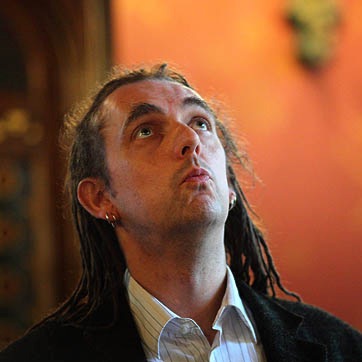
Reality is a tricky thing. Is love real? What about the number 5? This is clearly a job for a philosopher, and James Ladyman is one of the world's acknowledged experts. He and his collaborators have been championing a view known as "structural realism," in which real things are those that reflect true, useful patterns in the underlying reality. We talk about that, but also about a couple of other subjects in the broad area of philosophy of science: the history and current status of materialism/physicalism, and the nature of complex systems. This is a deep one.
Support Mindscape on Patreon or Paypal.
James Ladyman obtained his Ph.D. from the University of Leeds, and is currently a Professor of Philosophy at the University of Bristol. He has worked broadly within the philosophy of science, including issues of realism, empiricism, physicalism, complexity, and information. His book Everything Must Go (co-authored with Don Ross) has become an influential work on the relationship between metaphysics and science.
- Web page
- Everything Must Go
- Academia.edu page
- PhilPeople profile
- Conversation with Raymond Tallis
- Structural Realism at the Stanford Encyclopedia of Philosophy
Click to Show Episode Transcript
0:00:00 Sean Carroll: Hello everyone, and welcome to the Mindscape Podcast, I'm your host, Sean Carroll and today we're going to talk about reality. We like to think that almost all episodes of Mindscape talk about reality in one way or another, but today we're gonna dig a little bit more deeply into what it means for something to be real. You know what that means. We're gonna be talking philosophy as well as science. Some things you just know are real, tables and chairs being classic examples of things you know are real, but we could even question them. But there's other categories where the issue is less clear. Are morals real? Is the ability to make free choices and to have free will real in the world? What about numbers? What about a perfect sphere and other mathematical structures? Are they real in the same way? So today's guest is James Ladyman, who is a philosopher whose work is distinguished by insisting that philosophy, metaphysics, ontology and so forth, had better be informed by our best current scientific knowledge. Everyone agrees with this as a sort of cliche, but James really tries to make it real in his philosophy.
0:01:05 SC: And one of the issues that comes up when you try to do that as a metaphysicist, metaphysician they say, sorry about that, is one of the things about science is that it keeps changing our idea of what is really real, right? Aristotle had some idea of what reality is, Newton had a different idea, Einstein had a different idea, Schrodinger had yet a different idea. How can you hope to have any purchase on the idea of what is real, if the scientific stuff of which the world is made, keeps changing as our understanding improves? So James has championed an idea called structural realism. That is the patterns, the structures that relate different things in the world that really matter that are real, not the actual stuff out of which it's made. Maybe some day we'll understand what that stuff is perfectly, but the patterns between different objects remain in good shape, even as you make a transition from Newtonian physics to relativity and so forth.
0:02:01 SC: There are very plausibly down-to-earth consequences of a view like this. One of the other things that James has been working on is the idea of complexity and complex structures and whether there is something truly new that comes into being when simple pieces come together to form something complex. This is an issue of obvious philosophical relevance, but it's also very important for computer science, for biology, for physics and so forth. Now I'll be honest, this is a mind-bending episode, no doubt about it. So, put your thinking caps on and let's go.
[music]
0:02:50 SC: James Ladyman, welcome to the Mindscape podcast.
0:02:52 James Ladyman: Thank you, Sean.
0:02:53 SC: So, just in case we don't get through all of our many topics to discuss, I want to start with some of the big picture questions. So you're an expert on metaphysics and philosophy. So tell me, what is real?
0:03:05 JL: Well, I wanna know what you mean, what is meant by real or do you want an examples of what's real or what things I think are real, that are controversial or what?
0:03:15 SC: So yeah, unless you have some wacky ideas about examples, why don't we give a definition of what it means for something to be real?
0:03:23 JL: In the book I wrote with Don Ross called Every Thing Must Go, we use this idea of Dan Dennett that to be is to be a real pattern.
0:03:32 SC: Okay.
0:03:33 JL: So, that is a putative definition of what's real. And the story there is something like what's real is, what it's necessary to talk about if you want to capture information about the world and in particular, capture a... Want to make predictions and explanations. So on that kind of view, it doesn't make any sense to say, something's real, but by the way, you can't predict or explain anything with it.
0:04:08 SC: Okay, very good.
0:04:11 JL: So if you take that kind of view, you're tying reality to kind of indispensability in a predicted explanatory scheme. The good thing about that way of thinking about things is it gives a unified account of reality between common sense, everyday life, and science. So, for example, let's say the table's real, because I need to talk about it to get by in the world, but I can also say, you know, the Andromeda galaxy is real, because I need to talk about it to systematize the observations I have of the universe. Now, part of the criterion is non-redundancy and information efficiency. So, I'll give you an example. The reason why it's good to talk about the table rather than just the parts of the table is because if I talked about all the parts of the table separately, it would take me much longer to say things and to make predictions than if I just talk about the table as a whole. But the reason for that is 'cause the table hangs together as a whole.
0:05:28 SC: And talking about it as an object serves a purpose.
0:05:31 JL: Talking about it as an object serves a purpose, whereas let's... Don Ross' favorite example is... Or used to be the compound object of my left earlobe, Miles Davis' last solo, the largest elephant in Namibia. You combine those things, and you get no extra purchase on the world than you have by talking about each of them separately. And so for that reason, that wouldn't count as a bonafide object.
0:06:00 SC: Yeah. So those are separately real things.
0:06:02 JL: They're separately real things, but the compound of them is not a real thing.
0:06:05 SC: Okay.
0:06:06 JL: Whereas, the compound of the parts of the table is a real thing because they hang together, but roughly speaking. I mean, but we could put it slightly... Artificially, we could say something like, "Well, in order to track the behavior of the world, I talk about the table because I can move the table from here to there, and all the parts stay together." I can do a kind of dynamics of the table if I was interested in rolling the table across the room or something.
0:06:36 SC: Do we worry that this puts too much emphasis on usefulness to us human beings?
0:06:40 JL: Right. So that's an objection to this. So some people will say, "Look, that's just epistemological. You're just talking about what you need to talk about to keep track of things, and that's not the same thing as what's real." My view would be, yes it is. The whole point of this is to say no. But what we mean by real, what counts as real is what we need to talk about to track the phenomena.
0:07:13 SC: In the sense that the notion of reality is a word that we invented and we're gonna assign to it meanings that are useful to us?
0:07:20 JL: Yeah, or you could say, or you could say well let's just look at uncontentious examples of what's real and try to generalize and abstract a way, a criterion for... Abstract a way... In virtue of why are we calling those things real? And the thought is well, all the uncontentious examples satisfy this criterion and examples that we don't wanna count as real, like the one I just mentioned, of the compound of the earlobe and the solo and the elephant violate the criteria. So, it's doing a reasonable job with paradigmatic examples and therefore is useful for contested examples.
0:08:11 SC: Right. And aren't there people who are little bit more extremist about this and say that even things like tables and chairs aren't real, only the sort of fundamental layer of reality is real?
0:08:20 JL: Right. So there are loads of people who say... You probably know the quote that's attributed to Rutherford I think, "In science there's physics and there's stamp collecting."
0:08:37 SC: Yes, I know it well. A colleague of mine has it on the poster on their door. [chuckle]
0:08:40 JL: Right. So the thought there is something like, "Okay, we wanna distinguish between the stuff which pragmatically we talk about and the really real. I could talk for a while about why I don't think that's the right way to go. But for the moment, I'll just say I understand that view, but I disagree with it.
0:09:03 SC: Well, certainly by those standards you just set, things like tables and chairs do serve this function and we should definitely call them real.
0:09:09 JL: Yeah. I sometimes find that philosophers will say... I mean, a lot of philosophers will say this, right? That "All that's real is that fundamental level or the ultimate building blocks or something." And what I'll say to that is something like this. Look, I am interested in the distinction which we make between unicorns and horses, right? If you tell me all that's really real, the fundamental building blocks, then I'll just say, "Okay, real schmeal" right? What I'm interested in is the distinction that we make in everyday life and in science, between things that we hypothesized but then decide don't exist or that people claim exist, but we think there's no evidence for, and the things that we do think exist, like horses. And that's the distinction I'm interested in, and that's the distinction which I think I've got a good grip on. If you talked to me about some putative fundamental level which nobody has ever found and we don't have, then I'm gonna say, "But that's not the distinction that we're marking with our ordinary talk of reality, according to which, horses are part of reality and unicorns aren't".
0:10:23 SC: But there are... Let's go move on to the more contentious examples. Numbers. Are numbers real?
0:10:32 JL: Good. They're not gonna fit the real patterns account. So we then have to say, okay, the real patterns account is an account of concrete, empirical reality of something. You, as well as numbers, you could talk about courage or abstract...
0:10:56 SC: Love.
0:10:56 JL: Yeah.
0:11:01 SC: You're not gonna tell me love is not real James, come on. [chuckle]
0:11:04 JL: You know the three illusions that human life is based on, Sean?
0:11:07 SC: I don't know those.
0:11:09 JL: The self, free will, and love.
0:11:12 SC: I'm a big fan of all of those illusions. [chuckle]
0:11:17 JL: Real love. No, love is real, but it's not real in the same way that the horses are, I guess. And what we're interested in the book is giving an account of real that's gonna be applicable to the kind of questions that people discuss in the philosophy of science when they ask "Are atoms real?" How can... Are tables real as well as atoms? So, good. So the real patterns account is a partial account and if you want to allow the reality of abstract objects, then the criterion is gonna have to be modified. So I'll say something disjunctive, right? You could either say the real patterns account just is what's real full stop, and all this other stuff is not. Or you can say the real patterns account is a good account of empirical reality, and we have to say something different about abstract stuff. Now, my own view about numbers is that there's something misleading about saying that the number two is real, and there's also something misleading about saying the number two is not real.
0:12:41 SC: I completely agree with that.
[laughter]
0:12:43 SC: Yeah, I get it. Yeah. So you mentioned by the way the book, you mean the book, Everything Must Go with you and Don Ross.
0:12:49 JL: Yeah.
0:12:50 SC: Right. And so, I can imagine in the real patterns account, in some sense, the number five or the concept of love do denote real patterns. They certainly... They do explanatory work, right? If I say I have five apples, people know what that means. It's a meaningful statement.
0:13:06 JL: Right.
0:13:07 SC: But it's... I think I agree with what you're saying, is that the number five doesn't exist in the same sense that a table exists. It doesn't have this physical reality.
0:13:17 JL: Right. I mean, it's not...
0:13:18 SC: Is that a meaningful distinction?
0:13:19 JL: Yeah, definitely. The status of mathematical objects is something that I've thought about for a very long time. It's very close to my heart, and I don't know what the right view is.
0:13:40 SC: Okay.
0:13:42 JL: One thing I do think is... It's less misleading to say something like "There is reality to mathematics." Now, why is that less misleading? I would say, because what that conveys is something like the thought that mathematics is objective and mind independent or something, right?
0:14:08 SC: Right.
0:14:08 JL: That we don't just get... We don't just make it up, and that is my view about mathematics. But there are lots of people who know a lot about mathematics who disagree with that.
0:14:25 SC: Yeah.
0:14:25 JL: I was just talking about this with someone the other evening and they'll be saying, "You know, it's really interesting because I sometimes think, "Oh well, my kind of belief that mathematics is an objective reality that we discover rather than invent is to do with the fact that I went to university to do pure maths and maths was my kind of first intellectual love". But then, there are people who are much more mathematicians than I am, who would say, "No, it's just a formal system. I make up some rules and then I see what follows." That's one of the very interesting things about mathematics is that within the mathematical community, the Platonism is not... Platonism, by which I mean the view that maths has an independent reality or something. Is not the dominant view of mathematicians, and that's quite interesting. I mean, there are these people who devote their lives to studying this subject matter and are quite happy with the idea that it's all invented, or that there isn't a reality to it as opposed to just the playing out of inferences based on it rules. I mean, what people will sometimes call if-thenism is a kinda crude version of this view. You just say, "Well, what follows if?"
0:15:39 SC: I think that makes sense to me. It might be a crude version, but I think... Yeah, it's a set of conditional statements, right?
0:15:45 JL: Right. But then the thing that people always say in reply to that is, "Doesn't there seem to be this sense in which mathematics is built into the world because there's this close connection between the discourse of abstractions and application and reality?" This is a very difficult issue.
0:16:15 SC: Yeah.
[chuckle]
0:16:17 SC: But wait, I think I didn't quite get where you're coming. So I get that for mathematical objects, you're a little bit open. You can see the force of arguments on either side. And where did you come down about love, and courage being real? Accepting that this is us deciding how to decide, define the terms rather than us learning new things about the universe.
0:16:40 JL: I'll come down on love and courage being real. When people ask what's real, they often mean what are the objects and philosophers would say something like "First order quantification" or you know... Well, love isn't an object, but properties can be real too and I think talking about characteristics like that seems to be indispensable in understanding human beings so...
0:17:27 SC: So then, where does that bring you down on free will, being real or not?
0:17:30 JL: Free will, now that's just a difficult one because I never really know what's meant by that. I always say to my students "Free will is always supposed to be problematized by determinism."
0:17:49 SC: Right.
0:17:49 JL: And then people say, and you get all these people saying stuff like, "Oh yeah, so because we have quantum mechanics, we can have free will or something, right? And then I think...
0:17:57 SC: We all believe that's nonsense.
0:17:58 JL: Right. Because then I think alright, that's okay then. Yeah, 'cause my actions are the result of some stochastic event. Right, that doesn't make me free, I want my actions to be caused.
0:18:08 SC: Yeah.
0:18:09 JL: I just want them to be caused by my deliberations, right? So I suppose my view on free will is, and this is something I'm no way an expert on haven't thought nearly enough about and this is really impressionistic and... But I think probably my views might be quite close to humian kind of compatiblism that I think the right thing to say is something like I'm free when I can tell a plausible story about why I did what I did in terms of my deliberations. And I don't need that to be something that's outside the causal structure of reality. I mean, If you wanna tell me some facts about how my deliberations are the result of in the end the physical goings on in my brain, I don't mind, I mean as long as the right thing to say is that I did it because I decided to, rather than someone held a gun to my head. Then it would seem like I was free, but I didn't hear that It's really difficult, but again I think there is so many levels of freedom. So, I freely choose, but I have a habit is that free, I freely choose but I decide very quickly and I'm clicking on something on a web page that's outrageous. That isn't full-blown freedom, I think. So maybe the right thing to say about free will is it's not an all-nothing thing, that there are degrees.
0:19:52 JL: So in this book with Don Ross, Everything Must Go, you defend a view called structural realism. So this is a particular point of view on what counts as real, right? How would you tell us what structural realism is?
0:20:03 JL: Well, structural realism is started out as a view about scientific theories and the reality of the positive scientific theories in the light of the fact that theories change, and that... We've had very good theories, which we now think are not 100% true and we... Wise... We will think that not everything in our current theories is 100% true, and so what we wanna do is have a sensible form of realism about science, by sensible meaning a view that's compatible with the fact of theory change, and the fact that sometimes theory change can be quite radical in respect of the fundamental claims that are made.
0:21:00 JL: So for example, Newtonian physics says there's absolute time. We don't think there's absolute time. It says that that mass is an intrinsic property of objects, we don't think it is. It says that there's instantaneous action at a distance due to gravity. We don't think there is. And yet I would say there's a kind of reality to Newtonian forces. And you know, of course, the great thing about Newtonian gravitation was it made novel predictions. So if we think that novel prediction is the reason why we commit ourselves to what scientific theories say exist, we have to realize that that they can make those predictions whilst not being 100% correct.
0:21:52 JL: Now, the point of structural realism is not to say there's a distinction between structure and nature and we should believe the structure and not the nature, it's just to say, when you look at those cases where we've abandoned theories, what you find is that you've... It's much easier to see the continuity with our current theories at the mathematical or structural level, than it is at the level of the fundamental claims those theories make about reality. And so, there's this...
0:22:24 SC: So what reality is might differ from theory to theory, but there's something that is maintained.
0:22:30 JL: I would say something like... Yeah, what's maintained are the real patterns at some level of approximation. So, we were hearing all about dark matter, and the thing that dark matter is needed for is for compatibility with the emergent correctness of Newton's law of gravitation, right? So even in the light of general relativity, we still think that Newton's law is a low energy limit, that's a real pattern for many practical purposes within a domain up to some degree of accuracy. So, I guess the idea of structural realism in the most basic level is to say, "Well, look, if you loosen up a bit about about reality, you can understand how our theories can be getting things right, without getting everything 100% right." And the way I put it is, in terms of the theory's capturing the causal structure of the world, that the law-like structure the world... Philosophers... I would say the modal structure of the world, but that's not a word that many people use.
0:23:46 SC: How would you define it?
0:23:49 JL: Relations of necessity and possibility between events.
0:23:53 SC: So what is necessary, what is possible, what is not possible.
0:23:55 SC: What is necessary, what is possible, and what follows. And Newtonian mechanics is gonna be just as good at predicting the return of comets as it was in the 17th and 18th centuries.
0:24:11 SC: Yeah.
0:24:14 JL: Does that help?
0:24:15 SC: Yeah, no, well it helps, but it leaves me with this question, because I get the usefulness or the attractiveness of structural realism to help us maintain belief that older theories that have since been superseded, nevertheless captured some aspect of reality. And it's the structures, that it were, being captured. But is it just the structures? Is that really all there is to reality? The relations between different things, or is there something or set of things, even if we don't know what that set is, that we would label as real things?
0:24:48 JL: Right. You see, if you take the real patterns view, then things are kind of ways of describing the structure, and if there are no patterns, there's no point in talking about the thing. So it's kind of like the pattern is primary, the thing is the way of identifying the pattern, the way of just talking about it. One of the thoughts of structural realism is that we have this object property way of thinking. But our physical theories are not just our physical theories now. Many theories, theories in economics, theories in mathematical biology aren't really easily translatable into object property talk. And one of the thoughts behind structural realism is, or at least the way I think about structural realism, and I think Don does, and I think David Wallace thinks this way, is kind of mathematical representation is primary and we shouldn't expect that we can translate our best theories without residue out of that mathematical representation.
0:26:10 SC: Would we go so far... It seems like we're talking about relations, but are reluctant to say that there exists the things that are being related by these relations. You see where my issue comes in?
0:26:24 JL: Yeah. I suppose I think of... You can't talk about relations without talking about things that are related. There's a kind of logical point, but whenever you talk about any actual cases we have of things, we find that when you investigate them a bit further, they are collections of relations among other things, right?
0:26:53 SC: Relations all the way down.
0:26:55 JL: Well, at least maybe.
0:27:00 SC: Maybe.
0:27:01 JL: And if maybe, then don't assume not.
0:27:05 SC: Yeah, okay, it's motley possible.
0:27:08 JL: Epistemically possible. Yeah, for all we know. I guess what we come up against a lot in science and philosophy is that there are sort of unknown limits of our cognition and the way we conceptualize the world. To what extent are our theories based on how the world is and to what extent are they based on how we have to think about things. That probably, like the kind of... I don't if I'm right to say this, but I would say... Stick my neck out and say that maybe the basic insight we get from Kant is that there's the possibility that the way that we conceptualize things conditions our representations and that plays a role to some extent, as well as how things are, how the world is.
0:28:11 JL: So we can't escape our own cognition and say, "Well, suppose I wasn't this contingent being that has evolved this limited way of thinking about things, how would I think then?" Well, I just can't. I am this contingent being who has these ways of thinking.
0:28:30 SC: Not a meaningful counterfactual?
0:28:32 SC: No, but it is worth recognizing. Given that we've reached the level of sophistication we have, we can now see that maybe we are in that situation. Maybe our cognition isn't apt to describe the fundamental nature of reality as it is in itself or something, and therefore, I think a degree of kind of hedging and agnosticism is appropriate here.
0:29:13 SC: Yeah, okay. And this whole field, this area in which these conversations take place, is metaphysics, right?
0:29:21 JL: Yeah. Philosophy in...
0:29:21 SC: That's how we label it?
0:29:23 JL: Philosophy of science. But I think the conversations take place within science itself.
0:29:29 SC: Okay. Well, in fact, that's what I was going to lean in toward because in your book, you sort of talk about scientific metaphysics and...
0:29:35 JL: Yeah. Well, our book's called... The subtitle of our book is Metaphysics Naturalized.
0:29:38 SC: Right. And you give a hard time the conventional what we call, analytic metaphysics.
0:29:43 JL: Yeah, which is not... Which is a fairly recent phenomenon in the way that it's currently done, I guess.
0:29:54 SC: Can you just, for background purposes, explain a little bit the way it's currently done and what you're reacting against?
0:30:00 JL: Yeah. So what we react against is two things, at least. One is a priori kind of first philosophy approaches that say, "I don't need to know about science. I'll just think about the fundamental nature of reality using from the armchair without scientific knowledge." For example, you get debates in metaphysics about what would it... In virtue of what does some parts form a whole? Now, I would say, "Well, it depends what you're talking about. In virtue of what do cells form an organism?" Well, the specific nature of the interactions and relationships between them that aren't generic, aren't knowable a priori. In virtue of what do...
0:30:54 SC: If you have never have met an organism or a cell, you would not be able to say why cells form an organism?
0:31:00 JL: Right. And if you don't know physics, you can't say in virtue of what the atoms form the table, right?
0:31:06 SC: Right.
0:31:07 JL: There are specific to those things, how they interact. One of the themes there is that... We point out that in science, composition is dynamical. It's not a static thing, right? So there's a kind of image that I have all these parts and then they are a whole for some reason or other, whereas in science I know these parts are a whole because of how they're interacting. Often what we talk about is interactions that are taking place in a very short time and length scales, relative to the scale we're interested in. And so, it can seem like there are just these parts, but they're actually... The table is a dynamical entity, right? Yeah. So that's an example of kind of the way you can get into thinking about reality if you don't pay attention to science, you just think a priori. Another thing that we object to is the imposing of the manifest image on the scientific image. So for example, a kind of view of building blocks or little particles bumping into each other, which we would regard as just completely outdated in the light of physics. Another thing, we...
0:32:30 SC: Because of quantum mechanics and quantum field theory.
0:32:32 JL: Because of quantum mechanics and even before that with field theory or whatever. But we call that the domestication of science. So we say that one thing is ignore science completely. Another thing is take science, and then distort it so it fits your commonsense way of thinking about things and then kind of pretend that you're talking about the scientific objects, but you're not really because you're not talking about them as they are.
0:32:57 SC: Right.
0:32:58 JL: And... I guess... We have a positive conception of metaphysics, which is one that I think scientists engage in, whether or not they would call it metaphysics. So this is why I don't think this is just a philosophical game or activity. I think people do it all the time. So for example, you wrote a book about it, right? What can we say about the whole of reality? In the light of our knowledge of physics, how does reality at the macroscopic level relate to the microscopic level? How does biology relate to chemistry, relate to physics? What we say is naturalized metaphysics is the attempt to say something about the world as a whole in the light of all the science that we have. And another way of putting that is to say something like naturalized metaphysics is about saying how science as a whole hangs together. It's about the unification of science, I guess.
0:34:09 SC: So it can't be... See, it sounds like you're arguing that metaphysics can't really be prior to science because until we've learned things about how the world works, we have no hope of just a priori coming up with these relations. But it still adds something to science 'cause it talks about things that cross scientific disciplines or transcend them?
0:34:27 JL: Right. And I think the ultimate test is it needs to contribute, actually. And this may be unrealistic and ridiculously ambitious, but I think when we wrote our book, we were saying, "Look, this should actually help scientists who are interested in how the world is, and it should play some kind of role. And if it doesn't, we should stop talking about it." But we didn't set a time limit on that.
0:34:53 SC: Okay, that's very clever of us.
[laughter]
0:34:57 JL: But you often get scientists actually making metaphysical claims. So I give an example. Sir Paul Nurse, who was the President of the Royal Society, came and gave a talk in Bristol. He talked about the five most important ideas in biology, and one of them he said was biological processes are physical/chemical processes. His example was the discovery that the fermentation of yeast is oxidation. That this is a way of unifying biology with chemistry. It's a way of understanding biological processes as nothing... No special added ingredient, no extra mystery. Just a very complicated emergent phenomenon that is ultimately resulting from chemical, physical processes. Now, that's a metaphysical claim.
0:35:53 SC: Yeah.
0:35:55 JL: But he didn't come to give a metaphysics talk. He came to tell everyone about biology, and he would regard that as a biological discovery. I would say this is not really a... Not a tool, but my idea... David Papineau, I guess, was the person who I learned this from, chronicled how physicalism is a view about the mind, and more generally was a contingent empirical discovery. There was no reason to think it had to be true a priori. So in the 19th century, people wondered, "Are there special physiological forces? Are there special chemical forces?"
0:36:38 SC: Right.
0:36:39 JL: Right now, there's nothing crazy about that. I mean, a priori, maybe. It just turned out that there was no need to posit such things. We now understand chemistry in terms of predominately electromagnetism. So, if you're wanting to do justice to what's been learned in the history of science, then you need to say, "Well, we've learned this metaphysical thing which is about the relationship between chemistry and physics," and that is all by way of exemplifying why it's not true that metaphysics is this other thing, compared to science, it is sort of connect... It's connected to first order scientific practice. Not everybody's scientific practice. Lots of scientists don't have to care about these issues at all, but every now and again, they're really crucial and some scientists think about them a lot and don't separate thinking about them from being scientists.
0:37:50 SC: So I was very interested at a poster session last night, we're here, for those of you in podcast land, at a meeting of the Philosophy of Science Association, and there is a poster by a guy who had surveyed philosophers of science, among other things, on the question of what was the biggest challenge. What was the biggest flaw in their field right now, and there were two big things that people held out as big flaws. One was not enough engagement with science and one was not enough engagement with philosophy, apparently because they thought that as philosophers of science, they were isolated within their philosophy departments. So how do you think, I mean, I think you just said a little bit about how you think the relationship should go, how do you think the relationship between philosophy and science and philosophy of science does go right now in practice? And then, do you see it changing?
0:38:44 JL: Very good question. How it is for me is that I spend more time engaging with scientists, I think, than I do philosophers and I...
0:38:58 SC: There you go.
0:38:58 JL: I brought up that philosophers who aren't philosophers of science. And so I would say in my field as well, I mean I think, in philosophy of physics, which is the main area that I work on, as well as kind of general philosophy of science. The engagement is very close and I think it's very healthy, I see it is probably going in the right direction as well. I think that more and more physicists are realizing that philosophists of physics know what they're talking about, and they're not doing kind of philos... Not thinking about physics from a distance. A lot of the young people are exceptionally good and really knowledgeable about the physics, I mean some of them have got two PhDs. It's not that unusual that they have a PhD in Physics and a PhD in philosophy.
0:39:49 SC: Right.
0:39:51 JL: I think intellectual standards and the level of engagement is very high. Now, of course one still finds the odd physicists who thinks that philosophers are idiots who don't know anything about physics, but you... In my own institution, I've written papers with physicists, I teach in the physics department as well as in the philosophy department. I have very good relations. We have a lots of joint Honors students. So really the interaction is strong and I don't think I'm that unusual in that respect.
0:40:24 SC: Do you think that's a change over the recent years, are the barriers coming down or were they just less high than I thought?
0:40:30 JL: I think the barrier has come down a bit. I mean I think when I was learning my subject, it was true then, that the philosophers of physics, people like Michael Redhead and Jeremy Butterfield and Nancy Cartwright were very knowledgeable about physics.
0:40:48 SC: Right.
0:40:48 JL: And I think you can look back now on some of their work in the foundations of quantum mechanics and say this was absolutely top-notch by anyone's standards. So I guess I'm lucky that I absorbed that culture early on. I think that, I mean the point about how philosophy of science relates to the rest of philosophy, it depends what part of philosophy you're talking about. I mean, I go to seminars in my department on asset ethics and aesthetics and I'm interested in general philosophy. But where I'm less keen on the pure philosophy is where I think science bears on it, but people are doing it in ignorance of science. And I... In those kinds of areas I'm sympathetic to this quote that we have in our book from the philosopher Quine who said, "Philosophy of science is philosophy enough."
0:41:43 SC: Oh, I had not heard that quote. [chuckle] I must have missed it.
0:41:45 JL: I think what he was saying... I mean, I think so for example, if you take epistemology. Epistemology is about knowledge, about justification. Well in philosophy of science, we have people who study Bayesianism, and confirmation theory, and statistical methods of inference, and so on. And you know, I think really the idea of doing epistemology and not engaging with that kind of work is a bit odd. And likewise with philosophy of mind, I think come on, you've gotta look at cognitive science. Why would you...
0:42:24 SC: Sure.
0:42:24 JL: Why would you wanna do philosophy of mind without knowing about the science of the mind?
0:42:28 SC: How the mind works, yeah.
0:42:29 JL: And if you think about the history of philosophy, I don't think... Many of the great philosophers were also great scientists. Some of them spent more time doing science than they did philosophy. I mean, Aristotle would be an example. So I think if you reincarnated Aristotle or Kant or Descartes or Leibniz, they would be... They would... The last things on their reading list would be pure philosophy, right? Or they would be wanting to catch up with the scientific knowledge which has developed in the last hundreds of years since they were alive. That would... They would be super excited.
0:43:11 SC: Right. I thought that Philosophy of Science and this is not quite what Quine said, but related. That philosophy of science should be or could be a paradigm for the rest of the philosophy in the sense that if there's any one thing that we should be able to understand at this fundamental level, it's science.
0:43:29 JL: Right.
0:43:29 SC: Like science is in some sense so much easier than aesthetics or ethics, right? If we can't get physics figured out...
0:43:33 JL: Well that's why I often say that ethics is... Political philosophy's much too hard for me. I'd much rather try and learn quantum field theory than that. [chuckle] But it's funny when people talk about science as if it was this thing, right? Whereas, it's kind of everything, right? I mean, what is science? Well, that includes anthropology and it includes economics and includes biology and it includes cosmology. It's the study of the world.
0:44:03 SC: Right.
0:44:03 JL: Right? Now, what's philosophy? Well, it's the attempt to understand the world, isn't it? So, how could you really not do philosophy of science? I mean, what, it doesn't really make much sense to me.
0:44:18 SC: Well good, we're all on the same side then.
[chuckle]
0:44:20 SC: Speaking of which though, to shift topics a little bit, but I think there is continuity here. You have a book in preparation on complex systems, which might be an area of science and physics, but also many other sciences are related to it, which is growing in popularity, but perhaps under-philosophized. Is that fair to say?
0:44:42 JL: Yeah. Lucky for me, it's under-philosophized because Karoline Wiesner, with whom I've written this book, and I wrote a paper a few years ago called "What is a complex system?" and it came out in 2013 and it's got a lot of citations. And I think part of the reason is because they're just aren't that many papers on that topic. But I'd like to think...
0:45:03 SC: You'd like to think it's because...
0:45:05 JL: I'd like to think it's because it's such a brilliant paper, but I think at least part of the explanation is that there's a... People are crying out for papers like that because they wanna think about complexity and complex systems and understand it. Yeah, that is an area that has been looked at by plenty of other philosophers of science other than myself though. So, there's lots of other work out there. One can think of people... Early papers in philosophy of science by Herbert Simon way back on complex systems, more recent work by people like Bill Bechtel and Michael Strevens, and other people have worked on it. But it's a great area because it's the area of science that's, I guess, giving us most understanding of emergence, and emergence is precisely the name for whatever goes on when we have biology, as well as chemistry, as well as physics. So that's exactly what the topic we were talking about, how does science, as a whole, relate? How do we get higher level structure out of the basics?
0:46:37 SC: I like that definition of emergence. I never heard that one before. The thing that you need to explain a world where you get biology and chemistry, as well as physics.
0:46:44 JL: Yeah.
0:46:47 SC: It's a contentious word, right? There's weak emergence and strong emergence and...
0:46:50 JL: Oh don't now... The problem with the philosophical lecture on the topic is that probably not a month goes by without somebody doesn't come up with the new taxonomy of different kinds of emergence.
0:47:00 SC: Right. When I wrote The Big Picture, I was warned by some philosophers, but even more sociologists "Don't call it emergence 'cause it means, in some subfield, exactly the opposite of what you wanted to mean." There's a form of emergence that I like and try to promulgate, where you have some microscopic understanding. But then there are ways of looking at the system from afar where you see a different kind of behavior that you might not have noticed, but it's still implied by the microscopic behavior. And then there's this entirely different notion of emergence where the microscopic behavior just doesn't entail the macroscopic behavior and it's certainly stronger than that.
0:47:39 JL: Yeah, that's right. So some conceptions of emergence, there's some extra magic ingredient that appears or something. I don't know how to make sense of that. The way that I've thought about emergence since working on complex systems is exemplified, I guess, by how ant colonies work. No overall controller, but incredible emergence in the sense that the ants can build bridges and not only that. They can decide whether it's more efficient to build a bridge or go the long way round, right?
0:48:28 SC: Right.
0:48:31 JL: They consider "Well if we go the long way round, that's gonna tie up the ants who are traveling. But if we build a bridge, it's gonna tie up ants in being part of the bridge and there's gonna be a trade-off there," and they optimize pretty well.
0:48:45 SC: And yet no single ant is asking itself these questions?
0:48:47 JL: No single... Of course, when I say the ants, no ant is asking itself that question. So the interesting thing is, how does this arise then? And the answer is, it arises through interaction and feedback between individual ants. And that's the thing you've got to understand if you want to understand emergence and this of course goes back to Anderson and More Is Different, the importance of interactions among the parts of a system in giving rise the behavior of a whole... And feedback I think... More and more, I think, now feedback is key. And in the case of human beings, I think we really wanna think hard about the feedback between ourselves and the technology that we've made in the form of smartphones, say. Where you look and think 10 years ago, people didn't do everything on smartphones, right? Now, they kind of do. Why is that feedback basically?
0:49:52 SC: And so, potentially new kinds of emerging behavior might be emerging?
0:49:57 JL: Right, which we're seeing. Yeah. And you know, feedback is the basis of our cognition anyway, right? Because the way that we become conscious, self-conscious, normal, let's say minds is by interacting with each other. If you have a human being who doesn't interact with any other human beings, then they will not be able to learn language, they won't have many of the aspects which we say are essential to human beings. So, what that means is that it's essential to our natures that we develop in interaction. And what worries me quite a lot is, "Okay, so what's gonna happen if that interaction is with technology? What's gonna happen if that interaction is with an AI system or robot?"
0:50:58 SC: Then we become something different, you mean?
0:51:00 JL: Yeah.
0:51:01 SC: Yeah. And so, is this providing a partial or complete answer to the question raised by the title of your new book? What is a complex system? Is it all about feedback and emergence from constituent parts?
0:51:11 JL: Yeah. So what we say really is... You know sometimes the right answer isn't terribly exciting and it's the kind of boring answer, right? And I think that's actually often true. The right answer is "Well, there are different kinds of complex system and they have different features. Not all of them have all the features."
0:51:35 SC: What are your favorite features that make up a complex system?
0:51:41 JL: Nested structure, robustness of behavioral structure, modularity, so that means something like the division of labor, division of function. And also your new kinds of invariants and universality that come about when you modeled systems as networks or you model them as information processing systems.
0:52:10 SC: So is this...
0:52:11 JL: Those are some of the examples.
0:52:12 SC: Is the aspiration that this would be a useful contribution of scientific metaphysics because we're noticing regularities or universalities between very different kinds of systems?
0:52:23 JL: Yeah. And the book is not a book primarily for philosophers. I wrote it with Karoline Wiesner, as I said, she's a mathematician. We started working together when Bristol opened the Center for Complexity Sciences. I had a graduate program and they wanted to have a component in that program that just asked the question, "What is complexity?" The graduates were a heterogeneous bunch. Some of them were working on cells, some of them were working on the economy, some of them were working on social structures or one kind another, ants, and all sorts of things. And right from the beginning, we were asking the question "What is complexity? Is there a single thing? Is this... " One kind of cynical view, is something like, "There's no such thing as complexity, it's just a buzzword that people use to get grants." Because for a period, it really was a very big buzzword, as I'm sure you know.
0:53:17 SC: Yeah, yeah. [chuckle]
0:53:18 JL: And the view that we've ended up taking is a kind of middle view. Yeah, there is a kind of distinctive phenomena here, but there isn't a single thing called complexity. And one of the things we do in the book is we discuss the different measures of complexity that have been proposed in the literature, of which there were many.
0:53:37 SC: I proposed one.
0:53:38 JL: Okay. [chuckle]
0:53:39 SC: It's not in your book I'm sure, but...
0:53:43 JL: It might be... Maybe it's not, no. But what we say, basically, is that each of these measures is measuring a feature of a complex system and it's not measuring complexities per se, but... Let me give you an example. Some of the measures, clearly what they really measure is order of one kind or another, right?
0:54:05 SC: Exactly.
0:54:05 JL: Now, order could have been produced by a central controller and that's not what we associate with complex systems. The measure itself can't tell you whether the order that you've got where it came from. It just tells you how much order there is. So for example, you can imagine a string of digits. You can calculate what's the order. What kind of correlations are there are? And at what length scales in that string for example. But it doesn't tell you where that string came from. But if you know that that came from a complex system, then it's a kind of proxy measure for the complexity of that system, but it's not measuring complexity as such. It's measuring order produced by a complex system.
0:54:47 SC: So, what definition of complexity is this? Does this have a name? I know that Jim Crutchfield for example, likes to always stop people when they measure complexity and says, "Which measure of complexity are you using?"
0:54:58 JL: Right. So what we're saying is each of the measures of complexity is measuring a feature of complex systems, and that's why there are lots of different measures. So you don't have to choose, because if what you're measuring is something like the... How cliquey is the network, for example. You may wanna measure that in terms of the kind of average connectivity of nodes or something, or the degree of clustering of nodes, or whatever. There are perfect... There are good useful measures of such things. But if you were studying a different aspect of a complex system, you'd be using a different measure. So you might, for example, have a measure of the robustness of the system. So, what we're saying is there are different features that complex systems have, and there are measures of those features. There's no one true measure of complexity.
0:55:50 SC: And are there or should we hope to find laws of complex systems, like we find laws of thermodynamics or arguably even in biology?
0:56:00 JL: I think you get things like power laws that turn up in different places and you can associate those with complexity. But I don't think we're gonna have something like a law of all complex systems. No, I don't think that... That doesn't make a lot of sense, I think.
0:56:19 SC: Well we had... Our symposium that brought us here, we talked about the notion of fundamentality, which is sort of on the opposite side of complexity in some sense maybe. And you brought up an interesting issue that in some sense we talk about the standard model of particle physics as being very fundamental, it talks about elementary particles, and so forth. But in a very different sense, we talk about Darwinian evolution, natural selection, as also fundamental. But the words fundamental clearly means something very, very different in those two cases. One means that it microscopically describes everything around us. The other is it would still hold true if the microscopic description of everything around us was utterly different. So, there's some robustness that extends across possible worlds we could live in. So I guess what I'm getting at for the complex systems, could there be Darwin-like behavior that you say "Once you have a system satisfying these criteria, we can have certain expectations about how it might behave?"
0:57:19 JL: Good. In answer to that, I would say yes, there could be. So for example, that might be... I guess you could say... Well, some of the laws in biology, like the Price equation or something, are just that, right? They're emergent laws that apply to complex living systems. So yes, there could be, in that sense, yes, there could be. But I don't know... I wouldn't say they'd apply to all complex systems, because on our kind of quite liberal view...
0:57:56 SC: Yeah, it's a lot of things.
0:57:58 JL: A condensed matter system is a complex system, and so, too, is the internet, and so, too, is the economy.
0:58:06 SC: Good. And so I've learned also last night that you're finishing up another book, this one on materialism, is that right?
0:58:13 JL: That's with Robin Brown, yeah.
0:58:14 SC: And this is materialism in the sense of the world is made of matter, or not of supernatural forces, it's not about, "You're greedy, and you wanna go shopping, 'cause you like money"?
0:58:24 JL: Right. Yeah. Lots of philosophers would call it physicalism these days, but we talk about materialism, just 'cause we think that the kind of reader that we want to engage with the book won't know what we mean if we say physicalism. I think for your listeners...
0:58:40 SC: Whereas they would think they know what you mean if you said materialism. [chuckle]
0:58:43 JL: Right. Well, they might think they're interested in materialism, and then they might wanna know more about it, whereas if you say physicalism, they might just think, "What?" I mean, for your listeners, to clarify, physicalism is just what we say in the light of the fact that the kind of classical early modern conception of matter is not really apt for contemporary physics. But one of the things that Robin and I wrote about in a paper from some years ago was that there's a kind of negative side to materialism and a positive side to materialism. And the positive side is some claim about, "All there is is the physical," or, "Everything somehow is ultimately physical," or, "Everything emerges from the physical," or what... There's lots of different versions of it. But the negative side is in no supernatural stuff, I guess. And what we're interested in doing is chronicling the history of those ideas and also the way that materialists have been slandered and persecuted, I guess.
[chuckle]
0:59:57 JL: And often people will say things like, "Oh, well, if you're a materialist, then you must have no morality," or... Yeah, as you said, "If you're a materialist, then you must only be motivated to pursue base pleasures," or something, and that's obviously not correct. And actually, one of the things that I've written about elsewhere is that people often say, "Oh, scientism is this terrible view that takes away all the magic from human beings, and therefore, somehow, it is rightly associated with not caring about them." And I just point out that if you look at the history, you find that the more that we've naturalized our understanding of human beings, the more we've been inclined to treat people humanely.
1:01:03 JL: So for example, if I don't know anything about medicine, I might think that my elderly relative has suddenly become a horrible person, but when I understand dementia, then I'm now... I mean, no necessary connection, but just actually correlates with treating the person more humanely, because you realize, "No, they've got a degenerative brain disease, it's not their fault that they're now being really grumpy and angry a lot." Another example might be autistic children, where an old-fashioned view would be something like, "Oh, this kid is clearly just a crazy kid." And a more humane view is, "No, this child is developing differently from how some other children develop." Actually, I wouldn't say it's not normal, because it's part of the normal spectrum of human behaviors and they have lots of different kind of variations among human beings and it's normal that some people are on the autistic spectrum, but if you've got someone who's quite... A young child who is quite extreme on the autistic spectrum they may produce behavior which you otherwise would just think they're just a horrible kid.
1:02:19 JL: Once you understand that they're autistic, you say, "Oh, this child is having difficulty understanding what's going on. We need to communicate with them in special ways and when we do that we're able to help them develop and be happy and interact with them better, and so on." So you could take other examples, schizophrenia, they're not possessed by the devil. It's okay, right?
1:02:43 SC: Yeah.
1:02:43 JL: So I think that the kind of materialistic, naturalistic way of understanding human beings actually correlates with more humane treatments of what we might call a typical human psychology and behavior.
1:03:01 SC: I think this is a... It's a fascinating claim and partly because on the one hand I'm inclined to agree, and my anecdotal experience aligns up with this, that in some sense, for example, in situations where people are dying, I've found that atheists and naturalists tend to deal with it better than religious people sometimes. But on the other hand, I also recognize I have a huge cognitive bias in this particular area 'cause that's what I think, and I wanna think that people like me are better equipped to handle these things. So it'd be interesting to study in some rigorous quantitative way, whether the connection between materialism or physicalism or naturalism, and humane treatment about the human beings is in fact causal and a real connection or it's just a coincidence.
1:03:52 JL: Yeah, I'm not making that strong a claim. I think that I'm just making the weaker claim that there's no necessary connection whatsoever, between a kind of naturalistic view of human beings and a cold clinical attitude to human beings.
1:04:05 SC: Yeah.
1:04:05 JL: Right? That's really the point. I'm not making the claim that naturalists are nicer people than religious people. In fact, there's a lot of evidence that pro-social behavior correlates strongly with religious...
1:04:19 SC: That's true.
1:04:19 JL: Religious belief. Lots of the very best... We often, maybe those of us who aren't religious may forget that actually a lot of the really important charity work that's done in this world is done by people with very strong religious commitment, and I respect people's religious faith and I don't think that people who believe in God idiots or irrational or anything, but I'm just saying that it's wrong to think that if you're a naturalist or a materialist that means that you think that human life doesn't matter or that you are going to somehow be cold and disregarding of human beings.
1:05:11 SC: And is your book mostly about the intellectual history of materialism? You said you were doing a lot of work on how people with these views were treated, and so forth.
1:05:20 JL: Right. So yeah, it's a bit historical and a bit about what would a viable contemporary form of physicalism look like.
1:05:30 SC: And do you think... I've felt myself, and again, but I know that I have a bias, so I'm trying to be careful. On the one hand, the fraction of people who are atheists, naturalists, materialists, physicalists seems to be increasing with time, but our popular social discourse hasn't caught up in some way, right? We still treat atheists as a little scary on TV or something like that.
1:06:00 JL: Yeah, you could look at it this way, if you don't believe in anything supernatural, then that means each of us have got this life and nothing else, and that makes it more important, right? If I've potentially got the afterlife, then not such a big deal if it doesn't go well for me here, right? But if this is it, and let's not talk about me, let's talk about some child that's born in poverty and destitution, right? That if you think that kid has only got this one life, then it matters a hell of a lot that their life options are so curtailed and their life is full of so much suffering and lack of opportunity. You know, if you tell yourself, "Well, yeah, but don't worry because they're virtuous. God will make up for it later," you might, you might be less motivated to do something about it. Now, you might not be, but you might be.
1:07:09 SC: Well, to slightly misuse a phrase, you are preaching to the converted on this one. I'm very much in agreement. All right, James Ladyman, thanks so much for being on the podcast.
1:07:17 JL: Thanks. It was my pleasure. Thank you very much.
[music]
Are real things only those which can be described (communicated?) What if we are dealing with an (apparently*) delusional person who denies the existence of said chair? Is it real nonetheless their objections to it?
I tend to take a maximalist view of these things: All logically consistent propositions are “real,” though not necessarily true (comporting with external reality). The more people subscribe to a set of said propositions, the more “real” it becomes, so that we can speak of apparently abstract entities like cultures AS IF they are independent of the minds that adhere to them (strong emergence, but a monism in that all this arises from underlying physical phenomena). This would then account for those who may be cognitively different that the norm, may not subscribe to a scientific worldview, etc.
Is materialism sufficient to account for our inner consciousness and self awareness which is expressed outwardly through words? Human complex biological systems consist exclusively of inanimate elements mostly arranged around carbon. Yet carbon speaks. The answer to this mystery may be a prerequisite to eventually determining what is real in this world. Without it, we may be fumbling around in a dark room for a very long time.
The definition of ‘real’ in the dictionary is quite complex. Are we not, in some sense, arguing about what that definition comprehends (when we’re allowed to apply the word) and not whether mathematical objects, quantum fields, and tables share some essential feature that puts them all into that definition?
Overall great content! Still, some areas you could have probed more deeply: (1) What is a pattern and what isn’t? (2) What is a concept? (3) What is the ontological status and role of representation? (4) Can new concepts / representations instantiate real things? (5) Why the primacy of language? (6) Why think that “real” refers to one internally coherent set of objects as opposed to a union of several sets whose objects are real in different ways? (7) Why focus on what’s “really real” in the first place, instead of just the relations of different types of reality i.e. some kind of grounding mishmash, per Schaffer and… Aristotle? (8) Doesn’t this make reality rather parochial and limited? What reality would totally inhuman consciousness have? Multiple realities? (9) Ethics, please? (10) Generally, the return to pragmatism? (11) What happens to model epistemology now?
> 0:26:53 SC: Relations all the way down.
This is the concept of reality in Buddhist philosophy, also called dependent origination. The ’emptiness’ in Buddhism means that objects themselves don’t have substance. Just like father and son can’t exist independently. Buddhist philosophy take this to extreme. Everything exists like this.
This was one of the few discussions with a philosopher I’ve enjoyed. How sensible he was. One small note of disappointment, though, was when he said something like that he had no problem with religious people. That is kind of an odd attitude for someone interested in what’s real, and it reflects the common (but wrong) idea that a person’s religion is their own business — people vote, have too many children, make wars… based on (bugus) religious beliefs, and it screws things up for everyone.
Thank you both, though, for your excellent interview.