
Einstein's theory of general relativity has been our best understanding of gravity for over a century, withstanding a variety of experimental challenges of ever-increasing precision. But we have to be open to the possibility that general relativity -- even at the classical level, aside from any questions of quantum gravity -- isn't the right theory of gravity. Such speculation is motivated by cosmology, where we have a good model of the universe but one with a number of loose ends. Claudia de Rham has been a leader in exploring how gravity could be modified in cosmologically interesting ways, and we discuss the current state of the art as well as future prospects.
Support Mindscape on Patreon.
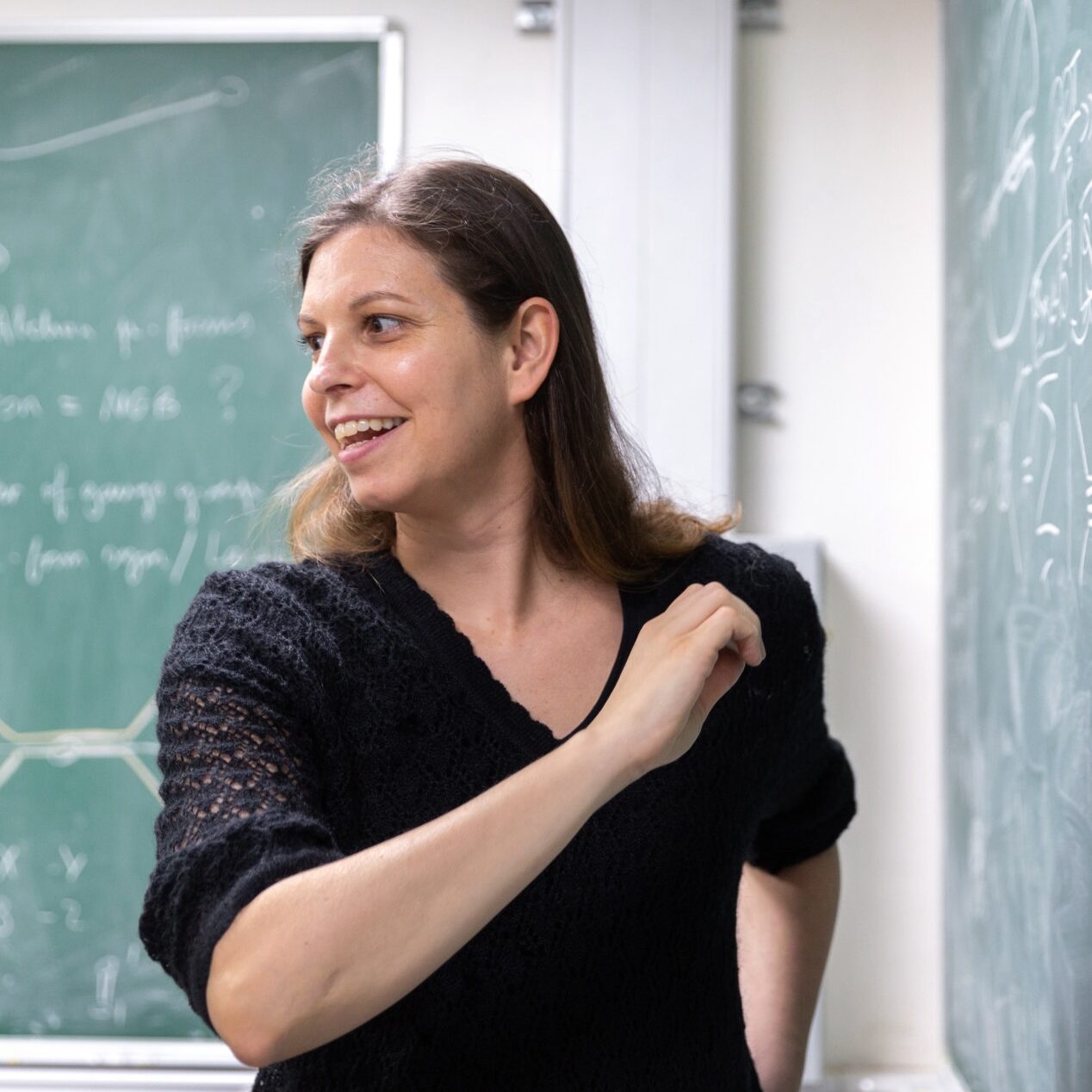
Claudia de Rham received her Ph.D. in physics from the University of Cambridge. She is currently a professor of physics and deputy department head at Imperial College, London. She is a Simons Foundation Investigator, winner of the Blavatnik Award, and a member of the American Academy of Arts and Sciences. Her new book is The Beauty of Falling: A Life in Pursuit of Gravity.
Click to Show Episode Transcript
0:00:00.3 Sean Carroll: Hello, everyone, and welcome to The Mindscape Podcast. I'm your host, Sean Carroll. There's a talk that I sometimes give, I've been giving for the last year and a half, I'm sure you can find versions of it online. It's related to Volume I of The Biggest Ideas in the Universe, where I go through classical mechanics, space-time, all the way up to general relativity, Einstein's theory of gravity. So, in the talk, I have the high aspiration of, in one hour, explaining to you Einstein's equation in all of its specific real glory, the real equation, r mu nu minus 1/2 rg mu nu equals 8pi gt mu nu. Not just e equals mc squared. That's easy enough, everyone can understand that.
0:00:39.6 SC: And one of the themes of this talk that I give is the equations are smarter than we are. This is why I think it's worth the effort in a book like The Biggest Ideas series of talking about the equations. Not that it's the only way to talk about physics, et cetera. Just 'cause I have some equations in my recent book doesn't mean that I'm suddenly looking down upon people who don't have equations in their books. I think that all different levels, all of different approaches, are interesting and important, but one of those interesting ones is the equation-based one. And the reason why is because, as I said, the equations seem to capture more than we put into them. I mean, Einstein was a smart guy, but his equation implied things that had never occurred to Einstein himself, from the expansion of the universe to gravitational waves to black holes, right? They're right there, implied in solutions of the equations, but Einstein himself didn't come up with these ideas.
0:01:40.2 SC: And so, it's therefore kind of interesting to imagine changing a theory like general relativity. Einstein had this wonderful theory of gravity that is done better than we ever had any right to expect. Not only does it explain things like the deflection of light and the procession of the perihelion of Mercury; it also works for all of these very, very far-flung regions of the cosmos where we had no direct empirical evidence about when Einstein was doing his stuff.
0:02:11.8 SC: Having said all that, of course, we don't think that Einstein's theory is the final answer. General relativity, as we know, doesn't play well with quantum mechanics. You can approximate, you can get a pretty good theory of quantum gravity if you're just in weak fields, like you're in the solar system and whatever, but when it comes to the interior of black holes or the beginning of the universe, quantum mechanics is going to be important. That's what leads people to explore ideas like string theory, where gravity is part of a bigger picture, and maybe the whole bigger picture holds together. But if you talk to people who do quantum field theory, they will say the expectation is that general relativity will work well on long length scales. In field theory, we have a connection between large distances and low energies, and basically, you should expect your field theory to break down at high energies, short distances, but there's no general reason to expect it to break down at long distances or low energies.
0:03:16.7 SC: Here, though, we have a special situation with gravity, because we have the whole universe. There's a very, very explicit case where the long distance, low energy behavior of the theory is of special interest. Let's just put it that way. And also, it kind of fits and makes sense. We have good theories to explain the cosmological observations that we have, but there are some lingering puzzles, most obviously, the cosmological constant and the acceleration of the universe. So despite the fact that Einstein's theory is so good, his equations are so smart, and it's been so successful at fitting all the data, it is still worth thinking about ways to modify or change Einstein's general relativity, both at short scales and high distances, and at long distances and low energy scales. That's what we're talking about today in the podcast.
0:04:12.9 SC: Claudia de Rham is a theoretical physicist who also has a new book out called The Beauty of Falling: A Life in Pursuit of Gravity. But we theoretical physicists know her as the world's expert in what we call massive gravity. So you know that gravity, once you have a little bit of quantum mechanics in the game, implies the existence of graviton particles, and they can be analyzed using the usual tools of particle physics and quantum field theory, and they're massless. The graviton has zero mass, just like the photon does.
0:04:45.0 SC: What if you imagine giving gravitons a little, tiny mass? Is that good? Is it bad? Does it make your life easier? Does it make it harder? What do you... What we'll find out in the episode is that, in fact, it's actually super difficult to do that in any coherent way, because there's just so many constraints, so many rules you have to play by, in quantum field theory. But Claudia and her collaborators have figured out a way to do it, and these days, they're applying their ideas to cosmology to see if maybe we can do even better than Einstein did himself. It's an ambitious kind of thing, but that's why theoretical physicists get paid the big bucks. So, let's go.
[music]
0:05:41.6 SC: Claudia de Rham, welcome to The Mindscape Podcast.
0:05:43.3 Claudia De Rham: Thank you. Hi.
0:05:44.4 SC: So you, of course, do all of these fancy things with gravity and field theory and things like that that we will get into, but they're all starting with general relativity. And let's imagine that the typical podcast listener has heard of general relativity, but doesn't exactly know the details. In fact, coincidentally, recently on social media, people were arguing about whether or not gravity is a force. Why don't tell us how you think of, how you conceptualize, what general relativity is trying to tell us?
0:06:16.5 CR: Yeah, it's amazing, because there's a big emphasis in saying that according to Einstein's theory of general relativity, gravity is unlike the other phenomenon, and it's not a force. And I guess I like to defer a little bit, and I'm not gonna say anything controversial there. So far. [chuckle] Maybe for the first five minutes, it's gonna be quite standard. But still, we can very much think of gravity as a force, I would say, like electromagnetism or the weak force or the other fundamental forces of nature. But it's true that what we typically experience as gravitational attraction, let's say, it's better understood as being the representation, the manifestation, I would say, of the curvature of space-time we live in. So in this sense, it's much more an and embedding in where we are with in mind the fact that if we are living on that space-time, if a planet is living on that space-time, it has an effect on the curvature of space-time. And in turn, this curvature of space-time is dictating to us how we should evolve and move in that space-time.
0:07:28.6 CR: I think what is quite remarkable about about gravity, let me say, really about gravity, and at the core of everything, and perhaps what is really, really exciting about gravity is that it's entirely... It's really completely equivalent to everybody. It has this equivalence principle, which tells you that it will affect everything, everyone, in exactly the same way. So the gravitational pull, attraction on different masses, no matter what the masses are, and you can have something as light as light itself if you want to, and it will still have a gravitational effect on them. And so from this equivalence principle, it became clear to Einstein that it had to be something a bit more fundamental than just you have masses which sort of the chart with respect to gravity and they get affected in this way. It had to be much more internal, in some sense, much more related to intrinsically the evolution in space and time. And this understanding that it's not just something outside that would act on different masses in different ways, on different charges, on different ways. It's very much more internal and related to the motion in space and time, and therefore related to curvature or how we affect curvature around the space-time around ourselves and how this space-time curvature affect us in return.
0:09:00.6 CR: So I think that is the standard picture that gravity, from that perspective, is much more of an embedding, is much more omnipresent, than your typical forces. But you still have a force deep down, there is still a force in gravity, and we have observed it. We don't experience it in every day. When we think of us falling down, whether I'm drop gonna drop my pen, or maybe we have the apple falling on Newton's head, and we have things which are even bigger, like the orbit of the planets around the stars. Those are all gravitational phenomenon, and it's perhaps not exactly what we think as the gravitational force per se. But there is still a gravitational force. Something, maybe before we get there, is how... One way I like to think about it is, if we imagine, try to think of, what does gravity feel like? You can wonder, what does the question even mean? What does gravity feel like?
0:10:07.5 CR: [chuckle] And I don't know. You don't know. No one knows because gravity is not something we can feel at a given point. We can't, I can't tell you, you can't, as a human being, feel gravity. It's impossible. It's impossible, first because it affects every single cell in a body. Every single molecule, every single atom, every single fundamental particle in your body, are affected in exactly the same way through this gravitational way we experience the curvature space-time around ourselves. So there's no stretching of any cells apart. There's no e drum cells which are being pushed apart. There's no chemical reaction in our tongues, there's no light coming in our eyes, there's no pressure on our skin. We can't feel gravity. We can't feel gravity, in the same way that we could say we can, in some sense, feel or see light or electromagnetism. It's quite different, because every single fundamental particle in our body experiences gravity in exactly the same way, so they can't be distinguishing it in any possible way. So that is a typical sense in which gravity affect us, and there's no feeling in that sense. To really...
0:11:25.0 SC: But once you get to my age, it certainly feels like you can feel gravity.
0:11:30.9 CR: [laughter] Yeah. I can feel the gravity of time.
[chuckle]
0:11:35.9 CR: I can definitely feel that. [chuckle] Yeah. And I can feel the gravity of space as well, when I propagate myself. [chuckle]
0:11:43.6 SC: Yeah. There you go.
0:11:44.9 CR: And I can feel the gravity of my mass as well sometimes. [chuckle] So I can feel a lot of things related to gravity, but the fundamental effect of gravity, actually, it's something which you're not gonna be able to experience at any given one point. And already, if you think of the notion of, okay, gravity manifests itself through curvature, curvature of space-time, that very notion of curvature already requires connecting between different points, requires comparing what happens at a given point, and then comparing at another point. If you think of you sitting here on Earth, okay, both of us, we are on different places on the planet, but myself, I feel around myself is pretty flat, and probably you feel the same thing for you. And it's only if we started trying to wave at each other or trying to look at each other or try to look, we both start looking at the stars and comparing what we see, then if we were very clever, [chuckle] we would be able to see that what we observe is different.
0:12:54.8 CR: So we do comparison between you and me, and we see that what is different, and from there, we should be able to determine that actually the surface of the earth is curved, because we are not seeing the sky in the same way. So, a perspective of the sky is rotated with respect to one another, and so there's a curvature on the surface of which we live, and we can infer the notion of curvature. So the reason I'm saying that is already the notion of curvature, experiencing curvature, and then in some sense, experiencing gravity, does really require comparing between different points, communicating between different points. There's not such a thing as gravity, there's not such a thing as curvature, really, locally. It always requires some comparison.
0:13:38.3 SC: It's relative. So, the name relativity kind of makes sense in this case. Yeah.
0:13:42.8 CR: That's right. That's right. Exactly. It's general relativity. So relative, it's general. It's as general relative than... [laughter] And actually, the name does really make sense. It's interesting. [laughter] Now, still, I would beg to say that there is a force in gravity in very similar way that there is an electromagnetic force. And also, just in the same way that fundamentally, electromagnetism is a quantum phenomenon and all of the fundamental forces are quantum phenomenon, I would say that gravity also is a quantum phenomenon. And we do understand very, very well how to describe this, up to some given extent, at the quantum level, to describe gravity as a force, as a quantum force, up to a given level.
0:14:40.0 SC: Well, let's...
0:14:42.0 CR: So the force... Yeah?
0:14:42.2 SC: Let's get into this, because that's a provocative statement that you just made. And I think that one that I agree with, but it does require some unpacking for people who might have simply heard that we don't know what quantum gravity is. And you are not someone who is taking sides about string theory or loop quantum gravity or anything like that, but you are kind of thinking about quantum mechanics and gravity together. So how is that possible?
0:15:09.4 CR: Yes. Yes. Yes. Yes, so first, maybe I should say why I think gravity is a force, and how I want to put it in the same footing as the other phenomenon or fundamental forces of nature. And then I think maybe it'll be simpler to think of why what I'm saying is not at all controversial. I think string theorists and quantum gravity people and also people that do find challenging to quanta as gravity would still find what I'm saying not at all controversial. So we have observed gravitational waves. We have, and I think there's little debate now that gravitational waves are real phenomenon in nature, and they could correspond to a distortion of space and time around what we call a quadrupole. So you should really think of comparing along not only two points, but really along two directions to see gravitational waves.
0:15:58.3 CR: But this distortion of space-time is really waves of gravity, gravitational waves, propagating through space-time. This is very similar than light, actually. Light are waves of electromagnetic nature. They're electromagnetic waves. They're fluctuation in the electromagnetic field propagating at the speed of light through space-time. And if you think of the same thing for gravity, the fluctuation of a gravitational field, so, what correspond to the space-time, through space and time themselves, they're gravitational waves. And we have observed them. And it is through this squeezing and pulling and pushing and squeezing, tearing us apart a little bit. If we were close to a black hole, we would feel that much, much more. But since we are quite far away from there, it's very, very subtle. But this strain of gravitational waves that they have between different bodies on different directions, they are fundamentally the force of gravity, just like there is an electromagnetic force. And so, if we think of it like that, it's very similar, non-electromagnetism. And it is very similar than the weak force, for instance, or the strong force to some extent also, or those... The strong force has some complications which are really due to the strong force itself.
0:17:22.6 SC: And this is why when we have, for those of us who have seen pictures of the gravitational wave observatories like LIGO and Virgo and so forth, there's two long tubes at right angles to each other, because they're testing that squeezing that you just talked about, that quadrupole, is exactly that you're squeezed in one direction and stretched in the perpendicular direction.
0:17:44.9 CR: That's right. That's right. That's right. It's exactly that. That would be, if we were able to experience that in our body ourselves, that would be us feeling gravity.
0:17:54.8 SC: Yeah.
0:17:55.0 CR: But we need such extraordinary experiments to feel that on such big scales that it's quite unlikely we're gonna feel that in our body.
0:18:04.9 SC: [chuckle] I hope so.
0:18:05.2 CR: And if we do, probably that's the last thing we feel, because we're probably falling into two black hole merging into one another or something like that. So, it'll be a quick feeling.
0:18:16.6 SC: Yeah.
[chuckle]
0:18:18.6 CR: But yes, we do. We can't think of it just like... Now, this is good, because we see the gravitational force as sort of a quadrupole phenomenon, a quadrupole force. We have these two long tube at right angle to one another. We need to compare those two directions to experience it. And the electromagnetic force is, we just need a dipole, if we want to. We can [0:18:46.1] ____ experience it through the variation of two electrons accelerated with respect to one another. They will lead to the propagation of light, the propagation of an electromagnetic field. And similarly, they would receive the electromagnetic field, and that would affect them. We can measure it like that. In some sense, then it's very similar, the fundamental properties of one, it's a dipole, the other one is a quadrupole. The subtleties are a little bit different, and that has a big impact for some of the effects, but at a quite fundamental level, there are just two forces. One which we think of it as a dipole, the other one as a quadrupole. Maybe if I've put that more in terms of quantum field theory, because I want to go there...
0:19:33.5 SC: That's where we're going, yeah.
0:19:34.3 CR: [chuckle] Group theory. One is what I would call a spin 1. And then the other one is a spin 2. And it's just a technicality, at this level, related to how they behave and rotations. Really, under rotational space-time, but if you don't want to think of... Rotational space-times are what we call Lorentz environs. So we can rotate space, but we can also sort of rotate time, and that's also related to this relative notion of special relativity. If you're moving with respect to one another, then not only your space is affected, but your time is also affected, and so you have rotational space-time. And so a photon which is the particle propagating or mediating the electromagnetic force from a quantum field theory perspective, there's a quantum of this electromagnetic field, which is a photon. And that is, from a particle point of view, we can think of it as a particle which has spin 1.
0:20:35.7 CR: So, it rotates in a particular way under Lorentz transformation in the Lorentz rotations. You can think of it a little bit like an apple with a stern on top. And then you need a full rotation to see it again. And a graviton would be, then, by analogy, if I make the exact same analogy, a graviton would be the same thing as a photon. It's a fundamental particle before gravity. So it would be the particle responsible for the gravitational mediation, and you can think of the gravitational waves that we have observed. They are a classical phenomenon, but they're not made of a completely continuum of waves. Really, fundamentally, there's a quantum of this wave, which we call a graviton. The gravitational waves we have observed, they have a lot, really, a lot of those gravitons, about 10 to the 40, 44 gravitons. So just picking one of them would be quite challenging, but if in principle, we can make our experiment as precise as possible, more precise than what would be valid by Heisenberg Uncertainty Principle, then in principle, we could think of detecting one graviton. But that's maybe for later, for another story.
0:21:53.4 SC: Well, I'm sure that there's gonna be some people who are listening and they've been told that we'll never detect gravitons, so how do you know that they're real? But you're talking as if you think that gravitons are pretty well-established.
0:22:07.9 CR: Yeah. So, there's multiple reasons for that, but for one thing is that, first of all, let me just say, there's no problem thinking about the graviton. Maybe let me just say that what I'm saying so far is not at all controversial, it's not that I have come up with a new theory of quantum gravity that I'm trying to unveil and to sell to everybody. No. What I'm saying is very uncontroversial, and we are dealing with quantum gravity on a daily basis. Everything, if you look on the back of my blackboard, is related to gravity and is related to quantum field theory. And there's no problem thinking about a graviton, thinking about quantum gravity, within a given regime. In our everyday life, that's absolutely possible. And if you think at sufficiently low curvatures, sufficiently low energy scales, then you can quantize gravity, if you want to say, in a perturbative way.
0:23:05.0 CR: So, what we do, actually, we think of flat space-time and we think of gravitational waves leaving on flat space-time, and those gravitational waves, they have a quantum of them, which is the graviton. And from that perspective, there's no issue whatsoever. That's absolutely fine. Really, what becomes problematic is if you're trying to think of this quantum and of the quantum nature of gravity, when you're reaching very high energy scales or very high curvature scales or very short distances, that close to the Planck scale, the Planck energy scale, for instance. So if I were performing a particle collision at energy scales which is way beyond what is currently at CERN, so at CERN, we are TV energy scale, roughly speaking, so 10 to the 12 electron volt. But if I was going to tend to the 19 giga electron volts, so 10 to the 27 electron volt, so that's 25 orders of magnitude... No, sorry.
0:24:08.1 SC: 15.
0:24:09.1 CR: 15 orders... 15, thank you. [chuckle] 15 orders of magnitude more than CERN, than the Large Hadron Collider, 15 orders of magnitude. That's a lot. If I were at 15 orders of magnitude larger than that, then when I start colliding particles, I would expect to produce black holes. But also, I would expect that it's gonna be quite difficult to understand, to predict, what the outcome is, precisely because it requires me understanding the quantum nature of gravity at those scales. And that maybe some of my colleagues know what it is, maybe it's string theory, maybe it's quantum gravity, maybe it's causal set, maybe it's loads of different things. I don't know. Actually, I really don't know. I'm quite agnostic about that. I'm happy to believe [chuckle] whatever they may think and consider different perspective.
0:24:58.3 CR: But I don't know for sure. So far, I don't think we know for sure. What we know is that we don't have yet a fully complete theory of everything at those scales, and so we don't have a fully complete theory of quantum gravity at those very high energy scales, if we were to imagine a very high energetic process of colliding any particles. So if you were to collide any particles, even if you wanted to think of it as electrons or protons, and you were colliding them, even if you're not colliding gravitons per se, you can't prevent them from interacting with gravity. This is the beauty of the equivalence principle, that everything connects with gravity. It's the beauty of it, but it's also a curse. So you can't shield gravity from play along. It will come into play, whether you want it or not. And on our everyday life, when we do particle collisions at the LHC... I guess that's my everyday life.
[chuckle]
0:26:00.0 CR: That's not really my everyday life, but in what we do. The gravitational effect is quite small, and we don't need to worry too much about it. But if we were to go to much higher energy, we can't prevent but worrying about it. It will come in, for sure, and it will have a dramatic effect on the outcome. So dramatic that I don't know what happens.
0:26:20.8 SC: So this is crucially important, so I just want to make sure that we all get it. So, you're admitting that we don't know what happens at the Planck scale. We don't know what the fundamental theory of quantum gravity is deep down. But nevertheless, we can do quantum gravity in the sense of thinking of gravitons in a regime where we're perfectly safe. And that's the game that you want to play. You want to think about ways to understand and even modify our theory of gravitons in various cases.
0:26:51.8 CR: Exactly. Absolutely. Exactly. That's right.
0:26:52.5 SC: And the other thing to just drive home, because it's really important and almost never gets explained, this dipole versus quadrupole thing is related to the spin of the particles, as you said.
0:27:03.3 CR: Exactly.
0:27:04.0 SC: So, an electron in an electromagnetic wave jiggles up and down. That's a dipole. That's spin 1. The graviton squeezes, and then stretches, which is a different thing. And that's spin 2. And all that's going to matter for what we're about to say. [chuckle]
0:27:19.0 CR: That's right. That's right. That's right. So if we're just explaining like that, it looks like it's very similar. But when we're trying to implement that in a fully-fledged theory, then it makes a big [chuckle] difference. I can say, let me just say something technical just now, which may seem a bit technical and innocent. Let me just say, nonetheless, because this is interesting. If you take this spin 1, for instance, of the electromagnetic force, it means that if I start having some collisions, I take particles and I collide them with each other, let me take electrons, for instance, and I collide them with each other. And then I'm trying to see... They will exchange photons, because they can. They will exchange photons. And the probability of a given outcome will typically grow for some of the effect of that, if I'm trying to pick up a particular effect of that, will grow in energy, like the spin of the particles. So if I have the photon, it will grow like spin 1. So it will go actually like twice the spin, so like energy squared, will go like energy squared.
0:28:30.0 CR: But if I take another... I can take the same thing, and in prior, you could also exchange graviton in that process, and that would be quite a weak interactions, because everything interacts quite weakly with gravity to start with. But the probability of the outcome will grow the energy for that process, the energy comes to the power twice the spin. So that's to the power four. And that increases... To start with, it's not very much, it's very weak at very low energy, like the energies we're probing nowadays, but because it grows faster in energy, it comes to a point where this is really the process that dominates and it start really growing too fast for us to make sense of it when it gets close to the Planck scale.
0:29:23.8 CR: And so this is where the difference in spin becomes really important. And if we wanted to think of something, particles of higher spin, even higher than spin 1, higher than a graviton, then we know that we wouldn't be able to fully make sense of them by themselves. We need to mediate and mitigate them in different ways. So gravity, the spin 2 is the last thing we can try to make sense, to some extent. And then that's it. Anything higher spin than that, if it is a fundamental particle, then it just goes a bit too crazy. If it is a fundamental particle.
0:30:00.3 SC: Right. And this is actually a wonderful thing. I'm glad that you mentioned that technical point, because it opens the window a little bit into how real physicists spend their time thinking about things. I think that I get a lot of emails, I don't know if you do. You have a book coming out. Claudia has a book coming out called The Beauty of Falling. So, your number of emails is going to increase once the book comes out, and they're proposing a new theory and they say, "Well, what if gravity is time?" And that is not how physicists think. They're thinking about all of these constraints from the behavior of scattering processes as a function of energy and the spins of the fields and things like that. And there's a whole bunch of ideas you got to keep around at all times when you're even imagining different approaches.
0:30:54.8 CR: That's right. Yeah. You and me and many of our colleagues have thought a lot about gravity and also if we can challenge it, and if we can think of something else. And one thing is we really need to understand general relativity and how it connects with all the observation, and all the beauty, all the fundamental physics beyond it, and how it connects also with quantum field theory. We need to understand all of this to a huge level to then make an indent into how we can think of it and challenge it slightly differently, because it is working so remarkably well.
0:31:28.8 SC: It's annoying. Yeah. [chuckle]
0:31:30.3 CR: Yes. Yeah. [chuckle] We really need to have all of this under track before we can try to understand how to challenge it slightly. But yes, indeed, we're thinking of it very much in terms of I think the symmetries and the energy scales and how they relate to one another and how things transform and how we can push them to the limits, is very important. We can't just start over from scratch and think of a different concept.
0:31:58.3 SC: And the other thing that you mentioned, again, I'm repeating things you said 'cause they're so important, but these spins that particles have are quite constrained, right? We have mostly... Most of the universe around us looks like spin 1/2 particles, like electrons and quarks, or spin 1 particles, like photons and gluons. There's the Higgs-Boson, which is spin zero, the graviton, which is spin two. That's it. Those are the only options that we've seen. We can imagine others. We've never found a fundamental particle with any spin other than that.
0:32:31.9 CR: That's right. That's right. That's right. That's right. Yeah.
0:32:34.5 SC: And the spin 2 nature of the graviton comes from general relativity. Right? Einstein didn't think of it that way, but the modern particle physicist will think of it that way.
0:32:45.9 CR: Exactly, yes. So, it's there in Einstein's general theory of relativity. He didn't build general relativity in thinking, "Aha, let me think about... We have the photon, so let me think of a spin 2 now and build general relativity." But nowadays, we actually... That's very much the way I think about it, very much down-to-earth and say, "Okay, we have these different possibilities of particles. And so if I have a spin half, if I have a spin 0, if I have a spin 1, if I have a spin 2," and if I start to understand how to make sense of a theory of a massless spin 2, so a particle which mass, internal mass, is inertial mass, I should say, is zero, like the photon, which is a particle of spin 1, which inertial mass is zero.
0:33:39.9 CR: I would be... And this now, there are theorems done, for instance, by Feynman, by Deza, by all sorts of amazing physicists in the past century, that show that the only consistent theory that I can have within some given assumptions about how they couple and things like that and the symmetry level, is general relativity. That's the only thing we can have. So we're really able to build Einstein's theory of general relativity from the grounds up. And I think that that's quite beautiful, because we typically are taught, or we hear about Einstein's theory of general relativity as relying on some pillars. Einstein's pillars of general relativity requiring some things. For instance, we often hear about special relativity as requiring that nothing propagates faster than the speed of light or the speed of light being this fundamental thing.
0:34:33.4 CR: And nowadays, I would say we almost think of it the other way around. We can very much think of the fundamental particles and the fundamental symmetries, and a lot of those things come out of that, that nothing can travel faster than light, because of the symmetry that we are relying on ourselves. And we need to have general relativity, which is a theory of a massless spin 2, which encodes a metric that describes how space and times are evolving all around us. This is the only possibility. It's not because it's beautiful; it's because it's the only thing [chuckle] that makes sense.
0:35:11.1 CR: It's also beautiful. But you're right. Yeah.
0:35:12.1 CR: It is. It is. Yes. Yeah, yeah, yeah.
0:35:13.8 SC: Okay, so you wanna take this beautiful structure, Einstein came up with this theory. As you said, something that I just think is a remarkable fact, that if Einstein hadn't come up with it, but we knew that there was gravity, someday, much later, people might have started thinking about spin 2 particles and invented general relativity, which is a wonderful idea. So you wanna mess it up. I don't understand.
[chuckle]
0:35:38.4 SC: So we have this beautiful...
0:35:39.2 CR: Well, I don't know if... If there's one thing... That's one of the things, if there's one thing I learned about all of the things I've done, is how, as you say, how beautiful and how fundamental and how challenging it is to challenge general relativity. So if anything, I don't really want to challenge it per se, but first to understand how fundamental it is and how much it is the only possibility that we can ever think about, we need to think a little bit beyond the box, and then we understand how challenging it would be, what it would mean to have something ever so slightly different than general relativity so that we can compare it with it, when we have observations, we can understand what you would mean. Because if the only game in town is general relativity, we can take it for granted.
0:36:26.0 CR: But if we have no reference and it's all relative, so if we have no reference, then I don't know what to say. So yeah, let me give you some elements of what makes me a bit uncomfortable for some of the aspect that we think about. So of course, I spent now maybe half an hour telling you how there's absolutely no problem with modern gravity, we know how to deal with that. [laughter] But we do know that there will come a point where we need another theory than general relativity. We know general relativity is not the theory of everything. That, we know for sure. So we know there's gonna be new layers of physics. I'm not gonna tell you what they are, because I don't know, because that's a very, very challenging question.
0:37:14.3 CR: But I'm telling you that, because already in our way of thinking as physicists nowadays, we don't really ever think of this is the theory of everything and there's nothing else to be learned. And this is a theory which is applicable at [0:37:29.9] ____ every energy scales possible. Already in telling you that we understand Einstein's theory of general relativity, we can treat it as a quantum field theory, up to a given energy scale. In those statements, we make it clear that the description we do of the world around us, the way we describe nature around us, adapts depending on precisely what we're interested in and the type of energy scales we're interested in in particular, or the type of curvature scales we're interested in.
0:38:02.7 SC: And we do that everyday. For instance, if I want to understand how flow dynamics works to a good approximation, I don't really need to look at the particle descriptions of the electrons and the protons inside the atoms and the molecules of water. I don't need to do that. I can have a much more effective description of what's going on.
0:38:24.6 CR: Sure.
0:38:25.4 SC: And then I can dive deeper into the underlying fundamental physics that goes on. So in the way we describe the world around us, we try to understand what it is we're interested in, and then we have a particular description which is relevant for those scales. And so we know that within energy scales we're dealing with here, for instance, in the solar system, for instance, in the galaxy, we can treat general relativity as an effective quantum field theory, and that works really well. But we also know that if I wanted to understand what's happening very close to the singularity of a black hole, then I would need to have something else. If I wanted to do a particle collision at energy scales which are of the order of the Planck scale, I would need to have something else. If I wanted to look at what happens at the very beginning of the universe, very close to the Big Bang, I would need to understand what is the underlying structure of quantum theory of gravity.
0:39:22.7 CR: But now, I'm going to ask myself the question, is general relativity really a good description? We know it's a good description for the scales we're interested in. We know it's not such a good description for too high energy scales. And how about very low energy scales? What do I mean by that? Maybe that's a bit harder to appreciate, so let me just say, there's a duality, or not a duality, but in physics, we always have this notion of high energy corresponds to small distance, and low energy corresponds to long distances. I don't know how familiar you think this will be to...
0:40:00.8 SC: I think that you just said it, and I think that's good. We can get it. But I guess the only thing to say is that that idea is so ingrained in physicists that they almost forget which one they're talking about.
0:40:15.9 CR: Yes. Yeah Yeah.
0:40:16.7 SC: Short distance just is high energy. Long distance is low energy. They mean the same thing. Yeah.
0:40:21.3 CR: Yeah. Yeah. And if you want, if you think of it as a wave, if I have a wave with a very long wavelength with a very long spread, then it's actually a very low frequency, towards the red, if you want. And so that has a low energy. And then vice versa, if it's very peaked, it has a very short wavelength, then it's very high frequency, and I would say it's high energy. Again, here, I'm mixing all sorts of different units and notion, and we just exchange them. It's very hard to think about which one we're thinking about.
0:40:53.7 SC: In fact, people call them the infrared and the ultraviolet, right, for long distances and short distances.
0:41:00.6 SC: Exactly, exactly, exactly. Yeah. The notion of color and wavelength and frequency and energy and curvature. It's all mixed into one pack. [chuckle]
0:41:09.0 SC: And you're suggesting that even though we don't claim, you don't claim, I don't claim, to understand gravity in the ultraviolet, the short distance, high energy regime, maybe there's room to learn something about the long distance infrared regime.
0:41:24.5 CR: That's right. Exactly. So I want to think of gravity in the, let me say, IR, infrared, and by that color of gravity, it's a funny concept. But what I mean by that is very, very long distances. So, what do I mean by very long distances? Imagine the longest possible distance you can imagine. And that is the scale of the observable universe today. So I don't know if the universe is infinite in size or finite. That's also a very complicated question. Maybe we'll never know. I think most people maybe would believe it's infinite, or maybe it was infinite in creation, or maybe it was... I don't know.
0:42:03.5 SC: Truly don't know, yeah.
0:42:05.4 CR: No, we don't know. I don't think we know. I think it would be hard to really claim for sure. But we have a finite-size observable universe, which means we can only see up to a given distance. Because the universe is expanding, that means that the structure of space and time is stretching. And so the further away you look, the fastest objects seem to be moving away from you. And if you look far enough, then the objects will... Really, it's a structure of space-time between us, but it would look as if the objects are moving away from us faster than light. And so, that would mean that if you looked too far away, you can't see the objects anymore, because it's moving faster than light. It doesn't mean that information is propagating faster than light. There's no information propagating there; it's just the structure of space between different objects, between different galaxies, if you want, in the universe, is stretching so fast that if you're looking very far away, then it seems like it's going faster than light.
0:43:09.5 CR: So, because of that, and also if you want, because of the fact that the universe has a finite life, lifetime, there's only a finite size for our observable universe. We can't see further than that. And so that's the longest possible distances that I can picture in my head. I can think of distances longer than that, but then they'd never be observable. They never really make sense nowadays. Maybe if we wait, I don't know, that will depend on the future of our universe. I don't know. So, let me think of gravity on those very, very large distance scales. And it's very likely that it is... If I think of gravity, if I think of the structure of space-time on those very, very large distances, it is well-described by Einstein's theory of general relativity. But who am I to know? I don't know, because I have no other experiments done at those scales. I have no way to compare.
0:44:04.4 CR: The only thing I can do is think of it, but it's not like I can do another experiment in the lab measuring these big distances, the behavior of gravity on those big distances, or if we want the behavior of gravity on very, very low curvature scales, very, very low. It's almost so low, it's flat, almost. It's not quite, but it's very, very low. It's something we have never measured before. We can't compare and say, "Okay, it is well-described by Einstein's theory of general relativity," because we don't know. So this is just the premises. It doesn't mean that it's wrong, but that's just the premises of where we stand. I don't think anything I'm saying so far is controversial. Something else I'm going to say which is not controversial is that we do observe that the expansion, the universe is expanding, but not only it is expanding, this expansion is accelerating. And that led to the 2013 Nobel Prize, I think it was, for the... Sorry. The 2011.
0:45:07.9 SC: It was earlier than that, yeah, yeah.
0:45:09.2 CR: I think it was 2011, right? Yeah, 2011. 2013 was the discovery of the Higgs.
0:45:13.6 SC: Former Mindscape guest Adam Riess was one of the winners of the Nobel Prize.
0:45:18.1 CR: Yes. Exactly. For the discovery, I don't know the exact citations, but it's something like The Redshift of Supernovae.
0:45:28.4 SC: Yeah, but it's really the acceleration of the universe, obviously, yes.
0:45:31.3 CR: Yeah. Yeah. So we do see that the universe is expanding, but that expansion is also accelerating. So maybe most of you have heard some things along those lines. And then also the fact that we may have some notion of what could lead to this accelerated expansion, but it's not entirely clear. And if we, for lack of a better name, we can say it's dark energy. There's some sort of dark energy out there. I just... Really, I might say anything, any other word I want, I can call it glubybulka, I can call it whatever I want. I don't know what it is. It's just a placeholder. And we can think of it as a fluid with negative pressure. We sometimes say it's a negative... What is it, it's anti-gravity fluid. And I think that's not quite right, because it's actually very gravity.
0:46:24.9 SC: It's gravity, yeah. I never use those words, right.
0:46:28.1 CR: Yeah, it's not at all counter-gravity in any way. It really acts with gravity, and it acts with gravity in its favor. There's nothing anti about it. But it's a fluid which we can describe with positive energy density but negative pressure. And that's this negative pressure that would lead to the accelerated expansion of the universe. So that's fine, that's an effective description of what's going on. But this effective description is not really explaining what is happening, it's not telling us where this dark energy is coming from.
0:47:04.1 CR: However, this is where I think the quantum nature of the world we're living is important. We also know that every particle that we know of, let's say the electron, the Higgs, the top quark and everything, they are fundamentally quantum objects. That is not controversial. I think all of those particles we know, they're quantum objects, they're quantum field. And they lead to quantum fluctuations in a vacuum. They sort of have a soul. Wherever you are, you can be in a galaxy, you can be in a cluster of galaxy, you can be near a black hole, or you can be in the middle of a cosmic void, in a completely empty region of the universe with nothing, absolutely nothing, around you for millions of light years around you, and yet, you have this constant bubbling up, out of nothing, of fundamental particle that come in and out of existence for a little instant, and then disappear.
0:48:00.7 CR: They're virtual particles. To detect them, really, you should make something else. But we can see the effect of this constant bubbling of vacuum particles in other effects, like at the LHC, like at CERN. This virtual effect is present, not necessarily directly from the vacuum, but it is something we have very strong reasons to believe has some level of reality that is not just a mathematical artifact. It's actually something real. And so, this soul, if you want, quantum soul of all the particles that we know, we would expect them to lead to an energy density in the vacuum. And this energy density locally is quite small, but it's everywhere. It's absolutely everywhere in the universe. It doesn't care about the local environment. It will be everywhere in the universe.
0:48:53.2 CR: And so integrated out, it leads to a huge contribution in the universe. It would really dominate the whole energy content of the universe by many, many, many orders of magnitude. And this contribution, because it is constant everywhere in the universe, everywhere in space, everywhere in time, we can call it a cosmological constant. And actually, that is a term that Einstein had introduced himself from very early on in his Einstein's theory, which he then retracted. But it's probably one of the most eureka moment he had, to introduce this cosmological constant. It can lead to an accelerated expansion of the universe. So in some sense, so far, it seems things seem to fit in together, that we have the quantum fields of all the particles that we know, lead to some vacuum energy, that looks like a cosmological constant, that can lead to an accelerated expansion of the universe, which is precisely what we observe. And so this seems all consistent.
0:49:55.3 CR: The only thing is that the level of the contribution of vacuum energy to this cosmological constant is too big, by at least 56 orders of magnitude, if I just consider the particles that I do know for sure do exist in nature, like the Higgs, like the electron. Just by themselves, they lead to a huge level of vacuum energy, and then therefore, I would say the cosmological constant, which is way too big to be consistent with the observations of the current accelerated expansion of the universe. We would have expected, actually, that the universe would be accelerating far, far, far faster. So this is really where the issue lies. And some of you may have heard of this discrepancy of 120 orders of magnitude. This is really if you consider that you have contribution that would come in all the way up to the Planck scale. And that, I'm going to remain agnostic about, because I have no reason to believe for or against. I don't know. We haven't seen particles beyond the Higgs or beyond of mass larger than the top quark. So, I'm not going to claim anything about that.
0:51:06.4 CR: But from what we know, we know there's a Higgs field with a given mass, and already that mass leads to a contribution to the vacuum energy which is way too fast to be consistent with our current observation, any observation. It does not mean... Everybody would tell from the beginning that is it would otherwise have been way too fast.
0:51:28.7 SC: So this is a problem.
0:51:30.5 CR: So this is... I think the community would agree [chuckle] that it is probably one of the biggest problem we have. The biggest discrepancy, at the very least, of the whole history of physics, of science, of everything. It's a huge discrepancy.
0:51:47.7 SC: Yeah.
0:51:48.3 CR: It's a huge paradox, in some sense, that we have this theory of general relativity on one side that works so well, and everything seems to be fitting in perfectly together, even the fact that a cosmological constant will lead to the accelerated expansion of the universe, which we do observe that. And on the other hand, we have quantum field theory, which has been working with remarkable precision for the particles that we know of, and all of the sea of virtual particles that... We go within so deep layers of those loops of fundamental particles, to do calculations, to look at predictions of what will happen at CERN and all the particle accelerators. And that works so well, really, really incredibly well to such a high precision.
0:52:33.3 CR: And so, we have those two descriptions of nature, which are not at all contradictory. I would say, in average day life, we can really put gravity in the quantum world together, and it's not at all any contradiction. But the real contradiction is coming into the effect of the vacuum energy of those fundamental particles into gravity, into the curvature of space-time, and into how fast you would want it to make the universe expansion accelerate. This is the real contradiction.
0:53:03.8 SC: And that's the motivation for messing with gravity at long distances.
0:53:08.5 CR: That's right. [chuckle] So all of this is my excuse for... [chuckle]
0:53:12.3 SC: Yeah. Okay. You're excused. I think you have a very, very good motivation there. And so, there could be many different ways to mess with gravity. I've even done this, I've played this game myself. But what you wanna say, if I'm vastly oversimplifying, is that that starting point, when we were talking about particles and spins, and you say that the graviton, like the photon, is a massless particle, it moves at the speed of light. You wanna say maybe it doesn't.
0:53:41.1 CR: That's right. I want to say all of this is a big paradox, because I'm assuming that the graviton is a massless particle that moves at the speed of light, and that has an infinite range. That means that I really need to include all of the vacuum energy throughout the whole universe, throughout the whole past of the universe, and that has an effect on universe which is way too big. But maybe this is because we are actually just starting to probe the fact that gravity itself has a finite range, maybe in space. But what's even more relevant is that it has a finite range in time. So it's sort of a little bit lazy, just a tiny, little bit lazy. [chuckle] After 14 billion years, I think you can forgive it if you want to say, "Okay, enough. Enough with this vacuum energy. I've been carrying it along."
0:54:33.5 CR: Maybe it's been much longer than that. We don't know. Maybe the universe is even older than that, and it's been carrying this vacuum energy and taking it very seriously for such a long time. And maybe now it's saying, "Okay, enough. I'm a bit tired out. I'm not gonna let it affect me as much as Einstein wants it to be. Let me just relax a little bit." And slowly, the effect of this huge vacuum energy could... Not be so important on the curvature space-time. After some time, after billions and billions of years, the effect could be weakened out a little bit. And so, these are just words, but to make that concrete, if we think of gravity as being the propagation of a spin 2 particle, and I don't really want to mess up with that, because we have observed gravitational waves, because there's so many fundamental aspect that really rely on this. I don't want to mess up with that too much. The one thing I can think of investigating, which doesn't seem like completely crazy, is to wonder whether this particle could have a mass, actually.
0:55:46.7 SC: The graviton. Yeah.
0:55:47.1 CR: And this is not completely crazy, because we do know actually from the Higgs mechanism, that fundamental particle that carry a mass, sorry, that carry a force, can have a mass. That is the case of the W and the Z Boson. They are actually spin 1 particles, they carry a mass and they carry a force, which is the weak force. And maybe we are not all very familiar with the weak force. It's not something I think I spend all my... Well, I do spend my day thinking, but not thinking, in my everyday life, because it's a weak force. And the reason it's weak, it's because it's been propagated by very massive particles.
0:56:29.0 SC: Yeah.
0:56:29.3 CR: The W and the Z Boson, they are very massive particle. And so, this is just to give you a little bit more intuitively how the Higgs mechanism that can give a mass to fundamental particles, for instance, to the W and the Z Boson, are related to the fact that it weakens some of the forces, it weakens the force mediated by this particle, in this case, the weak force. And you can think of that, because if you have a massive object, this is an analogy, it's not exactly like that, but if you have a massive object, then... By massive, I mean a last inertia, then it'll be harder to drag it along. So it's not gonna want to be... If you could give it a kick, it's may not want to go along for until the end of time. It may want to stop at some time. This is an analogy.
0:57:20.0 SC: That's just an analogy. Okay. Yeah. [0:57:20.3] ____ will be very upset with us, 'cause he doesn't like those analogies and he was just on. But that's okay. I think it does convey exactly what you're trying to get to. Yeah.
0:57:31.8 CR: So this is just an analogy to say that effectively, if I want to weaken out gravity, but I still want to think of it at the particle level and I still want to think of it as a spin 2 particle, then one of the thing I can start thinking about is to give it an inertial mass. So rather than being a massless spin 2 particle, as in Einstein theory of general relativity, it can be perhaps a massive particle. As in massive gravity. And massive gravity doesn't mean that gravity is ginormous; it just means that the particle that propagates it is massive, it has an inertial mass. So that is the idea behind what we're trying to do.
0:58:13.6 SC: But as we said before, the particle physicists out there, the quantum field theorists such as yourself, have to struggle with a million constraints that nature puts on you. So, is it easy to imagine, "Oh, let's give the graviton a small mass," or do you have to work very hard at this?
0:58:32.5 CR: [chuckle] So you're leading the question.
0:58:33.5 SC: I know the answer to this one. Yes.
[chuckle]
0:58:37.0 CR: Yeah, if it was easy, I wouldn't be there to talk about it. It would have been done on day one. I think thinking of this type of thing, so thinking about, at the very least, what it means to give a mass to a spin 2 particle, that is something that is not, I mean, motivated as something which is quite natural. And so people naturally have tried it very early on. Fierz and Pauli have tried it already in 1939. So now it's almost 100 years ago.
0:59:07.4 SC: Well, but it's important. That's Wolfgang Pauli, the same guy behind the exclusion principle. He tried to give the graviton a mass.
0:59:15.8 CR: Yes, he tried, they tried that very, very early on, because it's such a natural thing to do. Really, it's not extravagant, if you think of it like that. It's very much, from the particle physics point of view, you can try that. And if the mass is sufficiently small, it should be identical to general relativity. So let's try it and see how big the mass can be. That's a very natural question. It's a very innocent question. It's a very phenomenological question, in some sense. So let's try that. And already then, already, Wolfgang Pauli and Markus Fierz tried that in 1939, and one thing they realized was that, if you think of gravity as being propagated by a spin 2 particle, it has, in the manifestation of the waves of this field, if you think of gravitational waves, for instance, it has different polarizations, just like the polarization of light, light has two polarizations.
1:00:18.0 CR: And if you had polarized sunglasses, you filter out one polarization and just see the other one. And the same thing happens for gravitational waves. I don't think we're going to have polarized sunglasses for gravitational waves very soon. But you can think of the polarizations of gravitational waves as well. And gravitational waves have two polarizations. The fact that the same number as light is just an accident of four dimensions. In higher dimensions, it would be different, but so be it. Those two polarizations, as you mentioned, when we think of the gravitational observatory, they have these two tubes at a 90-degree angle, we can think of one polarization will fluctuate in one particular way, and then the other one, it will cross 90 degrees from that. I don't know if people are familiar with the plus and cross-polarizations.
1:01:15.0 SC: I think 45 degrees, right?
1:01:17.2 CR: Yeah, sorry. Absolutely, 45 degrees.
1:01:18.9 SC: So a plus sign and an X, 45 degrees apart.
1:01:22.9 CR: That's right. That's right. Exactly. Sorry. So those are the two polarization of gravitational waves according to Einstein's theory of general relativity. But if the particle that mediates gravity had a mass, if it was a massive graviton, you could actually have additional polarizations. And some of those polarization wouldn't be just along, transverse to the line of propagation of the gravitational waves; they will also be along the line of propagation, some of them would be longitudinal propagations. So if you think, for instance, of sound waves, sound waves, they're very, well, they're waves, they're not fundamental waves, but they're still waves. Those are much more longitudinal waves, they are compression of the air along the line of propagation. So those are longitudinal waves. And that's how we hear, that's how we... They are very familiar waves.
1:02:23.1 CR: So in principle, if you consider a slight modification of gravity, and if you add a small mass to the graviton, you could have those additional polarizations, these additional channel of propagation, additional channel of communications, of gravitational waves. And what's quite interesting is that it doesn't, in principle, it doesn't matter how small the mass is. It could be extremely small, it could be smaller than anything you could ever measure, but conceptually, it doesn't make a difference on whether it is zero, exactly zero, and those polarization are not allowed to be there, there's a symmetry reason, and the underlying symmetries that Einstein relied on, which tells you those extra polarization are absolutely forbidden. And if the mass is infinitesimal, so just tiny, tiny bit there, or if it's large, but as soon as you have the possibility of a non-zero mass, then you open up the possibility of these additional polarizations, additional channel of communication.
1:03:29.9 CR: So let me call it a force, I'm going to provoke people, let me call it the force of gravity, would then have new ways of communicating between any two things, any two objects, in the universe. And that changes, in principle, things dramatically, absolutely dramatically. One thing I should say, though, is that that already seems like a problem, a problem from observations. But it gets worse.
[chuckle]
1:03:53.0 CR: That may be a problem in the sense that maybe if you're unlucky, or even if you're lucky, this may not be... The observables may not be the same as what you would have expected from general relativity, that's one thing. But the more problematic in that is that gravitational waves are not just innocent waves; they actually fluctuation in space and time. So when they propagate, they do affect the flow of space for the standard gravitational waves, but if you have additional polarization, they can also start messing up with the flow of time. And there is this connection between time and energy, and if you start messing up with that, you end up with some polarization which have negative energy. We call them ghosts. And so some of these longitudinal modes, they're actually ghostly, they are modes which have a negative energy. It costs them a negative amount of energy to get produced, which means they will get produced, whether you want it or not. They will be there, and not only will they be there, they will enjoy being as big, as large as possible, and dominating the whole world and destroying the whole structure of reality along with it.
1:05:09.4 SC: [chuckle] Yeah, I wrote a paper about that once.
1:05:09.7 CR: So that's the problem.
1:05:11.6 SC: I think that people are a little bit... Once again, a constraint that you have to worry about, right? Like you invent a new theory, you think it's all fine, but then you realize it causes instant doom for everything in the universe, which is bad.
1:05:23.3 CR: That's right. That's right. That's right. And so, Fierz and Pauli in 1939 knew that, they already knew that. And at the time, they were just looking at a theory at what we call the linear level. So the first effect around flat space-time. They didn't even think too much about doing something which is fully gravitational and looking, for instance, at the curvature in the solar system or anything like that. Let's just think of the simplest thing we can think of, just gravitational waves living on flat space-time. And already, they realized there was this huge problem related to the negative energy of some of the modes, what we call ghost. And they already had to work very hard to make sure there wasn't any such pathology occurring around that very simple case.
1:06:12.1 SC: I just wanna, I just wanna let everyone know you said it, but it went by very quickly. Particle physicists call these negative energy particles ghosts, [chuckle] which is very funny.
1:06:22.4 CR: That's right. That's right. That's right. That's right. And so it sounds like I'm just making up things.
[laughter]
1:06:28.1 SC: There's even little doodles of ghosts in your book, I know.
[chuckle]
1:06:33.4 CR: Yeah. This is actually the correct scientific terminology, believe it or not, they are called ghosts. That's the way we call them. They are different. Let me just say, they are different from other type of instabilities you may have heard of, like tachyonic instabilities. Tachyonic instabilities, you can argue, for instance, the Higgs in its past, it underwent a period of unstable phase where its potential got changed and the potential was unstable for a little bit until the Higgs find a new vacuum, a new grant state. Tachyon can exist, and maybe they're not very comfortable with for a given time, but we know how to deal with them. They're okay. Ghost are really negative kinetic energy phenomenon, and that is beyond uncomfortable; it's simply unviable.
1:07:27.4 SC: Okay. So, why do we still need to keep talking? Why can't we just say, "It didn't work. We failed"?
1:07:36.5 CR: Okay. So, this is where it becomes interesting. At the linear level as described by Fierz and Pauli, they could make it work, actually. They could make it work. But quickly, it was... Not quickly, actually, in the '70s, it was realized that that wasn't good enough, because the world is not just flat space-time. We're small ripples living on top of us. We are there, we have curvature around us, and perhaps even more so, you could have the other polarizations of gravity coming in into massive gravity, and we haven't observed them yet. So what is going on? And what was realized is that it wasn't sufficient just to do the analysis in the way that Fierz and Pauli did it, which was what I'll call a linear theory, a perturbative theory. It had to be a fully-fledged non-linear theory of massive gravity to make sense. Something completely non-linear.
1:08:28.1 CR: Einstein theory of general relativity is a fully-fledged full theory. Okay, we don't know the full quantum theory of gravity, but it's a effective quantum phenomenon, and it's a very non-linear phenomenon, and we can describe some very non-trivial phenomenon like black holes and like the evolution of the universe and like the solar system and very, very non-trivial systems in there. And so, in order to pass any test, we need to be able to do the same thing for massive gravity, and so we need to think of a theory of massive gravity at the non-linear level, fully-fledged non-linear level. And this is where the complication came, because it seemed very... Well, it seemed, let me just say it, it seemed impossible at the time to make it work. And not only impossible, but people came up with all sorts of argument ensuring how this would never be the case. There was what we call no-go theorems that are really, as the name sound, as it as it states, it's a theorem that tells you, there's no way.
1:09:29.2 SC: No go. Yeah.
1:09:29.7 CR: Impossible. There's no go. And there wasn't just one no-go theorems; there was at least six no-go theorems in different ways, was showing in that language, in that language, in this way, in this formulation. It's impossible. So stop talking about it, then. Let's move on. And it's not like I came in and said, "Okay, I'm gonna... " [laughter],
1:09:50.1 SC: Yeah.
1:09:50.1 CR: "I'm gonna want to challenge everybody and show... Make everybody hate me." [laughter] It wasn't like that, actually. With Gregory Gabadadze, independently but actually at the same time, we were working on models with extra dimensions, and in the way gravity leaks into the extra dimension, it did look like, from the four-dimensional point of view, as a theory of massive gravity. And in that case, we saw that the problems that people were talking about didn't manifest themselves. Didn't manifest themselves in higher dimensions, because it was actually gravity in higher dimensions. But they didn't manifest themselves in four dimensions, either. And I was sure we were making a mistake, so we spent ages and ages just going back and forth and trying to understand. And of course, it was relying on extra dimensions, but all of that formalism couldn't actually be captured just from a point of view of four dimensions.
1:10:50.7 CR: And all of the arguments was claimed until then should have applied, and the no-go should have been preventing us to find the result that we were finding. So that seemed very controversial... Well, that seemed very unlikely. And the most likely reason was that we made a mistake. So, we spent ages, really ages going back and trying to see where we made a mistake. Until we realized that there was actually no mistake in what we've done. It's just that all of the no-go's theorems, you have a no-go, but there's always some level of assumptions that go beyond, beyond it. Underlying it, I should say. And maybe one of the most common assumption, it wasn't just that, but one of the most common assumption was that, at least to start with in the '70s, wasn't to chart all the possibilities, because this is really very hard to do every possible case.
1:11:46.1 CR: So what one can do, to start with, is you look at a given region, you look at the way things are in a given situation, and from there, you extrapolate, assuming all things are never gonna look too different if you had charted whole allowed region of possibilities. But that's sometimes also a bit circular, because you'll never know if something different can happen if you haven't actually gone further and looked for other things. So that was one of the reasons why some of the no-go theorems that were developed, they weren't exactly no-go theorems for all possibilities.
1:12:25.6 SC: Okay.
1:12:26.1 CR: There were no-go theorems for the simplest models, and then that was extrapolating to lots of models, thinking, surely there's nothing else to think about, but actually, that wasn't quite the case.
1:12:37.4 SC: But the upshot is that you now think that you have a way to give the graviton a really tiny mass.
1:12:44.2 CR: That's right. That's right. That's right. So with that, that really pushed us to understand much more what was going on with these no-gos, and then to come up with a fully-fledged four-dimensional, not relying on extra dimensions, four-dimensional theory of massive gravity, which evades all of those problems related to these ghosts, to these instabilities. And so where the graviton could in principle have a mass, have an inertial mass. So it comes with lots of possible signatures. It comes with lots of features which are also in themselves quite uncomfortable, which we need to deal with. It's not a perfect theory, by any stretch of imagination, but no one would expect that. And if it was too comfortable, if it was too close to GR, it wouldn't play any role, either. We want to have it something quite different, we want it to... The way it interacts with the rest of the world has to be slightly different, particularly for cosmology. That is a good feature, in some sense, if we can allow ourselves a simple cosmological constant and something which has a lot of symmetry not to affect space-time in the same way as it would do in GR.
1:13:51.2 SC: Okay. But this is...
1:13:52.7 CR: It makes it much more complicated.
1:13:53.3 CR: That's exactly what I wanna get to, 'cause I know that we're gonna run out of time here very soon. Tell me how we would ever know the difference between your theory and Albert Einstein's theory. I won't even remark on the chutzpah of trying to compare, but what is the observation or experiment we could do?
1:14:11.9 CR: Okay. So very good. So there's different things that can happen. The thing is, with gravity, be it general relativity or massive gravity, is that they are fully-fledged theories, so it's not like you can just have one observation. There's loads, a multitude of observations, just like general relativity has black holes and the solar system and the cosmology and the bending of light and all of those things, and all of those things have to be consistent with one another. And the same thing has to be true for massive gravity. So, there are lots of different things that should happen, that can happen, and some of them will be observable, some of them will not.
1:14:48.5 CR: One of the simplest thing to think about, if we go back to gravitational waves, is in the way they propagate. So in the way we build the theory of massive gravity, it is such that when gravitational waves are emitted, for instance, from black hole mergers, they are still very like those of general relativity. So you're not gonna produce many of the other polarizations. But you're still gonna produce the same ones as in general relativity. However, if gravitational waves are massive, then those at low frequency will be more affected by the mass and will start propagating at a slightly lower speed than those at a higher frequency that travel close to the speed of light. So the gravitational waves that have been observed by LIGO so far, they're relatively high frequency compared to the mass of the graviton so far.
1:15:37.7 CR: And so, even though we have strong reason to believe that within the realm of what we have observed, all the frequency travel at the same speed, roughly, so there's no distortion of the signal. And that speed, nonetheless, is very close to that of speed of light. We have observed that from the neutron star merger, that they travel very close to the speed of light, in one part to the 10 to the 15. So this doesn't put yet a very strong constraint on the graviton mass. It puts a constraint on the graviton mass that it has to be smaller than roughly 10 to the minus 22 electron volts or so. So just for comparison, what we have in mind is a graviton mass which is of the order... Again, I'm gonna have different units. A graviton mass which is of the order of the Hubble parameter today, so 10 to the minus 32, 33 electron volt, because that's the size, in distance, that's the size of the observable universe today, the Hubble parameter today.
1:16:33.1 CR: Roughly, people would... We know that in terms of kilometers per second per megaparsecs, but I like to think of it in terms of electron volts.
1:16:39.7 SC: Yes. Me, too.
1:16:41.8 CR: The Hubble parameter today is roughly 10 to the minus 32 electron volts, so we want a graviton mass which is roughly of that order of magnitude. And the current constraints, from LIGO and from neutron star mergers multi-messenger, are roughly 10 to the minus 22 electron volts. So we're still within our 10 orders of magnitude margin. That's good. That's fine. But as we go and observe gravitational waves with a much lower frequency, then we can hope to put better constraint on the graviton mass. And maybe, if one day, we were able to observe gravitational waves with a wavelength as long as the whole observable universe today, then we could actually tell whether gravity is massive or not. That would be one way. So for instance, if we were able to observe primordial gravitational waves, gravitational waves that have been emitted at the very beginning of the universe and propagating throughout the age of the universe to us, and they would have an imprint, for instance, on the cosmic microwave background, on the CMB, through B-mode polarizations.
1:17:50.6 CR: So if you were able to observe B-mode polarizations, and you were really sure that they came from primordial gravitational waves and nothing else, and if you were able to observe the power spectrum of these B-mode polarizations, then you should be able to say whether it's consistent with general relativity, or whether it's consistent with massive gravity. For massive gravity, at low frequency, you would have a plateau as opposed to a production of gravitational waves, because the mass would inhibit the production of the gravitational waves, unlike in massive gravity.
1:18:26.8 SC: Okay. So...
1:18:28.4 CR: So that's a possible way.
1:18:28.8 SC: Yeah. So it does seem very testable, very constrainable. Is it... Do you get a benefit from giving the graviton a mass? Did you actually explain why the cosmological constant is small?
1:18:41.1 CR: [chuckle] That is the hope, right? That is the hope. So, I can do a back-of-the-envelope calculation. Not me, but that's the original motivation, which would take two lines based on linearized gravity and then say, "Yes, if I come in myself, I can think of gravity. The effect of a cosmological constant on gravity would be tuned down after a while, and therefore I can explain observations." In reality, to make that work in the real cosmological setup, is extremely challenging. And it is extremely challenging, mainly because the typical cosmological solutions that we have, the way we construct them in general relativity, that doesn't work anymore for massive gravity.
1:19:26.0 SC: Oh. Okay.
1:19:26.2 CR: And that is a huge challenge. I would say it's perhaps... [chuckle] People would disagree. I would say, actually, this is a good sign. It's a sign that it's not working quite the way you would have expected in general relativity. You didn't want it to work in the same way as in general relativity.
1:19:42.1 SC: Fair enough.
1:19:42.8 CR: You don't want it to have a simple relation between the cosmological constant and having a homogeneous and isotropic universe with a huge acceleration, because then you won't do anything. So you want these correspondence to change a little bit. But that's also the gift and the curse, that, okay, it has changed. [chuckle]
1:20:03.3 SC: Yeah, okay.
1:20:04.5 CR: That has happened, but into what? I don't know. And I really don't know, and what I can tell you is that it's extremely challenging. And probably the fact that it's so challenging would tell us that we can't do it at the end of the day. But I don't know.
1:20:17.0 SC: Well, but you've already explained how there were literally theorems that convinced people that this whole thing couldn't work, and they found loopholes in the theorems. So, that motivates us when we have such a big puzzle like the vacuum energy, like the cosmological history more generally, let's explore the different alternatives.
1:20:39.7 CR: Exactly. Exactly. That is exactly the way we think about it. And I would say, with that in mind, I would say we are in a much better position now, because rather than having an answer that we weren't even allowed to question before, now we have a question that I can't answer for you, but I think that's much better.
1:20:57.0 SC: [laughter] Well, that's good, and I hope that we at least helped some people be more convinced that gravitons are real things. And we don't know all their polarizations, but we're learning a lot more about them.
1:21:08.5 CR: That's right, that's right. Yeah.
1:21:09.7 SC: So Claudia de Rham, thanks so much.
1:21:11.0 CR: Lots of things to do.
1:21:11.4 SC: Lots of things to do. Never a dull moment around here. So, thanks so much for being on The Mindscape Podcast.
1:21:18.0 CR: Thank you very much. Pleasure. Thanks a lot.
[music]
I have to fully digest this episode. An interesting point made here is that Einstein himself didn’t know about the consequence that his own equations would bring about. Therefore, when we talk about mathematical equations of Quantum physics we are far from interpreting them completely and correctly in a realistic sense.
We need to take the mathematical interpretation of the physicists and interpret them better from the viewpoint of oneness with reality. All the paradoxes that these theories present are anomalies to be resolved in terms of correct interpretations of the mathematical equations.
My problem has been to understand the basic definitions of Physics. Here is an attempt, and I am continuing to build upon it.
https://vinaire.me/2023/10/16/subject-clearing-universe/
This concerns only the interpretation and not the mathematics. I trust the mathematics.
The video posted below: ‘The Standard Model of Particle Physics: A Triumph of Science’ (16 Jul 2021) does a good job of explaining why it’s the pinnacle of 400 years of science that gives the correct answer to hundreds of thousands of experiments. It also points out what is missing from the model and what work is left to do in order to complete the ‘Theory of Everything’.
https://www.youtube.com/watch?v=Unl1jXFnzgo
Oh my this is great. I bought your book and will be reading it while sitting on the beach in Puerto Rico. (On vacation!) In a past life I was a solid state experimentalist, (so mostly ignorant about what you do), but maybe we sorta think the same. Following the principle that you only look under the lamp post for the keys, I’ve often wondered about a Bose-Einstein condensation (or some phase transition) of gravitons. What energy scale would this happen at? “Can’t happen”, I’ve been told, because gravitons can’t have mass. But what about just a little bit?, “Nope”
So I want to ask what seems like the obvious question. Has someone done the simple, back of the envelope, calculation for a B-E condensation of gravitons into their lowest state? (Which to my feeble mind is a wiggle across the entire universe!)