
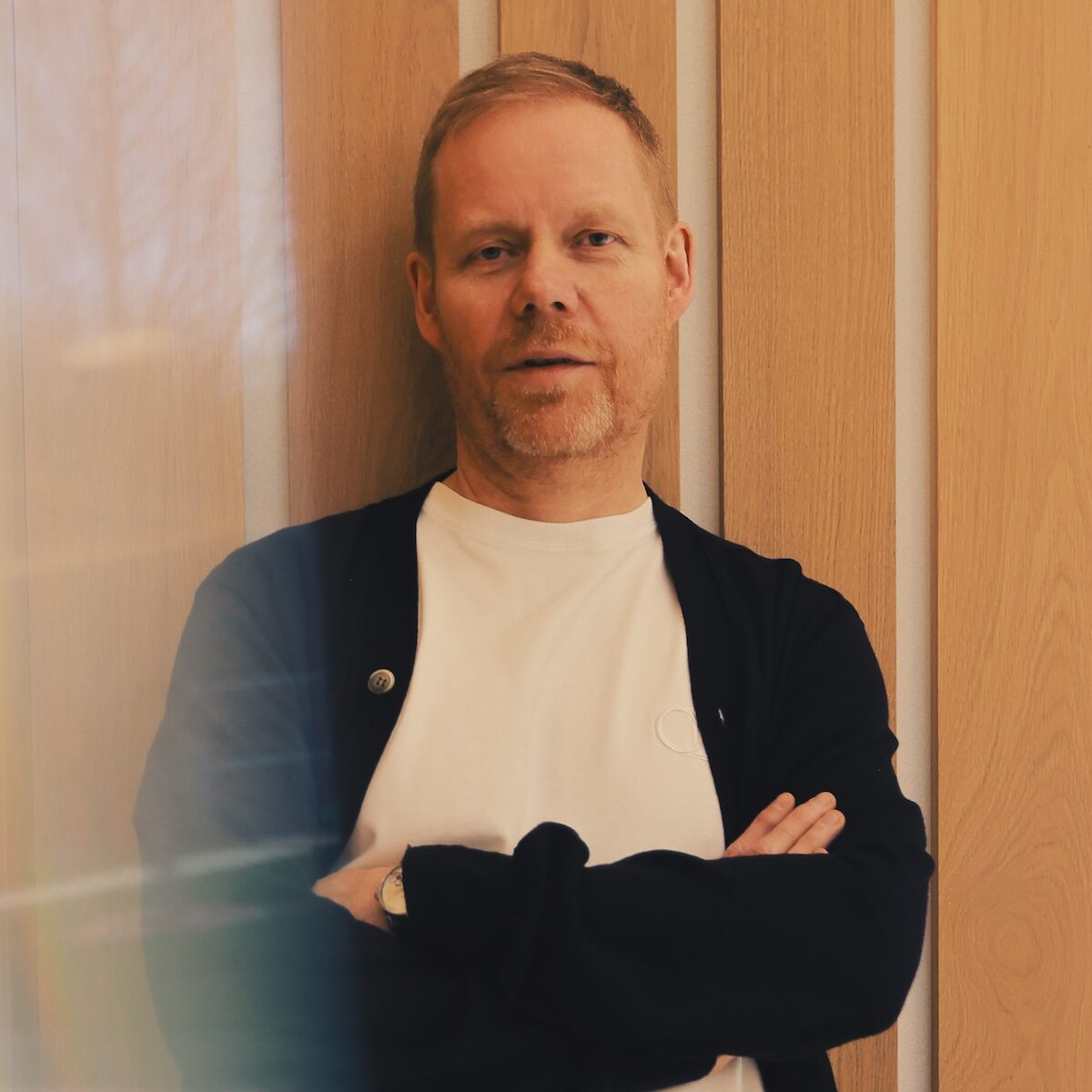
It wasn't that long ago, historically speaking, that you might put on your tuxedo or floor-length evening gown to go out and hear a live opera or symphony. But today's world is faster, more technologically connected, and casual. Is there still a place for classical music in the contemporary environment? Max Richter, whose new album In a Landscape releases soon, proves that there is. We talk about what goes into making modern classical music, how musical styles evolve, and why every note should count.
Support Mindscape on Patreon.
Max Richter trained in composition and piano at Edinburgh University, at the Royal Academy of Music, and with Luciano Berio in Florence. He was a co-founder of the ensemble Piano Circus. His first solo album, "Memoryhouse," was released in 2002. He has since released numerous solo albums, as well as extensive work on soundtracks for film and television, ballet, opera, and collaborations with visual artists.
Here is a rendition of Max Richter's "On the Nature of Daylight" by Cremaine Booker and Caitlin Edwards.
Click to Show Episode Transcript
0:00:00.0 Sean Carroll: Hello everyone, welcome to the Mindscape Podcast. I'm your host, Sean Carroll. Sometimes I wonder what Henry David Thoreau would have thought of the modern world. Thoreau, among other things, wrote Walden about his experience sort of escaping from the hustle and bustle of modern life back in the mid-19th century. Our modern life is a lot more hustly and bustly than that, not just in terms of what we're doing but in terms of what we're hearing and seeing. All of the buzzing, blooming confusion around us is amplified in our modern world of electronics and streaming and cell phones and so forth.
0:00:39.0 SC: What is the role of something like classical music in an environment like that? Popular music famously can interrupt into your attention, right? It can be catchy, it can be loud, it can be fast-paced, and maybe you hear it in the background or in a store and you get a little bit of it then you recognize the song and it contributes to the atmosphere. But at least the stereotype of classical music is you're supposed to sit and listen to it. You're supposed to give your attention over to this intricately constructed, careful piece of music.
0:01:15.6 SC: Do we really have time for things like that anymore? Some people do, of course, but maybe fewer people than did before. Someone who has very, successfully pushed against this worry about modern classical music is today's guest, Max Richter. Max is a classical composer in a very real sense, but someone who has completely embraced the modern world rather than trying to fight against it.
0:01:40.3 SC: You can go to his Wikipedia page and find that he has passed one billion streams for his music and over a million album sales. Very, very good by the standards of modern classical music. But he's a composer who works in a variety of media.
0:01:55.3 SC: He has solo albums, he does commissions for classical ensembles, he also works with the ballet and scores TV shows and films. Films like Arrival, TV shows like The Leftovers on HBO, Black Mirror from the UK, and he's even been very successful at crafting little pieces of music that can be used as ringtones on your phone. So I love this ability to stretch from the ability to do a major performance at the Sydney Opera House, but also really vibe with how people are living today.
0:02:30.0 SC: And in this conversation, we get to what this kind of music means today., how it fits in with the history of music, how it fits in with how people listen to music right now, how the process of composing and creativity goes, and how it can be the case that music that is essentially non-vocal, right? Almost purely instrumental music. He's done some vocal music things, but most of his music is just the instruments doing their part.
0:02:57.9 SC: How can that have a message? How can that have a theme? How can that resonate with what we're thinking about something in the modern world? He has a new solo album called, In a Landscape. It's a solo album, so it's just him constructing all the sounds, recorded in his new home studio that he and his partner have put together. And it's sort of a back and forth between these constructed pieces of music in a more or less traditional sense, and little bits of found sounds, everyday life, the human world, the natural world, all fitting it together in a new way.
0:03:32.3 SC: It gives us hope, this kind of interview you're just about to hear, that classical music is not going away, that it can be super vibrant and absolutely part of the world moving forward. So, with that, let's go.
[music]
0:04:01.2 SC: Max Richter, welcome to the Mindscape podcast.
0:04:03.4 Max Ritcher: Hi, great to be here.
0:04:05.7 SC: I do appreciate you coming on. I understand that you are preparing for a world tour, and what is that about? What is that like? I mean, I think of world tours as being done by performers, and I think of you as a composer, but of course you're a bit of both?
0:04:19.6 MR: Yeah, I mean, playing music live is really, in a way, the most authentic, the realist, most direct musical experience we have. It's a setting where you really get to experience the conversational aspect of music in real time., you're there in the room, it's a one-time thing, it's a unique occasion.
0:04:48.0 MR: So, it's super exciting, and I think we all love doing it. So, yeah, I have a new record coming. In fact, it's out in a couple of days. So, yeah, we thought, we'll take it on the road and see what happens.
0:05:03.2 SC: What about the actual mechanics here, are you playing piano I know that you have electronic instruments in your music?
0:05:11.5 MR: Yes, I play, I mean, I play piano. I'm playing various keyboards, computers, gizmos of all sorts, and then there's a string ensemble.
0:05:22.7 SC: Okay.
0:05:23.1 MR: Yeah.
0:05:26.7 SC: And you've, correct me if I'm wrong, not done a world tour before. You've done plenty of individual performances, but this is like the Rolling Stones going on tour.
0:05:34.3 MR: Yeah, this is the first time we've really put it together in a kind of a planned way. I mean, I've played, a lot of concerts over the years, but we've never really, gone out on a tour like a band. So, that's what I'm doing now.
0:05:50.7 SC: Yeah, so exciting, intimidating, different?
0:05:55.5 MR: Yeah, I'm excited about it, actually. I love, putting the music out into the real world and seeing what happens, because I think it's a little bit like testing a theory. I write a bunch of stuff on a piece of paper, and I have ideas about what that might be, and what it might turn into, and part one of learning what it is the recording process. But really, part two, and maybe the most important part, is finding out what happens when you put it in a room with human beings. And also, actually, audiences are different around the world, they really are. There's different energies, different enthusiasms, and yeah, it's always a really fun thing to do.
0:06:39.8 SC: Well, I was going to ask about that. I mean, how much do you feel you are feeling the emotions or reactions of the audience in real time? How much does that come across?
0:06:52.7 MR: Yeah, you really get a sense of it. You really get a sense when people are listening, when they're engaged, when they're sort of, when they're really connected, you really feel it. And yeah, it's this moment to moment experience for us as performers and for the audience.
0:07:08.5 SC: I once went to a concert at Walt Disney Concert Hall, which I think is on your tour, right?
0:07:14.4 MR: Yeah.
0:07:15.6 SC: So I went to a recital by Andras Schiff playing piano. And I don't know whether this is gonna affect you or not, but the acoustics are very, very good in that hall. And for some reason, it was the time of year where everyone started coughing in the audience. And it got so bad, 'cause once one person starts coughing, everyone else catches on, that Schiff actually stopped playing and stormed off of the stage. [laughter]
0:07:40.3 MR: Did he, he got cross.
0:07:43.1 SC: He did. [laughter]
0:07:44.1 MR: Well, yeah, there's a weird thing with coughing, isn't there?
0:07:47.4 SC: Yeah.
0:07:48.3 MR: We've had it a few times, and sometimes you think, one, as you say, one person will start coughing, and then it sort of sets off this sort of ripple of like, it's like a permission has been given, and then everyone starts doing it. But also, I wonder whether coughing isn't, sometimes like you'll get loads of coughing between numbers. And it's almost like a substitute for applause.
0:08:14.1 SC: Okay.
0:08:15.0 MR: And people are like no, we're not allowed to clap, 'cause it's like not finished between movements, but we will cough. So you get this sort of huge, it's a strange thing. Yeah.
0:08:24.4 SC: Well, that's a great segue, because I wanna give the audience a chance to just think about the idea of classical music. One of the ideas of classical music is that you don't clap when you're still in the middle of a chain of pieces that are connected together. I mean, how do you think about... What is your definition of classical music? Let's ask it that way.
0:08:46.0 MR: Well, there's a few different ones, I guess. I mean, strictly speaking, classical music is, the sort of common practice era, sort of 18th century music. So, Mozart Haydn, that's classical music. When we say classical music now, we really mean instrumental music played by an orchestra written by somebody in the past, [laughter] probably a sort of dead guy. So, there is that perception. So it's something, I think, in the sort of public consciousness, it's a bit like a museum. It's this thing that comes from history. But really, it's a living thing. It's a thing, human beings, telling stories with sound, writing things they're passionate about, trying to communicate those things, telling stories, responding to the world around them via the medium of music.
0:09:48.3 MR: I personally think classical music now is something which is really borderless, we've got to a position now where it isn't really just about, adding to the canon, sort of Bach Mozart, Beethoven, Brahms, dah dah dah, it isn't about that, even though, in a way, all music is about other music. But we've sort of escaped this idea of a sort of building on a canon. And there's this kind wonderful multiplicity, this sort of wide openness of influence going on in music culture right now. So, that ideally, we would kind of stop talking about classical music, and we'd just be talking about music.
0:10:39.2 SC: That would be great. It's never gonna happen. I don't think, [laughter] we're too fond of putting things into boxes, right? It does help us think about things.
0:10:47.4 MR: It's convenient, right?
0:10:48.7 SC: Yeah.
0:10:48.7 MR: It is convenient. And of course, marketing people and, it's just kind of gives people a frame of reference. It's quite simple, here's your latest symphony cycle, here's this, whatever it might be concerto, say, or, and it's, yeah, I get why people kind of gravitate to that. But, human beings, we don't exist in boxes, we're multidimensional, and we change our minds, and we turn into other people. And music is really like that by nature, I think.
0:11:23.7 SC: Well, I grew up enjoying bands like Emerson, Lake & Palmer, who would play the occasional Prokofiev or Holst or whatever. And there's also always been classical orchestras doing kind of gimmicky covers of popular music. But from what you're saying, it sounds like there's a bit more seriousness to the erasure of the boundaries.
0:11:47.9 MR: Yeah, I mean, I think that there's a couple of things have happened. The first is that, musicians of all kinds are now working with the computer. So, we've all got the same tools, whether you're a Conservatoire studying composition, you'll be working with a notation program and maybe some samplers to make mock-ups or, Max MSP or something like that, there are many tools which you might use.
0:12:22.6 MR: But also, if you're coming from what, like a dance music perspective, or an EDM perspective, or there's a kind of interpenetration of like tools. So, everyone's using the same things. And that, I think, has led to a kind of an openness to materials and methods. And the other thing, I think, is that streaming has happened.
0:12:50.5 MR: So, unlike when I was a kid, if I heard something that I loved and wanted to know more about, I had to like, open up my piggy bank, get the pocket money out, take the risk, go to the record store, this is a whole chain of actions and processes and like investment and commitment to hear that sound. Whereas now, you literally just click your mouse and there it is, all the music in the world. So, that's meant that people...
0:13:21.8 MR: Have no risk in terms of just following their enthusiasms through the musical universe. And that's meant that people are listening much more widely. I think.
0:13:30.6 SC: I guess, yeah, I've never really thought of that impact, but that feeds into the idea that the boundaries should come down. There's no reason why someone can't make a playlist with, Taylor Swift followed by something classical.
0:13:44.8 MR: Absolutely. Right. Yeah.
0:13:46.6 SC: And you also, the other thing about your music, so that the audience knows, is that, you do, you're pretty eclectic in terms of instrumentation and not only conventionally understood instruments, but ambient sounds, electronic instruments, etcetera. I mean, how, how, what role do those things play, would you say?
0:14:06.8 MR: Well, for me, as a kid, I was going, did a very straightforward sort of composer education, piano lessons as a kid, and then university and Conservatoires and all of those things. But I had a simultaneous kind of enthusiasm for the music I was hearing, from the charts, which at that time was, early the early punk, early electronic music, and the sort of tail end of Prague and, experimental, whatever, wasn't really post rock in those days, but can and ye and the sort of that kind of stuff. So a lot of different languages.
0:14:48.9 MR: It seemed to me always quite natural that I should, be working with those tools as well. I see it really as simply a continuation of a process that's happened to the orchestra from the beginning, really all through the 18th and 19th century. The orchestra grows both in size and in terms of available colors, different instruments get added. And composers have always pushed against, the possible and tried to go into new spaces. You only have to look at what happens to the piano keyboard in Beethoven's lifetime, just took longer and longer and longer. Right. So, so, we're always looking for new things, new colors, new possibilities, and for me, the electronics, are really just the palette getting bigger.
0:15:40.8 SC: And am I right that these formative years where you were looking for vinyl records, was that in Germany?
0:15:47.8 MR: No, I grew up in the UK. I was born in Germany.
0:15:49.4 SC: Oh, okay.
0:15:52.0 MR: We moved to the UK when I was really very young. I was like three.
0:15:53.9 SC: Because Germany obviously has been a, in the vanguard of electronic music and experimental music.
0:16:00.1 MR: Sure, of course. Yeah. Yeah. I mean, for me hearing Kart track for the first time, which was when I was about 12 or 13, absolutely blew my mind and was completely formative for me. I heard this music on a TV show, it was the opening of Autobahn and I just I'd never heard anything like it. And I was intoxicated and, I wrote a letter to the BBC and said, please tell me what the music is in this program. And I posted it in the postbox, waited six weeks, got a reply back, it's Autobahn. Right. So, then I know what it is. So then I get my, I get my pocket money out, get on the bus into town, get to the record shop. I mean, it sounds crazy now, right?
0:16:44.1 SC: It does. It's very different, different world.
[laughter]
0:16:46.9 MR: Anyway, so days and weeks later I get this record, put it on the record player, and, hearing the baseline at the beginning of Autobahn, was like my life has changed, [laughter] absolutely transformed. And, from then on I just, knew I wanted to get my hands on a synthesizer.
0:17:06.5 SC: Were you already in love with classical music at this time?
0:17:09.5 MR: Oh, yeah. No, I was, practicing the piano and I was into music.
0:17:15.5 SC: Okay. Very good. Let's do our best to give the audience an idea of what your music sounds like, given that if we try to actually play some music for them, there are rights issues and lawyers will come in, so I will link to that, absolutely. But, how would you describe your own approach within this eclectic musical universe?
0:17:34.8 MR: Yeah, so, okay, so maybe I need to sort of do this kind of chronologically. So basically I trained, at a time, at university and then at the academy in London. And then I went to Florence and studied with Barry over there. So, a very sort of straightforward academic composed training. And at that time there was an orthodoxy, about the kind of music you should write. And this was kind of complexity, basically [laughter], It was sort of post boles, total serialism plus, plus plus. And if you were interested in tonal music, it just meant you were stupid. Literally, that was the attitude. You can write, but you are stupid.
0:18:28.3 SC: Let me, let me just, interrupt to, ask for an explanation of tonal versus the alternative...
0:18:35.1 MR: Okay. So, tonal music is what we're used to hearing in pop music or most of the music around us. It's music based around the tonal system, which is a structure of triads. It comes from, well, it was codified really by bar, but tonality itself, the tonal system is really like a cultural elaboration of the Harmonic series. The Harmonic series is something from physics and it's to do with numerical physical relationships. And the tonal system is like an expression of that. So, does that make any sense? That's what the tonal system is.
0:19:18.5 SC: I think it kind of makes sense. You know, probably a lot of people have seen those videos where people play the same three chords, right. The route the fourth and the fifth, and it fits half the songs they've ever heard in their lives. Right?
0:19:31.8 MR: Exactly. Right. So, it's like this amazing resource, kind of lexicon of musical possibility, we're saturated with it, you know? That doesn't mean it's exhausted. There's lots to come from total tonality. [laughter]
0:19:47.8 SC: But in your schools, this was looked down upon.
0:19:50.0 MR: Well, yeah. So, what happened is that, there was a sort of... There was like a historical view of musical, inverted commas, progress. And what happens is that as music history goes along from, it moves from Bach into the Romantics, and the Romantics basically add dissonance. Dissonance is like tones which are foreign to the chords that we're hearing, foreign to the key that we're hearing. So, you get a piling up of dissonance. And then towards the very end of the 19th century, early 20th century, you get this kind of, it's like a big wave of dissonance that sort of breaks. And you get into a situation where you take away the tonal center.
0:20:41.8 MR: And various people start to try and think of ways of writing music which are not to do with tonality. And it's kind of bracing/terrifying/confusing/interesting. It's kind of all of those things. And you get one of the ways that people try to organize music in the absence of a tonal center. So, we don't have our familiar chords anymore. How do we organize those sounds? So, one of the ways of organizing it was a thing called serialism, which Schoenberg comes up with around 1908, '9, '10, around there. And actually slightly later, sorry, more like '12, '13, '15. And this is to do with like putting tones in a predetermined order and building sort of geometrical structures out of tones. It sounds very abstract, and that's because it is. It's actually nothing to do with like the sensation and feeling of music.
0:21:50.9 SC: From the head, not the heart.
0:21:52.2 MR: It's like taking music and turning it into this kind of abstract system. Basically, that's the 20th century. It gets more and more of that. Schoenberg starts off making series of pitches, and then you get duration and rhythm and dynamics and all kinds of things. So, everything is like systematized. And it becomes this really weird sort of arms race of abstraction. So, that's what I was supposed to be writing when I was a kid.
[laughter]
0:22:23.2 MR: And I was like, I did do that for a while. Very complex, very abstract sort of music, very hard to understand or love. And then I just, I'd got to study with Berio, and I showed him this piano piece of mine, which is in the tradition of like student composer's piano pieces, which are impossible to play. Really hard, so dead, so difficult, you know. And he looked at it, and he was just like, is this actually what you wanna be doing, really, with your time? What is music for? Why are you doing this? Asking sort of really profound questions, really, basic fundamental questions about what music was. And so, that kind of, in a way, unsettled me.
0:23:17.2 MR: And then around the same time, we were starting to hear the music of the kind of new tonal music coming out of the Baltic states. So, this is [0:23:30.5] ____ and these sorts of composers. Plus, I had been playing loads of minimal music as part of a six-piano group. So, we played, Steve Reich's six pianos, the early Philip Glass things, lots of kind of pulse-y sort of minimal music. And all these things kind of piled up on me, really. And so, I just kind of thought, "Hang on a minute, why am I doing this other stuff when here's an alternative, here's a potential new language for me, new language, which can, where I can be very direct about what I'm trying to say." And that, to me, ultimately made much more sense.
0:24:14.8 SC: It sounds like an amazingly familiar kind of story, not just in music, but in art, literature, maybe even like science and politics, where there's some super successful paradigm, tonal music, and so successful that it just gets done to death and people react against it, and maybe they go too far reacting against it. So, there becomes more room for experimenting in some perpendicular direction.
0:24:37.6 MR: Yeah. Yeah, I think that happens a lot in culture, right?
0:24:42.1 SC: Yeah. And it's part of the historic aspect of it, right? Like when you write a piece of music, the audience has heard other pieces of music, right? They've heard some of these things, and they put it in that context, whether consciously or otherwise.
0:24:56.3 MR: That's right. Yeah. I mean, every listener is bringing, well, put it this way, they're listening through the prism of their biography, right?
0:25:03.5 SC: Yeah.
0:25:04.7 MR: Every piece of music they've heard informs the way they hear what they're hearing in that moment. And there's something really beautiful about that.
0:25:11.3 SC: So would you, and again, this is labels, and I know they're never perfect, but again, the audience has to go out and find the music for themselves. So until then, would you count yourself as a minimalist composer?
0:25:25.8 MR: I don't know. I'm certainly trying to do the maximum with the minimum. Every note is there for a reason. And I try very hard to make things, to make the things I'm writing come over or connect in as direct a way as possible. And that means they are quite sort of, they're sort of low information zones in a way. I'm trying to sort of achieve a kind of a very lean, direct expression, I think if we, minimalism in music, we think of like the early Glass and Reich pieces, which are very pattern based. I mean, I work a lot with patterns because there's something very fundamental in music to do with patterns. It goes all the way back. Well, all the way back. [laughter]
0:26:28.1 SC: Sure.
0:26:29.0 MR: Mozart's all made of patterns, just it's how Bach, so. So, I do work with those things, but that isn't my sort of main thing or rather it's not a thing in itself.
0:26:43.0 SC: Is there, but it is a little bit in there. Are there explicitly geometric or mathematical ideas that go into your head when you're composing a piece of music?
0:27:00.8 MR: Yes. No. I would rather... If I can tell the story in a way where the kind of technical aspect of the music also expresses what I'm trying to say, then I will do that because that enriches the experience of the listener. I mean, like, I don't know, I mean, sort of imagine like a trivial example. Say, I read a piece called Falling Say.
0:27:32.9 SC: Yeah.
0:27:33.3 MR: And it was just made out of lines of notes which descended, something like that. I mean, you could imagine a piece like that. And if you could make something satisfying musically, where that's a kind of a mad example 'cause it's... But you know what I mean?
0:27:52.2 SC: Yeah.
0:27:53.0 MR: Something, if there's something about the musical texture itself, which can embody the subject matter, then I'll definitely try and do that. I enjoy those kinds of things.
0:28:08.1 SC: Well, I have two different completely, uneducated ideas about music that I'm gonna take advantage of you being here to run by you. And, you can tell me whether I'm right or wrong. One, dealing with what we were just talking about, is that a lot of the pleasure of music comes from some competition between anticipation and novelty, right? Like, we get, there's a rhythm. If you have no rhythm, if you have no structure at all, it's kind of not musical, but of course if it's just repeating exactly the same thing over and over again, it's not musical either. So, finding that sweet spot is a lot of the part of success story.
0:28:43.4 MR: Yes. Yeah. I work a lot with, I suppose you call redundancy, redundant information. That's something I've taken from the minimalists, this idea of a continually, well, how could you describe it? If you work, say with repeated material, in a sense, you are sort of always in the same place. You are re-experiencing the same moment. And so, if you make small shifts and changes, you get the experience of novelty, but within a known space. For me, one of the things I like to do, is I like the listener to, in a sense, learn the territory of a piece while the piece is happening.
0:29:34.8 SC: Okay.
0:29:35.7 MR: And then once you've sort of marked out the basic terrain, then you can sort of make changes which will be very affecting, say, for example, a piece of peace of mind, like, say the dream music in sleep. This is very, very simple music. You have piano chords with, which are regular, they happen absolutely regularly. You have a subsonic base tone, which happens absolutely regularly. The piano chords themselves, are a thing called a chain of suspensions, which is something I borrowed from the Baroque. So it is a kind of a known thing.
[laughter]
0:30:40.9 MR: So, we have a lot of different things, all of which are in a way familiar to us, at some level. And because I repeat them, they become very familiar to us. So, that then when I make very small changes by introducing a, for example, a melody line, it's like a character walking into a room that we know very well. So, that kind of a glamour, that kind of a structure is that can be very effective.
0:31:13.4 SC: Do you think of different elements of your music as characters in a drama?
0:31:20.9 MR: For me, writing a piece of music is like trying to... It is like trying to make a space or there's an element of sort of architecture or landscape about it. There's a kind of a... It's quite hard to explain it, but there's a sort of feeling of like trying to... It's sort of world building a little bit.
0:31:45.8 SC: Yeah. Okay. That's great.
0:31:46.1 MR: That kind of a quality.
0:31:48.6 SC: So, you did mention borrowing suspended chords from the Baroque and I should tell the audience, you've done a whole album of Reimagining Vivaldi.
0:32:00.4 MR: Yes, I have. Yeah. That's, yeah.
0:32:03.3 SC: And so, it leads me to ask... So, here's my other crazy theory, and this is even crazier. The first one was kind of obvious. In biology or in physics, we sometimes talk about a fitness landscape. We have all different sorts of ways that DNA can be arranged or fields or particles can be arranged, and they have different energies and different possibilities of survival. And the idea is that there's kind of isolated peaks where everything is good and happy. And then in the valleys in between them, you're unstable. So, for example, elephants are very successful, ants are very successful, but something that was halfway in between an elephant and an ant would not be successful. Right?
0:32:46.5 MR: Right.
0:32:46.9 SC: So, my crazy theory is that music is the same way. That there are different kinds of music that are individually successful. And that there's reasons for internal coherence and so forth that they are successful and you can try to blend them, but it's never quite the same. So there's... There will always be orchestral music and there will always be pop music and there will always be jazz, and they'll always be talking to each other, but a little bit different. That's my theory. What do you think? [laughter]
0:33:14.1 MR: Yeah, I think it's interesting, isn't it? Because, yeah, like for example, say in the Vivaldi project so that this is Recomposed. So where I took... I basically took the Four Seasons, very famous piece of Vivaldi. And did an off-road trip through Vivaldi's landscape. That's how I see it. And for me, this is a personal project. I fell in love with the original when I was a kid. And then I heard it on people trying to sell you insurance on the phone or something gusty or in an elevator, just depressing, depressing experiences it must be. So for me, it's a salvage mission to try and reconnect with the original. So, really, yeah.
0:34:12.4 MR: I was sort of faced with how to connect my language or what I was doing with the Vivaldi. And I did that via the, we talked about this already, via the medium of pattern. When you look at the Four Seasons, the original, some of those pages, you think, well, that kind of looks John Adams, or it's just these patterns, 'cause it's really just patterns, sort of with jump cuts. That's how Vivaldi is made. A lot of that material is very modern, actually, in structurally. And I thought, aha, these are patterns I can get this. So, I use that principle and connected my language with Vivaldi's language via that idea.
0:35:00.1 MR: But as you say, there are plenty of other musical traditions where if you tried to connect them with the Vivaldi, they might be quite a lot less successful, or sort of, they wouldn't make as much sense. I guess I have this skeleton key of the idea of pattern.
0:35:21.8 SC: And is this among people who might be thought of as classical composers of your generation? Do some of them completely reject the historical perspective? Or is it very common for people to kind of be quoting and in conversation with their predecessors?
0:35:37.4 MR: I think music has always done this. Variation forms, the idea of a fantasia on whatever it might be. Vivaldi did it with Vivaldi's own music, but rewrote, reworked, so many different of his own pieces. Also, Vivaldi, of course, if you think of someone Liszt or Brahms, they were writing variations, versions of other people's music. It's a process as old as composition, because once a piece of material is sort of out there, it just floats around in the sort of global musical mind. And people catch on to these things. And they think, hang on a minute, I like that, I wanna do this with it. And I think it's a very natural thing.
0:36:31.7 SC: Well, we already mentioned the audience reaction in real time when you're doing a performance. But it seems your new album... Tell us about your new album 'cause the quote that comes with it is, "It is an open conversation with the audience."
0:36:48.0 MR: Yeah, for me, this project is, it's called, Inner Landscape. And the record is about kind of polarities and reconciling polarities. So, I'm working with disparate means. So, acoustic instruments, electronic instruments, looking at themes from the natural world, the human world. And also, as implied in the title, which you can mishear as inner landscape, as an internal landscape, sort of deliberately playing with that idea of the external and the human and the societal.
0:37:33.2 MR: So, yeah, for me, writing a piece of music, and we've already mentioned this idea, is sort of half of the conversation in a way. And the other half of the conversation is what that listener will bring to it. And that's actually what I'm really interested in hearing. For me, it's really fascinating to discover what people make of things because that actually tells me a lot about what I've done.
0:38:08.0 SC: The idea of spatial structures seems to be very common, whether it's a landscape, or you mentioned different patterns out there in the world, walking into a room, and so forth. But at the end of the day, it's sound that you're making. How much of that connection is personal versus, oh, here's the theory of why these sounds fit into this spatial structure?
0:38:35.6 MR: I think ultimately, music is really a feeling thing. It's such an interesting language because it is very conceptual. There's a lot of thinking going on, a lot of conceptualizing, planning strategy, architectural schemes, ideas about structure, ideas about how to move through time in a piece of music. How fast is it? Where's the energy? How does the architecture work? Very conceptual. But ultimately, it's totally a feeling thing. A listener doesn't go, "Oh, that was a 13-bar thing. And then there was a dominant preparation and blah, blah, blah." They don't think that. They go, they either nod their head and go, hmmm or they walk out of the room. It's there's a... Or they tap their feet. There's something... It's completely a sort of visceral, sensory experience. It's a feeling thing. And of course, goes directly to our emotions. So, it's paradoxical in that sense.
0:39:48.8 SC: I had a music teacher in junior high school, who was the one who explained to us that if you just listen to a pop song, there are things called verses and choruses and instrumental sections and guitar solos and drum solos. And that it... Very embarrassed to say that it never really occurred to me, not being a practicing performer of music myself. I just, like you say, I just sort of enjoyed the thing, the song as a gestalt. And this idea of structure warmed my proto-physicist heart. Then I could see layers there that I hadn't seen before. But I suspect a lot of musicians and composers don't realize the extent to which the audience doesn't appreciate some of the structural bells and whistles that they have.
0:40:38.6 MR: Right, yeah. I mean, I think, and again, I guess that goes back to this idea that of trying to have a language which is very direct and plain, and in a way not hiding those things. Because, you know, a lot, within music, there's a lot of artifice, there's almost like misdirection or sleight of hand, you know, looks over here and now this is happening, you know. So, I'm sort of, I've been trying to get towards a situation where the material speaks very directly and plainly. So, in other words, it's not, it's not necessary to think of it in a kind of analytical way, but you can just listen to it.
0:41:22.8 SC: But that was interesting, because you use the phrase speaks very directly and plainly. But a lot of the music is instrumental, right? And when you describe it, it's clear that in your mind, there are often, you know, words or themes or things that could be expressed verbally that are attached to it. How close is that connection there, when you say like a certain piece is about the Iraq war. But I wouldn't know that if I were just listening to it, right?
0:41:54.1 MR: Yeah. Well, this, [chuckle] again, this is the other, one of the other paradoxes, isn't it? I mean, when you hear a piece of music, if you sort of connect with it in any way, you do feel like you're being spoken to about something. And you're sharing something of the consciousness of the person who made that piece or who played it. And this is, again, one of the great puzzles of music. We feel it look, this is just air bouncing around, right? And yet there is something very profound going on. But I mean, it's just such a paradoxical and interesting thing.
0:42:40.9 SC: And I guess, now that I'm just thinking of this right now, so I might be embarrassed to say this, but it makes me think of Bruce Springsteen's song, Born in the USA. I don't know if you know it, but the music is sort of anthemic, right? And it makes you feel, given the title, that this is some patriotic anthem or whatever. But the words are telling a very different story, and so many people don't get that because they don't listen to the words.
0:43:03.7 MR: It's a very dark song. It's a song about loss and everything falling to pieces, right?
0:43:10.9 SC: Yeah.
0:43:11.0 MR: It's hilarious, right? Because I think, at one point, it was even used as a kind of campaign song, wasn't it?
0:43:16.5 SC: Absolutely, yeah. Over and over again, not just at one point. People love it.
0:43:18.7 MR: It's like an anthem. It's like, really? Are you even listening to it?
0:43:25.5 SC: No, no, they are not.
0:43:28.4 MR: Yeah, no, I mean, it's interesting that, isn't it? I mean, he's obviously a brilliant songwriter, it's a very clever piece of writing, because it's actually the blackest irony, right? That song.
0:43:39.6 SC: Yeah. So the other thing you say about In a Landscape is that it asks the audience to consider the dualities in their own life. And that was just sort of pregnant with meaning there, I didn't want to unpack it for you. So, what are the dualities we're thinking about here?
0:43:55.0 MR: Well, in the record itself, you have composed music, so instrumental music, which has been written down. And then you have essentially found objects, interludes, really, between the composed music. So, you've got this sort of polarity operating in the piece all the time. And that, I guess, sort of speaks to the idea of polarities. And this, for me, I guess, leans into the societal aspect of the record. And the time that we're living in. We live in a very polarized time. At the moment we are... A historical moment is a moment where people have mild disagreements. You can't even speak to one another. It's a very, very problematic. And I guess, in trying to have these different kinds of objects live with one another, the electronic, the acoustic, the found object, the intentionally written music, putting these things into a kind of fruitful unity, I guess I'm making a kind of a small plea for coexistence and listening.
0:45:16.2 SC: Well, the listening does matter. And I get... And here is the topic I'm most interested in hearing your thoughts about. I once had a friend who was a musician who would come over to our house, and if I had music playing in the background, he would ask me to turn it off. He did not want there to be any music if you could not sit silently and listen to it. But I guess there's layers, there's different approaches here. Are you... How do you... Where do you come down on the, if there's music at all, you'd better be paying close attention to it question?
0:45:49.3 MR: I can see both sides of this. I have the radio on in my kitchen during all waking hours. But it's set at such a level, so that if I'm cooking, I can hear the music. Because, I like to be surprised, I like to hear things that I haven't heard, or wasn't expecting to hear. On the other hand, if I listen to music, then I'll... If I put a record on, then I will sit and listen to that music with full concentration. Because that is what the artist will have intended. So, I guess that's a sort of, it's like a contract. [laughter]
0:46:39.8 SC: Well, usually that's what the artist intends. But you do have this famous record called Sleep, not really a record, a piece. Tell the audience about that, because I just love the whole concept.
0:46:50.3 MR: Okay, so Sleep comes from, I guess, about 2013, 2014, when 4G internet moved into our pockets. So, that meant we then had social media 24/7 in our pockets. And Yulia, my partner, and I were talking about this and the sort of societal effects on it, of it, and of course, loads of fun, very interesting, but also significant psychological load and pressure. So, I was thinking about the way that large-scale artworks, a long movie, a big painting, say a big Rothko or something, a big novel, Anna Karenina or something, you can use it as a way to kind of, kind of blanket out reality and just concentrate on that. An extended duration music can have that effect, right? So, I thought, okay, so I'm gonna make a piece which can be like a big pause button. You'll put it on and you can just like zone out for eight hours. And so, that's what Sleep is. It's at one level a kind of a lullaby, at one level a kind of a protest song.
0:48:15.9 SC: Sorry, what's being protested?
0:48:18.8 MR: Neoliberalism.
0:48:19.2 SC: Okay, wow.
[laughter]
0:48:22.3 MR: The idea of constant productivity. So it's a kind of like, let's just stop for a second. Yeah, so that was, yeah, that was Sleep. It's a music for piano, organ synthesizers, string, quintet, and soprano.
0:48:43.1 SC: But the eight hours is not chosen as a random number. It is meant to allow you to put the music on while you are sleeping at night.
0:48:53.3 MR: Yes, exactly. So, the piece isn't really to be, well, you can experience it any way you like, but I intended it really to just be inhabited, to be slept through. More like, again, like a landscape rather than, yeah, a concert. And actually for us, when we started to play the piece live, it was a bit of a learning curve, because we realized that we weren't really playing a concert. It looked a bit like a concert, even though, of course, we had 500 people in beds in front of us, but there was still us and an audience. And we thought, okay, so we went into a kind of our default setting as musicians, and we try to project this piece into the space. And actually very quickly we realized this was not what we should be doing. What we were doing is we were accompanying something that is happening in the room, which is a community of strangers, hundreds of people who don't know one another, who've come together and basically trusted one another to be sort of in this very vulnerable state and go on this journey through the night together. And really, we were just accompanying this thing that's happening. So, it's a very different dynamic.
0:50:13.1 SC: And maybe in some sense, a more truthful acknowledgement of the fact that music like anything else is just one aspect of the life that is going on all around us. So, rather than insisting that you stop everything else and pay attention, work it into the fabric.
0:50:28.7 MR: Exactly. Yeah, exactly. And also, yeah, to try and sort of, I guess, question the sort of hierarchical aspect of music as this, again, going back to the Romantics or the modernists, this idea of greatness. [laughter] You have the sort of the great composer, who writes the great piece, and then we all have to listen and sort of shut up and behave, try to absorb the greatness. It's just, I wanted to try and get away from that idea.
0:51:03.2 SC: Well, and the other manifestation of that, which I truly love, is that rather than being annoyed or frustrated that in the smartphone era, someone might use your music as a ringtone, you leaned into that. You said, all right, here's a bunch of ringtones for you. [laughter]
0:51:21.1 MR: Yeah, so I mean, this comes... So this is the 24 postcards. Yeah, I guess, really, the thing that kind of prompted this was hearing that crazy frog ringtone everywhere. I don't know if anyone remembers that, but pretty traumatic. Just hearing this thing going off all the time. And I suddenly thought to myself, look, there's all these millions of little loudspeakers going around the world. We could actually... This is a space for music, music. It could be a creative space. So I wrote, yeah, all these little fragments. And just almost like treated them like Polaroids, just little snapshots of a moment for people to use as ringtones.
0:52:11.1 SC: Well, there's a difference between greatness and grandiosity, right? [laughter]
0:52:15.9 MR: Yeah.
0:52:16.7 SC: And for, well, it reminds me of, again, completely randomly, very recently, someone pointed out that the most reproduced example of visual art in the history of the world is probably, do you want to guess? [laughter]
0:52:35.6 MR: Yeah. Don't know, actually.
0:52:38.6 SC: The portrait of Abraham Lincoln on the US penny.
0:52:42.3 MR: Really?
0:52:43.0 SC: Just because there's so many pennies out there, right? [laughter]
0:52:45.5 MR: Of course, right. Okay, fair enough. Yes.
0:52:47.6 SC: So, little bits of art all around, why not make it good?
0:52:50.8 MR: Yeah, exactly. Exactly.
0:52:53.6 SC: And is it true that for Sleep, you thought a little bit about sleep, about the neuroscience of sleep, about what's going on in people's brains when they're asleep?
0:53:02.5 MR: Yes. Yeah. I mean, obviously, I had sort of ideas from a purely musical point of view, what kinds of things I should be doing, but I had no real data and actually around, it's funny to think, but 2012, 2013, around there, there hadn't been that much research about the effects of music and sound on sleep. There's been a ton recently, but there wasn't an awful lot out there. I called up a friend of mine, David Eagleman, who is a neuroscientist.
0:53:34.6 SC: Former guest of the podcast.
0:53:36.4 MR: Okay, well, you know David, he's an absolute live wire and so sort of multidimensional. So, he pointed me at some stuff and I just sort of checked through a few things. And just to kind of, it was like a sense check really, just to make sure that what I was planning to do would actually have some beneficial effect. I guess the big thing is, and this for me compositionally was beautiful, is that some people have demonstrated that using like repetitive low frequency tones can elongate slow wave sleep so you get better information processing and memory, that kind of stuff. So, that for me was great 'cause I love, I love the sort of low end and sub-sonics. It's all over my work for decades. So, I was then able to reach into that space for Sleep, which was great.
0:54:36.3 SC: When you say the word subsonic, do you mean literally too low to hear? We don't know we're experiencing it?
0:54:42.2 MR: Almost, yeah. I mean, down at sort of 25, 30, 35, 40 kind of thing, where you sort of hear it and sort of feel it.
0:54:51.8 SC: So has anyone done the obvious follow-up study of seeing what happens to people's brains while they're listening to your composition and they're sleeping?
0:55:00.5 MR: Well, I would love someone to do that.
0:55:01.2 SC: Okay, good.
0:55:02.3 MR: But I don't think it's been done. So, anyone out there?
0:55:04.4 SC: Throw it out there. Yeah. [laughter] I'm sure we have some neuroscience grad students who are looking for a good PhD project. That might just be it. Okay, the other thing I wanted to talk about, I can't let you go without asking, I always have these sort of craft questions. Like what is it like to be a composer in the way that you're doing it? I mean, I hate asking this question, but it's the standard one. Where do you get your ideas for a tune? Is it random? Do you like sit down and think, "Okay, now I will come up with a melody or a harmony?"
0:55:41.6 MR: It's... There's kind of no one way, honestly. I mean, I... As a, I guess this goes back to childhood, really, for me. I've always had just music going around in my head. When I was a tiny kid, I thought everyone always had music going around in their head. Just later on, I was like, no, this is not happening to everybody. So I've always got sort of just little fragments, things bubbling away. I'm... If I have a project, a specific thing to do, then it's partly just, I guess, trying to assemble little atoms into something and seeing which things stick together and how they interrelate. And then you can build structures. It's like, in a way, it's like any kind of process, it's like macro and micro in parallel. I guess the big thing that I really, and I think probably most creative people have this that I really love is when the material starts to feel like it has a kind of intentionality. Things start to sort of happen in the material. And that is, that's then very exciting. Then it's about like following that material kind of where it wants to go. And sometimes actually it's, it actually sort of goes somewhere outside the project and you think, oh, no, no, this is a different piece. This is not what I'm doing right now, but okay you keep going, but it's something else. So, there's, the writing process is like continuous basically. And the individual projects have sort of dotted lines around them, but there's actually just writing going on all the time.
0:57:35.5 SC: Well, that's a fascinating thing to say 'cause I've never heard a musical composer say that, but I've heard many, many fiction writers say that, right? Once they get characters, they go places that they had no idea.
0:57:47.1 MR: Yeah, exactly. Yeah. It's the same.
0:57:49.8 SC: And I do think that I am one of those people who always has music bouncing around in their heads, but it's music that has been written and recorded by other people. So, I think that, it would be very hard for me to break out of that and make something new, having been exposed to so many really good pieces of music already in my life.
0:58:07.6 MR: Yeah. I mean, I think, I mean, in my case, it's sort of both of those, you know, if I... I don't know if I'm, when I'm making coffee in the morning, I hear something on the radio that I love, it will be sort of there as well. It'll be kind of... It'll be around for a while.
0:58:24.0 SC: And then in that process, once you go from, well, sorry, let me, let me just back up and be very down to earth. Do you then go to the piano or do you have other instruments you go to, or do you go to a piece of paper and start writing a score?
0:58:36.4 MR: It depends. I mean, I do work on paper. So most... The beginning of, at some point towards the beginning of a project, there will be a lot of writing on paper. I'm a pianist. That's my sort of sketch pad. So, I will also be just trying stuff, but a lot of the time I'll be sort of playing and writing. So, with that kind of process, and then depending on what it is, I will at some point probably get the computer involved. Whether that's just scoring, whatever it is I've done, making sort of copies or if it's something which is more about sound itself, then maybe working with the synthesizers or the computer in terms of like shaping material. So yeah.
0:59:30.6 SC: And that always leaves you with many more ideas and paths, ideas sketched out and paths walked down than you can possibly fit into the final piece, right? Do those stay with you when you hear a piece of music that you have composed, you recall like all the things you didn't do?
0:59:46.8 MR: Definitely. Yeah. The finished piece is a sort of a, it's like a negative map of the things you didn't do with it. Right.
0:59:54.3 SC: Yeah. [laughter]
0:59:56.3 MR: It just really describes the territory. And there's a million other universes out there with the, all the different versions, right.
1:00:04.5 SC: Have you or anyone else done a, an album or a piece around that idea? Like, here the paths not walked down for this final thing that we end up with?
1:00:16.0 MR: I don't know. I mean, I guess in a way, variation forms in music fill that space a little bit. You know they do. If you listen to the Goldbergs, you've got 31 different ways to make that journey. And of course there are many more, but that's all you had time for.
[laughter]
1:00:35.2 SC: Okay. And then for someone like you, you're established, you've made a name for yourself to say the least. Do you hand over the music to performers? Or is it, I don't know. How does it work?
1:00:49.9 MR: It depends what it is. If somebody's commissioned something, say an orchestral piece or ballet or whatever it might be, then yes. Then I write it all down. We make a score, then here is the score. And then it's over to whoever it is who's playing the piece or conducting it. Other times with a say it's a film project, then I'll be recording it here at the studio and there'll be a sort of a dialogue, back and forth with director, editor in terms of how it should all work. That's much more conversational kind of a process. Or if it's a solo album, then it's me sitting in this room writing away and then recording it and then doing absolutely every aspect of it myself.
1:01:37.4 SC: I guess that is true. I forgot to ask about this process of collaborating with a movie or TV director or what have you. I mean, is that, that sounds very different to me than sitting down and writing a solo album or a... Sorry, the word went out of my head. A commissioned, symphony.
1:02:00.6 MR: Yeah. It's completely different. It's a fundamentally a collaborative thing. It's... Music is, well, a TV show is not a symphony, right. There are other things going on.
1:02:10.6 SC: Yes.
[laughter]
1:02:11.0 MR: There are actors there, there's a story. So, quite, naturally the music has to be any part of something, but what's the best way for the music to be part of the thing? That's what we're trying to figure out. Trying to figure out, what is the music that feels innate or inevitable within the world of that story. And that's something which you arrive at by experiment and conversation and luck sometimes.
1:02:46.5 SC: Are you presented with basically the film without a soundtrack and you start filling in?
1:02:54.2 MR: Yeah, I mean, there's a million different ways. I mean, quite often I'll write things from the page, from the script. So then I'm just dealing with the themes, the psychology of the thing or whatever it might be the drama. Other times, you'll get scenes or a whole cut of a thing and then you're responding to the visuals. Yeah, it varies.
1:03:19.2 SC: I mean, the theme that seems to come through over and over again is that music is not independent of the rest of our Sensoria. Right. The rest of what we are experiencing and related to in our everyday lives.
1:03:33.4 MR: Yeah. Yeah. It's something which is involving and connected in a really deep way, I think to, I mean, for me the experience of being a person, how we relate to one another, all of these things. It's a very simultaneously very simple and very mysterious thing. And I really enjoy that about it actually. The fact that it's kind of endlessly elusive in a way.
1:04:09.3 SC: Alright, last question then. Any advice for the teenagers in the audience who have made the somewhat foolhardy decision to try to make a living being a composer of music or a performer for that matter?
1:04:23.2 MR: Well, I think, yeah, I mean, I think for composers, I mean, probably for all musicians ultimately, there's a few different things aren't there? I mean, you have to just learn, learn, learn. Learn everything you can learn and then keep learning, technical stuff, historical stuff. Just be immersed with it. And then I think try to figure out what it is that you've got, which is the thing that really makes you, you. That bit of your biography, that bit of your story, which is really, which no one else has got, right. Because that's what you write from, and that's where you, that's your sort of origin point. And that, everyone has a unique version of that. And, I think if... I think ultimately it's probably the best thing you've got. Right.
1:05:28.4 SC: This is great. This is good advice for no matter what you're growing up to be, I think.
[laughter]
1:05:31.6 MR: Right? I agree. You know, I mean, I think, you know, if you can do that, it's, first of all, it's more, you are being, you're sort of having more fun probably 'cause you're just being you. But you also have to have a lot of, in a way, trust in that because we tend to sort of get a bit anxious about being ourselves. But actually, it's the best thing you can do.
[laughter]
1:05:53.4 SC: Good. Perfect. I like ending on the optimistic note and that was a perfect place to stop. So, Max Richter, thanks so much for being on the Mindscape podcast.
1:06:00.6 MR: Thank you it's a pleasure.
[music]
As a Hopkins/Peabody alum, I was a bit disappointed that Sean didn’t have someone from Peabody as a guest on this topic, his being on the JHU faculty and all. Of course, I understand I may be the only person listening to this podcast that would make such a comment, so I won’t hold it against Sean too severely.
Kidding aside, I do take some issue with the idea that atonality’s purpose was to create music that is cerebral and devoid of emotion (“from the head and not the heart”). I think it would he more appropriate to say that something like the 12 tone system, for example, is a set of techniques to help the composer explore a space of atonality _intentionally_; it being easy to fall into a tonal language almost without realizing. It’s a tool, and whether the music composed using it is overtly cerebral or not is orthogonal to the tool itself. Plenty of atonal music is incredibly emotional and expressive. See Berg’s opera Wozzek, for example.
I think giving the lay audience of this podcast the impression that atonal music exists to be an intellectual exercise does a disservice to about 80 years of composers, and potentially robs this audience of the enjoyment and appreciation of some of the greatest music ever composed.
Max Richter is an intelligent and well-spoken person and has clearly been well-educated (viz. Luciano Berio). Some of his historical analysis is informative, although I too take issue with his interpretation of atonal music, serialism especially, and echo the previous poster’s remarks. Wozzeck is one of the most highly impassioned – and in my opinion greatest – works of the 20th century. And there are countless others.
But more generally, I believe Prof. Carroll’s listeners would have been better served with a different kind of classical composer. To be clear, I have no problem with current composers writing tonal and near-tonal music. There’s lots of it that’s great. However, Richter’s music to my conservatory-trained and lifetime professional classical performer’s ear is banal, repetitive and ultimately boring.
Prof. Carroll would be better served in future if he invited a composer like John Adams, Jennifer Higdon, John Corigliano, Thomas Ades, Kaija Saariaho, or others of that caliber.