
Erwin Schrödinger said that the important characteristic of life is that it "goes on doing something... for a much longer period than we would expect an inanimate piece of matter to keep going under similar circumstances." Living organisms are in constant motion inside; so where does this stability and persistence come from? Addy Pross points to a novel kind of chemical phenomenon -- "dynamic kinetic stability" (DKS), a feature that enables a chemical "fountain" to persist in the presence of an energy source. This suggests an interesting perspective on the question of life's origin, and perhaps on the origin of consciousness.
Support Mindscape on Patreon.
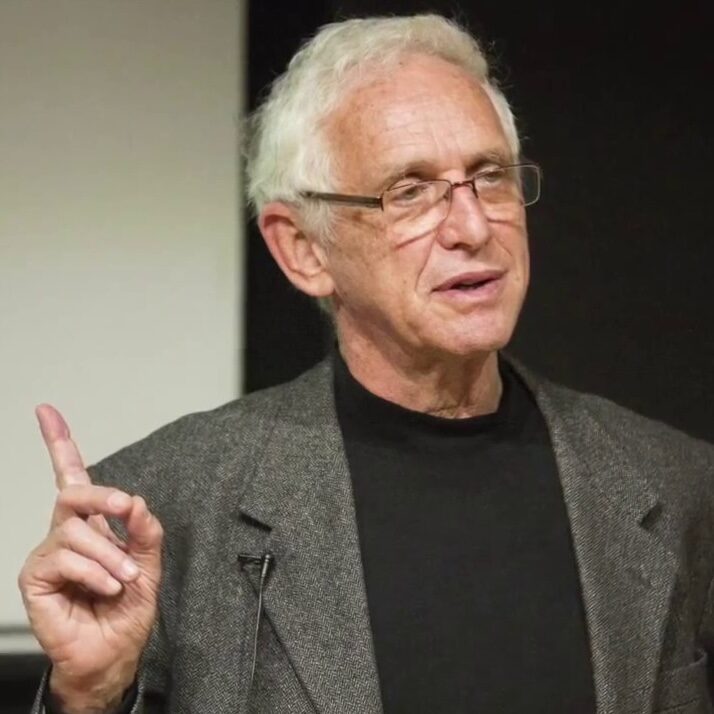
Addy Pross received his Ph.D. in chemistry from the University of Sydney. He is currently Professor Emeritus of Chemistry at Ben-Gurion University. He has held visiting positions in the University of Lund, Stanford University, Rutgers University, University of California at Irvine, University of Padova, the Australian National University Canberra, and the University of Sydney. He is the author of What Is Life? How Chemistry Becomes Biology.
Click to Show Episode Transcript
0:00:00.0 Sean Carroll: Hello everyone, and welcome to the Mindscape Podcast. I'm your host Sean Carroll.
0:00:04.1 SC: In physics, we're very used to talking about balls rolling down hills. This is one of our paradigmatic examples of a physical system that you can study to death. And it's very familiar in your everyday life that if a ball rolls down a hill and it comes down to the valley at the bottom of the hill, eventually it will stop there. It might roll around a little bit, bump into some things, but it will come to rest. And if you just took your first year physics course straightforwardly to heart, it would say that that shouldn't happen, because energy is conserved, right? If a ball rolls down the hill one way, it will roll up the hill the other way to exactly the height that it started at originally because of conservation of energy, of course, no one's really worried about this.
0:00:49.3 SC: We know that in the real world, there is friction, there is dissipation, there's air resistance. The ball makes noise, and that generates heat and things like that. So the energy is dissipated into the environment, and it makes perfect sense to us that the ball ends up on the bottom of the hill. Why am I telling you this? Because physicists have a way of thinking about structures that persist for extended periods of time. Stable structures, in other words. The ball rolling down a hill and getting to the bottom of the valley is a paradigmatic example. That ball's gonna stay there unless someone picks it up or some other force comes along and moves it. In a world with friction, you can distinguish between the total energy of a system and what is called the free energy of the system, the energy that is available to do work. And that free energy is degraded, is used up by friction, entropy increasing processes in general.
0:01:46.3 SC: So that ball rolling down to the bottom of the hill reaches a state of minimum free energy. There's nothing more that it can do, but sit there, and that's how we understand stability. This to no one's surprise, is not a good way of thinking about living beings. In particular, it's not a good way of thinking about the origin of life. You and I as organic creatures in our own right, individuals, are not minima of potential energy or even free energy. We are not sitting at the bottom of some metaphorical hill. Unlike the ball sitting at the bottom of the hill, we are internally quite dynamic, right? Even if we try our best to sit still, still our breathing, slow down our heart rate, there's a billion little processes going on in our cells.
0:02:36.5 SC: The ATP is being generated, blood is rushing from place to place. There's a lot going on. On slightly longer timescales, all of our atoms and molecules are going to be replaced, right? There're gonna be a ship of Theseus kind of situation going on where one by one, the actual bits of matter that make up you and me mostly get replaced. Not 100%, but to a very great degree, maintaining the kind of pattern that we have. So this is a very different kind of thing than just minimizing the energy or the free energy of a system. Today's guest, Addy Pross, is a chemist by training who became interested quite a while ago in the origin of life. And he wrote a book called What Is Life? How Chemistry Becomes Biology, where he focuses on a particular idea that he and his collaborators have developed called Dynamic Kinetic Stability.
0:03:29.4 SC: It's a way for a configuration of stuff to be stable or at least pretty stable, but not because it's kind of mechanically stable like the ball at the bottom of the hill, or even thermodynamically stable, like a box of gas in its equilibrium configuration. But a dynamically kinetically stable system, DKS, as they call it, is one that is constantly renewed by resources from the outside world in order to maintain a stable configuration. And as we'll talk about in the podcast, it's a little bit different from the physics version of this, where you're constantly getting new energy from the outside world. In what Addie is talking about, you're constantly getting new chemicals from the outside world, new molecules and running through them. And he makes the case that this kind of process is absolutely key to understanding the origin of life.
0:04:25.2 SC: The first sort of proto living organisms were these dynamically kinetically stable patterns in chemical reactions, which develop the ability to reproduce. And then once you can reproduce, you can take over, right? You might not be individually as robust as the rest of the world, but you can reproduce. So you can make a whole bunch of copies of yourselves, and those copies of yourselves can adapt to their environments. They can learn about things. So there's a whole new way of surviving and persisting, and as he emphasizes, persisting is what it's all about when it comes to existing in the world.
0:05:00.8 SC: So this is an interesting episode. It connects to other things that we've talked about, to the recent episode with Blaise Aguera y Arcas, to previous episodes with Stuart Bartlett and others about the origin of life with Sarah Walker. We don't understand the origin of life yet, but what we know is that it involves a whole bunch of different things. A whole bunch of different aspects are going to be involved, and I think this new kind of stability is one of them. And at the end, we'll even talk about how consciousness comes into that game. So stay tuned for that. Let's go.
[music]
0:05:49.9 SC: Addy Pross. Welcome to the Mindscape Podcast.
0:05:52.3 Addy Pross: Thank you Sean. Great to be here.
0:05:55.3 SC: So let's start very, very broadly. We're gonna work our way into some cool ideas I know, but one of the topics that we need to discuss is what is life? You wrote a book with that title, right? What is your definition of what life is?
0:06:13.4 AP: Yeah. Well, that's where the difficulty start. There are literally hundreds of definitions of life, and the fact that there are so many definitions means that probably none of them are very good, otherwise we wouldn't need hundreds of definitions. And the biological ones tend to be focused on biological aspects, nucleic acids, proteins, replication evolution, and the more physical ones tend to look at more physical aspects, self-organization, information, stability, instability. Somehow that hasn't been enough, and I think there have been developments in the last several years in systems chemistry, which I think can make a definition that enables you to have a recipe, how to make life in principle. An outline would be useful, and that's, which I will mention in a moment, is based on the idea that we've just learned.
0:07:24.6 AP: As I say, that there's a new state of matter that's been uncovered in chemistry in the last 10, 15 years, a remarkable though. Chemistry is a very established science now. And yet we've discovered that beyond the familiar thermodynamic states of matter, there are kinetic states of matter, and we'll need to talk a little bit about that and what that means. And life, if I have to define life now, I would say it's a replicating chemical system in this dynamic kinetic state, this new state of matter that's been recently discovered.
0:08:06.9 SC: Well, that's an interesting way to put it, because I think, and you also mentioned stability and instability as both crucial features, right? As a physicist, if I didn't know that life existed, I know that's a difficult thought experiment to pull off, but I would think that probably most things in the universe either are sort of moving like a planet orbiting the sun in a uniform way, or they come to rest. But life has this ability to sort of turn on its motion and turn it off, and that's kind of remarkable.
0:08:40.7 AP: Well, that's exactly the nature of this new state of matter that I'm going to describe a little bit. We're very familiar with the thermodynamic states that basically say that matter wants to be in a low energy state, but the strange thing is that stability has, which we use frequently in science, but not just in science, has two meanings, which are actually quite different. One is, in science, we tend to think of stability as low energy, but science in an, sorry, stability in an everyday sense means persistent, unchanging over time. And these two terms don't have to be overlapping, and they're not always overlapping. So when we talk about thermodynamic stability, they're overlapping. Why? Because when something is low in energy in its lowest energy state, it is also persistent. It sticks around effectively forever.
0:10:00.2 AP: But it turns out you can have stuff that is unstable in energy terms, but stable in time terms and time stability is in a sense more fundamental than energy stability because it encompasses both kinetically stable systems and energetically stable systems. So this is the essence of what I'm going to talk about that you can have something that is unstable energetically, but it's stable in the time sense, it persists. And just to make that clear, life has been around for close to 4 billion years, bacteria for most of that time. That is pretty persistent, pretty stable in the time sense.
0:10:48.9 SC: Absolutely. Yeah. And just to flesh that out a little bit, because I think this is something the audience might be interested in. When you talk about the thermodynamic sense, I would even extend that to the more general physical sense, right? If you have some system that has an energy that depends on various parameters and there's a minimum energy that it can have, then it's automatically stable, because if you nudge it away from that minimum energy, it wants to come back, it'll oscillate around, right? And maybe, do you tell me whether I'm on the right track here. Are you saying that we've kind of been blinded by that? Like that's too easy? There might be other ways to really be stable than that simple energetic picture?
0:11:32.2 AP: Well, that's the bottom line. The answer is yes and some forms of that are actually very familiar. And the metaphor, I like to use a physical metaphor for this kinetic stability is the simple phenomenon of a water fountain. There's this wonderful fountain in Geneva goes up whatever, 150 meters or so, and it is stable in a time sense. Whenever you go to Geneva, there it is doing what fountains do, but it's clearly unstable in an energetic sense. The water in that fountain is suspended in midair. So what's going on here? You can have something stable in a time sense because it is being created in a dynamic way so that the fountain as an entity is persistent, stable in this time sense, but the water drops in the fountain are continually turning over. Now that's a physical, a very simple physical description of kinetic stability. But some 15 years ago, chemist discovered chemical fountains. In other words, materials that are unstable in an energetic sense, but persistent and stable in a time sense, because they're turning over consistently, continually through that water fountain mechanism, energy and stuff coming in all the time.
0:13:11.0 SC: Yeah. The stuff coming in all the time. The energy coming in all the time in particular. In fact, I bet it has to be free energy. It has to be energy in a nice useful form.
0:13:21.2 AP: Yes, correct. Yeah. Absolutely.
0:13:26.9 SC: This is at least related to the idea of, or at least similar to the idea of non-equilibrium steady states in thermodynamics, right? Where you have something that is relying on the use of low entropy energy that is then being dissipated, but it's overall form is somehow stable over time. You're talking about something similar to that, but sort of adjacent idea.
0:13:52.8 AP: Yeah. Well, as you say, physicists have been familiar with this idea actually for a while. Prigogine in fact got a Nobel Prize for his contributions to non-equilibrium thermodynamics and the familiar examples then, there are... I spoke about fountains, but hurricanes, whirlpools are such structures that are stable, persistent in a time sense, as long as you have energy provided to them. But what was not familiar is that you can have chemical systems that behave like that. And life is the ultimate example of dynamic, kinetically stable material, which is continually undergoing change. And in terms, and just as I said, the water drops in the fountain are turning over all the time. In a few months time, you will be a totally different person. Most of the stuff that is you won't be you anymore. It's still you, but the stuff has been turned over and it's new stuff all the time.
0:15:02.4 SC: So Dynamic Kinetic Stability, DKS, those are our buzzwords here.
0:15:07.7 AP: Yes.
0:15:10.2 SC: I like it. But in the thermodynamic case, it is clear to me what is the fuel for making this happen, right? You have some free energy, like whether it's from the sun or whether it's from glucose that we consume as living beings or what have you. Do you have an an analog of that? Is there some particular kind of chemistry that we need to make the dynamic kinetic stability work?
0:15:36.1 AP: Not really, just a source of energy generally. Typically, it'll be chemical energy. The classic example was when this area was discovered was with a very simple reaction. One of the most basic reactions in chemistry, esterification. Now, if you take a carboxylic acid and you methylate it, which you could consider a source of material, but also a source of energy, you end up with an ester. Now, that is a downhill reaction because you started off high in energy and you go downhill and you end up with your ester, nice crystals. And that's a very familiar reaction that we've known for, I don't know, well over 100 years.
0:16:32.7 AP: But what two young Dutch chemists discovered, which was quite remarkable, that if you do this reaction in a dynamic way, namely turn the acid into the ester, and then continually degrade the ester back to acid, and then make more ester all the time in this dynamic way, you end up with a new form of matter. You end up with a hydrogel. Not crystals, a hydrogel which has unusual properties because of the way... Because it's composed of both the ester and the acid in a dynamic process.
0:17:20.3 AP: Now, the other thing that's very interesting here and very relevant to life is for that one thermodynamic process with one thermodynamic state, you have thousands, literally millions of kinetic, potential kinetic states, depending on the proportion of the acid and the ester that you would in the hydrogel. So if the hydrogel is primarily ester, it'll be more solid in its behavior and its structure. If there is more of the acid in there, it'll be softer. So you can play around with its properties. And guess what? Life uses that flexibility of kinetic states all the time. In fact, every time you do any motion, you lift your hand, you scratch your nose, whatever, you are actually moving from one dynamic kinetic state. Your cells are moving from one dynamic kinetic state to another, which is more appropriate for the new conditions which have been induced by of course, your brain, and that's already a complicated system.
0:18:34.9 AP: But just to give the the simple example that was discovered some years ago that shows how useful this is, is the cytoskeleton. Now, you have a skeleton, and it's fairly rigid in structure, happily. Cells have a skeleton as well, but the skeleton in the cell, the cytoskeleton needs to have dynamic function in order to suit the cell's requirements. So sometimes the cell wants a rigid structure, and sometimes it wants a softer one to facilitate transport of material, motion of the cell. And it can play around with that structure, because it's a DKS system made up... The dynamic system is made up of tubulin dimers and microtubules. The equivalent, the analog of the ester and acid that I spoke about in the simple chemical reaction.
0:19:37.8 AP: So the cell, if it wants a more solid structure, microtubules largely. If it wants a softer structure, it degrades the microtubules to tubulin, but this is all continually done in a way that dissipates energy. In other words, this is very important, just like the fountain is dissipating energy all the time, you put energy in but of course the energy doesn't disappear, it dissipates, ends up as heat energy. The body does exactly the same thing. And that's why our body's releasing heat all the time because the energy that is dissipated ends up in the lowest form of energy, heat energy.
0:20:21.0 SC: So this sounds like, I know this is a distraction, but it sounds like it would be super interesting to roboticists. Isn't this a much better way to build a robot with flexible materials that can sort of become rigid upon command rather than just building them out of metal and plastic that break and and can't be repaired?
0:20:39.5 AP: Well, that's a good point. And let me be very clear here, that human technology is always way behind natural technology. Nature is so very smart, and I mean, some Nobel Prize were given out now for artificial intelligence and neural networks. Nature discovered neural networks, well, not billions of years ago, let's say millions of years ago. So that's how it is, nature is smarter than we are.
0:21:15.2 SC: It took nature a long time to do it, to be fair.
0:21:19.9 AP: That's true.
0:21:21.2 SC: So let me try to get a, if it's possible visual representation of what's going on here. I know what a fountain looks like in these chemical fountains or these DKS states. What is it that the I or the audience should picture going on? Like in a test tube or whatever the context is?
0:21:41.3 AP: Well, here's the problem. When people have tried to make life, they haven't thought too much about these, the dynamic state that life is, and they've tried to take chemical stuff, proteins, nucleic acids, to move in that direction, play around with it in a test tube, and hopefully move it towards life. But that doesn't work. Just in the same way that if you are wandering around on the earth, you can wander around on a horse or walk or in a car that's not gonna get you airborne. That's a new dimension. That's another dimension. And you've gotta do something different to access that dimension.
0:22:29.8 AP: And once we found flight there, transport changed. It's the same with this new kinetic state of matter. It's the equivalent of flight, in that we've discovered we've accessed a new means of doing things. Nature discovered this new dimension of stuff, and life is a manifestation of what can be done once you are in that new dimension, extraordinary. And I hope in the course of our discussion, we'll be able to understand how life's most striking characteristics, its purposeful nature, its mental dimension. How can we think what's going on here, cognition, where did all of this come from? And physics is struggling with that because it's not in the physical description of stuff for stuff to think, and to have feelings and to get angry and to be happy etcetera.
0:23:34.6 SC: We certainly haven't made things in the lab that would really qualify as completely ab initio life, but I think that we have made these DKS states, these dynamically kinetically stable states. And so I'm just saying like, is there a pattern? Is it spatially uniform or does it look pretty?
0:23:54.1 AP: Yeah, well, people have been making them now in the lab for some years for a purpose because once you have these systems, they can be utilized in a functional way. You can, for instance, if you have vesicles which are in this kind of state with a drug inside, you can activate it and tell it to release, you can trigger it to release the drug. So you have what has been discovered here is a means of doing what life does to use matter in a more functional way, in a more, dynamic, in a more useful way. And that's, it's a new area in material science, which is really just getting started. But the facet that fascinates me is not the material aspect, but the biological connection because biology has taken this capability just so far because as you say, it's had a lot of time to work on ways of doing that.
0:25:11.3 SC: Well, good. So I think that that links us up to life once again. So I take your point that we are examining what is in effect a new state of matter, this dynamic kinetically stable kind of stuff. And there seems to be an obvious connection to how life is and presumably began. But for those of us who are not experts, fill us in on maybe the conventional wisdom about how life began. I know there are different schools of thought about replication and metabolism and things like that.
0:25:45.1 AP: Yeah. Well, there've been different theories, of course, of how life began. And the problem is that there hasn't been any real way to check which is the right one. And an essential part of the problem is that it's hard to understand how it began if you don't know what it is. And I think what we've been talking about is starting to give some more insight into what it is. So probably the strongest, idea for the origin of life began with what was called is the RNA worldview. The RNA worldview, it was discovered some 60, almost 70 years ago, that certain molecules have an extraordinary capability they can replicate, they can make copies of themselves. Actually the mechanism of it is very simple. It's not, it sounds like dramatic but basically, a nucleic acid is a long chain molecule made up of segments. Now, if you put such a molecule in a test tube with lots of the segments, the component bits floating around, the component bits tend to be attracted to the long chain molecule, the RNA in this case.
0:27:13.3 AP: So they latch on in a template type mechanism, and then those segments can join up. And then when the segments that have joined up separate from the original nucleic acid, the molecule, you end up with two, molecules and the molecules copied itself. So a very, very simple template mechanism, just like you can make, if you've got a rubber stamp, you can make copies of what's on that stamp just by stamping bits of paper many times. So that was a dramatic discovery, and it came about just a little after the discovery of DNA as the very important molecule of life as I hope we'll get to as we proceed. It's been made to be more important than it really is, but we'll come back to that in a moment. Well, in several moments. But the problem was once replicating molecules, were allowed to replicate like RNA, something dramatic happened, which was very exciting.
0:28:26.7 AP: The replication process showed that the molecule could evolve. In other words, the replication didn't always come about perfectly, but there was a mutation, a slightly different replicating molecule was formed by mistake. The replication didn't work perfectly. And therefore there was a process of evolution. Now, this was very exciting. So you start off with a replicating molecule, it makes copies of itself and it evolves. And the feeling was, wow, we've discovered the origin of life, the beginning of evolution, except there was one problem, when it evolved, it didn't evolve towards something that was living. All that happened was the replicating molecule became shorter and shorter and shorter. It started out with something like 5,000 segments and ended up with something like 500 segments. And the reason was very simple. The 500 segment molecule replicated faster than the longer molecule. So the shorter molecule out replicated the longer one.
0:29:34.8 AP: And, but that was going from complexity to simplicity as opposed to the other way, which is what we want. And that's been holding up that way of thinking about life, well, for 50, 60 years. So that hasn't been the way to get there. There was a metabolism idea that you get the organization coming about first but already quite a few years ago, a physical chemist in Israel, Sonia Lipson said, there's a problem with the metabolism first idea. And the problem is you are asking, disorganized matter to become organized. Now, the second law doesn't like that. Second law likes organized matter to become disorganized. So you can't start off life with a counter thermodynamic process. And that, in a sense, has run out into difficulties because of that simple issue. What this new dynamic, kinetic state idea does is to overcome the metabolism problem that the fact that you are organizing because if you get energy coming in, the rules change.
0:31:00.9 AP: I like to say that the rules governing balls rolling down a hill are different to the rules governing cars driving along a road and up a hill. Different rules. So once nature spontaneously in some way, managed to form a dynamic kinetically stable system, an important step towards the creation of life came about, but we need one more element for that to happen. And this is where we are struggling experimentally. The DKS system that you make has to be replicative in order to undergo change so that it'll become more, I was about to say, stable, but more persistent, stable in the kinetic sense. And we've only started working with these sorts of systems. So to make a system that is both DKS stable and replicative, we're not there yet.
0:32:06.0 SC: Yeah, that makes perfect sense to me because in the discussions of metabolism first, and, and replication first, it always was clear to me that you would eventually need both, whichever one came first, and there was this looming problem of how to link them up together. How did an RNA molecule build an engine, or how did an engine start replicating itself? And that seems like just as hard as getting either one of them to start.
0:32:31.5 AP: My comment here is the guy that figures that out, there's a Nobel Prize waiting for him.
0:32:36.5 SC: Somewhere in the audience right now. They're there. Or maybe here, maybe it's one of the two of us, but you know, it could be an audience member. So you're saying that is not something we have, we're zeroing in on the right idea for that you think?
0:32:51.1 AP: Look, all I can say it's early days. One, a group in Holland has been trying to work on that. But it's... I'm a theoretician, so I run away from experimental problems, so I can't make, experimental suggestions as to how that might be done. But all I'm saying is we at least have an outline, a direction to think about in order to somehow create a system that could, once it replicates, it can evolve. And let me say here clearly once it evolves, it'll evolve in a direction that complexifies, that leads to not simplicity, but to complexity because, just as the second law is quantitative, there is a tiny quantitative element to the DKS system as well. When you do the differential equation that describes the formation of a system in the DKS state, it's just the predator, the classic predator prey equation, formation of decay.
0:34:06.7 AP: But once you have two DKS systems competing for the same resource, the math says quite explicitly that the more stable, the more persistent one will drive the less persistent one into extinction. In other words, once you have a mutation in the DKS system, it'll thrive, it'll be encouraged and it'll push away. If you like, sucks the water out of the other fountain. So the upper fountain just collapses. And what will it do? It'll take on characteristics that enable it to deal better with its environment. So here's the beginning of memory because the fact that it changes in a way that makes it more stable, that greater stability is not inherent to the system, it's environmentally dependent, it's stable for that particular environment. Just like a tiger might be stable in Africa, but if you're putting him in Alaska on an iceberg, it's not doing too well.
0:35:23.4 SC: Maybe it's worth saying a little bit about the relationship of ideas like entropy, organization, simplicity, complexity, things like that. It's something that I've talked about in the podcast quite a bit, but there's definitely this naive feeling that if all the universe does is increase in entropy, how could something organized like life ever come into existence? And I know that that's not a very good argument, but it's at least a little bit of a worry in the back of our minds.
0:35:50.6 AP: Yeah. Look, the thing that has to be stated is that that will only happen for a limited period of time, as long as energy is available. Once the energy stops, everything stops. Now look, the fact that we build houses, we build lots of things, that's all counter thermodynamic because we're utilizing energy in order to bring about these systems that are counter thermodynamic. But as we can only do that as long as energy is available, once we... And most of the energy that enables life to proceed and develop on earth is solar energy. Once the solar energy stops, and that will happen eventually, then all life will... Just like, if you stop pumping water into your fountain, the fountain will die. And all of life, in that same way will die. It'll collapse because you don't have the source of energy. So there'll be no life when we get to that state. You physicists love to talk about heat death. It's not gonna be fun there. We won't have any, no pleasure in being in heat death. That.
0:37:11.9 SC: I absolutely agree with you there. I'm wondering if there's a way to help us understand when these DKS states happen. We all know what a fountain looks like and you turn it on and you make it go. But apparently from what you're saying, the whole idea of dynamically kinetically stable states is a relatively recent one. Is there a trick or is there some particular thing you have to do to make that occur?
0:37:39.4 AP: I have to say that my understanding from the work of people in the field that making these DKS chemical systems is not easy. And that has to be worked on more as well. And I can't comment too much on that because I'm the guy that doesn't dare go into the lab. So I can't say much on that, but just to say that it is being done. But it has, the systems that arise have an extraordinary, dynamic capability, flexibility, because as I say this, the fact that for every thermodynamic state there are thousands of kinetic states means that once there's a driving force for change, and there is one, and we'll talk about that in a moment maybe because it's very important because biologists tend to think of evolution as without direction. That is not true. Evolution...
0:38:49.0 AP: This history has a direction and the direction is very simple as that, simple, differential equation that I described earlier states, systems go from less persistent to more persistent. But something here also has to be stated because it confuses biologists a lot and it it troubled me initially. If I'm saying there's this tendency towards greater complexity, why are bacteria still around because they're simple? So that seems to counter the complexification argument. The answer is bacteria aren't simple at all, they live in networks.
0:39:34.4 AP: They don't live individually and all life is increasingly an interconnected network where all the living things are interacting with one another. Your microbiome lives very comfortably off you. So it's wrong to think of bacteria as bacteria as an individual is simple, but life is a complex network and it's complexify-ing all the time and that's why life has basically taken over the planet. It's everywhere in this very intricate network, and it goes back to the Gaia ideas of who was it? Lovelock? Yeah.
0:40:20.4 SC: Lovelock. Yeah.
0:40:20.5 AP: It's very interesting that now biologists are starting to say, hey, you know what? Maybe... Modern biologists recently are starting to say maybe he was onto something and one should view life as almost, I don't wanna say one system, but it's there is something in that idea that it's a dynamic system where everything is connected to everything else.
0:40:49.0 SC: I do wanna dig in a little bit more to this idea of simply out reproducing your competitors. It sounds similar to an idea that we talked about recently with Blaise Aguera Y Arcas who I think you also communicated with. And he has a computer program where it can do all these different things. And when it stumbles across reproduction and computation, that little bit takes over the whole space. And am I right in thinking you're advocating something similar that once you have the right kind of DKS state and it learns to reproduce, that will start to take over?
0:41:24.6 AP: Look, there's no question that the power behind expanding as it has is the power of replication. If you take one single, the, a fertilized egg, a human fertilized egg, it undergoes something like 40 to 45 acts of replication to become, something like 50 or 70 trillion cells. The kinetic power of replication is awesome, but of course as Malthus pointed out some years ago, you can't keep doing that, you run out of resources. So what happens is the best you can hope for, and this is where we are all the time, a balance, you have rate of formation balanced by a rate of decay and these have to be, attuned to one another.
0:42:27.3 AP: So flies replicate at a rate that requires them to live for one day because that's when the balance comes about. Humans, it's close to a 100 years for that balance to be maintained, though I'm beginning to worry about that because we become, we're starting to edge towards that 9,000,000,000 or whatever but maybe that'll because once use nature once replication forgets about that Malthusian rule, nature is very cruel, nature doesn't forgive, and it comes back one way or another back to equilibrium, either kindly or unkindly.
0:43:22.1 SC: Good. So I guess then I would like to better understand stability then. I mean, there's... Stability because you've been mentioning stability, and it has a lot of aspects like you already pointed out. I am pretty darn stable, but is that what matters, my body, or is it, is the gene being passed down through generations and its stability what matters?
0:43:42.3 AP: Yeah. Well, I owe a lot of credit to a young guy, Steve Grant who wrote a wonderful book in the year 2000, Creation, where he said a statement that I saw was barely acknowledged in the literature. He said, the most important law of nature, that's quite an introduction to a law that you wanna propose and his most important law of nature was things that persist, persist and things that don't don't. So he was claiming that the tautology was the most important law of nature. Well, I think that can be improved a little bit, taken away from being a tautology and changed to there's a general tendency for things to go from less persistent to more persistent.
0:44:42.5 AP: And the second law of thermodynamics fits into that category, but the persistence principle is wider than the second law because the second law is restricted to energetically stable whereas the kinetically, the kinetic systems expand the space to kinetically state persistent systems that aren't energetically stable. So there it is, you can have stability of this dynamic kind, and that's part of nature as well. In that sense, life isn't a totally unexpected phenomenon because you can see that now in this new thermodynamic or kinetic perspective, the only thing one has to realize is that it seems that the ability for this to get going is highly contingent.
0:45:47.5 AP: So, if you're gonna ask me, are we gonna have life in every other planet in some form or other? The answer is I don't know because the high contingency means the probability that it will happen, that the circumstances will allow naturally for a dynamic kinetically stable system to emerge and for it then to become replicative so that it can evolve and expand, I am at a loss, I do not know the likelihood of that, except that it did happen once.
0:46:23.2 SC: Happened once. Right. Just so I know what the jargon means, is my body a DKS system?
0:46:36.4 AP: Absolutely because every cell in your body is a DKS system because the cell is a dynamic kinetic system where all the molecules in the cell are continually turning over, your body is a DKS system because your cells are turning over, some faster than others. Apparently brain cells turn over more slowly, blood cells, you're shedding millions, billions of these daily it's a dynamic system at many levels. It's, at the molecular level, it's happening at the cellular level, at the organismal level and, of course, at the societal level. In a 100 years time, all the people roaming the earth will be different people to us.
0:47:26.9 SC: Is this the moment where we should talk about how DNA is overrated?
0:47:33.0 AP: Well, maybe. Look Biology has been in a in a situation of ongoing crisis, developing crisis for several decades. The genomic paradigm has been very powerful and very useful, but it hasn't been able to answer certain things. And the way biology has gotten around that is by band aids well, horizontal gene transfer, epigenetics, continually looking for ways to maintain the fundamental idea which is genome centric, and that is the essence of neo Darwinian theory. But together with actually a bunch of some 20 very serious biologists, we put out a monograph, just a year ago with the title, Evolution on Purpose. Biologists have been realizing for quite a while that this purpose wherever we look and that doesn't fit in with the physical perspective that biology was trying to push onto itself to kind of be respected by physicists. They want physicists to look at them respectfully, so they were saying random mutation, natural selection, all physically logical. But it's simply not the case.
0:49:11.4 AP: And, what happens is you cannot replace an old paradigm with a new one, the paradigm doesn't change through failures in the old paradigm because what happens when the paradigm starts to not work, you add band aids. What you need is a new paradigm that will encompass the new information and that has been slow to come about. Let me just quote a very respectable biologist from Oxford, Denis Noble, who sai, the general view is that the genome controls the cell. He says it's actually the other way around. The cell controls the genome.
0:49:55.5 AP: That is quite a... That's changing the way one should look at a living system. Now, let me give you an example which is very striking, the CRISPR system, What's her name?
0:50:18.2 SC: Jennifer.
0:50:18.5 AP: Jennifer Doudna got the Nobel Prize for discovering how to edit DNA. Wonderful invention, except bacteria discovered that billions of years ago, so it was a copy and paste process there. As I was saying earlier, nature is very clever, but let me just say something here which is quite extraordinary. A bacterium, a very simple biological system, when it is attacked by a virus and the the viral attack fails, it takes a little bit of that viral DNA and puts it into its own genome. In other words, it changes its genome, that's not an accidental mutation, that's a deliberate change in its genome to incorporate some of the viral DNA as part of its immune system because once that DNA has a bit of viral elements in it, next time that virus comes around, it recognizes it and then it can protect itself by cutting the viral, DNA in 2 and then it's harmless. The very opposite of what biology has been telling us for almost a 100 years, well since DNA, that DNA Mutation is random, and, natural selection is how evolution comes about.
0:52:05.4 AP: Not true. Already, the beginnings of that understanding were uncovered by Barbara McClintock in the 1940s. And people just thought she was talking nonsense when she noticed jumping genes that genetic material was changing position in corn with a microscope. She saw this, and she was just ridiculed until people saw some decades later that this was true. And she got in 1980 war III or something, a Nobel Prize, for that work. Another biologist, who makes this point very clearly is Jim Shapiro in Chicago, who says, DNA is thought of as a read only system. He says it's a read write system. In other words, this is starting to come round to what I was saying, what, Denis Noble is saying. And biologists still have to take this in, that the cell basically controls the genome just as much.
0:53:05.8 AP: The genome is an important location for memory, for information for the cell. But it's clear that it's not the be all and end all because it's an extraordinary thing that when that one fertilized egg became trillions of cells, a human body, there are kidney cells and liver cells and brain cells and skin cells, and they're all different, but they all have the same genome. So basically the cell uses the bits of genome that are relevant for the cell at any particular moment. So it's, as I say, it's not the genome running the roost, it's the cell itself. And that brings me back. So where did this all start? So now you see the beginning of the evolutionary process in a system that is the dynamic kinetically stable system, has already a sense of self and an awareness of an outside.
0:54:24.4 AP: Now, this may be a little bit hard to comprehend initially, but I think the point is important. And again, the fact that DKS system is totally dependent, existentially dependent on its environment for resources and energy, that means it is aware in a very rudimentary sense of its environment, because without that it dies. So, and that external appreciation or awareness means there's the beginning of self-awareness. So it distinguishes between itself and the environment. Now, that might sound, huh, now a chemical system that is... That sounds a bit hard to swallow, but when you think of a leaf, this is how I think about it. A leaf blowing in the wind, it's hard to see the principles of flight in what happens with that leaf fluttering in the wind. But they're all there.
0:56:01.2 AP: So once you have a very simple DKS system with the beginning of self and the beginning of external awareness, if you now have an evolutionary process that enhances that for persistence, then the result will be an increasingly complex system that is increasingly self-aware and externally aware. So the bacterial cell, doesn't know too much about the planet. It only knows what's in its immediate vicinity. As we humans became more and more aware, well, animals like to know their environment, maybe a few kilometers or whatever. And we're looking far into space, into the solar system and beyond because of our increasing capability, increasing self-awareness and increasing external awareness, that's evolved over time.
0:56:35.1 SC: Yeah, maybe we can put these in terms similar to what... We had Chris Ami on the podcast, not too long ago, and he wrote a book about information in biology and makes the claim that every biological organism has a huge amount of mutual information with its environment. Not necessarily because it's thinking about the environment, but because it is adapted to survive in that particular environment. And this is exactly the point you were making earlier.
0:57:01.3 AP: Yes, I agree with that. I think it was the physicist, Max Debruch who said that every cell contains within its history going back, millions of years. Because that's been a continual adaptation, to its environment.
0:57:21.0 SC: And is this a kind of teleology, I think you were hinting at that earlier. I mean, I think that, I would certainly agree, but maybe I'm wrong with the conventional biological view that evolution is not typically forward thinking. It's not trying to solve a problem that hasn't arisen yet. It's just trying to survive in the present moment. Are you asking us to think beyond that paradigm?
0:57:44.8 AP: Absolutely. I think, just as the second law of thermodynamics is directed, very explicitly directed, and though we don't say it's purposeful, we just say there's a law of nature that directs in the direction that it goes. Change in the dynamic kinetic world is also directed, but because the topology of thermodynamic space is convergent, then the law of nature that describes that is very clear. The problem is in dynamic kinetic space, the space is divergent because when you're at a particular point, there isn't one pathway forward to increasing persistence. It's all contingent.
0:58:43.7 AP: So it's a divergent space, but that doesn't mean that there isn't a directive pushing it forward. It doesn't go backwards. Life never evolves in a reverse direction. It's moving forward towards increasing complexity for increasing persistence. So in that sense, the evolutionary direction, there is an evolutionary direction and the direction is towards, it's Steve Grant's principle towards increasingly persistent forms. You can get to persistent forms in two ways, the thermodynamic way, Boltzmann's way, and you can do it the life, the kinetic way, but change has to have a directive and it has a directive in the biological world as well.
0:59:43.4 SC: And I guess it makes sense that if you can begin to see glimmers of self-awareness in these persistent DKS systems, self-awareness broadly construed, then maybe it's not so surprising that you see self-awareness more narrowly construed and maybe even the beginnings of cognition and consciousness and things like that.
1:00:11.7 AP: Yes, this is very interesting because the problem biology has given, of course, physicists heartburn for a century. I mean, Schrödinger and Wigner and Bohr, they basically said life doesn't make sense according to the known physical principles. And I think it was Schrödinger that hinted that there may be laws of physics that need to be discovered yet to be able to explain all of this. But it turns, now I'm gonna say something cruel, that between physics and biology, there's this other little subject called chemistry that can help bridge between the two. And I think the kinetic dimension is suddenly allowing that physical biological connection to come together.
1:01:08.3 SC: Okay. I mean, maybe can you say a little bit more explicitly about consciousness itself? I mean, consciousness, as you know has just been something people have wondered about for a long time. Philosophers sometimes try to make it almost inexplicable. Where do you come down?
1:01:26.4 AP: Yeah, this is a wonderful question. And I think what we can see through this approach is the beginning of cognition, because we're saying inherently, the DKS system is cognitive. If cognitive means an awareness of the environment, it is aware. There's a definition of cognition that is a system that is able to store, access, and act on information. But that's exactly what a DKS system does. The energy and material that are coming in are, if you like, information input, and it acquires that information and responds to that information. So we can see essentially the beginning of cognition in the way that a DKS system behaves. By definition, it is cognitive. And then we come to the tricky bit that one couldn't have predicted that this internal sense, this sense, the inner sense that we have comes about as a result of self-awareness. Because in order to be able to deal better with the outside, you've got to look after your inside.
1:03:00.0 AP: You've got to be aware of what's happening inside of you. Your internal state is relevant to your ability to respond and react to the external environment. So there's a growing tendency of self-awareness that comes about naturally, if you like, through this evolutionary process.
1:03:24.3 AP: By knowing ourselves, look what we humans have done. We know ourselves to the extent that we understand all of the physiological processes, the metabolic processes that are going on within our bodies. Amazing. But apparently, one can argue that the cell, the bacterial cell, already is aware of its own state and responds to changes in the environment through interacting with the environment and its state may change. And of course, phenomena like changing, locating, chemotaxis, moving towards food. It's an awareness of its environment, and its internal state says, I'm hungry. Go get some food.
1:04:25.2 SC: I guess it makes perfect sense that a greater capacity to gather information about the environment and then process it helps you survive. Right?
1:04:32.6 AP: Exactly.
1:04:33.8 SC: That's that's not at all surprising, but then there's presumably some competition or constraints or trade offs because you don't wanna see something new out there in the world and then be frozen with option paralysis by saying what do I do? I'm gonna think about it. Right? In the real world, these are always sort of satisfying things where we do just well enough to get by rather than perfectly optimizing what's going on.
1:05:01.1 AP: Yeah. Look. Actually, this way of thinking has helped me reach the conclusion that sometimes there's a tendency for philosophers to say that everything we see around us may be illusory. It may not exist. But I actually say now that that can't be right because if we everything nature has given us all of these tools to persist and we, our understanding of the environment is important for our persistence, so it is there for a purpose. Consciousness, our mental activity apparently takes up something like 20% of our energy. A huge amount of energy is put into our cognitive state. Nature wouldn't do that if there wasn't some return for that. And so our, the fact that what we see is what is really there has to be true because otherwise, because if we get confused about it, then we won't persist. People who lose track with reality can't survive. So I am comfortable with that idea. In fact, it's very interesting.
1:06:26.8 AP: In our eyes, the vision, the image on our retina is an inverse image. But nature knows that the image is the other way, so we correct for that. In other words, nature wants us to see things as they are. And I think... And that is an interesting thought, which has a bearing on whether, the whole world is an illusion. And as Descartes said, the only thing I'm sure of is that I exist. Well, maybe, we can take that. Given the understanding of the interaction between self and the environment, maybe we could go a step further and be convinced that there is a universe out there after all, and we're not making all of this up.
1:07:24.7 SC: And it's a somewhat deflationary view of consciousness in the sense that, if I'm understanding correctly, like, even bacteria have a tiny bit of awareness of themselves in their environments, and all we human beings are doing are we're just much better at it than the bacteria are.
1:07:39.8 AP: I think so. I think in that sense that consciousness and cognition started off from the very beginning of the evolutionary process, and it's remarkable I have to make a comment on this because Darwin, in his endless wisdom, already foresaw that. He said in his treatise that the process of evolution takes place along both physical and mental dimensions. He was extraordinary. He understood that the mental dimension couldn't just pop up in the middle willy nilly out of a physical situation on its own, that's not how evolution works. Evolution improves on something that had to be there. So Darwin already foresaw the mental dimension as being there from the beginning of the evolutionary process. So going back to that point, so bacteria are cognitive, and I'm wary of the term conscious.
1:08:53.9 AP: But obviously, on the spectrum from 0 to 10, if we're, at 9.5, the bacteria are at 0.3. But they have something there in order for them to deal with the problems that they encounter and that they have to solve.
1:09:12.5 SC: Well, it's a good sort of wrapping up point because that picture of mental aspects and biological aspects both playing a role is parallel kind of to the picture of the genome and the structure in the cell both playing a role. I mean, the lesson overall is that information flows and control systems are not one way in biology. It's back and forth.
1:09:38.1 AP: Exactly. In that sense, what was it called? The central dogma, which with which we started information flows from the genome, DNA, RNA protein, we have to modify that. It's a more dynamic, type of things. The cell is holistically a wonderful term from Stuart Kauffman. The cell is holistically self replicating. In other words, no element in it on its own is self replicating. If you take a DNA molecule and put it on the table, and even if you throw nucleotides at it doesn't make copies of itself.
1:10:30.1 AP: It doesn't work. We're in a cycle that closes. A makes B, B makes C, D, E, F makes A, and once the cycle is closed, you have a self replicating system, and the cell is, if you like, holistically self replicating where everything plays a part and the genome is one part, a very important part, but it is just a part of the holistic cycle.
1:11:02.9 SC: We all are just a part of the holistic cycle at the end of the day. That's a good place to end on. Addy Pross, thanks so much for being on the Mindscape Podcast.
1:11:10.6 AP: Great talking to you, Sean.
“0:57:21.0 Sean Carroll: And is this a kind of teleology, I think you were hinting at that earlier. I mean, I think that, I would certainly agree, but maybe I’m wrong with the conventional biological view that evolution is not typically forward thinking. It’s not trying to solve a problem that hasn’t arisen yet. It’s just trying to survive in the present moment. Are you asking us to think beyond that paradigm? 0:57:44.8 Addy Pross: Absolutely.”
Well, we now know that at some point at least one physical-chemical-biological evolutionary system evinces teleology very expressly. This crowd called Homo sapiens are obsessed with meaning and purpose, and are actively trying to manipulate their internal and external environments in pursuit of goals they conjure up. They don’t stand apart from evolution; they are the product of evolution, even if only contingently so. And they are not even the culmination of that process. We know they are keen on individual and collective persistence, and something they call progress. Some think that they can achieve, through deliberate construction, anything not forbidden by the laws of physics (nature). The beginning of infinity, perhaps. Entropy be damned?
So, teleology seems to be built into the ‘laws’ are at least the features of genesis, incipiently with early life, but then expressed as an explicit phenomenon (in at least once case) down the track. We shall perhaps discover the same (inherent? inevitable?) trait as when we find life elsewhere in the universe.
Time for Sean to interview Kevin Mitchell (Free Agents), not to complete the circle (we are a long way from there) but just to join some more dots.
Tigers in Africa? Semper aliquid novi, it seems.
Sean,
At about twenty minutes you mention that it seems like roboticists would do well to build them out of more flexible materials. Connective Tissue is the reason why it is so easy to teach a robot to play chess but so hard to teach it to walk like an animal.. You can think of your skeletal system as DNA and the rest as the Cell as CT. Specifically here, Fascial CT-the body-wide collagenous web that covers and wraps up every item of you 2 or 3 times. You are one big tensegrity structure. The Isolated-Muscle Theory is long past. Physiological movement requires a body-wide responsive physiological network. Unfortunately, Plato’s quote that the Book of Nature may indeed be written in the Characters of Geometry is still dogma. Dogma limited to the Newtonian-based levers, vectors and inclined planes of the Isolated-Muscle Theory. Anatomy Trains, Fascia, ROM, and Tensegrity are helpful topics for further consideration. Think about Calculus and zeroing in on a point on curve. Consider that point to be an individual cell. For a Robot to move like a Human it will have to manage tension, strain, rebound, memory, etc.just like most every cell in the human body does besides neuronal cells.
Note: The Cell’s ability to effect DNA is really nearly unquestionable. Recall Michael Levin’s example of the flea whose cytoskeleton was partially changed, not its DNA, and that trait became heritable. Lastly, if considering fascia for the first time it may help to start with acknowledging that bones do not touch other bones. That shit hurts. Cartilage, ligaments , tendons are all part of this continuous web that surrounds, encapsulates, bags up every “part” of you 2-3 times.