
In a relatively short period of time, exoplanets (planets around stars other than our Sun) have gone from an intriguing conjecture to an active field of scientific study, with over 5,000 confirmed discoveries. The task now is to move beyond merely accumulating new examples, and embarking on systematic studies of their properties. What fraction of stars have planets, how are they distributed in size and distance, what kinds of atmospheres do they have, are any promising homes for life? I talk with Natalie Batalha about what we've learned so far, and prospects for future discoveries.
Support Mindscape on Patreon.
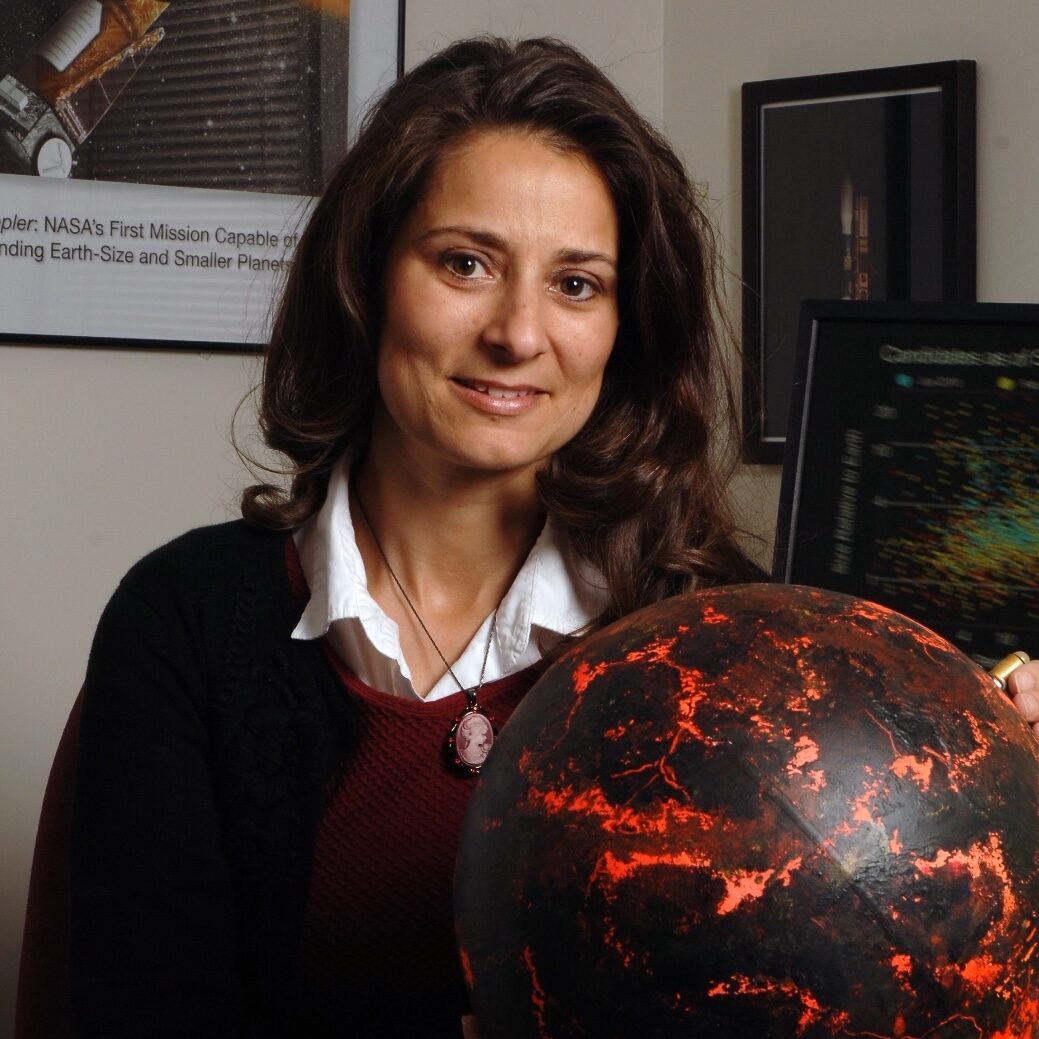
Natalie Batalha received a Ph.D. in astrophysics from the University of California, Santa Cruz. She is currently a professor of astronomy and astrophysics at UCSC. She has served as Science Team Leader, Mission Scientist, and Project Scientist for NASA's Kepler satellite observatory. She is a member of the American Academy of Arts and Sciences, and was listed as one of Time Magazine's 100 Most Influential People in the World in 2017.
Click to Show Episode Transcript
0:00:00.6 Sean Carroll: Hello everyone. Welcome to the Mindscape Podcast. I'm your host, Sean Carroll. One of the things that I learned back in my undergraduate astronomy major days was when you have a telescope, what the telescope can do is to find in part by the telescope itself, it's light collecting power, it's field of view, things like that, but very much by the instruments that you put at the other end of the telescope. The light comes in and then you detect certain features of the light. You could put a camera there, right? This is the obvious things where you get the pretty pictures from the Hubble Space Telescope or the James Webb Space Telescope. You could put a specter graph there. This is a workhorse instrument for real astronomy. You look at the spectrum of light from distant objects, you can detect redshifts using that and chemical compositions, all sorts of interesting things.
0:00:50.9 SC: Or you can just do a photometer. When I was an undergraduate at Villanova, suburbs of Philadelphia, we had a telescope on the roof of the science building, and I would spend hours out there collecting data. There weren't enough photons that you could get in that particular environment to do precision spectroscopy or even imaging, but you could do photometry. All you're doing is measuring the brightness of the source at different moments of time. We have filters, so you could do different colors, you could detect the redness, the blueness, et cetera, but not precision spectroscopy in any way. There's an enormous amount that a professional astronomer can squeeze out of the data you get from the photometric light curve of an object. Mostly at Villanova we did variable stars, binary stars, things like that. But the real amazing work that's been done over the past couple decades has, of course, been in detecting planets around other stars, exoplanets.
0:01:49.7 SC: The simplest, most direct way to find an exoplanet, you can't just take a picture of it. They're too dim. The planets these days, you're beginning to be able to do it, I should say. But when you first start detecting these, the simplest thing is just to wait until the planet passes in front of the star, blocking out a little bit of the light. And if you're able to very precisely measure the total amount of light, you can see that dip in brightness that is indicative of a planet being there. This is the method that was used by the Kepler mission, space telescope that was put up by NASA and by the TES mission, which was sort of a, a follow up to that. Today's guest, Natalie Batalha, was a project scientist on Kepler and she knows a lot about how these telescopes worked and how they brought us wonderful information about the population of exoplanets in the galaxy.
0:02:38.8 SC: There are a lot of them, as Natalie says, she suspects that essentially every star in the galaxy, almost all stars in the galaxy, have some kind of planets around them. We're just beginning to really understand the entire population of these planets. It's easier to find planets when they're heavy. It's easier to find them when they're near the star. So we have all sorts of things that are getting in the way of being an unbiased collection of planets. But the progress is amazing. And of course, once you detect the planets using a photometer and a dip in the light curve from a transit, you can follow up. You can say, "Oh, that star has a transiting planet. I'm going to point a much more precise telescope at it, like JWST, and try to measure features of its atmosphere." We're not quite to the point, as Natalie is very clear about where we can detect, you know, signatures of life on other planets using methods like this.
0:03:33.2 SC: But we can imagine getting there and it's, it's really going to be a revolution in how we think about our universe. We talked about this before on the podcast, but the progress is coming so fast, and the number of questions that we still have is so large that it's always worth diving in and seeing where we are right now, also, seeing where we're going in the future. And this is not something that's going to take a hundred years to do, uh, two decades from now. The situation is going to be very different than it is today. That's an exciting prospect. So, let's go. Natalie Batalha, welcome to the Mindscape Podcast.
0:04:21.1 Natalie Batalha: Podcast. Thank you so much for having me.
0:04:23.2 SC: We've talked about exoplanets before in the podcast, but it's always a subject that to me I can never get enough of, because when I was young, we didn't have any exoplanets, right? I was a grad student in the late '80s, early '90s, and thus we hoped there was some discussion, and now we have so many of them. It's like you've seen a complete transformation in real time. What was the situation when you started in this game? Did they already have a few exoplanets in pocket?
0:04:54.0 NB: No, no. I was a stellar astrophysicist, as were many of my colleagues, as were many of the people who were looking for exoplanets at the time, and the number of those individuals was very small. So I was a graduate student in the early '90s and early to mid-90s, and actually I got invited to go to a conference. My advisor was the one who got invited to go to the conference, but he couldn't go, so he sent me instead, and I was a third-year graduate student. And on the last day of that conference, Michel Mayor announced the very first exoplanet orbiting a normal sun-like star. So I was there when it happened, so I feel like I've had a front-row seat to exoplanet discovery since the beginning. And a lot of us who were doing stellar astrophysics at that time eventually changed our careers to search for exoplanets, not just because that's where the money was. Certainly there was funding that was going into it, but just because it was interesting and because our expertise was needed. The way that we were finding exoplanets was by observing the star itself and observing some oddity about the star that pointed to an extrasolar planet in orbit around it. So in order to do that, you had to understand the stars.
0:06:12.4 SC: So, let's talk about how we actually have been finding these. The Kepler mission, which was a NASA satellite, you were heavily involved with that at some point, project scientist, and I think it's probably the most well-known mission in the popular imagination that has found planets. So tell us about that.
0:06:30.5 NB: Yeah, I stumbled upon Kepler, I can't say by accident because I was very intentional. I reached out to Bill Borucki. I had learned that he was proposing such a mission, had done so a few times through the NASA Discovery Program. So I sent him an email in around 1999 saying that I was interested in what he was doing, but that I was actually very skeptical. He was proposing a new methodology, transit photometry. So you observe the brightnesses of stars and you look for these periodic dimmings of light when the planet eclipses its host star. But I knew I had been studying star spot distributions on young solar-like stars, and I knew that star spot areas could be larger than the shadow of a planet or a projected area of the planet on the disk of the star. And I knew that they rotate in and out of view with the rotation of the star, and I was wondering how you could use this methodology knowing that the brightnesses of stars modulate due to those star spots rotating in and out of view. And it was fortuitous. He responded to me immediately and said, "Oh, that was one of the reasons why our former proposals were rejected."
0:07:43.0 NB: There was a similar skepticism. And so he invited me to go interview for a postdoctoral position, and I arrived at NASA Ames in early 2000 and helped with some of the revisions to the proposal that went in and ultimately got selected. So again, another example of just like lucky me having a front row seat to all of these things happening kind of at the same time. So Kepler then had a very extended development phase due to various issues, not issues, but mostly at NASA headquarters, you know, things getting budget issues that kept pushing out the launch date, which was good for us. It gave us more time for the development phase, and we learned a lot during that phase. We were actually building a ground-based telescope, a roboticized ground-based telescope at Lick Observatory at the time, and that's how we cut our teeth, our baby teeth on this method. We were learning how to do it and how to analyze the data, the photometry, how to get the requisite precision that we needed on this tiny little shoestring budget like clooged together with duct tape and sailing pulleys and all kinds of crazy things. We did that in an abandoned dome up at Lick Observatory, an abandoned dome that leaked, and the dome itself, like, would get stuck.
0:09:06.7 NB: The motor had to be constantly repaired. It was quite an adventure. But that is how we learned to do it, and we did it in those years before launch. We also studied the stars themselves to select the best stars and point the telescope in the best place to optimize our chances of finding potentially habitable Earth-sized planets. So the goal of the Kepler mission was to identify planets as small as an Earth orbiting in the habitable zones of their host stars and to quantify their frequency in the galaxy.
0:09:43.1 SC: And how did you overcome this star spot problem?
0:09:48.6 NB: So, there was to, well, two approaches. One, on the digital signal processing side, there was a very talented PhD expert level in electrical engineering, John Jenkins, who did studies on the digital signal processing side. And he took the photometric variability of the sun that had been observed for many years using the SOHO spacecraft. And he tweaked it. He took it and he said, "Okay, let's increase the amplitude and let's decrease the timescale for variability, and let's see how that impacts transit detectability." And it turned out that the transits themselves are operating on, you know, 4-12 hour timescales, and most of the variability of the sun is operating on longer timescales. So then you could apply digital filters to separate out those frequencies. And so the only time then that it impinges on you is when the variability timescale of the star pushes down to the four to 12 hour timescale.
0:11:01.6 NB: And that happens when you have stars that are rapid rotators, rapidly rotating stars tend to be young stars. So that's where we enter the other part of the analysis, which was to do population synthesis of the stars in the galaxy and figure out what fraction of the stars we would be observing would be young enough so that their variability impinges on that timescale. And it turned out to be about, I don't know, 30% as much as 30%. And so that just meant that we had to observe enough stars to account for that attrition to still yield the detectability that we needed. And so, we ended up observing like 150,000 stars instead of a hundred thousand stars, and it all worked out.
0:11:48.4 SC: It's interesting just at a personal level, to me, I was an astronomy undergraduate, and I got my name on a research project as an undergrad on measuring chromospheric activity in main sequence stars. Not the sign...
0:12:00.6 NB: There you go.
0:12:01.2 SC: But elsewhere there. And I'm wondering if that helped one of you folks...
0:12:05.1 NB: Probably.
0:12:06.3 SC: Probably, yeah.
0:12:07.3 NB: Probably, yeah.
0:12:09.2 SC: It's a great example of, I suspect that the person who is not a professional scientist thinks, you know, they can absolutely wrap their brain around the idea, we're going to measure the brightness of this star, and it's going to dip when there's a planet in front 'cause of a little transit, and we're going to discover planets. But as you're pointing out, you always have to worry about what other things can cause exactly that signal.
0:12:32.6 NB: Exactly. Exactly. And not only just from a variability standpoint of the stars, but there are other sources of astrophysical, false positives that can confound us. You know, there are eclipsing binary stars in the galaxy, and they can actually dilute the signal of a foreground star and make it look like there's a transit. So, you know, those are the kinds of things that we learned during the ground-based survey. We had many candidates that were identified at Lick Observatory, and the project was called Vulcan. And we followed up a lot of them and we learned the different kinds of false positives that can appear, and that helped a lot.
0:13:14.1 SC: And Kepler was in some ways very successful. But we have to emphasize it wasn't a giant expensive thing on the scale of the JWST or the Hubble Space Tele Telescope. It was a relatively lightweight thing that all it did was measure brightness. There's no pictures, no spectra.
0:13:33.5 NB: Yeah. It was very simple. I mean, the budget, I think turned out to be something like, you know, in the hundreds of millions, not tens of billions or mini billions. So it was a discovery class mission, which sets its budget. And in terms of hardware, it was very simple. And that was intentional. Like we could have opted to put color filters on our photometer and observe the star isolating different colors. A lot of people, in fact, Plato is doing this because it suggested that you can rule out some of the false positive scenarios by looking in multiple colors. We opted not to do that, to keep it as simple as possible so that there were fewer failure modes and so, and fewer noise sources. And I think that that was a really good strategy at the time.
0:14:19.0 SC: And so tell us about, is it still going Kepler? It's turned off now, right?
0:14:24.4 NB: Yeah, so Kepler launched in 2009 and operated for just about four years to the day. And we had applied for an extended mission. We wanted another four years of data on the Kepler field for reasons I can talk about. And on May 14, 2013, which happened to be my birthday, I'm there at lunch enjoying my birthday taco with my friend Michelle Johnson, who was the director of the Kepler communications team at the time. And we both got messages at the same time that a second reaction wheel had failed. And so the loss of a second reaction wheel effectively precluded us from continuing observing the Kepler field. And so we had to completely shift strategies from there onward. So we ended up getting...
0:15:18.6 SC: I'm sorry. Tell us what a reaction wheel is.
0:15:20.4 NB: Yeah, so a reaction wheel is like a gyroscope. And you need three reaction wheels to control the three different axes of rotation that can occur. That keeps the telescope pointed in the right direction with great stability. And so we launched with four. So we had some redundancy. But we lost one of the reaction wheels in July of 2022 or something like that. I don't remember exactly. No, sorry. I'm mixing up my decades. Not 2022. What am I talking about? 2012. So I think around July 2012, we lost one reaction wheel. So then we had three. And then May of 2013, we lost a second one. So now we could control two axes of rotation, but the third was open loop. And you needed that third to be able to point in the direction we were pointing towards Cygnus, the constellation Cygnus.
0:16:20.8 SC: You needed to have some clever way of nevertheless getting some data.
0:16:24.4 NB: Yeah, the engineers came up with this very clever way of controlling that third axis of rotation by pointing the telescope towards the sun and making use of its architectural axis of symmetry. So one of the things that can cause a telescope to wander around is radiation pressure from the sun. You can think of it as like water flowing towards you down a stream. And that flow can cause your boat to sway from side to side, depending on how your boat is oriented in the stream, in the current. But if you take your boat and it's symmetric and you point it exactly upstream and you let the water push on you symmetrically, you will stay pointed exactly upstream. And so that's what they did. And they tested this mode of operation. They pointed the symmetry axis of the telescope exactly toward the sun. And then let the other angles vary. So you could point slightly above it, right? As long as you kept some symmetry in the architecture pointed towards the sun, you could move the telescope in other directions or rotate it around the other two axes of rotation.
0:17:47.9 NB: And so that's what they did. But it meant that we had to observe fields in the sky relatively close to the sun, basically the ecliptic, what we call the ecliptic or where the zodiacal constellations are. And so we completely reformulated the science goals of the next four years to observe fields along the ecliptic in that mode. And it worked beautifully.
0:18:12.6 SC: I love these stories of engineering heroics, especially for you're trying to control a satellite that's thousands of miles away, right? And you can't go and touch it.
0:18:21.6 NB: It's unbelievable. Yeah, it's kind of like magic to me. I mean, I know it's the laws of physics, but it's just so clever. And it's amazing how necessity is the mother of invention.
0:18:34.2 SC: And what was the final tally for Kepler discovering exoplanets?
0:18:41.3 NB: So, let's see. From the Kepler field itself, the first four years pointed at Cygnus, we ended up with about 5,000 planet candidates, of which I think about 2,800 have been confirmed. And then we have additional hundreds of planets that were identified by the subsequent four years along the ecliptic, which we called K2 after the mountain, but also kind of Kepler 2.0. Yeah. So that amounts to even today, all these years later, about half of the confirmed planets in the exoplanet catalogs, the public databases are from Kepler.
0:19:22.2 SC: And there's a bunch of different ways of finding exoplanets, some of them ground-based, some of them satellites. My impression is that TES is the big follow-up one that's been pretty successful also.
0:19:34.2 NB: That's right. Yeah, absolutely. So TES is also doing transit photometry, so the same method. But instead of staring at one field of view, Cygnus, it's actually doing a step and stare approach to cover or tile the whole entire sky. It has a smaller photometer, that is, it collects less area, so it has slightly less sensitivity. But it can do a whole sky survey. So its aim was to identify all of the nearby transiting planets. You know, the transiting planets, astronomers love coincidences in nature that they can leverage to learn new things, right? And so eclipses, solar eclipses, I mean, there's a huge history of doing this in astronomy over the centuries. But these eclipses of planets across their star give us a lot of information. From that, we can measure the planet radius. Of course, we can get the orbital period. But then there's other tricks of nature that you can do. For example, when a planet is right in front of its star, some of that starlight is going to filter through the atmosphere of the planet that is hugging the surface. And in doing so, it will bring to us the chemical fingerprints of that atmosphere.
0:20:52.7 NB: We call that transmission spectroscopy. So if we can then observe all of that light and disentangle the photons that are coming from the star versus the photons that are trickling through the atmosphere, then we can get at those chemical fingerprints. And so TES was going to identify the systems that are doing this, doing these transits, that are very close to us. And the reason that's critically important is because we had this big flagship mission that was about to launch called the James Webb Space Telescope. And it was going to do transmission spectroscopy and study the atmospheres of these planets. But it needs exquisite precision to be able to disentangle and pull out those chemical fingerprints. So it needs the brightest stars. It needs the nearest stars. And that's what TES did. So TES launched in 2018 and is still operational. I think it has confirmed something like 600 planets as of now, as of today. And again, these are all nearby planets. So for example, if you look at the exoplanet catalog and you pull out only the planets that are within, let's say, 300 light years, we like to use different units that we call parsecs.
0:22:16.4 NB: So it's about 3:1 ratio between light years and parsecs. So that's about 100 parsecs. So if we look only at the stars that are within 100 parsecs in our discovery catalogs, we have about, I don't know, 1,400 of these planets that are relatively nearby. And of those, maybe 500 or so are actually transiting. And TES has identified 328 of those. So it has made a huge contribution to identifying the nearby planets that are so important, not just for the James Webb Space Telescope, but also for ground-based follow-up observations like Doppler masses that we can do with ground-based telescopes. We haven't talked about the Doppler technique, but it provides a critical piece of information.
0:23:09.5 SC: You tell us that we wanted to see what the nearest exoplanets are because it helps JWST, but we all know it's really because you want to go visit them, isn't it?
0:23:19.1 NB: That's our secret. No promises, but.
0:23:24.6 SC: Keeping that one a secret.
0:23:25.0 NB: Yeah.
0:23:28.6 SC: But I mean, it's a great story of the teamwork between the different telescopes because, I mean, it's absolutely clear that you might want to shine light through the atmosphere, analyze it, ask what's in the atmosphere. Something like Kepler tests can't even imagine doing that. They are only tracking brightness.
0:23:44.5 NB: That's right.
0:23:45.9 SC: But they have broad enough vision that they can grab a lot of planets at once, and then you need the follow-up from this hyper-specialized, very precise instrument in JWST.
0:23:57.6 NB: That's right. It's almost like we planned it. I'm being sarcastic because I mean we actually did. I mean there is this like strategic vision. NASA has a 30-year roadmap that was drafted in like 2013, sometime around there, that includes TES but also goes beyond even James Webb and thinks about the future and how it all fits together. So yes, all of these missions have synergies, work together, complementarities. It's quite lovely.
0:24:29.9 SC: But my impression is, maybe I'm wrong about this, that in the early days of thinking about JWST, it was mostly sold on looking at early galaxies and doing cosmology. Because we didn't have a lot of exoplanets and we didn't know that that would be the growth area, but it turns out maybe it's not perfect for exoplanets, but it's a really good instrument for that.
0:24:50.6 NB: That's exactly right. Webb, the design of Webb started before there were exoplanet detections and the big science drivers were mostly extragalactic astronomy. So, you know, everything changed in 1995 when that first exoplanet was discovered on so many levels, but it changed for Webb as well, for Hubble. I mean, Hubble had just been launched. Hubble was already flying and, you know, now we have exoplanets and you have the possibility of doing transmission spectroscopy, which Hubble could even do for the giant planets. So it meant finding new instrument modes. I mean, Hubble was serviceable, so you could actually build new instruments or make adaptations. Webb is not. So what you launch with is what you got, is what you get.
0:25:42.1 SC: Too far away, right?
0:25:43.8 NB: It's too far away. Yeah. So, but there was time to build in, to modify the instruments that were under development and build in this time series mode for spectroscopic observations. And every instrument mode, there are multiple instruments on board and every one of them has the ability to do time series spectroscopy.
0:26:09.3 SC: So in other words, maybe explain on that a little bit. In the earlier version, it could take a spectrum, but not many spectra in a row to see what was changing over time?
0:26:19.6 NB: Yeah, not necessarily of single point sources like a star, but yes, it's the time series that's important. So the way I like to think about it, we talked about Kepler and TES observing these dimmings of light, okay? But it does so in one band, at one color or one collection of colors all integrated. Now, Webb and Hubble, they do the same exact thing, but at a thousand colors simultaneously, okay? And so you, I mean, it's another way of imagining the data. But what happens is you take a spectrum and you take a spectrum at many different time stamps, and then you can take one color at all the different times. And if you plot those numbers, how much brightness you have at that color at all the different times, you see a light curve with a transit, a dimming of light, just like Kepler and TES collect. But then you have those at all the other colors as well. So you can look for variations. And so when you hit a color that carbon dioxide loves to gobble up, then the star effectively absorbs or removes more light at that color. And so when you look at the eclipse, the dimming of light gets a little bit deeper, right? Because more light is being taken away at that specific color.
0:27:40.9 NB: So that's the game that we play. We look at all of these transits. Transit is just a dimming of light in this time space. And you measure the depth of the transit at all of these different colors very precisely, you know, at the part per million precision.
0:27:58.3 SC: And that also helps you with the thing that you alluded to earlier, the Doppler measurements.
0:28:04.0 NB: The Doppler measurements are really important in their own right because Doppler measurements give you dynamical information. What do I mean by that? I mean that planets and their stars are dynamical systems. The planet is orbiting the star so it's hurtling through space as it orbits the star. In fact, what's happening is that the star orbits the planet too. So both of them are orbiting about their common center of mass. So if you observe the star and take a spectrum, so I'm hesitating only because I have been given very specific instructions during various interviews not to use the word spectrum.
0:28:48.2 SC: Here's where you can use the word spectrum.
0:28:49.7 NB: Okay. I'm going to use the word spectrum here. Okay, let's put on our big girl pants here. And I'm not going to use the word rainbow. We're going to use the word spectrum. Okay? Basically we're taking all the starlight and we're spreading it out into its constituent colors. There are absorption lines, which is this chemical fingerprint of atoms and molecules that could be surrounding the outer layers of the star. Those are absorption lines. And we can see those absorption lines wiggle back and forth in color space due to the motion of the star. So that's the Doppler effect. And we measure that with very high precision and that gives us the velocity that the star is moving towards us and away from us. And that is the dynamical information that we need that maps to the gravitational force that maps to the mass of the planet that's tugging on it. So that's the chain of logic. So we measure this and we end up getting the mass of the planet. And why is that important? It actually helps us to interpret the spectra, the transmission spectra of the atmospheres of the planets. We need to know how thick the atmosphere is.
0:30:05.4 NB: There are different, I'll say degeneracies. Imagine you've got lots of knobs that you can tune that give you the size of an absorption line at a certain wavelength. That absorption line is going to be deeper or shallower depending on all these different knobs that you tune. One of those knobs is the surface gravity of the planet. If the surface gravity is really high, the atmosphere becomes very compact and it's thin. It scrunches down. If the surface gravity is low, the atmosphere lofts and it's very thick. And that affects how deep the absorption lines are. So you need to know the mass of the planet, the surface gravity, in order to disambiguate that effect from other effects due to, for example, what is the mean molecular weight? That's another technical term. It basically just means, is your atmosphere made of all hydrogen, which is very light, or is it native carbon dioxide, which is going to be very heavy? If the atmosphere is heavy, made of carbon dioxide, it's also going to be very compact. You see the degeneracy. They both have the same impact. You have to be able to disambiguate between them.
0:31:22.0 NB: And so you need the mass. The mass gives you the surface gravity. So that's one example of why mass is important, but also mass gives you compositional information. With the transit method, we get the radius because it's basically the disk of the planet blocking out a certain amount of light. However much light is being blocked is related to the size of the planet. Okay, so you get radius. Doppler method gives you mass. Well, if you have mass and radius, then you can calculate mass divided by volume, which is density.
0:31:58.3 SC: There you go.
0:31:59.3 NB: So that gives you the bulk density. And the bulk density of Jupiter is very different than the bulk density of Earth. Jupiter's bulk density is like one gram per cubic centimeter. Saturn is less than one. It would float in a bathtub. Earth is like five and a half. So just getting that density, that bulk average density, tells you something about the average composition of the planet. So all that's really important too.
0:32:26.1 SC: So we have then thousands of exoplanets, but there's hundreds of billions of stars in the Milky Way galaxy. What can we say about the overall population? If we fearlessly extrapolate just a little bit, what do you think that we've learned?
0:32:38.9 NB: Well, I mean, Kepler taught us a lot about the diversity of planets. It taught us that the diversity of planets in the galaxy far exceeds the diversity of planets in our solar system. It taught us that, you know, the nearest potentially habitable planet is probably 10 light years away, very close. That's like, the analogy we like to give is imagine that you take the Milky Way and you shrink it down to the size of the continental United States. And then, you know, I'm here in Santa Cruz, California, standing at the shores of the Pacific Ocean. I turn east facing Washington, D.C. I look out across the continental United States and I imagine, on this scale, where is the nearest potentially habitable planet? And it's like down at the library right here on campus. It's super close. Yeah. But it taught us that the most common type of planet orbiting normal stars in our galaxy, orbiting within one astronomical unit, so that's like an Earth orbit or interior, is a kind of planet we don't even have in our solar system. It's something, we don't even know what to call it, a super Earth or a mini Neptune. It's like in our solar system, we have the small rocky things, we have the big gas giants and nothing in between.
0:34:03.5 SC: There's a clear division, yeah.
0:34:05.0 NB: There's a clear division. But in the galaxy, the between planets are the most populous orbiting within one astronomical unit. And then there's other caveats, like I'm not including planets the size of Mercury and Mars, but for an Earth and bigger, those are the planets that are most populous. So we learned that. And then I can start to get a lot more technical. I think that Kepler is going to teach us, those Kepler demographic sample is going to teach us about the physics of planet formation and evolution for years to come because we're using the multi-dimensional parameter space of these bulk properties of planets to see patterns and to map those to synthesized populations from theory that include all the physics. You make a model of how planets form and evolve and you use that to simulate the planets, what you would expect the planet population to look like, and you compare that to Kepler data using all of the information that you have. And it's teaching us a tremendous amount of information about how planets evolve that will be important to habitability considerations in the future.
0:35:21.3 SC: Right, I definitely want to dig into that a little bit. But first, just are there stars out there we think that don't have planets or are we learning that most stars basically have little solar systems around them?
0:35:31.3 NB: That is another result from Kepler, is that on average, every star has at least one planet. So could there be stars without planets? My guess is no.
0:35:44.4 SC: Wow. Okay, that's great.
0:35:46.7 NB: But I suppose it's possible, yeah.
0:35:48.9 SC: But the typical star we expect will have planets around it. Do we have any idea how many it would have on average?
0:35:55.9 NB: So Kepler is only sensitive to orbits within an Earth orbit, you know, Earth or inward. So Earth is at one astronomical unit or inward. So we haven't even begun to probe the outer solar systems and we know that there's more planets at longer orbits. Kepler also was only sensitive to kind of an Earth sized or larger. So we haven't even probed the Mars and Mercury sized planets. So, you know, that's why whenever I'm asked this question, I say at least, you know, one or two planets per star on average. It's going to be more. That number is going to increase as future missions complete the picture.
0:36:40.7 SC: Right. So I guess TES also, I mean, it's kind of obvious. It's easier to see planets when they're close. They're more likely to do the transit. It's easier to see planets when they're big. They have a bigger effect. So tiny planets and planets that are far away, we know less about right now.
0:36:56.4 NB: That's right. That's going to change with the launch of Roman. What is that projected...
0:37:01.6 SC: Tell us about Roman and how it will help.
0:37:04.2 NB: Yeah. So the Roman Space Telescope is going to launch, and now I can't remember if it's, I think it's 2027 or 2026. I'm sorry. I can't remember the expected launch date.
0:37:14.9 SC: I don't believe any of the dates anyway, so.
0:37:16.5 NB: Yeah, exactly. Everything's in flux. Who knows if NASA's going to exist in a year.
0:37:21.0 SC: Exactly.
0:37:22.2 NB: But the Roman Space Telescope, in part, it's going to do multiple things, but one of the things it's going to do is a microlensing survey. This is another planet detection technique, which makes use of the general relativistic effect of light bending around masses, and it leverages that to detect planets orbiting foreground stars. And the great thing about this method is that it's unlike the transit method, as you just said so eloquently, which is sensitive to planets orbiting in short orbital periods around predominantly small stars. This method is more sensitive to longer orbital periods. And so it, too, is going to do a demographic survey like Kepler did, but beyond one astronomical unit. So some years now in the future, we're going to be able to link the Kepler Demographic Survey with the Roman Demographic Survey and have a complete census of exoplanets in the galaxy.
0:38:24.4 SC: My impression was that our expectations were not really quite right before we started doing these observations. How good are we at predicting ahead of time? Do we have a pretty firm feeling for how many planets the Roman Space Telescope will also detect?
0:38:40.3 NB: No, of course not. I mean, well, we have some data from the Doppler surveys, which have now been observing stars since the 1990s. So we've got a three-decade baseline, which is starting to reach out to some of the longer period planets, but those are going to be the giant planets. We know nothing about smaller planets, even Neptune-like planets, at longer orbital periods. So we can kind of start to see that as you go out in semi-major axis to larger and larger orbits, the occurrence of giant planets starts to, well, first it decreases, and then it starts to go up a lot. So you're starting to see a rise in occurrence as you get to longer orbital periods, and Roman will flush that out for us. And it'll do that also for smaller planets.
0:39:43.7 SC: So when you talk about the theory of making a planetary system, how good are those theories? Is it pencil and paper? Is it mostly simulations?
0:39:55.3 NB: It's definitely not pencil and paper. These are complex models of how planets form, and they generate synthetic populations that we can compare to Kepler data, and it actually does pretty good with the Kepler data. I mean, it qualitatively does okay. We've done some of these calculations ourselves, comparing synthetic populations to Kepler, and when you look at the distribution of the properties over orbital period and planet radius, it kind of looks okay. You can tune it to look reasonable, but then you take the synthetic population, which also has planet masses, and you plot the masses versus radius, and it kind of all goes to hell. So, it doesn't look so good. So there's still a lot of work that needs to be done. But, you know, it's qualitatively doing okay.
0:40:54.9 SC: My impression is that there is a, this is like Wikipedia-level knowledge, but there are kind of a bimodal distribution in the masses where you have, like, the rocky planets and the gaseous planets, maybe because if you're small but gaseous, your atmosphere gets blown away. But I might just be making that up.
0:41:16.0 NB: Okay, so what you're talking about, the bimodal distribution is from Kepler, and it's in the planet radii. So when you look at planets orbiting within one astronomical unit, and you plot their frequency as a function of radius, you see that nature makes small planets more efficiently than large planets at these orbits. So that was expected, just like in the solar system, right? You have more asteroids than you have planets. You have more terrestrial things than you have giants. So nature, even with stars in the galaxy, nature makes smaller stars more efficiently than larger stars. So we expected that. But buried inside of that is this little dip. So you have a lot of planets that are smaller than about one and a half times the radius of Earth, and you have a lot of planets that are larger, even more planets, that are larger than about 1.8 to 2 times the size of Earth. And there's a dearth of planets in between, kind of centered on about 1.8. And the models are telling us, yes, exactly what you said, that this could be due to the outer envelopes of the planets getting sculpted by stellar radiation impinging on their surfaces.
0:42:36.7 NB: These are all short-period planets. They're bombarded by radiation from their central stars. And when that radiation is in the ultraviolet or even the extreme ultraviolet, it's very efficient at breaking apart molecules and then driving them off of the surface altogether. And so that's going to radically modify their radii. And you put all of that physics in your models, and it actually yields this kind of bimodal distribution. So it's kind of a time scale issue, like how fast the mass loss occurs and how you get a pile up of planets at certain radii.
0:43:14.8 SC: But it's a good reminder of why the theory is so hard to do right. There's so many effects that go into this final answer.
0:43:20.9 NB: So many effects, yes. And it's not static. Stars, when they're young, look a lot different than they do when they're on the main sequence. And so the environment changes and activity levels change. And magnetic activity can produce this really high energy radiation. And so it's a very dynamic problem. And then planets move around, so they're not currently in the place that they were when they were born. So they lose angular momentum, they change their orbits. They might form out in the cold environments of a stellar disc, a proto-planetary disc, but then end up close to their stars. So they carry with them a lot more volatiles or light molecules like water ice, than they would've had if they had formed in C2, close to the star. So, it's a very complex problem with a lot of different degrees of freedom.
0:44:21.3 SC: We know that heavier elements are made in stellar explosions and winds and things like that. So stars that formed earlier have less heavier elements around them. I would therefore conjecture that they're less likely to have planets around them. Is that something that you can test in the data?
0:44:39.1 NB: One of the craziest surprises to me early on in the Kepler mission was the discovery of an Earth-sized planet orbiting the star. I think its phone number was Kepler-444. Because this star was literally the age of the galaxy itself. And here it had a rocky planet. And I was like, wait a second, how is that possible? I have since learned, and probably you with your extragalactic, more cosmology perspective, would be quick to point out that when the Milky Way formed, it was itself already enriched by a lot of supernovae that had occurred in the environs. So the Milky Way, as it formed, presumably already had some of these heavy elements that are important for planet formation. But I think that the devil is in the details. I think there are indications that if you dial up or down the relative abundances of some of these heavy elements, you get very different results. One example. The Earth currently is still very hot in its interior, right? We still have plate tectonics. We still have volcanism. All of those things are important for regulating the carbon, et cetera. Okay, but 50% of that internal heat is due to radioactivity that's going on in the center.
0:46:13.5 NB: And the radioactivity comes from elements like thorium or these really heavy elements. And it turns out that those heavy elements are largely produced in these extremely violent events like neutron star mergers. So our cosmologists and extragalactic astronomers who study these very extreme events, like those that generate gravitational waves, have been modeling nucleosynthesis and coming up with these results on these very heavy elements that are produced by neutron capture. And giving that information to our planetary scientists who then look at the galaxy and say, "Okay, how much does the abundance of these radiogenic elements vary across the galaxy? And then if I do my planet interior models and change these abundances, what is the outcome?" And it turns out that the models are extremely sensitive to how much of this radiogenic species you have in the interior. If you have too much, you change the interior convection of the core and you can actually shut off magnetism. And if you have too little, then you don't have enough heating to drive plate tectonics. And the Earth resides right at the sweet spot. So it's very interesting. Yeah. So these details do matter.
0:47:39.6 SC: Well, something I was thinking about just while thinking about this conversation is Earth, Venus and Mars are roughly the same size, not that different in their distance from the sun, but radically different conditions near the surface. Is this something that we completely understand or are there a lot of accidents of history, both inside the planet and the atmosphere that go into what the planets look like today?
0:48:06.9 NB: Yeah, it's a really good question. I think we know a lot about it. I mean, Mars is, you know, two times smaller, about half the radius of Earth, and its smaller size will influence the rate of heat loss. It's also further from the Sun, and that means that heat is going to be lost even faster. So it's no surprise that Mars is geologically dead today. Venus is quite a bit closer, so, you know, a runaway greenhouse can occur on Venus earlier, and that can act to desiccate the planet. Probably has something to do with that desiccation, probably has something to do with the viscosity or lack of viscosity of the mantle and how it outgasses. So, we know some of the details, but actually Venus is a great example. We know very little about Venus because we haven't visited it. So I'm really excited about missions like da Vinci, who are going to actually go there and study our twin, because you're right, you know, same mass, same radius, slightly different orbits. So is that the only reason why Venus is so different? I'm guessing yes, but, you know, we'll find out more when we go there and study it.
0:49:25.6 SC: Have we ever, or is it even reasonable to imagine discovering an exomoon around an exoplanet?
0:49:33.8 NB: Yeah, I mean, we're hopeful. We are hopeful, but I think it's very challenging. There are no indications of an exomoon yet, but people are actively doing it. There were in this last round of James Webb Space Telescope proposal selections, there were a couple of projects that were selected to look for exomoons. But right now it's just kind of like one target at a time, and it has to have other science to do as well. And you leverage that to say, "Oh, as long as I'm here, I'm going to see if there's any signals of a moon," that kind of a thing. And I think you need a much more rigorous search, but it's really tough. It's really a difficult problem.
0:50:22.8 SC: But we have been measuring atmospheres. So what have we learned about the atmospheres of exoplanets?
0:50:29.9 NB: Okay, great question. What have we learned? So first of all, it's remarkable how many planets the James Webb Space Telescope has studied in its short four years. I mean, especially if you compare it to like Hubble. I mean, Hubble over 20 years of operations observed maybe 50 planets, 50 exoplanets in transmission. Hubble in just four years has observed like 200.
0:50:58.9 SC: Webb.
0:51:00.1 NB: So, oh, sorry, Webb. Webb over four years has observed like 200. So in four years, you know, quadruple the number that Hubble did in its lifetime. So that's quite remarkable. We're able to do them a lot faster and we're able to do smaller planets. A lot of the resources have gone into observing giant planets. So we're learning a ton about giant planets. We're observing many chemical species. For example, the very first exoplanet that we observed in transmission, well, technically the second exoplanet we observed in transmission was WASP-39b, and we detected sulfur dioxide. That was interesting because sulfur dioxide cannot exist without photochemistry. That is, you have to have a star that's irradiating the surface and breaking apart water molecules in order to start a cascade of chemical reactions that leads to sulfur dioxide.
0:51:52.8 NB: So it's similar to what happens with ozone production in our upper atmosphere. So this was the first time that we have the opportunity to study a photochemical pathway in an exoplanet atmosphere. But, you know, we're observing lots of these giant planets orbiting at short orbital periods and trying to understand disequilibrium chemistry. You know, what are the kinds of processes that operate in atmospheres that can do things like, I don't know, preserve methane? Methane is a molecule that breaks apart at high temperature. So it's only going to exist in great abundance when you have low temperatures in the atmosphere. But then you've got these oddballs where you observe a hot planet and lo and behold, there's methane. So there's got to be some kind of weird disequilibrium process that's lofting more methane into the atmosphere. So what is that process? There are also giant planets for which we can take a raster of the longitudinal information. What do I mean by that? So, well, let's say, for example, we already talked about how planets eclipse their stars. They go in front of the star. Well, then they keep on orbiting and at some point they're going to duck behind the star, right?
0:53:10.8 NB: So if you observe the system right before it ducks behind the star, you see the star-facing illuminated side of the planet and then it dips behind the star and now you see only the star. So if you subtract those two things, you can get the light that's actually being emitted by the planetary surface, what we call the thermal radiation of the planet. So that's cool. You know, you can do lots of cool things with that. But here's the kicker. You can actually watch this in real time. You can get data as the planet is ducking behind the star and you get longitudinal information because you see the star eclipse, you know, longitudes or slices of the planet at a time.
0:53:57.1 SC: You're doing a CAT scan.
0:53:59.2 NB: It's this, yeah, it's a raster scan. You're doing a raster scan of the surface, and you're mapping out the temperature of that surface. And from that, you can deduce dynamical information about how heat is redistributed around the surface due to climate, you know, due to the motion of the atmosphere. So there's all kinds of interesting things you can do with giant planets. Then there are, let's jump now to the very small planets, the rocky planets. Everybody wants to observe the rocky planets. Sorry to disappoint, but we are not going to get biosignatures or evidence of life with the James Webb Space Telescope. However, there is one really interesting question that astronomers are asking, and that is, do rocky planets orbiting M dwarf stars even have atmospheres? And the reason they're asking this question is because the M dwarf stars, when they're young, are very bright. They're very luminous. Their luminosity changes dramatically between the time that the cloud creates, you know, an opaque ball of something to the time that it starts fusing hydrogen in its core, the overall luminosity is changing a lot.
0:55:27.0 SC: And these M dwarf stars are lower mass than the sun.
0:55:30.3 NB: That's right. The M dwarf stars are about 10 times smaller mass, one-tenth of the mass of the sun. And they comprise about 70% of the stars in our galaxy. Remember I said nature likes to make small things more efficiently than large things. 70% of the stars are these M dwarfs, right? So we're super interested. I mean, if all M dwarfs have habitable planets and life, I mean, the implications for life in the galaxy are huge. So we want to understand this. But there's this bugaboo, which is do M dwarf atmospheres get stripped away before the M dwarf even settles on what we call the main sequence, before the M dwarf starts fusing hydrogen in its core because of that luminosity. So this is a big open question. And so there are really clever methods for testing this with the James Webb Space Telescope. And so people have been trying very hard to do this. And so far, of the small handful of planets that have been observed, they look like bare rocks. Okay?
0:56:39.7 SC: That's too bad.
0:56:41.0 NB: Well, don't discount them yet. A lot of those bare rocks, we expect it to be bare rocks anyway, just because they're orbiting very close to their parent star. So even today with the star's luminosity, they're probably stripped bare rocks, okay? So there's that. But in addition, we don't have the precision maybe yet to detect low-level atmospheres. So we need cooler planets, that is planets that are orbiting a little bit further away, where we do expect the atmosphere to be there, and we need better precision. So what the Space Telescope Science Institute did, they're the organization that runs the James Webb Space Telescope, the director gets a little bit of time herself on the telescope. This is called director's discretionary time. And so she got 500 hours to do with as she pleased, and she decided to put out a call to the community to say, "Tell me what the most exciting exoplanet science would be." And the community did this exercise and said, "We want to know if M dwarf planets have atmospheres." So she is dedicating these 500 hours to that goal. And this is the first year that two of the targets are going to be observed this year. And we're going to observe them for a very long time to get the best precision we can.
0:58:04.2 NB: One of these targets is actually pretty cool. So it could very well have an atmosphere. And so we should have the answer to that question within the next, let's say, five years. So I'm excited about that. I feel like I'm talking too much, so I'm going to pause, Sean, and let you ask a question.
0:58:24.8 SC: No, no, no It's great. Yes. Well, it's a very, very good point because, like you say, most stars in the Milky Way are these relatively smaller, dimmer stars. You might think naively that if they all had planets, those are the best places to look for life. But you've just given us a, you've thrown some water on that, some cold water on that possibility. Maybe they all have planets. Maybe they last a very long time with a very long lifespan. But maybe they haven't been able to keep their atmospheres. So that is something to keep in mind.
0:58:58.0 NB: That's right. That's right. We need to very carefully dissect all of these different possibilities.
0:59:05.6 SC: And the sun is a G-type star rather than M.
0:59:10.1 NB: That's correct.
0:59:11.2 SC: How much do we know about the population of Earth-sized planets around G-type stars?
0:59:16.5 NB: Not much. I mean, really nothing. We probably won't until we have the next flagship mission after Roman, which would be the Habitable World Observatory. But in the meantime, there's one other thing that Webb can do that I'm really excited about, and that is observe these between worlds that I talked about earlier. These things that kind of are between the terrestrials and giant planets in our own solar system, you know, they're like one bigger than Earth but smaller than Neptune. Okay, maybe two and a half times the size of the Earth. That's where the most of them are concentrated. What are they? We don't know what they are, okay? We have no idea. I mean, we have some idea what they are, but there are many theoretical models that could explain their composition, and they all yield the same mass and radius. So there's what we call a degeneracy. We can't disentangle those different ideas. So people call them different things, like, "Oh, maybe they're a gas dwarf. Maybe they're a mini Neptune. Maybe that's a water world. Maybe it's a Haitian planet. Maybe it's a steam world." There's like all these ideas, but they all have redundant outputs in terms of the bulk properties.
1:00:34.6 NB: And we want to disentangle what these planets are, and these planets can be observed with the James Webb Space Telescope with this method of transmission spectroscopy and has been done for about a dozen or so of these planets, and a few of them have actually shown spectroscopic features, and these are planets like K2-18b, which was recently in the news. There's another TOI-270d, I want to say it is. I might have my letter wrong. You should verify that.
1:01:07.8 SC: Yeah. Okay.
1:01:09.1 NB: Yeah, so a few of these have shown features, methane molecules, some carbon dioxide, and we need to do more of that, and we need to do it at higher precision to really understand and be able to disentangle the possibilities for their interior composition. And, I mean, one, just because we don't know what they are, but two, because there is a possibility that they represent more real estate for habitability, and we need to understand that.
1:01:41.6 SC: My impression is that the idea of a Goldilocks zone where, you know, not too hot, not too cold, has come under a little bit of pressure. People are trying to say that, you know, we should be a little bit more forgiving about places where life might appear in different solar systems.
1:01:59.4 NB: What do I think about that? I mean, obviously, yes. We are very myopic in how we approach the search for life, and by design. I mean, necessarily so, because we only have one example of life. That said, the more I study astrobiology and I study the evolution of complexity in the universe from the Big Bang to intelligence, the more I think that life is creative and prolific and robust and is going to find its niches, that the laws of physics are going to give rise to complexity on a local scale, and interesting things are going to happen wherever there's an opportunity, right? But it's probably no coincidence that life on Earth is made of carbon, and carbon is also one of the most abundant heavy elements that the universe creates, carbon and oxygen, and nitrogen.
1:03:01.9 NB: So life uses carbon, nitrogen, oxygen. Those are the most abundant heavy elements that nature produces or that the universe produces. That's probably not a coincidence. Carbon has special properties. It has four valence electrons. It can create complex polymers. That's probably not a coincidence either. So can silicon, people say, "Yes, that's true, but silicon has more orbital shells, so its valence electrons are farther away from the nucleus, and so the chemical bonds of the molecules are going to be slightly weaker." I mean, you know, you can go through these kinds of arguments, and there are, like, really interesting, profound reasons why carbon-based life and why water as a solvent is really fortuitous and interesting and can do a lot. That doesn't necessarily mean that life won't find other pathways. I think it absolutely will, but I think it's reasonable to go in search of carbon-based life or life that uses water as a solvent as our first foray into the search for life.
1:04:09.9 SC: Did you ever think that you'd have to think so much about chemistry in your life as a stellar astrophysicist?
1:04:13.5 NB: No, no, absolutely not. I did take, you know, basic freshman chemistry in college. I never took organic chemistry, and I'm kicking myself for it now. I actually teach astrobiology and had to learn biology, which I also never took in college. So I'm having to, like, self-learn all of these topics, and I'm loving it. I mean, it's just been absolutely fantastic. It's really, really fun.
1:04:40.5 SC: So this is a little bit of a different flavor, but what does it mean to teach astrobiology? I mean, that sounds like you're teaching string theory. It's not a lot of data to rein you in.
1:04:51.8 NB: Yeah, that's such a good point. I mean, astrobiology is more than just the study of extant life or exolife. It's the study of the origin, evolution, and distribution of life in the universe wherever it is. So there is so much we don't understand about the origin of life even here on Earth and the evolution of life here on Earth. You know, there were moments in the history of life on Earth, really radical moments, radical things that happened, like endosymbiosis, where you produce a eukaryote, where an archaea and a bacteria hooked up and created a eukaryote that had a nucleus and a mitochondria. And oh, my God, now you're utilizing all, you know, then you can utilize oxygen, and that gives you a completely new way of harnessing energy to do work, which life does to keep itself going and do interesting things. Another huge evolutionary milestone was the transition from single-celled life to multi-celled life. You know, so there's all these crazy things that happened in the history of life on Earth, and we don't yet understand how they happened. We have this snapshot of life, like post-Cambrian explosion, like 500 million years ago, because we have fossils.
1:06:10.9 NB: That's when exoskeletons were invented. And so, okay, now you've got a fossil record and you can study life, but that's just 500 million years out of four and a half billion. So there's everything before that was soft-bodied, you know, so you need to invoke more clever ways of dissecting the information, like from isotopes or, you know, other looking for patterns or, you know, you have to be more creative.
1:06:36.2 SC: There's been some controversy over whether or not in the search for biosignatures and related ideas on other planets, we should look for certain chemicals that we think can only be made by life, or whether we should look for just longer, more complicated chemicals that are harder to explain unless there's some biological channels going on.
1:06:58.8 NB: That's absolutely right. I think there's a trend to think about what we call agnostic biosignatures, agnostic because it doesn't assume Earth life, you know, that's not the central nexus of it. So when you're thinking about agnostic biosignatures, that's the name of the game. You're thinking about, like, chemistry, like, okay, what is, you know, if you observed some weird disequilibrium chemistry, then you might invoke life as a potential source for that because that's what life does. It leverages disequilibrium to, again, harness energy to do work and produces molecules that wouldn't necessarily exist because they get destroyed by water or whatever, you know, methane gets destroyed by water or oxygen reacts with a bunch of things and shouldn't exist on a long timescale, on a geological or an astrophysical timescale. But if you see that existing, you know, that something is changing the environment on a short timescale. So that might be a signature to look for, or you might look for patterns. Life kind of sculpts its environment and makes patterns emerge that wouldn't necessarily be there. I mean, on a human scale, just look at a satellite image of Earth, right?
1:08:17.6 NB: But even on the molecular scale, you see those kinds of patterns emerge from life. Another one is isotope ratios. How does life affect the abundance of different isotopes that exist? Like life on Earth loves to eat up and use carbon-12 instead of carbon-13, which has an extra neutron in its nucleus. So life alters the ratio of abundances of those two things. And, you know, all of this kind of boils down to maybe information content, like how much information content is in your environment. And those are really interesting ways to think about life as just kind of this rise of complexity. That's how I see it, studying, right?
1:09:05.8 SC: The sympathetic audience right here, yeah, on your side. But so maybe then for the windup question, the obvious thing to ask about is the future. You've already mentioned the habitable worlds observatory. Maybe either tell us about that or what are the things that you're most looking forward to in the next decade or two?
1:09:27.2 NB: Well, I think that in order to understand what life is, you have to understand what life is not. And we have so much work to do to understand, again, the real estate for habitability, to understand the physical processes that sculpt planets, to understand abiogenic sources of things like dimethyl sulfide and whatever it is. So we're going to go out and explore the solar system. We're going to go to the icy moons. We're going to eventually have humans on Mars one day, but we're going to, in the meantime, have robots that are capable of measuring the existence of organics. So you want to be able to recognize life when you see it. And we have a lot to do to understand what life is not. And that's going to keep us busy for a very long time. But one day, hopefully soon, hopefully within my lifetime or maybe my daughter's lifetime, we are going to have the Habitable Worlds Observatory, which is a large space telescope with star suppression technology that will be capable of detecting biosignatures in the atmospheres of planets where life has taken a global toehold, where life has had a global impact on the atmosphere.
1:10:46.9 NB: And I think that that is a very, very promising pathway for finding the first evidence of life beyond Earth. So I'm very excited about that. It is supposed to launch after Roman. It's supposed to start construction. The conceptualization of that mission is supposed to be happening now. Everything is kind of on hold, but we'll see if that sorts itself out. And if it does, I would say within the next 20 years, we should have that observatory launching. So I am very excited about that.
1:11:22.6 SC: Good reason for people your or my age to stick around for a little while. I want to see what happens from these telescopes.
1:11:28.8 NB: Eat your vegetables, keep your blood pressure low.
1:11:32.4 SC: Exactly.
1:11:33.3 NB: That's what I'm trying to do. [laughter]
1:11:33.6 SC: I'm going to go do some elliptical after this just so I can see life discovered on other planets. So that's a great message. Natalie Batalha, thanks so much for being on the Mindscape podcast.
1:11:43.6 NB: It's been a pleasure. Thank you so much for your attention, Sean.