
One of the major obstacles to understanding quantum mechanics is the difficulty we have in simply accepting what the theory itself is telling us. The problem is that we know what the everyday world looks like -- stuff, arranged in space, evolving through time. So we can't resist the temptation to impose that picture on the quantum description, even if it's not actually there. In this solo episode I talk about what it means to take quantum mechanics at face value, and the difficult work involved in understanding how the everyday world of our experience fits into the picture.
Support Mindscape on Patreon.
Here is the survey on physicists' opinions about unsettled big-picture questions:
- Afshordi, Halper, Rini, and Schirber, "Big Mysteries Survey: Physicists' Views on Cosmology, Black Holes, Quantum Mechanics, and Quantum Gravity."
And here is a short technical overview on the ideas described in this episode:
- Carroll, "Reality as a Vector in Hilbert Space."
If you want further papers, look at the papers cited in this one.
Click to Show Episode Transcript
0:00:00.3 Sean Carroll: Hello everyone, and welcome to the Mindscape Podcast. I'm your host, Sean Carroll. You might remember about a year ago, we had a podcast episode with Niayesh Afshordi and Phil Halper. Now, Niayesh is a well-known, respectable working cosmologist at Perimeter Institute, and Phil is a science communicator who makes YouTube videos trying to explain ideas in physics and so forth. And the two of them, the reason we had them on the podcast is because they had a book out, Battle of the Big Bang, which was in part based on surveys they did. Rather than trying to push their own view of what happened at the Big Bang, they surveyed all sorts of scientists, all sorts of physicists and came up with a sort of way of thinking about all the possible methods that people have proposed to understand what happened at the Big Bang. Now, more recently, in the last few weeks, I guess, Phil and Niayesh have come out with another survey result. They were asked by the American Physical Society, and they teamed up with some other people to survey physicists on a whole bunch of questions that can be considered not yet settled, let's put them that way. You want to say controversial or whatever, but science always has controversies. It's not some flaw in the system. Everything we understand is put in the bucket of things we understand, and everything we don't, which is what is interesting and we talk about, is somehow controversial. So they were asking physicists about all these big questions, like what is making the universe accelerate, what happened at the Big Bang. Of course, they're gonna ask them about interpretations of quantum mechanics, right? That's one of the most famous unsolved issues in quantum mechanics.
0:01:39.3 SC: And if you've hung around these sorts of surveys long enough, this is certainly not the first one of its kind, you'll not be surprised to hear that among physicists, the Copenhagen interpretation gets more votes than any other interpretation. It doesn't get the most votes. It's about a third of the people surveyed, but all the others are split. I think in second place was many-worlds, but there's a whole bunch of support for other possibilities. Now, if you read in the survey, what do you mean by the Copenhagen interpretation? They define it as an object's behavior is described by a multi-state wave function which collapses to one state when an object is measured. I kind of don't agree with that way of stating what Copenhagen says. I do think, however, it's fine for the survey in the sense that most of the physicists who said yes to that particular option for the interpretations of quantum mechanics probably had something like that in mind. The problem with that, of course, is that it's hilariously ill-defined. It's not a good scientific theory. It's not even a scientific theory. Not because it's wrong there are plenty of scientific theories that are wrong but are still scientific theories it's just not defined. Right there in the definition, in the attempt at the definition, you say that the state collapses to one state when an object is measured. You don't say what it means for an object to be measured, and no one in the Copenhagen world has ever said that. Some of them have tried to say things like decoherence, etcetera, etcetera, but that doesn't tell you when this wave function is supposed to collapse. Now, the reason I bring this up is because there are people who are serious about the foundations of quantum mechanics and still lean in the direction of something like the Copenhagen interpretation.
0:03:34.1 SC: So it's possible to take it seriously and really think it through. I just don't think that most physicists have. If you do, you end up going down the road of people like Niels Bohr and Werner Heisenberg and John Wheeler, who deny the reality of the wave function and go so far as to say that they deny reality entirely until you have a measurement outcome. That is a very, very philosophically radical view to take, and I suspect that most of the people in the physics survey who said that they're Copenhagenists don't actually have that view themselves, but mostly because they haven't thought about it very carefully. Now, all of this is an overly long-winded way of me saying that when we talk about the different approaches to quantum mechanics, there's a lot of pros and cons on all the sides. There's a lot of reasons, or even better than pros and cons, let's say there are good reasons why people might prefer one approach over another, and there are also good reasons why people might reject any single approach. I'm very much on the record as saying that there is a feature of all formulations of quantum mechanics that they ask you to believe something that you really kind of don't want to believe. They push you into a place where you didn't want to be if you want to accept what nature is trying to tell you. So that's also true for my favorite theory, the Everettian version of quantum mechanics or the many-worlds theory. And I've often said that one of the frustrating things about being someone who talks about many-worlds in the popular landscape is that there are so many bad objections to the many-worlds interpretation. There are philosophically bad objections like, "Oh, that's just too many worlds and you can't observe them."
0:05:23.0 SC: There are also physically bad objections like, "Where does the energy come from to make all these different worlds?" So I don't take any of those very seriously because they are very easily answered. But there are things that are less easily answered about many-worlds. It is not, I would say, a completely 100% understood formulation of quantum mechanics. What the theory itself says, I think, is more or less completely understood, but how to apply it to the world becomes a little trickier. So today I'm gonna fulfill a promise I made during an AMA not too long ago and do a solo podcast where I talk about my ideas, my favorite ways of taking the bare-bones postulate of many-worlds, aka Everettian quantum mechanics, and connecting it to the real world. Not because I think it's really an objection to Everett in any way, but it's an open question. And these open questions are important. Open questions are opportunities to learn new things, to go beyond what you already understand. You shouldn't avoid them. I'm on the side of saying that if you have a new theory, or even an old theory like this one in physics, if you think the theory is promising, you should be the person who is most upfront about the open questions, the things we don't know in this theory. Because it's not a problem to have open questions. You always have open questions. It's an opportunity. You can maybe learn something and maybe even solve some puzzles that pre-existed the existence of your theory. In particular, just to say it very, very quickly, because we're gonna say it at great length soon enough, in the case of Everett and many-worlds, I think that there's a big puzzle about basically the fact that the theory is too simple.
0:07:19.4 SC: I know that people say that Everett is very complicated, it violates Occam's razor because of all these different worlds out there. But if you know what the theory actually says, it's a very, very austere, simple, pretty formalism. So austere that you really don't recognize the real world in it when you look. And so I will explain what I mean by that, and I will explain how I am nevertheless optimistic that we can find the real world lurking there in the Everettian quantum state. At least I think that we have reason to believe that that project will turn out well. But it's not done yet. So we could be wrong. And if that's true, then we'll still learn something. So let's go.
[music]
0:08:24.8 SC: I want to start with two caveats or warnings, I suppose. Which is never a good way to start your talk. I know, I always give that advice to never start with apologies, and then I always do it myself. So do as I tell you to do, not as I actually do myself. But the two apologies are this. One is it will get a little technical at times. In part, this solo episode grew out of the episode I had with Daniel Harlow where we talked in a semi-technical way about quantum mechanics, then got totally technical at the end just for fun. And some people liked that. Some people were mildly amused and put up with it, but didn't want to have too much of it. I'm not gonna try to get at that level of technicality. I'm not just gonna give you a lecture that I would give to professional physicists about this kind of stuff. I'm gonna try my best to make everything as understandable as I can. But the issues we're talking about are not about Schrodinger's cat or not about things that you're familiar with from popular discussions of quantum mechanics or many-worlds or anything like that. They're very, very specific research-level questions that I'm gonna have to try to explain as best as I can, but I may or may not succeed at that. So there you go.
0:09:37.4 SC: The other thing is, I want to be clear that there's a certain way of construing what I'm doing here, and people ask for it in the responses to the AMA and so forth, which is, "Okay, steelman the objections to many-worlds, because you've always been telling us how many-worlds is great, but you've never really told us why it's not so great." And I have to confess that the whole idea of steelmanning is not really my vibe. I do think that if you understand or want to try to understand difficult issues, you should understand arguments on both sides. That's fine. But I am not interested in sort of setting up a competition like a prize fight between the best arguments for a theory and the best arguments against the theory and then putting them in the arena and see who wins. I don't think that's the way things work. I think that rather than coming up with the steelmanned version of this argument or that argument, I want to come up with the correct version, the best version of every argument. I'm not gonna try to make an argument sound stronger than it is or weaker than it is. So I'm more about just getting things right than about steelmanning or strawmanning or whatever. Of course, your mileage may vary whether I actually succeed in that as well.
0:10:55.8 SC: Okay, with that throat clearing out of the way, let's remember what quantum mechanics says. I know that some of you have heard about quantum mechanics a lot. Some of you might be new. This might be the first ever Mindscape podcast that you've listened to, which is great. And if that's true, let me tell you about this thing called quantum mechanics very, very briefly, because it could be hours all by itself. The idea is, back in the early part of the 20th century, we knew about things like electrons. Electrons are always the example that physicists use because they're the elementary particle that is heavy enough and electrically charged enough to be manipulated, but also light enough to be pushed around very easily. All of chemistry and much of material science is based on what electrons do. There's also protons and neutrons in the nuclei of atoms, but they mostly sit there until you start considering nuclear fission or fusion or radioactivity or whatever. But in your body and in the table in front of you, most of your nuclei are just sitting there going along for the ride while the electrons do the interesting work. So, anyway, electrons were understood in the early 20th century, but they had this funny property that we have a picture that you've all seen of an atom that looks like a little solar system, with the nucleus in the center and the electrons orbiting. But it was instantly realized that that can't be right, because those electrons would give off light, lose energy, and spiral into the center of the nucleus. But they don't. In fact, atoms are pretty stable. Matter is stable.
0:12:28.4 SC: Our continued existence in the universe is evidence of that. Now, how could you explain that? And people came up with rather ad hoc ideas, like Niels Bohr just suggested that the possible orbits were just a discrete set. Not every possible way that the electron could circle the nucleus was allowed. Only some of them were allowed. But it was not understood why that would be the case. And it was finally Louis de Broglie and later Erwin Schrödinger who elaborated on this idea and said, let's think about electrons as waves rather than particles. And we started talking about what is called the wave function of the electron. And this is a very bad name, the wave function. It's not nearly evocative enough for such a centrally important concept, but there you go, there you have it. And it's also a little bit misleading for a reason I will tell you. But let's first give the true but somewhat misleading story. Think about the electron as kind of a wave that lives in the vicinity of the nucleus of the atom. And what Schrödinger did was provide an equation that this wave, this function it's a complex-valued function, but that's not gonna be important for anything we do Schrödinger's equation tells us the allowed solutions to different ways the electrons can behave. And if you've ever taken a chemistry class and you've learned about the orbitals of different electrons in atoms, really those are all just different solutions to Schrödinger's equation.
0:14:00.8 SC: And it all fit the data very nicely because electrons could go from one energy level, one orbit to another one, and emit certain amounts of light. And we observed exactly those amounts of light in the spectrum of the various substances. And so it's quantitatively super duper successful. The problem is, of course, that when we look at electrons, we don't see the wave function. We see a dot. We see the electron located at a point. And this is all of the mystery of quantum mechanics. The way that we explain what electrons or other things, everything is quantum the way that we explain what these things are is different than how they appear to us when we measure them. So we teach our students something like that Copenhagen interpretation that I referred to that says that electrons behave in one way when you're not measuring them, that is to say they obey the Schrödinger equation and they settle into orbitals in atoms and so forth. But then when you look at them, you need a whole other set of rules. When you make a measurement, when you observe them, you see a dot. You can't predict exactly where the dot's gonna be. What you can do is predict the probability of the dot being there. And that measurement that you did radically changes the state of the electron. We call that the collapse of the wave function. Now, as I said in the intro, these ideas, these concepts that are playing a crucially important role here are not well-defined, but they're well-defined enough to get us through the 20th century, basically. In other words, when do you do a measurement? What counts as a measurement? You know it when you see it. We have still not developed, in the Copenhagen view, a perfectly well-defined notion of when and how and why these wave functions collapse, okay. But it works. If you just say, well, I'm just gonna say that when I look at it, it collapses, that turns out to work. It works really, really well.
0:15:58.4 SC: So that's why physicists didn't spend a lot of time thinking about the foundations of quantum mechanics throughout the 20th century. They had a version of the theory that worked pretty well. Now, it becomes a little more complicated when you go from one electron to two electrons. You might not think it's that complicated. Isaac Newton went from the gravitational field of one planet to the gravitational field of two planets without that much difficulty. At least in the world of Newton or Einstein or Maxwell or any of the giants of pre-quantum physics. There's no special difficulty in going from a theory explaining one object to a theory explaining two objects. You just now have two things happening. You have one electron doing its thing. It has a wave, a wave function, and you have the other electron. It should have its own wave function. It turns out that's just not how it works. And we can go into justifications for this, but we have other fish to fry. So I'm just gonna tell you the answer. The answer is, if you have two electrons, then they can be entangled. What that means is, remember that first electron that I said we're gonna treat like a little wave, but we know it's not exactly right. Here's another way of thinking about it that actually is much closer to reality. The electron's wave function is a combination the technical word we use is a superposition of every possible measurement outcome.
0:17:27.0 SC: So when you have this picture of an electron in an orbital and it's sort of shaped like lobes or balloons or whatever, what that's trying to tell you is that's what the wave function is. But you're not gonna see the wave function when you look at it. What you're gonna see is a dot. And if you take that function that you plotted in the pretty picture and you take its square you just take the absolute value squared of this function that's the probability that you will see the measurement outcome to be the electron is located at that position. So really, that function that you call the wave function of the electron is a superposition of every possible answer to the question, where will the electron be were I to look at it? Even if you don't look at it, the wave function still has that status. So what is the difference? In one way of thinking about it, you think of a wave located in space. That's the way we usually picture these things. That's what we are used to growing up in physics, with things like the electric field and the gravitational field. We have the notion of a field. A field is something that has a value at every location in space. When you think of the wave function of an electron, boy, it sure looks like a field, doesn't it? There's a little picture of how big it is in the pictures of the orbitals of atoms.
0:18:50.1 SC: And you can use that to calculate the probability of different measurement outcomes. The description of the electron's wave function as either a field in space or a superposition of different possible measurement outcomes the second one just sounds sort of unnecessarily fussy, like maybe it's true, but what are we learning by doing that? And the answer is what happens when we have two electrons. Because your guess would be there'd be a wave function, a field for electron number one, and a different field or a different wave function for electron number two. But that is not what quantum mechanics says. It says that there is a single wave function for the combination of the two electrons. And if you're worried about subtleties about electrons being indistinguishable, just think of an electron and a proton or an electron and a positron, whatever. Two different particles, two distinguishable particles. So what does it mean to say that there is only one wave function for two particles? Well, if you think of the wave function not as a field living in space, but rather as the superposition of every possible measurement outcome, then when you have two electrons, these ideas, these concepts become distinguishable. Because what are the possible measurement outcomes of a system of two particles? It's every possible location of particle one and every possible location of particle two, considered separately. So for those of you who are a little bit mathematically inclined, the correct Greek letter to attach to the wave function is Psi, P-S-I. And what we're saying here is instead of Psi of electron one and Psi for electron two, there's only one psi. There's only one wave function. There's the wave function of the universe, ultimately.
0:20:41.4 SC: And it's a function of the position of electron one and the position of electron two. Okay? So that's very different, radically different than classical mechanics, where you would just have whatever particle one is doing and whatever particle two is doing. Quantum mechanics is telling you that this superposition of both electrons at once is the state of the universe or the state of the two-electron system, anyway. The reason why that implies entanglement is because there might be relationships between the probability of seeing one electron in one location and another electron in another location. Let's actually make our lives easy and switch to an electron and a proton, so they're two obviously different particles. Okay? Maybe the wave function of your two-particle system could be the electron is probably here or there. There's two locations, two boxes it could be in. It could be in box A or box B. And the proton could be in box A or box B. Okay? But they're absolutely not in the same box. So there is some wave function, some part of the superposition is electron is in box A, proton's in box B. There's also some part of the wave function that says proton is in box A, electron is in box B. But there's no part of the wave function that says the electron and proton are both in box A or both in box B. Totally new. That's entanglement. Nothing like this happens in classical mechanics. But if you think of the wave function as a superposition of every possible measurement outcome, it kind of makes sense. Because when you look to see where's the electron and where's the proton, you're gonna see them somewhere.
0:22:30.1 SC: And the example I gave of electrons and protons being in different boxes, that's just one possible wave function. That's not necessarily built into the idea of a wave function. You could have a different wave function which says they're both in the same box, okay, or they're both definitely in box A. There's all different possible wave functions. But you've opened up a new possibility because of entanglement in quantum mechanics, that you don't know which box the electron's in, but you know it's not in the same box as the proton. Or even better, just to be very, very precise about it, because I know that you people are sticklers and you're listening closely, it is a superposition of both of those possibilities, and there's no such thing in that wave function as where the electron is. This is a crucial feature of quantum mechanics that the wave function appears as a real thing. This is precisely what the Copenhagen interpretation denies. But there's all sorts of good reasons not to deny it, and that's one of the reasons why the more you think about the foundations of quantum mechanics, the less you like the Copenhagen interpretation. So, again, not everyone agrees, but I'm giving my views here, and this is a solo podcast, no guest that I have to put up with, you're just listening to me. So, in my view, the wave function is the real thing. And if that wave function says the electron has some possibility of being in box A and some possibility of being in box B, then there's no such thing as where the electron is, really. What there is is the wave function, which is a combination, a superposition of all of those possibilities.
0:24:00.4 SC: Okay, so that's quantum mechanics. I hope that made sense. There's more to be said about quantum mechanics, but that's the basic ontology, we would say, of the theory, what it says really exists. We're working, for the purposes of this podcast, in a realist ontology for the quantum wave function. We think the wave functions represent reality. Okay? And the Copenhagen interpretation goes on to say you don't measure all of reality. When you do a measurement, you see a version of it, and you can only predict the probability that you see some version of it. Many-worlds, by contrast and we're not gonna get into the worlds aspect of many-worlds that much because it's actually not relevant for what we're talking about today. I've often said that many-worlds is not mostly about the worlds. The worlds come along, they're there, no doubt. But what many-worlds is really about is saying there's no such thing as collapse. There's no such thing as a special cordoned-off concept of measurement in quantum mechanics. There's just the Schrödinger equation, letting the wave function evolve as it will. And Everett's brilliant idea was, if you count the observer as part of the quantum system, you get a very different answer than the Copenhagen story. And again, people like Heisenberg and Bohr, they're not dummies. They're very, very smart people who thought about this stuff really, really deeply and carefully. And they knew that if you treated the observer as part of the quantum system, you were gonna quickly go down a very strange road. Because what happens is when the observer measures the electron, let's say let's say, forget about the proton, okay, let's say you have an electron that's in a superposition of box A and box B. So there's no such thing as where the electron really is.
0:25:54.2 SC: You can solve the equations for what happens when an observer measures the position of the electron. And what you get is a superposition of the combined system of electron and observer. No one disagrees with this. Solving the equations is not something that you have optionality about. Okay? The equations are what the equations say. So if you solve the Schrödinger equation, when you measure the position of the electron, the wave function of the universe turns into a quantum superposition of the electron was in box A and the observer measured it in box A, plus the electron is in box B and the observer measured it in box B. People like Bohr and Heisenberg didn't wanna put up with that. They didn't wanna accept that. And to be fair, they had a little bit of experience on their side. No experimenter has ever felt like they were in a superposition, like that they had both measured the spin up and the spin down of some spinning particle. You always seem to get a definite outcome. And Everett's genius philosophical jujitsu move was to say the problem is not that you need to change the equations to add in this wave function collapse and whatever. The problem is you have to think carefully about identifying yourself in the wave function of the universe. And he said you should treat those two different parts of the wave function one says the electron is in box A and the observer saw it in box A, the other says the electron is in box B and the observer saw it in box B you should treat that as separate worlds. You, the observer, are not the superposition of both of them. You are one or the other.
0:27:30.1 SC: And there's another observer who shares a past with you, who is in the other thing that we call the other branch of the wave function. So that's many-worlds. I didn't even mean to get into many-worlds that much. But the point is that the formalism of many-worlds just says there are wave functions and they obey the Schrödinger equation. Everything else is derived from that. In the Copenhagen view, you postulate a whole bunch of other things. You postulate the existence of something called measurement, the wave function collapses, that there's a probability rule, the Born rule, for how often they collapse. All these extra postulates. And in Everett, you have no extra postulates. That's good for traditional measures of scientific simplicity. The fewer postulates, the fewer axioms you have for your theory, the better. It's bad for the philosophical task of connecting the formalism to reality. Because what Everett is saying is, "I just trust the equations. They're telling me what happens. And as long as I interpret who I am in the equations correctly, I'm gonna fit the data." But that interpretation of who you are in the wave function is a highly non-trivial thing. That requires a little bit of work. So Everettian quantum mechanics is much more philosophical heavy lifting than Copenhagen or really any other version of quantum mechanics. Well, it's... Sorry, I shouldn't say that. There's different philosophical heavy lifting. In Copenhagen, you have to disbelieve in reality.
0:28:55.9 SC: Until you actually measure something, which is even arguably a heavier lift. But it's a different, a different kind of heavy lift, philosophically speaking. Okay, so that's the minimal introduction to Everettian quantum mechanics, but that's not where I want to dwell here. I want to talk about sort of good old textbook quantum mechanics because I've been saying something over and over again, and maybe it's been bugging you or maybe it hasn't, but it's certainly something you should think about. I said that the wave function of, let's say, go back to a single electron, don't worry about entanglement or observers or anything like that. Again, textbook, simple, undergraduate, first semester quantum mechanics. I said that the wave function assigns a number, a complex number as it happens, to every possible measurement outcome. But then what I spoke of was measuring the position of the electron okay? That's not the only thing that I could measure. For example, even if I forget about the fact that electrons have spin, I could measure the velocity or the momentum equivalently of the electron. So naively, or at least taking my words overly literally, you might think, okay, so the wave function is a superposition of every possible measurement outcome, so that would include both positions and momenta of the electrons. Okay, that's not right. I think I was... Actually if you carefully parse the words I've said so far, it's compatible with that, but I didn't make it explicit.
0:30:31.2 SC: So let's make it explicit right now. If you give me, as it turns out, as Schrödinger himself noted, if you give me the wave function as a function of just position, which makes sense if you were thinking about it incorrectly as a field this is why people get mixed up right from the start so you think of psi of X, okay, the wave function as a function of the possible positions you could see the electron in. Then you're done. You don't separately give me psi of X and P, X being the letter we use to denote positions and P being the letter we use to denote momenta okay, you don't need to do that. You can actually calculate the probability of getting a momentum measurement outcome from psi of X, from just you give me the wave function as a function of measurement out... Sorry, position measurement outcomes, you can figure out what the probability is of different momentum measurements. In fact, this is deeply, closely, intimately related to the uncertainty principle in quantum mechanics. Heisenberg's uncertainty principle says that you don't have any quantum states that are simultaneously definite in both position and momentum. And that's because position and momentum, as it turns out, are two different ways, two different angles you can take looking at the same thing, looking at the quantum state, looking at the wave function, okay? And once you know the wave function as a function of position, you can do a thing called the Fourier transform. You can turn it into, you can transform it into a wave function as a function of momentum. If you just gave me the wave function as a probability of every possible measurement outcome of momentum, you could also go back and figure out the probability of every possible measurement outcome for position.
0:32:26.8 SC: So you just need psi of X or psi of P. You don't need psi of X and P. You don't need to know both at once. That's the origin of the uncertainty principle in quantum mechanics. And just to get a little tiny bit technical, if you envision in your mind a two-dimensional vector space, okay, with X and Y axis, I could imagine rotating the axis to x+y and x-y, the two diagonals that go through the origin. And different versions of momentum are kind of like those diagonal elements. And different versions of position are kind of like the original horizontal and vertical axis that you drew, X and Y. And so if I have a vector in xy coordinates and I specify it by a point in X and Y, I don't need to give you extra information to specify it in the rotated coordinate axis. It's already implicit there. There is a formula. It's easy to find the components of the same point in the new axis. And that's exactly what position and momentum are, how they're related in quantum mechanics. So the rule, again, just getting a little bit technical, the jargon, if you want to throw around at cocktail parties, is that an entire quantum wave function is expressed as a function of some complete set of commuting observables. So when I say commuting observables, I mean there's different observables I can do that I can measure one and then measure the other just fine. One does not interfere with the other. They do commute with each other. So if I measure the position of an electron and the spin of the same electron, or I measure the spin of an electron and the spin of a different particle, a proton or whatever, those are commuting observables.
0:34:18.3 SC: They don't bother each other. But the position and the momentum of the same electron, those don't commute with each other, so you don't need to include one of them. So people talk about expressing the wave function in position space or expressing the wave function in momentum space, okay? It's the same wave function, the same information about the state of the system, just expressed using different variables. And just as a little flag here, all this discussion about how I can express the wave function either position or momentum is not a minor technicality. This is going to be the essence of everything we're talking about in the rest of this podcast, so pay attention to it. Classically, if I have a particle, I can tell you the momentum and you know nothing about the position, and vice versa. Quantum mechanically, if I give you the wave function as a function of momentum, I know everything about the wave function as a function of position, and vice versa. It's very, very different. And this is part of why quantum mechanics is hard and why it's hard to accept, because position and momentum, in this realist view of the wave function, are not what exists. What exists is the wave function. Position and momentum are just sort of projections of what really exists onto different possible axes. They're different possible outcomes of asking different questions of the wave function and getting different possible answers, okay? So this is driving you in the direction, and I hope that you take this direction seriously, of saying that position and momentum aren't all that fundamental at the end of the day. There's something called the wave function. We had to invent it to explain the data, and we invented it in a world where, in our heads, position was very fundamental. Things are located in position. And the very existence of a quantum mechanical wave function says, well, okay, things aren't quite located in position.
0:36:14.2 SC: They have wave functions as a function of position. But then there's this extra thing that says, well, actually, the wave function isn't necessarily a function of position. It could equally well be a function of momentum. You don't even have to mention position. It's implicit, and you can transform the wave function and pull it out, but it's not necessary, okay? That's a deep fact. Position is not necessary to talk about the wave function of the universe. So what is necessary? What is fundamental? Where is the wave function living? And here's where there's a slightly confusing discourse that you might bump into about the difference between wave functions and fields. A field is something that lives in space. It is a function of space. By space, I mean good old three-dimensional space where we all live. At every point in space, there's a value for the electric field. It's a little vector, little arrow pointing somewhere. At every point in space, there's a value of the magnetic field, of the gravitational field, of the Higgs field, of what have you. Wave functions aren't like that, in part just because of entanglement, right? If I have two particles with positions x1 and x2, the wave function is a function of what we call the configuration space of the two-particle system. It's x1 and x2. And if x1 is really three different variables, x1, y1, z1, and likewise x2 is really x2, y2, z2, that configuration space for two particles is a six-dimensional space. It's not the three-dimensional space in which we live. So you're allowed to think of wave functions as functions of configuration space. And some people take that super-duper seriously and they talk that way.
0:38:07.6 SC: Configuration space is very big. Avogadro's number, which is the number chemists and physicists throw around for the approximate number of particles in a macroscopic thing really just like a gram of something, not a big thing, but a pretty big thing compared to an atom what is it, 6 times 10 to the 23? A big, big number. So six times that is the size of the number of dimensions of configuration space for Avogadro's number of particles. So configuration space is a giant thing. And the fact that this is one of the stops at which people get off the bus about realism of the quantum wave function, because people feel a deep-seated need to think that things live in space. This is one of Einstein's points of view. I'm very pro-Einstein. I think that he had a lot of good ideas about quantum mechanics. But one of the things that I think I would disagree with him, if we could conjure up his spirit here, is that he really was devoted to things having locations in space. And I think this is exactly what quantum mechanics says doesn't happen. The closest you can do is to say that wave functions have values as a function of configuration space for many, many particles, okay? And that's weird enough. That's already weird. But there's an extra weirdness is that even if you have a huge number of particles, Avogadro's number of particles or whatever, you can still do momentum space. You can still cast the wave function as a function of Avogadro's number of momentum components rather than position components. And in fact, as you might begin to suspect, there's an infinite number of combinations of position and momenta that work equally well as coordinates on some giant-dimensional space where the wave function lives.
0:39:52.8 SC: Okay? So that's already, it's sort of a demotion of our notions of the fundamentality of space and velocity and things like that. In fact, what it's pointing at and this is... So I'm gonna finally say out loud what we've been hinting at here is that what you call position and what you call momentum are choices of what questions to ask, okay? When you have the wave function and you say, "What is the probability of observing it in some position? ," you're making a choice. You're choosing to ask some question, to do a certain kind of observation that is going to give you a certain kind of answer. You can also do different questions. You can make different choices. "I'm gonna ask, what about the momentum of this particle?" Or, "I'm gonna ask about what is one over the square root of the position plus the momentum." You're allowed to do that if you want to do that. You're allowed to ask all sorts of questions and you will get different answers, and the underlying physics doesn't change, okay? So this is a very, very familiar circumstance in physics where you have a way of describing something, but it's the thing that matters, not your description of it. The classic example of something like this is coordinates, just in, again, ordinary three-dimensional space. So by coordinates, you might have heard, well, I can have Cartesian coordinates, that's X, Y, and Z with perpendicular axes, but I can also have spherical coordinates or elliptical coordinates or weird kinds of coordinate systems. In general relativity, Einstein's theory of curved spacetime, you need to have crazy coordinate systems because spacetime is not flat. And ordinary Cartesian coordinates, which become Minkowski coordinates in spacetime rather than space, those simple rectilinear coordinates are just not available anymore. You have to use some curvilinear coordinates.
0:41:51.7 SC: So people, mathematicians especially, did understand from a relatively early time that you shouldn't confuse the real thing for your convenient description of the real thing. You shouldn't confuse the thing that actually exists for your choice of labels, which are what coordinates are. And this is easy to say, and you're all nodding along, "Yes, yes, yes, it doesn't really matter whether I express a distance in meters or feet. Or whatever more complicated choices of coordinates. What matters is the physical thing called the length or the distance." But in fact, in practice, it is super hard for people to truly internalize this lesson. And here's where I will say that Einstein kind of failed at this over and over again. You might know that Einstein died, I don't know exactly what year, but it was the 1950s. He went to his grave not really understanding that there were these things called black holes and being very confused about whether or not there were these things called gravitational waves. These days, black holes and gravitational waves are taken as some of the most important and impressive implications of Einstein's theory of general relativity. But between 1915, when he wrote down the theory, and the 1950s, when he passed away, people were very confused about how to extract what was real in general relativity from what was simply an artifact of using one coordinate system over another.
0:43:25.7 SC: So for gravitational waves, there are ways to change coordinate systems so it looks like the wave isn't there. For black holes, there are ways to change the coordinate system so that it looks like the event horizon is just a boundary that you just can't get past it. And it took a lot of work for people to figure out how to disentangle, as it were, what is real, what is physically there, from what are merely coordinate implications. So the coordinates are not the territory, but that's a very simple motto to repeat, a very difficult lesson to truly internalize. And the reason why I'm diverting here into Einstein and coordinates is because I think and here I'm in a tiny idiosyncratic minority, so you're absolutely empowered to disbelieve me if you want but I think that we are facing a very similar kind of problem in quantum mechanics. The choice of position as something you could measure in a way of expressing the wave function, or the choice of momentum as an equally good way to represent the wave function, these are just choices of coordinates. We call the set of all possible wave functions or quantum states, we call it Hilbert space, as you've heard me talk about before, a big old vector space. Vector space because you can add wave functions together, scale them by numbers and things like that. So mathematically, we understand what Hilbert space is very, very well. And position and momentum, as we alluded to with the simple example of the two-dimensional plane, are two different choices of basis vectors in this vector space, which is just a particular kind of coordinate system on the vector space.
0:45:08.7 SC: And this idea that coordinates aren't what is real, they are simply convenient ways of talking, okay? If you take that seriously, which you were taking it seriously two minutes ago when I said it, that means that position and momentum are not real. Okay? Those are not in quantum mechanics, they're not. They're just choices of coordinates on Hilbert space. They're choices of bases. They are certain things you are able to observe, but they're not fundamental to the description of the theory. And this is another stop at which people get off the bus in certain ways because they say, "But the fact that I can observe and measure position and momentum relatively straightforwardly, to me, does give them a sort of privileged status in the description of the theory." Well, it's absolutely true that there is something very, very convenient about position and momentum. They're easier to observe than other things. But in the formalism of quantum mechanics, there's no rule that these are the things that are being observed, the only things you can possibly observe, okay? They're choices. And our convenience does not define the fundamental nature of reality. So what I would argue is that you can't take these particular bases in Hilbert space very seriously when trying to understand reality. So I don't want to undersell the implications of that. They are big. This is saying that position is not fundamental. Locations in space are not part of the fundamental description of reality.
0:46:47.3 SC: People don't like that. Einstein would have hated it. Many people very much alive and working on good things today don't want to go down that road. They think that space is where things are located and it's really, really important. And locality is the label that we give to the idea that things happen at locations in space. And Einstein was a big believer in locality. In some sense, John Bell in Bell's theorem points out that ways of understanding the quantum measurement problem are inevitably gonna involve non-locality in some kind of sense. Now, there's lots of papers to be written about what kind of sense that actually is. In many worlds, there's a sense in which that's true, but it's a different sense in other things. But okay, I don't sort of mess with those conversations very much because most of those conversations about the locality or non-locality in quantum measurement start from a presumption that, boy, we want locality to be there. We like locality. We want to try to preserve it or figure out some kind of dance we can do to keep it around. I just don't think that way. I think that if you stare quantum mechanics in the face and ask what it's trying to tell you, it's telling you locality is just not fundamental. It's not that important. And by the way, nothing that I said here involves quantum gravity or string theory or emergent space or anything like that. This is just undergraduate quantum mechanics. I think already in undergraduate quantum mechanics, you should know that locations in space are not fundamentally real.
0:48:24.8 SC: So the game we're gonna play today in this podcast and you might think, are we still just warming up? But no, we actually made some important points here. I'm not gonna have to talk for 12 hours in this podcast because I'm gonna be raising questions and gesturing vaguely toward the solution to them. But these are research-level questions to which we don't know the answers completely. So I can't give you a series of lectures spelling out all the answers. I'm still just trying to raise the questions and inform you a little bit about the progress we've made. So the attitude we're gonna take today is let's just stare reality in the eyeball, okay? Let's not try to take our precious notions of the world around us, what some people call folk physics the physics of stuff with locations moving around and things like that that you would have pre-Aristotle, you would know that there was stuff and it had locations. Or you might use Wilfrid Sellars's terminology and call it the manifest image of the world. The image of the world that we have just from our everyday life. Or as Judea Pearl said, when we're babies in the crib, we're sort of causally mapping the world around us. And as Alison Gopnik also said, and that causal map involves three-dimensional space, even if we don't call it that when we're babies, and things with locations in space. And what I'm saying is let's abandon all of that. Let's take seriously the idea that we're talking about a bare-bones, super austere, fundamental version of reality, and our job is to not impose our folk wisdom on it, but rather seeing how the manifest image of the world emerges from that deep-down austere image. That is the puzzle. That's the job. That's the assignment we're being given by the theory, okay? And if you take that attitude, if you say, "Alright, I'm just gonna be as bare-bones as possible. I'm not gonna bring the baggage that I have from my classical everyday experience and force it into boxes where it doesn't fit," what are we left with?
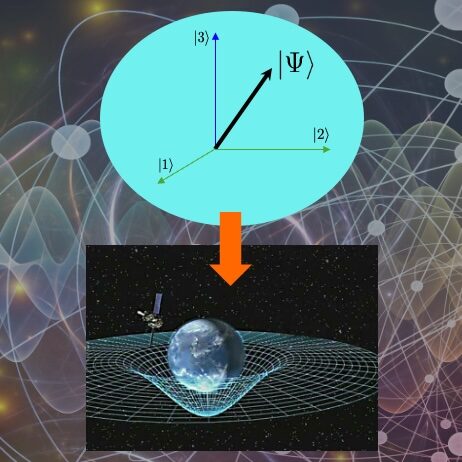
0:50:37.5 SC: What is quantum mechanics actually saying? So my claim is that the wave function, which you think of as a function of position or momentum or whatever, this is just a what we call in math a representation of the quantum mechanical state. The quantum mechanical state is a vector in Hilbert space, or sometimes it's an operator on Hilbert space. There's details there we're not gonna get into. But that sounds a little circular because Hilbert space is the space of all quantum mechanical states, and what I'm saying is that the quantum state is a vector in Hilbert space. What all this means is that we are positing that there is a mathematical formalism that represents reality perfectly faithfully. So what is the world? It is sui generis, as we philosophers like to say, which means it's its own thing. The world is not something else, but it is represented mathematically as a vector in Hilbert space. And you don't need to really know or care too much about what that means in terms of what are the implications of living in Hilbert space or whatever. There are technical requirements for a vector space to be a Hilbert space. All you need to know is that there's something called the quantum state, okay? And the quantum state exists independently of how you express it, just like a number. If you have a number that you express in base 10 notation, it will look very different if you express it in base 2 or in base 16, hexadecimal, or use Roman numerals or whatever, but it's the same number. I'm saying that it's that underlying essence that is independent of representation that really matters. It doesn't matter whether you're in position space or configuration space or momentum space or whatever. What matters is the vector, the quantum state that you're representing, okay? And let me tell you, even many committed Everettians are reluctant to admit this.
0:52:33.9 SC: Space as we know it, the place we live, or the configuration space of many particles moving in space, these are super useful quantities. You can't get through life without talking about them. To relate to another recent podcast, it's kind of like free will. You can't get through life acting as if human beings don't make choices and don't deserve praise or blame for the choices that they make. But they're nowhere to be found. Those choices are nowhere to be found in the fundamental laws of physics. That's okay. You can still imagine that free will is real. You can still imagine that position space and momentum space are real. They're just not fundamental. They're not there in the most austere, deepest-down way of talking about what reality is doing. Now, the reason why people are reluctant to go down that route is because, boy, space seems like more than a little bit useful. It seems super-duper real. Like, I move through it, literally. How could I possibly imagine having a description that didn't have space in it? And my answer is, space can still be there, but it's not fundamental. It's emergent. And that's the puzzle. That's why we're having this podcast, because that's the open question, the research level question, how do you start with quantum mechanics and find space within it? Is that even a sensible thing to do? I think it is a sensible thing to do, but let me mention that if you don't think it's a sensible thing to do, I get it. I appreciate why someone might not think that.
0:54:10.5 SC: Everettian quantum mechanics is already pretty far away from the manifest image of reality. With all these extra worlds and decoherence and things like that. Now you're pushing it even further away from the manifest image by saying that things like space and locations and particles bumping into each other and stuff like that, none of that is part of the fundamental description. And so you're making it even more work to connect the underlying theory to the world we see around us. To me, that's just a challenge that sounds fun. Let's take it up and let's push it forward. To others, it's like, "I'm too skeptical that's ever gonna work, so I don't wanna go down there." I get that, but I want to see what we can do. So I have called this the problem of structure in Everettian quantum mechanics. I realize belatedly that's probably not the best phrase to use. Simon Saunders and others have used the same label, the problem of structure, to talk about the problem of branching. Like, when do things branch? Where are the branches located? How many branches are there? That is not what I'm talking about. I'm talking about in each branch, why do things look like stuff arranged in space? Why do we get the particular manifest image that we get? And how? Is it uniquely defined? Is it just a choice that we make?
0:55:33.1 SC: I mean, we would like if... Even if objects and locations in space of objects are not fundamental, we would at least like to think that not only are they emergent, but there's kind of a uniquely right way to see them emerge. And that's what we're sort of after. Okay, now we'll raise our level of technicality just a little bit to try to address this question. Why does this super austere, bare-bones quantum mechanical theory, which I have called Mad Dog Everettianism. Mad Dog Everettianism was a phrase that Ashmeet Singh and I, a former student and current collaborator, coined after what Owen Flanagan, who's a philosopher, dubbed Alex Rosenberg. Remember, Alex Rosenberg was a previous guest on Mindscape, and Owen referred to Alex as a mad dog naturalist. To the extent that you can be a mad dog naturalist, you're not only a naturalist, you're taking naturalism as far as it can possibly go. The most extreme version. The X Games version of naturalism. And now we're doing that for Everettianism. We're saying, what is the least we can get away with? What is the most fundamental stuff? So if you asked people on the street, physicists on the street make sure your street is outside a physics department ask them, "Okay, what defines a quantum mechanical theory?" I don't mean what defines quantum mechanics, like, that's an Everett versus pilot waves or Copenhagen or whatever. I mean within some particular version of quantum mechanics, what chooses a model? What lets you know that this is the simple harmonic oscillator, that's the electromagnetic field. This is the electron in a hydrogen atom or whatever. There's different models for different quantum theories. So what do you have to tell me to specify that theory? And people might say things like, "Well, okay, you have a Hilbert space." That's the space of all the possible quantum states. Okay, that's important. So you have some vector in Hilbert space. Everyone thinks that you have a vector in Hilbert space. That's part of everyone's theory.
0:57:38.8 SC: The other thing that is part of everyone's version of quantum mechanics is some version of dynamics. So the vector not only exists, the quantum state not only is there, but it changes over time. That's what dynamics means. And that's usually phrased in terms of the Schrödinger equation, but there's other ways to do it. There's Heisenberg's equations, the von Neumann equation, the path integral, whatever, different ways of saying how the quantum state evolves over time. And one way, by the way, of specifying that information is in terms of the Hamiltonian of the theory. The Hamiltonian is a quantum idea that was descended from an analogous classical idea, and it's basically just asking how much energy is there in different parts of the wave function. And it turns out the whole point of Schrödinger's equation is that knowing the Hamiltonian, knowing how different quantum states are associated with different possible values of energy, is enough to fix the dynamics, okay? So sometimes I'm only telling you this little bit of jargon because sometimes in this game, people will use the word Hamiltonian a lot. That's what they mean. Hamiltonian is the thing that defines the dynamics of the theory via the Schrödinger equation. So you have Hilbert space, you have a state, you have dynamics. But then also people will say you have observables. You have things like position and momentum, and maybe they have some relationship they don't commute with each other.
0:59:03.8 SC: That's the uncertainty principle. So maybe you need to specify what all those observables are and exactly how they relate to each other in some way. And indeed, let me say that here is a technicality I'm not going to get into. When you do have a Hilbert space, there's a nice feature and a sad feature. The nice feature is Hilbert spaces are all the same. You don't need to say, like, which Hilbert space you're talking about. If you have the space of two-dimensional surfaces, that doesn't tell me what you have. You might have a sphere or a torus or a higher-genus Riemann surface or something. There's many, many two-dimensional surfaces. Once you tell me the dimension of Hilbert space, you're done. All Hilbert spaces of the same dimension are the same space. Okay, so that's nice. That's a good feature. The bad feature is that that dimensionality might be infinity. It might be what we call countable, which means it's the size of infinity related to the number of real numbers or, sorry, not the real numbers, the integers, or the counting numbers. The real numbers are a bigger infinity than countable. Those are uncountable in number. So in Hilbert space, the number of dimensions can either be finite, depending on what system you're looking at, or infinite but countable, so similar to the number of integers. And when Hilbert space is infinite-dimensional, unsurprisingly, there's a whole bunch of new mathematical subtleties that come into play. And this is where the idea of specifying what observables you have becomes super important, and people think that it's necessary. I suspect it's not.
1:00:38.9 SC: I'm writing a paper with a student right now, Hong Xu Ryu here at Johns Hopkins, where we're investigating this question. I don't think that the observables are actually necessary. I think they emerge from everything else. But there's some subtleties there that we'll get into in the paper. Right now, that's just a footnote. For sake of the rest of this podcast, let's make our lives easy and imagine that Hilbert space is finite-dimensional. It might be. Like, we actually don't know. This is one of the embarrassing things about approaches to the theory of everything, people don't even know how big Hilbert space is. Isn't that sad? But that's the state of the art right now. We have to work with what we have. Okay. So my claim is that these observables position, momentum, whatever, spin these are not part of what defines your quantum mechanical theory. What defines your quantum mechanical theory is just the vector in Hilbert space evolving through time. That's all that exists.
1:01:38.5 SC: Okay? Everything else... It's not that nothing else exists. All that exists at the most fundamental level. So what you need to do is say how that very, very minimal amount of information can imply a certain emergent structure at the higher level. So to be fair, you not only have the vector in Hilbert space and how it evolves, but kind of counterfactually how different vectors would evolve. That's what the Schrödinger equation tells you. So given the set of all possible wave functions, how would they all evolve? From that, tell me how to find space in Hilbert space. Find the manifest image description of the world in terms of stuff moving in a three-dimensional universe. That's the task. And those of you who know me, I've been working on this for 10 years now. Time flies. Like many people, my internal increment of time basically stopped during the pandemic. So things that are 10 years ago are in my brain just five years ago. But yeah, for roughly 10 years, my students and colleagues and I have been working on some version of this problem on and off. And right now it's very much on. I have a great group of students here at Hopkins that are diving into different aspects of this problem. How do you emerge the world from this bare-bones description of a vector traveling through Hilbert space? And the root is something that we have called quantum mereology. This is the title of a paper that I wrote with Ashmeet Singh again. And mereology is borrowed from the philosophers who use that word to refer to the relationship between a whole thing and its parts into which you divide it up the relationship between parts and wholes. You may have heard the famous idea that philosophy is about carving nature at its joints.
1:03:35.5 SC: This goes back to Plato. In Plato's dialogue the Phaedrus, he talked about how you understand the world better if you carve it as a butcher would do. When you carve up a piece of meat, you should do it by cutting in between the bones, that is to say at the joints, rather than artificially carving it somewhere else. So we're basically asking, how do you carve Hilbert space at the joints? That's what we're trying to do. That's what you don't have given to you by the theory. That's what we're trying to figure out. So said in slightly more technical terms, what we're looking for is a definition of subsystems in Hilbert space. Again, this is very backward from how the game is usually played. If you learn quantum mechanics as an undergraduate or you pick up a textbook or whatever, usually what you're told is the following. You have an electron, you have a way of describing the electron, it has a wave function, etcetera. Oh, what if you have two electrons? Well, here is the recipe for taking two systems, electron 1 and electron 2, and creating the combined system of both electron 1 and electron 2. And likewise, you can do this for other particles, for spins, whatever. There's a recipe that you're given if you really want to know, it involves tensor products but what matters is you can start with subsystems and there's a very definite way in quantum mechanics to aggregate them together into bigger systems. We're trying to go the other way. We're trying to reverse engineer.
1:05:10.2 SC: We're trying to say we have the whole system, but no one has divided it up into subsystems for us. Are there better and worse ways of dividing the whole of Hilbert space into subsystems? Carve Hilbert space at its joints. There are an infinite number of possible ways to divide up Hilbert space, okay? But there are some that will be more useful to us. And what we have in the back of our minds is basically space. That's the most important thing to get out of this game that we're trying to play. Space, again, doesn't show up as part of the fundamental definition of quantum mechanics, but we want to locate it somewhere. So what does that mean? And there's actually kind of two different ways in which space shows up. There's a long story here in which these two different ways are closely connected to each other, but we don't need to go into that. It'll be completely acceptable, I think. This is not one of the hard things to accept. One way is if you just have kind of things like an electron or a macroscopic thing like Schrödinger's cat, or some big buckyballs or, I don't know, some big solid superconductor. Whatever quantum system you want to talk about, you want to cast it as something moving in a three-dimensional world that we call space. So really what you want to do is divide up Hilbert space into say, here's the cat, here's the box it's in, here's the vial of gas, here's the Geiger counter, here's the source, etcetera, here's the observer.
1:06:45.7 SC: So you want to basically divide Hilbert space into subsystems that connect to or represent things that you'd identify as objects in the real world. Again, that's not there in the description of the theory in this bare-bones Everettian sense. It's something we're inventing. So there might be a good way to do that or a bad way to do it. The other way that space shows up, which is, again, it's connected, but it's a little bit different in presentation. In quantum field theory, which we think is the best way that we have of successfully describing particle physics and things like that, things are made of fields. So the electron is a vibration in the electron field. That's why all two electrons are the same. There's that famous idea by Wheeler that all electrons are the same because they're really the same electron. That is wrong. It doesn't work. The real answer is why are all electrons the same? Because they're all vibrations in a single underlying electron field. All photons are vibrations in a single underlying electromagnetic field, etc. Fields are defined as objects that take on a value at every point in space or every point in spacetime, if you want to put it that way. So you need the idea of space to talk about the idea of fields. And in fact, quantum mechanically, if you want to talk about the Hilbert space for a field theory, what you can do and there's more technicalities here that we're glossing over. Sorry about that, physicists listening to this. If I divide space into little regions. Like I take the room that I'm in right now and I subdivide it into little cubes one millimeter across on every side.
1:08:27.0 SC: So a huge number of little cubes locating different parts of the room that I'm in. Every one of those little cubes of space has fields that can vibrate in it. And I can express the wave function of the field in the room as a whole as the combination, the tensor product, of all of the different things that the fields are doing in every box. And of course, you can be entangled with each other as much as you want because it's quantum mechanics. And the reason why I'm going through all those details is because in that sort of division of what the field is into values of the field at different locations in space, the crucially, crucially important thing about quantum field theory is that the fields' interactions are local in space and also local in time. And this is a little bit... This is something where the philosophers of quantum mechanics and the working physicists talk past each other a lot. Because to the philosophers, remember John Bell proved that there is some kind of nonlocality in quantum measurement. The working physicists often think that quantum measurement is trivial. And what they care about, what they're doing, all they're spending all their time calculating, doing Feynman diagrams and things.
1:09:46.1 SC: Is the pre-measurement dynamics of the system. So when you have the electromagnetic field interacting with electrons and quarks and so forth, the way that a typical particle physicist says is they pour all of their effort into calculating the wave function and the quantum state evolving, and then they say, "Okay, at the end we observe it, the wave function collapses, and that's easy." Okay. So to working particle physicists, what they care about is the unmeasured or unitary dynamics of the system, and that, as far as we know, is strictly local in physics. That's just a way of saying that if I poke, let's say, the electromagnetic field at one point, it doesn't instantly change throughout the whole universe. Einstein taught us that's not even a meaningful statement. Instead, it changes within the influence of its future in what we call its future light cone. It can have influences that travel slower than the speed of light, but not faster than the speed of light. And the way that shows up in the laws of physics is if I do that poking of the electromagnetic field, that interacts directly with values that the field has right next door, its nearest neighbors, as we say. Go back to this picture where I've subdivided all of space around me into little cubes. The cube, any one cube, only touches and interacts with the cubes that are next to it. It doesn't immediately and directly influence what's going on very, very far away, at least as far as the unmeasured quantum dynamics is concerned.
1:11:21.7 SC: So as much as quantum measurement seems to involve some kind of non-locality, quantum field theory, when it's not being measured, seems to be very, very local. And we can think of that as an implication of a certain way of dividing up Hilbert space, of carving Hilbert space at its joints, namely, we carve up Hilbert space into the combination of the Hilbert space happening at this little cube in front of me and the Hilbert space happening at that little cube in front of me and all the cubes around me in space. All of the little lattice subdivisions of space go into Hilbert space. And so that is a particular way of dividing up Hilbert space, dividing it up so that it looks like space, so that it looks local. So I just gave you two ways in which space was important. One is sort of a very high-level way when we just talk about the division into objects, cats and boxes and observers and things like that. We divide up Hilbert space. A cat has its factor of Hilbert space, an observer has its factor of Hilbert space, a box has its factor, and so forth. Or at a slightly deeper level, when we talk about quantum field theory, literal regions of space have different vibrating fields in them, and they are local. Their dynamics are local in the sense that they only talk to their nearest neighbors. Okay, so both of those definitions of space are intimately related, as I said, but what matters is that they're there, and they're certainly there from the start in the usual way of talking about physics.
1:13:04.0 SC: Again, the usual thing that we would teach you is we start with that and then we just say, "Okay, how do we put this in a quantum mechanical context?" And our current project is going backwards. How do you start from a big vector in an abstract Hilbert space with no subdivision into regions of space or objects or anything like that? How do you find them? So the question is, how do you subdivide Hilbert space so that subsystems represent useful things in their own. There's some sort of tangible physical meaning to this subsystem of Hilbert space. And that sounds a little weak, right? A little fuzzy, a little unclear. Is that just back to some Copenhagen-level "you know it when you see it" kind of thing? If there's an infinite number of ways to divide up Hilbert space, how do we know when we get the right one? How do you know that your right one is the same as my right one? But in fact, I think it's not nearly as weak or as subjective as it sounds. This is a very common feature of emergence. Forget about quantum mechanics for a second, okay? Think about classical statistical physics, which is to say statistical mechanics leading and emerging into thermodynamics or fluid mechanics. I use this example all the time, so you all know it. If I have a bunch of atoms in the room around me, in the air, atoms and molecules, I can coarse-grain them to get things like temperature and density and pressure and so forth. I get a fluid mechanical description of the air in the room. But that's not given as an obvious thing to do. When I do that emergence, I can define things like temperature and density and pressure by making a little average over small regions of space, because space is the arena in which interactions are local.
1:14:53.1 SC: Just like we talked about in quantum field theory, in the particle physics way of talking, or in the kinetic theory way of talking, atoms bump into each other when they are at the same point in space, okay, not when they're moving at the same speed or something like that. So there is a way of coarse-graining the particle or atomic description by taking averages over regions of space. And that way is one of an infinite number of ways that I could possibly coarse-grain, but it's certainly the useful one. And the reason why it's useful is the answers that I get out of doing that coarse-graining, out of saying, "Okay, I'm gonna take a little tiny box with some particles in it, some atoms, and I'm gonna define macroscopic coarse-grained variables like pressure and density and temperature," those variables that I get are sufficient to give me a self-contained, autonomous emergent theory. I can talk about fluid mechanics or atmospheric or weather for that matter, atmospheric science, without knowing about atoms. Most meteorologists don't need to know about atoms to do their job. It would be weird if you needed to know about atoms or the standard model of particle physics. This is Philip Anderson's "more is different." I can talk about the emergent level without knowing about the lower level beneath it. They're both interesting, they're both connected, they need to be compatible with each other, but I don't need to know about one to talk about the other. That doesn't mean that the relationship between them is arbitrary. Fluid mechanics is a coarse-grained version of statistical mechanics or atomic physics or whatever you want to call it, but that coarse-graining is not arbitrary.
1:16:39.2 SC: It's a very, very specific way of coarse-graining the variables to get that emergent description. So the claim here is that the emergence of space itself is exactly the same. I can imagine a gajillion different ways to divide up Hilbert space into subsystems, but one of them has the property that, for example, interactions are local, okay? This was a result in a paper by Jordan Kotler, Jeff Pennington, and Daniel Ranard several years ago, one of my favorite papers, called "Locality from the Spectrum," where the spectrum is a way of specifying the Hamiltonian that gives you the dynamics. And they said if you didn't know about locality in quantum mechanics, could you find it? And they said, "Look, in the set of all possible ways to take a big Hilbert space and subdivide it into little Hilbert spaces representing what you would hope are regions of space, almost all of them would have the property that every little subsystem interacts directly with every other subsystem." So this little region of space right in front of my face, if I poked on it, if I defined space badly by doing the wrong coarse-graining, by doing the wrong carving of Hilbert space at its non-joints, then by poking the field, as I would attempt to think of it right in front of me, it would affect the value of the field everywhere through the universe instantly. So locality is very, very special. Locality in the sense that when I have a little quantum field at one point in space and I change its value, I interfere, I measure it or do whatever, the implications of that perturbation only affect its immediate neighbors and then they affect their immediate neighbors and so forth. That's a very, very delicately chosen way of dividing Hilbert space.
1:18:35.8 SC: So the implications of this paper are that most Hamiltonians, most ways of writing down the dynamics of a vector in Hilbert space, have no local way of talking about them. That is to say, you can't divide Hilbert space for a generic set of dynamics into a set of subsystems that resemble space, that have the property that if I poke it somewhere, then only its nearest neighbors feel the poking or the influence of it, okay? Generically, if I poke anything, everything changes right away. And then they go on to say that when there is a local way of subdividing Hilbert space, it's essentially unique. Now there, there's been some pushback in the literature. Some people have disagreed and they say, "Well, you need a little extra ingredient." Good, I'm all in favor of that. That's how research goes. We have discussions, we disagree, and we see how things shake out. But I think that morally it's basically right. I mean, maybe you need to add some details about the state or something like that, but roughly speaking, you don't have a huge number of inequivalent ways of taking the same Hilbert space and saying, "Oh, this looks like space in very, very different ways," like it looks like 10-dimensional space or 8-dimensional space or a cone or whatever, right? There's some rigidity there. There's some answer to the question, what is the right way to subdivide Hilbert space?
1:20:04.8 SC: Again, this is a very common thing that happens in treatments of emergence. If you go back to the philosophical discussions of mereology and emergence, this debate already happened in the philosophy literature, like, why can't you just divide things arbitrarily? Well, some divisions work, some don't. Some notions of subsystems work and some don't. David Lewis, who we talked about before, he was an advocate of modal realism and believing in all the existence of all possible worlds and using that as a way of reasoning about probabilities and things like that. So he wrote about some of these issues and he invented an example of something that would be a bad way to carve nature. He invented the trout-turkey. He said, "I have a particular trout," not like the idea of trout, but a particular fish, a particular organism. "I take the front half of the trout," I think it was the front half of the trout, "and then I have a particular turkey over there. I take the back half of the turkey and I consider the combination of these two things." I don't carve them apart and stick them together. I just consider the idea of the front half of this trout and the back half of that turkey. Don't ask me how the philosophers come up with these examples. This is their stock-in-trade, okay?
1:21:26.2 SC: But his point is that's not a good object. You're allowed to contemplate that if you want, but that doesn't give you a handle on reality. It doesn't really teach you something. It's not a useful element of analysis. There's no fact I can tell you about the trout-turkey that improves your understanding of the world that wouldn't be better served by separately telling you facts about the trout and facts about the turkey. Another way of saying the same thing was Dan Dennett, former Mindscape guest, where he introduced the idea of real. Patterns in the universe. There are many, many things that happen at the microscopic level. You might imagine many, many ways to get coarse-grained descriptions of them, but some of those give you real useful information and some don't. You can average over locations in space. You can't average over locations in momentum space. Or rather, sorry, you could, but the answer is not a useful emergent theory, okay? So what we're doing is... David Wallace, former Mindscape guest, not to be confused with David Lewis, has emphasized the idea of real patterns in Everettian quantum mechanics. And like his former colleague Simon Saunders, they're talking about the branches, the worlds. David's point is that the worlds in Everett are real patterns. You can show why they're useful ways of talking about the wave function. What I'm talking about here is something a little bit different. We're asking the question, where are the real patterns within each branch? So, like I said, I'm not really interested here in the worlds. I'm interested in the structure within the world. And so I gave you that example of space in the Cutler-Pennington-Renard paper, but the overall story is you invent criteria or you propose, I guess if you want to make it sound less arbitrary, you propose criteria that we recognize from the manifest image. So there's nothing wrong with knowing what you want the answer to be.
1:23:30.3 SC: At the end of the day, we want to start with this weird abstract thing, a vector in Hilbert space. Sounds nothing like the real world. And we want to locate within it three-dimensional space, cats and boxes and all that stuff. So we can use what we know about the real world, about the manifest image, to help us on that journey. We invent criteria that we recognize from the world around us, and then we ask whether those criteria can pinpoint the right way to divide up Hilbert space. That's the quantum mereology program. And so the answer is and this is the ongoing research problem, and this is where we're gonna start kind of fading out in what we can say here yes, I think it can be done. I think that the example of locality is an important step in the right direction. There's also the division in quantum mechanics, for those of you who know a little bit about it, about decoherence and branching and things like that. Something that is crucially important is dividing up the quantum state into what we would label as a system, the system we're going to study and measure. Maybe the system is just an electron, or maybe it's a cat, or maybe it's a solid or whatever. And then there's the environment. So in Everettian quantum mechanics, there's no special role played by observers or measurement or any of that. All that discussion is replaced by the dynamics of systems and environments and leading to the process that we know as decoherence. The relevance of all these words is when a system, a quantum mechanical system that is in a superposition of different possible measurement outcomes, gets monitored by its environment. Now, actually, we can talk about Schrödinger's cat, there's the cat. It's in a superposition of awake and asleep.
1:25:33.3 SC: There's also an environment, which is everything else in the box. So the photons of light, the atoms of air, and whatever. And those environmental degrees of freedom keep bumping into the cat. And so the environment becomes entangled with the cat very, very quickly. And that leads to decoherence. That is decoherence. Becoming entangled with the environment is decoherence. And that's when the wave function branches into two different branches. That's why when you open the box, you see the cat awake or asleep, not in a superposition of both. So this division of the macroscopic reality into systems and environments is super important to the story that we tell about relating quantum mechanics to the real world. And this was the subject of the paper that I wrote with Ashmeet Singh. And there's a whole bunch of different things going on here. I think that we've only actually just started thinking about this, really, even though we wrote a paper about it years ago. I think there's a lot more work to be done in this direction. But what Ashmeet and I pointed out was there's actually two things going on when you divide the world into a system and an environment.
1:26:37.8 SC: One is if the system is and this is what we teach undergraduates in their quantum classes there's a theorem called Ehrenfest's theorem, which basically says that if you have a system there's some technical requirements here, so we're not gonna go into all those things but roughly speaking, under good circumstances, the expectation value of a measurable quantity like the position actually obeys its classical equations of motion. So if you have the Earth, with its center of mass position, that's something you could imagine observing, the location of the Earth in space. Why is it that even though the world is truly quantum mechanical, the Earth does such a good job at obeying Newton's laws of gravity and celestial mechanics? The answer is Ehrenfest's theorem, that basically there's very, very little uncertainty in the position of the center of mass of the Earth, and it will basically obey its classical equations of motion. So one thing that you want remember the game we're playing is we're inventing criteria that we want to be true in the emergent classical or semi-classical description one thing you want is that when you have a big macroscopic system that has a more or less localized quantum state, that quantum state remains more or less localized. So if you picked your variables in such a way that when you localize some system of interest, it instantly delocalized, that would be bad, right? Maybe that would happen.
1:28:13.0 SC: In fact, that generically would happen. It's very closely related to the idea that in a generic division of Hilbert space, there's no locality. Everything is talking to everything else. Likewise, there's no localizability. Everything that starts in one little region instantly spreads out if you do a bad decomposition of Hilbert space. So one thing is that you want localized system to remain localized. But the other thing that is more subtle and I think kind of interesting and provocative is there's also a relationship between the environment and the system. I said that the atoms of air in the box with Schrödinger's cat, or the photons in the box, they will act differently, interact differently with the cat depending on whether the cat's awake or asleep. That's the origin of entanglement. That's one fact, and that's crucially important. And people like Wojciech Zurek and others have emphasized how that's the origin of decoherence, and it's wonderful and it's a beautiful story. But there's another fact which is also important, which is that once you're in a single branch that is to say, once you have decohered, okay, so now you have just a cat that is awake, and that's the classical world that you're familiar with, you don't keep entangling. Once you have the sort of spatially coherent cat in one form or another, all of the atoms of air in the room or the box and all the photons, they can interact with the cat, but they interact with the cat in the same way. It's not like the cat is in a superposition of being here and being there. If the cat is in a macroscopically distinct superposition, then it will entangle because it interacts differently.
1:29:56.3 SC: Those two parts of the cat interact differently with the environment around it. But if the cat is only in one spatially recognizable configuration, it doesn't interact differently with the atoms around it or the photons around it. It interacts, but in the same way. Every photon either gets absorbed or scatters or whatever. That's also an important facet of this idea of carving Hilbert space into systems and environments. We want the system, if it's localized, to remain localized, and if it's unentangled, to remain unentangled once it's in what we call the pointer state, the classical-looking state of the system. And we argued again that those criteria are enough to figure out how to divide Hilbert space to find the right way of carving Hilbert space into subsystems. So these two examples that I go on about many of you probably heard me talk about these examples before but the examples of finding locality in space and finding the system-environment distinction just from the bare-bones ingredients of a vector evolving in Hilbert space, they seem to be plausible. There seems to be a right way to do it. And I know I promised you that I'd be telling you about the challenges to Everettian quantum mechanics, but the challenge is not "This can't be done." The challenge is "This hasn't been done yet." Both of these examples are pretty tiny examples compared to the full glory of the world around us that we want to understand where it comes from. That little technicality about infinite dimensionality versus finite dimensionality is not really a technicality. That's super important.
1:31:41.9 SC: There's a lot still to be done there. So to me, there are only two real big looming questions in Everettian quantum mechanics. One is the nature of probability. I haven't talked about that. I'm not gonna talk about it in this podcast, but I think that's a good philosophical question. But I think that we know what the answer should be, and we have quite plausible, I would even say persuasive, arguments that that is the answer that we get, the Born rule, the probability is given by the wave function squared. The origin of structure space, things in it, things like that is much less understood. So I do think that this is the frontier in Everettian quantum mechanics. And it's possible it might fail. This is the sense in which it is a problem for Everettian quantum mechanics, because once you have a puzzle or a question that you haven't yet figured out the answer to, maybe you'll just figure out the answer, but maybe you'll realize, "Oh, actually there is no good answer." That is 100% possible for this particular program. So if Everettian quantum mechanics in some sense doesn't work, if it needs to be changed, modified, altered, replaced in some way, here is where I think it will be. If it turns out that despite all of these good things, all of these promising results about how to find structure and subsystems within Hilbert space and the wave function, maybe it doesn't work. Maybe there is too much arbitrariness. Maybe you need to put more ingredients into the theory. That would be a failure of Everettian quantum mechanics, at least as I understand it. Now, I've been telling you the sort of optimistic version of that story.
1:33:24.4 SC: So is there any reason to think that maybe it doesn't work? I'll give you the single best reason to think that it doesn't work, and then I will tell you why I still don't think that's a very good reason. If I didn't think it was gonna work, I wouldn't be working on this. I'd be doing something else. So the whole story I told you is about starting with almost nothing a vector in Hilbert space and deriving everything, deriving how to divide the world into subsystems that we recognize as objects and things and locations in space and all that. But surely the most important thing, the constraints, the information, the data that led to certain ways of dividing Hilbert space into being good and useful and certain other ways into being not good, wastes of time, came from the dynamics, came from how the quantum state evolved with time, clearly. But what if it doesn't? What if the quantum state just doesn't evolve with time? What if it just sits there statically? Well, on the one hand, you'd be in trouble. I think that that doesn't work. I think that everything we've said would completely fail if quantum mechanical systems truly did not evolve with time, because time evolution was the only thing we had to work with. If you have a quantum state that doesn't evolve with time, it's just sitting there in Hilbert space, it doesn't even matter that it's in Hilbert space. It's just a vector. Who cares about the rest of the Hilbert space that it will never visit? In some sense, you're stuck with the kind of problem that Daniel Harlow had, where he thinks that Hilbert space is one-dimensional at the fundamental level. There's nothing to do in one-dimensional Hilbert space. You want Hilbert space to be very, very big. If Hilbert space is big, but we only live in a single vector of it, then effectively it's just one-dimensional.
1:35:16.3 SC: Nothing can happen. And you might say, "Well, okay, that would be bad, but how likely is it that we're stuck in that situation?" Sadly, it's very plausible that we do get stuck in that situation, and the reason to think that is from quantum gravity. Now, of course, whenever we start talking about quantum gravity, we should be humble. What do we know? There's a lot that we haven't understood yet about it, but we can do a little bit. We can do the most obvious thing, that is to say, we can take our very successful theory of classical gravity, Einstein's theory of general relativity, and we can try to quantize it. And what you get by doing that, as we talked about with Harlow, is the Wheeler-DeWitt equation. It's just a version of the Schrödinger equation, but instead of a Schrödinger equation that says the Hamiltonian tells you how fast the wave function evolves with time, in the case of the Wheeler-DeWitt equation, what it says is the Hamiltonian says the wave function does not evolve with time. There's no time in the Wheeler-DeWitt equation. There's no variable, no t, that says, "Here's the time parameter, the time coordinate," or whatever you want to call it. This is so obvious and glaring and in your face that it has been given a name called the problem of time. And I've talked about it before in solo episodes and things like that. We've talked about, is time real? Can it emerge? Things like that. But again, in this particular context of figuring out how Hilbert space can be divided, it goes from like an annoying anomaly that we'll have to figure out some clever way to deal with to a real problem.
1:37:00.9 SC: All of the ways that we were getting structure in our Hilbert space at the emergent level depended on the dynamics of the quantum state. Given the dynamics, we can say things like local systems remain local, interactions only move through nearest neighbors all that stuff depends on interactions and change and dynamics. If there is no time, you can't play this game at all. So that's another thing that we're working on right now. Of course, the good news about that is that it does certainly seem that time does exist. In the real world, time seems to be important and it seems to be there. So it's sort of for any version of quantum gravity, we're gonna have to have time to emerge somehow. And once you get time to emerge, then you can use that emergent notion of time to play all the games that we were just talking about. The possible challenge is if there's sort of an order of operations issue where you need to have the structure in order to get time to emerge, and then you need time to emerge to get the structure. That would be a legitimate problem potentially. We have ways of thinking well, we have... Ideas that we're trying to work through to maybe fix this problem. Carlo Rovelli, who was one of the first Mindscape guests, had an idea with Alain Connes called thermal time, where basically you think of the quantum state as being defined by what is called a density operator on Hilbert space rather than a vector in Hilbert space. There's a lot of complicated mathematical technicalities there, but it might be a way to uniquely get time to emerge, or at least to a good way. But what I'm trying to tell you is these are open questions. I don't know how exactly it will work. We're thinking about that.
1:38:52.0 SC: The reason why, what I want to close with is, it matters. It matters to physics. And this is my sales pitch for why physicists as a whole, especially those who are interested in high energy physics or fundamental physics or whatever you want to call it, should care about the foundations of quantum mechanics. Because thinking about quantum states and mereology and things like that makes you confront these questions that otherwise you didn't have to confront. Like in, as we said, in the usual ways of doing physics, you start with something like a classical manifest description of the world and then you quantize it. So you're helping yourself to a huge amount of structure that is very, very useful. The suggestion from Everettian quantum mechanics is that that's cheating, that you're helping yourself to something that isn't there and you should find it, you should realize how it emerges. And that might help with a whole bunch of interesting questions that we have. Maybe that has implications for, I don't know, fine-tuning questions about the hierarchy or the cosmological constant. Maybe it has implications for what happened at the Big Bang or the arrow of time. Maybe there are experimental implications.
1:40:10.0 SC: And a lot of what I do, I'm very quick to admit, a lot of the sort of physics theorizing and philosophizing that I do has no immediate experimental implications. But the word "immediate" there is doing a lot of work. If we think about it carefully enough, we might be able to squeeze some experimental implications out of it. For example, if the very notion of locality, if the very notion that things exist at locations in space is not fundamental but rather is emergent, the thing about emergent things is that those emergent descriptions break down at some level. You can treat the air in this room as a fluid, but once you get down to one angstrom across, when you're only fitting a single atom into the box, you can't treat it as a fluid anymore. Maybe locality breaks down. Maybe it's just a good approximation. How would you know experimentally? That's another thing we're working on. I actually don't even know what experiment you would do. Why don't we know what experiment you would do? Because the way you do science is you come up with a theory, if it fits the data, you pat yourself on the back. All of our theories have locality built into them very, very centrally as a starting point, and it works. So we don't go beyond that and say, "How well does it work? Like, how would it fail if it weren't there?"
1:41:35.3 SC: So I think that by being forced to think about these questions in this way, you are led to ask other questions that you might not otherwise have thought of to ask. You're led to ask questions about possible experimental signatures. What would be the first thing to show up if locality was only approximately true rather than exactly true? I don't know, but that's an interesting thing to think about. So at the end of the day, I hope I've not disappointed anyone who wanted me to steelman all the reasons why Everettian quantum mechanics is wrong, because I don't think it is wrong. I think there are unanswered questions that it has, and if we become convinced that there are no good answers to those questions, then it would be wrong. Then we would give up on it. Then we would change our minds and move on to something else. I know that people want to have a single simple experiment we could do that would rule out the theory cleanly and once and for all. But that's just not how science works. Science is a complicated interplay between people coming up with theoretical ideas, people proposing experimental probes of those ideas, people doing experiments, other people doing experiments just for the hell of it and finding surprising things, and trying to figure out how it all best fits together.
1:42:51.2 SC: You don't have any right to demand, "You must do this experiment over the next few months, otherwise I'm not gonna take your theory seriously." I mean, you can demand it. No one has a necessity or an obligation to listen to you if you want to demand that. So instead, I think that what we're gonna do is to continue to develop the theory. We don't have knockdown arguments against Everett, but we have open questions. We're gonna continue to think about how best to address those open questions. And that continued thought, which we call research, is gonna lead both to hopefully new fun ideas, maybe solving some old problems, but also maybe some obstacles that don't go away. And we realize, "You know what? This didn't pan out. This idea wasn't as good as we thought it was." That is absolutely possible. I'm not betting that it's gonna happen. I think we're actually gonna discover some cool things. I think that taking the foundations of quantum mechanics seriously overall, and taking this super austere, ambitious version of Everettian quantum mechanics seriously in particular, is gonna lead to a lot of progress in lots of good ideas in physics. We'll see whether I turn out to be right or not.
[music]
appreciate these attempts to bridge some of the ‘gaps’ in how we think abstractly about the world and how we live it. At the level of lived-worlds prof Tony Chemero has a new book on how we are “intertwined” creatures that might be of interest.
https://cup.columbia.edu/book/intertwined-creatures/9780231223195/
The video posted below ‘What is Many-Worlds Interpretation of Reality?’ explains MWI, its benefits over other versions of quantum mechanics, like the Copenhagen Interpretation, and as yet, some of the unresolved issues it faces.
https://www.youtube.com/watch?v=MdNzxGFcRt4&t=1s
The emergence of space from the entanglement structure of a wavefunction is a quite intriguing notion. But it would appear to put time and space on very different footings, with time seemingly having a kind of absolute, axiomatic role in the theory. How would Lorentz invariance, and the kind of blending of space and time that it entails, emerge from this? And would this mean that there would be a (possibly unobservable) preferred direction in spacetime, aligned with that fundamental time?
Perhaps the easiest way to describe the difference between the 2 most popular interpretations of quantum mechanics, Copenhagen and Many-Worlds, is in how they explain the double-slit experiment.
According to the Copenhagen Interpretation before you look the particle is in a superposition- a cloud of possibilities. It doesn’t have a definite path. It behaves like a wave and goes through both slits at once as a probability wave, not as a physical object. The wave-like possibilities interfere with each other resulting in an interference pattern at the viewing screen.
If you should measure which slit it goes through the measurement collapses the wavefunction into one definite path and no interference pattern appears.
Simple metaphor: Reality is blurry until you look. Looking forces the particle to “make up its mind”.
According to the Many-Worlds Interpretation, the particle’s wavefunction is real and never collapses. At the slits the universe splits into branches:
o In one branch, the particle goes through the left slit.
o In another branch, it goes through the right slit.
The branches interfere with each other because they are still connected (coherent).
When you measure which slit it goes through your measuring device also branches. The branches become separate and can no longer interfere, so the interference pattern disappears.
Simple metaphor: The particle doesn’t choose a path – “The universe splits”, and both paths happen in parallel worlds.
The simplest possible summary
o Copenhagen: The world is uncertain until you look. Measurement creates a single outcome.
o Many-Worlds: All outcomes happen in parallel. Measurement just tells you which branch you’re in.
Ref: Microsoft Copilot
The foundations of QM are addressed most cogently by Karen Barad in her book Meeting The Universe Halfway. Her approach is called agential realism. Very many overlaps with yours, Sean, so it’d be great if you could interview her!