Now that we’ve figured out the existence of God and the reality of time, let’s get down to the important issues: please stop putting aioli on hot dogs.
Recently, a casual restaurant called the Dog Haus opened right on the street I drive down on my way to and from work. It’s a pretty simple concept: fancy hot dogs and sausages. As restaurant concepts go, this is right in my wheelhouse, combining two things I love very much: (1) fanciness, and (2) hot dogs. I am precisely the target audience for this establishment. I would not be surprised if some marketer had shown a picture of me in his PowerPoint presentation to the Dog Haus board meeting at one point.
However, upon actually eating at the Dog Haus a couple of times, my overall impression was one of grave disappointment. I had sampled a couple of their suggested special items — things like “Das Brat,” which comes with bratwurst, whole grain mustard aioli, white american cheese, caramelized onions, and sauerkraut. In each case, the offering came across as too bland and goopy to really qualify as anything special. I have had hot dogs at baseball stadiums that brought me greater pleasure.
But I persevered, out of a conviction that I should like this kind of place. Finally I decided to forgo the suggested menu offerings and just get a plain dog and put on the condiments myself.
It was heavenly. Spicy, crisp, lively, and served on an amazing Hawaiian bread bun. The hot dog I had been waiting for all my life.
It took me a while, but I eventually sussed out why I could take the Dog Haus raw ingredients and create something special, but was turned off by all of their pre-suggested menu items. Namely: the suggestions they put forward were far too likely to feature an innocent sausage drowned in “aioli.”
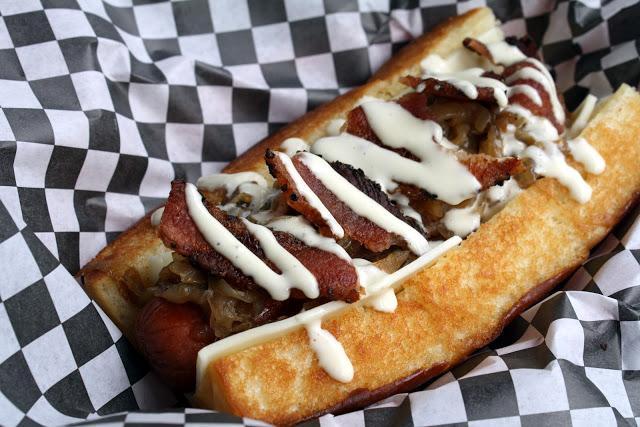
It’s not just the Dog Haus. I’ve been to a disturbing number of upscale burger joints that seem to think that aioli is what one puts on cheeseburgers. (Not to mention “brioche buns” — don’t get me started.)
It is not. Traditionally, on burgers one puts ketchup, and on hot dogs and sausages one puts mustard, in addition to whatever other creative accoutrements one is inspired to add. But not aioli, a garlicky kind of mayonnaise meant for eggs or fish or something else light and delicate.
I am here to inform the gourmet chefs of the world that hot dogs and hamburgers are not light and delicate foodstuffs. They are robust, coarse, energetic foods, and they require condiments that can stand up to the challenge. Something with a kick, with some life in it — not a greasy white emulsion of oil globules.
It’s not hard to see why such an obvious mistake is being made. You want to brand your dogs and burgers — traditionally classified as simple peasant fare — as something upscale and sophisticated. Mustard and ketchup are the antithesis of upscale sophistication, so you peer into your list of French condiments and see what comes up. (Whatever appears first in alphabetical order, apparently.)
The solution is equally obvious: better-quality mustard and ketchup. The Dog Haus even has such things, which explains why it’s not hard to build a memorable dog all by yourself, if you don’t make the mistake of letting them do it for you.
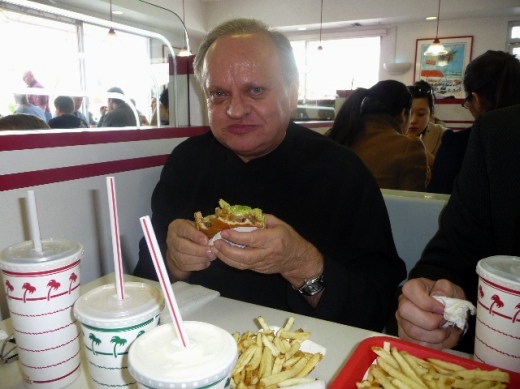
I will close with a picture of Joël Robuchon, one of the greatest chefs of our age, eating at In-And-Out Burger. I bet he was sad that “animal-style” burgers involve Thousand Island dressing.

 But I’d like to start mixing more espresso into my home coffee experience, so I’m in the market for a new espresso machine. If I were a physicist of means, I might go for a work of art like the Elektra Micro Casa Lever on right. Or would I? This is a spring-action lever machine, which is to be contrasted with the manual levers, not to mention the automatics and super-automatics, and then there’s the matter of boilers, switches, heat exchangers … a complete mess. The pumps are certainly elegant, but I’d also like something that is functional and doesn’t require constant pampering. So I am in the unusual position of being frozen with indecision about what kind of espresso machine to get. Any opinions out there?

 [T]he ’47 Cheval I drank that night now ranks as the greatest wine of my life, a title I doubt it will relinquish. The moment I lifted the glass to my nose and took in that sweet, spicy, arresting perfume, my notion of excellence in wine, and my understanding of what wine was capable of, was instantly transformed—I could almost hear the scales recalibrating in my head. The ’47 was the warmest, richest, most decadent wine I’d ever encountered. Even more striking than its opulence was its freshness. The flavors were redolent of stewed fruits and dead flowers, yet the wine tasted alive; it bristled with energy and purpose. The ’47s signature flaws—the residual sugar and volatile acidity—were readily apparent, but it was just as Lurton had said: In this wine, the flaws inexplicably became virtues….