It’s been hard to find time for blogging, but there’s one story I don’t want to let slip by before the end of the year: the observation by Ice Cube of neutrinos from beyond the Solar System.
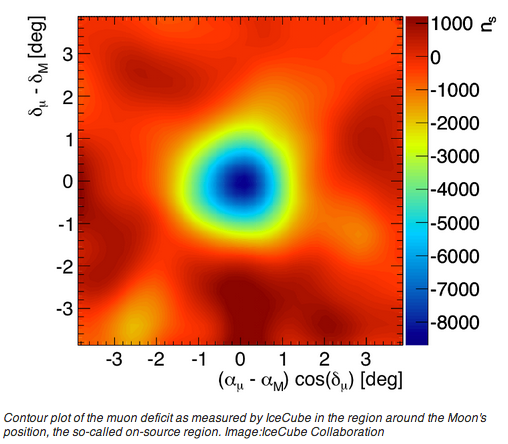
It was my own bad sense of timing to blog about Ice Cube mere days before they announced this result — but just to mention the fun fact that they confirmed the existence of the Moon. And, like noticing the Moon, there’s a sense in which we shouldn’t be too surprised — we were pretty confident that neutrinos were in fact raining down upon us from the sky all the time. But that’s a bad attitude, because this is a big deal. It’s a new way of looking at the universe, and historically new ways of looking at the universe have always brought us surprises and new insights of one form or another.
The actual process by which Ice Cube determined that they had found cosmic neutrinos is a bit convoluted, so let’s go through it. For one thing, the detector doesn’t “see” neutrinos directly. It sees Cherenkov radiation, which is emitted when a charged particle moves through a medium at a speed faster than the velocity of light in that medium. (Nothing moves faster than light moves in vacuum, but the speed of light in ice is lower than in vacuum.) Neutrinos, you may have figured from the name, are neutral particles, not charged ones. So what you’re actually seeing are events where a neutrino bumps into one of the water molecules in the ice and creates some charged particles.
But most of the neutrinos you detect by this method are not really cosmic. They’re byproducts of cosmic rays — mostly charged particles flying through space at enormous energies, which smash into Earth’s atmosphere, creating neutrinos (and various other particles) along the way. So a cosmic ray interacts with the atmosphere, creating a neutrino, which then interacts with the ice to make charged particles we can observe. Ice Cube sees these “atmospheric neutrinos” all the time; indeed, it makes maps of them. And that’s great, and certainly helps teach us something about cosmic rays. But it would still be cool to find some neutrinos that have themselves made the long journey across the desolate cold of interstellar space. And that’s not easy; even if the detector finds some, they are likely to be swamped by the bountiful atmospheric beasts.
Enter Bert and Ernie.
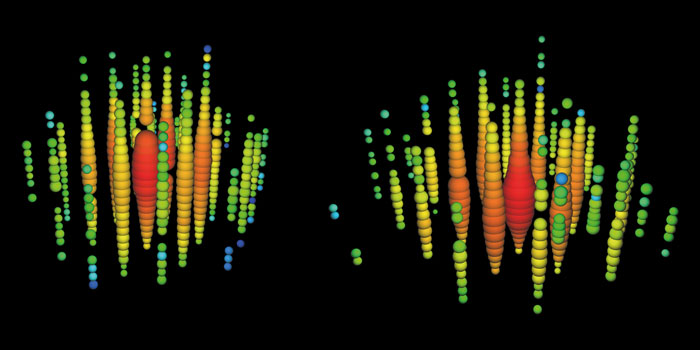
Those are the colorful names given to two events observed over the last couple of years by Ice Cube. What makes them remarkable is their very high energies; over 30 trillion electron volts (TeV). (Francis Halzen, doyen of the experiment, “takes no responsibility” for the whimsical names.) That’s a lot more than you would expect from atmospheric neutrinos, but right in line for the most energetic cosmic neutrinos we predicted. But it’s only two events; the finding was announced earlier this year, but like good cautious scientists the collaboration didn’t quite say they were sure the events were cosmic in origin. (Note that a “cosmic neutrino” is one that traveled across the cosmos by itself, not one that was produced by a cosmic ray — sorry for the confusing nomenclature, it’s a cosmic world out there.)
Now we can do better. In November, right after my blog post about the Moon, Ice Cube announced that they had more data, and were able to identify another twenty-six events at very high energies. They put the confidence that these are truly cosmic neutrinos at four sigma — perhaps not quite the five-sigma gold standard we would like to reach, but pretty darn convincing (especially where anything astrophysical is concerned).
This result opens up a new era in astronomy. We can now look at the universe with neutrino eyes. Previously we had discovered neutrinos from the Sun, as well as the lucky few from Supernova 1987A, but now we apparently have a persistent source of these elusive particles from very far away. Perhaps from the center of our galaxy, or perhaps from hyper-energetic events in galaxies well outside our own. At the very least this kind of work should teach us something about the origin of cosmic rays themselves, and who knows what else.
I’m not sure whether to feel happy or sorry for Bert and Ernie themselves. Born in a cosmic cataclysm half a universe away, they sped through billions of miles of empty space, witnessing untold astronomical wonders, only to come crashing into the ice on a fairly run-of-the-mill planet. But at least they brought more than a little joy to the hearts of some curious scientists, which is more than most particles can say.