 The question of how information escapes from evaporating black holes has puzzled physicists for almost forty years now, and while we’ve learned a lot we still don’t seem close to an answer. Increasingly, people who care about such things have been taking more seriously the intricacies of quantum information theory, and learning how to apply that general formalism to the specific issues of black hole information.
Now two students and I have offered a small contribution to this effort. Aidan Chatwin-Davies is a grad student here at Caltech, while Adam Jermyn was an undergraduate who has now gone on to do graduate work at Cambridge. Aidan came up with a simple method for getting out one “quantum bit” (qubit) of information from a black hole, using a strategy similar to “quantum teleportation.” Here’s our paper that just appeared on arxiv:
How to Recover a Qubit That Has Fallen Into a Black Hole
Aidan Chatwin-Davies, Adam S. Jermyn, Sean M. CarrollWe demonstrate an algorithm for the retrieval of a qubit, encoded in spin angular momentum, that has been dropped into a no-firewall unitary black hole. Retrieval is achieved analogously to quantum teleportation by collecting Hawking radiation and performing measurements on the black hole. Importantly, these methods only require the ability to perform measurements from outside the event horizon and to collect the Hawking radiation emitted after the state of interest is dropped into the black hole.
It’s a very specific — i.e. not very general — method: you have to have done measurements on the black hole ahead of time, and then drop in one qubit, and we show how to get it back out. Sadly it doesn’t work for two qubits (or more), so there’s no obvious way to generalize the procedure. But maybe the imagination of some clever person will be inspired by this particular thought experiment to come up with a way to get out two qubits, and we’ll be off.
I’m happy to host this guest post by Aidan, explaining the general method behind our madness.
If you were to ask someone on the bus which of Stephen Hawking’s contributions to physics he or she thought was most notable, the answer that you would almost certainly get is his prediction that a black hole should glow as if it were an object with some temperature. This glow is made up of thermal radiation which, unsurprisingly, we call Hawking radiation. As the black hole radiates, its mass slowly decreases and the black hole decreases in size. So, if you waited long enough and were careful not to enlarge the black hole by throwing stuff back in, then eventually it would completely evaporate away, leaving behind nothing but a bunch of Hawking radiation.
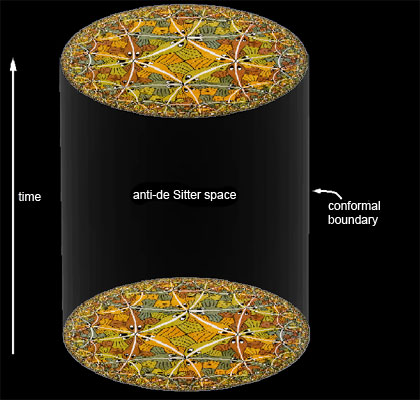
At a first glance, this phenomenon of black hole evaporation challenges a central notion in quantum theory, which is that it should not be possible to destroy information. Suppose, for example, that you were to toss a book, or a handful of atoms in a particular quantum state into the black hole. As the black hole evaporates into a collection of thermal Hawking particles, what happens to the information that was contained in that book or in the state of (what were formerly) your atoms? One possibility is that the information actually is destroyed, but then we would have to contend with some pretty ugly foundational consequences for quantum theory. Instead, it could be that the information is preserved in the state of the leftover Hawking radiation, albeit highly scrambled and difficult to distinguish from a thermal state. Besides being very pleasing on philosophical grounds, we also have evidence for the latter possibility from the AdS/CFT correspondence. Moreover, if the process of converting a black hole to Hawking radiation conserves information, then a stunning result of Hayden and Preskill says that for sufficiently old black holes, any information that you toss in comes back out almost a fast as possible!
Even so, exactly how information leaks out of a black hole and how one would go about converting a bunch of Hawking radiation to a useful state is quite mysterious. On that note, what we did in a recent piece of work was to propose a protocol whereby, under very modest and special circumstances, you can toss one qubit (a single unit of quantum information) into a black hole and then recover its state, and hence the information that it carried.
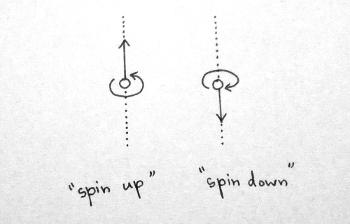
More precisely, the protocol describes how to recover a single qubit that is encoded in the spin angular momentum of a particle, i.e., a spin qubit. Spin is a property that any given particle possesses, just like mass or electric charge. For particles that have spin equal to 1/2 (like those that we consider in our protocol), at least classically, you can think of spin as a little arrow which points up or down and says whether the particle is spinning clockwise or counterclockwise about a line drawn through the arrow. In this classical picture, whether the arrow points up or down constitutes one classical bit of information. According to quantum mechanics, however, spin can actually exist in a superposition of being part up and part down; these proportions constitute one qubit of quantum information.
So, how does one throw a spin qubit into a black hole and get it back out again? Suppose that Alice is sitting outside of a black hole, the properties of which she is monitoring. From the outside, a black hole is characterized by only three properties: its total mass, total charge, and total spin. This latter property is essentially just a much bigger version of the spin of an individual particle and will be important for the protocol.
Next, suppose that Alice accidentally drops a spin qubit into the black hole. First, she doesn’t panic. Instead, she patiently waits and collects one particle of Hawking radiation from the black hole. Crucially, when a Hawking particle is produced by the black hole, a bizarro version of the same particle is also produced, but just behind the black hole’s horizon (boundary) so that it falls into the black hole. This bizarro ingoing particle is the same as the outgoing Hawking particle, but with opposite properties. In particular, its spin state will always be flipped relative to the outgoing Hawking particle. (The outgoing Hawking particle and the ingoing particle are entangled, for those in the know.)
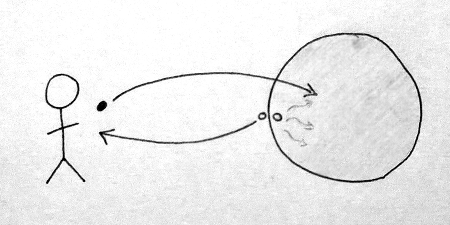
The picture so far is that Alice, who is outside of the black hole, collects a single particle of Hawking radiation whilst the spin qubit that she dropped and the ingoing bizarro Hawking particle fall into the black hole. When the dropped particle and the bizarro particle fall into the black hole, their spins combine with the spin of the black hole—but remember! The bizarro particle’s spin was highly correlated with the spin of the outgoing Hawking particle. As such, the new combined total spin of the black hole becomes highly correlated with the spin of the outgoing Hawking particle, which Alice now holds. So, Alice measures the black hole’s new total spin state. Then, essentially, she can exploit the correlations between her held Hawking particle and the black hole to transfer the old spin state of the particle that she dropped into the hole to the Hawking particle that she now holds. Alice’s lost qubit is thus restored. Furthermore, Alice didn’t even need to know the precise state that her initial particle was in to begin with; the qubit is recovered regardless!
That’s the protocol in a nutshell. If the words “quantum teleportation” mean anything to you, then you can think of the protocol as a variation on the quantum teleportation protocol where the transmitting party is the black hole and measurement is performed in the total angular momentum basis instead of the Bell basis. Of course, this is far from a resolution of the information problem for black holes. However, it is certainly a neat trick which shows, in a special set of circumstances, how to “bounce” a qubit of quantum information off of a black hole.