Entanglement is one of the “spookier” aspects of quantum mechanics. In classical physics, the states of two distinct objects (their positions, velocities, spins, etc.) are specified completely separately from each other. Knowing what this tomato is doing gives you no information, in principle, about what that carrot is doing. But quantum mechanics says there is only one “state of the whole world,” which refers to absolutely everything in it. And, of course, the quantum state is specified as a superposition of possible measurement outcomes, rather than one definite possibility. So the quantum state of two vegetables might take the form “the tomato is in the refrigerator and the carrot is on the kitchen counter, or the carrot is in the refrigerator and the tomato is on the counter.” Although usually we talk about spins and polarizations of particles rather than locations of foodstuffs.
Entanglement is by no means a mystery, in the same way that the measurement problem is a mystery. It’s just a straightforward prediction of quantum mechanics, repeatedly verified by experiments. But it bugs us, because it seems “nonlocal.” In the state described above, I can look at the tomato and instantly infer what the carrot is doing, without ever looking at it. This bothers people, although it doesn’t lead to anything dangerous or immoral, like communication faster than light. That’s because physical information still travels slower than light. Someone wondering about the carrot doesn’t gain any information just because you measured the location of the tomato; you still have to tell them what answer you got.
Still, entanglement is pretty cool. And now Anton Zeilinger’s group in Vienna, one of the leading labs working on quantum experiments, has queried the Zeitgeist and responded in a way appropriate to our internet age: they made a YouTube video. (Since they are also old-fashioned scientists, they also wrote a paper.)
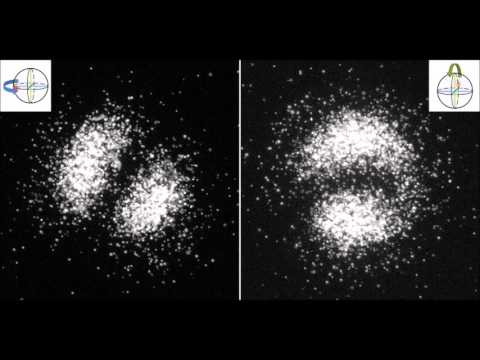
Let me try to explain this as I understand it, but I’ll confess up front this is a bit outside my comfort zone so real experts should chime in. Here we have two entangled photons, which can be polarized either H (horizontal) or V (vertical). The quantum state is of the form HV + VH, which means that we don’t know what either polarization is, but we know that the two polarizations must be opposite of each other. (If the state had been HH + VV, we still wouldn’t know either one, but we would know they were the same.) We send each photon through a merry path, observe one of them (that’s on the left), and see what happens to the other one (on the right). We’re looking at an image of where the individual photons land on a screen. You can see how the state of photon #2 is affected by what’s happening to photon #1.
Doesn’t it seem like you could use this to send information faster than light, if photon #2 is instantly affected by what we do to photon #1? I believe the trick here is that we’re not taking an image of all of the #2 photons. We’re only taking images of #2 if photon #1 was registered in a certain state. That is, we send photon #1 through a filter that only lets horizontal polarizations through. If photon #1 gets through, we turn on the camera and image photon #2. If it doesn’t, the camera never triggers, and photon #2 hits the screen harmlessly. So no superluminal chitchat, you science-fiction fans out there.
Nevertheless, pretty awesome. Quantum mechanics is sufficiently non-intuitive that we would only ever come up with it by having it forced on us by data. Even though experiments like this are completely explained by quantum mechanics as we currently know it, every little demonstration helps us appreciate it a bit more viscerally. As we strive toward a deeper understanding, that’s a crucially important part of the process.