
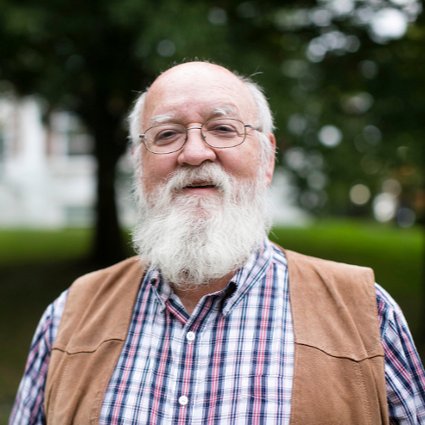
Wilfrid Sellars described the task of philosophy as explaining how things, in the broadest sense of term, hang together, in the broadest sense of the term. (Substitute "exploring" for "explaining" and you'd have a good mission statement for the Mindscape podcast.) Few modern thinkers have pursued this goal more energetically, creatively, and entertainingly than Daniel Dennett. One of the most respected philosophers of our time, Dennett's work has ranged over topics such as consciousness, artificial intelligence, metaphysics, free will, evolutionary biology, epistemology, and naturalism, always with an eye on our best scientific understanding of the phenomenon in question. His thinking in these areas is exceptionally lucid, and he has the rare ability to express his ideas in ways that non-specialists can find accessible and compelling. We talked about all of them, in a wide-ranging and wonderfully enjoyable conversation.
Support Mindscape on Patreon.
Daniel Dennett received his D.Phil. in philosophy from Oxford University. He is currently Austin B. Fletcher Professor of Philosophy and co-director of the Center for Cognitive Studies at Tufts University. He is known for a number of philosophical concepts and coinages, including the intentional stance, the Cartesian theater, and the multiple-drafts model of consciousness. Among his honors are the Erasmus Prize, a Guggenheim Fellowship, and the American Humanist Association's Humanist of the Year award. He is the author of a number of books that are simultaneously scholarly and popular, including Consciousness Explained, Darwin's Dangerous Idea, and most recently Bacteria to Bach and Back.
Click to Show Episode Transcript
0:00:00 Sean Carroll: Hello everyone, welcome to the Mindscape podcast. I'm your host Sean Carroll, and welcome to 2020. Hope everyone's having a good new year so far. I'd like to start a tradition of starting off each calendar year with a bang, podcast wise. Last year to begin 2019, we had Sir Roger Penrose, one of the world's most famous scientists in the public sphere but also someone who is enormously respected by his professional colleagues. So this year in 2020 we're gonna start off with Daniel Dennett, who is a philosopher who is as well known as any philosopher is in the modern age among the general public, and also once again extraordinarily respected among his professional colleagues. I in particular have enormous respect for what Dan has done. And part of it is just that our attitudes are very similar, our approaches to what we do are very similar. It would not be completely wrong to say that when I am in a more philosophical mode, I'm trying to do for physics, what Dan has been trying to do for biology and neuroscience and consciousness over the course of his career. As we'll talk about in the podcast, we go, it's a long podcast it's a long episode we cover an enormous amount of ground so individual topics are breezed through very quickly but there's a theme, there's a framework that ties it all together which is this idea of taking what science teaches us about the world and connecting it to the world of our every day experience.
0:01:34 SC: For whatever science teaches us, it is very often going to be the case that even though it comes ultimately from our experience of the world, the ultimate theories that we end up building might seem very different very surprising even disconcerting. The big bang, cosmology, quantum mechanics, Darwinian evolution, are things that you wouldn't have just guessed just on the basis of your everyday experience without enormous amounts of observation and experimentation into realms that you don't see in your everyday life. And therefore the theoretical frameworks you develop don't sound or feel much like our every day world. This is especially noticeable when it comes to things like consciousness, free will, the nature of human beings. So what Dan Dennett has devoted his career to, are taking discoveries from science, whether it's neuroscience or biology or what have you, computer science, artificial intelligence, and teasing out their philosophical implications. He is one of the world's leading philosophical naturalists, not a naturalist in the sense of going out into the forest and poking around the trees and the animals, but a naturalist in the sense of not being a super naturalist. An ontology that says there is only the natural world. So how do you then explain things like purposes and meanings? And other things that we human beings naturally associate with our lives here in the world?
0:03:06 SC: That's what Dan has been trying to figure out for the course of his whole career. And so we have a wonderful discussion back and forth, where we both ask each other questions because he's thought very very deeply about the nature of existence, the world we live in, the nature of thought, how we conceptualize what's going on, and questions that are very important to me like emergence and intentionality, how it's okay to talk about things like purposes and choices in a world that is ultimately governed by the laws of physics. So I already said previously and I think maybe only to patreon subscribers, but this is probably my favorite podcast interview that I've ever done, and I think that you're gonna enjoy it just as much. Remember we have a web page, preposterousuniverse.com/podcast, where you can find show notes, transcripts of every episode, and you can also find a link to support Mindscape if you like, on Patreon. And Patreon supporters get benefits like monthly ask me anything episodes and episodes that are completely ad free. So this is gonna be very very fun episode, I hope you enjoyed it as much as I did. Let's go.
[music]
0:04:31 SC: Dan Dennett, welcome to the Mindscape podcast.
0:04:33 Daniel Dennett: Glad to be with you.
0:04:35 SC: You had a little thing that you said when I was in the room one time that I'm sure you've said many many times, but it really struck a cord with me, talking about Wilfrid Sellars and the manifest image and the scientific image and how you thought of your task as a philosopher to reconcile these. Why don't you tell us? Why don't we begin setting the stage but telling us what these are?
0:04:58 DD: Oh good, I'm glad you asked. Wilfrid Sellars, great American philosopher, said the job of philosophy was to explain how things in the broadest sense of the term, hang together, in the broadest sense of the term. Well that sounds sort of trivial. [chuckle] "How things hang together". Well. But what he had in mind is this, there's all the things of the everyday world, colors and sounds and haircuts and pains and dollars and home runs. Those all things. Then in the scientific world, there's electrons and quarks and fields and molecules and how do we relate the things of our every day, sort of pre-scientific world to the things that science has discovered? And what 100 years and more have shown, is there's no simple answer.
0:06:10 SC: Wait, sorry, when did Sellars say this?
0:06:13 DD: In 1961 or two, but I mean, when I say 100 years I mean, let's say since Einstein. That's when the world really starts to look weird from a scientific point of view, and you have people saying, "Really it's all just atoms in the void and there's no such thing as solidity and there's no such things as colors. And after all, atoms aren't colored. And the world's made of atoms. It's just atoms and empty space." And then we can go on from there. So at one extreme, you have people who have insisted that the scientific image, that's the gold standard, that's what sets... What's real.
0:07:02 SC: That's reality, yeah.
0:07:03 DD: That's reality, everything else is illusion. But as a cartoon I like puts it, reality maybe... The world we live in maybe an illusion, but it's the only place you can get a good cup of coffee. [chuckle] So it's not very helpful to be told that not only do dollars and homeruns not exist, but colors don't exist and pain doesn't exist.
0:07:34 SC: Yeah.
0:07:34 DD: And solidity doesn't exist. So we have to negotiate between the two worlds. Summer says, that's what philosophy is for. And yeah I agree, that's about as good a definition of philosophy as I can think of.
0:07:54 SC: But you're adding a little bit, right? One could buy into Sellar's formulation while still denying that the manifest image is capturing something real, right?
0:08:05 DD: Oh yeah, I mean, Sellar's image leaves all the options open.
0:08:10 SC: Yeah.
0:08:11 DD: It leaves open both the hardcore scientific realist who says everything else is just illusion, eliminativism, as philosophers say. Or you could go the other extreme and say, the electrons and quarks and all that, that's just a useful fiction. What's really real is tables and chairs and people and ideas and love and so forth, and so those are the two extremes. And then there's all kinds of positions in the middle. And my view, which might seem to be giving up, especially to philosophers, is to think we have to learn how to get back and forth between these two images, the manifest image and the scientific image. But the way we do that is not by strict definitions that are counter example proof. The way we do it is with diplomatic and pedagogical ways of easing the passage. Like an old example: Voices. Are voices real?
0:09:37 SC: Okay.
0:09:38 DD: What's a voice? What's it made of? Is it a bodily part? Is it biological material? But you can record a voice, you can recognize a voice.
0:09:50 SC: It has causal power in the world, right?
0:09:52 DD: It has. Voices, if you say what category of things they are, you run out of... It seems to be almost in a category by itself. Well alright, fine. We don't need a voice-throat problem to go with a mind-body problem.
0:10:13 SC: Right, We could, yeah.
0:10:15 DD: We may not know how to answer the question of what voices are, but we're not mystified, we're not puzzled, we're not baffled. It's just a curious fact about the way language and our perception of the world, pre-scientific perception of the world, carves things up. And the otolaryngologists, and the other biologists and the acoustic engineers can tell us all about voices, without... We don't ever have to settle that issue.
0:10:47 SC: Right. I label this view, in my book The Big Picture, poetic naturalism. The motto being that there's only one world, the natural world, but there are many ways of talking about it. And those ways all can capture some elements of reality and it's silly to call them illusions just because they're not the most fundamental thing.
0:11:05 DD: I think that's good. And yeah I think that... Gee, I haven't read your book yet.
[chuckle]
0:11:11 SC: Yeah.
0:11:13 DD: You know, I think that's... That's about right.
0:11:17 SC: No, the idea was not supposed to be anything original, it's just a label to help people understand, 'cause there are people who want to... Or who are eliminativists, right? Who wanna say that some of these higher level structures shouldn't count as real.
0:11:27 DD: Yeah. And I've been battling against that view for decades.
0:11:39 SC: So I'm sure we'll get there, but just to label, to put things on the table so before we get there, so therefore you will think of things as... Such as consciousness and free will as real?
0:11:50 DD: Yeah.
0:11:51 SC: For exactly this kind of reason?
0:11:52 DD: Real, but they're not what you think they are.
0:11:54 SC: Not what we think they are, right. Okay.
0:11:57 DD: That's my motto. X is real but it's not what you think it is.
0:12:01 SC: Good. So you wrote a paper a while ago called Real Patterns.
0:12:06 DD: Yeah.
0:12:07 SC: And I wanna talk about that a little bit, I don't know if you even are aware that this has become an important fun topic in quantum mechanics.
0:12:15 DD: No, I didn't know that, no.
0:12:16 SC: Yeah, David Wallace, who is one of the leading theorists of the Everett, or many worlds interpretation which I'm also a partisan of, leans on your paper and your notion of real patterns very heavily in his book, The Emergent Multiverse.
0:12:29 DD: Oh great.
0:12:30 SC: Trying to explain how the classical world, forget about tables and chairs, but even electrons with positions, and atoms, and things like that, are somehow not there in the most fundamental formulation of quantum mechanics, but they describe the pattern and therefore they're real.
0:12:46 DD: Yeah. Wonderful, I'm delighted. Yeah.
0:12:48 SC: Can you give the sales pitch for what your view is there in that real patterns paper? What you're trying to get across?
0:12:57 DD: The main idea of the paper is that if we think about information, we think about information theory. We recognize that... Well, to put it in sort of everyday terms, "How big a file do you need to capture this particular phenomenon?"
0:13:20 SC: Yeah.
0:13:21 DD: And, if you have a checker board which has got just 64 squares and some are black and some are white, pretty easy you can give a very limited description of that pattern and write it on the back of an envelope. If you got a color picture of confetti, and you have to describe it in detail, you've got a much bigger file. That's why some pictures on your phone are bigger, have used more megabytes than other pictures. It all depends on how much complexity there is in the picture. And if there's no pattern in the picture at all, if it's just random, oddly enough that's the one that takes the most information to record because you have recorded every pixel. You can't say, "Well there's a region of deep-blue over here and there's a region of red over here." Those are nice concise ways of taking advantage of the pattern in the phenomenon. So, the idea of real patterns is, take any phenomenon and are there patterns in it? Well, what's a pattern? A pattern is a summary of concision, something that permits you to generalize so that you're better than a coin flip about what the next little bit of it is. If you've got any predictive edge at all on the data set that you're looking at, you got a pattern.
0:15:00 SC: Right. And, it's not necessarily... Well, let me put this way, we should be happily surprised when there are such patterns in some sense. What the patterns enable you to do is to ignore certain pieces of information like you said.
0:15:14 DD: Absolutely. Evolution, natural selection has designed organisms to be ruthless pattern finders, to ignore almost all the information that's officially available at their surfaces and just focusing on what matters to them. Those are the patterns that if they can latch onto those, they can feed themselves and avoid getting eaten and live long happy lives and mate and all the rest. So, the idea of a pattern is I think a very useful and deep idea and it can be given a nice clear mathematical formulation and it's the key. What science does is finds pattern but it's also what the manifest image does. We take for granted, all the patterns that we see. In fact we do more than that, we over interpret them. That is if we see two things that look the same shade of green to us, we think, "Well, deep-deep down, they are the same." No they might be green for entirely different reasons, they might be so called metamers and they only look the same color to us because where you might say green-green color blind. [chuckle]
0:16:41 SC: Yeah. I did a podcast with Melanie Mitchell who is a computer scientist.
0:16:45 DD: Oh yeah, I know her well.
0:16:46 SC: About the struggle of artificial intelligence to capture common sense. And, would it be off-base to think that some of this struggle has to do with the fact that AI's even very advanced Deep Learning networks and so forth are not as good at finding the patterns as a human intelligence is, at the current state of the art?
0:17:08 DD: Good. Let's see, I think that's true except for the fact that if you crank your deep learning system long enough it'll find patterns where there aren't any patterns. [chuckle] I mean deep learning systems, algorithms are very good at squeezing pattern out of apparently random data. That's how the neuroscientists, they train up, categorize on this FMRI data about what's going on in people's heads and they discover they can make a prediction about what person's gonna do 10 seconds later. Yeah, they can. And that shows that it's a real pattern. But a lot of the patterns they find by these methods aren't real. That is, they don't predict the thing.
0:18:08 SC: Well, that's the thing I'm wondering if because what the AI is, what the Deep Learning networks are so good at is manipulating huge amounts of data that they don't need to be as tricky as human beings are, define the patterns that let you know predictions with fewer.
0:18:24 DD: That's right. So of course, we pay a price for that, it's not a miracle. And, the price we pay for that is that we have a lot of false positives, we see a lot more pattern in the world than it is really there. We see similarities that are only similar in that they have the same effect on us but they are otherwise as different as can be.
0:18:50 SC: Well, what does the word real in the phrase "Real patterns" have the same meaning as the word real when we were just talking about baseballs being real?
0:19:00 DD: Well, that was the idea. I wanted to say, if we have the concept of a pattern, we do have some pretty good test as to whether it's real. That is to put it bluntly, can you make money betting on it? If you can, it's predictive, it's real. And that's a touchstone of reality that seems to hold up very well. So, let's say maybe patterns are the thing that's most obviously where we can make a real-non real distinction. And that everything, every other distinction between real and unreal and real and fictional, real and bogus, it's somehow dependent on that.
0:19:55 SC: So if there's a room and there's this huge number of atoms in the room and of course if you were infinitely smart and I gave you the location of all the atoms and their velocities you could predict anything, you could be Laplace's Demon but the patterns, the other structures are the idea that I could give you much less information than that, I could say there's a baseball, and it's headed toward a window. And then you could infer an enormous amount from that.
0:20:21 DD: Exactly, exactly.
0:20:22 SC: And therefore, baseballs are real in some sense.
0:20:24 DD: That's right. Years ago I concocted an example to show the power of this, where we have a visiting Martian, who's a sort of Laplacian Demon and he's in somebody's house and the phone rings and the lady picks up the phone and says, "Yes dear, you're bringing the boss home for dinner? Do get a bottle of wine on your way home. See you in half an hour." Hangs up, okay. So now, both the woman and the Martian predicts that within 30 minutes, two people are gonna walk in the door, one of them holding a glass bottle filled with an alcoholic beverage. But the Laplacian Demon has had to trace out the whole trajectory, the stop signs and the lights and the paying of the wine.
0:21:22 SC: Every photon, right.
0:21:23 DD: Every photon, and to the Laplacian, this is a miraculous prediction. Where did she find... How did she do this without all that information? Well, very simple. She understood what was being said, yeah.
0:21:39 SC: So let's take this point of view that patterns at the higher level, that captures some influence, some predictability of the world, and apply it to the difficult cases. Where we have things like people and agents and another phrase that you popularized way back in the day, is the intentional stance. So one of the sets of controversial concepts which we might ask, are these real? Or do they have some special status? Are things like intentions, reasons why, about-ness, why is a certain painting about something like that? So how do those boundary-contentious words fit into this picture?
0:22:20 DD: Oh they fit in beautifully. And the intentional stance patterns are just one particular set of patterns, and they're the set of patterns that have to do with living agents, and non living agents, that living agents have made. I don't think there's any other non-living agents. And what's the simplest one? Well when I first started writing about the intentional stance, I chose a thermostat. 'Cause then you can consider the thermostat as a little agent that can be instructed to keep the temperature a certain way, it senses the temperature and when the temperature falls below or below the set, it has a desire to raise the temperature. Treat a thermostat as an agent surrogate. You could have a person standing [chuckle] there and throwing logs on the fire, but you can replace it with this dead simple thing, and you can explain it to a child without going into the mechanics. And there are 100 different ways you can make a thermostat.
0:23:38 SC: In other words, you can explain it in terms of it's purpose.
0:23:40 DD: Of its purpose. In terms...
0:23:41 SC: Rather than its atoms.
0:23:42 DD: Exactly. You say, considered a little homunculus, a little agent, and it has one desire only, and that is to maintain the temperature, but it has a way of sensing the temperature and responding to changes by making an appropriate move.
0:24:00 SC: By the way, this is the way that one gets taught about transistors in physics class.
0:24:03 DD: Oh yeah.
0:24:04 SC: As if there's a little man in there, transistor man, who decides how much current to let through.
0:24:08 DD: Well, it turns out that this tactic, this strategy, of adopting the intentional stance, works throughout biology, it works not just for brains and for higher organisms, it works for bacteria. It works for archaea, it works for single celled organisms. The question is, does it work for things as it were smaller and simpler than that? Well I like to say we're robots made of robots made of robots made of robots made of robots. And once you get down to sub-cellular, you get down to the canasins, the motor proteins, and tubulin, and things like that, and or [chuckle] think of ribosomes, fantastic little machines. You can treat them from the intentional stance.
0:25:07 SC: They have a job to do.
0:25:08 DD: They have a job to do, they know how to do it, and one of the things that I particularly like about motor proteins is that it now turns out basically they're sailing. They're using the storm of the water molecules inside the sail, and they have sort of ratchets in their feet, so they're actually selectively using the energy in the random bombardment of the water molecules as a source of power and it reminds me of Ricky Skaggs, great line, "I can't control the wind but I can trim the sails." [chuckle] And that's your basic agent, and it's just a protein.
0:26:00 SC: Right, right. It's a little maximal demon. This is a...
0:26:03 DD: It is, it is.
0:26:04 SC: In the last just 15 or 20 years, this has become another hot topic in physics, understanding these non equilibrium fluctuations.
0:26:12 DD: Yeah, yeah.
0:26:12 SC: And very very tiny things. And I think that it's probably still under appreciated in my personal world how much this transition from the world of individual particles where it would make no sense to adopt the intentional stance to the macroscopic world, is driven by entropy and the arrow of time. I think it's interesting.
0:26:32 DD: Yeah, I think, I'm not a 100% sure of this, but I think the key element to being an agent is having a history... A history that makes a difference, that is something can happen to it, that changes it and that change is that again, it has a sort of memory.
0:27:01 SC: Yeah, I think just...
0:27:02 DD: And interesting thing about electrons, they don't pick up scars or dirt or anything, you can't... An electron over billion years doesn't change at all and that's a huge difference. We had a wonderful argument in Santa Fe at the Santa Fe Institute with David Wolpert and his colleagues and one of our big issues was whether tornadoes count as agents.
0:27:38 SC: I'm trying to predict which side are you on? I'm not like, I can't do it.
0:27:42 DD: I was against it.
0:27:43 SC: Yeah, okay.
0:27:47 DD: Because I didn't think that the tornado could actually explain information as... You know the way a thermostat...
0:27:57 SC: It's a complex system but ascribing agency or intention to it doesn't seem to help as much.
0:28:03 DD: So that was... But it was a very illuminating discussion. So, either if you want to look at the boundaries, you wanna look at things like tornados or motor proteins. But in the biology... In the living world everything bigger than a motor protein is a designed thing and it has purposes. It's got parts that have jobs to do.
0:28:35 SC: Yeah, I think participating in the arrow of time is probably a necessary pre-condition for being an agent in this sense.
0:28:41 DD: Yeah, yeah.
0:28:42 SC: The thing about electron is like you said, they don't have scars, they don't change over time really, but more complicated things have different access to the past versus the future. They have memories of the past and they can a little bit all they can do is predict the future. And that's when it becomes, that's when purposes and things like that might become necessary. So, I presume what you're gonna say then is ascribing intentionality or purposes to things has a reason why we do... There's a reason why we do that a reason we have reasons it makes sense for ribosomes. So, it makes sense in exactly the same way for human beings, it's not in a different way.
0:29:20 DD: Yeah, absolutely. And, I think it's interesting to think about the history of this. Before there was language, you didn't have any agents that were comparing notes, that were arguing, that were explaining. Language brought into the world onto our earth something that Wilfrid Sellars called, "In the Space of Reasons" and this is... The Space of Reasons is where human persuasion and explanation and querying and challenging happens. The whys and the becauses and the arrival, the emergence of the Space of Reasons that has to have an evolutionary history too. And this only in one species. So, that's why I'm interested so much in the evolution of language and in evolution of human minds which are profoundly different from even chimpanzee minds or dolphin minds or whale minds, take your favorite birds, take your favorite species. Human minds are really different. And they're different precisely because they are obliged to articulate reasons.
0:31:02 SC: Okay.
0:31:02 DD: And, they learn how to do this and it's an imperfect business and some are better than others but it's the fundamental basis for morality. If you are responsible it's because you respond to reason, you can't argue a bear out of what it's doing but you can... A human being is supposed to be persuadable.
0:31:32 SC: So, you can train or teach a dolphin or a dog or whatever but you don't give it a reason, why. It's just, it's pure stimulus and response, right?
0:31:41 DD: And recently, in my work I've had lots of examples of what I call free-floating rationales. This is where we see a phenomenon the reasons are clear but they're not the reasons of the organisms involved. So, the stotting or pronking gazelles, are throwing these great extravagant leaps and they're running away from the lions say, "What are they doing?" And, it's a tremendous waste of energy and it makes it dangerous. What they're doing is they're showing off. They are signaling to the lions, "Don't bother try to catch me I can throw these big expensive dangerous leaps and still outrun you. Go after my cousin over there, he can't do it." And the lions believe them. And, the evidence for this is pretty clear.
0:32:36 SC: I was gonna ask. There is a danger...
0:32:43 SC: This is a testable and tested hypotheses and sure enough, the lions discriminate and they don't go for the ones that are stunting. Now, I've given you the rational explanation. The lions are, in effect, wise to take this information that's being offered to them. It benefits both the speedy gazelle and the lion doesn't have to work as hard to get his supper. And there's lots and lots of cases of this. But don't think that the lion understands this or that the gazelle understands this. This is a rationale that has been uncovered by natural selection. The gazelle just doesn't know why it wants to make those leaps, it does if it can. The lion doesn't know why it doesn't care for those jumpy ones. They don't have to know. So they are the beneficiaries of a rational system that they don't have to understand it.
0:33:49 SC: And that's more or less exactly the same sense in which AlphaGo doesn't know why it puts a certain token on the Go board in some way.
0:33:55 DD: That's right. That's right.
0:33:56 SC: It knows what to do.
0:33:57 DD: Yeah.
0:33:57 SC: It couldn't tell you why.
0:33:58 DD: And so do the ribosomes in every one of your cells. There's a rationale for every part of the job, meaning, if you look at the machinery, elegant, elegant, engineering. But the ribosome doesn't know, and in fact, no agent figured that out in advance. The Nobel-winning molecular biologists, the chemists, they worked it out for the first time what the rationale is, but the rationale is secure as anything.
0:34:38 SC: And in some sense, 'cause we're among philosophers here, the fact that we human beings can attach reasons to this in this sense has to do with some sort of counter-factual thought experiment. If the gazelles were not leaping in that way, then we know that the lions would chase them even if the gazelles don't know that.
0:34:58 DD: Right. No, it's... The intentional stance... It's like an instinct. I think we're... And I think probably, though, it's a Baldwin effect. I think first it came on the scene in its articulate form with human beings discovering they could talk about the reasons why things were happening. But we're very, very good at it. And in fact, if you wanna see it as an instinct, you can go back and see the early animations of simple triangles and circles moving around on the screen, but everybody looks at it and says, "Oh, the big circle is trying to catch the little circle." Everybody instantly sees intentionality and purpose in these cases. Infants, quite young infants, are puzzled by violations of the apparent agency in very, very simple displays.
0:36:17 SC: But in circles and triangles, isn't that an edge case here because we're saying that the ascribing of intentions to human beings or to the behavior of the gazelles is real and true, whereas presumably it's not real and true in the case of the circles and triangles?
0:36:36 DD: Well, hang on. Let's see. Whose experiments am I thinking of? I can't think of his name right now, a German psychologist. When he made the films to show to people, he deliberately set out to create these intentional patterns.
0:37:00 SC: I see, okay. There was an intention working behind the scenes.
0:37:07 DD: He wanted to show that just by... And in fact, he tested this by having sort of randomly moving circles and triangles and people did not attribute intentionality to those. That was just noise. So there was... And [chuckle] in the same way, natural selection has enforced the patterns that we see in the jumping gazelles and the lions. That's not just random. So we can see intention where there's none. We're very good at that. It's called paranoia.
0:37:55 SC: Thomas Pynchon has some novels about this, yes.
0:37:56 DD: Yes, yes.
0:38:00 SC: And you can see it emerging, I guess. You don't use the word emergence that much, but are you happy with the word?
0:38:05 DD: Emergence is a word that I don't use much because it has a sordid history in philosophy where emergence comes to mean woo woo, inexplicable. And so...
0:38:23 SC: Physicists use it all the time, but I'm warned by my philosophy colleagues I shouldn't.
0:38:29 DD: In fact, when John Holland wrote his book Emergence, I said, "John, John, you've gotta put a foreword in where you say what you don't mean." And I completely approve of John Holland's work on emergence, because it does not mean that this is an inexplicable pattern, precisely not. In fact, I like to illustrate emergence with John Horton Conway's Life world and the amazing patterns that emerge there, and say, look, that's emergence, and that's completely explainable and predictable moves. There's no question mark anywhere in that system, but it creates stunning emergent effects.
0:39:27 SC: Yeah. And you can talk this higher-level vocabulary and capture some of the real...
0:39:31 DD: Absolutely, that's it, that's it. That's what emergence gets you.
0:39:35 SC: Yeah. So with that definition of emergence on the table, it seems to make sense that patterns are real, if we're gonna ascribe reality to these higher-level things that give us some way of capturing what's going on. Purposes and intentions are in that bucket like they serve a purpose like saying that is the reason why that helped us understand what's going on.
0:40:00 DD: Absolutely.
0:40:00 SC: So now we get to consciousness. Right? [chuckle]
0:40:00 DD: Yes. Yes.
0:40:03 SC: Maybe I'll just let you fit it in.
0:40:06 DD: And it emerges in this innocent sense, and the idea that it's one thing, that everything in the universe is either conscious or not, that it's the light is on or the light is off, that is, I think a fundamental error. But it's very widespread. It's just amazing how many really deep and clever thinkers can't get out of their heads that consciousness is all or nothing. And I think, no, no, it's emergent. And in fact what that means is that the search for the simplest form of consciousness, that's a snipe hunt it's a wild goose chase. Because it emerges. And yes, starfish are... Have some of the aspects of consciousness, so do trees and bacteria and as you...
0:41:25 SC: But not electrons?
0:41:27 DD: But not electrons. And we can argue about motor proteins. [chuckle] I guess. But...
0:41:39 SC: But once you admit that it's nothing mystical, something that builds up then you can write it.
0:41:43 DD: And the question, where do you draw the line, is an ill motivated question. That's like where do you draw the line between night and day?
0:41:52 SC: Do you have a simple definition of what consciousness is that you prefer?
0:41:57 DD: No. [chuckle] [chuckle] It's...
0:42:02 SC: You did write a book called, Consciousness Explained, so this might be an okay question.
0:42:04 DD: I did and I... But I think that that's in one regard that's the way science proceeds too. Scientists don't sit around, wasting hours and hours and hours trying to define time, energy, they get on with the theory and once they've got a really good theory, it will be obvious what time or energy is. And I think that's the same as consciousness.
0:42:39 SC: Okay. But still, you must have something in mind. Yeah.
0:42:41 DD: Yeah, I think that... Let's talk about human consciousness.
0:42:46 SC: Of course.
0:42:49 DD: Human consciousness is much more in my view and it's an inbound one but I'm pretty sure of it. Human consciousness, is much different from the consciousness of any other species. And the reason it's hard to see this is, well there's many reasons. One is that consciousness has a moral dimension. And we wanna be kind to animals and the very idea, so we say, "Well yes dogs are conscious but not the way we are." And people immediately, they get their backs up in there, "He's about ready to talk about mistreating animals and not matter." No, no, no. Because I think the properties of human consciousness that we share with dogs and mammals and birds, to some degree with reptiles and fish, those have moral significance, so let's see if we can take moral significance as itself a graded notion, if not... It's interesting. British law, Octopus Vulgaris, protected. It's an honorary vertebrate. It's against the law to throw a live octopus on a hot grill.
0:44:33 SC: And when did this become against the law in the UK?
0:44:39 DD: Some time in the last 23 years.
0:44:41 SC: Okay. I had not heard of this, it's interesting.
0:44:44 SC: It's that one. It's not all cephalopods, it probably should be. Squid, you wanna throw a squid on a live grill, you can.
0:44:54 SC: But the point it that you are allowed to boil a lobster. But you...
0:44:57 DD: You are allowed. Yeah.
0:44:58 SC: You can't do it for the hot grills.
0:45:00 DD: The British law says vertebrates. There's a cut off.
0:45:07 SC: Right, okay.
0:45:09 DD: And so you can.
0:45:12 SC: I think cut-offs are okay in general for these tricky questions. People say, "Well if you draw a line here, then they argue about either side." But you gotta draw it somewhere, especially for legal purposes.
0:45:20 DD: Well sometimes, well the law has to draw a line.
0:45:23 SC: Yeah exactly.
0:45:24 DD: And what we should recognize is the law draws lines that are reasonable to the vast majority of people and we can talk about exceptions. And this is an interesting case. The wonderfulness of octopus, the amount of convergent evolution between octopus and say, human beings is enough to sort of push them over the line. And I think I approve. I say, "Yes indeed." But if we put the moral issue behind us, we'll know and before we put the moral issue behind us we should know that almost nobody wants to hold any non-human species responsible, morally responsible for their behavior. That's key. They may be as one says moral patients but they're not moral agents. A bear that kills a tourist has not committed murder, just not. Because they don't have the mental wherewithal, they don't have the kind of free will that we have.
0:46:43 SC: We couldn't have offered them a reason not to do that.
0:46:45 DD: That's right. We can't expect them to appreciate the societal norms that we've set up and so forth. So don't look in the bear's brain and a human brain for the fact that one of them is indeterministic and the other one is deterministic. Determinism has nothing to do with the issue. It has to do with information. It has to do with self control and with degrees of freedom. And degrees of freedom is a term that I've been using more and more recently and really seeing it come more out of engineering than out of physics and thinking a degree of freedom is an opportunity for control. And you can clamp a degree of freedom and then you don't have to control it you can just lock it down in one way or another.
0:47:49 SC: Yeah.
0:47:50 DD: How many degrees of freedom do we have? Millions. Billions 'cause if we can think about so many things we have orders of magnitude more degrees of freedom than a bear does. That means the problem is...
0:48:07 SC: With roughly the same number of cells and so forth, right but the complexity is much higher.
0:48:10 DD: Yeah. Yeah, yeah. It means that the options that the bear has are a vanishing subset of the options that we have and learning to control our perusal of those options, that's not a science it's an art and it's what we try to train our kids to grow up so that when we launch them and they are no longer in our control, that they will be able to control themselves in ways that will lead them to have happy and productive lives and if they can't, they are gonna get in trouble and we have to have that set of troubles looming out there for those who can't control themselves.
0:49:10 SC: Well, you've used the word agent a few times and I use it all the time but we haven't yet described what that word means. So it's clearly a relationship between agency responsibility consciousness.
0:49:19 DD: Yeah.
0:49:20 SC: Is there a simple definition of agent if not of consciousness?
0:49:22 DD: Well again, the thing is that agents come in all sizes and shapes too and a few minutes ago we were talking about bacteria is agents, viruses is agents heavens. So that's not the sense of agent. We want something, we want a moral agent we wanna talk about a moral agent is not just a locus of self control with purposes and an ability to fend for itself and prolong its existence and improve its... Enhance its circumstances. That's a pretty good definition of an agent, something that can fend off the second law of thermodynamics, fend off dissolution. Mountains aren't agents 'cause erosion just...
0:50:18 SC: Yeah.
0:50:20 DD: They can't protect themselves, or move or anything.
0:50:24 SC: But you can see why tornados are an interesting edge case.
0:50:27 DD: Exactly and that's why tornadoes are an edge case. But at the most sophisticated as we climb that ladder and I think a pretty good scale would be how many degrees of freedom are available for control. And when it gets up into the billions as it does for even young children, now we're talking about potential moral agents and a moral agent is simply a human being at the moment we don't have any other. We could but we don't. A human being that is mature enough and has an identity with how old they are except coincidently, mature enough to control the degrees of freedom that matter when they matter and to be able to foresee and understand the outcomes of possible actions and act accordingly. So that gives us a pretty good, I call it a member of the moral agents club.
0:52:00 SC: Good. I think that does make sense to me but it deviated us from our task which was you were explaining the salient features of human consciousness.
0:52:07 DD: That's right yeah. So one of the curious features of the way the science has proceeded here is that many theories of consciousness, only a tenth have a theory. And this is the inbound path or the upward path, and we get from the photons striking the retina and the sound waves and up and up through the nervous system, up through the various cortical areas, and then ta-da, consciousness happens, that's the end of the theory. Wait a minute, I wanna ask my, what I call the hard question: And then what happens? What makes whatever you say amounts to consciousness in the brain, what makes that consciousness? What does it enable? What does becoming conscious of this or that enable the agent whose consciousness it is to do, or disable that agent from doing? What effects does it have on those multiple degrees of freedom? And the answer is, almost anything can happen, but we need to have the neuroscientific theory of how that can be true and how the various sequelae, the various outcomes, can spell themselves out.
0:53:56 DD: Some people's theories of consciousness are a little bit like somebody who mounts a closed-circuit TV camera on the hood of his car and puts a receiver under the hood so and the car can see where it's going. I mean, no! What's gonna consume that information? It's Ruth Millikan talks about the consumers of representations. And in scientific theories of consciousness, there has been a systematic neglect of the consumers.
0:54:46 SC: Sorry, the consumers are? Didn't understand that.
0:54:47 DD: The consumers are, ultimately, moral structures that respond to representations spread all over the brain in waves that give rise to the ability of people to report and reflect on and remember. There's a tremendous difference between sensing something and noticing that you're sensing something, and noticing that you're noticing that you're sensing something.
0:55:24 SC: The first time I ever was familiar with your work was the collection you had did with Douglas Hofstadter called "The Mind's I." And I'm not sure that at that young age when I came across it I absorbed it very much, but the one idea that kept coming through was this recursive self-awareness idea of looking at ourselves, and that has something to do with what it means to be conscious.
0:55:44 DD: Recursion, and Doug is the maestro there. His book I Am A Strange Loop is really a retelling of what he did in his earlier work in Gödel, Escher, Bach. And the amazing thing about Gödel, Escher, Bach is that it was a bestseller and Pulitzer Prize winner, and a lot of people read it, but a lot of people didn't understand it. And so...
0:56:11 SC: I read the dialogues when I was a kid, and it took me a lot of time to catch up and read the rest of it.
0:56:15 DD: So I Am A Strange Loop is, in a way, Doug's attempt to do what Hume did. Hume wrote A Treatise of Human Nature, which he said fell dead-born from the press. Then he had to write the Inquiry so that people would understand what he was saying in the Treatise. And Doug had to write I Am A Strange Loop. So absolutely right. Recursion, it's this capacity for indefinite reflection, and reflection on reflection. Because whenever you can reflect in this way, in effect you create a new object to think about. Let's take a frog. A frog has a fairly complicated life, and it's faced at every moment with a number of opportunities, and it survives if it makes good decisions at those opportunities. Those are degrees of freedom, and it controls them as best it can.
0:57:31 SC: Frogs are agents, they fend for themselves.
0:57:33 DD: Yeah. But they don't know they have opportunities. There's no sign that they can think about their opportunities as opportunities. The reason this, I think, quite obvious fact is hidden from us is what I sometimes call the Beatrix Potter Syndrome. Whenever we see a clever animal or animal doing something that is appropriate and reasonable, sly, we find it almost irresistible to attribute to the animal that understanding that we have of what it's doing, and the fact is that very often it's clueless. It's the beneficiary of a very good system that it doesn't have to understand it. And that's even true of a lot of human behavior. One of my favorite examples is Grice's theory of meaning. According to Paul Grice, the late great Paul Grice, when you and I converse, when an utterer I might give you a speech act, when I utter a speech act. I intend you to form a belief based on my speech act, but I also intend you to recognize that I have that intention, so we get third-order, I intend you to believe that I intend...
0:59:21 SC: The intentionality on both sides is key.
0:59:25 DD: You've got reflexivity, and Grice's theory, there was something clearly wonderful about this theory. But as a theory of human everyday psychology, it's not... Kids have deep and wonderful conversations with their parents and their peers long before they have the capacity to reflect in this way. What you have to understand is that Grice wasn't lying, he was uncovering the free-floating rationales of human communication. He was doing the same thing that the ethologists are doing when they figure out what the stotting is all about. He's finding the rationales. This is why communication has the forms it does. This is why it works, and these are the conditions. And various individuals can be more or less virtuosic in their sensitivity to this. You wouldn't want to be constantly thinking about recognizing the intentions of this person you're speaking to, 'cause if you did, you couldn't pay attention to what they were saying.
1:00:55 SC: This idea of the frog not worrying too much about its decision-making is fascinating. I did a podcast with Malcolm MacIver, who is a neuroscientist and mechanical engineer at Northwestern, and he is trying to explore the idea that one of the major transitions that led to consciousness was when fish climbed up on land, the idea being that a fish, swimming around at a few meters per second, is underwater and can only see a few meters in front of it. All of its evolutionary pressures are to make decisions very rapidly. Once you climb up on land and you can see for kilometers, there's a new space of possibilities that opens up, namely imagine different possible things to do and contemplate which one would be best. And so he says that climbing up onto land enabled the evolution of imagination, which was a crucial step along the road to consciousness.
1:01:47 DD: Oh, that's nice. I'm not sure I believe it, but it's a nice variation on a theme that I'm very fond of, and that's Andrew Parker's idea about the Cambrian explosion. And Parker hypothesizes that the shallow ocean became transparent in a way it hadn't been before, and this suddenly permitted distal perception, permitted eyesight. And the book is called In the Blink of an Eye. And he argues that the arms race of predator and prey locomotion, camouflage, armor, this all was generated by a growing transparency. And it's not the only theory out there, but it's one that I think there's gotta be an element of truth in it. And I've been arguing that what we're facing right now is the second great transparency, and that's the electronic transparency. And everybody's now worried, and so they should be, about privacy. And we can now see farther and we can see into things we could never see into before, but we can also be watched and we can be seen.
1:03:12 SC: Yeah, our sensory capacity's for better or for worse.
1:03:14 SC: And so we're now all... To invert the image, we're all now living in a fish bowl.
[laughter]
1:03:22 SC: Okay, but wait a minute, I wanna... You used a phrase that was... You did not use the phrase "the hard problem," but you use the phrase "the hard... "
1:03:28 DD: Question.
1:03:29 SC: Question? Good, but... There's at least a family resemblance between the distinction you're drawing between the bottom-up theories of consciousness and top-down and Chalmers's distinction between the easy problem and the hard problem.
1:03:41 DD: Yeah, and it's not coincidental. So I asked the hard question before David raised the hard problem, which I have been throwing pails of cold water on for decades now. And I think that the hard problem, Chalmers problem, is precisely the fix you get yourself into if you stop and don't try to answer the hard question. If you don't ask the hard question "then what happens," then you're left with this gob-smacking, jaw-dropping, mind-deadening mystery.
1:04:21 SC: For the audience, just let's very briefly let's tell them what the hard question is that you have and the hard problem that Chalmers likes to emphasize.
1:04:32 DD: David introduces the hard problem by contrasting it with the easy problems. The easy problems is, how does your brain discriminate things, how does it move your tongue in language, how does it do all the cognition that you engage in, how does it recognize things and have memory and all the rest. Those are the easy problems. So what's the hard problem?
1:04:56 SC: He, by the way, recognizes they're not actually easy as we are talking.
1:05:00 DD: They're not... Yes, he does. But the hard problem is the problem of why is it like anything at all to be me. And what's red? What's my experience of red or pain? And these are so called qualia. And, it's a philosopher's term comes from the Latin, it just means quality, properly, really. But qualia are a term of art in philosophy and I think it's a bad one. It's an artifact of bad theorizing which has led to hundreds of careers of misguided thinking about mind and consciousness, and alas, a lot of scientists have been seduced by it. So that they think that philosophers have this idea of qualia, and qualia that's where the going really gets tough. It's explaining qualia, those subjective properties. That's the hard problem. How do we explain qualia? And Chalmers has been arguing for this for decades and recently he's written a paper on the Meta-Problem. And the meta-problem is, "Why do we have a hard problem?" And to which part of my response is, "What do you mean we?" Dogs don't have a hard problem. That doesn't mean they're not conscious it means they're not reflexively, ruminatively, theoretically conscious of their consciousness, that's only for us. The hard problem arises as an artifact of the fact that we're reflective. And in our reflections we focus on what is otherwise a stunning embarrassment. When we look inside to see what's going on, mainly we can't tell. Now...
1:07:27 SC: You mean by a...
1:07:29 DD: Well let's think about seeing for a moment.
1:07:32 SC: Yeah.
1:07:36 DD: I look out the window and I see a birdhouse on a stake between two trees. How do I know I see it? Well if I close my eyes, I can't see it anymore. Alright so I now know light has to bounce off and the photons have to come into my eye and blah blah blah retina ganglion cells, lateral geniculate nucleus over. But that's nothing to which I have direct access that's something I had to learn from books. That's third person knowledge of the process. My first person knowledge is very limited. I tell you there's a birdhouse out there. "How do you know?" "I can see it." "What do you mean?" "Well my eyes are open and there it is."" Well how do you know that you're seeing a birdhouse?" "Well 'cause it looks like I birdhouse."
[laughter]
1:08:31 SC: "But how do you know it looks like a birdhouse? What's going on inside?" "I don't know, it just looks like a bird... I can describe it in more detail if you want." Now nobody is freaked out apparently, by the fact that neuroscientists can come in and figure out all these amazing details about what happens between the eyeball and the lips, let's say, but mainly between the eyeball and your experience. Well notice that that's only half the story. The other half of the story is and what happens between the experience and your ability to talk about it, and answer all these questions. Well it's just as much neuroscience it has to go into that, is it has to in the first part. Now if you stop with experience then you simply like declaring victory half-way through the battle. No, you got the whole rest of a... You don't have a theory of consciousness until you've explained what happens next. I like to point out that if you have a theory of consciousness that still has a witness in it, you've only got half a theory.
1:10:05 SC: So you wanna turn experience into something going on in the brain and the neurons, and that would be a necessary part of your theory.
1:10:09 DD: And all the reactions to the experience.
1:10:12 SC: Yeah.
1:10:14 DD: A good theory of consciousness when we finally have one, it will be like Leibniz's mill we'll walk right... It will be like a deserted factory. There's nobody home, there's no agents, it's all just machinery. A theory of consciousness simply has to have that form. And people who resist that like Chalmers, they've got a hard problem, in fact they've got a systematically impossible problem. And I at least can say, "I'll show you how to get out of the hard problem." Namely by asking and then answering the hard question. And then what happens? And, my way of doing that now, I've hit on this with the philosopher Keith Frankish. Have you ever piloted a drone, a little. So you've had the remote unit in your hands and you're making the drone go where it's going, you're looking at the little screen and using the joysticks and all that. All right, think of that. That remote controller for the drone, that's the Cartesian theater outside. It's a control room for the drone.
1:11:33 DD: So now, suppose we were to emancipate a drone. In other words, all the control decisions that you doing while you're piloting the drone, we're going to upload those, put them on-board the drone. It's already got a lot of self-control already on board, but we wanna get every last bit of decision-making and discrimination and noticing and so forth, and control, we wanna move it all into the drone. To do that, we'll be asking and answering the hard question, because... Notice, by the way, the first thing you do once you start doing that is you gotta throw away the screen.
1:12:17 SC: Who needs the screen? Right?
1:12:18 DD: You don't need the screen. You've already got all the spatial information in just the form you want it if you're uploading. Namely, you've got it into bit strings that can be computed. You've got just the medium you need. Now, that may not be the brain's medium, but at least you've got it into the medium that you're gonna have to get it into for controlling the drone in various ways. And in our thought experiment, very extended thought experiment, unpublished, we're just working on it, we gradually see the... We point out the importance of, instead of just rewiring it when it comes back from each mission, or reprogramming it, we wanna be able to inform it, suggest things to it, talk with it. We want it to be in the space of reasons.
1:13:10 SC: Give it reasons, yeah.
1:13:12 DD: And so we want to install language. But we don't wanna install language the old-fashioned, good old-fashioned AI way by designing it and simply putting it in. We want it to learn in negotiation with us. We want it to be able to have its own way of making points. And as we think about the task of helping a drone create a language that it can use to communicate with us, and we'd like it to be as close to English as we can get it, to teach the drone English. But we want the drone to learn English, not just be wired up for English at birth. This will give us models of answers to all the hard questions, and...
1:14:22 SC: It might not be the correct answer for our brains. AI is an answer.
1:14:24 DD: It might not be, but at least... Exactly. And I think that's the way AI has always been. It gives you an existence proof. This may not be the way we do it, but it's a way of doing this job. And the idea that it's magic or beyond human ken, we know it's not beyond human ken because we found a way of doing it. So it's very hard to even ask the hard questions. First of all, we have no personal private knowledge about how we do it. Suppose I asked you to imagine three cows standing in the field, and the one on the left is brown and the other two are mottled. You can do it.
1:15:34 SC: I do it, yep.
1:15:35 DD: Yeah. How?
1:15:38 SC: I don't know.
1:15:38 DD: You don't know? You heard my request and you were able to act on it.
1:15:45 SC: Yeah.
1:15:45 DD: Now, an interesting thing about just a simple case like that. Another example. I want you to imagine putting a plastic bucket over your head and climbing hand over hand up a rope.
1:16:04 SC: Okay.
1:16:05 DD: Okay? Now, I deliberately chose items that would not be alien to, say, a chimpanzee in the zoo. Can the chimpanzee stimulate its own brain, can it... Could it... We can't ask it. Can it ask itself? Does it have the layer of control over its own cognitive processes so that, as it sat there not otherwise occupied, it could manipulate those familiar items of its experience? Good question. I don't know the answer, but I suspect the answer is no, and I suspect the answer is no because you can't do that wordlessly until you can do it interactively with language. Without language, I don't think you have the systems in your cognitive system for self-stimulation, for self-probing, that we have. We are virtuoso self-probers of our own brain.
1:17:34 SC: It's interesting. I wanna pause just to say, we've been going on for a little over an hour now. I'm very happy to keep going, I have a lot to ask about, but I don't wanna impose on you too much.
1:17:43 DD: I'm happy, I've still got some water.
1:17:45 SC: Cool. Alright.
1:17:45 DD: I'm having a great time.
1:17:46 SC: Good, excellent. It's very interesting that you say exactly that, because I once asked Steven Pinker, what is the role that language plays in consciousness? And he says none whatsoever. He said it's a completely different thing.
1:18:00 DD: Yeah. Yes, I know Steve's view well, and I think Steve is tremendously smart, much smarter than some of his critics take him to be, but I think he's wrong about this.
1:18:14 SC: Got it, okay. I didn't know whether all the experts had a point of view or there was contention.
1:18:17 DD: No, no, no, no, no. I'm pretty much out on a limb here in claiming, as I did in Consciousness Explained that human language doesn't just let us talk about what we're conscious of. Human language allows us to be conscious of things that we otherwise wouldn't be conscious of, things that bears and dogs and fish and birds are not conscious of the way we are.
1:18:57 SC: Right. And I think once you appreciate, or if you appreciate, if you believe that recursion and self-representation, things like that, are crucial, then obviously language is a hugely useful tool.
1:19:10 DD: Indeed. I think that language is... Here this is a strange inversion of, say, Chomsky's view. Chomsky has the, I think, bizarre view that recursion is a shazam gift of natural selection, this giant leap that once you have recursion, then everything else falls into place. And it is the basis for language. And there's a sense in which I think he's almost right, but I think it's the other way around. I think it's language that doesn't make any heavy use of recursion in its controls, gradually creates in us the capacity to create recursive levels in our own brains. And it goes back to the thing I was giving some examples of a few minutes ago, like I can ask you, okay, now I want you to imagine a blue triangle, and you can do that. Not perfectly, but Daniel Dor has a book called The Instruction of Imagination, which is a wonderfully un-Chomskian look at language, and I think he's got a lot of this right.
1:20:49 DD: What language permits is the development of sort of a place to stand, you know, Archimedes and his "Give me a place to stand and I'll move the world with a lever." Language gives us places to stand in our own cognition, which permit us then to self-stimulate, to probe, to explore our own brains. And that's what creates recursion, and that's what creates the creatures of recursion, which I think is like qualia. It creates a whole menagerie of properties that are not real properties. They are properties that are the effects. Well no it's hard to say this. They are subjective in the sense that the appreciation of the property is what brings it into existence.
1:22:07 SC: I see. Yeah. Okay. Now, I think I probably agree with you too much about all these issues, but let me, for purposes of podcast conversation, try to channel the skeptics. They place a huge amount of emphasis on the distinction between an external third-person view and the internal first-person perspective. Chalmers goes so far as to imagine the possibility of a p-zombie that could act exactly like you do, but have no inner conscious experience. It always seems like a bit of a conversation stopper to me, that idea that you need to speak the language of first-person subjective experience even to have this conversation, because we're all different.
1:22:54 DD: Yeah, this is... On the one hand, I think the idea of a philosophical zombie is just an embarrassment. Somebody, one philosopher once said to me, "Dan, if I understand you right, if I wanna talk about philosophical zombies I should probably put a paper bag over my head." I said, "Yeah."
[laughter]
1:23:20 SC: Well, I do think that they're not possible, or not conceivable. I think they're incoherent.
1:23:23 DD: That's right. I think that there's a way of, I think, really showing that this is... Whatever it was trying to do, it doesn't do a real job. And it creates just a distracting monster that should be ignored. But, then let's look at the job it was trying to do, and you had a pretty good version of it just now when you said it looks as if we need... We can't just stay with the third-person point of view, we need the first-person point of view. And so let's agree that what's really amazing is that you have your point of view and I have my point of view, and we know that. And we can spend all day comparing our points of view, and that's a phenomenon that we wanna explain. Noticed by the way let's imagine some Martian scientists or utterly alien intelligences. They got a lot of good science though and they come to our planet and let's suppose that they if we can imagine this and maybe we can't but let's start with the idea that we can imagine they have no idea of consciousness or quality at all.
1:25:07 SC: Martian zombies.
1:25:08 DD: Martian zombies they're Martian zombies but they're not just Martian by being a Martian zombie philosophical zombies that are earthlings know all about consciousness because they have to, to get by in the world but these are aliens and they come in they study us. Are they gonna discover the first person point of view? Of course they are. How? By reading our novels by hearing how we talk to each other. We have filled the world with public third person accessible representations of our own first person subjectivity. Stream of consciousness novels and this is all available. This is data, hard data to the Martian zombies. They can go and hunt through our libraries or watch our television shows and just overhear conversations and they'll have a very, they will soon learn if they learn the rules of baseball and how do the stock market works they're also gonna learn that we all have a first person point of view.
1:26:35 SC: I did try unsuccessfully to convince Chalmers that the philosophical zombie argument was a great argument for physicalism because if you really believe that the zombie would act exactly as the same collection of atoms that had consciousness would you could ask it what it was experiencing and it would say, "Oh I'm experiencing pain or red", or whatever but by hypothesis it's not so it's lying and therefore you don't know if you're experiencing those things either because that's exactly what you would do but yeah he didn't buy that.
1:27:08 DD: I don't know I haven't tried the same argument on him. I mean I think in the end for David and for say Galen Strawson another philosopher they're just so sure that their intuition about their first person point of view is right that they can't they can't even hypothetically or for the sake of argument they can't abandon that intuition and you know I appreciate that inability or it's more of a reluctance than an inability I feel the same way when physicists start asking me to set aside some of my intuitions about space and time and I say I hear you. I hear you but something in me does I don't know if I try to abandon that intuition I don't know what to trust.
1:28:20 SC: Yeah. Well it calls up the reliability of usefulness of introspection generally. I mean introspection is where we get a lot of these ideas of our experiences. Should we be generally skeptical of introspection we learn something from it certainly?
1:28:34 DD: We learn something from it but yes we should be skeptical. First of all let's start small and build up. I love to point out to my students and others all the ways in which their consciousness isn't the way they think it is. For instance it seems that our color vision goes right way out to the edge of our vision, it doesn't. It seems that we have high resolution vision out to the side we don't. I love to point out that a lot of things that are surprising that I can demonstrate to them. Who knew that? Well you didn't did you? So forget about the so-called incorrigibility of first person acquaintance. That's just a mistake. That doesn't mean that we're not reliable informants to ourselves and others about many features. But forget about this Cartesian idea that on the inside we are the masters of what's going on.
1:29:43 SC: So you're saying that even when we experience the outside world there's a lot of stitching and jiggery-pokery that comes together to give us this image we have so why shouldn't the same thing be true about our introspection.
1:29:54 DD: Well no I think that yes I think that we have very clear cases where people miss introspective if you like and that raises the possibility which I think every theorist is really sort of honor bound to take seriously that their deepest intuitions, their most cherished intuitions about what their first person experience is might be mistaken. Well now you may go "Well I can see where Dennet is going here he's going to the idea that we're all zombies but that we have these strong intuitions that we're not." And in a sense I think that's right.
1:30:50 SC: In a sense.
1:30:51 DD: In a sense that is when we have a proper theory of consciousness, we look around inside, we're not gonna find any selves in there. We're not gonna find any witnesses in there. So, as far as we can tell, when we have that theory, it will be a theory which does not distinguish zombies from conscious beings. Now, is that a failing or that's the way it should be? I think that's the way it should be. So, in a sense, the distinction between a zombie, a philosophical zombie, and a conscious being, we can abandon that. But then, we have plenty of room to distinguish peoples' being conscious of this or that, and being unconscious of this or that, being not just in a coma, but not cognizant of various things that are going on around them, things happening beneath their notice, things that are subliminal, things that are unconsciously being done. We can have that wealth of cognitive science and psychology which has been building up for more than 100 years is available, and that's all untouched by this. The one thing you have to give up is this idea that you know that you're not a philosophical zombie. No. That's just an artifact of bad theorizing.
1:32:34 SC: So just to be super clear, to get the lingo right, you're not claiming that consciousness is an illusion. It's real in the same sense that the patterns that we talked about are real. These concepts of experiences play a useful role in how we explain what we go through.
1:32:52 DD: Well, I'm glad you asked that question.
1:32:56 SC: Or not so. Let's get it right.
1:32:58 DD: Because I like the term illusion.
1:33:00 SC: Okay.
1:33:03 DD: And I think it's a generational thing. I think that the younger generation has no trouble with illusion as a positive term, as in the user illusion. Consciousness is a user illusion, in fact, the manifest image is a user illusion. It's nature's way of simplifying the world for us. In the same way that software engineers have brilliantly created these metaphorical icons and sound effects, and, think of how badly you would misunderstand the computer if you tried to figure out how computers work by simply extrapolating from the user illusion.
1:33:53 SC: Yeah, taking literally the files on your desktop.
1:33:56 DD: That's right. The user illusion is a brilliantly designed... The user illusion of a laptop or a smartphone is brilliantly designed to exploit your perceptual and locomotory and hand dexterity powers, and your audition to your hearing, to permit you to perform things you wanna do ignorant of the details of how it's going on. Same thing is true in your brain, the one difference is that there's no screen, because there's no eyeball in there. So, if you wanna know who is the victim of the illusion? No. Who's the beneficiary of the user illusion?
1:34:49 SC: But now I'm a little confused 'cause we agreed the elements of manifest image are in oftentimes real.
1:34:55 DD: Well, yeah, they're real illusions.
1:35:00 SC: Okay, they're real illusions. This is...
1:35:00 DD: Well yeah. They're real.
1:35:01 SC: Maybe the vocabulary is not up to the task. So consciousness is both real and an illusion?
1:35:07 DD: Yeah.
1:35:07 SC: Yeah.
1:35:08 DD: Yeah.
1:35:09 SC: That's a trick. Trick is a better word than illusion? Maybe trick is a better word than illusion?
1:35:15 DD: Well, yeah. For years I've been saying consciousness is a bag of tricks. It's a whole lot of different tricks. It's not one big pre lengthening metaphysical trick. It's a whole lot of engineering tricks. And those engineering tricks create an agent that has a instant, reliable, dexterous, fluent use of a huge array of representations. The agent, one doesn't need to know how those representations are created, or, in this case even where they are or whether they have the properties they seem to have. Here's a way of thinking about it. Think of stage magic, and often, I like to use examples from stage magic. There's a sort of honor code among magicians. You're supposed to show something, show not tell. [chuckle] You haven't done a trick if you've simply bribed the audience. Or we can test our intuitions here. What would you think of a magician that used mass hypnosis, and simply could hypnotize the whole audience and then have flaming elephants dancing on their toes, and no display at all. Nothing on the stage, the magician is all alone, but everybody is just going, "Ooh and ah." We'd say, well that's a sort of a cheat.
1:37:14 SC: Yeah yeah.
1:37:15 DD: That doesn't really count. Well, why not? So instead of hypnosis, let's do it scientifically. Hypnosis is apparently a real phenomenon, but let's say that you got a magician who says, "I now ask people to wear a special headset to my magic shows, and this is a headset which simply beams" Keep it dead simple. Just beams directly to occipital cortex V1, the first major wave station for all visual information. And it can simply create hallucinations there. This is him bypassing the eyeballs. Photons, eyeballs, no longer part, but everything else, say, it could be from the optic nerve. Maybe what he's doing is he has simply captured the optic nerve with his device. Everything from the optic nerve in is as it would be if there was a flaming elephant standing on his trunk. Would that be magic? But at least we now have people that were darn tooting sure that they had seen an elephant standing on its trunk on the stage. Question. Would they have qualia? No. We've thrown away the screen. There's no more room. They think they have qualia.
1:39:12 SC: They think they've seen the elephant, but they haven't seen the elephant. They think they've had the experience of seeing the elephant.
1:39:17 DD: That's right. Well, they have had the experience of seeing an elephant. It's a bogus experience, because there was no elephant out there. But if we take the whole phenomenon from the light hitting whatever's on the stage up through the eyes and through to final, to the conviction center, to what people will swear on a Bible they saw, at every point, we could in principle intervene and lay out the food for the consumers at the next level. And it might be very, very late. And if it was very, very late, you might get some very anomalous things like, "This is weird. For a moment there, I could have sworn that there was an elephant on this stage. It just sort of hit me, but no details or anything." We do have experiences like that.
1:40:32 SC: Sure, oh yeah. So there's a sense in which consciousness is real, there's also a sense in which it's an illusion.
1:40:38 DD: Yeah, yeah. And in particular, there's the theorists' solution.
1:40:43 SC: Okay. What's that?
1:40:46 DD: The theorists' solution is what the theorists may have and the dog doesn't. The dog doesn't think it has qualia. The theorist does. That's just false, that's an artifact of bad theory.
1:41:03 SC: So would we take the same angle on free will, that there's an aspect of it that's real, aspect which is an illusion?
1:41:12 DD: Yes and no, of course.
1:41:15 SC: That's a philosopher's favorite answer to everything.
1:41:16 DD: Yes, yes. The traditional idea of free will where somehow our bodies or our brains are shielded from causation, that's crap. It's just gotta be false.
1:41:36 SC: We're not laws unto ourselves.
1:41:36 DD: We're not laws unto... There's no miracles happening like that. So if that's what you think free will has to be, if you think free will is incompatible with, say, determinism, then there's no free will. Then free will isn't real. It's an illusion. But I would prefer to say free will is perfectly real, it just isn't what you think it is.
1:42:03 SC: Yeah, which you did predict ahead of time that you were going to say, so good, so... But it is... So the sense in which it's real has something to do with the fact that it plays this explanatory role and you manifested it.
1:42:17 DD: Not just an explanatory role, it plays a huge role in people's lives, as I was saying before. Since our society has the concept of free will, when I signed the mortgage papers for this house I was asked if I was signing this of my own free will. I said yes, yes I am, yes.
1:42:44 SC: Did the agent have any idea who he was talking to or who she was talking to?
1:42:46 DD: Well, the notary was reading this off a piece of paper and I was only too happy to answer. But some people don't have free will. Some people are incapacitated. Some people aren't in control. So there's a very real difference, and it makes a huge difference in life. I like to put it this way. Consider back to our drone. Suppose we throw away the controller and just let it be its own self-controlled autonomous thing. Pretty dangerous, yeah. Well, you think that's dangerous, think how dangerous we are.
1:43:34 SC: Empirically, we're pretty darn dangerous, yes.
1:43:36 DD: Empirically, we have millions of degrees of freedom, and we're not in anybody's control but our own. Or we can try to control people. Parents. I like the idea that parents eventually have to launch their children, and once they've launched them, they're no longer guided missiles. They're now autonomous. And how do we dare let people do this? We dare let people do this, because we trust that people will have done their best to turn their offspring into self controlled responsible agents.
1:44:26 SC: Yeah.
1:44:27 DD: And that's what free will is and there's no metaphysical bright line. But there are lots of legal bright lines and they're negotiable and invasive and there's this sort of arms race going on where as we discover one loophole or another, we either exempt or not, various people from responsibility or diminish their responsibility.
1:44:58 SC: Well it's the legal responsible moral questions that make this very vivid and...
1:45:03 DD: Absolutely.
1:45:04 SC: And I know that you said things, I wanna take this opportunity to clarify as much as we can, you've sort of hinted at the idea that even though we sophisticated scientists and philosophers know that there are laws of physics and we all obey them we should let the people have their free will in some sense. Because it makes them act more morally. That may or may not be true for me personally, that fact has nothing to do with why I think that it's sensible to talk about free will. My reason for talking about free will is just the answer you just gave, which is that it does play this role in helping to explain what goes on.
1:45:39 DD: Yeah. Well I think... I don't think that the idea that we have free will is a sort of holy myth that we should preserve for the good of hoi polloi. No, no, no, we all need it. I think it's extremely paternalistic, patronizing to say, "Well I don't need the illusion of free will, but everyday folks they need it." No, I think that's... First of all I think that's just obnoxious.
1:46:15 SC: Right.
1:46:18 DD: We all go through life, gauging our opportunities, making choices taking them as seriously as we do, which is sometimes not seriously enough and sometimes...
1:46:33 SC: In trying to persuade others.
1:46:34 DD: And sometimes too serious, in trying to persuade others. It's no secret that this pattern of activity including mental activity, including hamlet-like thinking and mulling and musing and worrying, no secret why it exists, it's what makes civilization possible. And I for one would rather live in a civilized world.
1:47:07 SC: But so, that's a very crucial distinction I think that has the danger of slipping by there, it's not that we need to tell people they have free will to make them civilized. It's that we have to appreciate that we have free will so that we create civilization.
1:47:22 DD: Yes, absolutely right, yes.
1:47:24 SC: Got it. Okay, that's very good.
1:47:25 DD: But then that does mean that the free will skeptics, including some heavy hitting scientists.
1:47:34 SC: Some of our best friends. Yeah.
1:47:36 DD: Yeah, some of my best friends. They're really engaging in a sort of an anti-social behavior, it's a sort of cognitive vandalism. I try to shock them with that term. I have a little thought experiment about that the... It's possible if you have an obsessive compulsive disorder, to have a little device installed in your brain that will help control it and so that's facts so fat, and now we're gonna add a little science fiction. So this chap has obsessive compulsive disorder and he goes to his local neurosurgeon and asks for the installation and she installs it and then after he wakes up after the operation she says, "Now you're free to go. Oh and by the way, we're in radio control here, we monitor you 24/7. And if you ever are about to commit some terrible act we intervene of course."
[laughter]
1:49:00 DD: Have a nice life.
1:49:01 SC: I think that's a Black Mirror episode. Have you watched Black Mirror?
1:49:04 DD: No, no.
1:49:05 SC: I think if you have any inclination whatsoever, especially like the first few seasons of Black Mirror are made for you. You should watch all of them.
1:49:14 DD: Okay.
1:49:14 SC: 'Cause they're all thought experiments about how technology is controlling our brain and getting into our lives.
1:49:19 DD: Okay, so I wonder if Black Mirror has the sequel that I have... So this fellow goes off and reassured that he's got this safety net, he becomes a little bit slovenly in his decision making and he makes some bad decisions, pretty soon he ends up in court. And the judge confronts him and asks him, "What about this?" He says, "Well, no. I don't have any free will." "You know I'm controlled... "
1:49:49 SC: Just obeying the laws of physics.
1:49:52 DD: I just obey the laws of physics. And the neurosurgeons, you know they are... They're... I'm their puppet." And the judge calls in the neurosurgeon says, "Did you tell this man that when you put this device in that henceforth that he would be a sort of electronically controlled puppet." And she said, "Yeah, yeah we did." He says, "It's not true, is it?" She says, "No, of course not. We're just messing with his brain." Now, she did something evil. Well, if she in her white coat, her scientist white coat is doing something evil for that guy, what about you folks out there in science land who are going around telling everybody that free will is an illusion, that they don't, that they're all really just puppets? Why isn't that the same sort of anti-social behavior that this neurosurgeon, this imaginary neurosurgeon is engaged in?
1:51:04 SC: I like that, okay, very good, I will remember that. Not how the black mirror episode ended but still a good one. Good. I think to wrap up, let's deviate a little bit from you've had a long career with many greatest hits, so I think we've hit some of them here but what are the... There's a world view that you're sketching out that is very coherent and fits together in various ways, laws of physics, Darwinian evolution, intentional stances, real patterns, what are the implications of that, as we've been, we've begun to touch on this but for morality, for ethics, for how we should live our lives, right? Is there a meta ethical conclusion that comes from this or even ethical conclusion?
1:51:46 DD: Well, yes, I think there is and part of it is yet another aspect to my work we haven't mentioned is it means we don't need religion. Religion was maybe a good scaffold on which to build civilization, maybe the myths of religion kept people in line and cooperating because they were worried about big brother watching them and maybe I'm quite content with a hypotheses, not provable, but they might be true and say that that civilization depended on religion. I don't think it does anymore. I think we can grow up and simply abandon the myths. But when we do that, we wanna be sure that we don't destroy or discard some of the valuable things that came along with that. The one that most concerns me is one that you can get at with the line of Robert Frost. He says a home is where when you have to go there they have to take you in. Now, in that sense, there's a lot of people that are homeless and don't trust the state to take care of them. One of the things that religions have done over the decades, over the millennia, is taken in and provided a sense of meaning and love for people who otherwise would not have that.
1:53:41 DD: And those of us who were fortunate enough to live exciting lives should recognize that this is a social service, to call it that is to under play its significance by orders of magnitude. This is a life healing, life protecting, life improving feature of the world that we don't want to throw away. The question is how do you save it without also saving the sort of brute irrationality or arationality, the valorization of unreason and superstition? I think it's possible to domesticate religions a little further. They've been domesticated a lot, but I think we can go a little farther and keep ceremony, keep community, keep music and art and celebration intact and leave out the myths. But that's a tall order but I see progress all around and I do share the concern that a lot of people have that while the fastest growing group in the world is the nones, the N-O-N-E-S, those that have no religion at all, if they have no community, if they have no allegiance, if they have no, if there's nothing that they think of that's bigger than and more important than they are to guide their lives then we're in trouble. It just shouldn't be... So I think morality is itself a, is a human, it's a social construct and that...
1:56:07 SC: Not for a realist?
1:56:10 DD: Yeah, and again it's really just isn't what you think it is. It's not given by god, it isn't deducible from a set of axioms, it's a, in a certain sense, political and racial creation of ideally an informed community of people. So we can...
1:56:43 SC: Something that we exercise our free will to create?
1:56:46 DD: Yeah, we can imagine as a sort of grounding myth, they've been, philosophers like to do this sort of thing. You all come, everybody come, you're all welcome, you gotta obey some rules, some rules of discourse and whatever your current beliefs are about what's right and what's wrong, share them with us. If there's something that your group thinks is really, really wrong and the rest of us haven't seen that yet, that might be eating meat or it might be, well, any of the things that religions have taboos about. Don't just play the faith card and say, "Well, I'm an Xist and Xist think this is a sin." No, your task is to convince the rest of us that you're right.
1:57:54 SC: Give us reasons.
1:57:54 DD: Give us reasons. If you can persuade us that there's a case to be made we'll listen, but if you play the faith card, if you say, "This is beyond reason, this is simply who I am. I can do no other." Basically what you're doing when you say that is you're saying, "I'm disqualified from this discussion. I'm disabled. My irrationality prevents me from playing the role that's available to me here." And I think if we imagine morality as whatever emerges from that in the ideal circumstance, that's the kind of human construction it is.
1:58:43 SC: Well, I think I've done a terrible job at playing the devil's advocate here 'cause I agree with you too much but Dan Dennett thanks very much for being on the podcast, it was very educational and fun.
1:58:50 DD: Well, thank you Sean, you asked all the right questions.
[music]
Wonderful. Just wonderful.
My impression of Dan Dennett is that he seldomly gives out “A is B” kind of sentences to define the key concept involved in the conversation, which makes his opinion hard to grasp. His brilliant counterexamples can make it easier, but maybe the real difficulty lies in the topic itself. I remember Patricia Churchland once said in the podcast “we don’t even understand stereovision, how the hell can we get to consciousness?” Maybe Dan’s way is a valid way, not involve axioms, yet clears up the view by showing what it is not.
I really enjoyed every episode of the podcast, thanks Sean for doing this.
Greatly enjoyed the podcast.
I would like to argue against on the idea that free will is an illusion or a societal construct, and argue that people can have free will despite being quite incapacitated in some fashion. I think that free will is the experience of brain processes coming to an outcome. Free will is an inherent part of being conscious and being able to think about thoughts, and to have knowledge of self as an entity which is continuous in time and which has made choices in the past. The outcomes of brain processes that lead to a choice are entirely determined, but so is the experience of seeing “green”, and we are usually don’t try to convince people that their experience of seeing green is an illusion. The experience of free will can exist regardless of whether a choice is rational. I give two examples. If a man is psychotic and punches a person because he believes he is being attacked by a martian, the psychotic man still experiences his choice to punch as being his free will. Indeed he is outraged and distressed when he is locked up in a psychiatric hospital as he believes that others have encroached upon his free will and they just don’t understand. His behaviour is both determined and irrational, but his free will is present as it is his experience of his brain processes coming to an outcome regardless of how this occurs. If another man becomes enraged when he is treated badly by his boss and thus quits his job, his decision may have been affected by anger arising from years of abuse from his parents when he was a child. While his decision is affected by unconscious processes and his anger at his boss is out of proportion, his experience remains that of free will.
The legal/moral questions regarding someone’s decisions don’t necessarily hinge upon free will. A judge may give an angry man a short jail sentence for a crime of assault as the man has a childhood history of abuse and he is thus seen as not being entirely culpable, or the judge may give the same man a long jail sentence as the man’s childhood history of abuse makes him more likely to assault again. The judge may order the psychotic man to get psychiatric treatment (rather than send him to jail) despite the man experiencing free will at the time of the assault.
Free will is an experience and thus can’t be denied. Societal issues of responsibility and morality are related but distinct.
It was very nice to notice that a new episode has “emerged”, and that today’s guest is Daniel Dennett. Wonderful.
DD: “A human being is supposed to be persuadable.” Doesn’t that statement imply something more than physical laws at work. What is at work when we declare that anything is supposed to be true?
Wonderful discussion. Loved every bit. Maybe one reason that Sean enjoyed this podcast so much is that he
and Dan agree on almost everything.
Dennett is persuasive on all the controversies. Not only do I find myself consistently agreeing with his ideas, but the arguments and examples and thought experiments he deploys to support them are so carefully chosen and honed.
Bravissimo, Sean! This is really accessible for the educated lay person, but without muddying or dumbing down.
Pingback: Mini-Heap - Daily Nous
Dear Sean, I just listened to this podcast and I wanna mention some points. First, Dan seems to stick to his old ideas on conaciousness without saying anything new. Every single argument he mentioned on cinsciousness has a simple counter argument propoaed by his opposing counterparts. He has to answer this simple question, that, if we want to plant the subjective experience of pain( burning, etc, ) , what kind of hardware or software we need to put on a robot, other than its necessary hardwares or softwares for reaction or reflex. We know that pain is just not a reaction or reflex, but pain is a subjective unpleasant experience. Until now, no philosopher or scientists including Dan has been able to procide an answer for that. So I really want you to invite a philosopher who is harfly defending the hard problem.
Best,
Ario
Dennett is an illusionist about phenomenal experience – the various qualities that, according to him, we mistakenly believe to exist when we’re conscious and having sensory experiences. He says that we’re wrong to think experiential qualities exist, for instance the feeling of pain or the sweetness of sugar. There are only various behaviors, internal and external, including reports of sensations (see his Journal of Consciousness paper, “Illusionism as the obvious default theory of consciousness” at https://ase.tufts.edu/cogstud/dennett/papers/illusionism.pdf ) Illusionism is a pretty radical and (not surprisingly) minority view among philosophers and I’m wondering if Sean follows Dennett in this, since it wasn’t clear (to me) from the podcast. In any case, I argue against illusionism in part 3 of “Locating consciousness: why experience can’t be objectified,” also in the Journal of Consciousness Studies, see https://naturalism.org/sites/naturalism.org/files/Locating%20Consciousness_0.pdf
Dennett says we don’t hold animals morally responsible for their actions but that’s not true. If a dog attacks a human they are routinely put down, in other words they are found guilty by a judge and given the death penalty. Same goes for wild animals. If a bear kills a human or even if a bear kills livestock or a pet they are also put down because they are deemed to be too used to humanity and the easy meal options at the edges of human habitation.
I don’t know if this changes his point about animal consciousness but we humans definitely hold animals morally responsible for their actions.
Great episode as always.
One caveat is how you both claim that animals are incapable of reasoning. A better way of putting that point would have been that other animals species are not capable of many kinds of *human* reasoning. We should not dogmatically exclude the possibility that other species have their own unique reasoning processes.
Another assertion I found dogmatic was Sean’s remark that non-human animal thought is “pure stimulus and response.” If you look at zombie arguments, for example, you see very quickly that there is no consistent way of exempting humans if we are to take a mechanistic view of the mental life of other beings.
For those who are interested in an introduction to animal studies, specifically focusing on animal consciousness, reasoning, and emotions, I highly recommend the following books.
Marc Beckoff (foreword by Jane Goodall), “The Emotional Lives of Animals”
https://www.amazon.com/Emotional-Lives-Animals-Scientist-Explores/dp/1577316290/
Jeffrey Masson & Susan McCarthy, “When Elephants Weep: The Emotional Lives of Animals”
https://www.amazon.com/When-Elephants-Weep-Emotional-Animals/dp/0385314280/
Barbara King, “How Animals Grieve”
https://www.amazon.com/How-Animals-Grieve-Barbara-King/dp/022615520X/
As scientists and philosophers we need to keep an open mind, read the science, and make informed assertions, especially when it comes to complex phenomena such as the inner lives of animals.
Pingback: Recap – Efrens' Blog
I really respect Dan and think Consciousness Explained is a seminal work in philosophy of mind.
I do however have some issues that other people have raised here. I feel he misdirects a lot, especially when discounting others theories. A good example was when he was explaining why he thought the Hard Problem wasn’t a good way to look at things. He falsely explains the intention of the theory which isn’t what Chalmers has in mind – it’s simply that ‘why’ is it that a collection of atoms gives rise to phenomenal experience. Also, because a dog can’t ponder the hard question has nothing to do with the statements legitimacy – the hard problem exists for dogs just as much as humans. I’ve noticed he does this a lot – I can’t remember specifically but he does the exact same thing with the Chinese Room Experiment on philosophy bites. Maybe a straw man is the right term?
I didn’t quite understand his Hard Question either. For a moment it sounded great with the drone but then he lost me. This could be my inability to understand the complexity of it however.
Also all this talk on language vs consciousness etc – both seem to be overlooking something that seems so obvious to me (maybe I’m ignorant and don’t understand). Why do either of them have to come first? It’s the ‘hardware’ that exists which is capable of running the ‘software’.
All in all though – Consciousness Explained is an amazing book and even though it doesn’t tell you what it is, through illusions and experiments he tells you what it isn’t and introduces a new paradigm.
Ps – Get Peter Singer on and he will explain very clearly the oversights made why moral significance isn’t reliant on culpability or reason.
In open-ended discussions of what makes humans so special etc., I always worry there’s a risk that one could accidentally stumble on a justification for discrimination against people with disabilities, even a justification for eugenics. I’ve heard that racism has been shaped by intentional attempts to create standards for what makes someone fully human, specifically in order to kick some people out of those standards. Being gay or transgender used to be classified as a mental disorder, as being incorrectly human. The precedent for oppression is sobering. It’s not fundamentally wrong, of course, to ask the question of what makes me a person and what makes my cat a cat. We shouldn’t not ask hard questions simply because they’re so hard. Also, we EAT some animals, so of course we want to know more about the justification behind that. I just want to point to the sheer gravitas of what’s at stake for human rights if we ever come up with a definitive human/not-human cutoff that potentially leaves some cases of actually-human on the wrong side, I just question whether it’s responsible to implicitly leave that kind of thing up for debate. This article offers an important perspective from Amy Sequenzia, a disability rights activist with the lived experience of disability: https://ollibean.com/intelligence-is-an-ableist-concept/ The article title is attention-grabbing and provocative, like that book title arguing against empathy, but please consider the content!
On the subject of free will as a necessary concept for giving people a stake in taking control of their lives, I’d say that the idea that all people are FUNDAMENTALLY equal is a necessary concept for giving people a stake in not trying to define some people out of humanity. I think the ‘why’ of religion’s consistency with offering people shelter and support without asking questions is exactly that; it doesn’t ask questions. Goes full speed ahead on…faith, as it were, that every human being is a human being. To replicate the result and the security of unconditional support without invoking the idea of a spooky deity who tells people to offer that, a good place to start is probably beginning with the premise that every human being is a human being, that we’re all equal and can’t possibly ever be diminished to the level of slightly-more-complicated cat, and working backwards to figure out why we believe that (and if we don’t believe that, we’re sunk). It’s possible I”m misinterpreting something, but put into practice, the framework you guys are going for in this episode seems to effectively base the ENTIRE worthiness of each individual person on trying to figure out whether they are or aren’t sufficiently enlightened/thinking/choosing/etc., on a case-by-case basis, and a minute-by-minute basis (Is a person in a coma, who might not wake up, enlightened/thinking/choosing? Is it possible for me to ever be in a coma like that? I don’t know if I like this rabbit hole!). What about figuring that we’re all the same species and we’re going to selfishly operate in our best interests with loyalty to each other, as any other species in nature does? I think that, while me eating cows and not other people does relate to me being able to have a conversation with other people and not with cows, another huge factor is simply that cows are not other people. I mean, with some people, I’d rather take what I can get talking to cows than talking to them, and I’m still not going to eat them! Maybe it would still be possible for bad-faith actors to try and define people out of rights even with a being-the-same-species argument, just considering how horrifically common oppression can be, but it still seems more stable than considering criteria for being rational.
All of that’s to say, some kind of statement about the importance of valuing all people as equal could be a valuable addition to future discussions like this on the podcast. You seem incredibly morally-minded, and you don’t seem the type to try to look for excuses for things like eugenics, but I do take you at your word when you say you want a framework for building morality from the ground up, and this is an important consideration that could enrich further discussions.
(This comment is long enough as it is, but there’s also the thought experiment of a hyper-intelligent, hyper-capable alien that can outperform us in every way. If one of those visited earth and saw us as animals, we would never just lie down and give up and let it eat us and make decisions for us because after all, we’re no better than cows to something like that. A principle of species-loyalty would satisfy the intuition that we should always advocate for our own interests, dignity, and lives regardless of who or what is out there outperforming us.)
maybe agreeing with Liu GaoXiang (in the second above comment) I find this discussion to be very loosy goosey.
Can’t comprehend that the Sean Carroll I am used to following found it a positive experience but apparently
he did.
Content, delivery, use of voice and most all else were not enlightening to me and often irritating.
I suggest Damasio’s book THE STRANGE ORDER OF THINGS and podcast 44 between Sean and Damasio
as an example of content and delivery I respect.
My comment above was critical of Sean where I have no right to be critical.
His recommendations in his holiday message about Dennett’s podcast were very positive and I was disappointed. That’s OK for me. But it does not give me the right to put down Sean’s judgement in the underhanded way I did above.
My take home from this episode (pointed to by biologist and blogger Jerry Coyne) is that philosophers become everyday more like theologians. The latest excuse for philosophy – which is non-empirical, empty – I read was that it should inspire science. But it doesn’t much, if any. So now I learn of the retreat that it should complement scientists and science journalists in popularizing science.
I don’t think it should try that either, and quite frankly as scientists become more engaged like Sean Carroll they will dilute the odd ducks into insignificance. After several millenniums, it is time to let Bronze Age ideologies go.
What Daniel Dennett calls the “brilliantly designed user illusion” of today’s computers and phones results from decades of step-by-step evolution and not from any overarching design, brilliant or otherwise. Yes, every step was designed, but not all steps led to what we experience today. Some steps were designed by brilliant teams and failed miserably, like Google Wave. Other steps were designed by misguided loners coding on a whim and evolved over the years to take over the planet, like Facebook. But none of the contributors along the way had today’s user illusion sketched out on a whiteboard to design from. Today’s user illusion is as undesigned as the life forms that use it.
At 1:41:40, Denett maintains that an audience does not have qualia if their visual input is coming from a computer-generated nerve stimulator rather than from their eyes. This seems to me to suggest that he does not understand what qualia are, though that seems scarcely believable and I’m of course willing to be corrrected. Aren’t qualia simply the experience of a particular perceptual quality — a particular colour, or sensation, or sound, for example? A conscious experience of *this* red is an experience of *this* red whether it comes from a red apple in front of me, or directly through brain stimulation a la Penfield. Whether it’s a veridical representation of something in the world is irrelevant.
I’ve often hand the feeling that Denett is talking past other philosophers of consciousness, while thinking he’s addressing their concerns. This kind of statement strengthens that impression.
Pingback: Dillahunty and Dennett's Dogma | The Free Thought Prophet
Pingback: User Is Content › What’s In My Shuffle 1/18/20
Totally agree with Joe Lapsley (comment no. 1). A privilege to be able to listen in to such an illuminating conversation.
It seems to me that whenever people discuss free will vis-a-vis criminal culpability they assume that the judge and jury do have free will, while the accused does not. If there is no free will, then the police, journalists, judge, jury, and general public all have no choice in the conclusions they come to and the opinions they express. Both the crime and the sentence were determined at the beginning of the universe.
And of course, if there is no free will then I have no choice but to believe that there is. And if I change my mind, that won’t really be a choice.
I will say upfront that I consider myself to be more in the Dennett camp than the Chalmers camp on the consciousness issue but you make an argument in this podcast and the podcast with Chalmers that I find bizarre. You seem to say that:
1. Based on the notion of a zombie it would act EXACTLY like us in every way.
2. Therefore, it would answer “Yes” if we asked if it was conscious and describe its experiences to us if we asked about them and so on.
3. Since the zombie would behave just like us how do we know we are not zombies?
This is a bizarre argument because it seems to me to imply the notion that you only know you are conscious because you observe your own behavior, you observe the answers that you give to questions about whether you are conscious, and you infer from your behavior and the answers that you observe yourself giving that you are conscious. I don’t think we infer that we are conscious in this way. It’s not as if we are walking around without having any idea whether we are conscious or not until someone asks us, we observe ourselves saying “yes”, and then infer we are conscious because we heard ourselves say “yes.” We answer “yes” because we already know we are conscious (though consciousness may be very different than we imagine it to be).
It would be meaningful to ask “If a zombie behaves just like us then how do I know YOU are not a zombie?” but it doesn’t make a lot of sense to me to say “If a zombie behaves just like us then how do I know I am not a zombie?” Is there any observation you could make of your own behavior that would lead you to conclude “I guess I’m not conscious?” It is hard for me to imagine what that would be. Even if I observed myself behaving like an automaton I would not conclude I was not conscious. Rather, I would probably suffer from the feeling of being a slave at the mercy of forces I did not understand. Since there is no observation of our own behavior that could lead us to conclude we are in fact not conscious I don’t think it makes sense to say we know we are conscious by observing our behavior (though we may infer others are conscious by observing their behavior).
The argument also seems to imply that the term “consciousness” refers to some kind of Platonic essence and gets its meaning from that essence rather than from the empirical world and that we could be mistaken about really having it. Consciousness is an English word that is used to describe a real empirical phenomenon that we are acquainted with. The explanation of consciousness is meant to explain that phenomenon. It doesn’t make a lot of sense to me to ask “Could we be zombies and be mistaken about having consciousness?” If we are mistaken than what does the term “consciousness” even mean? If it is not referring to the phenomenon of being awake, aware, having experiences, that we are directly acquainted with than what does it mean? If we are mistaken about having consciousness than the word is as meaningful as the word “gloorp” and asking about the nature of consciousness, or whether we could be mistaken about having consciousness, is as meaningful as asking if we could be mistaken about having “gloorp.” We don’t know what gloorp is so it is not meaningful to talk about it at all.
If you are going to deny that we have consciousness (or wonder whether it is possible we are zombies without consciousness) you have to know what the term “consciousness” means at least in some preliminary way. And how could you possibly know that if you are a zombie?
If we are zombies, i.e. not conscious, then the word consciousness has no meaning at all. It is just a non-sense word. It refers to nothing. That or we somehow know about a Platonic Idea of “consciousness” even though we don’t actually possess consciousness. Neither of those options makes any sense to me.
The notion of a zombie was meant to ask the question “Could there be a being that behaved just like us, and was physically identical to us, but did not possess the phenomenon that we invented the English word “consciousness” to describe?” The answer might be no. The notion of a zombie might be incoherent (though it is not as obvious to me that it is as it is to you and Dennett) but it doesn’t make a lot of sense to me to ask if we are zombies. Even if we decided we are zombies, and that we don’t possess the Platonic essence “consciousness”, there is still SOME phenomenon that needs explaining and that we have labeled consciousness up until this point.