
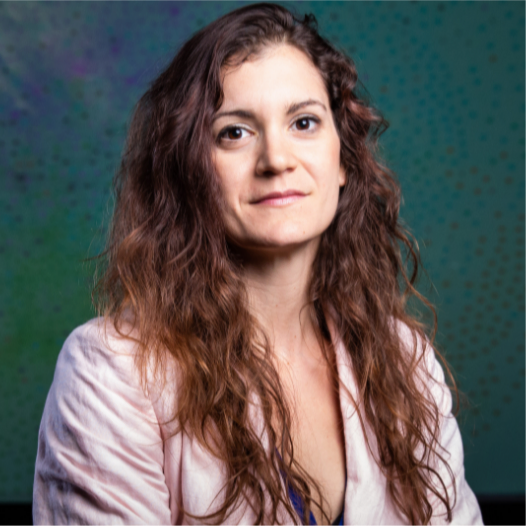
We are all alive, but "life" is something we struggle to understand. How do we distinguish a "living organism" from an emergent dynamical system like a hurricane, or a resource-consuming chemical reaction like a forest fire, or an information-processing system like a laptop computer? There is probably no one crisp set of criteria that delineates life from non-life, but it's worth the exercise to think about what we really mean, especially as the quest to find life outside the confines of the Earth picks up steam. Sara Imari Walker planned to become a cosmologist before shifting her focus to astrobiology, and is now a leading researcher on the origin and nature of life. We talk about what life is and how to find it, with a special focus on the role played by information and computation in living beings.
Support Mindscape on Patreon.
Sara Imari Walker received her Ph.D. in physics from Dartmouth college. She is currently Associate Professor in the School of Earth and Space Exploration at Arizona State University, Deputy Director of the Beyond Center for Fundamental Concepts in Science, and Associate Director of the ASU-Santa Fe Institute Center for Biosocial Complex Systems. She is the co-founder of the astrobiology social network SAGANet, and serves on the Board of Directors for Blue Marble Space.
Click to Show Episode Transcript
0:00:01 Sean Carroll: Hello everyone, and welcome to the Mindscape Podcast. I'm your host, Sean Carroll, and today, we are talking about life. Maybe we always talk about life, in some sense. Most people who I've had on the Mindscape Podcast are living organisms themselves. No one has yet noticed that any of my guests have been chatbots or artificial intelligences. But let's get deep a little bit here. Let's ask, what is life? What do you mean by life?
0:00:27 SC: This is the subject of Astrobiology, which apparently grew out of exobiology. I really just learned these vocabulary words. I knew about the vocabulary words, but I didn't know about their relationship. Apparently, we used to use the word exobiology, but exo means external, right? Out there. So life on other planets or other stellar systems or whatever, so it excludes life here on Earth. But Astrobiology, despite the word astro being there, is now taken to mean just the idea of life, both on Earth and outside.
0:01:00 SC: So what do you mean when you say life? And there's basically two angles you can take. One is, you can look at actual life, of course, we're stuck with life here on Earth, but that's okay. It comes in various forms. You can look at big organisms, mammals or insects or what have you. You can look at little organisms, algae and bacteria. You can look at edge cases like viruses. You could look at things that are not living, but are complicated, like chemical reaction networks. And you can try to draw some line and you can try to say, "Well, this is what counts as life, this is what doesn't." There's a whole another way of thinking about it, which is just a backup, to forget about the details of chemicals and geology and what's going on here on Earth or anywhere else in the universe and say, "What do you mean by the idea of life?"
0:01:47 SC: It's something to do with complex systems that can keep going. People debate what life actually is. Maybe the processing of information is somehow very important here. So today's guest, Sara Imari Walker, is an expert on both of these approaches, both looking at actual life, looking at the chemistry, thinking about how the molecules fit together to form the origin of life, whether it's on here or on other planets. And also the more information theoretic point-of-view that tries to ask, what kinds of structures would count as a living being, even if they were made out of completely different kinds of chemistry?
0:02:26 SC: So, you'll be un-surprised to learn, given those kind of interests, that Sara was actually trained as a physicist before becoming a full-fledged astrobiologist. So we have a wonderful conversation here, words like entropy and complexity appear. But it's a fascinating topic. We're going to be returning to it on other episodes in the year to come. How do you look for life elsewhere in the universe, in our solar system? What do you mean by life? Could there be different forms of life here on Earth? Could you make life in the laboratory? I think it's a very exciting frontier, and this conversation is a wonderful introduction to some of the major ideas.
0:03:01 SC: Remember, that we have a website, preposterousuniverse.com/podcast. So don't forget you can go to that website and you can find complete transcripts for every single episode. So if there's something interesting that goes on that you hear in the episode, you don't need to re-listen to the whole episode six months from now when you wanna catch what that thing was. You can go to the website and actually search for it. Those transcripts are paid for by Patreon supporters, so many thanks to them. And with that, I think we're ready for some life talk. So, let's go.
[music]
0:03:44 SC: Sara Imari Walker, welcome to the Mindscape Podcast.
0:03:50 Sara Imari Walker: Hi. Happy to be here.
0:03:53 SC: Yeah, it's great to have you here, especially because I keep having these people on the podcast, who I just think are intrinsically interesting. And then, in the middle of the conversation, I realize they were trained as physicists at a young age and that includes you, right?
0:04:06 SW: That's right.
0:04:06 SC: So what... How did you get from... Right now, you're working on origin of life, and a whole bunch of other things. Maybe, I wanna dive into the ideas, but maybe to calibrate the audience, why don't you tell them how you got to point A from point B and vice versa?
0:04:19 SW: Sure. How back in history do you want me to go?
0:04:21 SC: When you were an undergraduate or maybe, let's say, graduate school, let's start with graduate school.
0:04:25 SW: Okay, yeah. Okay, so I started graduate school at Dartmouth College, and I wanted to be a cosmologist at the time or study particle physics. And so, actually to understand that motivation, I might have to go back a little earlier.
0:04:37 SC: Okay.
0:04:39 SW: So what happened was I went to community college actually for my first two years of college, and I took a physics class, and I became deeply infatuated with physics.
0:04:46 SC: Great.
0:04:47 SW: Okay, so it does go back in history.
0:04:49 SC: That's also a great message to anyone who's listening at a local college or something like that.
0:04:53 SW: That's right. Yeah, I think it's important to mention. So it was quite funny. So I was 18, at a two year college and I was walking around saying, "I wanna be a theoretical physicist when I grow up," and everyone thought I had two heads. But to me, it was really important and I had some really supportive mentors there, but I think what really intrigued me about it, what really motivated me to continue at university and then to go to grad school was I was very interested in fundamental descriptions of nature and what reality was, and the fact that mathematics could describe so much of reality, and that humans were really good at doing that.
0:05:24 SW: And so, I actually literally remember the lecture where I got interested in physics in community college, it was the first day, and my physics professor was talking about magnetic monopoles, and the fact that they don't exist, but we predicted them and we were going out to look for them. And so that idea deeply intrigued me. And so, what I thought was I wanted to be like the people that were predicting those things and going to look for them. And so, I had this idea in mind that I wanted to do theoretical physics and theoretical physics was like particle physics and cosmology, so I went to undergrad at Florida Tech and I studied physics there. And I worked in a lab that did particle physics. So, I was working on some calibration of detectors for the CMS experiment, LHC, and then I went to grad school to do cosmology in particle physics, 'cause I really wanted to do theory.
0:06:00 SW: So what happened when I got to grad school was I started working with Marcelo Gleiser, who was my PhD advisor, and he has spent most of his career working on early universe cosmology. And I was very excited about that topic and trying to think about where does matter come from and re-heating after inflation. And so, I just wanted to work with him, but he was starting to work on this thing called, Astrobiology, and I was like, "What is that?" [laughter]
0:06:38 SW: And, so he explained to me about the origin of life field and that people... That there were these problems in origins of life. And so I started working on a specific problem related to the origin of life, which is about the origin of homochirality. So, biomolecules in our bodies come in mirror image form, so amino acids that are made into proteins come in a left-handed, right-handed variety, but proteins are only made of left-handed amino acids. And DNA and RNA are composed of right-handed sugars, even though you could have left or right-handed sugar bases. So, I was...
0:07:15 SC: And that the general concept of left versus right is chirality.
0:07:18 SW: Chiral, yeah. So chiral actually literally means "hand" in Greek. And so it's actually really fun to give talks for the public and stuff 'cause you can actually wave your hands around like you... So...
0:07:27 SC: It's your job, yeah.
0:07:27 SW: Yeah. So I'm waving my hands now, but obviously, podcast audience can't see that. But anyway, so that was a fun problem to work on because there's this questioning the origin of life about how life became homochiral and what happened in the origin of life to actually break that symmetry. So if you try to do prebiotic synthesis, which is basically making compounds without biology and making biomolecules, you'll get roughly equal mixtures of both the chiral form. So left and right hand...
0:07:57 SC: So non-biological chemistry gives you both?
0:08:00 SW: Yeah, basically. And so, I was studying that problem, but as a physicist would study. So, physicists get really excited about certain classes of problems, as you know being a physicist, but maybe the audience doesn't know. But there's a particular problem called the "icing model", which we use to model ferromagnets, for example. And you can talk about a spin-up or a spin-down system, and symmetry breaking between spin-up and spin-down. You can do the same thing with left and right-handed. And so, I started studying symmetry-breaking processes in chemistry from the perspective of a physicist, related to origins of life.
0:08:36 SW: And so, that was kind of a physics segue into the problem. And it was quite interesting for me because I was working on that problem, but I was thinking about this deep motivation I had when I first started getting into physics about idolizing my heroes in science like Einstein, Fermi and Dirac, and these people that had these really deep thoughts about the structure of reality and advanced fundamental understanding of how we see the world. And I'm thinking about this origin of life problem, and I'm like, "That's not... " I was taught physics was these certain sets of problems. But as I started to work on it more, I realized that we really didn't understand the origin of life and we didn't understand the questions, and that maybe there was some deep physics to be uncovered in life or in the origin of life that might actually explain it.
0:09:14 SW: So I had this transition point maybe three or four years into my PhD where I started not becoming resistant to working on origins of life as a fundamental problem and realized the actual reason I got into physics in the first place was I wanted to contribute fundamental understanding. And here was this place that's sort of like the Wild West of science where nobody knows what's going on. And so, you can actually be really creative in the ideas you bring to the field. And there were very few theorists working on origins of life. So I remember going to conferences as a PhD student and it would be 100 people at the conference and they're all prebiotic chemists and no theorists and nobody thinking very deeply about this issue of what life is and how we can try to build new theory to try to understand the process of origins of life.
0:09:58 SC: I think also for the people who are not experts out there, it's crucially important that origin of life research is not a mature field in the same way that particle physics and cosmology are. Particle physics and cosmology, we have what are literally called "standard models" and they're correct, that we've tested them and we're trying hard to push beyond them. But it's difficult even to get any experimental clue. Whereas in origin of life, we're like, "Ah... "
[chuckle]
0:10:21 SW: Yeah.
0:10:22 SC: There's many different models, none of them is standard.
0:10:24 SW: Exactly, that's right. And I like that about that field. So I love particle physics and I love all the things that have been built, but it's like, somehow you wanna also be actively contributing to that. So yeah. So it's fun about the field, but it's also infuriating 'cause you're constantly not sure what the question to ask is, let alone how to answer it.
0:10:44 SC: That's right. Both situations have their downsides.
0:10:46 SW: Yeah.
0:10:46 SC: The downside of particle physics and cosmology is, it's hard to make true progress understanding nature 'cause we understand it too much. And in origin of life, we understand it too little. So it's hard.
0:10:55 SW: That's right. That's right.
0:10:56 SC: So what do you do... But then you got a PhD. You are a physicist, but then now you're not in a physics department.
0:11:03 SW: Right. So when I left graduate school, I went to work at Georgia Tech. And so, part of my reason for doing that was I got a position there working in their Center for Chemical Evolution, and they have a really a great group of researchers there focusing on origins of life from the chemistry side. And so I thought, I didn't know much chemistry and much biochemistry, amd so if I went there and did some theoretical modeling that I would learn a lot about how chemists think about the problem and how people from different disciplines think about the problem. And that was incredibly helpful, but I remember also thinking the whole time...
0:11:37 SW: So I was doing these models for how... We had these simple models in chemistry for original of life processes. And so, the idea is we wanna study "chemical evolution" where the evolution is leading to something life-like. But we don't know what life is. And so, I started becoming increasingly dissatisfied with the fact that I could do all of these modeling of origin of life without having any metrics of success. And even any of the ways we think about origin of life science are really far from what we would call "life".
0:12:09 SW: So there's actually this huge gap in the field that we have prebiotic chemistry, which makes simple compounds like amino acids or RNA, nucleotides, under prebiotic conditions, so without biology. But you can only make the simple building blocks. You can't make big molecules and you can't make anything as complex as a cell, obviously, from such a simple condition, or at least we can't yet. Presumably, that happened at some point in the past through some evolutionary process. But the way prebiotic chemistry is now, it's very focused on building specific components of biological systems. And so far, we can only get very simple ones under non-biological conditions.
0:12:48 SC: Basically, molecule by molecule.
0:12:49 SW: By molecule by molecule. So the standard of proof in that field right now is you make a molecule that's in biology...
0:12:57 SC: Yup. [laughter]
0:12:57 SW: Without biology. But you have...
0:13:00 SC: The gold standard is one that reproduces itself like a...
[overlapping conversation]
0:13:01 SW: Well, eventually, but we're nowhere near that. So right now, a successful prebiotic synthesis experiment is you make a molecule that's found in biology without biology.
0:13:12 SC: Okay.
0:13:12 SW: And so, my only point with that is that's useful to know what conditions those molecules can be made under, but it's not life.
0:13:18 SC: It's a step.
0:13:18 SW: And it's nowhere near life. And then on the other side of it, we can trace back phylogenetically to try to reconstruct what we think the last universal common ancestor of life on Earth is. So we have this idea that life evolved from a population of cells with modern translation machinery. So DNA and proteins like we have today, but when we try to look back in history, we get to a certain point where we call the last universal common ancestor and we can't go back any further. Because before the original translation, we can't reconstruct what happened, 'cause we reconstruct what happened based on DNA, and if DNA isn't being read out by the translation machinery to do something... So it's sort of been equated in my field to the CMB of biology. So, it's like their surface of last [0:14:08] ____ that you can't actually push back with our standard way of looking at biological organisms.
0:14:14 SC: It sounds like you were the only one who would make that comparison.
0:14:17 SW: No, I'm not the only one. There are other physicists that make that comparison. So, I think I heard that one actually first from Nigel Goldenfeld. So another physicist working in astrobiology and physics of life stuff. But anyway, so...
0:14:29 SC: But maybe it's just because I know that I used to get confused about this, the difference between the first living organism and the last universal common ancestor.
0:14:37 SW: Is potentially huge.
0:14:38 SC: Potentially huge in years, in complexity, and what does that mean?
0:14:42 SW: In years and complexity, and maybe scale, like a spatial scale, which we can talk about a little bit. But so, we don't know when life emerged, we don't know where life emerged. I think there's this idea that life emerged as a single cellular entity on early Earth and then it started reproducing itself and evolved to take over the planet. But there's an alternative set of ideas that life emerged from geochemistry. And with some organizing geochemical cycle, it might have actually been a planetary process from the start. And I find those sets of ideas to be more intriguing, but that's what I mean about scale. Because you could think about an individual organism emerging and being alive, or you could think about emergence of life as this process that's happening on a planet, and then individuals, the things we call cells or units in biology emerge much later. And that's...
0:15:38 SW: So just to go back to where we were, 'cause we can come back to the set of ideas, but I wanted to finish about the motivation. So when I was at Georgia Tech, I was just... That gap just really bothered me, and the fact that I feel like a lot of people in origins of life field, although it's been changing significantly over even my short career, 'cause I think the field is really starting to move in some new directions that are quite exciting for various reasons that I can talk about. But just to cut to the main point here, that gap was bothering me, and the fact that people weren't tackling the origin of life transition directly.
0:16:10 SC: This is the gap between making a single molecule versus trace back to the last common ancestor?
0:16:14 SW: Yeah, versus having a complex functional minimal cell or an early living system, versus having molecules that are in that living system, and the steps in between are like a black box.
0:16:24 SC: A mystery.
0:16:25 SW: And they still are a black box. We don't know what those steps are. And so, then I became deeply interested in this "What is life?" question, how do we quantify it, and then could we build theory for understanding the transition from non-life to life? What would that theory look like? And how do we actually quantify this thing that we call life so that we could actually build better origin of life experiments? And so I ended up getting an NASA fellowship and going to ASU after Georgia Tech, and that's when I got back more into physics thinking. And in that fellowship, my mentor was Paul Davies. And so what I worked on with him was really trying to think about the origin of life transition more from the perspective of if we think that there's some interesting fundamental physics going on there, what is it and what would we say the origin of life transition is? And so, I ended up spending a lot of my postdoc thinking more like a philosopher, I guess.
0:17:18 SC: Good, yeah.
0:17:19 SW: About what I thought the origin of life was. And so by the time I became a professor, what I really... I had this clear idea in mind of what I thought a concrete way of addressing the problem was. And what I've done with my research group is basically build infrastructure to try to build toward that theory. And that takes a lot of forms. There's a lot of ways to think about the problem and a lot of it is about the role of information in physical reality, 'cause I think that has a lot to do with what biology is, which I can explain more. But most of it is just trying to understand what life is so that we can solve the origin of life.
0:17:56 SC: Yeah, definitely. Information theory and its role, that's mostly what I wanna talk about. But just to... So there's something more concrete in our listeners' heads, what are the theories for, number one, what the last universal common ancestor is, and number two, what the first living organism is? Is there even a set of models that people argue about or is it really just, who knows?
0:18:19 SW: No, there are a set of...
0:18:21 SC: And when did they happen, I guess?
0:18:23 SW: Yeah. So the origin of life itself, I think, is easier to talk about the different classes of models, because there are concrete camps, so to speak, where people have a particular idea in mind or a set of hypotheses and they're actively working on that. And so, probably the most famous is the RNA world hypothesis for the origin of life, which is that life started with RNA as the primary biomolecule. And so...
0:18:48 SC: Maybe we should even say what RNA does in our present cell system. Yeah.
0:18:52 SW: Yeah. So, the reason for that, yeah, is that RNA is an intermediary between DNA and protein. So, when DNA gets translated or transcribed, it's transcribed into RNA, and RNA is read out by the translation machinery into proteins. But RNA also has this dual role where some RNA molecules fold and they have function on their own. So it can both act as a genetic molecule and a functional molecule, whereas in modern biology, those rules are mostly split as DNA being the informational molecule or genetic molecule and proteins being the functional molecule that does stuff in the cell. So the idea was if you wanted to have a simple explanation for the origins of life, and we know RNA plays both these roles, perhaps RNA was the first major biological macromolecule. Now, even within the RNA world though, there's a very varying set of hypotheses about what the RNA world actually means. So, you could say... One extreme end of it is the RNA world means that an RNA molecule emerged on the early Earth, started copying itself and started evolving, and then somehow evolved into all of the rest of biology.
0:19:35 SC: Wrapped the cell around it, yeah.
0:19:35 SW: Yeah. And so, that really relies very strongly and evolution being a very strong force in nature to really generate novelty and complexity. Now, on the other side of it, there's the softer RNA world view, which is just the idea that RNA was the first genetic material and DNA evolved later. So you might have had some metabolism and some cellular structures before you even had RNA. But when you got genetics, it was RNA.
0:20:24 SC: So, replication first versus metabolism first?
0:20:28 SW: A little bit. So I'll get to that.
0:20:29 SC: Those are the words I've heard. That's why I'm just trying to put my lesser knowledge to work here...
0:20:33 SW: No, no, no. That's good. Yeah. But this is just thinking still genetics being important. So I've actually, because I tend to be in the more metabolism camp if I was gonna self-identify as a camp, although I try to be as agnostic as possible. So I kind of wrapped that RNA is the first genetic material into a metabolic narrative, but some people think that just purely think about the genetics. So they don't make strong claims about RNA being the very first living thing, but all they care about is being life is the first genetic things. And then there's... The RNA world is part of what are called genetics first hypothesis. And the genetics first hypothesis doesn't just include RNA as the first genetic material, but there's a whole variety of other nucleic acids that could have potentially preceded RNA. So there's things like TNA and PNA and all these NAs...
0:21:30 SC: Who knew. Yeah.
0:21:31 SW: I know, right? And it's actually interesting 'cause people use these in synthetic biology and show that some of these XNAs, as they're called, can be functional in modern cells. But there are people that work on trying to figure out which nucleic acid polymers can talk to each other. The idea being if you think about chemistry as hardware, that you could have had a succession of hardware upgrades in some sense where the genetic information and coding could have been in one molecule class and then copied to another. And so DNA copies to RNA, which is part of the central dogma biology that information flows from DNA to RNA. But the question of that idea of origin of life science is, which polymers can copy information to each other? And it's not always bi-directional.
0:22:10 SW: It's like sometimes you could get information transfer from one to the next, but not backwards. So there's a whole research industry on that. And then alternative to that is the metabolism first, which is what you were alluding to, which is this idea that life started not with a molecule that could copy itself and undergo an evolutionary process, in the sense we would understand as being very Darwinian, where you have a genetic molecule that copies itself and has heredity and variation. But some kind of self-organizing set of molecules, which is we call in the field are autocatalytic sets. You have a bunch of molecules that catalyze a reaction, and then those reactions form a closed cycle, so the system as a whole reproduces itself.
0:22:49 SW: And so the idea there is that there were some autocatalytic chemical reaction networks of these reactions that actually emerged on early Earth. And there's varying sets of ideas there are also, so some people think that's a... Would have been... Early proteins would have been the best candidate for that. So you would have gotten some peptides, so polymers and amino acids. Amino acids make proteins. Proteins are just very big, long macromolecules. But if you think short amino acid sequences that could have catalyzed the production of other amino acid sequences, you would have got an auto-catalytic cycle. But other versions of auto-catalytic cycles include things like a primitive metabolism.
0:23:31 SW: So there's a set of ideas that maybe the citric acid cycle, which is a metabolic cycle that happens in modern biology, is actually the most primitive metabolism and emerged from geochemical cycles. And I find that set of ideas deeply intriguing for a number of reasons, because it's trying to tie the origin of life to planetary processes and geochemistry. And so what you'll notice about... And also, I should mention in metabolism first, there you get more emphasis on energy and thermodynamics and those kind of approaches. And in genetics, approach is more focused on information and copying and evolution. And both of those things are obviously important in biology, but they've been parsed out as separate to be origin of life hypothesis. And then there's other things like the cell first hypothesis that you might have just got lipid vesicles or something forming an earlier...
0:24:31 SC: Or cell walls that differentiate inside and outside.
0:24:32 SW: Yeah. That, and then molecules would have gotten inside them and that would have started some copying and evolutionary process. So there's a whole swath of different ideas. And I think, you know, what happens with each of these hypotheses is they have their own set of experiments that are possible to do. But what ends up being hard about the whole enterprise is that I think a lot of the ways that we're thinking about it are, A, very anthropocentric. They're imposing things that are biological into chemistry in ways that maybe aren't... They're almost anticipating this solution and...
0:25:04 SC: Because we are poisoned by knowing what we do, what life is now.
0:25:08 SW: Yeah, exactly. So just to think about the idea I was talking about before about when a pre-biotic chemist wants to make a molecule that's in life, they wanna do origin of life chemistry, the way to do origin of life chemistry is to try to produce something like an amino acid under non-biological conditions. But we don't know that life started with the chemistry that it has now. There could have been lots of changes in the chemical structure of what molecules, living systems, were using as they became alive. And so I think it gets very hard to say if any of these things are really in the right space of ideas.
0:25:44 SC: Well, you're doing a good job of letting the non-experts know that it is a mess 'cause life right now has a lot of things going on...
0:25:53 SW: It sure does.
0:25:54 SC: And it's not even clear which of these are most important or could be first and then build upon. So it's a wonderful open field to play in, but it can be hard to get a purchase on something different.
0:26:05 SW: Yeah. Right. And I think part of the thing is the field has been really deeply focused on the idea of the historical origins of life. And so what I mean by that is what we know is that the origin of life happened once in the universe.
0:26:06 SC: At least.
0:26:06 SW: We think it happened on the planet... At least once, yeah. At least once. Thank you for clarifying that. It happened at least once, which is what I meant. So we know for sure it's happened once. We don't know if it's happened more than once.
0:26:30 SW: And we think that was on Earth, although people have alternative hypothesis it might have emerged somewhere else and then travelled to Earth, but it's easier to assume it happened on Earth. And then the historical origin of life problem is concerned with how did life as we know it arise. But you could ask the more general question about how does life arise in the universe? And then that doesn't necessarily need to assume the chemistry is the same. And so the way you frame that question and ask those questions is actually a little bit different than the way origin of life traditionally has been posed. And that way of asking it tends to border more with other fields like artificial life, or start thinking about what life could look like on other planets. And I think that's actually much more fruitful personally. But I think there's a lot of growth in the field to really understand how to parcel all of those different ideas about how to think about it.
0:27:14 SC: And it's very natural, once one has training as a physicist to try, to say, well forget about life on this planet...
0:27:19 SW: Yes.
0:27:19 SC: Let's just imagine the idea of life.
0:27:21 SW: I know, I know.
0:27:23 SC: And where it could have come from.
0:27:23 SW: It's like, you can take the girl out of cosmology, but you can't take the cosmologist out of the girl.
0:27:26 SC: It's really true, yeah.
0:27:27 SW: I really just, I can't... I can't get that mindset out... But I think I went into physics because I had that mindset in the first place.
0:27:34 SC: Yeah, exactly right.
0:27:37 SW: And so I do think that life is something that happens in our universe, and there should be some explanatory framework for what life is and why it happens. And I don't, I personally... Well, I don't know what I actually think because I try not to have a firm opinion on these things, because then it's difficult to make scientific progress. I think, intrinsically, I'm hopeful that life exists in multiple places. But I don't know for sure. But scientifically, I think the most useful hypothesis is that there are rules underlying the origin of life, because that allows us to ask questions about what those rules might be. If life was such an odd statistical fluke that we really were the only life in the universe, then it's not a scientific question anymore in some senses that...
0:28:14 SC: Then it's hard, yeah.
0:28:14 SW: Yeah. It's just so low probability, how would you actually get the principles out of it?
0:28:18 SC: Or even if there were 100 different times when life started, but they were all different.
0:28:21 SW: Yes.
0:28:21 SC: And that would be disappointing to our physicists' hearts.
0:28:23 SW: Right. But also... But actually, I think that's interesting, and one of the reasons that I'm an astrobiologist rather than, say, a biophysicist or theoretical biologist, is that I think there is something about the way you ask about the question of life astro-biologically that's actually quite useful, in the sense that if I say I'm gonna go look for life on other planets or I think there is this thing called life in the universe, then I really am saying there's this objective category that exists that we can call life and it should have some property common to all life. And so then the idea is, what are those universal properties?
0:28:54 SC: Good.
0:28:54 SW: The challenging thing is, those may not be things that we expect them to be. So they might not be things like the molecules are always gonna be the same.
0:29:03 SC: Yeah. Okay.
0:29:03 SW: And so that's when the thing about the idea of information becomes more important to me, because I don't think that the physical stuff, the molecules, is always gonna be the same. But what is gonna be the same is that there's some informational process organizing matter, and that's what life is. And then that gets into a whole bunch of things about what does that actually mean? And that's where we're stuck in this idea development of how do we actually understand what this thing is?
0:29:30 SC: It does. But that sounded right there like you gave a definition of life.
0:29:32 SW: Yeah.
0:29:32 SC: I mean, in my book, 'The Big Picture,' I quoted this definition that was offered by some NASA panel of some sort.
0:29:38 SW: Oh, right. Yes.
0:29:39 SC: And I really didn't like it at all. It seemed...
0:29:40 SW: The infamous, life is a self-sustaining chemical system capable of Darwinian evolution. Was that the one?
0:29:45 SC: That was the one, yes.
0:29:46 SW: Yeah. That's the one, yes.
0:29:46 SC: And so I thought that that was just very blinkered. And also the fact that life is capable of Darwinian evolution in particular, is certainly a historical fact about life. But I could imagine building a synthetic thing that we would all agree is living but is not capable of Darwinian evolution. It seemed to miss the point.
0:30:06 SW: Yeah, no. It's definitely missed the point on a lot of things, and that's one of them. Even across life on Earth, Darwinian evolution is not the only mode of evolution that we know exists. So, for example, the last universal common ancestor I was talking about, horizontal gene transfer was really important. So it was more of a collective evolutionary process because individual units weren't clearly defined.
0:30:26 SC: Yeah. So back in the day that you would pass genes back and forth to your friends not just to your children.
0:30:31 SW: Yeah, exactly. Exactly. And micro-organisms still do that. It's still a really dominant mechanism of exchanging information, even in modern systems. And then you have things like cultural evolution, which is not necessarily Darwinian. And so we do know that biology uses a lot of different ways of changing over time and changing information over time besides Darwinian, and you can theorize about all kinds of different ways evolution could work. So that's one of them, the Darwinian evolution. I think the part that actually bothers me more about that definition, and also about a lot of definitions of life, is they assume life is chemical.
0:31:07 SC: Chemical, yeah.
0:31:07 SW: And that chemistry needs to be in the definition of life. And I think there's a major confusion between chemistry, which is the scale of physical reality, talking like a physicist, where life emerges and what life is. So I think chemistry is the scale where information becomes important as a part of physics. I don't think it really matters at smaller scales in physical systems, and I can talk about what I mean by information and chemistry in just a minute. But I think life is like... When I think about what life is, I think about you and me being life. We're not just chemistry. Technological civilizations are life. Multicellular organisms are life. So I think life emerges in chemistry, but it's this process of information organizing matter, as I was saying, but it happens across many scales that are...
0:31:57 SW: And part of what's interesting about life is life is actually like this hierarchically organized process. So we talk about this idea, in evolutionary biology, of major transitions in evolution. The first one was the origin of life, but subsequent ones are origin of multi-cellularity, origin of social systems, and all of that structure is still part of life. But we don't necessarily talk about chemistry there. And so I think that's actually really important. And I think part of it is also this idea that when we're talking about defining life, we need to talk about an individual cell. This is also something that's really interesting to me because we're really fixated on this idea of the definition of life should describe an individual.
0:32:39 SW: And so one of my colleagues, Michael Lachmann, at the Santa Fe Institute, is really interesting the way he thinks about it. 'Cause he... The way he thinks about a cell is a cell is a current manifestation of an evolutionary lineage, but you can't really separate the cell from the fact that it has this long evolutionary history. So he would talk about the unit of life actually being the lineage. And I think that's a really nice idea. But I also think when you start thinking about expanding your definition of life that way, that you can't really just isolate the lineage, but you need to think about all the lineages. And so it's almost like we had an origin of life event, and when we talk about life, it's the origin of life event and all the subsequent structure that emerged from that. And it's this information structure that's constantly constructing all of these individuals and all of these processes by having information distributed in space and time, and that's actually what life is.
0:33:33 SW: And the natural boundary for that actually ends up being the planetary scale. And so I think a lot about the biosphere as being as a whole, as a proper unit of life. And then when we study the components of the biosphere, it's partitioned into things we call individuals or societies or ecosystems. And those are all part of that living structure. But you have to consider the whole thing.
0:33:53 SC: Right, right. Okay.
0:33:54 SW: And that's a very different perspective than people usually take.
0:33:56 SC: It is. And so you're expanding the scope of the thing both in space and in time, right?
0:34:02 SW: Yeah.
0:34:03 SC: So there's basically one life that we know about.
0:34:06 SW: This is why the origin of life is so hard. Because it's the origin of that process, right?
0:34:10 SC: Yeah.
0:34:11 SW: Yeah. And so I think very much about this idea that there's some scale where this physics becomes important. And then what is that scale? And that was part of... Once you get the process of life going, it is this expansion process in space and time and we're building more structures like tables and microphones and things by information accumulated or over evolutionary history. But getting that process started is quite interesting. And so one of the points I was making about chemistry and why I think this physics emerges in chemistry and maybe not at lower scale. So the origin life is always maybe gonna be happening in chemistry, is that when you think about chemical space, like the possible set of all possible molecules, it's infinitely huge. It's uncountably huge. People... Every... If you look at the largest pharmaceutical databases we have, they have millions of compounds, and it's not even scratching the surface of the size of the number of compounds you could make even with just a few elements.
0:35:06 SC: And it's just combinatorial.
0:35:07 SW: Just combinatorial.
0:35:07 SC: Especially carbon molecules, if you just keep stringing them on there.
0:35:10 SW: Yeah. It's a huge combinatorial space. And so Stuart Kauffman has this idea, he talks all about the adjacent possible, that once you get into molecular space, it's like you have so many structures even for a protein of possible molecules that not everyone could possibly exist within the lifetime or resources of the universe. And so what happens in chemistry, that at a certain scale, is that not everything that could exist will ever exist. And so to see something like a protein requires a lot of information to reproduce it in the universe reliably because there's no... Otherwise, it would just be a statistical improbable fluke. And the same thing with the table. And so I think the process that we need to understand is, how does information emerge or what is information, and then how does it make it so that things like cups and tables and very complex molecules are reproduced in the universe reliably?
0:36:04 SC: Well, clearly, the idea of information is playing a huge role when you're...
0:36:07 SW: Yeah, I know. Obviously.
0:36:08 SC: Thinking about this, you've already mentioned several times.
0:36:10 SW: Yeah, I know.
0:36:11 SC: Maybe let's focus in on this a little bit. I'm asking a lot here, but is there a simple definition of what you mean by information, and how does it affect all these other things going on?
0:36:21 SW: So I should say that there's obviously something called the information theory, which people talk about quite a lot and was developed by Claude Shannon in the 1940s. And it's a huge industry of people that work on information theory, and I use information theory a lot in my work, but that's not exactly what I mean when I'm talking about information relevant to physics of life. And so information theory will often talk about, if you have a quantity of information, it's somehow related to your reduction and uncertainty about a process. So if you walk into the room carrying an umbrella, my uncertainty is maybe reduced about whether it's raining or not outside because you had an umbrella and you were bringing it to work today. So there's some information in the umbrella that I can have about predicting what else is happening. And so that's what people usually think about when they think about information.
0:37:09 SC: And Shannon was interested literally in sending signals over wires.
0:37:11 SW: Yeah. Right.
0:37:13 SC: And how to do that efficiently.
0:37:14 SW: Yeah, it's very much about communication, and there's a lot of caveats there about how... Which might get more into the technical details, but it also requires that you have some way of encoding the message. So it automatically assumes a lot of things about what a physical system is to be able to communicate, because it has to have a semantic representation or some kind of symbolic way of describing things that both the sender and receiver understand, so that the message can be decoded. And so that's already a very large set of assumptions, and I think whatever physics underlies information, that should be a property that drops out of the physics, not something you impose on it. And so...
0:37:56 SC: So is it safe to compare this to my favorite example? If I have a textbook that is written in French, but I don't speak French, in some sense it doesn't convey any information to me.
0:38:06 SW: Exactly. Yeah, yeah. That's exactly right. And so, yes... [chuckle] And so that's the way people usually talk about information, is within that formal... Formalization. What I'm interested in is the fact that there seem to be some processes that require some kind of abstraction or some kind of representation that can... That's not necessarily tied to the physical substrate. So, an electron has charge, and you can't remove the charge from the electron, that is a property of the electron. But information is quite different in the sense that I'm holding... Evian? Is that how you pronounce this? I never know...
0:38:37 SC: Evian.
0:38:37 SW: Evian. Water bottle, right? So I can read Evian and now I have that word in my mind, but it's existing on the water bottle which is one kind of physical material, my mind is a different kind of physical material, and then I'm talking about it into this giant microphone, which is really quite large. And now it's traveling over wires and is now on somebody's computer that they're... Well, in the future will be, but my now and their now are different.
0:38:37 SC: Yeah.
0:39:19 SW: So it's information that can exist in a lot of different media, but somehow it still has the same property that it means the same thing in all of those different instances. And that's a really intriguing property for something physical to have. And so this gets into a lot of deep philosophical debates about how physical information actually is, because it seems to be this abstract quantity or property that can exist in many different media, it can be copied between media, and it doesn't have the same physical oomph that something like electric charge has. Although it's a little bit like energy, 'cause we think about energy flowing...
0:39:53 SC: It's a little like energy, I feel. I think, yeah.
0:39:54 SW: Yeah. So energy is actually quite an abstract concept also, but we have more concrete theory for understanding energy as a physical thing, and I think information we don't. My favorite example to use about why I think information is really different in the kind of physics that it mediates, is to actually think about examples of technology 'cause they're very visceral. So chemistry is hard because chemistry seems very abstract, it happens inside ourselves, we can't experience it in our daily experience, but I like to use this example of launching satellites into space and to think about that as a physical process.
0:40:25 SW: And so, if you think about what's necessary for a planet like the Earth to have thousands of satellites orbiting it, which we do, although most of them are artificial. We have one natural satellite, and then we have all these artificial satellites. The artificial satellites are quite interesting, because in order for them to be there, it requires that you have a technological civilization or some kind of intelligent process with knowledge of the laws of gravitation and engineering principles to actually build little metal boxes and throw them into space. And it's that idea that knowledge or information about regularities of the physical world and the ability to control them to mediate new physical transformations, like launching satellites into space, that really intrigues me about information. 'Cause in order to get to that point, you had this long evolutionary history, we had biological systems, learning about physical reality or learning about their environment the way biologists would talk about it, and they've gradually acquired all of this information to the point that you had science emerge on the planet and then learning about gravitation and formalizing it in mathematical laws, and those mathematical laws are information. And they allow us to do these transformations in the physical world that wouldn't be possible without that information.
0:41:32 SW: And so, we are... David Greenspan has this nice way of phrasing it, that we're a planet that's anti-accreting matter.
0:41:37 SC: Yeah, flinging matter off around us.
0:41:40 SW: We're flinging matter into space, so people... Planetary formation, they talk about planets accreting to form, so they're accreting matter and they're forming planets, and then you might get a few satellites. And then you have this weird kind of planet that has life on it and it's evolving over a long time doing all this weird stuff, and then suddenly it's anti-accreting. And I think that's a really nice example of the fact that that process just wouldn't happen without certain kinds of information in the system.
0:42:06 SW: And I really like this quote that David Deutsch has in one of his books, which I use almost all the time in my talks, 'cause I love it so much, but it's something like, "Base metals can be transmuted to gold by the powers... The processes that power stars and by intelligent beings that understand those processes, and by nothing else in the Universe." So there is something about intelligence as a physical process that's quite different. Because it's like, physics happens, and then you have biological or intelligent systems that understand physics, and then they can make these transformations that are not physically impossible. It's not impossible to launch a satellite into space, it's just... If you just had physics and chemistry and no biology, no organisms, no evolutionary history acquiring information, you would never see a planet launching satellites into space.
0:42:55 SC: You haven't quite given a formal definition, but it sounds like what matters to you about information is somehow a matter of potential, or ability, or leverage, you can somehow affect the world in a way because you have this information.
0:43:09 SW: Yeah, right. So, it's sort of about the possibilities that are... I use the word causation a lot, which people have various problems with... And I have problems with it a little bit myself because it's kind of a loaded word, but what's interesting to me is what can happen causally in the Universe. And I think there's a lot of processes that can happen, but just don't. And that what biology does is it somehow can cause things to happen that wouldn't happen outside of the kind of process that biology is. And you could call that thing that's causative, information, but somehow it's... And so, I think there is a deep connection actually between information and causation.
0:43:46 SC: We're back to philosophy again.
0:43:47 SW: And now we're back to philosophy, and there's a huge industry in complex systems trying to understand that deep connection, and I don't think anybody really... I think a lot of people have a lot of insights into it, but we don't really understand it. So, I guess... I think life is information structuring matter. What is information? In some sense it's like, causes that can be copied between physical systems.
0:44:09 SC: Yeah, okay.
0:44:09 SW: And so, there is kind of a framework there, but it's really funny 'cause, every once in a while, I have with my research group this... I just like to pounce on them at group meeting, "Let's have a 'what is life' discussion today." And everybody has to write on the board their definition of life, and it's amazing how much it changes.
[laughter]
0:44:23 SW: But that's good. I think it's productive, 'cause it means...
0:44:27 SC: Which wouldn't happen in a particle physics group thing, "What is the electron?" Right? They'd all agree...
0:44:29 SW: Yeah, exactly, exactly. Yeah, yeah. So I think a lot of our challenges, we have a really loose conceptual cloud of what the right space is, but how to actually penetrate it and build a rigorous theory and have the experiments to test against... It's just really hard.
0:44:45 SC: It sounds like this goes well beyond the question of origin of life or the nature of life, because, as you mentioned, there is something called information theory, you can buy text books called Information Theory, but in some sense, you're hinting that we are lacking a full theory of how information interacts in the world or what information does. We can quantify it...
0:45:04 SW: Yes.
0:45:04 SC: There's entropy, and flow of information, correlations, but the interface of maybe information and energy or information and work, or something like that, is fallow territory.
0:45:16 SW: Yeah. No, I think that's very accurate. I do think that there is a missing physics in some sense, various people like to describe it in different ways. For me, I think there have been major revolutions in physics, and if we're gonna have the next major one like quantum mechanics or general relativity was, it would be somehow physics of information, but that's my bias obviously, but poor hope.
0:45:17 SC: Yeah, we've all gotta go out there with the view.
0:45:17 SW: Yeah, we gotta go for it. But, ] anyways, I do think it's a fundamental property of our universe and it's pretty ubiquitous. So it exists outside of life, and it should tie into other ways we think about physics and exist in other physical systems. But I think what's interesting is... I make an analogy sometimes when thinking about gravity, it's like gravity exists everywhere, at least spacetime exists everywhere, but sometimes if we wanna study gravity at its most extreme, and we really wanna get insights into curvature of spacetime and things, we study things like black holes. If you wanna understand information and how it operates in the physical world, I think you study something like a living system.
0:46:17 SC: Go to the limits of those themes, yeah.
0:46:18 SW: Yeah. Because we are literally the things that exist where that physics is most evident.
0:46:23 SC: Right. Okay. So, does that kind of perspective... I guess, I have two questions. One, do other people share this perspective? And the other one is, are there tangible ways in which it might help us understand the origin of life?
0:46:36 SW: Yeah. I think other people do share the perspective. I'm not gonna say it's a majority view, obviously, and I tend to not wanna work on majority views because I feel like there's...
0:46:46 SC: Oh, yeah, that's good.
0:46:46 SW: More room for...
0:46:46 SC: There's other people doing that.
0:46:47 SW: Yeah, exactly. And also part... One of my goals, actually thinking about the "what is life" question is, I don't know if I'm right or not, right? And in some sense, one of the ways I justify why I push so hard on trying to really push the boundaries of how we think about that problem, is just that I think that needs to be done. And whether the way I'm doing it is the right way or not is subject to discussion, debate, and scientific inquiry, and validation against experiments once we can build the right theory. But it also, hopefully, will get people to start... Just start getting out of our boxes and think about the problem differently, which I just think is desperately needed. So I think what I do do in my work and something I think my group is quite good at, I work with insanely talented grad students and postdocs, but we always are trying to think about what are the experiments and how do we actually connect to experiments or real data sets. And so my hope is that there will be, in the same way that physics has really progressed because of the interface of theory and experiment, that's something that really needs to happen in origins of life, and not in the sense... 'Cause I make a distinction between modeling and theory, in the sense that a model...
0:48:04 SC: Okay, what is that distinction?
0:48:05 SW: The model is something that'll describe like a particular system. So I can build a mathematical model that will describe a particular enzyme and how it functions or something, but if you have a theory, it's much more encompassing and explanatory, and some say...
0:48:19 SC: It's hand model or something like that, yeah.
0:48:19 SW: Yeah, exactly. And theories are more predictive I think across different systems. Maybe that's just my own personal classification, but I purposefully make that kind of distinction because I think in origins of life we've had a lot of modeling. It's not like we're absent of theoreticians, but we don't have any motivating theories really. All those hypotheses are... They're very specific kind of model. It's not talking about general principles. So I don't really think of the RNA world hypothesis is a general principle for origins of life. It's a very specific kind of set of idea that was designed to be experimentally tractable and relate to life on Earth. But what I would really like to see the field move toward is having theory for what we think life is and trying to test it by doing experiments that could test it. Or looking for... Or using searches for life on other planets as tests of hypotheses about what life is.
0:49:16 SC: Can you give us an example of something that you would either do or advocate people doing in the lab to touch on these ideas?
0:49:23 SW: Yeah. One of the things I think is... So there's been this kind of newer set of ideas related to what is so-called "messy chemistry" in origins of life, which is like...
0:49:32 SC: Messy chemistry.
0:49:32 SW: Messy chemistry. So people are doing a lot of this kind of soup chemistry. So it's a little bit like the Miller-Urey experiment was done in the 1950s, and that it was like... Famously produced amino acids from some guk. But the idea is now to try to have some simple building blocks, but have them coupled maybe to an environmental source, and also do multiple experiments. So, my ideal scenario, and actually I do... I work with experimentalists. So one lab I work with is Lee Cronin's lab at University of Glasgow, and they do these kind of experiments. So I've been on some work with them on that. But they take these soup chemistries and they try to change the environment by having different minerals introduced to the system as a function of the... Changing the history of the chemistry or changing the pH, and there's a lot of hydrating and dehydrating. And so you have these environmental cycles that you introduce to these messy chemistries and then what you see is you get really different product distributions out of different histories. But what's interesting is you never reproduce the same exact set of products, but you do reproduce features. So in...
0:50:40 SC: You mean... Sorry, if you do the same experiment twice, you get different answers?
0:50:44 SW: Yeah, because chemistry is stochastic.
0:50:46 SC: Okay, so there's just random fluctuations and...
0:50:48 SW: Right. Yeah, and also, it's just... These are lots of different molecular species in the [0:50:56] ____ we were talking about before. And then molecules can be catalytically active, so they change the nature of the distribution. And that's exactly the kind of dynamic you wanna get to life, right? 'Cause you want a changing history over time, and...
0:51:06 SC: So the kind of early adopter effects, so if one molecule comes into existence early, it can change the whole future progress.
0:51:12 SW: It can change the whole future. Yeah, exactly. And that's exactly what we wanna look for, and amplify, and understand the statistics over. And so, in some sense, it's like, we need a statistical approach to chemistry in the same way that people took a statistical approach to understanding thermodynamics in the 1800s and things. But how do you actually do statistics over chemistry, it's really difficult because chemistry is quite complex.
0:51:32 SC: But you can see where the information theory is coming in then?
0:51:34 SW: Yeah, exactly, yeah. And so what I like... And also, it's sort of like, physicists are obsessed with macro states and micro states. And I like this because it's starting to get into a macro-scale view of chemistry. You don't care about the specific details of the chemistry and the history, but maybe there's some macroscopic properties of the chemistry that are reproducible, given a certain history, and those might lead to specific features that are life-like. Potentially.
0:51:42 SC: Do you think that the origin of life... And this is something you can just have an opinion on and not necessarily something you have established, but do you think that when life started it required some leap, some sort of very unlikely fluctuation, or was it more or less inevitable given the conditions?
0:52:13 SW: I am not sure how... I get asked that question a lot, and I've thought about it a lot, and I don't think I have a firm opinion one way or the other. I think what I do think is, in some sense, if we think the origin of life is a reproducible process, that if you get the right conditions it should happen. But with the likelihood it would happen is still uncertain.
0:52:33 SC: Okay.
0:52:34 SW: And so with these kind of experiments, one thing that I was describing that I like is they're being robotized so you can automate this process. And so I have in my mind this vision of a large scale origin of life experiment, which people have actually tried to get off the ground various times. So there's been a lot of talk over many many years about when CERN finally shuts down, maybe they allocate all those resources to origin of life stuff.
[laughter]
0:53:00 SW: And it's my secret hope that...
0:53:01 SC: I don't think that they're planning to shut down in our lifetimes, but yeah.
0:53:03 SW: No, no. No, but... I don't think so either, but I do know there have been several origin of life meetings at CERN talking about whether some of the resources from CERN could be used for origin of life. And whether that will ever actually happen or not is another thing. But I do think... I think one of the things is, right now the field is, as you were saying before, it's in this very early stage of development. And we don't have standard models and we don't... And so it's like every isolated lab has their pet theory they're working on. And the experiments, they're exploring one tiny regime of chemical parameter space, and one tiny set of conditions. And imagine if we could get all those labs together, and build one massive experiment that was exploring the statistics over what's chemically possible, when we start to get life-like structures or when we don't. And what I like about that is, because we don't know the probability of the origin of life, we could at least start to build experiments to bound it. So we have, for example...
0:53:55 SC: Is it easy or is it hard?
0:53:56 SW: Yeah. So, for example, you have the super Super-Kamiokande experiment, which is trying to bound the proton decay. And so every time we don't observe that event, we know it's less likely. So, could you build... Think about the origin of life that way. And it would be a much more agnostic way of thinking about the physical process, 'cause you're now looking for things in chemistry to happen, and trying to characterize them rather than imposing what you believe is the origin of life story.
0:54:19 SC: And there's probably orders of magnitude less funding for origin of life research than for particles.
0:54:23 SW: Yes, yes, yes.
0:54:25 SC: Is that just because the achievements have been less tangible so far?
0:54:31 SW: I think so. And I think there's less convincing narratives.
0:54:33 SC: Okay.
0:54:33 SW: To be honest. Because I think when you go through all the different hypotheses people have, they tend to be very disciplinarily divided, and they tend to be very... There's not a clear path set.
0:54:49 SC: Yeah, okay.
0:54:49 SW: Lots of investment would be needed to... And this would really solve the problem. And I think the challenge for the origin of life community is that we really do need to build that convincing case, 'cause if we are gonna solve the problem, I think it's gonna have to be a massive international scale effort. It's not a trivial problem to solve, but we have in our mind that each little lab is gonna solve its one little part and then suddenly the whole narrative's gonna come together and life's... With the Miller-Urey experiment, it was almost ridiculous the way the newspapers were talking about it, 'cause they got amino acids in a couple of days and then they had these pictures of aliens crawling out of the test tubes.
[laughter]
0:55:20 SW: And it's just like... It's like...
0:55:21 SC: Well, people were excited. They didn't realize...
0:55:22 SW: They were excited, I know, of course.
0:55:26 SC: That it is much harder to turn amino acids into proteins...
0:55:27 SW: Of course, yeah.
0:55:27 SC: Than it is to make amino acids.
0:55:27 SW: Yeah, and I think at the time it was right... It was very revolutionary that that could even happen at all. So then they thought, "Well, maybe the subsequent steps should be as easy."
0:55:34 SC: Yeah.
0:55:36 SW: But we haven't found that to be the case. And they might be. It might just be we're looking at the wrong conditions and maybe somebody's lab will just magically pop out some new alien life form, but I find that highly unlikely. So I think there does need to be sort of a transition in the field as far as how we frame the question, how we think about the question, how we collaborate to make headway on the question. And I think we're just not quite there yet.
0:55:56 SC: Is there any usefulness in either replacing or augmenting these chemistry experiments with computer simulations? Or is it just the space of possibility is too large?
0:56:06 SW: My personal opinion on that is gonna be a little bit philosophical, but I think there is something different between simulator reality and real reality.
0:56:14 SC: Okay.
0:56:14 SW: Physical reality. And I think if you wanna simulate things in a computer, it's fine. But I think since we don't know the physics, we actually have to do the experiments.
0:56:20 SC: Well, we know the standard model of particle physics.
0:56:23 SW: We do.
0:56:23 SC: We know how atoms behave.
0:56:25 SW: We do indeed. But I...
0:56:26 SC: Is that not enough you think?
0:56:28 SW: No.
0:56:28 SC: Okay.
0:56:29 SW: I don't think it's enough.
0:56:30 SC: Okay. I think this is where we're gonna diverge.
0:56:32 SW: No. I know.
0:56:32 SC: We agree about everything else, but...
0:56:33 SW: I'm sure we're gonna diverge on some things.
0:56:34 SC: Say it. Say it out loud. Why... Do you really think that the core theory, the standard model of particle physics is not up to the task of explaining life?
0:56:42 SW: Yes. I do. I don't think...
0:56:44 SC: Okay, in what way? How could it... How can we change it? Or how do we look towards changing it?
0:56:46 SW: Well, I just... I think it operates at a certain scale of reality and it's really good at that scale. And I think that there are probably other kinds of physics that emerge at other scales. Like longer length scales, longer time scales. And that's really where the physics of information or whatever this thing is that we're talking about exists. And it's somewhere in chemical space, and it's just not... It's not encapsulated in what we call the standard model.
0:57:13 SC: So I don't know if you know... Of course, the word emergence is something that people disagree about what it means just as much as...
0:57:19 SW: Of course, yeah.
0:57:19 SC: Information and things like that.
0:57:20 SW: And so we... Actually, since you brought that up, I'll just mention this...
0:57:23 SC: Good.
0:57:23 SW: 'Cause it's really funny, but at my group meeting yesterday we were just talking about all these words, and everyone just wants to throw away information, complexity, emergence, and life, and some... All these words are just so loaded and mean so many...
0:57:34 SC: Add consciousness and free will...
0:57:34 SW: Yeah, you just...
0:57:36 SC: And you might get me to sign on to this. [laughter]
0:57:36 SW: Yeah, yeah, yeah. Well, we also were talking about those and trying to throw them away. And decision-making is another one that's hard.
0:57:41 SC: Yeah.
0:57:41 SW: So there's all these... Yeah, that we... Concepts we're struggling with where people don't know what the words are.
0:57:47 SC: So there is a nice paper, a classic paper, by Marc Bedau, about what he calls weak emergence versus strong. And other people have written about this too. And basically, his suggested delineation was, properties at the higher scale are weakly emergent if, in principle, you could put the microscopic theory on a computer and simulate it.
0:58:05 SW: Yes. Right.
0:58:06 SC: And get the answer. Whereas they're strongly emergent, if you can see them at the higher level, but you could never even simulate the thing, if all you knew where the microscopic...
0:58:15 SW: Yeah.
0:58:16 SC: Laws. And so I'm a big believer in weak emergence, not in strong emergence. But you're probably...
0:58:20 SW: I'm a big believer in strong emergence.
0:58:21 SC: Yeah, there you go.
0:58:22 SW: And part of my reason for that is the standard model is an equation written down by humans.
0:58:26 SC: It is.
0:58:26 SW: And it emerged from human minds.
[laughter]
0:58:29 SW: And so, I have actually... So one of the thought experiments...
0:58:31 SC: So were all the other equations.
0:58:34 SW: Yeah, I know, exactly. So I think there's something interesting 'cause we wanna try to reduce biology to physics, but physics is an emerging property of biology. And I think that's actually deeply important. And so, one of my favorite sets of thought experiments that I play around with now, is to think about what math is, as a physical system.
0:58:48 SC: Cool.
0:58:49 SW: And so, a lot of people are interested in mathematical physics and why is it that math... Wigner had this unreasonable effectiveness of mathematics. Right? And so, we don't understand my math corresponds to physical reality so well. And then you'll get people that... Like Max Tegmark's Mathematical Universe Hypothesis, just all math exists somewhere and...
0:59:08 SC: A recent podcast cast Max Tegmark.
0:59:09 SW: Yes, okay, good, there you go. I can refer to that podcast, so... And which I like, it's elegant. But I think what's interesting to me to think about, is to think about math as a kind of information, and one that evolved out of Biology. And I think it's a really interesting microcosm of trying to understand the physics because I think the reason that we think that mathematics does work so well for us, as the language of science or physics, is that it's the kind of information that is the most copyable between different physical systems. So if I make a semantic statement, you can misinterpret me. We've been debating information for the last, however long we've been talking, but if I make a mathematical statement, you know exactly what I mean. Right? And you could put it in the computer. The computer knows exactly what it means. Right? So there is sort of a different quality about transferring information between physical systems in mathematics than in semantic language or in any other kind of way that we might have abstractions that represent information. And I think that's one of the reasons that mathematics works so well of describing physical reality, is because it's this abstraction that our human minds have evolved, that's really good at being represented in different media. And that's also probably in some way, why we get dualities in physics, why one kind of physical reality looks the same mathematically as another kind of physical reality.
1:00:25 SC: So there's some kind of bias because we're able to look at certain things in certain ways.
1:00:30 SW: Yeah, yeah, and so I think you can make those kinda arguments about the standard model, but I'm always intrigued by this idea that the standard model is a... It's effectively a core screening that we've made of certain regularities we've seen in the world, and is effective description that works really well, but we're a physical system that made that model.
1:00:46 SC: Yup.
1:00:47 SW: And we use that model.
1:00:47 SC: Some of my best friends were involved in it, yeah.
1:00:49 SW: I know. And we made that model to build... And we use that model to build giant detectors that can probe the smallest scales of physical reality. Right? But in order to get to that loop, you had to go through a system to even be able to construct that. And I think that loop is really deeply intriguing, and there is some physics that describes that loop, that's not encoded in physics as we know it, because we have to suddenly... It is actually, in some ways, it's deeply related to the problem of the observer in physics. Right? 'Cause we don't know how to put the observer into physics.
1:01:18 SC: Yeah, all this reflection, self-awareness.
1:01:21 SW: Yeah.
1:01:25 SC: Recursion, I guess, is the word I'm looking for.
1:01:26 SW: Yeah. And I think that's why it's so hard, because we don't know how to reason about ourselves agnostically.
1:01:32 SC: Well, what about... You had this definition of life, maybe you didn't claim it was a definition, but this way of looking at life is something that uses information to manipulate matter. Can I ask where the information comes from? And do you have a picture of the universe starting with a lot of information and life learning to take advantage of it, or is information created in the process of life being... Coming to existence?
1:01:57 SW: I think it's created with life in some sense, I think the physics is there, but I think biology is accumulating or generating information. And in some sense, if you wanted to go to a Shannon-esque definition, it's sort of like the exclusion of possibility, is this table exists, so it has a lot of information in it, because if you wanna think about all the possible configurations that could be this table, most of them are not this table.
1:02:17 SC: Okay.
1:02:17 SW: So to make specifically this table, it requires a lot of information. So if you wanted to go to the traditional physicist narrative, you can think about that. And that biology is basically storing the information specific to a table.
1:02:27 SC: But wait. But wait. I'm lost.
1:02:28 SW: Or generating the information specific to a table.
1:02:29 SC: Yeah, that's why I wanna know the difference between, was it there and we organized it or... So in your view, Is information conserved?
1:02:38 SW: I've debated this a lot, and you know who asked me this question all the time, is Paul Davies actually, 'cause he's like, he's always like...
1:02:44 SC: Physicist, yeah.
1:02:44 SW: Yeah, another physicist. I don't know.
1:02:46 SC: Okay.
1:02:47 SW: I'm deeply intrigued by that question. I am deeply mystified by it. So I think one of the questions I keep going back to, there's a lot of things I kind of like... I can't decide which side of it I'm on. And one of them is precisely your question about whether the origin of life is the origin of information or if information preceded life.
1:03:07 SC: I bet there's a sense in which both of those are true. Right?
1:03:09 SW: Yeah, probably.
1:03:09 SC: Different senses of the word information.
1:03:11 SW: Yeah, yeah, yeah. And I think that gets...
1:03:12 SC: And so, this is a way to trip ourselves out.
1:03:14 SW: Yeah, and I think that's also hard about working in new conceptual spaces, because when I use the word even I use it in different ways, even... So I think, like when you're trying to build a theory, you have many ideas of the theory in mind and they're conceptually related, but they're not all identical. And then where you are in the space of ideas at any given time shifts, and I think that's healthy for developing new ideas, but it's very hard to describe what... Like you can't say something concrete about some of it, and you could be on both sides of... That seem like they disagree with each other, because they're...
1:03:46 SC: Well, why don't we spin it as saying that, you know, to the young people out there listening, who might decide to be future origin of life information theory researchers, there is a lot of possibilities. There are a lot of possibilities out there, there are interesting ideas of...
1:03:58 SW: There's a lot of scope for creativity.
1:04:00 SC: Questions that are easy to ask and hard to answer.
1:04:02 SW: Yes, yes. I think it's hard to ask the right question.
1:04:06 SC: Right.
1:04:06 SW: And then, when you ask the right question, it might be easy to answer, so I would actually click, you know...
1:04:10 SC: Yeah, okay, that's also true. That's also true. So easy to ask some questions, hard to ask the right question.
1:04:14 SW: Yes. Yeah, yeah.
1:04:16 SC: That's the situation.
1:04:16 SW: And I think that's where a lot of the creativity is, it's like, "How do you know which question to ask?"
1:04:21 SC: Okay, but... So let me rephrase the angle I've been getting at, maybe in a different way. Is there something that information, that thinking about information has brought to the table already, that has been very helpful in understanding how life comes to be, or is it more an aspiration?
1:04:40 SW: I think it's an aspiration, but I think the most... There's a couple of helpful things about the dialogue, as far as reframing how we think about the life problem, that I find really useful, and I think should be useful to the community, independent of whether they think information is the right way of thinking about it. One is that life should be quantifiable in some way, that there is a property of life, and it's not a black or white criteria that the system's not alive. The system's alive but there might be more of like a scale of life. Like this system's more alive than that system because it's more of a manifestation of that physics. In the same sense you have deeper gravitational potential wells or something. Right? So there should be some kind of objective property. It might be a high dimensional space of objective properties. Right? 'Cause life is a complex system. And so we might just need to figure out all the parameters that we need to measure to say something about, "How alive," but at least this idea that life has universal properties and they're ones that could be formalized in a quantitative way.
1:05:34 SC: And I like, but... Dare not to interrupt, but...
1:05:36 SW: Yeah.
1:05:37 SC: You sort of made this point that if we ever went to another planet and found an artificial satellite circling it, we would not have found life, but we would know there was life down there.
1:05:47 SW: Yeah, it's definitely... Yeah.
1:05:48 SC: Right? It wouldn't have just happened.
1:05:49 SW: Yeah, exactly, exactly.
1:05:50 SC: So somehow there can be the impact of life on the universe...
1:05:55 SW: Exactly.
1:05:56 SC: Can be something that goes hand in hand with life without being life.
1:05:58 SW: Right, right. Exactly. So I do think that life has an indelible imprint on the universe, in the sense that it actually generates things that would be impossible without that kind of process.
1:06:07 SC: And I guess what you're getting at is that we would like to be able to know how to quantify that or to know it when we see it.
1:06:12 SW: Yes, exactly. Exactly. So that's one. Another one is that life is not like... We have this idea of life being chemical and we need to define it in terms of individual units, like a cell is the fundamental unit of life, but that it could be more about a process that occurs over space and time. And that's much more of like... Like there's this whole field of open-ended evolution that just wants to understand what kind of processes can generate structure indefinitely. Right?
1:06:36 SC: Okay.
1:06:37 SW: As an open ended process. And so you might think about life just as that process.
1:06:40 SC: You mean outside of specifically Darwinian biological evolution?
1:06:43 SW: Yeah, just, yeah. What is open-ended evolution? Does it actually exist in our physical universe? Those are interesting questions to ask, because there could be physical bounds on how much intelligence, technology could do or how much biology could do. 'Cause we have this idea that biology generates novelty, or technology generates novelty, and there might be physical bounds on that process. And so, does it continue indefinitely and how open-ended actually is it? But that's just to bring in a separate set of ideas to the mix. But just the idea that life is not necessarily bounded in the physical structures we observe, and there could be something hidden underneath that, in the same... So it's interesting to me that people think life is gonna have this definition that's obvious based on the physical structures we see.
1:07:30 SW: It reminds me a little bit of like when people are trying to describe planetary orbits with epicycles. So it's like you have these models that are just very obvious based on what you actually see, but they're completely un-explanatory or predictive. And then, it took a long time and a lot of deep intuition and deep thinking for Einstein, eventually, to come up with this idea of the curvature of space-time underlying gravity. And that is deeply un-intuitive. It's not like I sit here feeling like I'm embedded in a space-time manifold and it's curved right now. So I think to think that the physics of life doesn't have something equally odd and interesting underlying it, is something that's really hindered the creativity of the human mind to really approach that problem.
1:08:09 SC: Do you think we could be living in a simulation?
1:08:12 SW: Potentially, but I think that question's kind of... I think it misguides thinking. Right? So I think one of the things that's interesting for me is that we take computation for granted in the sense that we think computation can happen in any physical system and it's equally equivalent. And I think that there is something about some physical systems can do some computations and some physical systems can do others. So I don't think that computation is... Like in the same way, I don't think mathematics is abstract and exists autonomous to physical reality, I don't think computation is either. And so I think you could ask it for a simulation, but I think simulations have to be instantiated and the properties of that physical media actually matter. So the idea of stimulating whole universes I think would still ultimately have hallmarks of whatever physical system underlied that somewhere. It doesn't make sense?
1:09:03 SC: Maybe. I thought that where you're gonna go is, you know, once you have...
1:09:05 SW: And I'm not sure life can exist in a computer, I guess, from that perspective.
1:09:08 SC: Well, that's where I was gonna go because you were talking about the different ways that life could be and whether... I was gonna ask whether we could make it purely virtually, whether that would count in some sense.
1:09:18 SW: Well, so I don't think it would count. You could make a projection of life in a computer, but I don't think it would be quite the same as life in chemistry, but it would probably still be life. So in the same sense that I think the table and the microphone are examples of life.
1:09:32 SC: Because they were created by living organisms?
1:09:34 SW: Yeah. And so Michael Lachmann and I wrote this essay for Aeon about the distinction between life and alive. And life was supposed to be objects, things like microphones, and tables, and chalkboards, and things that require an evolutionary process to create them. But things that are alive might be qualitative different because they're the things that actually actively can construct those kind of things. And so, I think making those kind of distinctions can be quite important as far as how we think about it. I've totally forgotten my train of thoughts. [chuckle]
1:10:05 SC: So if you defined... If we agree that some aspect of life is using information to manipulate matter, then maybe if the life is just in a computer, it's not doing that?
1:10:16 SW: Yeah. Oh, okay, yeah. No, and that's true. But it is in the sense that electrons are moving around the computer and that's what I mean about it being a flat projection of it. It's so separated, what we're looking at from the simulation, from its physical implementation, that I think it's masking what the actual physics is.
1:10:32 SC: Yeah, okay.
1:10:33 SW: And so that's why I favor trying to think about chemistry from an informational perspective than thinking about chemistry as a substrate of information because I can think about the physics of life at any scale of biology, but the thing that's nice about chemistry is it's like the base level of biological reality. So it's the easiest to see the physics clearly. So when I talk about biology creates or... Biology uses information to construct things that couldn't exist otherwise in the absence of information. When I talk about that with a molecule, it's very clear how to think about that. There's a certain...
1:11:06 SC: The molecule's capacities and how they interact.
1:11:08 SW: Yeah, yeah. And the fact that molecular space is huge but I can actually count that space. Right? Like the space of possible tables, I don't even know what the objects are. Right? So I think chemistry is a good microcosm for studying physics of life from that perspective. And so, when I study biochemistry, we do a lot of work in my group studying statistical regularities in biochemistry, trying to understand biochemistry from a statistical perspective. What distinguishes the ensemble of living chemistries from non-living chemistries? And the way I think about that is like part of like although I'm just looking at chemistry, the chemistry that biology has is shaped by all of those higher scales. Right?
1:11:49 SW: So it's actually still... It's the physics at the base level, but it has the imprint of all the information of the higher scales. And one way to think about that is just to think about, what is the chemical space that technology has opened up? For example. And in order to get to technological chemical space like pharmaceutical drugs and the kind of things that we're doing in chemical space now as an industrial civilization, you had to go through billions of years of evolutionary process [laughter] and invent chemistry, and then...
1:12:13 SC: Right.
1:12:14 SW: To get there. So... So, there is this kind of interesting thing where life emerges from chemistry. But if you wanna talk about quantum physics and stuff, it takes billions of years for life to invent quantum mechanics, and then life can actually impact the quantum scale by building quantum experiments and things. So it's not like... Life can potentially manipulate any scale of physical reality, but emerges in chemistry. And I think trying to understand where that imprint is on chemistry, how many orders of hierarchy like multi-cellularity technology, social systems, and what their capacity is of all that information to then expand the space even further. It's quite interesting.
1:12:51 SC: And it's all just different ways to use the information. Right?
1:12:54 SW: Yeah, yeah.
1:12:54 SC: And that's... That is clearly a sort of unifying thread.
1:12:56 SW: Yeah, it's a unifying thread through everything I think and do, but I think it's... But the problem is that question is so hard to get at. You have to look at where can you actually make the traction on it. And so that's one place where I feel like there's really concrete ways of trying to get at that physics and at least see parts of that physics.
1:13:11 SC: So maybe to bring it home, we can think a little bit more pragmatically about exobiology. Right?
1:13:16 SW: Sure. Yeah.
1:13:18 SC: For one thing, Do you think there's life out there? Elsewhere in the universe? I mean it's kind of your job to, I guess. It would be weird if you said no.
1:13:25 SW: Yeah. So I... Yeah, I guess... Yeah. No, it would... It would be very weird. So I think... I'm obviously... I'm a very optimistic person in general, it's just my personality, so I'm very hopeful there is life out there. I think that we don't know enough about what life is though. So... And so, I can't make a concrete statement one way or the other. And I think one of the things, you know, astrobiologists have a tendency to wanna state the odds of life. So you'll often see headlines, like more exoplanets with water discovered. The likelihood of life in the universe has increased. [laughter] And like, "We have a 10% chance that any of these exoplanets has life on it."
1:14:00 SW: But actually, we don't have a clue. Right? And I think... And I think just being very brutally honest about that is actually more constructive, because you frame the way you do the science differently than if you assume a probability. And so, I try to... I'm obviously... I hope life is out there, but I don't have any assumptions about what it is or what it looks like. I just wanna discover that physics. And so, one way I think about the search for life on other planets, that maybe is a little bit different than other peoples', I actually really wanna use the search for life to at least bound the probability of life. And so, I think the planets we don't find life on are equally informative to the ones that we might find it. Right? 'Cause we're at least... Again, it goes back to bounding the probabilities.
1:14:37 SC: No results are some of the most important ones.
1:14:39 SW: Yeah.
1:14:39 SC: Yeah.
1:14:40 SW: So... And so I... I've actually...
1:14:41 SC: The Michelson-Morley experiment.
1:14:42 SW: Yeah, yeah. Exactly. So... So again, the history of physics teaches us.
1:14:47 SC: Yes.
[laughter]
1:14:48 SW: So biased. It's so funny.
[laughter]
1:14:50 SW: It's... Well...
1:14:51 SC: You're in a safe space for being biased in that direction, that's okay.
1:14:52 SW: Yeah, I know, it's fine. Well, I think as long as I... So... And like the way I use it is like, there's a narrative about how science progressed, and I think some aspects of that narrative are really powerful for thinking about how science is gonna progress in the future. And I think talking about the history of physics, 'cause physics has been really successful in telling us about a lot of reality and like trying to learn from that history to project how we should think about other problems that physics hasn't really made traction on yet is really useful, so. So I am obviously biased as a physicist to like those things, but I also think it's a useful lens for thinking about where we are in the context of the history of science.
1:15:27 SC: Do you have a favorite resolution for why we have not yet found life out there in the universe?
1:15:32 SW: Yes. I think... I think we just do not know what we're looking for.
1:15:36 SC: Okay.
1:15:36 SW: I really do. And I... I think... I think it's really interesting because...
1:15:38 SC: 'Cause you... You think it could be out there all over the place?
1:15:41 SW: Potentially, yeah.
1:15:41 SC: Yeah, potentially.
1:15:42 SW: So... So, one example... 'Cause I think a lot about life as a planetary scale phenomena, so... So I think life is deeply coupled to planets, and like earth's evolution has been completely dependent, as a planet, on life. And you can't really decouple the history. Actually, people have... And that model, exoplanets, have a really hard time modeling earth without life, 'cause we just don't know what it would look like. And so... And... And part of that is that biology has controlled a lot of geochemical cycles. Obviously, the oxygen, our atmosphere was controlled by biology. And so, all sorts of things about this planet, including modern climate change, are dictated by biology.
1:16:15 SC: And we're... We're bracketed by Venus and Mars which are completely different from each other.
1:16:17 SW: Yeah. Yeah. Completely different, yeah.
1:16:19 SC: Right? So that's a warning.
1:16:21 SW: Right. And so... Yes, exactly. But... So you get... And then you get Titan, which is a moon of Saturn, that we actually have a mission now, Dragonfly, that NASA's gonna send to Titan. But Titan could be alive, but as a moon, maybe... Maybe it doesn't have cell... It maybe never... If you think about life as a planetary scale process or some kind of chemical organization and something happening, that's kind of like almost life, but maybe it doesn't make the transition to cellular life in the kind of open evolution we have, then maybe Titan could be alive. I'm totally wildly speculating...
1:16:51 SC: Yeah. No, that's okay, right.
1:16:51 SW: Just to make an example, but... But I think that those are the kind of things that we haven't looked for or thought about.
1:16:56 SC: And Europa and Enceladus could be alive, yeah.
1:16:57 SW: Yeah. Yeah. Yeah. So I think... I think there's lots of... Lots of potential that... That life could be...
1:17:04 SC: I like how you very specifically say, "Could be alive." Not, "Could harbor life." [chuckle]
1:17:08 SW: Yes. Yes. Yes. Yeah. And... Yes. I think... Yeah.
1:17:12 SC: But let me just get your professional opinions on some of the other options. Right?
1:17:16 SW: Sure.
1:17:16 SC: There's an option that says that single-cell life is easy and multiple-cell life is hard. There's an option that says once you become intelligent, you kill yourself off. There's an option that says even multi-cellular life doesn't usually become technological 'cause it's underwater or something like that. Your feelings about any of these?
1:17:33 SW: I think... I think it is the case that life appears to have gone through several bottlenecks that are very rare and unlikely events because they happened once in the history of our planet. But I think that's also a matter of scale. Again, so... So it's interesting 'cause when... When... So they may be rare, they may be common, we can't really reason effectively about that. But one of the ways that I like to think about it, that I think challenges some of the ways that we even have that discussion, is to think we've had one biosphere that's been evolving for four billion years, and it's had certain things happen in its evolution. But the biosphere, as a whole, is a system and we don't really think about that as an evolving system, because it's not a Darwinian system, but it is an evolving system.
1:18:15 SC: Changing in that sense, yeah.
1:18:16 SW: It is changing, yeah. And in some sense the biosphere could reproduce itself, but in order to reproduce it would have to emerge a technological civilization that moved off-planet and terra-formed another planet to look exactly like our planet. And then you could think about planets as a whole, reproducing themselves.
1:18:31 SC: I like that, yeah.
1:18:31 SW: Which is kind of a crazy idea, but it is the way a planet could reproduce. Right? So I think a lot of the way that we frame those kind of arguments and discussion are based on certain assumptions we have about what life is and what scale it operates, and I think we just don't know enough about those things. So what I try to do is just find where are the challenges to that framework and then, how can we play with it? But I don't have a concrete answer about how I think about it. 'Cause people make the argument like eukaryogenesis, for example, happened once in the history of our planet and that led to complex life. So complex life...
1:19:01 SC: That's getting a cell...
1:19:02 SW: Yeah.
1:19:02 SC: A nucleus in a cell.
1:19:03 SW: Yeah, a nucleus in a cell. So we have three domains of life, Archaea, Bacteria, and Eukaryotes, and the standard model, [chuckle] so to speak, of the origin of the Eukaryotic cell is that an Archaea and a Bacteria merged and formed the Eukaryotic cell. And as far as we know, that happened once. And so, that event is perceived to be very rare, but multi-cellularity actually emerged multiple times independently. And so, people make the argument that could be more common, but it could be that these things are predisposed based on the biological architectures that we had before. So you had a completely different origin of life, with a different... Completely different chemical, you know, biological structure. It might have very different transitions.
1:19:41 SC: Yeah.
1:19:42 SW: And so, I think we're not at the stage where we can really reason about that effectively.
1:19:46 SC: Do any of these considerations have practical implications for how we search for life elsewhere?
1:19:52 SW: I think they do. So one of the things that I've been doing a lot in the last few years is starting to work more on exoplanet science, but thinking more about how can we frame the problem of life detection in sort of a statistical framework. And so, I've been really advocating for more using statistical methods and basing inference to try to infer the presence of life and try to construct probability distributions for what our expectations are, and actually do it more as an inference problem. And I think that's a more fruitful way of doing it than saying, "Oh, we found oxygen and methane. We have a disequilibria. It's alive." But... And so I think... So the community's starting to actually try to build structures to try to combine multiple lines of evidence and try to develop statistical frameworks for life detection. And I think that's a really important avenue of future progress. And one of the things that I've been doing, personally, with my group, is working on network theory of planetary atmosphere. So we do network theory to characterize statistical properties of biochemistry, but you can also do the same thing for planetary chemistry or atmospheric chemistry. And we have sort of a running hypothesis that atmospheric chemistry will have different patterns in the molecules and the reactions used than non-living planets will. And that we might be able to get some insights about life detection from that perspective.
1:21:17 SC: Now that we're in the big data era of exoplanet science.
1:21:19 SW: Big data. Yeah, exactly. That's right. [chuckle]
1:21:20 SC: Yeah.
1:21:21 SW: So... And what I'm hoping is that more of the way that bio-signatures for exoplanets, or even bio-signatures in the solar system, are constructed and thought about is more moving toward big data approaches and trying to use statistical tools to infer that life is present or not.
1:21:37 SC: Alright, well if we find it, you promise to come back on the podcast. We'll talk about it.
1:21:40 SW: I will indeed do that.
1:21:42 SC: Carve out an hour and a half...
1:21:43 SW: Yes.
1:21:43 SC: Okay, very good. Alright, Sara Imari Walker, thanks so much for being on the podcast.
1:21:47 SW: Thanks. That was great.
[music]
Best podcast episode of 2020! (Low bar I know, but I did at least listen to the Dennett episode 😉
1) Dr Walker’s idea that there is “missing physics” in the form of an information-type theory is something that I’ve heard Carlo Rovelli also say, although his field is quantum gravity / thermodynamics; very interesting.
2) I wonder if Dr Walker has betrayed the fact that she leans more toward “weak” emergence when she says that artificial satellites stem from “some kind of intelligent process with knowledge of the laws of gravitation and engineering principles”, because those laws themselves produced our natural satellite, which preceded our artificial ones.
3) I also love the idea of life as a planetary process, and I wonder if maybe the simplest definition of life might be “an emergent entropy pump”, and by emergent I mean it would be cheating to go backwards in complexity such that less-complex entropy pumps created by more complex pumps would violate the definition.
So fun! Cheers all!!
Oooh:
4) I also love the discussion on meaning vs information (e.g. when Dr Walker says “a semantic representation or some kind of symbolic way of describing things that both the sender and receiver understand”). I tend to think of meaning as a relativistic form of information. Again, so fun!!
Great content, but intense to listen to re delivery speed and interaction with interviewer.
A minor correction to the transcript at 00:57:47 – the paper Sean refers to is by Mark Bedau, not Marc Vidal. It’s available in full on Bedau’s site http://www.reed.edu/~mab if anyone’s interested in further reading. Quite an interesting topic which comes up in a few podcasts (e.g. the David Chalmers episode), so worth a look.
I’ll correct that, thanks!
Please consider summarizing your guests’ main ideas, and perhaps reflecting on the implications of these ideas, at the end of each podcast.
Pingback: Writing as a p-zombie – Efrens' Blog
Very good podcast! I would recommend that Dr. (?) Sara Walker lay off the caffeine – the rate at which she speaks is off the Richter scale. No biggy. I just listen again, pause the mp3 and catch up and ponder the ideas.
Loved it!
I loved this episode!
The question of whether some notion of “life” can refer to abstract things like societies and processes, in addition to the individual biological units that create those things, is so interesting (and makes so much sense, as all of us are made of smaller biological units working together to create an abstract thing, and WE count as life). Could a person inside a car be thought of as its own form of life, with the person as the brain/nucleus/control center? Is a house people are living in its own quasi-alive thing, as a structure with organized insides, a regulated internal temperature, and different processes and routines like dishes and laundry that are carried out by agents inside of it? A house can’t reason or have goals, it’s true, but it’s surely still meaningful to consider that when you try to design the perfect place for a living thing to live, you end up with something that has so many parallels to life itself (internal organization, processes, etc.), completely unintentionally. Is a highway a kind of abstract bloodstream that supplies material to buildings, as they carry on with their internal processes? If all of the dishes in a house break, new dishes are needed for the dishes-process to continue. I wonder if it’s meaningful that life can often create structures that “look like” itself in terms of being organized and having processes in a life-like way, which then in turn do the same thing (a cell is internally organized and has processes, it contributes to a person that’s internally organized and has processes, a person contributes to a house that’s internally organized and has processes, the house contributes to a country that’s internally organized and has processes, etc.). Electrons and protons and such are distinctly not alive, and they will happily build structures all day that have no obvious “signature” that points to the structure being made out of packets of charge and so on. Maybe quantum mechanics can be so “spooky” to people precisely because we’re so conditioned to understand complex structures made by living things that when the telltale signs aren’t there, whether we know we’re looking for telltale signs or not, we do know that we’re out of our element.
On the subject of planets and moons and such being alive, I think it’s really cool to consider that Earth as a planet has an outer membrane, a fluid inside that’s warmer than its environment, and something that sure is shaped like an inner nucleus. Volcanoes could be a way to expel waste products. Have we ever looked for organelles inside Earth? Do we know that it’s NOT a big single-celled organism? We have gut bacteria and things living on our skin, it’s not uncommon at all for life to provide shelter for other life. I wonder if we’ll ever find magma whales or some kind of symbiotic critter that lives inside the earth. Maybe this line of thinking isn’t useful for considering how the world works, but I’d happily read a cool science fiction story about a planet that did work like that.
By far one of my favorite episodes of yours! Listening to her speak incites a flurry of cross-disciplinary ideas in my head.
Also, it should be Stuart Kauffman*, instead of Stewart Copen.
Cheers!
Fixed, thanks.
My favorite idea was the concept of biospheres reproducing by generating sufficiently advanced beings to develop the ability to migrate beyond the biosphere and alter other planets to allow their own form of life to exist on the surface. It makes the idea of terraforming other worlds, such as Mars, feel less of an extreme option, rather one that is essentially an inevitable result of a fully mature biosphere.
In Planet and Sky, my rock opera and podcast, the “Sky” character serves as the voice and intelligence of a biosphere married to “Planet” who serves as the body and, to some extent soul of the union. There is an implicit tragedy due to the inability of the union to be sustained long enough to permit an advanced species to evolve and emigrate off world. What I failed to consider is why they (Planet and Sky) should care. Parker’s idea makes it clear. They are “dying” before they can reproduce! If interested please have a listen to the podcast/album at planetandsky.com and please let me know what you think.
Walker not Parker (argh)
I found this very stimulating and informative (which I seldom say about people talking about origin of life). I thought Sara had an amazingly open attitude and willingness to say “I don’t know” (words we don’t often hear from male scientists).
Some great perspectives here.
To my mind the fundamental problem with RNA world and replication first models is *feedstock*. Nucleotides don’t just spontaneously form from random environmental bucket chemistry. It takes several specific chemical pathways to produce a sugar and an amino-acid and a phosphate anion, and they don’t easily co-exist. And to get sustained replication you need a constant feedstock of building blocks. RNA seems like a phase life might have gone through, but only in an environment that churn out building block molecules and turn them into nucleotides. That environment is *metabolism*.
The idea that planetary scale processes define life rather than individuals is intriguing. The downside of the liberal ideology (whether classical or social or neoclassical) is that it too easily falls prey to sophistry – it sees the individual in isolation. Sean used to have a Twitter bio that read “If the blind guys had just compared notes they have quickly figured out it was a elephant.” Science is a social activity. All humans are social (with very few exceptions). Sociality defines our psychology not the other way around.
The idea that bacteria exchanging genetic material between cells and across communities is familiar from Lynn Margulis, who sometimes made the point that since all bacteria can, in principle exchange bacteria with all other bacteria they are all one species. A bit surprised to find that gene transfer is not considered Darwinian evolution though. Natural selection is still at work. Isn’t it?
And finally Sara’s argument for strong emergence was a humdinger – the standard model was written down by humans. Maths and physics emerged from human minds: “physics is an emergent property of biology”. Hell yes!
So it seems that we might have to invert the hierarchy of sciences a la Comte and Mill: biology > sociology > psychology > mathematics > physics & chemistry.
Sara notes the messiness/uncertainties of non-math grammatical/symbol exchanges but includes social assemblies in her theorizing, what is it that binds them together and isn’t our uses of maths achieved via non-math communications/socialization?
“In The Social Theory of Practices as well as in other writings Turner argues against collective concepts like culture: what we call culture (and similar concepts), he argues, needs to be understood in terms of the means of its transmission. There is no collective server by which it is simply downloaded and “shared”. What we take as “collective” is really produced through experiences of interaction which are different and produce different results for different individuals but which also produce a rough uniformity through mechanisms of feedback rather than “sharing”.”
https://en.wikipedia.org/wiki/Stephen_Park_Turner
Fascinating! But since I struggled with being out of my depth, I wonder if anyone here could suggest a layperson’s book (or a lecture series, etc) on the topics and questions explored in this episode, I’d appreciate it, and perhaps others would too. In the meantime I’ll explore the guest’s other talks and resources, and get a better grip on some biology basics. Thanks.
Your most captivating and though provoking episode. Physics, Chemistry, Philosophy. All in one place. And you did an excellent job keeping her on track and guiding her through this diversity.