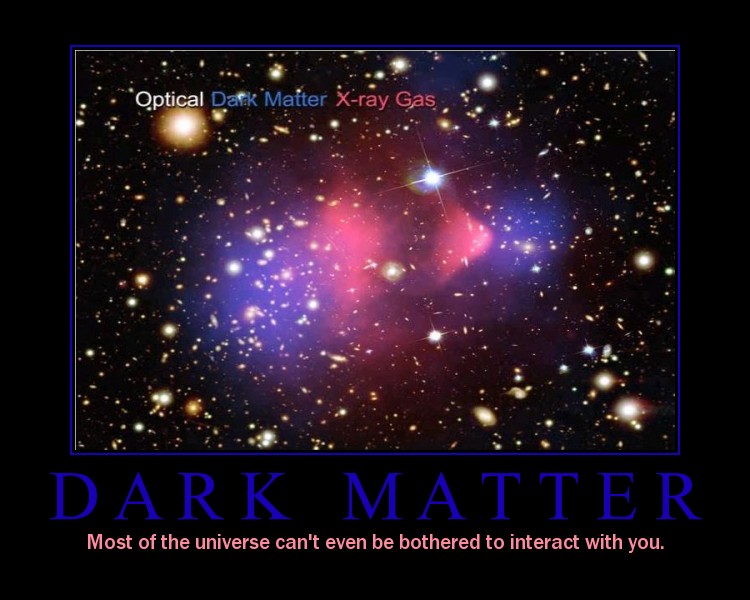
The 2010’s is known among the cognoscenti as the Dark Matter Decade. At least among those cognoscenti who are optimists by nature. After years of effort, experimentalists have improved the reach of their detectors to the point where we might be close to directly detecting dark matter (DM) particles — at least if the DM falls into the Weakly Interacting Massive Particle paradigm, or comes close to it for some reason. (Not every dark matter model does; axions are the obvious counterexample.) Jennifer summarizes the current situation in the latest issue of Quanta; some previous updates are from Matt Strassler and Résonaances.
There are two things going on. One is that the experiments, which look for energy being deposited by a (rare but predictable) interaction between dark matter particles and atomic nuclei, are now cutting into large regions of the predicted parameter space for weakly-interacting dark matter. So if the DM is WIMP-like, we have a great chance of seeing it before the decade is out.
The other is that there are already some hints that we have seen something. But those hints are confusing. It’s unclear whether they amount to the first tentative glimpses of most of the matter in the universe, or just statistical fluctuations in the detectors.
Here’s a figure summarizing the situation, adapted from a paper earlier this year from the CDMS experiment.
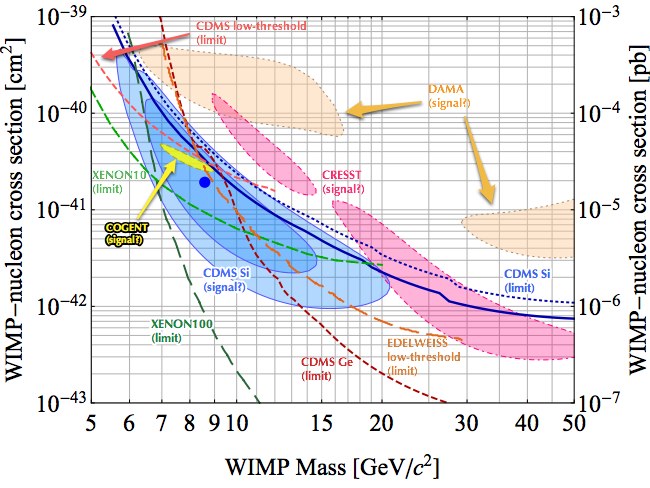
The horizontal axis is the mass of the DM particle in GeV (where a proton is about 1 GeV). The vertical axis is the strength with which the DM interacts with a proton or neutron. Lines are limits; anything above the line is supposedly ruled out. Colored regions are possible signals, if we optimistically interpret some of the data. The various limits come from CDMS’s Silicon detectors, CDMS’s Germanium detectors, a CDMS low-threshold analysis, EDELWEISS, XENON10, and XENON100. The possible signals come from CDMS’s Silicon detectors, DAMA, CoGeNT, and CRESST.
You can see why the purported hints are confusing. For one thing, they don’t really agree with each other (although they’re not too far apart). More importantly, the possible signals are apparently ruled out by some of the limits! XENON, in particular, seems incompatible even with CoGeNT and CDMS, while practically everything is incompatible with DAMA and CRESST. And no, you’re not reading the labels wrong; the recent CDMS results from their Silicon detectors are quoted both as a limit and as a signal. They see three events, where they would expect to see less than one. So the limits are what we can infer if those events are just a fluke, while the blue region is the best fit if they are actually dark matter.
Even though the various possible detections don’t completely agree with each other, they do share an intriguing property: they are pointing roughly to DM masses in the 5-15 GeV range. That is not where most people would have expected to find the dark matter. The mass isn’t precisely predicted, but typical WIMP models have masses in the 100-500 GeV range. So if this is indeed the dark matter, it’s noticeably lighter than people would have guessed. On the other hand, and in part because it’s not what was expected, it’s also a region of parameter space where the experiments are just a bit less reliable. It’s not too hard to imagine that there are backgrounds we haven’t completely taken into account, which would give the same kind of events that you might attribute to light dark matter. Rest assured that the experimenters are all over this issue.
Finally, there’s something potentially very intriguing about light dark matter. Remember that there’s about five or six times as much dark matter (by mass density) than ordinary matter in the universe. And almost all the mass of ordinary matter is in the form of nucleons (protons and neutrons). So if the dark matter particle is actually five or six GeV, it’s conceivable that there is precisely one dark matter particle per ordinary particle in the universe. And if that’s true, it’s irresistible to imagine that the origin of dark matter is somehow tied to the origin of ordinary matter — more particularly, to the asymmetry of matter and antimatter. If you could cook up a theory (and people have certainly been trying) where the dark particles carried anti-baryon number, the world would be a very interesting place. (Not that it’s not interesting already, but we would have an extra glimpse into just how interesting it is.)