Entanglement is one of the most important features — arguably, when you get down to it, the most important feature — of quantum mechanics, but it’s often glossed over in how we introduce the subject to students. Here we dive in, and I use this as an excuse to eventually talk about some of the different physical theories vying to be a complete formulation of quantum mechanics.
Update: I originally uploaded the wrong file, this should be the right one!
The Biggest Ideas in the Universe | 8. Entanglement
And here is the associated Q&A video. (Sorry I was in a hurry and didn’t do the lighting correctly … I’ll never make it big in Hollywood at this rate.)
The Biggest Ideas in the Universe | Q&A 8 – Entanglement
I thought about making the title for this week’s Idea simply “Quantum,” since one-word titles are kind of cool, but ultimately decided that accuracy was a higher priority than coolness. That’s why I’ll never be cool.
Anyway, quantum mechanics! This installment runs down the basic ideas; we’ll leave the conceptual heavy lifting for next week.
The Biggest Ideas in the Universe | 7. Quantum Mechanics
And here is the Q&A video. Mostly I talk about the double-slit experiment, and how it implies that the wave function is something other than simply a stand-in for our lack of knowledge about where the particle is.
The Biggest Ideas in the Universe | Q&A 7 – Quantum Mechanics
This week’s edition of The Biggest Ideas in the Universe completes a little trilogy, following as it does 4. Space and 5. Time. The theory of special relativity brings these two big ideas into one unified notion of four-dimensional spacetime. Learn why I don’t like talking about length contraction and time dilation!
The Biggest Ideas in the Universe | 6. Spacetime
And here’s the Q&A video:
The Biggest Ideas in the Universe | Q&A 6 – Spacetime
For this installment of The Biggest Ideas in the Universe, we turn to one of my favorite topics, Time. (It’s a natural followup to Space, which we looked at last week.) There is so much to say about time that we have to judiciously choose just a few aspects: are the past and future as real as the present, how do we measure time, and why does it have an arrow? But I suspect we’ll be diving more deeply into the mysteries of time as the series progresses.
The Biggest Ideas in the Universe | 5. Time
And here is the associated Q&A video, where I sneak in a discussion of Newcomb’s Paradox:
This installment of our Biggest Ideas in the Universe series talks about Space. As in, the three-dimensional plenum of locations in which we find ourselves situated. Is space fundamental? Why is it precisely three-dimensional? Why is there space at all? Find out here! (Or at least find out that we don’t know the answers, but we have some clues about how to ask the questions.)
The Biggest Ideas in the Universe | 4. Space
This is likely one of my favorite Ideas in the series, as we get to think about the nature of space in ways that aren’t usually discussed in physics classes.
Update: here is the followup Q&A video. More details on Hamiltonians, yay!
Welcome to the third installment in our video series, The Biggest Ideas in the Universe. Today’s idea is actually three ideas: Force, Energy and Action. There is a compelling argument to be made for splitting these up — and the resulting video is longer than it should be — but they kind of flowed together. So there you go.
The Biggest Ideas in the Universe | 3. Force, Energy, and Action
Major technological upgrades this time around, with improved green-screen setup, dark background on the writing, and a landscape format for the text. I am learning!
Hope everyone is staying safe and healthy during the lockdown.
Update: Here is the Q&A video. No cats make an appearance this time, sorry.
The Biggest Ideas in the Universe | Q&A 3 – Force, Energy, and Action
Welcome to the second installment in our video series, The Biggest Ideas in the Universe. Today’s idea is Change. This sounds like a big and rather vague topic, and it is, but I’m actually using the label to sneak in a discussion of continuous change through time — what mathematicians call calculus. (I know some of you would jump on a video about calculus, but for others we need to ease them in softly.)
Don’t worry, no real equations here — I do write down some symbols, but just so you might recognize them if you come across them elsewhere.
The Biggest Ideas in the Universe | 2. Change
Also, I’m still fiddling with the green-screen technology, and this was not my finest moment. But I think I have settled on a good mixture of settings, so video quality should improve going forward.
Update: here is the Q&A video. Technical proficiency improving apace!
The Biggest Ideas in the Universe | Q&A 2 – Change
We kick off our informal video series on The Biggest Ideas in the Universe with one of my favorites — Conservation, as in “conservation of momentum,” “conservation of energy,” things like that. Readers of The Big Picture will recognize this as one of my favorite themes, and smile with familiarity as we mention some important names — Aristotle, Ibn Sina, Galileo, Laplace, and others.
The Biggest Ideas in the Universe | 1. Conservation
Remember that for the next couple of days you are encouraged to leave questions about what was discussed in the video, either here or directly at the YouTube page. I will pick some of my favorites and make another video giving some answers.
Update: here’s the Q&A.
The Biggest Ideas in the Universe | Q&A 1 – Conservation
So, how about all that social distancing due to the growing pandemic, eh? There is a lot more staying-at-home these days than we’re normally used to, and I think it’s important to keep our brains active as well as our hands washed and our homes stocked with toilet paper.
To that end, I’m doing a little experiment: a series of informal videos I’m calling The Biggest Ideas in the Universe. (Very tempted to put an exclamation point every time I write that, but mostly resisting.) They will have nothing directly to do with viruses or pandemics, but hopefully will be a way for people to think and learn something new while we’re struggling through this somewhat surreal experience. Who knows, they may even be useful long after things have returned to normal.
The idea will be to have me talking about one Big Idea in each video, hopefully with a new installment released each week. I’ll invite viewers to leave questions here (where I’ll be linking to each video), and at YouTube. Then I’ll pick out some of the most interesting questions and make another short video addressing them.
Before anyone jumps in to tell me — yes, I am very amateur at this! My green-screen usage could definitely use an upgrade, for one thing. Happy to take suggestions as to how to improve the quality of the video production (quality of the substance is what it is, I’m afraid).
Consider this a very tiny gesture in the direction of sticking together and moving forward during some trying times. I hope everyone out there is staying as safe as possible.
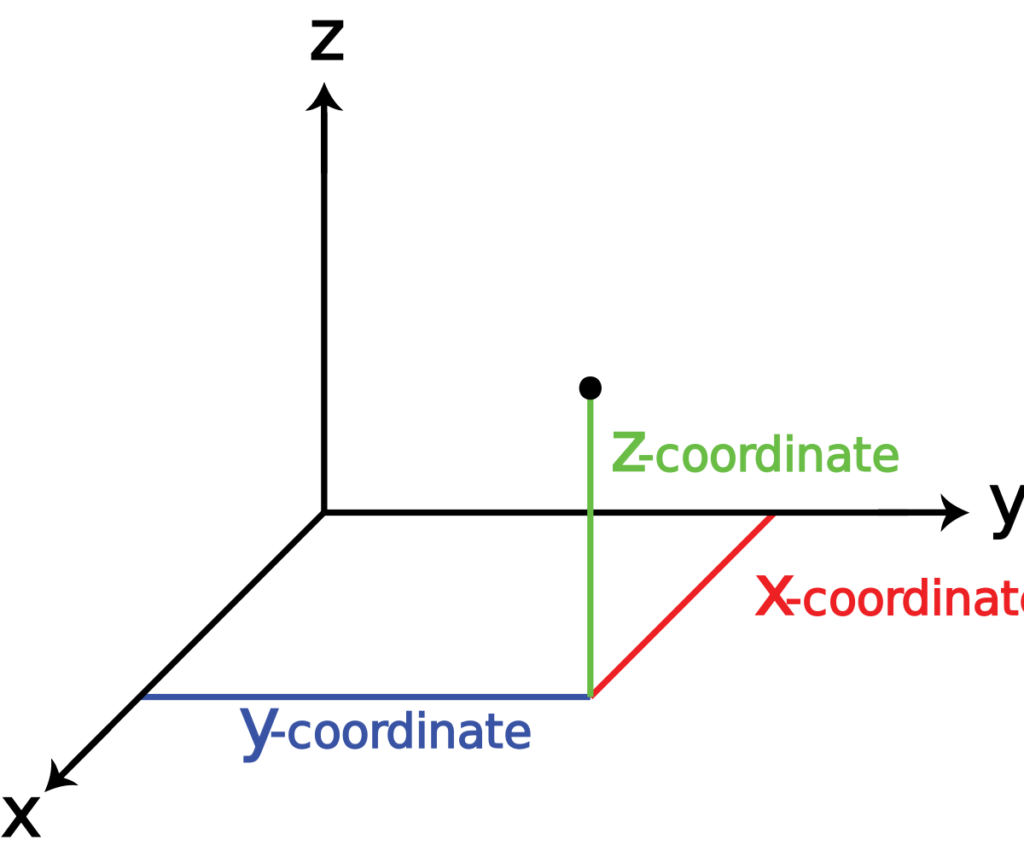
Even when we restrict to essentially scientific contexts, “space” can have a number of meanings. In a tangible sense, it can mean outer space — the final frontier, that place we could go away from the Earth, where the stars and other planets are located. In a much more abstract setting, mathematicians use “space” to mean some kind of set with additional structure, like Hilbert space or the space of all maps between two manifolds. Here we’re aiming in between, using “space” to mean the three-dimensional manifold in which physical objects are located, at least as far as our observable universe is concerned.
That last clause reminds us that there are some complications here. The three dimensions we see of space might not be all there are; extra dimensions could be hidden from us by being curled up into tiny balls (or generalizations thereof) that are too small to see, or if the known particles and forces are confined to a three-dimensional brane embedded in a larger universe. On the other side, we have intimations that quantum theories of gravity imply the holographic principle, according to which an N-dimensional universe can be thought of as arising as a projection of (N-1)-dimensions worth of information. And much less speculatively, Einstein and Minkowski taught us long ago that three-dimensional space is better thought of as part of four-dimensional spacetime.
Let’s put all of that aside. Our everyday world is accurately modeled as stuff, distributed through three-dimensional space, evolving with time. That’s something to be thankful for! But we can also wonder why it is the case.
I don’t mean “Why is space three-dimensional?”, although there is that. I mean why is there something called “space” at all? I recently gave an informal seminar on this at Columbia, and I talk about it a bit in Something Deeply Hidden, and it’s related in spirit to a question Michael Nielsen recently asked on Twitter, “Why does F=ma?”
Space is probably emergent rather than fundamental, and the ultimate answer to why it exists is probably going to involve quantum mechanics, and perhaps quantum gravity in particular. The right question is “Why does the wave function of the universe admit a description as a set of branching semi-classical worlds, each of which feature objects evolving in three-dimensional space?” We’re working on that!
But rather than answer it, for the purposes of thankfulness I just want to point out that it’s not obvious that space as we know it had to exist, even if classical mechanics had been the correct theory of the world.
Newton himself thought of space as absolute and fundamental. His ontology, as the philosophers would put it, featured objects located in space, evolving with time. Each object has a trajectory, which is its position in space at each moment of time. Quantities like “velocity” and “acceleration” are important, but they’re not fundamental — they are derived from spatial position, as the first and second derivatives with respect to time, respectively.
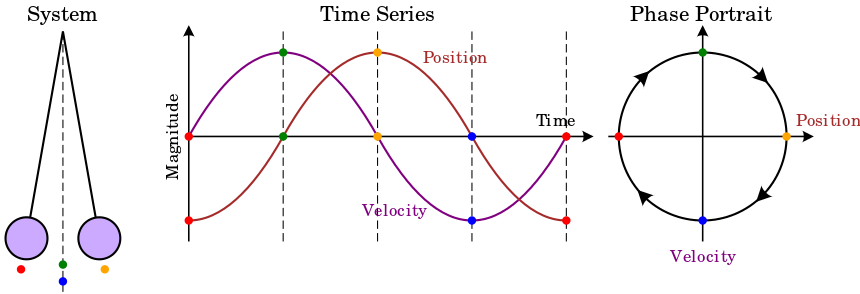
But that’s not the only way to do classical mechanics, and in some sense it’s not the most basic and powerful way. An alternative formulation is provided by Hamiltonian mechanics, where the fundamental variable isn’t “position,” but the combination of “position and momentum,” which together describe the phase space of a system. The state of a system at any one time is given by a point in phase space. There is a function of phase space cleverly called the Hamiltonian H(x,p), from which the dynamical equations of the system can be derived.
That might seem a little weird, and students tend to be somewhat puzzled by the underlying idea of Hamiltonian mechanics when they are first exposed to it. Momentum, we are initially taught in our physics courses, is just the mass times the velocity. So it seems like a derived quantity, not a fundamental one. How can Hamiltonian mechanics put momentum on an equal footing to position, if one is derived from the other?
The answer is that in the Hamiltonian approach, momentum is not defined to be mass times velocity. It ends up being equal to that by virtue of an equation of motion, at least if the Hamiltonian takes the right form. But in principle it’s an independent variable.
That’s a subtle distinction! Hamiltonian mechanics says that at any one moment a system is described by two quantities, its position and its momentum. No time derivatives or trajectories are involved; position and momentum are completely different things. Then there are two equations telling us how the position and the momentum change with time. The derivative of the position is the velocity, and one equation sets it equal to the momentum divided by the mass, just as in Newtonian mechanics. The other equation sets the derivative of the momentum equal to the force. Combining the two, we again find that force equals mass times acceleration (derivative of velocity).
So from the Hamiltonian perspective, positions and momenta are on a pretty equal footing. Why then, in the real world, do we seem to “live in position space”? Why don’t we live in momentum space?
As far as I know, no complete and rigorous answer to these questions has ever been given. But we do have some clues, and the basic principle is understood, even if some details remain to be ironed out.
That principle is this: we can divide the world into subsystems that interact with each other under appropriate circumstances. And those circumstances come down to “when they are nearby in space.” In other words, interactions are local in space. They are not local in momentum. Two billiard balls can bump into each other when they arrive at the same location, but nothing special happens when they have the same momentum or anything like that.
Ultimately this can be traced to the fact that the Hamiltonian of the real world is not some arbitrary function of positions and momenta; it’s a very specific kind of function. The ultimate expression of this kind of locality is field theory — space is suffused with fields, and what happens to a field at one point in space only directly depends on the other fields at precisely the same point in space, nowhere else. And that’s embedded in the Hamiltonian of the universe, in particular in the fact that the Hamiltonian can be written as an integral over three-dimensional space of a local function, called the “Hamiltonian density.”
where φ is the field (which here acts as a “coordinate”) and π is its corresponding momentum.
This represents progress on the “Why is there space?” question. The answer is “Because space is the set of variables with respect to which interactions are local.” Which raises another question, of course: why are interactions local with respect to anything? Why do the fundamental degrees of freedom of nature arrange themselves into this kind of very specific structure, rather than some other one?
We have some guesses there, too. One of my favorite recent papers is “Locality From the Spectrum,” by Jordan Cotler, Geoffrey Penington, and Daniel Ranard. By “the spectrum” they mean the set of energy eigenvalues of a quantum Hamiltonian — i.e. the possible energies that states of definite energy can have in a theory. The game they play is to divide up the Hilbert space of quantum states into subsystems, and then ask whether a certain list of energies is compatible with “local” interactions between those subsystems. The answers are that most Hamiltonians aren’t compatible with locality in any sense, and for those where locality is possible, the division into local subsystems is essentially unique. So locality might just be a consequence of certain properties of the quantum Hamiltonian that governs the universe.
Fine, but why that Hamiltonian? Who knows? This is above our pay grade right now, though it’s fun to speculate. Meanwhile, let’s be thankful that the fundamental laws of physics allow us to describe our everyday world as a collection of stuff distributed through space. If they didn’t, how would we ever find our keys?