
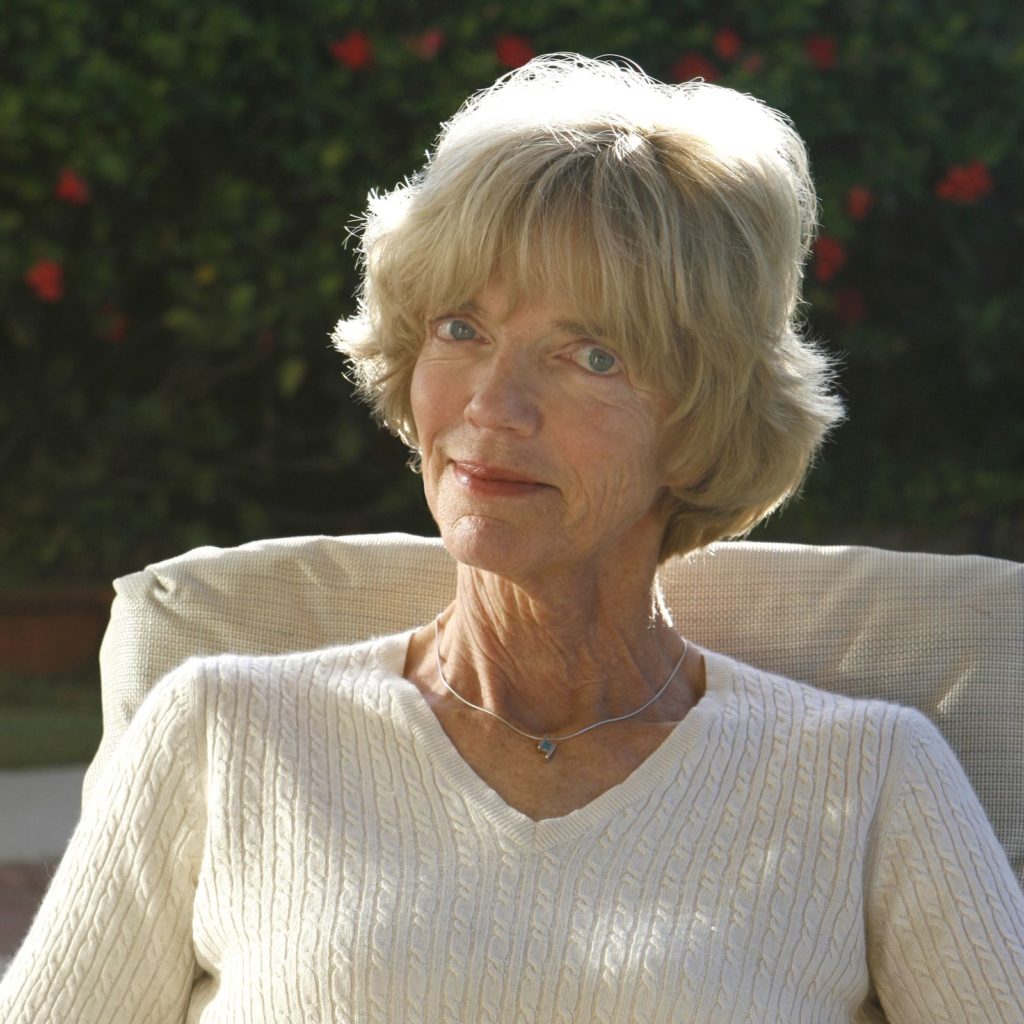
It's fun to spend time thinking about how other people should behave, but fortunately we also have an inner voice that keeps offering opinions about how we should behave ourselves: our conscience. Where did that come from? Today's guest, Patricia Churchland, is a philosopher and neuroscientist, one of the founders of the subfield of "neurophilosophy." We dig into the neuroscience of it all, especially how neurochemicals like oxytocin affect our attitudes and behaviors. But we also explore the philosophical ramifications of having a conscience, with an eye to understanding morality and ethics in a neurophilosophical context.
Support Mindscape on Patreon or Paypal.
Patricia Churchland received her B.Phil. in philosophy from Oxford University. She is currently the President's Professor of Philosophy (emerita) at the University of California, San Diego, as well as an adjunct professor of neuroscience at the Salk Institute. Among her awards are the MacArthur Prize, The Rossi Prize for Neuroscience and the Prose Prize for Science. Her latest book, Conscience: The Origins of Moral Intuition, was just released. She has arguably the best web site of any professional philosopher.
Click to Show Episode Transcript
0:00:00 Sean Carroll: Hello, everyone. Welcome to the Mindscape Podcast, I'm your host, Sean Carroll. And today, we're going to go back into neuroscience. We're very, very happy to have Patricia Churchland on the show. Patricia Churchland is an extremely celebrated and influential neuroscientist and philosopher. In fact, one of her claims to fame is popularizing the phrase "neurophilosophy." So as you might guess, she's a philosopher of mind, but someone who thinks we're going to learn about the mind by studying the brain and tries to make connections between what happens to us as people, our conscious selves and what's going on in the brain, the neurons, their connections, their firings and so forth.
0:00:38 SC: In fact, I think that Patricia is the first MacArthur fellow to appear here on Mindscape. You know, the MacArthur fellowships, the Genius Grants. So everyone we have as a guest is a genius in one way or another, but she's officially a genius. And her most recent book is going to be the topic we're talking about today, which is conscience, not conscious, or consciousness, conscience as in Jiminy Cricket, as in the part of our inner selves that says, "You know, you really shouldn't be doing that, or you really should be doing this thing that you're not doing." Obviously, there's a relationship here between this idea of conscience and other ideas we've talked about on the podcast, the parts of our thinking and the parts of our self-hood, that come from our brains and our bodies, right? Not simply higher cognition, rationality and so forth, but the impulses that we have that make us who we are.
0:01:31 SC: And so, Patricia Churchland has thought about these things more carefully than anybody. We're going to talk about not only what conscience is, how it relates to emotions and intuitions and instincts, but also how it relates to specific things going on in the brain. We'll talk about oxytocin, the cuddle molecule, and we'll talk about where this leads us in terms of morality and empathy, right? You know there's going to be a is versus ought kind of discussion in here. We will not completely resolve it, but I think we're basically on the same side. One way or another, it's always a delight to talk to Patricia Churchland. By the way, her husband, Paul Churchland, is also a famous neuroscientist and philosopher. And they have two children, both of whom became neuroscientists. So maybe there's some genetic determinism going on there, I'm not sure.
0:02:16 SC: Anyway, this is a wonderful discussion. Patricia is always good to talk to, not only because she has a charming Canadian accent, but she's also one of the smartest people I know. So. Let's go.
[music]
0:02:44 SC: Pat Churchland, welcome to Mindscape Podcast.
0:02:47 Pat Churchland: Lovely to be here.
0:02:48 SC: I know that there's no academic in the world who would be happy to have their entire career reduced to a single word, but I have to say that you have a word that is very associated with you, namely neurophilosophy. Maybe you can tell us a little bit about what that is and how it came to be.
0:03:04 PC: Well, I think of neurophilosophy in the following way, that it kind of works the ground that exists between neuroscience on the one hand, and the grand old philosophical questions on the other hand. So I sort of came of age, so to speak, at the time when neuroscience was developing to the degree that you could begin to see that it was going to have an impact on all of the big questions, how do we make decisions and choose, what's the nature of learning and memory, how do we know anything? What's nature of consciousness?
0:03:40 SC: Ancient questions, yeah, yeah.
0:03:42 PC: Ancient questions. And I think one of the things that really motivated me, were the split brain results, because here, you had these subjects, who because they had epilepsy that couldn't be treated with drugs, underwent surgery where the surgery consisted in separating the two hemispheres. The idea was that you didn't want the epileptic seizure to travel from one hemisphere to the other. And at first, of course, people thought that, "Oh, it didn't really make any difference to anything except the epilepsy. Isn't that grand?" But then it turned out that if you looked very closely, the hemispheres so to speak, knew different things, were aware of different things, and it's not like you had two people exactly, but it... The fact that one hemisphere could be consciously aware of something while the other one was not was really profound. Because it meant that all these years, we had these abstract arguments about, "Is there a mind that's separate from the brain, and if there is, how does that work?" And I thought, this just makes it flaming obvious.
0:05:00 SC: Yeah.
0:05:00 PC: If consciousness can be split by cutting a set of nerve fibers, game over. Now, I don't want to do these arguments anymore that are in the abstract. What I want to do is understand the thing itself.
0:05:15 SC: And when you proposed this idea of neurophilosophy, was that immediately well accepted throughout the various communities?
0:05:22 PC: Oh, yes.
[laughter]
0:05:23 PC: Well, it took a while to come to fruition. At the time, Paul and I were on the faculty at the University of Manitoba, in the philosophy department.
0:05:35 SC: This is Paul Churchland?
0:05:36 PC: Paul Churchland, who is my husband. That's right. And because things were not run as a really tight ship, and we had a certain amount of flexibility, I decided that if I was going to really think about the brain in a thoroughgoing way, I had to really understand anatomy. And you can't understand anatomy by looking at a two-dimensional picture, because the brain is a three-dimensional thing.
0:06:03 PC: So I went down to the medical school and explained my dilemma to the head of the Anatomy Department and he said, "Oh, this is wonderful." He was an Englishman, John Baskerville Hyde. And Baskerville Hyde said, "Oh, this is great. You should come and do all of the neuroscience you want. Come to the neuroanatomy classes. You should go to neurology rounds, and see patients and so forth." And so, as soon as I taught my classes, I'd get my old beat-up jalopy and I'd roar down to the medical school and it was bliss.
[laughter]
0:06:41 PC: It was just the most eye-opening, wondrous experience for me to really begin to understand what we did and didn't know, what we could know, if we had new tools and so forth.
0:06:56 SC: But the philosophy, the philosophers, rebelled a little bit at this idea that there should even be a thing called neurophilosophy.
0:07:04 PC: So when I finally wrote the book and the book came out, yes, there was consternation. By and large, the philosophers hated it and still do. They think that... The interesting thing to me was that even philosophers who didn't think there was spooky stuff, who didn't think there was a mind independent as the brain.
0:07:29 SC: Mentalists, physicalists, yeah.
0:07:31 PC: They said, "The brain is actually irrelevant." Dan Dennett was a great case in point, 'cause he now presents himself as being very brain-friendly. But let me tell you, in those days, he was entirely brain-hostile. He would say, "Look, there's a difference between the software and the hardware. I don't need to understand a computer in order to understand how to work, say, Microsoft Word. So since cognition is running software on the hardware, I don't need to know about neurons."
0:08:05 SC: That actually makes sense, that argument.
0:08:07 PC: Except it doesn't.
0:08:07 SC: I don't think it's true but... It's not true, it's not correct, but at that level of analysis, it's plausible.
0:08:13 PC: It was, except it really wasn't, because even at that time, we knew very well that the brain was not like a digital computer, that the very connections between neurons changed as you learned something. There wasn't the memory box, there wasn't RAM. And we knew that the processing was all parallel, it wasn't like it is in a digital computer. And we also knew that very tiny changes at the microstructure could affect the nature of cognition.
0:08:50 SC: And like you say, in retrospect, it makes sense because hardware versus software is a very human construct. The brain did not evolve...
0:08:56 PC: Well, that's a very good point. The brain did not evolve that way. And, in fact, there was a wonderful occasion when Francis Crick and I and Dan Dennett were having dinner, and Francis knew about this, this software-hardware story of Dan's. And so, he started to push him in the inimitable way that Francis had about, "You don't care about neurons and don't you understand how you can't get function except out of structure? And if you don't understand the structure, you're not going to understand the function." So that was rather interesting, but most philosophers had a lot of sympathy with Dan's take on things. There were other philosophers who thought that, really, the job of philosophers is to lay down the foundations for science. And so, why would we look to science to do those foundations? We, the philosophers, are going to tell you what you can discover, and what you can't discover is how we think by looking at the brain. That was their basic story.
0:10:08 SC: And, also, if we're going to get into morality and consciousness, and things like that, and I presume that, hopefully you can fill in, but I presume that some of the philosophers thought that what is right and what is wrong should be independent of what's going on in the brain.
0:10:24 PC: Absolutely.
0:10:25 SC: Maybe it will help us think about how we get there, but what the answers are should be true for computers and lizards and human beings equally.
0:10:32 PC: Yeah, yeah, I think so. And I think something like that was especially true about the nature of morality. So there had been this long-standing project, by long-standing, I guess, I mean in the 20th century, where really, the project was for philosophers to uncover this very special thing, this Ur rule, that is the absolute rule that applies to all people under all conditions at all times. And that's what they would try to dream up and they'd argue about it, and they'd go back and forth, and it was all a waste of time.
[chuckle]
0:11:15 SC: Well, I don't know if it was a waste of time but you would want to say, well, we should get into it. It's much older than the 20th century, right? Kant, Descartes, Aristotle probably and Plato talked about what are the general rules for morality.
0:11:28 PC: No, interestingly. This is something I find really fascinating is that actually, just like there are two traditions about the mind, there's a physicalist tradition and then there is the dualist tradition. So, in morality, there are the... It's all about rules and there are the people who say, "No, look, rules are at best soft guidelines, they don't apply to all situations." So if you're going to have people behave in a moral way, there has to be something that is deeper than that. And what those are are the values that people pick up, and why would they do that. And here, Aristotle, Hume, Charles Darwin, all agreed it has to be something that is part of our nature.
0:12:23 SC: As opposed to pure reason.
0:12:24 PC: As opposed to pure reason, whereas for poor old Kant, it was all about pure reason. And this demarcated, in ancient Greece, a profound difference between Aristotle on the one hand and Plato. Plato, who thought that the absolute truths were in this abstract third realm that could be accessed through, as he said, intellection. Aristotle was a man of the world.
0:12:53 SC: An empiricist, yeah.
0:12:54 PC: An empiricist. And he didn't think that that made any sense.
0:13:00 SC: Aristotle was an obvious mistake on my part adding him in there. I should have said...
0:13:02 PC: Oh, okay, okay.
0:13:03 SC: But Plato and Kant, yes, they did have this idea.
0:13:06 PC: Yes, yeah, they did.
0:13:06 SC: That they should be finding the right rules. And it's also... So I wonder, something that actually was spurred by reading a couple of your books. I'm going to float a crazy hypothesis and tell me what you think.
0:13:17 PC: Okay.
0:13:17 SC: Because you mentioned along with Aristotle and Hume as people who are more on the side of... There's not one simple rule, there's a bunch of indications or guidelines and let's work through it. You also mention Eastern traditions, both Buddhism, Confucianism.
0:13:32 PC: Absolutely, absolutely.
0:13:32 SC: And Native American traditions, folk wisdom, etcetera. I wonder if the Western philosophical tradition of looking for the one true rule has anything to do with monotheism. Even among philosophers who are not necessarily religious, there's sort of the spirit that we'll get the one right answer, which is maybe less congenial if you're a Confucianist or a Buddhist.
0:13:53 PC: I think it is sort of appealing. It certainly didn't appeal to Hume and Adam Smith, but then they were both kind of atheists.
0:14:03 SC: Yeah.
0:14:04 PC: But perhaps something like the Ten Commandments is in the back of people's minds. It was certainly in the back of the mind of Aquinas, and almost certainly Kant, who was a Christian but didn't think that it was God who actually provided the rules. He just provided us with the reason to figure them out. Yeah, I think that's not surprising, I think that's a very interesting hypothesis.
0:14:30 SC: Well, you tell a wonderful story about asking what the Buddhist version of the Ten Commandments would be.
0:14:36 PC: Well yes, this was an amazing occasion. It was arranged by one of the people who started the Department of Neuroscience here at UCSD, who's now gone, Bob Livingston, and the Dalai Lama wanted to know about the brain. And so, Bob collected a few of us, took us up to Los Angeles where the Dalai Lama was staying, and we had these meetings with him. And at lunch time, I was able to be a decent guest. And I had a Buddhist priest next to me, and so I began the conversation and I sort of said in all my ignorance, so what in Buddhism corresponds to the Ten Commandments? And of course, now I realize how embarrassing that was, and how graciously he didn't look embarrassed for me.
0:15:28 PC: But it was amazing because then he went on to talk about the very different style of thinking through moral issues that prevails in Buddhism. And when the Dalai Lama then gave his public lecture, he actually worked the same themes. And it really had a big effect on me because I thought, I had not been particularly interested in moral questions as a philosopher, at least at that time, but I thought, well, if Buddhists are good people, and they understand why it's important to be honest and fair, and why sharing is good and why we defend each other and so on, then... And they don't have these absolute rules that say you must always do X and Y, then maybe there is something deeply wrong with the way moral theorists are looking at these things.
0:16:29 PC: But I didn't really pick up on it in a systematic way, because at that point, I still didn't really understand how neuroscience could ever really make inroads into understanding something like empathy or loyalty or honesty. I thought well, how the heck... We don't understand how stereoptic vision works. So yeah, then how the heck are we going to get empathy? I mean, give me a break. So I just put it on the shelf.
0:17:00 SC: But it raises, we should get out of the way, a little bit of the discussion of the ought versus is problem. So just so people know what we talk about a little bit here. I mean, the word neurophilosophy raises the danger that you're going to tell us, you're going to do an FMRI and then tell me what is right and what is wrong.
0:17:15 PC: Yeah, yeah.
0:17:15 SC: That's not what you have in mind.
0:17:17 PC: No, no. That really is not. I mean, social life is so incredibly complicated that that wouldn't be possible, but what is common amongst all of us is something that we, of course, also share with all mammals and that is the wiring that makes us sensitive to others. And it does so because we form attachments to others, in the first analysis to our children, our babies, our offspring. And that's a kind of general platform that allows for the ambit of care of myself, where I see to my own food and warmth and safety. For the ambit of my care to expand, so I see to the food and warmth and safety of others, in particular, of course, to the offspring.
0:18:13 PC: And as you know, anybody who observes animals at all knows how ferocious any mother is of the newborns, whether it's a mother rat or a squirrel or a bear, a mother human, they do the most heroic things. And we know a little bit now about the circuitry for that. So we do see social behavior, of course, in insects and wonderful... Ed Wilson, of course, is somebody who's thought very long deeply about this, but we know the social behavior in mammals and in birds is different.
0:18:50 SC: Right. And I do want to get to the mammals in particular, but I'm still... I still want to make sure that we understand that you're not claiming to derive ought from is. [chuckle]
0:18:58 PC: Yeah, I think that the way to think about it is that our biological constraints put constraints on what rules make sense to us, so that, if you were to have a rule that said all first born babies should be boiled in water and eaten. People could not do that.
0:19:22 SC: Right, the biology is a constraint.
0:19:23 PC: The biology constrains us. And it's not just the biology of caring and affection, but other aspects of problem-solving and so forth. So there is a kind of limited way in which the science can say about a certain proposed rule, such as the obnoxious rule I suggested, that that that's not a rule that's going to work.
0:19:53 SC: Right.
0:19:54 PC: However, having said that, I do agree with you that what we, as scientists, can't do is say, "We see how the brain works. Utilitarianism is the way to go."
[laughter]
0:20:07 PC: Yeah, you laugh but you know who says that.
0:20:09 SC: No, no I laugh. I do. [chuckle]
0:20:09 PC: Yeah, Sam Harris.
0:20:11 SC: Yeah. [chuckle]
0:20:12 PC: And I tried to talk him out of that at one point, but he was really very convinced that science endorses utilitarianism, and it doesn't.
0:20:24 SC: It doesn't, no. No.
0:20:25 PC: And in the new book, I do talk a lot about why science couldn't do that. But, in particular, what scientists can do is help bring facts to the table. And as Hume and Adam Smith were fond of pointing out, we want all the available facts. But, as a concerned citizen, the scientist might weigh in on the dilemma, whatever it happens to be. Like, "Shall we log old growth forests?" might bring the fact... His own or her own opinion to the table, but it doesn't count for more because it comes from a scientist.
0:21:08 SC: Yeah.
0:21:09 PC: And scientists who take the moral high ground in this way are really hurting the case, because the fact of the matter is, there are wonderfully, deeply, wise, uneducated people.
0:21:27 SC: Who are very moral.
0:21:28 PC: Who are very moral, who have the education of the world, so to speak. Whereas, there are moral philosophers to whom you would never go for advice if you had a moral problem.
0:21:41 SC: Who behave abominably, right?
0:21:43 PC: Yeah. And so, I think it's not that the is-ought distinction is so hard and fast that we don't want to take into account these biological constraints that are on us. We have physical limitations. We have certain psychological limitations, such as not killing your firstborn or any of your children. And so, that makes the boundary a little bit fuzzy.
0:22:12 SC: I think everyone...
0:22:12 PC: But having said that, everybody already knows that.
0:22:16 SC: Exactly, and everyone knows that learning things that are true about the world will be relevant to what decisions we make in the world. Sure, but there is some... Hume understood this, even though he never quite articulated as cleanly as we would like. He was making fun of other people rather than trying to make a systematic point but there is just... At the level of logic, you need some input other than descriptive facts about the world to decide what is...
0:22:41 PC: Yes, you do, you do. And that can come from inside the scientist and his reward system, and his hypothalamus.
[laughter]
0:22:51 PC: It can come from inside the scientist but it can also come from inside the carpenter and the fisherman.
0:22:56 SC: Yeah, yeah. And so I think that we'll get... We'll circle back at the end to ideas or proposals for how we should think about right and wrong and morality, but let's take... I can't do better than take the path you took in the book, which is trying to talk about our brains and how they evolved in the particular way that they did. And you put a lot of emphasis on the transition at which mammals first appeared.
0:23:22 PC: Yes, yes, because...
0:23:22 SC: What's so great about mammals?
0:23:24 PC: What's so great about mammals, indeed. Well, the thing is that we know that mammals and birds, but we'll focus on mammals. We know that they all, in every case, the mother cares about the offspring. And we are pretty sure that part of what happened was, in the evolution of the mammalian nervous system, the wiring for self-care was modified and repurposed.
0:23:51 SC: So our listeners are all mammals, so they might not know that many other animal species don't care about their offspring.
0:23:57 PC: Yeah, a salamander lays her eggs, off she goes. She doesn't care what happens to them. It doesn't occur to her to care. And even if she saw some bird pecking away at them, she might not do anything. She'd just go off and surf or whatever it is. And so, yeah, it is very different. Now, as some of your listeners will know, there are some reptiles who sort of do care. Alligators, famously. We don't know whether that's an instance of convergent evolution or not, but the question that I wanted to ask about this thing about mammals is why did it happen?
0:24:37 SC: Right, yeah. And you start talking about the origin of being warm-blooded as a crucial point.
0:24:42 PC: It seems that that was the crucial thing, was that, at some point in our evolutionary past, these warm-blooded creatures who weren't yet fully mammals, they were warm-blooded reptiles, appeared.
0:24:57 SC: So we're talking 250 million years ago or something like that?
0:25:01 PC: About 250 million years ago. And the great thing about being warm-blooded was that you could do this really cool thing. You could feed at night and nobody else was there. Yum, yum.
0:25:11 SC: Buffet is open.
0:25:12 PC: And all these guys, these insects were lying around, waiting for the sun to come up. And you could, yes, buffet. So it was a great, great thing. However, it's been observed that gram for gram, you have to eat 10 times as much if you're warm-blooded as your cold-blooded cousins. That's a huge constraint. So the hypothesis is that, over time, mother nature, so to speak, realized that in order to solve this problem of calories, one thing to do is to be smart. Now, there's a couple of ways you can go to be smart. One is to build it all in with the genes so that for every contingency that arises, you know what to do. The problem with that, of course, is that when the world changes, you're stuck.
0:26:07 SC: Yeah.
0:26:08 PC: The other problem is that it takes place over very long time scales, whereas, if what you do if you're mother nature is you say, "Let's crank up learning, let's take those learning mechanisms and just crank the crap out of them, and then let's see if we get smart." And that was basically the strategy. And thus, we see in mammals, and only in mammals, this remarkable structure that makes us smart. And that's the cortex. Now, it's not that frogs are super dumb. They're not like rocks, [chuckle] and they do learn, but they... What they can learn, is highly constrained and very minimal, whereas even a modest rat can learn a lot, a lot about spacial organization, a lot about what to avoid, how to get on and so forth.
0:27:07 PC: So, the great thing was then that you're warm-blooded and you're going to be smart, but wait, there is a problem. If you're going to be smart, then the neurons that you have when you're born have to be able to grow, because the only way that learning happens in nervous systems is that structure gets built. So you gotta have the genes to make structure and the structure has to go to the right places, but if you gotta have lots of room in order to grow your brain then you have to be born very immature.
0:27:45 SC: Just because you can't fit the big brain through the birth canal?
0:27:50 PC: Well, not just that. There are sort of deep developmental reasons too that have to do with how far learning can go in a circuit and...
0:28:03 SC: So if you want to maximize for learning, you better be conscious and out there in the world for as long as possible, not in the uterus.
0:28:08 PC: Yeah, that's right, that's a nice way to put it. Yeah, you've got to be out there and your nervous system has to be immature so it can do all these things, which, in other things are done in the egg. So then, the problem that somehow evolution solved was to say, "Well, basically, look, the only thing is we've got to have somebody take care of these highly dependent, going to be smart creatures. The mom's the only one around, so let's cap her." So essentially, then what happened was that the circuitry of the ancient structures, the hypothalamus and the brain stem were changed, integrated into cortex, and you had mothers who now felt pain when their infants were away from them. Felt good, felt pleasure when they were close by, pain when they cried, pleasure when they were warm and fed, and so forth.
0:29:09 SC: And this is a very typical strategy in the history of evolution, where you had something in your body that does something and rather than come up with an entirely new system to do something new, you adapt the existing system, so here we had organisms which already had self-preservation instincts, and we just sort of, evolution said, "Well, maybe we can extend that a little bit to your brood."
0:29:29 PC: Yes, and the pleasure and pain for self-survival was kind of re-purposed and modified as well. And so, you get this system of social pain and social pleasure.
0:29:43 SC: Empathy and love and...
0:29:43 PC: But it appears to have come from this more fundamental system of self-care. But bear in mind, too, that self-care doesn't go away once you've got a mother.
0:29:56 SC: No.
0:29:57 PC: Yeah. So...
0:30:00 SC: And then it naturally extends out to people beyond our offspring, hopefully.
0:30:05 PC: Well, depending on what happens. I presume that in the history of the evolution of the mammalian brain, probably in the early days, only the mothers did the work, in the way that it's only the mother for bears, but even in mice, the dad often helps. And in other species of rodents, the father helps.
0:30:30 SC: We'd like to think that in human beings, the father helps sometimes.
[chuckle]
0:30:33 PC: Oh, for sure. Absolutely, for sure. And so, what we know is that much depends on the species, but the thing seems to be that once you've got the circuitry for care, that sort of platform for care in place, you can tweak it a bit, and you can tweak it so that now you're caring for mates. And now we see things like the prairie voles or beavers, where they mate for life, they care about each other, they are bi-parental, they both take care of the babies. And humans, which are different yet again. We're not quite like beavers and not quite like chimpanzees, so each species has its unique way of being social, but pretty clearly, in humans, there are big, strong attachments within the family, to mates, to kin, even to cousins, to friends and sometimes well beyond that.
0:31:31 SC: We have to talk about the prairie voles, 'cause those are crucial in saying not only that there's some mechanism that makes us attached to other people, our relatives and our friends and so forth, but actually, helping to identify part of what that mechanism is.
0:31:44 PC: That was the thing that made me realize that there was going to be a biological story about morality that I hadn't foreseen. The story of the prairie voles and the montane voles or lots of voles goes like this. So there are many species of voles; phenomenologically, they're very similar. They look the same, they kind of weigh the same, they have about the same number of babies and so forth, but socially, they're very different. So, prairie voles mate for life. After the first sexual encounter, they stay together for life. And the males guard the nest, they provision the females, they huddle over the babies. Montane voles are completely different. They are what we sort of customarily think of as a rodent, and that is that, the male and the female meet, they mate and then they go their separate ways.
0:32:41 PC: So when this difference in social behavior was discovered, some neuroscientists said, "What's the difference in the brain? Here we've got these two species that are so similar, what's the difference in the brain?" And after a lot of false starts and looking and wondering, they discovered that the neurochemical oxytocin has a high density of receptors in a very special part of the reward system in the prairie voles. Doesn't have it in the montane voles. And there is a sibling molecule called vasopressin, sibling to oxytocin. It just differs in a couple of amino acids. And it turns out that vasopressin is also special in the prairie vole because here, again, there's a high density of receptors for this vasopressin in a very special part of the reward system. Not so in the montane voles.
0:33:46 PC: With that correlation in hand, then the researchers really went to work, "Is it causal?" And you do all the manipulations and they showed it is causal. Now, it's probably not the whole story.
0:34:00 SC: Of course.
0:34:01 PC: And we know that there are other things that matter, but it is a significant part of the story, so that the bonding between mates is critical, critically dependent on oxytocin receptors.
0:34:17 SC: And I am all on board with the idea that this is a big part but it's very complicated and you should emphasize the complications, but I still like the idea that oxytocin is the cuddle molecule. [chuckle]
0:34:28 PC: Well, it just blew my socks off. When Larry Young came here to the Salk to give this talk, it had a very worrying title and I went 'cause I... Nyah, nyah, nyah. And I just sat there, my jaw dropped. That something as simple as receptor density could be the hub of something that we thought of was socially extremely subtle and complex, monogamy. I mean... Really? Yes.
0:35:02 SC: And they turn on and off the levels of oxytocin or the efficiency of the receptors and the monogamy comes and goes.
0:35:09 PC: Comes and goes.
0:35:10 SC: And that's just something that human beings are going to find scary. Even if you would ask someone, "Is our behavior ultimately an expression of what goes on in our brain?" and they said yes. But then you point, "Here's the molecule doing it or the system molecules doing it." And that scares us a little bit. That means...
0:35:27 PC: It does.
0:35:27 SC: If someone could turn off the receptors for oxytocin in my brain and I would not be in love with my wife anymore, that's terrible.
0:35:34 PC: Yeah, yeah, yeah, yeah, it is terrible. But, on the other hand, somebody can put a hole in my head in a certain place and I won't be able to talk anymore.
0:35:43 SC: Or you'd be dead.
0:35:43 PC: Or I'd be dead, that's right.
0:35:44 SC: These are physical effects that definitely affect who we are.
0:35:47 PC: But it is a remarkable discovery and... But, as you say, of course, it's complex. But the other part of the story that I really love is that oxytocin works hand-in-hand with the endogenous opioids and the endogenous cannabinoids that our brain makes. Part of the pleasure you feel when you pick up that crying baby and you hold it, and it stops crying, and you feel that wonderful softness and so forth, a lot of that is endocannabinoids, which isn't to say you're high. It's just to say that the pleasure of that is dependent on certain neurochemicals and the endocannabinoids play a big role.
0:36:35 SC: And just to be very clear for the non-experts, among whom I include myself, these are... What we're talking about are peptides, chemicals, neurotransmitters that get received by individual neurons. So, basically, the existence of these chemicals in the right parts of the brain will make us more empathetic or whatever it is than not. Is that roughly the story?
0:37:00 PC: Yeah, roughly the story. The thing is that the way neurons work is that they have a little receptor on them and it's only when the molecule fits into that receptor that the neuron has a response to the molecule. And so, receptor density is really important because if you have a ton of oxytocin flashing around in your brain but you got no receptors, it isn't going to help. So you have to have the receptors there and that's one of the things that I think was so important that came out of this work, was our understanding that these two have got to fit together.
0:37:40 SC: And how does it work when my cat jumps on my lap and starts purring? I'm sure that oxytocin flashes in my brain. So how does the brain know? What is the signal... Where does the oxytocin come from?
0:37:51 PC: The oxytocin comes from the hypothalamus and it's released in the hypothalamus, but it's also in cortex. Now, it took a while for us to know that because the first things that were looked at, of course, were voles and there isn't so much in voles, in the cortex, but in monkeys, there's quite a lot. And so it's released from these sites when we have these warm social interactions. Now, part of the reason for this... Mother nature doesn't really care if we feel good or not. Evolution don't care.
0:38:27 SC: Right, there has to be some purpose.
0:38:30 PC: So what's the thing? And the answer really is that when the stress hormones go up, oxytocin goes down. But when oxytocin goes up, the stress hormones go down. And so, oxytocin makes us feel good. And so then we can do certain things. And if you're mother nature and you want this mom to take care of these babies, you want her to feel good about this. So you raise her levels of oxytocin when she's caring for the babies and things are going well. You raise your stress hormones when the cats are around sniffing out the babies and that provokes or initiates different behavior patterns. So, oxytocin... You know, we think of oxytocin as being the love molecule.
0:39:28 SC: The cuddle molecule.
0:39:29 PC: Yeah, the cuddle molecule. But the fact is that it's truly, truly ancient, well before mammals. And it's just that it was repurposed. Evolution being what it is, it was repurposed in mammals, so that there is this relationship between stress and oxytocin levels. Stress goes down when oxytocin goes up. And that's super important when you think about the sociality of mammals and how important... Mike Gazzaniga once said to me, "Don't you find it odd that there is as little murder amongst humans as there is?" Now, he meant this in a joking way.
0:40:11 SC: Sure. Philosophy joke.
0:40:12 PC: But what he... Yeah, but what he was pointing out was that often people are really, really annoying and irritating, and they say stupid things and they do stupid things. What's remarkable is how we just let it roll off.
0:40:29 SC: We don't murder them.
0:40:30 PC: We mostly don't.
[chuckle]
0:40:34 PC: And so... Where was I going with this? Oh, yeah, so oxytocin is really very important for all kinds of social functioning. And of course, as you know, there are social species where there isn't monogamous pair bonding as there is in voles and in titi monkeys and to a first approximation, humans.
0:40:56 SC: Is the oxytocin... Was it some arbitrary choice for what the molecule would be? Is it basically just signaling the fact of empathy or compassion, or is there something actually about that molecular structure that is useful to that particular neurochemical use?
0:41:12 PC: It's a really interesting question and I've thought about it and I think the neurochemists would probably be able to say more about it than I could. It does lower levels of stress and so when stress levels are lower, and this could be in a lizard, when stress levels are lower, that allows certain other things to happen. And so, part of sociality isn't just that we're drawn to each other but that when I'm not threatened and the stress levels go down, then I'm comfortable and then, then, then maybe we can cooperate on something. And so highly social animals find it of course very useful to have fairly high levels of oxytocin so they can accomplish things jointly.
0:42:09 SC: This discussion is amazing. It fires up a couple of issues. I'm just going to throw them out there, they're tangents, but then we'll come back. One tangent is does this kind of discussion raise obstacles for people who would want us to upload our consciousnesses into computers where there's the equivalent of neurons but maybe not the equivalent of these hormones that are changing the receptors?
0:42:30 PC: Yeah, I don't see how you could do it at this stage, I don't, and it isn't just oxytocin, of course, there's also vasopressin, and the endogenous cannabinoids and the endogenous opioids, which play a really, I mean, we think of them as, well, we know them via street drugs, right? But they play a hugely critical role in bonding between parents and offspring and in bonding across community and in people managing to get on with each other even though the other guys are a bit nasty or smell bad, or do bad things and so forth.
0:43:15 PC: So the biochemistry, the whole story is, of course, very, very complex, but in a certain really important way, oxytocin and vasopressin are at the heart of it, but I do want to stress the importance of the opioids and cannabinoids.
0:43:31 SC: Yeah. And but I always... Not always, but I've had wonders, worries about The Matrix, about the idea that we could have our existence inside a simulated environment.
0:43:41 PC: I don't think so.
0:43:42 SC: In principle, I'm sure it's possible, but I think that the people who think about it undervalue the importance of the fact that we're in a body, our brain. So, we get tired, we get thirsty, we get irritated and you're sort of bringing something else. We have all these hormones being turned on and turned off to change how our brains work. Right? So even if we can do it in principle, it's really not going to be... It's going to even more complicated than finding out what every neuron does.
0:44:10 PC: I think it is, I think it's going to be super complicated, because if you just... If you imagine that neurons communicate with just one neurotransmitter, and that's all there is to it. Well, you know, sadly, it ain't like that and it's... The neurochemistry is really, really complex and there are many fundamental issues which are still not resolved.
0:44:34 SC: Good, and then the other tangent that I wanted to... I need to ask this almost every single podcast, all of these facts about the relationship of chemicals in our brain and how we behave and think brings up questions about free will.
0:44:47 PC: Yeah, yeah, yeah, for sure.
0:44:49 SC: So, is there nevertheless a space for talking about people as autonomous decision-making agents or are we just bundles of chemical networks?
0:44:57 PC: Well, it depends on how you really want to think about free will and certainly, there is space for contemplated choice or what you might even want to call rational choice. Almost certainly the brain is a causal machine and we certainly do feel differently and make different kinds of decisions as a function of the neurochemicals that happen to be sloshing around at a particular time. When you're really tired, you're not the same as when you have just woken up. On the other hand, the whole issue of free will really arises in a very special context, it arises in the context of the law, and of holding people responsible.
0:45:44 SC: Blame and responsibility.
0:45:46 PC: And there the question is whether or not we want to hold somebody, anybody, responsible for anti-social things that they do, like just for the sheer fun of it, murdering all kinds of folks. And on that question, it seems that we proceed really by looking at sort of stereotypical examples of people who really are out of their minds, and people who do really terrible things but are not out of their minds. And so, somebody like Bernie Madoff, who over the course of 20 years ran a Ponzi scheme that was extremely elaborate. I happen to have met him once, actually.
0:46:34 SC: Oh.
0:46:34 PC: Yeah, and...
0:46:36 PC: You didn't invest, I hope.
0:46:37 PC: No, no. Crazily enough, it was at an MIT event, and I was seated next to him at a table, and I tried to make conversation with him and he wasn't having it, and...
0:46:48 SC: Before he was a notorious criminal?
0:46:50 PC: Yes, before he was a notorious criminal. It happened I think about six months later. So, he was probably uncommunicative because he was the...
0:46:57 SC: He was thinking about it.
0:47:00 PC: He had more on his mind than making conversation with a Californian. But in the case of someone like like Madoff, where it was clearly forethought, and well worked out, of course you've got to hold them responsible.
0:47:15 SC: It was not a crime of passion.
0:47:17 PC: It was not a crime of passion. So, the distinctions that the law already makes are actually, in many ways, very sensible. Are there things we can do to improve the law? Part of which would be applying the law as it actually is.
0:47:36 SC: That would be nice, yeah.
0:47:37 PC: That would be nice. But the fact that we are causal machines is not really relevant in the case of... It's no excuse for Bernie Madoff to say, "But I'm a causal machine."
0:47:49 SC: Right, right. So, good. So yeah, I think I'm completely on board with that, and I'll consider our tangents to be closed. We can come back to the story of mammalian evolution and we've evolved this capability of feeling empathy toward other people. And are we going to say this is the precursor of our moral instincts and intuitions?
0:48:12 PC: Yeah, I think something like that is. All highly social animals have some sorts of rules about how they get on, and what they can do, and when they have to stop fighting, and when it's okay to have a short fight, and so forth. Some of those rules may actually be part of their innate endowment. Some of them may have been socially constructed as time went on. And I really think of morality as a kind of socially enforced set of constructs that come into being, and they're different for different communities, living in very different conditions. The moral system that worked very well for the Inuit in the 19th century, for example, is very different from what might have worked very well in Paris at the same time.
0:49:12 PC: So, these were people living in small groups. They knew that they were living in tremendously harsh conditions, and that you couldn't have certain kinds of crime like murders. And when people didn't get along, especially when men didn't get along because they were fighting over women, they had these very elaborate rituals where they had a kind of, what they called a song duel. It kind of translates into that. And so, they would have a day or so to make up their songs, and then everybody would congregate in the igloo, and one guy would sing his song, which was usually nasty, about the other guy. And so...
0:49:54 SC: A diss track.
0:49:55 PC: Yeah, a diss track. And then it was to be resolved. There was to be no more, no more fighting, because if you're living on the knife edge of survival, and your hunters kill each other, that's bad.
0:50:11 SC: Yeah. Okay.
0:50:13 PC: So, particular moral styles, I think, grew out of this sort of basic, hard-pan kind of caring. And wanting to be with others, that is provided by oxytocin.
0:50:31 SC: Let's just loop back to the philosophy of morality discussions. You have a very good chapter in your book about the rule givers and the utilitarians. So, explain these different traditions in Western philosophy, or vis-a-vis morality.
0:50:45 PC: Yeah, it is a very interesting tradition, and I have to confess that I wasn't very interested in moral philosophy, either as a graduate student, but certainly not as an undergraduate. It sounded to me like going to church.
[laughter]
0:51:00 SC: Have to be good or you'll get punished.
0:51:04 PC: But I got interested in moral philosophy really as a result of the prairie voles, and realizing that these really quite strong behavioral patterns could emerge as a result of rather simple chemical changes, and having the appropriate neurons in the appropriate place. So, there are, within the philosophical tradition, there are the people who think of rules as kind of the be all and the end all, and the people who think that you can have rules of thumb, and that's really kind of about it. But that if people grow up in the right kind of atmosphere, with the right kind of community, they will have the right dispositions, and they won't need to rely on these highly specific rules. So, Kant of course, belongs in the rule group.
0:52:02 SC: So, if I understand correctly and people who listen to previous episodes of the podcast, there's a well-known distinction between deontologists and consequentialists. People who think that right, or wrong and here's and what you do versus people who think the right or wrong and here's, and the consequences of what you do. You're lumping both of those people into the rules camp. There's a whole another...
0:52:19 PC: That's right. Thank you for that. So, if I can just diss philosophy departments for a while, most philosophy departments have ethicists who say, "There's really two traditions in philosophy. There's the utilitarians, and then there is the deontologists." The guy who says...
0:52:40 SC: I never said that.
0:52:41 PC: Yeah, yeah, yeah, yeah. And they're neglecting a whole, rich, interesting tradition that includes Aristotle, of course, Hume, David Smith, Confucius and a few other fairly smart folks.
0:52:57 PC: So when I thought about how it could be that the oxytocin and the related neurochemicals in the brain affect social behavior, it seemed to me that the rule guys, the deontologists and the utilitarians didn't really have much to offer. So that was the basic way that I wanted to look at it.
0:53:25 SC: And in some very real sense, they're both part of this tradition of finding, using pure reason the right way to act.
0:53:32 PC: Using pure reason. And, of course, everybody knows that when a moral decision is made, that there are lots of emotions involved too. Now, we also know that you don't want the emotions to run away with you and so forth, but that the emotions do, of course, play an extremely important role.
0:53:55 SC: And you have in the book substantive objections to both the idea that you can be a deontologist like Kant or you can be a utilitarian like Mill.
0:54:04 PC: Yeah, yeah, yeah, and Mill, funnily enough, doesn't come across as quite the bad guy because I think he realized, especially later in life, that utilitarianism had had tremendous limitations, but that it worked to a first approximation if you don't look too closely. And on the other hand, the 19th century philosophers and many thereafter liked the idea not of just relying on people's good judgment and internal sense of propriety, they want rules.
[chuckle]
0:54:48 SC: So I'm sympathetic with it. I think that I'm evolving personally. I think that I was a utilitarian growing up and now I'm moving into this non-rule-based camp. But part of me thinks... There's an argument that says, "If I knew in every specific instance, in every conceivable circumstance, what the right thing to do was or not even know if I had an opinion about that, I can always reverse engineer a rule that recovers all of those instances." It might be a very, very complicated rule. Is the problem with rules that simple rules are just too simple or is there a more metaphysical objection that it's not...
0:55:27 PC: I see. That's a really, really good question. No, the problem is that we're not smart enough and that we are smart enough to recognize an exception to the rule and to realize that everything would be a lot better if you just tweaked it a bit here and tweaked it a bit there. And we all know of morally really, really decent people who don't always adhere to the rules. They are sometimes especially merciful on occasion or they are sometimes especially kind on an occasion, and so forth. And so it seemed to me that when you... When people really look at what's on offer from utilitarians and from deontologists like the Kantians, it doesn't really map on to the real social world in a very comfortable way. On the other hand, we do like things to be cut and dried. We look at Confucius, for example, or Hume, or Smith, who are not giving us precise rules and we think, "Then how do you ever get it right?"
0:56:53 SC: It's just too fuzzy.
0:56:53 PC: "How can I be sure?"
0:56:55 SC: Yeah. There should be an answer. Yes, it's a very human...
0:56:58 PC: It's a very human quality. We want to know and we also... Everybody knows that if you do what Martin Luther King... Sorry, Martin Luther said, which was relying on your conscience because God will always give you the right answer, no, that's wrong. That sometimes our conscience isn't up to it. Certain things we didn't foresee or we were too young, or we were too tired, or we were too scared.
0:57:28 SC: I've always thought there's a parallel between moral philosophy and bureaucracy, in the sense that you start from some good goals and then you make up a list of rules, and then you forget what the goals were, [chuckle] and you stick with the rules, and the rules become important. And that's why bureaucracies are terrible because it's just a matter of following the rules.
0:57:46 PC: I love that analogy, actually. That is an interesting analogy. So I understand that it's hard to think about being moral in the way that, say, Confucius would recommend or that Aristotle would recommend, but it can't be that hard because the Confucians do it. And they're not noticeably more immoral than are, say, Christians or Jews, or people who adhere to very specific rules.
0:58:15 SC: And so you're certainly not deriving ought from is, but it does sound like you are being inspired by the biological realities to take them into account when we try to think about, when we construct our view of how to be moral.
0:58:28 PC: We do. I think how we get to the point of making moral decisions is really poorly understood. It's, in some sense, a constraint satisfaction process but we don't really... That's not saying anything very substantive. We really don't know how that works. And it's not that I think we won't ever, but I don't think we're even close at this point. And that's why... Sometimes... I grew up on a farm and the farmers where I grew up, nobody had any education, but these were smart, good and interesting people. And I often go back and I think about the conversations they would have at night. And I'd be, the kid's supposed to be in bed listening away to them, and there was just a lot of good common sense. And then I contrast that with some of the philosophical discussions I hear in philosophy departments and I think, "This... It doesn't compute for me."
0:59:38 SC: Well, let me bring up the obvious worry about this that people have. I don't necessarily have it myself, but it's just moral relativism. You're saying that whoever wants to make up whatever rules they can make up, like if you don't give me an absolute guideline, doesn't everything descend into chaos?
0:59:54 PC: It is a really interesting question, and somehow I think theologians have sort of taught us to believe that.
1:00:03 SC: I said exactly those words.
1:00:04 PC: Thank you, okay, because you know, I mean, are Confucians and Buddhists in that problem? I don't think so. They seem to do very well, and there... I have a friend who's a child psychologist, experimental psychologist in Canada, and in Vancouver, it's a nice place to compare how Asian children and how kids who have, are fourth-generation Canadian, how they differ. First-generation Asian and fourth-generation Canadian, and they differ in really quite interesting ways. The Canadian kids when presented with a moral dilemma, say "Well, what... The rule is this," And the Asian kids say, "Well, it could be this, but is it... Do we know about X, do we know about Y? Because if it's Z then we have to do something else." So they do come from a tradition of thinking about it in a different way. Now, that doesn't mean, I'm not saying that the Christian kids are totally messed up or anything of that kind, because I think in their actual life, they behave much...
1:01:19 SC: Very similarly, right.
1:01:19 PC: As the Asian kids do.
1:01:21 SC: Because the urge to find the rule that will clarify it with them.
1:01:23 PC: But the urge to articulate and say that's what you're doing, but mostly that's not what you're doing.
1:01:29 SC: Right. [laughter]
1:01:30 PC: Which I think is really terrifically interesting.
1:01:33 SC: Well, and that comes back to, the title of your book is Conscience. I keep wanting to say "conscious," because, of course, you've also done a lot of important work on consciousness, but conscience, it conjures up to me the fact that we human beings are not these unified cells, we have lots of different voices talking in our heads and we anthropomorphize the conscience as Jiminy Cricket, like a separate voice talking to us, and neurobiologically this makes all the sense in the world. How do you see that role of the conscience inside ourselves as feeding into the moral conversation in our brains?
1:02:11 PC: Well, you know, I'm not sure. And part of the reason I'm not sure is sort of historical and that is, the Greeks never had a word for it. The Greeks, to whom we look for such wisdom in all of these matters.
1:02:30 SC: Socrates did have a demon.
1:02:31 PC: Socrates had a demon, but...
1:02:33 SC: Not quite the same.
1:02:35 PC: It wasn't quite the same. So where did the word conscience come from? Well, actually, it was invented by the Romans and it was to mean knowledge of what is expected of you in terms of the law. But then of course we have come... It means something quite different to us now, but there were the Greeks, for hundreds of years, merrily talking about the nature of ethics, and values, and how to think about it, and whether they were other worldly or this worldly, and they didn't have a word for it, so I say to myself, "How important is this word?"
1:03:18 SC: Yeah.
1:03:18 PC: And then I look at how people actually use the word, and it's been observed by many linguists that it mostly only comes up in the context where something goes wrong, and it says...
1:03:29 SC: Shouldn't your conscience have prevented from doing that?
1:03:30 PC: Shouldn't your conscience be bothering you? And so forth.
1:03:36 SC: Yeah, yeah. Because you... And as you mentioned very early, sometimes our conscience is not right, right? Like it's another part of our system that comes from evolution and training and so forth, and it serves an important purpose. But it's by no means the final arbiter.
1:03:51 PC: Yeah, no. And it's certainly not infallible, heaven knows. And you know, you look back on your own sort of life, especially as an adolescent, where you would claim you were doing this for reasons of conscience and you think, "Oh, God, help me, and oh, why didn't somebody just sort of set me straight on this." So, yeah, I don't know how important the word is, but I chose to use it for a book because it does resonate with what we are really interested in, and that is our moral understanding and what it rests on, that is the instincts, and the innate sort of circuitry that it rests on, and how it can grow and develop as you are a person in the world.
1:04:41 SC: So is there a word for this school of thought that is more Confucian or Buddhist or Aristotelian that is not rule-based? I've heard virtue ethics.
1:04:51 PC: Yeah.
1:04:51 SC: Used as a term is that a good one or no?
1:04:54 PC: I don't know, it sort of is. And I tended not to use it, and the reason I tended not to, is that the virtue ethics people, those who are philosophers, that is to say, are not really interested in the brain at all.
1:05:08 SC: Right.
1:05:09 PC: They want to do it all without talking about the brain, and don't I think it had...
1:05:13 SC: They want to read the Iliad or...
1:05:14 PC: Yeah, yeah, I think, no, no... It's not going to work, it's not going to work.
1:05:19 SC: Yeah, it seems like, I guess this is a good place to start wrapping up. So I was going to say, as sort of the final question, how do you see the future progressing in terms of the conversation between morality conceived of as a bunch of good ideas that we have, but don't necessarily simplifying the rules? And our improving understanding of the brain, and all of its little sub-systems working together?
1:05:43 PC: I don't know, I think it's really hard to say. I think... I used to think that, that only the sort of dumb and religious people took courses in moral philosophy when I was an undergraduate, I know that's very bad of me, but I did. I now think about it rather differently. I think it's a really, really difficult subject. Because you know, if you're thinking about a single brain and how a single brain manages to organize itself, so the body it's in can walk, that's a tough problem.
1:06:21 SC: It's already hard but what's easier...
[chuckle]
1:06:22 PC: It's already hard but when you're talking about how groups of individuals manage to get on, then I think it's really, really difficult. On the other hand, I never would have predicted the oxytocin story, it absolutely blew me away. Francis Crick and I used to talk about morality a lot, because he really wondered what the basis for it was. He said it can't just be that it's taught. He thought Kant was just up a tree, and it has... He was much more of the Humean persuasion, as I was, so that was kind of a bond between us, I guess you'd say...
1:07:02 SC: I have to find some Kantians to get on the podcast 'cause I'm definitely slanted towards the Humeans by a big margin myself.
1:07:09 PC: Well, you're in the minority. I mean, if you go to the philosophy meetings, the Kantians are coming out of the woodwork.
1:07:15 SC: They are, yeah.
[chuckle]
1:07:16 PC: And it is really horrendously complicated how we managed to interact, but on the other hand, what's kind of amazing and this kind of takes me back to Mike Gazzaniga, is how well, actually, we do get along. I mean, of course, it's true that there are terrible laws and there is class warfare within the nation, and so forth. Nevertheless, as Mike would put it, given how annoying other people are, it's surprising how few killings...
[chuckle]
1:07:51 SC: And how fairly easy it is to kill people really in the modern world.
1:07:53 PC: How fairly easy it is to kill people.
1:07:56 SC: And it also gives me a little bit of focus on a narrower scope, but this kind of perspective is a different way of thinking about the relationship between science and the humanities, right?
1:08:08 PC: I think it is, I think it is.
1:08:09 SC: There's a way of saying that the relationship is that the humanities should be subsumed into sciences and this is not that, this is a true conversation.
1:08:16 PC: Yeah, I think it is, I think it is. And I used to... Paul and I and our kids used to sit in the hot tub at home and have these long arguments about morality and whether there was any point in studying it or understanding it, this was long ago, of course, and I would just despair. I mean, I think if we're not going to understand anything about really how the brain is interested in these things and where these social urges come from, we're not going to make any progress. But now, I kind of feel, I feel very differently about it then... I mean, I think this is a very deep feature of all mammals, all mammals. The highly social ones are very striking because they live in groups. But there's actually some evidence that those mammals who are loners actually have a suppression of their sociality in order that they can function alone because they need to for their own ecological reasons. But now it does seem to me that there are really deep things that we can understand about the nature of sociality and how to get better and so forth.
1:09:34 SC: And is it fair to say that if you're willing at the philosophical level, to say that morality is something that we construct and base in sort of informal ways on our intuitions rather than pure reason, then knowing more about how the brain works and how the chemicals inside it work, provide a useful starting point for finding out what our commonalities are and how we can work together.
1:09:54 PC: I really think so, I really do think so. And I think that would actually be an amazing and quite wonderful sort of thing. I mean, there are many huge questions that remain, any sensitive person, of course, realizes how dreadful it is to incarcerate people who break the law. And of course, when I used to teach philosophy, there were always undergraduates who would say, "You know, there's gotta be a better way." And sometimes some... At some point in our development, there will be a better way. In the meanwhile, of course, it's hard to know what else to do, I mean, psychopaths are pretty scary folks. And...
1:10:39 SC: But I like it. I think we've given us... We given ourselves a little optimistic place to end and see how things are moving forward. It's nice to see that there's also a little bit of progress even in philosophy as far as I'm concerned.
[chuckle]
1:10:50 PC: Yeah, well, except I don't know, I think that... Well, as a sort of rough index of whether philosophers take what I have to say seriously, I am never invited to give a talk in a philosophy department, or almost never, whereas I've been all over the world, of course, to talk to neuroscience departments. And I think that's because they really don't want to hear this message; now, I think the next generation will.
1:11:24 SC: I think things are changing, yeah.
1:11:26 PC: And so I'm hopeful but it... I think I was just very naive, I thought philosophers would think, "Oh, wow, this is really cool." And they did not.
1:11:40 SC: Well, let's choose to be hopeful about the next generation.
[chuckle]
1:11:42 SC: All right, Patricia Churchland.
1:11:43 PC: Okay, thank you.
1:11:43 SC: Thanks so much for being on the podcast.
1:11:45 PC: Thanks a lot.
[music]
Mammal
https://youtu.be/mXD7YOoHpAs
I did a quick Google search of legal and judicial theory for the term “neurolegal realism” and failed to find a cite, therefore, I claim I have coined this term, without more, in relation to “is/ought”, legal theory, whatever.
Comment moderation…ineffable
Sorry, Patricia and Sean, but Sam Harris does not say that science endorses utilitarianism, and in multiple places he specifically says he is not a utilitarianor a consequentialist. I think you should go back and read this https://samharris.org/thinking-about-go/
Indeed, very untrue how Sam Harris is portrayed.
Patricia makes a big mistake tot mix the moral opinion of a scientist with scientific knowledge about what makes humans feel better and what harmes them. In order words: to study the biological basis of morale behaviour you implicitly have concepts of good and bad consequences. That’s all Harris claims.
Forget this 21st century witchcraft and read Nietzsche’s “The Genealogy of Morals”.
“Nietzsche had a more penetrating knowledge of himself than any other man who ever lived or was ever likely to live.” Sigmund Freud
Excellent episode, I listened twice as I do with all of the good ones because my mind is so inspired to wander that I miss out on things the first time. I am slightly perturbed the Sam Harris apologists here, I thought her criticism was both well stated and honestly fairly muted.
perturbed by the*
Bem, so posso dizer que me “envolvi” completamente!
Excelente episódio!
Obrigada, Patricia e Sean!
This was a fascinating conversation, but it seems to me that there was a lack of appreciation for the unlikely happenstance that two mammals were talking to each other about how mammals are controlled by causal brains energized by various chemicals. In regard to the unconscious, autonomic brain, it makes perfect sense, but there is something transcendent about the use of words to convey ideas.